Blog

  • How Pain Turns Writers Into NPCs. 

    How Pain Turns Writers Into NPCs. 

    Writers love to repeat this creed: writers write. Every day. They sit down, stare at the blank page, and through sheer ritual force the gears to turn. In The War of Art, Stephen Pressfield insists on this daily discipline and warns of the inevitable adversary—Resistance. Resistance whispers that your writing is vain, repulsive, predictable, and hollow. Why bother? Go online. Look at shoes. Browse wristwatches. Watch YouTube reviews of sedans you’ll never buy. Burn the day on frictionless nonsense. It’s all equally meaningless, right?

    Pressfield and therapist Phil Stutz argue that this internal battle is the whole point of being alive. Pressfield calls the enemy Resistance. Stutz calls it Part X. Different names, same parasite. Its goal is not laziness but annihilation—to grind you into a nihilist, a Non Player Character who anesthetizes himself with consumer trinkets and cheap pleasures while his self-respect quietly decomposes.

    This morning, Part X arrived early and well-fed. My left shoulder throbbed from a five-month war with a torn rotator cuff and biceps tendon. Two days ago, I committed the cardinal sin: light pec flyes. Light. Humane. Respectful. Wrong. My shoulder throbbed. Apparently my shoulder has revised the Geneva Convention. I’m furious. A pec pump feels like a constitutional right. Don’t take that from me.

    But reason—cold, joyless, correct—has entered the chat. It says: you don’t need a pec pump; you need healing. If the weight room has turned hostile, pivot. Yoga. The bike. Calisthenics that whisper instead of shout. I’ve lifted my entire life, but at sixty-four my shoulder has submitted its closing argument, and it’s persuasive.

    The real danger isn’t losing bench presses. It’s waking up sore, cranky, and vulnerable—exactly the emotional state Part X thrives on. Injury lowers your defenses. Pain invites despair. Despair opens the door to distraction, and distraction is how the demon eats.

    So today I’ll keep it modest. Trader Joe’s. Groceries. Lower-body kettlebells. Rehab work that looks unimpressive but feels like loyalty to the future. May my shoulder accept this offering. More importantly, may it keep Part X from getting its teeth in me before breakfast.

  • The Man Who Broke Time: A Watch Obsession Goes Viral

    The Man Who Broke Time: A Watch Obsession Goes Viral

    Because I am known around The New Yorker offices as someone whose interest in watches occasionally elicits polite concern and the kind of side-eye usually reserved for men who won’t stop explaining cable management, it was perhaps inevitable that I would be assigned the Jeff McMahon story. When word spread that a 64-year-old writing instructor at Prospect College in Redondo Beach had triggered a watch-related disturbance of almost mythic proportions—drawing hundreds, then thousands of people into a crusade to “fix” his collection—I was dispatched to investigate how a private obsession metastasized into a civic emergency.

    I visited McMahon during winter break. His wife, a middle-school teacher, and his twin daughters, high-school sophomores, were safely elsewhere, leaving him alone with his thoughts, his watches, and whatever demons had learned to tell time. He answered the door wearing black travel pants with zippered pockets and a black T-shirt. Nearly six feet tall, close to 230 pounds, bald, square-jawed, with the squint of a man perpetually assessing lug-to-lug ratios, McMahon resembled a retired linebacker who had traded blitz packages for forum debates.

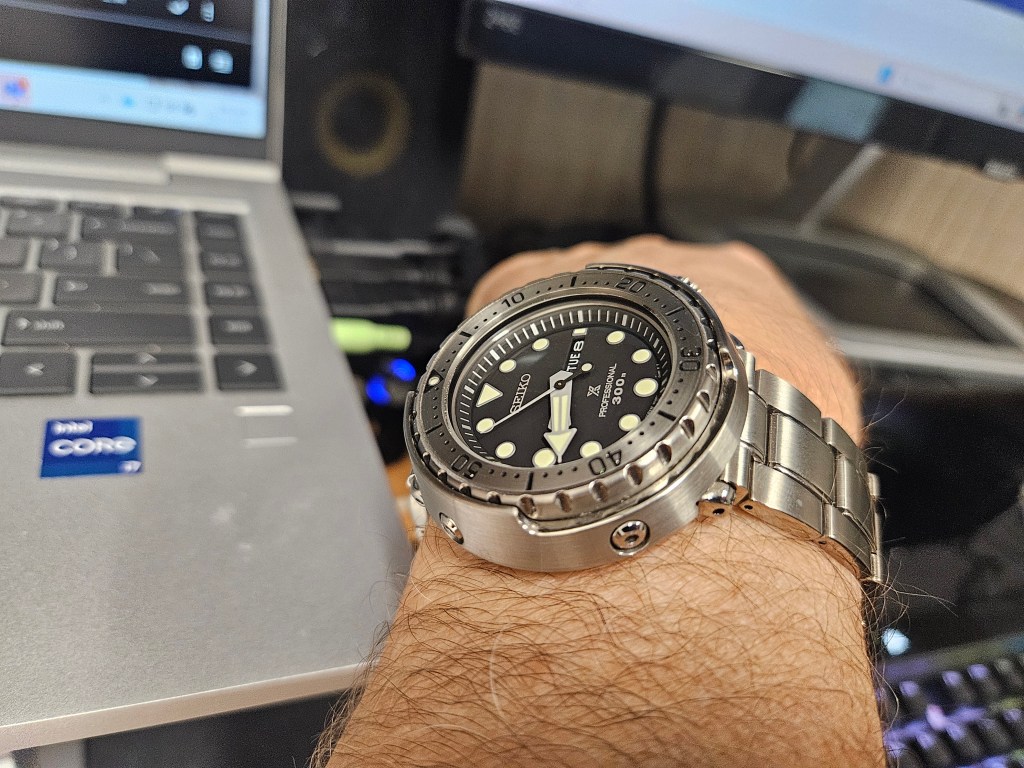
    Naturally, I clocked the watch immediately: a third-generation Seiko MM300 with a blue dial on a waffle strap.

    “It looks right on you,” I said, gesturing toward his forearm. “Especially given your build.”

    He shrugged. “It’s too late for me. I’m past swag. And honestly, the watch makes me miserable. I can’t decide if it belongs on a strap or a bracelet. I’ve switched so many times I no longer trust my own judgment. The only thing consistent about me is my inconsistency.”

    He led me into a bright, tile-heavy kitchen flooded with Southern California light. On the windowsill sat several shortwave radios, arranged among scattered lemons like some improvised altar.

    “Not just watches,” I observed. “Radios too.”

    He nodded, as if admitting to a second addiction was no longer worth defending.

    We sat at the kitchen table eating garlic hummus and rye crackers, drinking dark-roast coffee with soy milk and molasses.

    “Welcome,” he said with a tired smile, “to the House of Seiko. My man cave of madness.”

    I asked him why an entire community had mobilized to help solve his watch problem.

    “I have no idea,” he said. “It’s ridiculous. There are causes that matter. This doesn’t. I’m useless, over the hill, and fully Gollumified.”

    The saga began, he explained, at monthly meetups at Mimo’s Jewelry and Watches in Long Beach—friendly gatherings that escalated when he confessed the hobby no longer brought him joy. He wasn’t short on money; he was paralyzed by decision. Every choice felt wrong. The cognitive load became unbearable. He went to bed thinking about watches. He woke up thinking about watches.

    “Why not walk away?” I asked.

    “Because obsession doesn’t issue exit visas,” he said. “Once you’re in, the riddle feels existential. Solving it felt as urgent as founding a religion. I wanted to crack the code and then preach the gospel of happiness.”

    The intervention only made things worse. Camps formed. Seiko purists. Swiss loyalists. Minimalists. Maximalists. Arguments erupted. Then fights. A friend named Manny filmed the altercations. The videos went viral. Suddenly McMahon was a cause célèbre.

    “That’s when the watches started arriving in the mail,” he said.

    Luxury pieces worth more than his cars. None of them helped. He sold them and donated the money to charity. This, too, became content. More watches arrived. Then robberies. Burglaries. A P.O. box. A manager to process donations and deflect thieves.

    Millions eventually went to good causes. The silver lining, as they say.

    McMahon stared into his coffee. “I wish I felt redeemed. Mostly I feel disturbed—not just by my obsession, but by how easily the internet turned it into a farce. Sometimes I wonder if it had been anything else—stamps, guitars, fountain pens—would it have played out the same? Or is there something uniquely deranged about watches? Time itself? Father Time? Somehow my fixation feels disrespectful to him.”

    He paused, then added, “I have a friend who sold all his luxury watches. He wears a twenty-dollar Casio. Every day he thanks it for keeping him humble. He’s sane. That makes him my hero.”

    “You could follow his example,” I suggested. “Salvation is just a Casio away.”

    “And sell my divers?” he said flatly. “Not happening.”

    “You’d rather be miserable with expensive watches than happy with a cheap one.”

    “Exactly. Happiness is irrelevant now.”

    I studied him. “I don’t buy it,” I said. “This misery feels performative. A kind of cosplay.”

    He nodded slowly. “You’re right. But if I stop playing the miserable man, I have no idea who I’m supposed to be next. And that scares me more than any watch ever could.”

  • It Took a Village to Buy My Watch

    It Took a Village to Buy My Watch

    Last night I dreamt I was presiding over a vast communal effort devoted to a project of enormous importance—though no one, least of all me, could say what the project actually was. It had the gravity of a cathedral build or a moon launch, but the specifics were conspicuously absent. People just knew it mattered. My daughter’s childhood therapist, Olivia, was there, radiating purpose. She had invested a great deal of money into the endeavor, and I could hear others murmuring that I ought to reimburse her, which struck me as both reasonable and vaguely ominous.

    The house filled with people. Then it overflowed. There was so much movement, discussion, and civic enthusiasm that I slipped out, went to the gym, exercised—as one does in dreams when overwhelmed by responsibility—and returned to find the situation had escalated. Now there were dozens of neighbors on the lawn, standing around with the earnest posture of volunteers waiting to be assigned meaning. The sheer body heat inside the house had become an issue, so an air-conditioning repairman was summoned, as if climate control were now a municipal concern.

    I stood on the front lawn waiting for the repairman when Olivia emerged from the house and calmly announced that the project was complete. No speeches. No ribbon-cutting. Just resolution. She approached me holding a velvet pillow, and on it rested a three-thousand-dollar Seiko MM300 diver—white dial, blue markings, mounted on a sumptuous bracelet. I accepted it, stunned. I had believed myself to be in a strap-only phase, a man past bracelets, past flash. But there it was, on my wrist, and I knew instantly that this was the watch. The Holy Grail. Bracelet and all.

    The joy was real—but so was the shame. It dawned on me that I had apparently mobilized an entire community, generated heat waves, summoned tradesmen, and absorbed financial investment…all to solve a problem that was, at its core, exquisitely trivial. A watch. Beautiful, yes. All-consuming, certainly. But narcissistic? Undeniably. I woke with the uneasy recognition that even my unconscious mind knows how absurdly far I’m willing to go in pursuit of the right object—and how many people I’m prepared to inconvenience along the way.

  • How Zombies Taught Me to Do the Dishes

    How Zombies Taught Me to Do the Dishes

    I was in sixth grade when I made the worst procrastination decision of my young life: I watched Night of the Living Dead instead of doing the dishes.

    I didn’t even want to watch it. My parents were out for the evening and issued a single, modest commandment: Do whatever you want—just do the dishes. The sink was stacked with plates, bowls, pots, and pans, a greasy jungle daring me to enter. I took one look and decided I deserved a short rest before battle. I collapsed into a yellow bean bag chair, turned on the TV, and landed on Creature Features, which was broadcasting one of the most psychologically devastating films ever made.

    I’d heard about the movie at school. Kids spoke of it in hushed, reverent tones, as if surviving it were a rite of passage. Fear, apparently, was proof of greatness. How bad could it really be? I told myself this while enjoying the immediate relief of not scrubbing forks. Then the movie started: a brother and sister visiting a grave. The atmosphere curdled instantly. Something was wrong. I should have changed the channel. I didn’t. I couldn’t. Fear and curiosity locked arms and dragged me forward.

    Minutes turned into hours. I watched bodies fall apart, social order dissolve, and hope get eaten alive. The gore wasn’t just gross—it was existential. By the time the credits rolled, something essential in me had been misplaced. Innocence, for starters.

    It was nearly midnight. My parents still weren’t home. I wandered into the kitchen and stared at the sink, now radiating menace of a different kind. I was in no psychological condition to clean anything. Zombies had ruined that option. I retreated to my room, crawled into bed, and slept with the covers pulled over my head like a man hiding from the apocalypse.

    Morning arrived with consequences. My parents were furious. The dishes remained undone. I tried to explain that I had endured profound trauma at the hands of George A. Romero, but this defense carried no legal weight. I had failed on all fronts: my psyche was scarred, my parents were enraged, and the dishes were still filthy.

    That night taught me a lesson I’ve never forgotten. Procrastination lies. It promises comfort and ease but delivers a punishment far worse than the task you avoided. I could have spent thirty dull minutes cleaning plates. Instead, I spent the night traumatized by the collapse of civilization and woke up grounded. Avoiding the dishes cost me about a hundred times more than doing them ever would have.

  • How I Tried to Shrink Time to Survive

    How I Tried to Shrink Time to Survive

    In mid-December of 1967, when I was six years old, my mother had a severe bipolar episode, attempted to take her own life, and was hospitalized for a year. My brother was eighteen months old. My father was overwhelmed. The decision was made that I would live with my grandparents in Long Beach while my mother disappeared behind hospital walls and locked doors.

    I was enrolled in a new elementary school where I had no friends and made no effort to find any. I was distant and guarded, already practiced in withdrawal. I was preoccupied with my mother’s absence and with the unanswered question that haunted me daily: what version of her, if any, would come back. My grandparents were loving, steady, and kind, but Long Beach felt foreign and provisional, like a place you wait in, not a place you live. All I talked about was going home to San Jose.

    One afternoon, my grandmother tried to help me endure the waiting. She gave me a calendar and a red pen. She told me I would be going home on June 15, 1968. “Every day,” she said, “you can circle the date, and you’ll know you’re one day closer.” I flipped through the pages and felt something tighten in my chest. The calendar reminded me of movies where prisoners lie on cots in damp cells, carving days into stone, counting time as if it were a sentence rather than a passage.

    After about a week of dutiful circling, patience failed me. I circled every remaining day at once, all the way to June 15, as if the red pen were not just a marker but a lever, something that could force time to lurch forward. When my grandmother saw what I had done, she didn’t scold me. She smiled, but there was sadness in it. “You thought the pen could move time itself,” she said. “It doesn’t work that way.”

    That instinct—to accelerate the calendar, to force arrival—never left me. It hardened into a temperament. When I feel overwhelmed, I reach for control. I measure, schedule, ritualize. I distrust spontaneity. I cling to routines and clocks and daily structures as if they were railings on a narrow bridge. In many ways, I am still that six-year-old boy, circling days, believing that orderly time might tame a chaotic universe and keep me from falling apart.

    The cost of this way of living is distance from life itself. I’m reminded of Ariel Leve’s memoir An Abbreviated Life, which I’ve read twice. Leve describes growing up with a psychologically volatile mother and coping by shrinking the world—by narrowing experience, limiting exposure, contracting life until it feels survivable. That’s what I was doing with the calendar. I wasn’t counting days so much as trying to reduce terror to something measurable.

    I think I’ll listen to Leve’s book again, this time on Audible. Some stories need to be revisited, not because they change, but because you finally recognize yourself inside them.

  • Chuck Klosterman, Joe Montana, and the Shape of Greatness

    Chuck Klosterman, Joe Montana, and the Shape of Greatness

    I’ve been reading—and now listening to—Chuck Klosterman on music and culture for over a decade. He’s a rare specimen: a true hipster precisely because he has no interest in being cool and too much interest in ideas to waste time polishing his image. His new essay collection, Football, keeps that streak alive. I’m consuming it on Audible while trying to erase myself on the Schwinn Airdyne, pedaling hard enough to regret my life choices. Every so often, Klosterman drops a line that forces me to slow the bike, release the upper-body levers, and frantically thumb notes into Google Docs like a deranged monk copying scripture mid-martyrdom.

    Today’s line stopped me cold: “Greatness is about the creation of archetypes.” He was talking about the Beatles. Not record sales. Not chart dominance. Greatness, he argued, is the act of filling an archetypal mold so completely that everyone who follows can only approximate it. They may be talented, even brilliant, but they’re echoes, not origins. The mold has already been cast.

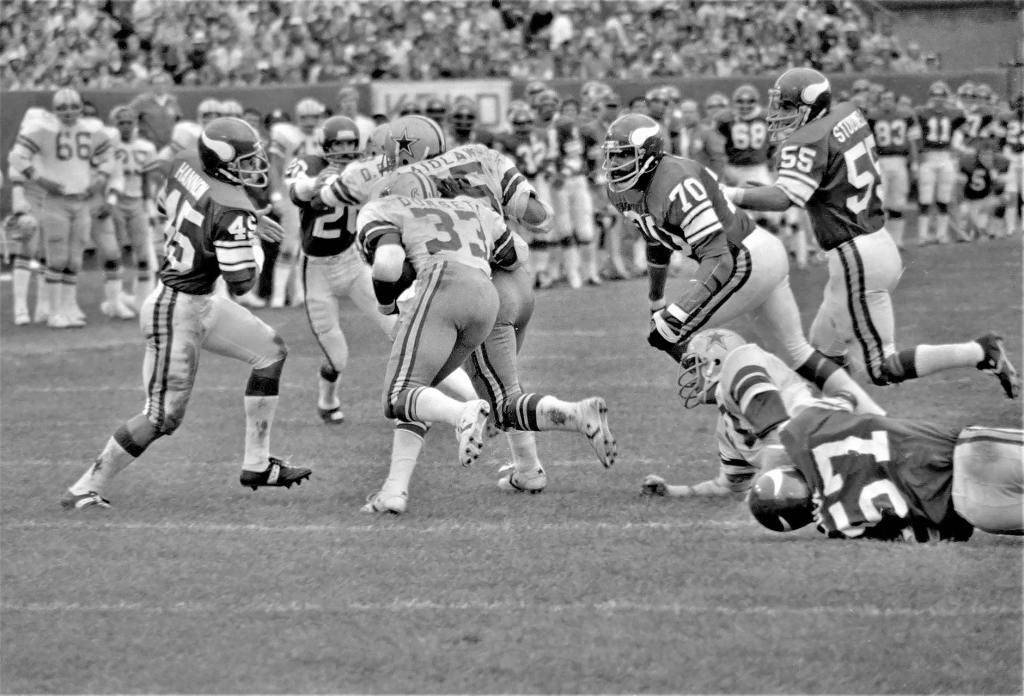
    That idea made me think of Klosterman as a fourth grader, devastated when the Cowboys lost the 1982 NFC Championship to the 49ers on Joe Montana’s pass to Dwight Clark. I was living in the Bay Area then, and Montana instantly became something more than a quarterback. He wasn’t a flamethrower like Elway or a mythic warhorse like Staubach. He was smaller, calmer, unnervingly steady. He slew the Goliath that had humiliated the Niners for years. Montana wasn’t just great—he was David with a slingshot. That archetype mattered more than his stat line, and for a time it made him the greatest quarterback alive.

    I’m not a Beatles devotee, but I understand why people place them on that pedestal. Archetypes don’t require personal devotion; they require recognition. You can see the mold even if you don’t want to live inside it.

    Earlier in the book Klosterman expressed his genuine, hard-earned contempt for Creed—contempt earned the old-fashioned way, through actually listening—and my mind wandered to the opposite of greatness: a strange kind of cultural infamy where a band becomes a symbol rather than a sound. That’s when I realized I’d mixed up Creed with Nickelback, which led me down a brief but intense psychological spiral when I couldn’t find the documentary Hate to Love: Nickelback on Netflix. That film makes it painfully clear that Nickelback’s “crime” is not incompetence or fraud. They’re talented, professional, and wildly successful at pleasing their audience. Their real achievement is unwanted: they became the most socially acceptable band to hate.

    Nickelback’s loathing isn’t sincere. It’s ritualized. Once social media weaponized contempt for them, sneering became a form of virtue signaling—a low-effort way to broadcast cultural superiority without doing the work of listening. Most of the haters probably couldn’t name three songs. The scorn isn’t about music; it’s about belonging.

    Which is why I’d love to talk this through with Klosterman. He’s the right mind for it. Also, he might help me straighten out my chronic band confusion. This isn’t new. When I was five, I used to confuse the Monkees with the Beatles. Apparently, my brain has always had trouble keeping its mop-tops and punchlines in their proper bins.

  • Always Be Closing: The Lie We Keep Buying

    Always Be Closing: The Lie We Keep Buying

    “Always be closing,” Alec Baldwin snarls in Glengarry Glen Ross, playing Blake, a blustering emissary of pure cortisol sent to terrify a roomful of salesmen into obedience. Closing, he tells them, is the only thing that matters. Not effort. Not integrity. Not sanity. Close or die. The line is famous because it taps into something already rotting inside us. We don’t just want to close deals; we want to close life. Getting married is a close. Deciding on a religion is a close. Graduating college is a close. Buying a house, buying a car, settling on a diet, hitting a goal weight—each one dangles the same promise: after this, I can rest. After this, I’ll be done.

    The culture worships closers. Closers are decisive. Closers have plans. Closers stride forward with laminated confidence. Closers collect ceremonies, milestones, certificates, and Instagram captions. Closing is marketed as maturity itself—the moment when uncertainty is evicted and order takes possession of the premises. Winners close. Losers waffle. That’s the myth.

    But closing is a con, and a lazy one at that. It sells the toddler fantasy of permanent comfort: arrive somewhere and stay arrived. Life, unfortunately, does not honor this contract. It leaks, mutates, backslides, and doubles back. I once knew a couple who were desperate to permanently break up with each other. So they got married as a strategy for divorce. They believed the divorce would provide closure—clean lines, sealed chapters, emotional foreclosure. Instead, they remarried. Then divorced again. Then they remarried. Then got another divorce. Closure didn’t show up. It never does. The story simply kept going, indifferent to their paperwork.

    The same lie infects consumer life. I know a man who believed salvation came in the shape of a Rolex Explorer. Ten thousand dollars later, he congratulated himself on having found his Exit Watch—the final piece, the closing bell. Within months, he was browsing watches that made the Rolex look like an appetizer. The watch didn’t close anything. It became a monument to the futility of the attempt.

    We love the idea of closing because we are exhausted—by the volatility of the world and the chaos inside our own skulls. “Always be closing” offers a fantasy of stillness, a promise that motion can end and anxiety can be put in storage. But it’s just another pressure pitch, no more real than the sales patter Mamet skewered. Life doesn’t close. It revises, reopens, and keeps charging interest. The only thing that truly closes is the sales pitch itself.

  • Why Men Can’t Stop Writing Manifestos

    Why Men Can’t Stop Writing Manifestos

    My wife has never been one to traffic in lazy generalizations about men and women, but a few years ago she offered one observation so sharp it lodged itself in my brain. Men, she said, have a peculiar itch that women conspicuously lack: the need to write a manifesto. Not a gentle essay about waking up early to tend tomatoes and eggplant while discovering the joys of fiber and self-care. No. A manifesto is something else entirely—a doctrinal collision, an absolutist thunderclap so brimming with rectitude, so certain of its own world-historical importance, that its author feels morally obligated to broadcast it to the four corners of the earth. Silence would be selfish. Restraint would be unethical.

    A manifesto, of course, cannot emerge from a vacuum. It requires a conversion story—preferably violent. The man was once lost, deformed, wandering in a fog of ignorance. Then something happened. The cosmos intervened. He was singled out. Enlightened. Charged with a mission. His truth, having been hard-won and privately revealed, must now be universalized. To keep it to himself would be a crime against humanity. Thus the manifesto is born: part gospel, part grievance, part personal branding exercise.

    My wife was not complimenting men. She was diagnosing a particular strain of virulent egotism—one that disguises itself as sincerity and moral urgency while quietly pursuing something else: control. To impose a worldview is to dominate. To dominate is to feel powerful. Strip away the rhetoric and you find that many manifestos are not about helping others live better lives but about arranging the world so it finally stops resisting the author’s will.

    Because many men will inevitably produce many manifestos, conflict follows. Doctrines metastasize. Defenses harden. Footnotes sprout like fortifications. Converts gather. Commentaries appear. Some commentaries become so influential they eclipse the original manifesto and establish themselves as superior, corrected versions. The ecosystem expands, competitive and self-referential, like an intellectual CrossFit gym where everyone is chasing the same leaderboard.

    What my wife was really saying, I think, is that men don’t create philosophies primarily to serve others. They create them the way athletes build muscle: to compete. A manifesto is intellectual athletics—grandstanding, bluster, and chest-thumping in paragraph form. It’s less a tool for understanding the world than a way to announce dominance within it.

    Here is my confession, one I may or may not share when my wife gets home tonight: I, too, feel the pull of the manifesto. The fantasy of a grand conversion, followed by the construction of a flawless, infallible system that explains everything, is intoxicating. But if I’m honest, what draws me to that fantasy isn’t egotism so much as fear. The world is a roiling swamp of ambiguity and uncertainty. A manifesto promises certainty on a silver platter, a pacifier for the anxious adult who wants the noise to stop.

    Perhaps my wife is right. Egotism may just be fear in a tuxedo. Men, for whatever reason—biology, culture, testosterone, self-loathing—seem especially adept at projecting their inner chaos onto the world and then mistrusting it for the mess they recognize in themselves. The manifesto becomes a coping mechanism, a way to simulate control in a reality that stubbornly refuses to cooperate.

    Women don’t write manifestos because a manifesto lectures. It talks down. It closes the case. Women talk instead. Life, as they seem to understand it, is an open court—conversation, improvisation, shared meaning, surprise, trust. Men, by contrast, barricade themselves inside doctrine, shout it through a megaphone, and grow indignant when no one salutes.

    When my wife gets home, I think I’ll abandon the manifesto project. I’ll try something riskier. I’ll start a conversation. I’ll listen.

  • Why Sitting Still Is Killing Your Writing

    Why Sitting Still Is Killing Your Writing

    You can’t write all day and expect to produce anything alive. You can sit hunched in your creative cocoon for hours, but don’t be surprised when your prose comes out pale and airless. You’ve ignored your body, your need for oxygen and circulation, your need for what can only be called Otherness—a physical and spiritual encounter with the world that does not occur while you’re marinating in your own chair. I’ve always known this in my bones. Recently, Bonnie Tsui gave it language in her essay “The Writer’s Secret Weapon.” For Tsui, creativity peaks not at the desk but in the water. Swimming becomes a form of mobile meditation, a way of clearing internal static. A body in motion reroutes the brain. Kinetic energy pries open doors that inertia bolts shut. When she swims, she doesn’t skim her subjects; she descends into them.

    Tsui also makes a bracing point writers love to resist: you can’t write about something while you’re still drenched in it. When she was working on a book about swimming, she couldn’t write fresh from the pool, water still in her ears. The experience had to ferment. The mind needs distance, a change of context, a step into Otherness to metabolize meaning. This is why even writers who log eight-hour days at their desks punctuate them with long walks. You must toggle between worlds. Living in only one—especially the interior one—is claustrophobic, coercive, and hostile to genuine creativity.

    When I think of a writer who never leaves the room, I think of Nikolai Gogol’s The Overcoat. Akaky Akakievich copies documents all day, takes his copying home at night, and copies some more. Eventually, copying is all he can do. He no longer registers the world: not mockery, not humiliation, not even a horse sneezing on him. He produces mountains of text and nothing of consequence. He has become a Non Player Character. Only when winter cold seeps into his bones does he wake from his stupor, lured by a demonic tailor into an overcoat that violently reconnects him to the world. The shock is too much. His mind, underdeveloped by isolation, cannot withstand reality’s ambitions and fever dreams. He breaks. Gogol understood something essential: the writer’s task is not to hide from the physical world but to be altered by it. That radical shift in perception—the moment when the world intrudes and rearranges you—is not a distraction from writing. It is the point.

  • Captain Cancel and the Rise of Domestic Hermit Drift

    Captain Cancel and the Rise of Domestic Hermit Drift

    The other day my wife went to lunch with a longtime friend—call her A—and, as women do with admirable efficiency, they covered marriage in a single sitting. A complained that her husband had been drinking more, growing possessive, increasingly controlling. During the meal, he called her three times. By the third interruption, my wife said, the phone might as well have been sitting at the table demanding a chair. When she told me the story later, I said it reminded me of the Tears for Fears song “Woman in Chains.” She didn’t hesitate. “That’s her life exactly,” she said.

    After a pause, the conversation turned, as it inevitably does, to me. “I told A you don’t drink,” my wife said. “You’re not jealous or possessive. But you won’t leave the house. You’re a shut-in.”
    “Doesn’t he go to the gym?” A asked.
    “Not for twenty years,” my wife replied. “He does yoga and kettlebells at home. He’s been trapped in the man cave ever since. And what scares me,” she added, “is that he’s happy.”

    I’m not entirely sure I am happy. I just know my tolerance for annoyance is perilously low, and it drops another notch with each passing birthday. I also know that my friends from my formative college years now live scattered across the country, like artifacts from a previous civilization. We’ve grown apart without drama, which is to say, efficiently. Locally, I have two friends. Tom, a wrestling coach, is either teaching or in Santa Barbara with his girlfriend. I see him about once a year, usually when he drives me to Home Depot so I can transport oversized items back to my cave. My other friend, Pedro, is an engineer who is thirty years younger than I am. The generational differences are… pronounced. We have lunch about four times a year. Add it up and yes—half a dozen social encounters annually qualifies me as a shut-in. Which makes me, by default, an authority on a condition many men my age quietly acquire: Domestic Hermit Drift.

    Domestic Hermit Drift is the gradual, mostly unintentional retreat of a married man from friendships and public life into the managed comfort of home, where routine, hobbies, and solitude replace the effort and risk of maintaining relationships. It isn’t fueled by hostility or misanthropy but by convenience, irritability, fatigue, and the slow atrophy of social muscles. As his world contracts, his wife’s often expands, creating an asymmetry in which she carries the invisible labor of social connection, public presence, and emotional buffering. The genius of the drift is its stealth. No announcement is made. No door slams. The man simply mistakes peace for fulfillment and stability for sufficiency.

    As an expert in Hermit Drift, allow me to identify the warning signs.

    First, your sleepwear, gym clothes, and home clothes become indistinguishable. You sleep in gym shorts and a workout shirt, wear them around the house, exercise in them, shower, and rotate in a freshly washed identical set. You call this efficiency. You experience genuine pleasure in this loungewear optimization and feel morally superior to the sheeple who change outfits multiple times a day. Minimalism, you insist, is a virtue.

    Second, while your wife and her friends design custom T-shirts and handmade signs for rock concerts in the desert, you remain home on a Saturday night swapping straps on your diver watches. You build watch-rotation calendars. You track wrist time. You rank your collection by annual usage. The fact that you know you wore your Seiko Marine Master for exactly 863 hours last year strikes you as reasonable, even impressive. Others find it alarming.

    Third, because your tolerance for irritation is low, you shop only at dawn, when grocery stores are nearly empty and the few people present are still half-asleep—docile, unthreatening, manageable. You take pride in shopping before the rat race wakes up. This dovetails nicely with your time-management philosophy: bed at nine, up at five. By the time the world stirs, you’ve had your coffee, your steel-cut oats, your kettlebell workout, and your canvas grocery bags—your weekly macros—put neatly away. You are, in your own mind, winning.

    The rest of the day unfolds under a regime your wife has named Captain Cancel. Every proposed outing meets a veto. You can’t attend a concert because it might rain, despite cloudless skies. You can’t go to a restaurant because parking is inadequate, and when your wife reminds you of the new parking structure, you explain that it’s widely known to be contaminated with asbestos. A comedian you once loved is playing in Hermosa Beach, but you inform her he hasn’t been funny since the Reagan administration. A trip to Maui is ill-advised due to avian flu, especially dangerous during air travel. A beach picnic is canceled because of a sewage spill that, you explain, has compromised not just the water but the atmosphere. You agree to Taco Tuesday at the local brewery, but it’s too loud. You stuff toilet paper in your ears, announce you’re unwell, and Uber home. You are never invited again. This makes you smile as you drift into a deeply satisfying sleep.

    If you recognize any of these traits, congratulations. You are anti-social. You are Captain Cancel. You have chosen your isolation, locked yourself in your cage, and—most importantly—convinced yourself it was the sensible thing to do.