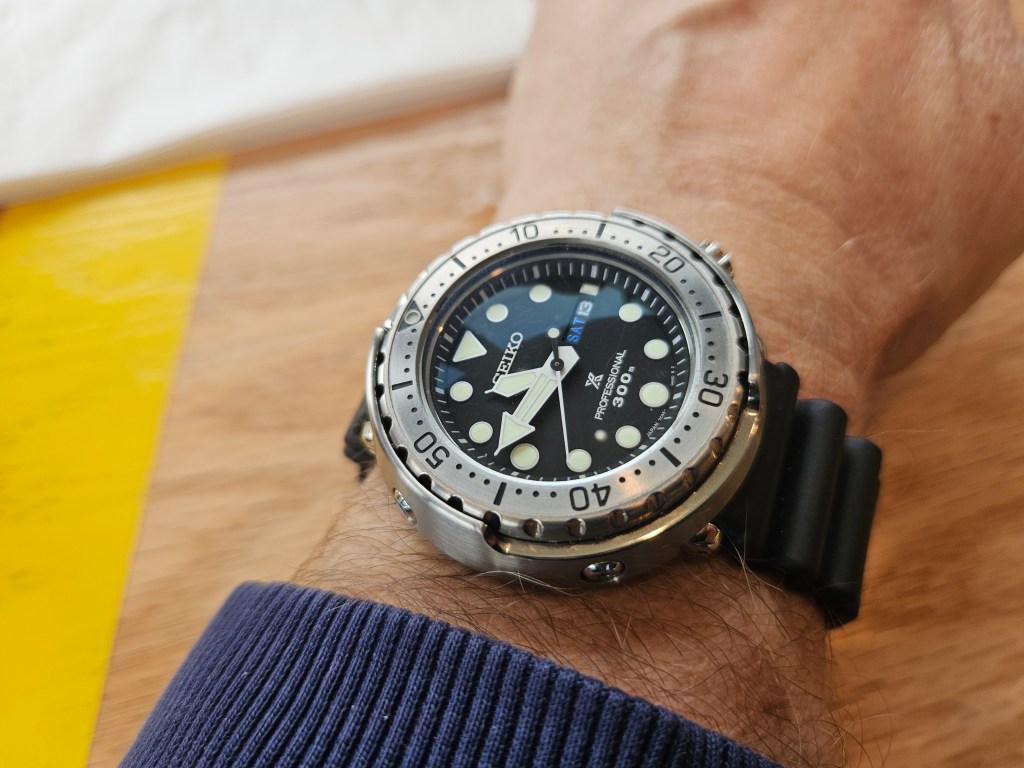
People always ask why I started focusing on watches ten years ago on my YouTube channel. The honest answer is awkward: I love watches—but I love food more. Obsessively more. Food has been my lifelong religion. In the early ’90s, when I lived in a bachelor pad that smelled like basil and ambition, my Navy SEAL friend Mike used to call and say, “McMahon, I can hear you chewing through the phone again. Every time I call you, you’re eating. What is it now, Fat Face?”
“Angel hair pasta with pesto.”
“Sounds dangerous. I’m coming over, Fat Face.”
And he would—just in time to demolish everything I’d made. His appetite was powered by military drills and endless surfing sessions in Huntington Beach and Ventura. The man burned calories like a forest fire burns pine needles.
One day he called again. “I’m heading to Santa Barbara to surf. Come with me.”
“I can’t surf, Mike.”
“I know you can’t surf, genius. My girlfriend Nicole will be there. She wants to set you up with her friend, Michelle, from Newport Beach. Now can you surf?”
That’s how I ended up tagging along on adventures that had nothing to do with waves and everything to do with spectacle.
Mike lived with his dad, Bob, a former Marine with a voice like a foghorn and a temper to match. Their daily ritual involved shouting matches over lawn mowing, garage messes, and grocery duties—two barrel-chested men poking each other like rival roosters while spittle flew. Five minutes later, the war would end, and we’d be off on a Mongolian beef run with Social Distortion blasting in Mike’s Toyota four-wheeler. Back at the house, they’d watch John Wayne movies, and Bob would open his gun safe “just in case the Duke needs backup.” This was not dysfunction to me. This was home.
I’m a Boomer. I grew up in a world where anger was normal—where fathers barked orders and discipline came with a belt. When rage becomes your baseline, it’s like living with your brain permanently tuned to a Death Metal station. After a while, you stop hearing the noise. You just call it life. But it isn’t life. I know that now because I’m married to a woman fourteen years younger than me, and we have twin teenage daughters. They do not accept Death Metal Dad. They want something closer to Smooth Jazz—Bach, Earth, Wind & Fire, anything that doesn’t rattle the walls of the house. And they’re right. Rage is not masculinity. It’s a form of intoxication. A dangerous one.
For me, sobriety isn’t about alcohol or drugs. It’s about anger. That means I have to watch my triggers like a hawk. One of the biggest? New watches. Shiny new objects flip the switch in my brain. Suddenly the Death Metal station is humming again, and I’m spiraling into desire, anxiety, and self-reproach. I know feeding my watch addiction makes me miserable, and when I do something that makes me miserable, I get angry at myself. Then I become a joyless human being—Grandma Sour Pants in sneakers. My family doesn’t want to be around me, and frankly, neither do I.
The irony is that money isn’t the problem. I’m at a stage in life where I could buy any watch I want. But sanity is expensive. I own seven watches worth about fifteen grand in total, and even that feels like mental labor—keeping the rotation straight, remembering what I have, managing the noise in my head. If I owned twelve, I’d lose my grip entirely. My watch friends tell me, “Life is short. Buy what you want.” Those are words of indulgence, not wisdom. Indulgence has never made me happy. Indulgence is just infantilism in a tuxedo. A man-child with a credit card is still a man-child—and no man-child is happy. He buys things to outrun loneliness, and the things always lose the race.
Ninety-five percent of my watch purchases were impulsive. Which means ninety-five percent of them were evidence of my own immaturity. I sold most of them at a loss—not because I needed the money, but because I needed my dignity back.
I come from the Me-Generation, raised in California in the ’70s on a steady diet of self-worship. Rob Lowe’s memoir Stories I Only Tell My Friends nailed it for me. He described the Counterculture as the Worship of the Self—whatever the Self wants, the Self gets. No brakes. No compass. He watched people overdose, vanish, and destroy themselves in Malibu’s sunlit fantasyland. The message was simple: when desire becomes sacred, reality becomes optional—and disaster becomes inevitable.
I am a watch freak. When I see a watch I love, my brain lights up like I’ve just taken a hit of something illegal. Desire surges. Anger follows. The loss of control is what really enrages me. Rob Lowe had to go to rehab to escape his fantasy life. I don’t want rehab for watches. I want a hobby that fits inside reality instead of dragging me out of it. I want pleasure without compulsion. Enjoyment without obsession. A life without permanent FOMO.
And here’s the final joke on me: even talking about this makes me nostalgic for being fifteen in Santa Monica and Malibu in 1976. I start looking backward like Lot’s wife, and I can feel myself turning into a pillar of salt. The Death Metal station is warming up again. That’s my cue. I need to change the channel—before I buy another watch and call it happiness.
 Cinemorphosis