Author: Jeffrey McMahon

  • 30 Years of Teaching College Writing in the Greatest City in the World

    30 Years of Teaching College Writing in the Greatest City in the World

    Yesterday, in my college critical thinking class, I played a clip from Liza Treyger’s Night Owls set, where she spirals into a monologue about her addiction to animal videos. The class erupted in recognition—Treyger’s bit was less comedy, more collective confession. We then compared the insidious grip of food addiction to the death grip of smartphones, two habits nearly impossible to break because, unlike more glamorous vices, they’re baked into the daily human experience. You have to eat. You have to communicate. And thanks to Pavlovian conditioning, the mere buzz of a notification or the scent of a cheeseburger can hijack your willpower before you even know what hit you.

    At one point, I noticed one of my students—a professional surfer—had a can of Celsius energy drink perched on his desk like a talisman of modern endurance. I mentioned that my daughters practically mainline the stuff, to which he casually replied that he was transitioning to Accelerator, as if he were upgrading his addiction to something with a more explosive name. This led us down a delightful rabbit hole about the marketing committee responsible for naming that monstrosity, the raw aggression of Costco shoppers jostling for bulk energy drinks, and how smartphones are turning my students into exhausted zombies. They shared their chosen comfort foods, each confession tinged with equal parts nostalgia and shame.

    The discussion was sharp, lively, and deeply engaging. And yet, in a moment of brutal self-awareness, I admitted to them that I felt pathetic. Here I was, sitting among the chillest students in the world, having a profound conversation about addiction—and all I could think about was ditching class to speed down to Costco and buy a case of Accelerator. They cracked up, and we carried on dissecting addiction for their essay on weight management and free will.

    After thirty years of teaching in Los Angeles, I’m convinced I’ve won the academic lottery. There’s no better place to teach, no better students to challenge my tomfoolery, and no better city to fuel my own ridiculous, completely relatable compulsions.

  • FORCING MYSELF TO WATCH SUCCESSION

    FORCING MYSELF TO WATCH SUCCESSION

    I forced myself to finish the last season of Succession, a venomous spectacle of rich siblings ripping each other to shreds. Succession is the best critically-acclaimed show I couldn’t stand to watch. Not just disliked—hated. Watching it was excruciating, like willingly stepping on a Lego over and over again. The plot? Thin and stagnant, a slow-motion shark tank of sociopaths jockeying for the top spot in their dad’s empire. They rose and fell not from strategy but as if some capricious god was rolling dice behind the scenes. Shame and truth were foreign concepts to them. These weren’t mere narcissists; they were full-blown solipsists, their self-absorption so relentless it crushed any hope for real plot twists. Their behavior was less cunning and more clockwork: predictable, joyless, inevitable.

    And yet, I endured. I forced myself to watch this spectacle of feral appetites clashing like crocodiles over a wildebeest carcass. Why? Because Succession felt like a forbidden window into a gilded world where humanity’s worst impulses roamed free, unchecked by the civilizing guardrails the rest of us adhere to (if only because we can’t afford not to). The show wasn’t just a car crash—it was a multicar pileup filmed in slow motion, designed to scratch our voyeuristic itch.

    In the end, Succession is a mirror held up to the grotesque, the rich and shameless shriveling into their own private hells without a flicker of self-awareness. It feeds our appetite for schadenfreude, letting us revel in their misery while secretly thanking the heavens that our own lives, for all their flaws, don’t include daily battles for dominance over a media conglomerate—or the soul-crushing emptiness that comes with it.

  • Kenny G Is Not Jazz

    Kenny G Is Not Jazz

    I recently watched Listening to Kenny G, Penny Lane’s documentary on the world’s most famous saxophonist. It left me in a knot of conflicting emotions. Here’s a man, decent and diligent, who built a global empire of “smooth jazz”—a genre that, to my ears, is the musical equivalent of baby food: cloying, textureless, and aggressively inoffensive. And yet, millions worship him. The crowds at his concerts glow with unfiltered joy, their faces alight as if they’re receiving communion through the smooth, syrupy notes of his soprano sax.

    Who am I to sneer at them—or at him? I’m just a guy recovering from influenza, after all, with no musical empire to my name. But damn if I didn’t feel the urge to reach for some cultural antacid to settle my aesthetic nausea while judging him and his fans.

    And judge, I did. Kenny G, with his chirpy demeanor and ornithological cheer, seems blissfully detached from the rich, complex history of jazz that his music pretends to embody. He comes across as a musical solipsist, spinning out saccharine, Cliff Notes versions of jazz—an imitation so shallow it feels like he’s never ventured beyond the surface. His long, flowing hair and darting, eager eyes bring to mind a medieval court musician, strumming cloying pavane tunes to lull a bloated king into a post-feast stupor. Listening to Kenny G isn’t an artistic experience; it’s being spoon-fed emotional mush, a cheap confection disguised as depth. This is jazz devoid of soul, grit, or struggle—a hollow desecration of the genre’s essence, delivered with a smile so unrelenting it borders on the surreal.

    And yet, the guilt creeps in. Kenny G himself is disarmingly likable, a man seemingly immune to the venom of critics. He’s successful, and so are many of his fans, who are undoubtedly smart and decent people. Does that make their taste in music immune to critique? Hardly. Popularity is not an arbiter of artistic merit, and Kenny G’s music remains, to me, a vulgarity—saccharine and soulless, a betrayal of jazz’s improvisational brilliance. But the fact that his audience finds bliss in his syrupy melodies leaves me grappling with a larger question: Is artistic taste a bastion of universal truth, or just another playground for our pretensions?

    Am I so obsessed with Kenny G that I feel the need to join the ranks of his detractors, delivering a fiery diatribe like Pat Metheny’s infamous takedown? Not quite. But am I endlessly fascinated that something so blatantly saccharine, so clearly an abomination of music, can bring others to the brink of elation and transcendence? Absolutely. Kenny G’s music strikes me as the sonic equivalent of New Age spirituality: the kind where you pay for a weekend retreat only to be serenaded by a guru with Kenny G’s hair, who doles out self-help clichés like they’re sacred mantras. It’s the auditory version of being flattered into blissful mediocrity, a soothing appeal to one’s narcissism wrapped in smooth sax tones. And let’s face it: the appetite for such cloying bromides is insatiable—and always has been.

    I can’t help but feel a twinge of guilt for roasting Kenny G. I’m clearly afflicted with Sax Shamer’s Syndrome—the nagging unease of mocking a man whose soprano sax has brought legions of fans genuine joy, even if it makes me wince. I try to rationalize my disdain, reminding myself that I, too, have been guilty of infantile pleasures. As a child, I devoured Cap’n Crunch like it was manna from heaven, exalting its sugary crunch as the pinnacle of culinary achievement. The difference? I outgrew Cap’n Crunch. Meanwhile, Kenny G fans seem eternally devoted, treating his smooth jazz like the apotheosis of music. Does that make me a snob for pointing this out, or am I just calling it as I see it?

    The guilt gnaws at me. By deriding Kenny G, I’m effectively sneering at millions of perfectly decent, hard-working people who find solace in his musical equivalent of high-fructose corn syrup. But who am I to judge? I have my own guilty pleasures. I still scroll Instagram for black-and-white photos of 70s bodybuilders, sighing nostalgically for a golden age that was never mine. I still revel in childhood comfort foods—pigs-in-a-blanket dunked in mustard and barbecue sauce, as if I’m at a suburban soirée circa 1982.

    So really, what separates me from the Kenny G crowd? Not much. Scorning his fans isn’t a declaration of superior taste; it’s an act of hubris. We’re all creatures of indulgence, clinging to the things that soothe us. The real sin isn’t enjoying Kenny G or Cap’n Crunch—it’s forgetting that, at the end of the day, we’re all just looking for something to hum along to as we float through life.

  • What devotion really looks like

    What devotion really looks like

    When I think of love in all its fullness, I dredge up a memory from 1982—a gem buried deep in my psyche from my early twenties. Back then, I was in college, slogging through a statistics course taught by a professor who looked like he’d been teleported straight out of a Dickens novel. Wild white hair defied gravity, crazed blue eyes darted around like they were searching for meaning, a nose as red as a warning light hinted at extracurricular activities with a bottle, and his overall aura was eau de whiskey. He was a kind man, though, in that shabby, endearingly tragic way.

    The class itself was a masochist’s delight, and by week four—when the sadistic monster called “standard deviation” reared its head—half of us were drowning. Among my classmates was an elderly African American couple in their early seventies and always dressed for church, who were either a heartwarming sitcom subplot or walking proof that God has a delicious sense of humor. The husband, a determined relic with a cane, announced on the first day of class that this was his seventh attempt at passing statistics. His wife, the embodiment of long-suffering devotion, was there not as a student but as his support system—a Bible-toting, knitting saint.

    The husband’s approach to learning was…unorthodox. While the rest of us quietly sunk in our seats, he would occasionally leap to his feet mid-lecture, his cane clattering dramatically, and hobble to the chalkboard. Pointing a finger like a preacher calling out sin, he’d declare, “That’s not the answer I got. Let me show you!” And then he’d scrawl his “solution” on the board—a series of hieroglyphics that no one could understand. 

    The professor, to his credit, tolerated these interruptions with the forbearance of a man who had seen worse (probably in his flask). Meanwhile, the wife would bow her head and whisper desperate prayers to “sweet Jesus” as if divine intervention might save her husband—or at least restore a shred of her dignity. Students stifled laughter behind cupped hands, and I sat there, torn between secondhand embarrassment and the sneaking suspicion that this was comedy gold worthy of Saturday Night Live.

    After class, I’d drive home and pop in a cassette of “Tiny Children” by The Teardrop Explodes—a song that paired perfectly with my mood of existential dread. I’d replay the scene in my mind: the old man’s quixotic battle with the chalkboard, the wife’s quiet perseverance. And then, like clockwork, I’d start crying. Not just because I was floundering as badly as he was with standard deviation or because my social skills were nonexistent, but because that woman had shown me something profound: the power of love. Real love—the kind that sticks with you through seven attempts at statistics, through public humiliation, through everything.

    I can still see that couple vividly. The husband’s determination, the wife’s quiet strength, and my own pathetic, lonely self, sitting there and learning—without realizing it—what devotion really looks like.

  • Father Time’s Frenemy

    Father Time’s Frenemy

    I often think back to the summer of 2019 when my wife and twin daughters were vacationing in Maui. There, on the beach, I spotted a short, compact man in his mid-seventies parading around in dark blue Speedos with a woman at least fifty years his junior—a striking Mediterranean beauty in her twenties. The guy was trim, well-manscaped, and scampering confidently on the sand like a millionaire who spends half his life in boardrooms and the other half trying to outrun the Grim Reaper. He dove into the waves with the vigor of someone convinced that as long as he keeps moving, Father Time can’t catch him.

    You could smell the wealth on him. He was probably some CEO with a portfolio big enough to buy the illusion of eternal youth. He worked hard and played hard, to quote Hugh Hefner’s mantra. Now, I’m not here to pass judgment on the guy for choosing a partner young enough to be his granddaughter—that’s his business. What fascinates me is this idea that money, discipline, and a little manscaping can somehow hold age at bay, like youth is a rare potion you can sip on to stay forever young.

    But the whole scene was off. He and his youthful companion looked like mismatched puzzle pieces being forced together by sheer willpower. It was as if they were two jagged halves of a broken mirror, stubbornly pressed together despite clearly not fitting. And with each attempt to make it work, the edges chipped away a little more, until all that was left was a pile of shattered glass—a perfect metaphor for trying to cheat time.

    This rich fit man is Father Time’s Frenemy–a guy who pretends he’s on good terms with aging while secretly plotting to outwit it. He may have fooled himself with the “perfect picture” he created, but the eyesore is as plain as day to the rest of us. 

  • DEATH BY SNACKS

    DEATH BY SNACKS

    After dinner, my wife and I luxuriated in a couple of Arrested Development reruns, marveling at the genius of Mitchell Hurwitz and Ron Howard. The show, an absurdist ode to familial dysfunction, felt decades ahead of its time—sharp enough to leave paper cuts on your brain. During the opening credits, I rose from the couch with noble intentions: I was off to fetch my so-called “satiety apple,” a modest, virtuous snack that allegedly curbs my post-dinner cravings without derailing my calorie count.

    But as I crossed the kitchen, fate—or treachery—beckoned me toward the microwave. There it sat: a pie box, faintly glowing, practically humming a siren song of buttery crust and spiced filling. One peek inside, and there it was—the last slice of Thanksgiving pie, radiating the kind of allure that no apple could ever muster.

    Before I knew it, I was hunched over the sink, inhaling that pie like a feral animal who’d just discovered civilization’s baked goods. Crumbs flew. Filling dripped. I was mid-bite, fully in beast mode, when my daughter Alison walked in. She stopped, surveyed the scene, and with surgical precision, dropped her line: “When’s the last time you were on a diet?”

    I froze mid-chew, my cheeks puffed out like a chipmunk caught in a raid. “A single slice of pie hardly merits such harsh judgment,” I said, wiping a smear of whipped cream off my chin.

    “Don’t be so defensive,” she said, her voice carrying the kind of condescension only a teenage girl can master. “I’m just asking—when was the last time you were on a diet?”

    “I didn’t realize you were the official historian of my weight management strategies,” I shot back, trying to maintain some shred of dignity.

    “What strategy?” she deadpanned, her tone as flat as the pie tin now sitting empty in the sink.

    I opened my mouth in an exaggerated display of mock offense, as if her words had wounded me so deeply that I could only respond with silence. We laughed, but the truth landed like a sucker punch: despite my heroic kettlebell workouts and high-protein meal plans, my daughter saw me for what I really was—a fat slob, undone by my inability to resist the siren song of leftover pie.

    My conversation with my daughter hit a nerve: my relationship with food is less of a partnership and more of a chaotic entanglement worthy of a reality show. I’m living with a chronic condition others have dubbed food noise—the relentless, mind-consuming obsession with food. It’s not just a passing craving; it’s a full-time occupation. Food noise is that little gremlin in your head planning tomorrow’s breakfast while you’re still wiping pie crumbs off your shirt from dinner. It’s exhausting, intrusive, and, frankly, a massive pain in the ass.

    I’ve tried all the supposed solutions. High-protein meals? Check. Fiber-packed fruits and veggies? Done. Permission to eat favorite foods to deflate their psychological power? Sure, why not. Listening to my so-called “hunger cues”? Please, those cues have been drowned out by a symphony of appetite louder than a Wagner opera. The truth is, my love of food has nothing to do with hunger. This isn’t about survival—it’s about passion.

    I crave food the way a musician craves music, except instead of performing Beethoven’s Ninth, I’m inhaling pie and serenading a protein bar like it’s my muse. Eating isn’t just sustenance; it’s a full-body euphoria, a never-ending sonata of chewing that I never want to end.

    So here I am, a helpless Snack Serenader, crooning over every dish like it’s the centerpiece of my magnum opus. Pie, pasta, cereal, or steak—it doesn’t matter. They’re all part of the eternal love song I sing to food, even as it steamrolls my willpower and expands my waistline. And while it may sound romantic, let’s be honest: it’s less about joy and more about imprisonment. I don’t just eat food; I worship it. I’m not hungry for a meal; I’m desperate for an encore. Just as a Beethoven superfan can lose themselves in the ninth symphony on repeat, I want to marinate in a bottomless jacuzzi of flavor, chewing my way through life’s buffet like a one-man marching band of mastication.

    As a Snack Serenader, I croon love songs to everything from pie to chicken shawarma. That Thanksgiving slice of pie wasn’t dessert; it was a crescendo. A bag of chips isn’t a snack; it’s an aria. And here I am, the tragic hero, swooning over leftovers as my waistline rolls its eyes and mutters, “You’re killing me.”

    The irony isn’t lost on me that I began this post with Arrested Development while chronicling my sink-side pie binge—a man-child devouring apple pie like it was the elixir of life, all under the unimpressed gaze of my daughter. Uncontrolled eating, it seems, is less about hunger and more about a deep-seated infantilization for which there’s no cure, just a lifetime subscription.

  • CHATGPT LIVES RENT-FREE INSIDE YOUR HEAD

    CHATGPT LIVES RENT-FREE INSIDE YOUR HEAD

    One thing I know about my colleagues is that we have an unrelenting love affair with control. We thrive on reliability, routine, and preparation. These three pillars are our holy trinity—without them, the classroom descends into anarchy. And despite the tech tidal waves that keep crashing against us, we cling to these pillars like castaways on a raft.

    Remember when smartphones hijacked human attention spans fifteen years ago? We adapted—begrudgingly—when our students started caring more about their screens than us. Our power waned, but we put on our game face and carried on. Then came the digital migration: Canvas, Pronto, Nuventive—all those lovely platforms that no one asked us if we wanted. We learned them anyway, with as much grace as one can muster when faced with endless login screens and forgotten passwords.

    Technology never asks permission; it just barges in like an unwelcome houseguest. One morning, you wake up to find it’s moved in—like a freeloading uncle you didn’t know you had. He doesn’t just take over the guest room; he follows you to work, plops on your couch, and eats your sanity for breakfast. Now that homeless uncle is ChatGPT. I tried to evict him. I said, “Look, dude, I’ve already got Canvas, Pronto, and Edmodo crammed in the guest room. No vacancy!”

    But ChatGPT just grinned and said, “No problem, bro. I’ll crash rent-free in your head.” And here he is—shuffling around my brain, lounging in my workspace, and making himself way too comfortable. This time, though, something’s different. Students are asking me—dead serious—if I’m still going to have a job in a few years. As far as they’re concerned, I’m just another fossil ChatGPT is about to shove into irrelevance.

    And honestly, they have a point. According to The Washington Post article, “ChatGPT took their jobs. Now they walk dogs and fix air conditioners,” AI might soon rearrange the workforce with all the finesse of a wrecking ball. Economists predict this upheaval could rival the industrial revolution. Students aren’t just worried about us—they’re terrified about their own future in a post-literate world where books collect dust, podcasts reign supreme, and “good enough” AI-generated writing becomes the standard.

    So, what’s the game plan for college writing instructors? If we’re going to have a chance at survival, we need to tackle these tasks:

    1. Reassess how we teach to highlight our relevance.
    2. Identify what ChatGPT can’t replicate in our content and communication styles.
    3. Design assignments that AI can’t easily fake.
    4. Set clear boundaries: ChatGPT stays in its lane, and we own ours.

    We’ll adapt because we always do. But let’s be real—this is only the first round. ChatGPT is a shape-shifter. Whatever we fix today might need a reboot tomorrow. Such is life in the never-ending tech arms race. 

    The real existential threat to my job isn’t just ChatGPT’s constant shape-shifting. No, the real menace is the creeping reality that we might be tumbling headfirst into a post-literate society—one that wouldn’t hesitate to outsource my teaching duties to a soulless algorithm with a smarmy virtual smile.

    Let’s start with the illusion of “best-sellers.” In today’s shrinking reader pool, a “best-seller” might move a tenth of the copies it would have a decade ago. Long-form reading is withering on the vine, replaced by a flood of bite-sized content. Tweets, memes, and TikTok clips now reign supreme. Even a 500-word blog post gets slapped with the dreaded “TL;DR” tag. Back in 2015, when I had the audacity to assign The Autobiography of Malcolm X, my students grumbled like I’d asked them to scale Everest barefoot. Today? I’d be lucky if half the class didn’t drop out before I finished explaining who Malcolm X was.

    Emojis, GIFs, and memes now serve as emotional shorthand, flattening language into reaction shots and cartoon hearts. If the brain dines too long on these fast-food visuals, it may lose its appetite for gourmet intellectual discourse. Why savor complexity when you can swipe to the next dopamine hit?

    In this post-literate dystopia, autodidacticism—a fancy word for “learning via YouTube rabbit holes”—is king. Need to understand the American Revolution, Civil War, and Frederick Douglass? There’s a 10-minute video for that, perfectly timed to finish as your Hot Pocket dings. Meanwhile, print journalism decomposes like roadkill, replaced by podcasts that stretch on for hours, allowing listeners to feel productively busy as they fold laundry or doomscroll Twitter.

    The smartphone, of course, has been the linchpin of this decline. It’s normalized text-speak and obliterated grammar. LOL, brb, IDK, and ikr are now the lingua franca. Capitalization and punctuation? Optional. Precision? Passé.

    Content today isn’t designed to deepen understanding; it’s designed to appease the almighty algorithm. Search engines prioritize clickbait with shallow engagement metrics over nuanced quality. As a result, journalism dies and “information” becomes a hall of mirrors where truth is a quaint, optional accessory.

    In this bleak future, animated explainer videos could take over college classrooms, pushing instructors like me out the door. Lessons on grammar and argumentation might be spoon-fed by ChatGPT clones. Higher education will shift from cultivating wisdom and cultural literacy to churning out “job-ready” drones. Figures like Toni Morrison, James Baldwin, and Gabriel García Márquez? Erased, replaced by influencers hawking hustle culture and tech bros promising “disruption.”

    Convenience will smother curiosity. Screens will become the ultimate opiate, numbing users into passive compliance. Authoritarians won’t even need force—just a well-timed notification and a steady stream of distraction. The Convenience Brain will replace the Curiosity Brain, and we’ll all be too zombified to notice.

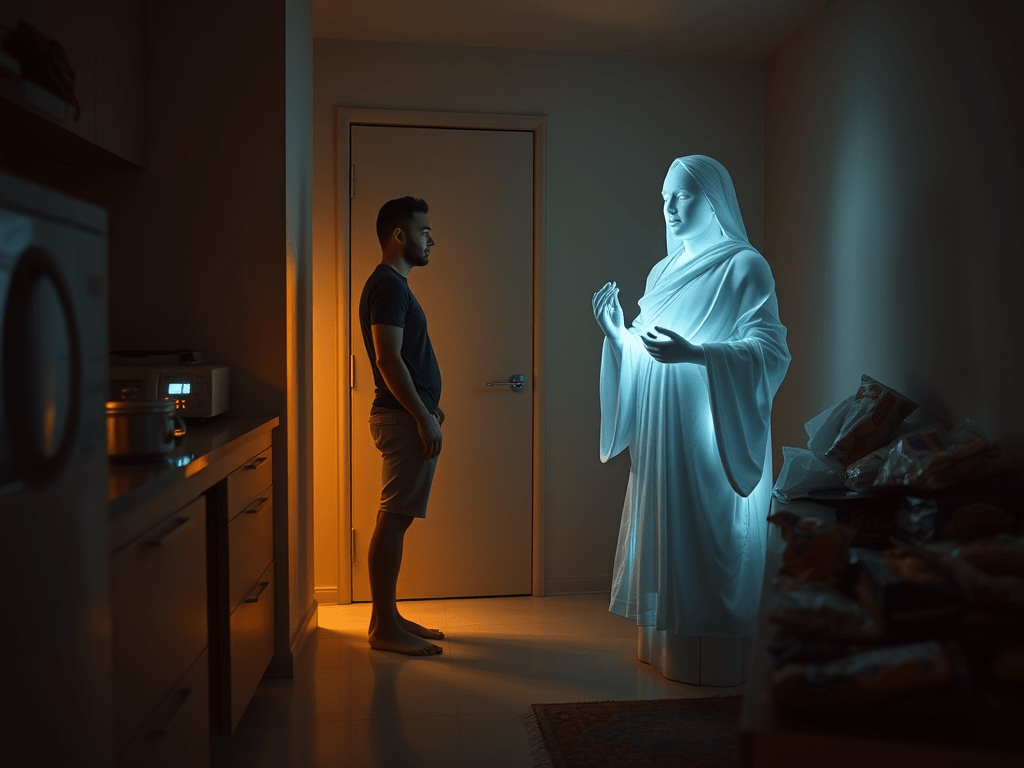
    In this post-literate world, I would inevitably fully expect to be replaced by a hologram—a cheerful AI that preps students for the workforce while serenading them with dopamine-laced infotainment. But at least I’ll get to say “I told you so” in my unemployment memoir.

    Perhaps my rant has become disconnected from reality, the result of the kind of paranoia that overtakes you when ChatGPT has been living rent-free inside your brain for too long. 

  • YOUR RELATIONSHIP WITH CHATGPT COMES AT A COST

    YOUR RELATIONSHIP WITH CHATGPT COMES AT A COST

    The slow erosion of our appetite for real, messy human experiences—sacrificed on the altar of convenience—haunts me like a bad tattoo decision. It’s this haunting quality, this inability to shake a topic, that marks it as a candidate for a truly worthy essay assignment. If a subject doesn’t linger in the students’ minds long after the semester ends, why bother assigning it?

    I’ve been particularly haunted by Derek Thompson’s essay “The Anti-Social Century,” a deep dive into the causes of our collective loneliness and disconnection. One culprit stands out like a neon billboard in Times Square: convenience. The seductive lure of convenience has driven people to prioritize the ease of solitude over the messiness of human connection. The price for this efficiency? A buffet of mental health issues—depression, anxiety, and the gnawing ache of alienation.

    Fifty years ago, America was brimming with social spaces where people gathered, formed friendships, and built a sense of belonging. Then came the suburbs—glorified hiding places where the American Dream morphed into a binge-watching marathon in a domestic cave lit by the flickering glow of network TV. Decades later, that TV was usurped by an even more hypnotic device: the smartphone. Thompson points out that these screens now consume 30 percent of our waking hours, superglued to our palms like a digital limb. If this screen addiction defines adolescence, it’s no wonder adulthood is turning into a solitary confinement sentence.

    In this context of isolation, some may turn to an unsettling new friend—ChatGPT. Equipped with “paralinguistic cues” that simulate human warmth, intonation, and empathy, AI is poised to become the perfect confidant. It’s always available, never interrupts, and never judges. But therein lies the danger. If AI is programmed to endlessly validate, never to challenge or disagree, users risk becoming socially maladapted, unable to handle the friction of real relationships. Instead of learning to navigate the complexities of human interaction, they might find themselves trapped in a feedback loop of synthetic comfort—a simulation of connection as flat and lifeless as convenience itself.

    As I read Derek Thompson’s analysis of America’s epidemic of loneliness and self-imposed isolation, I pause and exhale a deep sigh of gratitude. I’ve spent my life immersed in the chaos of public spaces, from my college job at a wine shop in Berkeley to three decades of full-time teaching in Los Angeles. In these cosmopolitan pressure cookers, people of every persuasion—hippies, yuppies, eccentrics, and your everyday lunatics—have taught me life lessons you won’t find on TikTok. No influencer, contorting into their latest anxiety-driven performance, can compete with the raw theater of human conflict played out in public spaces.

    Take, for example, my stint at Jackson’s Wine & Spirits, a Berkeley institution perched conveniently next to the Claremont Hotel. It was more than just a wine store; it housed a deli that was a gladiatorial arena of culinary egos. One afternoon, a man in his fifties—radiating that unmistakable “I’m from New York and I’m better than you” energy—strolled in and ordered a Reuben sandwich.

    George, our deli manager, was a fellow New Yorker and a sight to behold: a 300-pound behemoth with black-framed glasses, a permanent cigar stub dangling from his mouth, and a voice that could crush souls like overripe grapes. George had one rule in his deli: no one challenged his authority on sandwiches. But today, that rule would be tested.

    “What kind of cheese do you want on your Reuben?” George asked, calm but ominous, like a mob boss offering you a “favor.”

    The customer froze, as if George had just insulted his ancestors. His face contorted with the righteous fury of a man whose entire worldview had just been shattered. He bellowed, “A Reuben is rye bread, corned beef, Swiss cheese, sauerkraut, and Russian dressing! That’s it! That’s the Reuben!” He might as well have been handing down the Ten Commandments from Mount Pastrami.

    George, unshaken and clearly unimpressed by this deli manifesto, repeated the question with chilling indifference: “What kind of cheese do you want?”

    The man turned beet-red, veins throbbing, and launched into another dramatic recital of the holy Reuben ingredients. What followed was a clash of titans—two stubborn New Yorkers locked in mortal combat over sandwich orthodoxy. Neither would yield. George wouldn’t stop asking about the cheese. The customer wouldn’t stop quoting Reuben scripture like a sandwich prophet. The tension built to a breaking point until the customer unleashed a symphony of expletives that could’ve made a Hell’s Kitchen chef blush. He stormed out, vowing never to patronize such heretical deli blasphemy again.

    To this day, I marvel at that showdown. One man left hungry, the other lost a sale, and neither could claim victory. It was a masterclass in pride, ego, and the unyielding madness that surrounds food rituals. And while ChatGPT might one day learn how to imitate human conflict, I doubt it’ll ever capture the raw grandeur of two alpha New Yorkers battling over a sandwich.

  • Where ChatGPT falls short as a writing tool

    Where ChatGPT falls short as a writing tool

    In More Than Words: How to Think About Writing in the Age of AI, John Warner points out just how emotionally tone-deaf ChatGPT is when tasked with describing something as tantalizing as a cinnamon roll. At best, the AI produces a sterile list of adjectives like “delicious,” “fattening,” and “comforting.” For a human who has gluttonous memories, however, the scent of cinnamon rolls sets off a chain reaction of sensory and emotional triggers—suddenly, you’re transported into a heavenly world of warm, gooey indulgence. For Warner, the smell launches him straight into vivid memories of losing his willpower at a Cinnabon in O’Hare Airport. ChatGPT, by contrast, is utterly incapable of such sensory delirium. It has no desire, no memory, no inner turmoil. As Warner explains, “ChatGPT has no capacity for sense memory; it has no memory in the way human memory works, period.”

    Without memory, ChatGPT can’t make meaningful connections and associations. The cinnamon roll for John Warner is a marker for a very particular time and place in his life. He was in a state of mind then that made him a different person than he was twelve years later reminiscing about the days of caving in to the temptation to buy a Cinnabon. For him, the cinnamon roll has layers and layers of associations that inform his writing about the cinnamon roll that gives depth to his description of that dessert that ChatGPT cannot match.

    Imagine ChatGPT writing a vivid description of Farrell’s Ice Cream Parlour. It would perform a serviceable job describing the physical layout–the sweet aroma of fresh waffle cones, sizzling burgers, and syrupy fudge;  the red-and-white striped wallpaper stretched from corner to corner, the dark, polished wooden booths lining the walls; the waitstaff, dressed in candy-cane-striped vests and straw boater hats, and so on. However, there are vital components missing in the description–a kid’s imagination full of memories and references to their favorite movies, TV shows, and books. The ChatGPT version is also lacking in a kid’s perspective, which is full of grandiose aspirations to being like their heroes and mythical legends. 

    For someone who grow up believing that Farrell’s was the Holy Grail for birthday parties, my memory of the place adds multiple dimensions to the ice cream parlour that ChatGPT is incapable of rendering:

    When I was a kid growing up in the San Francisco Bay Area in the 1970s, there was an ice creamery called Farrell’s. In a child’s imagination, Farrell’s was the equivalent of Willy Wonka’s Chocolate Factory. You didn’t go to Farrell’s often, maybe once every two years or so. Entering Farrell’s, you were greeted by the cacophony of laughter and the clinking of spoons against glass. Servers in candy-striped uniforms dashed around with the energy of marathon runners, bearing trays laden with gargantuan sundaes. You sat down, your eyes wide with awe, and the menu was presented to you like a sacred scroll. You don’t need to read it, though. Your quest was clear: the legendary banana split. When the dessert finally arrived, it was nothing short of a spectacle. The banana split was monumental, an ice cream behemoth. It was as if the dessert gods themselves had conspired to create this masterpiece. Three scoops of ice cream, draped in velvety hot fudge and caramel, crowned with mountains of whipped cream and adorned with maraschino cherries, all nestled between perfectly ripe bananas. Sprinkles and nuts cascaded down the sides like the treasures of a sugar-coated El Dorado. As you took your first bite, you embarked on a journey as grand and transformative as any hero’s quest. The flavors exploded in your mouth, each spoonful a step deeper into the enchanted forest of dessert ecstasy. You were not just eating ice cream; you were battling dragons of indulgence and conquering kingdoms of sweetness. The sheer magnitude of the banana split demanded your full attention and stamina. Your small arms wielded the spoon like a warrior’s sword, and with each bite, you felt a mixture of triumph and fatigue. By the time you reached the bottom of the bowl, you were exhausted. Your muscles ached as if you’d climbed a mountain, and you were certain that you’d expanded your stomach capacity to Herculean proportions. You briefly considered the possibility of needing an appendectomy. But oh, the glory of it all! Your Farrell’s sojourn was worth every ache and groan. You entered the ice creamery as an ordinary child and emerged as a hero. In this fairy-tale-like journey, you had undergone a metamorphosis. You were no longer just a scrawny kid from the Bay Area; you were now a muscle-bound strutting Viking of the dessert world, having mastered the art of indulgence and delight. As you returned home, the experience of Farrell’s left a lasting imprint on your soul. You regaled your friends with tales of your conquest, the banana split becoming a legendary feast in the annals of your childhood adventures. In your heart, you knew that this epic journey to Farrell’s, this magical pilgrimage, had elevated you to the ranks of dessert royalty, a memory that would forever glitter like a golden crown in the kingdom of your mind. As a child, even an innocent trip to an ice creamery was a transformational experience. You entered Farrell’s a helpless runt; you exited it a glorious Viking. 

    The other failure of ChatGPT is that it cannot generate meaningful narratives. Without memory or point of view, ChatGPT has no stories to tell and no lessons to impart. Since the days of our Paleolithic ancestors, humans have shared emotionally charged stories around the campfire to ward off both external dangers—like saber-toothed tigers—and internal demons—obsessions, pride, and unbridled desires that can lead to madness. These tales resonate because they acknowledge a truth that thoughtful people, religious or not, can agree on: we are flawed and prone to self-destruction. It’s this precarious condition that makes storytelling essential. Stories filled with struggle, regret, and redemption offer us more than entertainment; they arm us with the tools to stay grounded and resist our darker impulses. ChatGPT, devoid of human frailty, cannot offer us such wisdom.

    Because ChatGPT has no memory, it cannot give us the stories and life lessons we crave and have craved for thousands of years in the form of folk tales, religious screeds, philosophical treatises, and personal manifestos. 

    That ChatGPT can only muster a Wikipedia-like description of a cinnamon roll hardly makes it competitive with humans when it comes to the kind of writing we crave with all of our heart, mind, and soul. 

    One of ChatGPT’s greatest disadvantages is that, unlike us, it is not a fallen creature slogging through the freak show that is this world, to use the language of George Carlin. Nor does ChatGPT understand how our fallen condition can put us at the mercy of our own internal demons and obsessions that cause us to warp reality that leads to dysfunction. In other words, ChatGPT does not have a haunted mind and without any oppressive memories, it cannot impart stories of value to us.

    When I think of being haunted, I think of one emotion above all others–regret. Regret doesn’t just trap people in the past—it embalms them in it, like a fly in amber, forever twitching with regret. Case in point: there are  three men I know who, decades later, are still gnashing their teeth over a squandered romantic encounter so catastrophic in their minds, it may as well be their personal Waterloo.

    It was the summer of their senior year, a time when testosterone and bad decisions flowed freely. Driving from Bakersfield to Los Angeles for a Dodgers game, they were winding through the Grapevine when fate, wearing a tie-dye bikini, waved them down. On the side of the road, an overheated vintage Volkswagen van—a sunbaked shade of decayed orange—coughed its last breath. Standing next to it? Four radiant, sun-kissed Grateful Dead followers, fresh from a concert and still floating on a psychedelic afterglow.

    These weren’t just women. These were ethereal, free-spirited nymphs, perfumed in the intoxicating mix of patchouli, wild musk, and possibility. Their laughter tinkled like wind chimes in an ocean breeze, their sun-bronzed shoulders glistening as they waved their bikinis and spaghetti-strap tops in the air like celestial signals guiding sailors to shore.

    My friends, handy with an engine but fatally clueless in the ways of the universe, leaped to action. With grease-stained heroism, they nursed the van back to health, coaxing it into a purring submission. Their reward? An invitation to abandon their pedestrian baseball game and join the Deadhead goddesses at the Santa Barbara Summer Solstice Festival—an offer so dripping with hedonistic promise that even a monk would’ve paused to consider.

    But my friends? Naïve. Stupid. Shackled to their Dodgers tickets as if they were golden keys to Valhalla. With profuse thanks (and, one imagines, the self-awareness of a plank of wood), they declined. They drove off, leaving behind the road-worn sirens who, even now, are probably still dancing barefoot somewhere, oblivious to the tragedy they unwittingly inflicted.

    Decades later, my friends can’t recall a single play from that Dodgers game, but they can describe—down to the last bead of sweat—the precise moment they drove away from paradise. Bring it up, and they revert into snarling, feral beasts, snapping at each other over whose fault it was that they abandoned the best opportunity of their pathetic young lives. Their girlfriends, beautiful and present, might as well be holograms. After all, these men are still spiritually chained to that sun-scorched highway, watching the tie-dye bikini tops flutter in the wind like banners of a lost kingdom.

    Insomnia haunts them. Their nights are riddled with fever dreams of sun-drenched bacchanals that never happened. They wake in cold sweats, whispering the names of women they never actually kissed. Their relationships suffer, their souls remain malnourished, and all because, on that fateful day, they chose baseball over Dionysian bliss.

    Regret couldn’t have orchestrated a better long-term psychological prison if it tried. It’s been forty years, but they still can’t forgive themselves. They never will. And in their minds, somewhere on that dusty stretch of highway, a rusted-out orange van still sits, idling in the sun, filled with the ghosts of what could have been.

    Humans have always craved stories of folly, and for good reason. First, there’s the guilty pleasure of witnessing someone else’s spectacular downfall—our inner schadenfreude finds comfort in knowing it wasn’t us who tumbled into the abyss of human madness. Second, these stories hold up a mirror to our own vulnerability, reminding us that we’re all just one bad decision away from disaster.

    As a teacher, I can tell you that if you don’t anchor your ideas to a compelling story, you might as well be lecturing to statues. Without a narrative hook, students’ eyes glaze over, their minds drift, and you’re left questioning every career choice that led you to this moment. But if you offer stories brimming with flawed characters—haunted by regrets so deep they’re like Lot’s wife, frozen and unmovable in their failure—students perk up. These narratives speak to something profoundly human: the agony of being broken and the relentless desire to become whole again. That’s precisely where AI like ChatGPT falls short. It may craft mechanically perfect prose, but it has never known the sting of regret or the crushing weight of shame. Without that depth, it can’t deliver the kind of storytelling that truly resonates.

  • WILL WRITING INSTRUCTORS BE REPLACED BY CHATBOTS?

    WILL WRITING INSTRUCTORS BE REPLACED BY CHATBOTS?

    Last night, I was trapped in a surreal nightmare—a bureaucratic limbo masquerading as a college elective. The course had no purpose other than to grant students enough credits to graduate. No curriculum, no topics, no teaching—just endless hours of supervised inertia. My role? Clock in, clock out, and do absolutely nothing.

    The students were oddly cheerful, like campers at some low-budget retreat. They brought packed lunches, sprawled across desks, and killed time with card games and checkers. They socialized, laughed, and blissfully ignored the fact that this whole charade was a colossal waste of time. Meanwhile, I sat there, twitching with existential dread. The urge to teach something—anything—gnawed at my gut. But that was forbidden. I was there to babysit, not educate.

    The shame hung on me like wet clothes. I felt obsolete, like a relic from the days when education had meaning. The minutes dragged by like a DMV line, each one stretching into a slow, agonizing eternity. I wondered if this Kafkaesque hell was a punishment for still believing that teaching is more than glorified daycare.

    This dream echoes a fear many writing instructors share: irrelevance. Daniel Herman explores this anxiety in his essay, “The End of High-School English.” He laments how students have always found shortcuts to learning—CliffsNotes, YouTube summaries—but still had to confront the terror of a blank page. Now, with AI tools like ChatGPT, that gatekeeping moment is gone. Writing is no longer a “metric for intelligence” or a teachable skill, Herman claims.

    I agree to an extent. Yes, AI can generate competent writing faster than a student pulling an all-nighter. But let’s not pretend this is new. Even in pre-ChatGPT days, students outsourced essays to parents, tutors, and paid services. We were always grappling with academic honesty. What’s different now is the scale of disruption.

    Herman’s deeper question—just how necessary are writing instructors in the age of AI—is far more troubling. Can ChatGPT really replace us? Maybe it can teach grammar and structure well enough for mundane tasks. But writing instructors have a higher purpose: teaching students to recognize the difference between surface-level mediocrity and powerful, persuasive writing.

    Herman himself admits that ChatGPT produces essays that are “adequate” but superficial. Sure, it can churn out syntactically flawless drivel, but syntax isn’t everything. Writing that leaves a lasting impression—“Higher Writing”—is built on sharp thought, strong argumentation, and a dynamic authorial voice. Think Baldwin, Didion, or Nabokov. That’s the standard. I’d argue it’s our job to steer students away from lifeless, task-oriented prose and toward writing that resonates.

    Herman’s pessimism about students’ indifference to rhetorical nuance and literary flair is half-baked at best. Sure, dive too deep into the murky waters of Shakespearean arcana or Melville’s endless tangents, and you’ll bore them stiff—faster than an unpaid intern at a three-hour faculty meeting. But let’s get real. You didn’t go into teaching to serve as a human snooze button. You went into sales, whether you like it or not. And what are you selling? Persona, ideas, and the antidote to chaos.

    First up: persona. It’s not just about writing—it’s about becoming. How do you craft an identity, project it with swagger, and use it to navigate life’s messiness? When students read Oscar Wilde, Frederick Douglass, or Octavia Butler, they don’t just see words on a page—they see mastery. A fully-realized persona commands attention with wit, irony, and rhetorical flair. Wilde nailed it when he said, “The first task in life is to assume a pose.” He wasn’t joking. That pose—your persona—grows stronger through mastery of language and argumentation. Once students catch a glimpse of that, they want it. They crave the power to command a room, not just survive it. And let’s be clear—ChatGPT isn’t in the persona business. That’s your turf.

    Next: ideas. You became a teacher because you believe in the transformative power of ideas. Great ideas don’t just fill word counts; they ignite brains and reshape worldviews. Over the years, students have thanked me for introducing them to concepts that stuck with them like intellectual tattoos. Take Bread and Circus—the idea that a tiny elite has always controlled the masses through cheap food and mindless entertainment. Students eat that up (pun intended). Or nihilism—the grim doctrine that nothing matters and we’re all here just killing time before we die. They’ll argue over that for hours. And Rousseau’s “noble savage” versus the myth of human hubris? They’ll debate whether we’re pure souls corrupted by society or doomed from birth by faulty wiring like it’s the Super Bowl of philosophy.

    ChatGPT doesn’t sell ideas. It regurgitates language like a well-trained parrot, but without the fire of intellectual curiosity. You, on the other hand, are in the idea business. If you’re not selling your students on the thrill of big ideas, you’re failing at your job.

    Finally: chaos. Most people live in a swirling mess of dysfunction and anxiety. You sell your students the tools to push back: discipline, routine, and what Cal Newport calls “deep work.” Writers like Newport, Oliver Burkeman, Phil Stutz, and Angela Duckworth offer blueprints for repelling chaos and replacing it with order. ChatGPT can’t teach students to prioritize, strategize, or persevere. That’s your domain.

    So keep honing your pitch. You’re selling something AI can’t: a powerful persona, the transformative power of ideas, and the tools to carve order from the chaos. ChatGPT can crunch words all it wants, but when it comes to shaping human beings, it’s just another cog. You? You’re the architect.