
Author: Jeffrey McMahon

  • The Mysterious Woman at the Moscow Zoo

    The Mysterious Woman at the Moscow Zoo

    The morning after landing in Moscow—still basking in the relief that no grim-faced customs officer had pried A Clockwork Orange from my hands—I found myself standing with a dozen other jet-lagged Americans at the Moscow Zoo, led by our perpetually chipper tour guide, Natasha. The air was thick with a mix of animal musk and cigarette smoke, and somewhere in the distance, a public speaker crooned a heart-wrenching Rachmaninoff piano piece, as if the entire city were in a state of elegant despair.

    I stood transfixed before the silverback gorilla, watching as he pounded his enormous, muscle-corded chest inside his moated enclosure, the very embodiment of brute strength and existential boredom. That’s when she appeared—an elegant woman in a black dress so perfectly tailored it looked painted onto her body, a matching black hat perched at a rakish angle, and a string of pearls glistening like a final touch of old-world sophistication. She moved toward me with an effortless grace, her dark eyes alight with something between mischief and intrigue.

    Not only was she stunning—she was smiling. At me. As if we were long-lost confidantes about to dive into a tête-à-tête of world-altering significance. My sleep-deprived, jet-lagged brain struggled to process this impossible scenario: a beautiful Russian woman, dressed for a rendezvous at Café Pushkin rather than a casual afternoon at the zoo, suddenly deciding that I was worth her time. I had come to Moscow expecting bureaucracy, bad food, and a surplus of dour expressions—not this. It was as if I had stumbled into the first act of a Cold War spy thriller, and I had absolutely no idea what my lines were supposed to be.

    “I can tell you’re American,” she said with a sharp accent that sent chills down my spine, “but you look very Russian.”

    This was true. My mother’s family was from Poland and Belarus, and I had dramatic Eastern European features. Even the other tourists on our tour said I looked Russian.

    “Russian men are very strong,” she said. “And you are a weightlifter, of course.”

    Indeed, I was. In fact, before I pivoted to bodybuilding in my mid-teens, I was an award-winning Olympic Weightlifter, and I was very fond of the great Soviet world record breaker Vasily Alekseyev. 

    “Russian women love strong men,” she said, smiling at me.

    I was too flattered by her attention to be suspicious of her ulterior motives, but Natasha saw what was going on, and the goody-two-shoes tour guide with thick spectacles grabbed me by the arm with her strong grip, walked me to some nearby bushes, and warned me that the woman was probably KGB attempting to ensnare me into some kind of kompromat or other. What the trap was Natasha did not say, so it was left to my prurient imagination. 

    While the reality was that Natasha had probably saved me from a lot of grief, I was too enticed by this elegant woman to get her out of my mind. In college, I was too socially awkward and absorbed by my bodybuilding, piano playing, and reading of “dark literature” to date or have what people considered normal socializing, but thousands of miles away from my mundane environment in the San Francisco Bay Area and now in the forbidden Soviet Union, I found myself feeling emboldened around the opposite sex, and I was hungry for a memorable encounter of some kind. What I’m trying to say is that I found myself feeling unusually lusty. My desires compelled me to believe that I had a grand opportunity with this lovely Russian woman at the zoo, and the fact that Natasha had ruined my chances pissed me off in ways that got me in touch with my Inner Silverback. Contrary to Natasha’s warnings, there may have been an outside chance that this mysterious woman simply found me attractive and wanted to get to know me, but her opportunity, and mine, had been repelled by my no-nonsense busy-body tour guide. 
  • Reading A Clockwork Orange in Russia

    Reading A Clockwork Orange in Russia

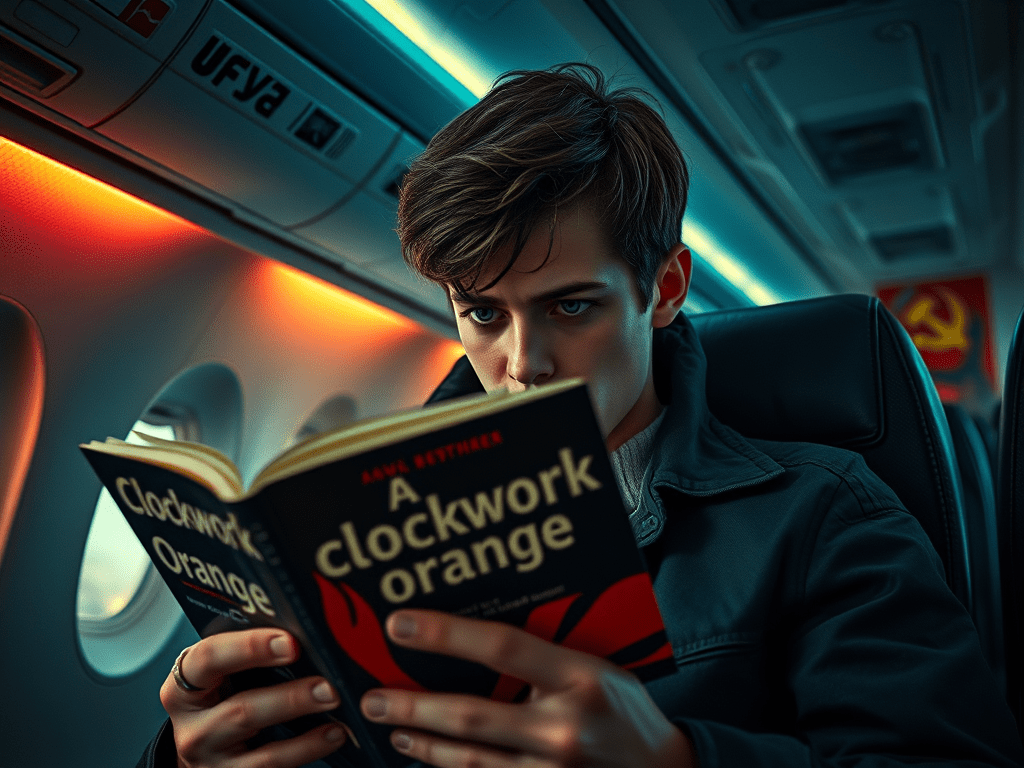
    In my early twenties, I was holding a copy of A Clockwork Orange on an Aeroflot flight from New York to Moscow, and I was fairly certain I’d be arrested before I even touched Soviet soil. This was not the book I was supposed to be reading. My grandfather, a proud, card-carrying Communist, had made it clear that my in-flight reading should be Cities Without Crisis: The Soviet Union Through the Eyes of an American by Mike Davidow—a glowing, uncritical love letter to the USSR. According to Davidow, the Soviet Union was well on its way to utopia, a land where happy, apple-cheeked children played in clean, orderly cities, miraculously untouched by the crime, chaos, and moral decay of capitalist America.

    I had every intention of honoring my grandfather’s wishes. He had, after all, funded my spot on this Sputnik Peace Tour, a Cold War-era cultural exchange designed to showcase the Soviet Union’s superiority and convince impressionable American university students that their homeland was little more than a dilapidated shack compared to the Soviet skyscraper. My grandfather, who spent his golden years vacationing in Russia and Cuba and had personally befriended Fidel Castro, hoped I’d return to the States ready to sing the Soviet anthem on command, with a crimson hammer-and-sickle tattoo stretched across my chest.

    But try as I might, I couldn’t stomach Davidow’s propaganda. It read like an overlong infomercial scripted by a particularly humorless bureaucrat. Every page was predictable, every assertion dripping with a blind, almost devotional reverence for the Soviet system. By chapter three, my eyelids were growing heavier than a Soviet cement block. That’s when I ditched it for A Clockwork Orange, a novel that, in its satirical depiction of authoritarianism and mindless conformity, was just about the worst reading material one could bring on a goodwill trip to the USSR. My grandfather would have called it “reactionary,” but I wasn’t worried about him.

    No, my real concern was the Soviet customs officers waiting for us on the tarmac. They’d be rummaging through our luggage, sniffing out any hint of anti-Soviet subversion. And there I was, gripping a book that, if noticed, might earn me an all-expenses-paid trip to the kind of re-education program I had no interest in attending.

    When one of my fellow tourists, Jerry Gold, who was studying law at Brown University, saw me reading the subversive novel while sitting next to me on the plane, he warned me that the Soviet police would probably confiscate it when we got to the airport. “Not only will they take your book,” he said, “they will mark you as a troublemaker and keep tags on you throughout the entire trip. You must now constantly look over your shoulder for spies, my friend. And remember, if anyone wants to offer you good money for your jeans, it’s probably KGB. Selling Western commodities for the black market is a crime that could get you sent to a Soviet prison.”

    I’ll admit, I was a little anxious about some stern-faced Soviet officer confiscating A Clockwork Orange from my hands, but that concern quickly took a backseat to a far more immediate crisis: the inedible horrors being passed off as food on the Aeroflot flight. The demure flight attendants, clad in their stiff, no-nonsense uniforms, moved through the cabin with a grim efficiency, depositing onto our trays what could only be described as Cold War rations—waxy cheese triangles entombed in foil, anemic cold cuts that looked like they had lost a war of their own, limp lettuce gasping for dignity, and carrot slices so soggy they seemed to be pre-chewed. It was a meal that could single-handedly refute Mike Davidow’s utopian vision in Cities Without Crisis. His thesis—that the Soviet Union was building thriving cities free of strife—collapsed under the weight of this culinary travesty. Because if a nation’s food is a reflection of its prosperity, then a country that serves despair on a tray is, in fact, in crisis. And a man who fails to acknowledge that crisis is a fraud.

    Across the aisle, Jerry Gold, the kind of guy who exuded the unshakable self-assurance of someone who spent his summers at debate camp and his winters skiing in Vermont, curled his lip in disgust. A mop of reddish-brown hair and a constellation of freckles gave him the air of a scholarly leprechaun. He peeled back the foil on his cheese triangle with surgical precision, examined its plasticky surface like a jeweler appraising a fake diamond, and let out a slow, deliberate sigh. Then, in a display of Ivy League pragmatism, he took the industrial-grade brown napkin from his tray, folded it with the care of a man preparing for a high-stakes origami competition, and tucked it into the inner pocket of his coat. “You might want to do the same,” he advised me in a tone that suggested this was less a suggestion and more a survival strategy. I nodded, following suit, because when faced with Soviet airline cuisine, you learned to take advice from the man with a backup plan.

    “This could be the only toilet paper you’re going to have on this trip,” he said. “You would be wise to save all your napkins. They’re worth their weight in gold around here.”

    “That’s disgusting.”

    “Have you ever used an Eastern European toilet?”

    I shook my head.

    “A hole in the ground. An invitation to the deep knee bend. It’s a free Jack Lalanne workout every time you go to the shitter. Things can be rather primitive.”

    “For someone so hellbent on horrifying me on every aspect of this tour, can you please tell me why you decided to go on this trip?”

    “It’s college credit. It’s exotic. How many Americans can boast of having been inside the Soviet Union?” He forced down a bite of cheese and asked me why I was going on the tour. 

    “My grandfather is a card-carrying communist,” I said. “He’s trying to convert me.”

    “So he sent you to paradise.” He laughed, then pinched a cold cut, lifted it before his face, and scrutinized it carefully.

    “The food isn’t a winning argument,” I said. “Nor is the absence of toilet paper.”

    “There is a saying in the Soviet Union,” he said while tossing the uneaten cold cut on his tray. “If you see people standing in line, make sure you stand in it. People are always waiting in line for something.”

    His statement proved to be true. A week later when we were in a sweltering market in Kyiv, we saw forlorn citizens, mostly stoic-faced babushkas, standing in a long line to buy wrinkled room-temperature chickens with flies swarming over them. I kept thinking to myself, “Cities without crisis? Bullshit.” Little did I know, I was standing 62 miles from Chernobyl and that two years later the nuclear reactor would explode causing worldwide radioactive contamination. Cities without crisis indeed.

    But in 1984 as I witnessed long lines, food shortages, nonexistent toilet paper, and primitive toilets, I found something about the Soviet Union that struck me as almost admirable: Everywhere we went, markets, train stations, parks, and museums, there were government speakers playing classical music, much of it from Rachmaninoff, Shostakovich, and Prokofiev. I wanted to believe, as my grandfather would want me to, that the violin chamber pieces and piano sonatas were the Soviet Union’s idea of music for the masses based on the government cultivating sophisticated taste in its citizens. But a darker motive was that the music was part of the Soviet Union’s propaganda: Classical music from Russian composers was a way of rebuking the vulgarity and corruption of the West. 

  • In the 1970s, Books Were Sacred Texts

    In the 1970s, Books Were Sacred Texts

    In the 1970s—when books weren’t just books; they were sacred texts, maps to enlightenment, portals to a better world. Back then, the right book could change everything. And no place embodied this belief more than the Co-Op grocery store in the San Francisco Bay Area, a socialist utopia disguised as a supermarket.

    Co-Op wasn’t just a store—it was a temple of countercultural righteousness, a fluorescent-lit commune where food was political, capitalism was the enemy, and books were the gospel of enlightenment and revolution. The employees, mostly bearded men in survivalist gear and women in flowing skirts, looked like they had just emerged from a transcendental meditation retreat in Big Sur. The store carried everything necessary for the well-intentioned ascetic: wheat germ, carob honey ice cream, tofu, Japanese yams, granola by the truckload. In one corner, you could buy an alfalfa sprout home-growing kit; in another, you could pick up a well-worn copy of Zen and the Art of Motorcycle Maintenance. The book section—small, but potent—was a who’s who of 70s countercultural essentials: The Secret Life of Plants, Chariots of the Gods, The Peter Principle, and the vegetarian bible of all vegetarian bibles, Frances Moore Lappé’s Diet for a Small Planet.

    Shopping at Co-Op was an act of ideological purification. You weren’t just filling your pantry—you were waging war against The Man. Your grocery list was a manifesto. Brown rice instead of white? A stance against industrial food tyranny. Organic honey? A protest against corporate sugar slavery. Granola? The fuel of the revolution.

    But here’s the problem with turning your diet into a moral crusade—it comes with unintended consequences. Specifically, Granola Belly.

    The self-styled revolutionaries of the Co-Op era, those brave warriors against the forces of corporate food oppression, were inadvertently overeating their way to oblivion. Granola, wheat germ, and honey—pure, untainted by corporate greed—were caloric landmines. Yet they shoveled it down in righteous indignation, their burgeoning bellies a testament to their dietary zealotry. They waddled through the aisles, draped in North Face survival gear, looking ready to disappear into the Alaskan wilderness at any moment—if only they weren’t weighed down by their own moral superiority.

    Granola enthusiasts of the 70s were, in essence, a contradiction wrapped in a paradox and coated in raw honey. They raged against consumerism, yet consumed with a ferocity that would make a glutton blush. They preached self-discipline while mainlining carbohydrate ecstasy. They railed against corporate food tyranny, but the only thing expanding faster than their political righteousness was their waistlines.

    But Co-Op wasn’t just about the food—it was about the books. If the aisles were the body of the revolution, the books were its soul. They were blueprints for enlightenment, roadmaps to utopia. Talk to plants, replace animal protein with soy, meditate your way to cosmic awareness, learn the wisdom of the ancient aliens—everything you needed to build a new world was right there, tucked between the sacks of lentils and jars of miso paste.

    Which brings me back to my writing demon.

    Just as the Co-Op faithful believed books could transform civilization, I have spent my life believing the same about my own writing. The demon isn’t just some compulsive need to write—it’s the insatiable hunger for literary immortality, the delusion that one book—one perfectly crafted book—could define me, complete me, redeem me.

    It’s the same old obsession, wrapped in different packaging. My granola bowl is now a manuscript, my utopian blueprint now a satirical screed. I am still that wide-eyed Co-Op kid, convinced that books can reshape the world. But instead of reading the gospel, I am trying—foolishly, obsessively—to write it.

  • It’s Never Been a Worse Time to Write a Book

    It’s Never Been a Worse Time to Write a Book

    Looking at Paul’s literary success—a man whose brief collection of letters has been on history’s all-time best-seller list—I can’t help but feel I bet on the wrong horse. Here I was, grinding away at novels, when I should have been an epistle-wielding scrivener, maybe even the founder of my own religion. Paul understood something I clearly did not: the world wasn’t clamoring for door stopper novels the size of The Count of Monte Cristo—it wanted sharp, incendiary tracts that could shake the foundations of belief. His instincts were dead-on, and two millennia later, his work is still in print, while my manuscripts remain in purgatory.

    And let’s be honest—there’s never been a worse time to write a book. We inhabit a post-literate wasteland, where the next generation’s idea of reading is squinting at subtitles while scrolling TikTok. The written word is being replaced by 15-second dopamine jolts, and syntax is being butchered faster than a hog in a slaughterhouse. Meanwhile, AI-generated prose is turning human creativity into an optional relic—why agonize over writing when you can plug a prompt into ChatGPT and get a grammatically competent, if soulless, 2,000-word essay faster than it takes to microwave a Hot Pocket? Argument structure, rhetorical flourish, actual thought? Who needs those when the algorithm can produce a sterile, citation-laden monstrosity with all the passion of an instruction manual? Paul saw the writing on the wall—literally. And I? I spent five decades wrestling with novels that no one wanted to read. Maybe it’s time to rethink my approach before I, too, become just another artifact of a bygone literary era.

    And yet, when you’re possessed by the writing demon, as I am, none of this matters. Reality bends around the obsession. Practical concerns slide off me like water off a duck’s back—or more accurately, like rejection letters into my trash bin. The demon doesn’t care about markets, trends, or the creeping irrelevance of books. No, the demon is hell-bent on proselytizing, convinced that I’ve stumbled upon the elixir of life, and that the world must hear my truth, whether it wants to or not. It’s not just enthusiasm—it’s derangement, the kind of fevered compulsion that outs you as a hopeless fanboy for your own ideas. People start calling you “touched” or “special,” which is just polite society’s way of saying, “You are utterly unhinged, and we wish you would stop.”

    You’re ashamed of your writing obsession, yet powerless to stop because the impulse isn’t tethered to reality—it’s pure pathology. You’re a self-appointed evangelist, convinced the world needs your message, your perspective, you. If only people would listen, if only your words took root in the collective consciousness, then maybe—just maybe—you’d finally feel the validation that’s eluded you your entire life.

    And yet, you’re no fool. You see the absurdity of your crusade. You know the odds, the futility, the sheer delusion of it all. But you’re a divided soul—the rational part watches in horror as the compulsive part keeps writing into the void, hoping someone, somewhere, will care.

  • The Aspiring Writer Strives to Overcome His Inferiority Complex

    The Aspiring Writer Strives to Overcome His Inferiority Complex

    The aspiring writer, Manuscriptus Rex, writes not out of pure inspiration but from the unholy fusion of a chip on his shoulder and a raging inferiority complex. His desperation for a cure has somehow led him to the worst possible conclusion: that literary dominance is the only path to salvation. Anything short of conquering the literary world? Utter failure.

    Why such extremes? Because Manuscriptus Rex is an eternal adolescent, emotionally stunted and incapable of nuance. Life is a brutal, binary equation—winners or losers, triumph or oblivion. There is no middle ground. And for those with just enough talent to know they’ll never be the best? The humiliation is unbearable. They sink into a spiral of self-loathing so profound, they start questioning why they were born in the first place.

    This despair is captured well in the 1984 movie Amadeus, in which Salieri, the patron saint of mediocrity, spends his life gnashing his teeth over the fact that, for all his ambition, he’ll always be the guy in the cheap seats while Mozart, the true genius, takes center stage. Some might be tempted to draw the same parallel between Paul and Jesus, as if Paul were some whiny Salieri, shaking his fist at the heavens over his lack of messianic charisma. Dead wrong. Paul didn’t sulk in anyone’s shadow. He sharpened his writing tools, rearranged the spotlight, and made damn sure it was aimed squarely at himself.

    How successful was Paul at making his writing stick? Let’s put it this way—his entire written output amounts to about eighty pages. Eighty pages. That’s not even the length of a middling beach read you’d abandon in an airport terminal. And yet, those pages have been scrutinized, weaponized, and dissected with more fervor than any artistic or literary masterpiece in human history.

    I sit here, surveying the wreckage of five decades of my own writing, knowing full well that it will likely fade into the void, while Paul’s scant eighty pages have dictated the course of Western thought, politics, and religion for two thousand years. The word “influence” doesn’t even begin to cover it. This is literary world domination.

    And was this tidal wave of influence accidental? Hardly. Paul wasn’t just writing to save souls—he was writing for his own immortality.

    Pauline scholars love to point out that Paul wasn’t exactly thrilled with what the original apostles were peddling. Their Jesus still had training wheels—tied to Torah, saddled with Jewish law, bogged down by the pesky weight of tradition. Paul, on the other hand, had a better idea. His Jesus was purer, punchier, and more potent—a spiritual superfood untainted by Torah preservatives. And Paul wasn’t shy about it. He called it “my gospel”—not once, but over and over again, like a divine trademark. Forget the Jewish-flavored Jesus movement—Paul’s was gluten-free, carb-free, and straight to the Gentile bloodstream.

    This wasn’t just a theological shift—it was a hostile takeover. Paul didn’t seem particularly interested in Jesus’ actual words. Sermons? Parables? “Love thy neighbor”? Small-time. Paul’s focus was on his own visions, his personal revelations, the ones that conveniently made himself the authority on Jesus. While Peter and James clung to their quaint Jewish traditions, Paul rebranded Christianity in his own image, rolling out a one-man revolution that sidelined the original apostles like outdated board members in a corporate coup.

    And rabbi scholar Hyam Maccoby—never one to understate a theological conspiracy—takes it even further. According to The Mythmaker, Paul didn’t just step out from Jesus’ shadow—he steamrolled over it and rebranded Christianity as a Paul Production, with himself as lead architect of one of history’s largest religious empires. Salieri could only dream of that level of self-promotion.

    But Paul didn’t just change the messaging—he altered the entire emotional foundation of Christianity. Maccoby doesn’t just accuse Paul of hijacking Christianity—he accuses him of rewriting the entire Old Testament like a hack screenwriter with a savior complex. The Jewish tradition of free will, strength, and human agency is replaced with Paul’s bleak vision of humanity—where people are helpless worms, groveling in the dirt, utterly incapable of doing anything good without divine intervention.

    Fast-forward two millennia, and we’re still drowning in the wreckage of Paul’s inferiority complex—scrolling ourselves into oblivion, slaves to algorithms, locked in a spiritual malaise that might as well have been engineered by Paul himself. Maccoby paints Paul not as a mystical visionary, but as a man crippled by his own self-loathing, a former Pharisee who couldn’t hack it in Jewish law, so he torched the whole thing and built his own damn religion. And it worked.

    Paul’s biggest marketing coup was turning Jesus into something unrecognizable. Gone was the Torah-loving Jewish teacher—in his place, a Hellenized God-man with cosmic grandeur. But Paul didn’t work alone. He had Luke, his personal spin doctor, crafting The Acts of the Apostles—a biblical infomercial designed to make Paul look like a tireless hero, smoothing out his awkward edges, burying any embarrassing missteps, and giving the real apostles about as much airtime as unpaid extras in Paul’s vanity project. The result? A Christianity that barely resembled anything Jesus actually taught, but one tailor-made for mass adoption.

    It’s a corporate rebrand so slick that Paul might as well be the Steve Jobs of Western religion.

    Paul didn’t just invent a religion—he invented religious dominance. His theology was designed for maximum influence, structured like a brilliantly engineered algorithm—one that self-replicates, adapts, and burrows into the psyche like a spiritual virus. You don’t just believe in Paul’s Christianity; you’re owned by it.

    And this is where the connection to my own writing demon becomes uncomfortably clear.

    Paul did what I’ve always wanted to do—he wrote something so potent, so inescapable, so monolithic, that it hijacked human consciousness for centuries. His letters didn’t just survive—they became the foundation for an entire civilization. And what is that if not the ultimate literary ambition?

    The writing demon inside me has always whispered the same temptation—that if I just write the right book, if I craft my message well enough, if I design the perfect narrative, I can transcend obscurity, reshape reality, and carve my name into history.

    Paul did it. He wrote himself into religious permanence, his eighty pages outlasting every empire, every cultural movement, every literary masterpiece.

    And maybe that’s why I can’t stop thinking about him.

    Because deep down, I know: Paul is the ghostwriter of my own ambition.

  • Writing Is World-Building

    Writing Is World-Building

    The writer who seeks literary dominance can be called Manuscriptus Rex. He is a beast acutely aware of his own brokenness, a self-awareness that drags him into the depths of morbidity and despair. But mere recognition of his anguish isn’t enough—he must transcend it. Not through quiet introspection or self-acceptance, but through literary dominance. Writing isn’t just therapy; it’s conquest. His words are not gentle offerings but acts of aggression against the world, though he convinces himself otherwise. He’s not a tyrant—he’s a savior. He doesn’t crave attention—he has something urgent to say, something the world must hear.

    One of the most exalted members of the Manuscriptus Rex species? The Apostle Paul. His life reads like a high-stakes thriller—a battle-worn intellectual waging ideological war through the written word. If Hollywood ever needed a poster child for a writer with a messianic mission, Paul would be it. Ink-stained fingers, unshakable conviction, and a belief that his words would outlast empires—because, of course, they did.

    Thinking of Paul as a character in a movie reminds me of a similarly absurd but far less consequential scene from my own past: the time my high school bodybuilding buddy, Martino, and I were ensnared by the oldest bait-and-switch in history—free food and salvation. We had been lured to a Wednesday night church youth group by the promise of unlimited lasagna and Kool-Aid, a trap set by the twin seductions of carbs and sugar. The youth pastor, a bearded, bespectacled man with the unshakable enthusiasm of someone who truly believed he could sell eternal life like a used car, paced the room as he spun his gospel pitch. He wanted to know if we were ready to accept Jesus Christ as our Lord and Savior, as though an extra serving of garlic bread might tip us into theological certainty.

    Martino, a squat, blocky fellow with a neck so thick it could’ve moonlighted as a battering ram, sat politely through the sermon, nodding with the blank expression of a man deep in a carb coma. His eyebrows, heavy and brooding, looked as if they were preparing to stage a labor strike right there on his face. By the time we left, his stomach was full, but his soul remained stubbornly unmoved. Driving home, he grunted through a yawn, “Nice lasagna, but I don’t think I found Jesus in there.”

    Paul would’ve had a field day with Martino, hammering him with letters, debates, and fiery rebukes until he saw the light—or at least surrendered out of sheer exhaustion.

    “Eternal paradise? Eternal hell? If you want to win me over, show me the movie.” Without a flicker of humor, he added, “Jacques Cousteau and his film crew need to do a deep dive into heaven and hell and report back. Then maybe the pastor will have something worth talking about.”

    I couldn’t help but think of Jacques Cousteau and his team of underwater explorers filming their way through the afterlife when I was reading French novelist Emmanuel Carrère’s The Kingdom. In typical Carrère fashion, he takes the early church and flips it into a bizarre TV production, with Saint Paul as the leading man, flexing his theological muscles for the cameras, while Luke, ever the dutiful biographer and behind-the-scenes producer, works overtime to keep Paul in the best possible light. It’s like watching Keeping Up with the Apostles, with Luke spinning Paul’s antics while fending off rival apostles who think ditching the Torah is a little too avant-garde. You can almost picture Luke yelling “Cut!” every time Paul’s dramatic speeches veer a little too close to heresy, scrambling to keep the script on track as the whole Jesus movement teeters on the edge of a theological reality show gone wrong.

    Carrère kicks off his novel with a nod to a TV show he worked on about people who had the inconvenient habit of dying and then popping back into life in a small town. He muses,  “I stopped writing fiction long ago, but I can recognize a powerful fictional device when I see it. And this was by far the most powerful one I’ed been offered in my career as a screenwriter.” In a world that’s often nasty, brutish, and short (thanks, Hobbes), the idea of reuniting with our dearly departed is practically irresistible. The implication? Any religion that dangles this tantalizing offer in front of us is going to beat out the competition—especially those dull creeds that don’t have a resurrection hook.

    As Carrère (who writes as the narrator and a version of himself) dives into production for Les Revenants (The Returned), he lets slip to the show’s directors that he’s also knee-deep in another project—a book about the early days of Christianity, circa 50 A.D. in Corinth. Just like the TV show’s fascination with life after death, his book is centered on a ragtag hero, Paul, a weak and afflicted guy who has the audacity to proclaim the resurrection of a prophet. But Paul doesn’t stop there. He’s selling resurrection like it’s the next big thing, a kind of spiritual VIP access, where believers in this prophet get to share in the resurrection perks. And guess what? This faith spreads like wildfire, catching on faster than the latest TikTok trend, and brings with it a personal transformation that Carrère dubs a “mutation.”

    Soon, this belief system grows so big it becomes mainstream. While Greek mythology gets relegated to the kiddie pool of fairy tales, Paul’s gospel of resurrection, virgin birth, sacrifice, and atonement becomes the intellectual equivalent of filet mignon—served up and taken seriously by the world’s smartest, most educated minds, who swallow it whole. It’s no longer quaint mythology—it’s doctrine. And everyone’s buying in.

    But Carrère doesn’t treat this religion as some ironic punchline. Nope, he’s serious, bordering on obsessive. His novel isn’t a parody of early Christianity; it’s a deep dive into how these early religious pioneers, especially Paul, wrestled to bring their story to life. In Carrère’s view, this whole endeavor is a lot like producing a TV show—grappling with messy production details, contending with rival storylines, and trying to make the narrative stick. His novel becomes a meditation on storytelling itself, especially the stories that linger in our minds, take root, and possess us—even as our faith wobbles on shaky ground. It’s about the narratives that survive the centuries, not because they’re quaint, but because they hit us where it counts.

    By the time Carrère loses his faith and slides into agnosticism, he’s still obsessed with the steadfast faith of others. Religion, he realizes, isn’t going anywhere—it’s hardwired into our brains like some sort of default app we can’t delete. We’re suckers for stories that explain the human condition, and like William James says in The Varieties of Religious Experience, we’ve all got our internal wiring that divides the “healthy-minded soul” from the “sick-minded soul.” Shame, guilt, penance—it’s all built into our psyche. And in moments of catharsis, we somehow manage to feel connected to our Maker, like a spiritual Wi-Fi signal we can only tap into when we’re having an existential meltdown.

    I couldn’t read The Kingdom without recognizing my own affliction: the belief that writing a novel isn’t just storytelling—it’s world-building, doctrine-crafting, the construction of a system so compelling that it hijacks minds and rewires belief. Carrère brilliantly lays out the blueprint for how a book mutates into a religion, how a narrative, if potent enough, doesn’t just entertain—it converts, indoctrinates, and dominates. And that’s when it hit me: my writing demon wasn’t interested in just producing a book. It wanted a Bible, something so monumental it would command devotion, establish authority, and secure my literary immortality. It wasn’t enough to write—I had to found a faith, recruit disciples, and stake my claim in the intellectual marketplace of salvation. Whether it was Paul pitching resurrection or me hammering away at my so-called masterpiece, the impulse was the same: create something too big to ignore, too transformative to discard, and too undeniable to fade into obscurity. And just like Paul, I was willing to burn through years, health, and sanity for the cause.

  • How Eddie Murphy’s Advice Pushed Tiffany Haddish’s Career in the Right Direction

    How Eddie Murphy’s Advice Pushed Tiffany Haddish’s Career in the Right Direction

    If I was indeed possessed by a misguided writing demon in the mid-’80s—courtesy of reading A Confederacy of Dunces on repeat and subsequently squandering decades chasing a fool’s errand to capture some fraction of Toole’s novelistic splendor—then one could argue, with a certain tragic flair, that A Confederacy of Dunces ruined my life. Of course, that’s a spectacular oversimplification, but it has a nice literary ring to it, the kind of statement that cries out for a memoir deal. A perfect hook for a writing addict who, in theory, is supposed to have sworn off writing books but is secretly mainlining one on the side. It’s theatrical, adolescent, irresistibly neat. But let’s indulge the idea for a moment: a novel ruined a young man’s life. Decades later, the question remains—what do we do with this squandered life? Do we ignore it, dismiss it as a useless souvenir, or can something be salvaged from the wreckage?

    If there’s anything worth extracting from my own literary misadventures, it’s a warning to younger, equally deluded souls who might be possessed by the same demon of ambition. And make no mistake—ambition alone will not get you anywhere worth going. Yes, it will drag you through years of toil, ensure you hit your daily word count, and convince you that sheer willpower equals literary success. But ultimately, ambition alone will lead you into a tunnel with no exit. You’ll work hard—but not the right way. You’ll write, but without joy, without connection, without meaning. You will produce, but you will not matter.

    So instead of chasing the illusion of grandeur, you should be asking yourself four crucial questions. First, are you having fun with the creative process? If not, why are you doing this? The comedian Tiffany Haddish once said that Eddie Murphy pulled her aside and told her that if she wasn’t having fun on stage, the audience would sense it—and once she embraced that, her career took off. The same applies to writing. If your joy doesn’t translate onto the page, don’t expect anyone else to find it. Ambition will get words onto the page, but it won’t make them worth reading. Second, are you the only person in the world who could write this book? What unique gifts, obsessions, or quirks of personality make you the best person to write this, or are you forcing an idea simply because you think it’s marketable? If the demon of ambition is blinding you to your weaknesses, rest assured that agents and editors will see them clearly—and they will tell you to go home. The demon, of course, won’t listen. He never does.

    Third, why this book? Can you articulate—persuasively—why your book matters? Will it survive in an attention economy where a two-minute TikTok can go viral while your ten-year opus sells six copies? Do you know what your book is competing against? Can you justify its existence? 

    Imagine, for a moment, that you’ve never been published and have no social media following to catapult your debut novel into relevance. How exactly do you think this book is going to survive? Picture a horde of baby sea turtles, freshly hatched, flopping their way toward the ocean. Before they even touch the surf, they’re picked off by seagulls, crabs, raccoons, foxes, coyotes, frigatebirds, herons, egrets, snappers, jacks, barracudas, dolphins, sharks—the list of assassins is endless. The ones that do make it into open water face even worse odds. And yet, statistically, they still have a better shot at survival than your novel has at flourishing into a living, breathing piece of art that embeds itself in millions of imaginations.

    So before you get too deep into your literary fever dream, you need to ask yourself a sobering question: Is there enough juice for the squeeze? Best-selling author Sam Harris certainly asked himself that before shifting his focus away from books to his wildly successful Making Sense podcast. I remember him breaking it down with ruthless efficiency: writing a book can take five grueling years—writing, editing, publishing, book tours—and even after all that, sales might not justify the effort. Meanwhile, he can record a podcast in a few hours and reach millions instantly. No torturous rewrites, no endless editing loops, no begging the world to care.

    And that’s a best-selling author speaking. You’re not one. You’re a nobody with a dream, convinced that your fragile little hatchling of a book will somehow defy the gauntlet and fulfill your delusions of literary immortality. You have lost your mind. More than likely, the book won’t be read. Which brings us to your final, painful reckoning.

    Will your book actually connect with anyone? Or will it be yet another tree falling in the forest with no one around to hear it? Failure to connect isn’t bad luck—it’s bad writing. If your prose exists in a silo of delirious echoes, unread and unloved, then it isn’t literature—it’s literary vapor, ghostly and weightless, doomed to drift into oblivion. And here’s the cruelest truth of all: your writing demon won’t make this distinction. He’ll tell you that writing is writing, that piling up pages is progress, that if you just keep going, success is inevitable.

    It isn’t.

    Had I asked myself these questions before chasing my writing demon down every blind alley, perhaps I would have written with purpose instead of compulsion. But I was too busy obeying the demon to pause and think. If you’re an aspiring writer, don’t make the same mistake. Ambition can drive you forward, but only if it’s tethered to something real—joy, originality, necessity, and connection. Otherwise, you’re just manufacturing words, filling pages with the sound and the fury, signifying nothing.

  • Interrogating the impulse to achieve literary dominance

    Interrogating the impulse to achieve literary dominance

    Looking back at 5 decades of writing dozens of failed novels, I’m torn between admiring my audacity and filing a restraining order against my judgment. How, exactly, did I manage to pin so much hope on novels that, despite their half-decent opening chapters, quickly spiraled into the literary equivalent of a stalled elevator—going nowhere and deeply uncomfortable for everyone involved?

    In contrast, my short essays were clearly sharper, more potent—but I refused to let reality intrude on my mission. No, I was going to write the comic novel.

    This compulsion was never about art. It was about pain—the kind so deep that Jonathan Franzen famously coined Ache to describe the existential condition of adulthood: the rude awakening that we are not, in fact, the center of the universe and that our desires will always outrun our ability to satisfy them.

    Manuscriptus Rex feels this Ache acutely and has embarked on a fool’s errand to silence it with literary fame. But why this brand of glory? Why not build a real estate empire, become a movie heartthrob, or invent the perfect bed that guarantees twelve uninterrupted hours of blissful, coma-grade sleep? Because Manuscriptus Rex is too much of a narcissist for mere wealth, beauty, or utility. Writing a book—one that matters—offers something more intoxicating: the power to hijack people’s brains.

    And that’s what you really crave—not just admiration, but full cognitive occupation. You want your words burrowed into the minds of millions, your dream world dictating their thoughts. Your need for validation is so bottomless that only mass literary infiltration will mollify you. That this ambition is wildly improbable, driven by pathology, and guaranteed to bring more suffering than satisfaction? Irrelevant. The mission is all that matters. And the mission is literary dominance.

    My wife once observed that men, with their colossal egos, often wake up with sudden revelations, epiphanies so grand they feel compelled to start religions. She’s not wrong. The novelist, the polemicist—what are they really doing but trying to ignite a movement, disrupt the world, and bask in the glow of their own importance? Their gospel isn’t about some grand truth—it’s about them, standing center stage, ablaze with self-appointed brilliance.

    Religion is the ultimate expression of literary dominance. I think of the Apostle Paul himself, scribbling his epistles in a manic frenzy, waging rhetorical war in the bustling marketplace of spiritual ideas, demolishing rival orators, and confessing his own unhinged nature in Romans—his theological magnum opus, a mini-Bible inside the Bible. Only eighty pages in total. That was the sum of his obsessive writing, and yet his literary dominance is established. He’s been the talk of the town for over two thousand years. Whether they like him or not, people still want to hear what he has to say about the human condition. 

    This was the novelist’s role five decades ago, back when novelists were secular prophets, summoned to The Dick Cavett Show to pontificate on the issues of the day—because, once upon a time, their opinions mattered.

    And that’s what I loved about Cavett. Even as a ten-year-old, I grasped the show’s implicit assumption: the intellectual life was its own parallel universe, just as electrifying as Paul’s eschatological one—except with better punchlines.

    Perhaps Cavett planted the seeds of my literary delusion, setting the stage for a demon that would fully blossom into madness a decade later when I read A Confederacy of Dunces—then Portnoy’s Complaint and The Ginger Man. If I could write something as riotously funny as those masterpieces, I wouldn’t just be funny—I’d be brilliant, important, part of the conversation. My name would be etched into the pantheon of literary wit, my shattered self-esteem miraculously restored. I would find completion.

    And lest you think this was mere posturing, let me be clear: my aspirations weren’t some carefully curated cool pose. I was, without question, funny—not in the “guy who recycles late-night monologue jokes” way, but in the gimlet-eyed, take-no-prisoners way that slices through the world’s absurdities like a scalpel. I was an ally of Kafka, wielding my literary axe to shatter the frozen ocean of human folly. My quest was real, my voice authentic, my success inevitable.

    Except, of course, it wasn’t.

    I failed. Repeatedly. The novels kept coming, and to my credit, they got better—sharper, wittier, good enough to attract literary agents, which was dangerous because it fed the delusion. This wasn’t a phase. It became a lifelong affliction. In my twenties, thirties, forties, fifties—hell, even my sixties—the novels kept churning, like those chocolates on the conveyor belt in I Love Lucy, coming faster than I could process, devour, or even appreciate.

    The demon was still in business.

    And how good were these books as the result of all my literary effort? “Just okay.” Which, in an attention economy, is about as useful as a dial-up modem in the age of fiber optics. “Just okay” might sell 300 copies—a number so pitiful that the editor who championed your book could lose their job over it.

    But sure, let’s keep the dream alive.

    Having failed to write my grand, world-shaking book and having let A Confederacy of Dunces derail my life, I am left standing amid the wreckage of my literary ambitions, clutching at whatever scraps of wisdom I can salvage. Something must be redeemed, after all. And what better way to salvage a wreck than by turning it into yet another book? The Confessions of a Recovering Writing Addict.

    But of course, that’s just the demon running its mouth again. The same devious little imp that once whispered sweet nothings about my inevitable literary greatness now insists that my failure is my brand, my gimmick, my golden ticket to the book that will finally rock the world.

    And what is this seismic masterpiece, this literary game-changer? Oh, just a book about aspiring writers so starved for attention that they write not as artists, but as junkies, chasing the next fix of validation. A cautionary tale wrapped in a confession, packaged as a sales pitch—because irony, it seems, is the one thing I have mastered.

    Writing with an ego hellbent on domination, we writing junkies reveal an uncomfortable truth—we all have a little Paul in us. We insist we write out of sincerity, fueled by a pure, burning need to communicate something true. But let’s not kid ourselves. Deep down, what we really crave isn’t truth—it’s importance. Recognition. Veneration. And, above all, relevance.

    We aren’t just stringing words together; we’re mounting a last-ditch offensive against oblivion, hammering out prose as if sheer verbosity might hold off the reaper a little longer.

    In the end, we place our hope in something as fragile as a glue-and-paper book in the digital age, believing—despite all evidence to the contrary—that it will elevate us, transcend us, and make us immortal.

  • 30 Years of Teaching College Writing in the Greatest City in the World

    30 Years of Teaching College Writing in the Greatest City in the World

    Yesterday, in my college critical thinking class, I played a clip from Liza Treyger’s Night Owls set, where she spirals into a monologue about her addiction to animal videos. The class erupted in recognition—Treyger’s bit was less comedy, more collective confession. We then compared the insidious grip of food addiction to the death grip of smartphones, two habits nearly impossible to break because, unlike more glamorous vices, they’re baked into the daily human experience. You have to eat. You have to communicate. And thanks to Pavlovian conditioning, the mere buzz of a notification or the scent of a cheeseburger can hijack your willpower before you even know what hit you.

    At one point, I noticed one of my students—a professional surfer—had a can of Celsius energy drink perched on his desk like a talisman of modern endurance. I mentioned that my daughters practically mainline the stuff, to which he casually replied that he was transitioning to Accelerator, as if he were upgrading his addiction to something with a more explosive name. This led us down a delightful rabbit hole about the marketing committee responsible for naming that monstrosity, the raw aggression of Costco shoppers jostling for bulk energy drinks, and how smartphones are turning my students into exhausted zombies. They shared their chosen comfort foods, each confession tinged with equal parts nostalgia and shame.

    The discussion was sharp, lively, and deeply engaging. And yet, in a moment of brutal self-awareness, I admitted to them that I felt pathetic. Here I was, sitting among the chillest students in the world, having a profound conversation about addiction—and all I could think about was ditching class to speed down to Costco and buy a case of Accelerator. They cracked up, and we carried on dissecting addiction for their essay on weight management and free will.

    After thirty years of teaching in Los Angeles, I’m convinced I’ve won the academic lottery. There’s no better place to teach, no better students to challenge my tomfoolery, and no better city to fuel my own ridiculous, completely relatable compulsions.

  • FORCING MYSELF TO WATCH SUCCESSION

    FORCING MYSELF TO WATCH SUCCESSION

    I forced myself to finish the last season of Succession, a venomous spectacle of rich siblings ripping each other to shreds. Succession is the best critically-acclaimed show I couldn’t stand to watch. Not just disliked—hated. Watching it was excruciating, like willingly stepping on a Lego over and over again. The plot? Thin and stagnant, a slow-motion shark tank of sociopaths jockeying for the top spot in their dad’s empire. They rose and fell not from strategy but as if some capricious god was rolling dice behind the scenes. Shame and truth were foreign concepts to them. These weren’t mere narcissists; they were full-blown solipsists, their self-absorption so relentless it crushed any hope for real plot twists. Their behavior was less cunning and more clockwork: predictable, joyless, inevitable.

    And yet, I endured. I forced myself to watch this spectacle of feral appetites clashing like crocodiles over a wildebeest carcass. Why? Because Succession felt like a forbidden window into a gilded world where humanity’s worst impulses roamed free, unchecked by the civilizing guardrails the rest of us adhere to (if only because we can’t afford not to). The show wasn’t just a car crash—it was a multicar pileup filmed in slow motion, designed to scratch our voyeuristic itch.

    In the end, Succession is a mirror held up to the grotesque, the rich and shameless shriveling into their own private hells without a flicker of self-awareness. It feeds our appetite for schadenfreude, letting us revel in their misery while secretly thanking the heavens that our own lives, for all their flaws, don’t include daily battles for dominance over a media conglomerate—or the soul-crushing emptiness that comes with it.