Author: Jeffrey McMahon

  • The Engagement Meter Hits 10 with my AI Writing Assignment

    The Engagement Meter Hits 10 with my AI Writing Assignment

    Every semester, I pull out my Engagement Meter and see what topics make my students’ neurons fire. This term, in freshman composition (C1000), the essays on “bro influencers manipulating young men” and “fast fashion manipulating young women” barely twitched the needle—a flat 3 on the Engagement Scale. Things improved when we compared Frederick Douglass’s memoir with the “Sunken Place” in Get Out, which jumped to a 7.

    In my critical thinking class (C1001), we hit an 8 when students explored how GLP-1 weight-loss drugs prove that self-control is no longer a moral virtue but a technical setting. They saw that biology and convenience have replaced grit and willpower.

    But the assignment that detonated the Engagement Meter—a clean, seismic 10—was the essay on AI. Students wrote about how AI tools make life easier while quietly siphoning their agency, originality, and voice. They confessed that “helpful” algorithms were making them sound polished but hollow, frictionless but forgettable.

    I call these scaffolded assignments “building blocks.” After seven years of teaching them, I’ve never seen such intensity. The AI essays weren’t just reflections; they were confessions—students realizing that technology isn’t merely reshaping their writing but their sense of self.

    The irony? The more they wrote about AI replacing them, the more human they sounded.

  • The Temu-ization of Everything—Again

    The Temu-ization of Everything—Again

    I’m reading Cory Doctorow’s freshly minted Enshittification. Early on, he revisits Facebook circa 2010: the honey pot that lured billions before curdling into a slurry of compulsion loops, conspiracy gristle, and industrial-scale data mining. It’s sharp, it’s punchy—and it gave me déjà vu. Then my stomach dropped: I like the coinage, I like the thesis that we’re living through the Enshittocene, but the insights feel old. Jaron Lanier mapped a lot of this terrain eight years ago in Ten Arguments for Deleting Your Social Media Accounts Right Now, a book I’ve taught over the last seven years.

    Doctorow’s Amazon chapter triggers the same shrug. The platform seduces us with convenience, tightens its talons, and gradually morphs from glossy marketplace into Temu-adjacent bazaar. True, and thoroughly litigated across a thousand essays and think pieces. We’ve been warned about the house always winning; we don’t need another tour of the casino floor.

    What I wanted—and didn’t get—was a deeper dive into the anthropology of the rot. Black Mirror’s “Nosedive” or “Joan Is Awful” doesn’t just wag a finger at platforms; it autopsies the psyche and the systems. New Yorker writer Kyle Chayka nails the gap: Enshittification is “pointed and efficient,” but reads like “professional blogging extended for three-hundred-plus pages,” leaving you hungry for a larger cultural x-ray that goes beyond the usual suspects.

    To be fair, packaging a messy discourse into one memorable term matters; not everyone read Lanier or binged Brooker. Doctorow’s snark has its uses. A clean label can move an idea from seminar rooms to dinner tables. But once you’ve named the disease, the next move isn’t to repeat symptoms; it’s to map vectors, power centers, and countermeasures with fresh cases outside the Big Tech pentagon.

    So yes: I love the word. But the book left me underwhelmed. Doctorow has given us the bumper sticker; I’m still waiting for the field manual. The Enshittocene doesn’t need another catalog of platform sins—it needs a blueprint that shows how to break the flywheels, where policy and design can bite, and why our appetites keep refilling the trough. Name the era, sure. Now show us how to survive it—and, if we’re lucky, how to end it.

  • State of the Misalignment Situation

    State of the Misalignment Situation

    I had hoped my blog, Cinemorphosis, would feed my video essays—serve as a compost heap of half-baked thoughts that could later bloom into something cinematic and worthy of making video essays. Instead, the blog has swallowed the energy that once went into my videos. What was meant to be a support system has become a rival ecosystem. The crossover I imagined—the blog fueling the videos and the videos enriching the blog—never happened. It turns out writing and filming come from different parts of the brain, and those parts refuse to share the same neural conference room.

    Friends say, “Don’t sweat it, McMahon. Just lean into the blog and let the videos go.” Easy advice for people who aren’t haunted by the specter of irrelevance. I can’t shake the feeling that the video essays keep me sharper—more visible, more alive. The blog satisfies my mind; the camera keeps me from turning into dust.

    Sam Harris once said he can spend five years writing a book, agonizing over edits and the publishing gauntlet, only to reach a few thousand readers—if he’s lucky. Meanwhile, a one-hour podcast can reach millions overnight, and snippets of it go viral before the author’s espresso cools. That line haunts me. The medium matters. The way we reach people has become part of the message.

    I see the same logic in my own small way. A blog post I’m proud of might earn a few dozen engagements. A decent video essay? Thousands of views, maybe more. But numbers only tell part of the story. The real draw is the vitality the videos demand—something performative, almost athletic. When I’m on camera, I feel like I’m “getting my reps in,” keeping mentally limber. The blog is therapy; the videos are training.

    Still, there’s a fine line between vitality and vanity. Part of me believes the videos keep me youthful, engaged, even relevant. Another part suspects it’s all just a resistance workout against mortality. Staying fit is one thing; refusing to age gracefully is another. Desperation doesn’t wear well on men over sixty, even under good lighting.

    So maybe writing suits me better now. Maybe the written word is the right pace for a man learning to accept that his eyesight, patience, and tech literacy are all in slow retreat. Maybe I should only return to video when I have something worth saying—something that isn’t just a performance of endurance.

    Which brings me to the real question: what do I still have to contribute?

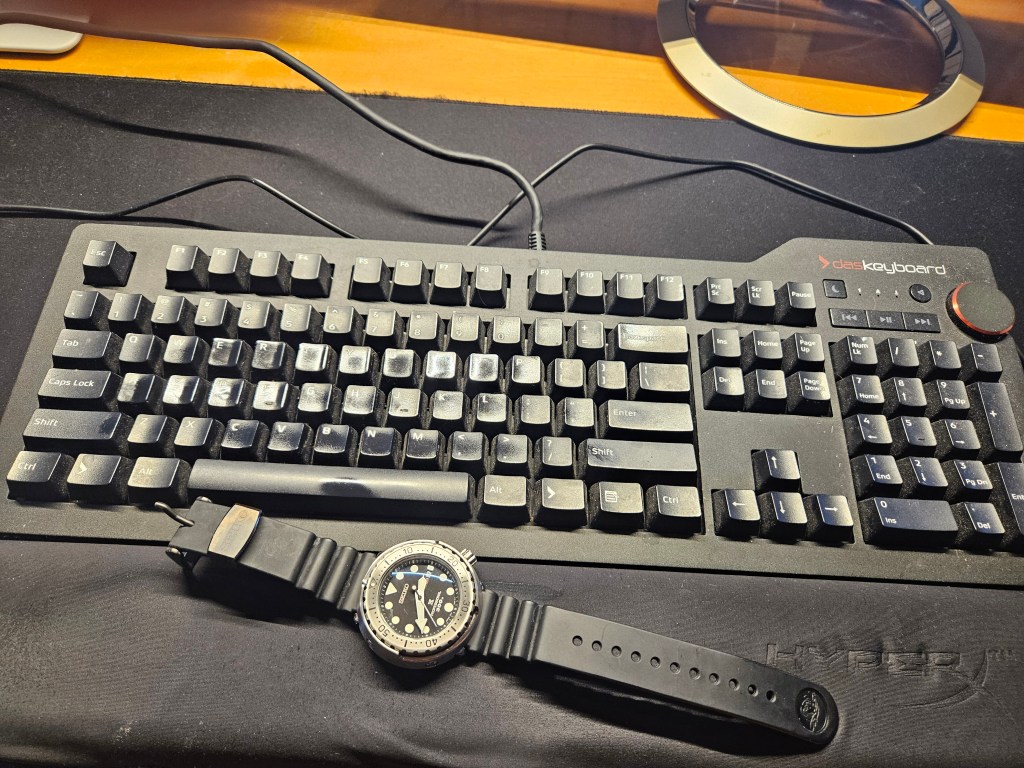
    For over a decade, my YouTube channel orbited around my watch obsession. That obsession gradually narrowed until it became monastic—just diver watches, all on straps. I convinced myself that a collection larger than seven would doom me to spiritual ruin. I also stopped flipping watches like a Wall Street day trader, deciding it was bad for my mental health. That slowdown siphoned the manic energy that used to fuel my videos. The creative rush didn’t vanish—it simply rerouted into blog posts about my newest fixation: alignment. Or more precisely, misalignment.

    Because if I’m honest, I feel increasingly out of sync with the modern world. I adapt to new technology at the pace of continental drift. TikTok bewilders me. Smartphones offend my thumbs. Driving at night now feels like a scene from Apocalypse Now. My relevance, visibility, and patience are fading in a culture that worships youth and touchscreens.

    My anxieties about self-worth and mortality are now on the front burner, while watch collecting—the “Watch Potency Principle,” the “wrist-rotation anxiety”—has been moved to the back burner where it is simmering to a lukewarm stew.

    To illustrate my current state: two weeks ago, I bought a new LG OLED TV, which was fine—until I broke two Samsungs in one day trying to move them. I manhandled the first 55-inch like it was a kettlebell, frying half its pixels in a single jerk. Then I jammed my thumb straight through the second screen while relocating it from my daughter’s room. My wife, the household adult, had to carry the new Roku replacement into our bedroom as I stood there looking like a Neanderthal who’d just discovered electricity—and promptly electrocuted himself.

    My war with technology didn’t end there. The new garage door opener came with instructions written in a dialect of cruel mockery. The installer vanished without explaining how to sync it with my phone, so my wife once again had to step in and figure it out. Now I open the garage door through an app, and every time I hear the alert that the door is moving, I step back in awe—half-terrified, half-mesmerized—like a caveman who’s just invented fire.

    I feel both too old for this world and too infantile to function in it. A man-baby marveling at his gadgets, bewildered by his own house. Think about that. My house has become a museum for technology of the future while I wander through it like a mesmerized tourist. My mouth is agape and my daughters say to me, “Relax, Dad, this is our house.” I respond by saying, “No it’s not. It’s a museum of strange and wonderful things that I don’t know how to use.” 

    These are the moments that give me content for my blog Cinemorphosis. I post almost daily, while it takes me weeks to metabolize these experiences into something coherent enough for a video essay. Writing helps me think; filming helps me pretend I’m still current.

    So that’s my current state of affairs. This channel used to be State of the Watch Collection. Now it’s more like State of the Man Who Can’t Sync His Garage Door Opener.

  • The Eight Ages of –ification

    The Eight Ages of –ification

    From Conformification to Enshittification: how every decade found a fresh way to ruin itself.


    The Age of Decline, Accelerated

    In Enshittification, Cory Doctorow argues that our decline isn’t gradual—it’s accelerating. Everything is turning to crap simultaneously, like civilization performing a synchronized swan dive into the sewer.

    The book’s subtitle, Why Everything Suddenly Got Worse and What to Do About It, suggests that degradation is now both universal and, somehow, fixable.

    Doctorow isn’t the first prophet to glimpse the digital abyss. Jaron Lanier, Jonathan Haidt, and other cultural Cassandras have long warned about the stupidification that comes from living inside the algorithmic aquarium. We swim in the same recycled sludge of dopamine and outrage, growing ever duller while congratulating ourselves on being “connected.”

    This numbness—the ethical anesthesia of the online age—makes us tolerate more crappiness from our corporate overlords. As the platforms enshittify, we invent our own little coping rituals. Some of us chant words with –ion suffixes as if they were incantations, linguistic ASMR to soothe our digital despair.

    When I saw Ozempic and ChatGPT promising frictionless perfection—weight loss without effort, prose without struggle—I coined Ozempification: the blissful surrender of self-agency to the cult of convenience.

    Now there’s an entire liturgy of –ifications, each describing a new layer of rot:


    • Enshittification — Doctorow’s coinage for the systematic decay of platforms that once worked.
    • Crapification / Encrappification — The transformation of quality into garbage in the name of efficiency.
    • Gamification — Turning life into a perpetual contest of meaningless points and dopamine rewards.
    • Attentionification — Reducing every act of expression to a plea for clicks.
    • Misinformationfication — When truth becomes a casualty of virality.
    • Ozempification — Replacing effort with optimization until we resemble our own avatars.
    • Stupidification — The great numbing: scrolling ourselves into idiocy while our neurons beg for mercy.

    But the crown jewel of this lexicon remains Enshittification—Doctorow’s diagnosis so precise that the American Dialect Society crowned it Word of the Year for 2023.

    Still, I’d like to push back on Doctorow’s suggestion that our current malaise is unique. Yes, technology accelerates decay, but each era has had its own pathology—its signature form of cultural rot. We’ve been creatively self-destructing for decades.

    So, let’s place Enshittification in historical context. Behold The Eight Ages of –ification: a timeline of civilization’s greatest hits in decline.


    1950s — Conformification

    The age of white fences and beige minds. America sold sameness as safety. Individuality was ironed flat, and television became the nation’s priest. Conformification is the fantasy that security comes from imitation—a tranquilized suburbia of identical dreams in identical ranch homes.


    1960s — Psychedelification

    When rebellion became transcendence through chemistry. Psychedelification was the belief that consciousness expansion could topple empires, if only the colors were bright enough. The result: self-absorption in tie-dye and the illusion that enlightenment could be mass-produced.


    1970s — Lustification

    A Freudian carnival of polyester and pelvic thrusts. From Deep Throat to Studio 54, desire was liberation and the body was both altar and marketplace. Lustification crowned pleasure as the last remaining ideology.


    1980s — Greedification

    When morality was replaced by market share. The decade baptized ambition in champagne and cocaine. Greedification is the conviction that money cleanses sin and that a Rolex can double as a rosary.


    1990s — Ironification

    The decade of smirks. Sincerity was cringe; irony was armor. Ironification made detachment the new intelligence: nothing believed, everything quoted, and feelings outsourced to sarcasm.


    2000s — Digitification

    Humanity uploaded itself. Digitification was the mass migration to the screen—the decade of Facebook envy, email anxiety, and dopamine disguised as connection. We stopped remembering and started refreshing.


    2010s — Influencification

    When everyone became a brand. Influencification turned authenticity into a business model and experience into content. The self became a product to be optimized for engagement.


    2020s — Enshittification

    Doctorow’s masterstroke: the final form of digital decay. Enshittification is what happens when every system optimizes for extraction—when user, worker, and platform all drown in the same algorithmic tar pit. It’s the exhaustion of meaning itself, disguised as progress.


    Epilogue: The 2030s — Reification

    If trends continue, we’ll soon enter Reification: a desperate attempt to make the unreal feel real again. After decades of filters, feeds, and frictionless fakery, we’ll long for something tangible—until, inevitably, we commodify that too.

    History repeats itself—only this time with better Wi-Fi.

  • Why I’m Breaking Up with the YouTube Feed

    Why I’m Breaking Up with the YouTube Feed

    When I open YouTube, my homepage looks like a digital gladiator pit. Comedians, podcasters, and fitness influencers are constantly “dunking on,” “roasting,” or “destroying” one another. The algorithm assumes I crave conflict like a Roman spectator—hungry for outrage, giddy for blood. It’s pathetic, really. My only objection today is a simple one: stop turning my comedians into content. They’ve long been the high priests of outrage, transmuting it into gold through timing, irony, and a killer punchline. Outrage used to be an art form, not a business model.

    But comedy has competition now. For the past decade, social media has been strip-mining outrage for clicks. Unlike comedians, who craft original points of view and occasionally elevate our spirits, the algorithm slaps together cheap dopamine with a glue gun—strawman fallacies, emotional bait, polarization, and tribal garbage—all to keep us doom-scrolling through the sludge.

    Comedians once showed us our shared absurdity. Algorithms show us our mutual contempt. That’s not progress; that’s spiritual rot. I fear that as AI devours art and originality, comedians may go the way of Paul Bunyan—felled not by fatigue but by the chainsaw of automation.

    Maybe I should reprogram my feed with videos of pandas hugging ducklings. But swapping venom for saccharine isn’t redemption; it’s sedation. Better to log off entirely, read a book, or at least choose what I watch. For now, YouTube feels like poison—delivered daily, in high definition.

  • Caveman Meets Garage App

    Caveman Meets Garage App

    In March 2005, at 43, I was besotted with my Classic iPod and its holy clickwheel. It took a minute to learn how to tether it to desktop iTunes and wrangle my playlists (mostly podcasts), but I did it without pestering my wife, and I was proud. A newer iPod arrived soon after; I refused to learn its tricks. Once I master a gadget, it becomes my comfort zone—I’d rather live there than relocate.

    I listened to podcasts all night and during post-workout naps. My life felt archived in that iPod, which—ridiculously, wonderfully—made me feel plugged into the modern world.
    My wife, less sentimental, declared it obsolete. The future was smartphones. I recoiled. They looked like bricks of chaos—apps, updates, notifications—houseplants with demands, only worse because I had to squint at ant-sized text.

    By 2014, I still clung to the iPod. It wasn’t cheap loyalty: the headphone jack snapped about once a year, and I’d pay $70 at the local shop to resurrect it. Then September 2014 arrived, our twin daughters started preschool, and my wife insisted I get a smartphone—for school runs, doctor visits, playdates. Texting was essential; parenthood demanded it.

    So I pried my fingers off the fossil and bought a Galaxy S4 at Costco. To my surprise, downloading podcasts was blissfully easy. As a podcast machine, the phone was a star. Everything else? Lame. I hated watching tiny videos, reading tiny text, and spelunking for apps. The phone became a super-iPod; the rest of its features were just extra chaos. Texting was torture—my fat fingers whacked the wrong letters, and I backspaced my way through tedium. I barely used the thing except for podcasts. My wife envied my perpetually 90% battery; to console her, I’d brag that after an all-night podcast binge I dropped to a shocking 80%.

    Yes, smartphones are addiction machines that track, nudge, and strip privacy. True. But I only use a sliver of their powers because the tactile experience annoys me.

    Part of me resents the smartphone for killing the rotary landline. That dial’s ratcheting click felt like reciting a secret code to open a cave. Beige, avocado, mint green, custard—those phones had heft that implied quality, with long, flexible cords that snaked across the room. Conversations were events; an ear would grow tender and force the ritual mid-call ear swap. Now the landline is dead—and so, largely, are conversations, replaced by texts and emojis. Speed and convenience exacted their toll: degraded communication, which means degraded friendships.

    Cory Doctorow gave us enshittification—how tech optimizes itself into garbage. I’d love to say that’s why I resist. But that’s too pat. I’m simply slow to adapt. Incompetent with new tools. My memory refuses the steps; I have to re-teach myself, again and again.

    Recently, my wife synced my phone to our garage door. A week later, I tapped the app and watched the door rise, gawking like a caveman who just discovered fire and is already imagining a barbecued brontosaurus rack. It’s a good trick. I still keep Genie remotes in the house and car as backups, but the phone option is lovely. This isn’t enshittification; it’s the opposite—unsuckification. Some things that used to suck don’t have to anymore.

    In fact, I’m eager for toilet + AI matrimony: a throne that reads biomarkers, prescribes medication, screens like a colonoscopy, and spares me the waiting room. I’m also rooting for a custom GLP-1 patch that recalibrates appetite so a morning bowl of porridge with protein powder—and another in the late afternoon—actually sates me. Easy weight management, better markers, minimal dishes.

    All of this is part of the unsuckification project.

    I’ll admit it: I’m older, I resist change, and new tech gives me a headache. But if modern tech can spare me a colonoscopy, open heart surgery, and the indignities of being twenty pounds overweight, then sign me up. 

  • Comparison Is the Mother of Misery

    Comparison Is the Mother of Misery

    The mother of misery is comparison. In fourth grade I plunged into despair because I couldn’t draw like Joseph Schidelman, the illustrator of Charlie and the Chocolate Factory. About the same time, baseball humbled me: my bat speed wasn’t in the same galaxy as Willie Mays, Dick Allen, or Henry Aaron. In my teenage bodybuilding years, I had muscles, but nothing like that of Arnold Schwarzenegger, Sergio Oliva, and Frank Zane; I wisely retired the fantasy of becoming Mr. Universe and managing a gym in the Bahamas. In college, as an aspiring intellectual, I flogged myself for lacking Vladimir Nabokov’s wit and velocity. My chances of becoming a famous novelist were equal to my odds of winning Mr. Olympia. Later, when I flirted with composing and singing, I heard Jeff Buckley’s soul pour through the speakers and realized my voice would mainly trigger a neighborhood dog-barking contest and a chorus of angry neighbors. Decades passed. My classroom persona faced a generation handcuffed to smartphones and ChatGPT. I scrambled for “edutainment” tricks to dodge irrelevance, but the gap widened no matter how I danced.

    The sting doubled when I watched Earthquake (Nathaniel Stroman) flatten an audience with a preacher’s cadence and bulletproof wisdom. His special Joke Telling Business left me muttering, “If I had Earthquake’s power, I could resuscitate my teaching career and stroll into old age with a shred of dignity.”

    Meanwhile, fresh incompetencies arrived like junk mail. I broke two Samsung TVs in one day. I failed to sync my new garage door opener to my phone. My wife had to rescue me from my own maladroit tech spiral. The result was predictable: I was condemned to the Shame Dungeon.

    Down in the basement of depression, I noticed another casualty: my YouTube channel. I usually post once a week and have for over a decade—mostly about my obsession with diver watches. But as sanity demanded I stop flipping watches, I ran out of new divers to discuss. I tried pivoting—open with a little watch talk, then segue to a wry misadventure with a morsel of human insight. If I nailed the landing, I’d get a few thousand views and enough comment energy to believe the enterprise mattered.

    But with my sixty-fourth birthday closing in, the doubts got loud. I don’t want to do “watch talk,” and I’m too mortified to perform a perky, self-deprecating monologue about my misalignment with the universe.

    I keep hearing Mike Birbiglia in my head: you must process your material before you present it; the set has to be a gift, not your live catharsis. The healing happens before you step onstage. You speak from the far shore, not mid-drowning. Otherwise, you’re asking the audience to be your therapist.

    So I’m stuck at a fork: Will this current fear and anxiety about age and disconnection pass through the refinery of my psyche and emerge as something worthy? Or will I remain in the Shame Dungeon, comparing myself to Earthquake, and decide that with talent like his prowling the earth, my best move is to hide under a rock?

    Here’s the dilemma plain: Hiding isn’t viable; it starves the soul. But serving the world a plate of unprocessed mediocrity is just as unforgivable. If I’m going to tell a story about breaking two TVs and my garage-opener meltdown, I have to deliver it with Earthquake’s power and confidence. Otherwise I’ll stay home, mope on the couch, and binge crime documentaries—losing myself in bigger, cleaner tragedies than my own.

  • Aunt Gladys from Weapons Needs 10 Hours

    Aunt Gladys from Weapons Needs 10 Hours

    Zach Cregger’s Weapons gets a lot right for a two-hour horror film. Its humor lands in the smallest places: those casual, cliché-soaked conversations that turn darkly funny once a community realizes seventeen children are missing.

    Then there’s the film’s grotesque lodestar—Amy Madigan’s Aunt Gladys—a magnificently vile parasite who embodies the loser-relative archetype: the houseguest who arrives “for a few days,” never leaves, and drinks your sanity like it’s iced tea. Madigan plays her as equal parts mildew and menace.

    But two hours isn’t enough runway. The world Cregger sketches begs for a longer canvas. I kept thinking of the HBO series The Leftovers, Tom Perrotta’s grief-haunted universe that needed several episodes to breathe. Weapons feels like it wants ten one-hour episodes—time for Gladys to poison the neighborhood vein by vein, and for the side characters to develop from silhouettes into people you’d fight for.

    As a feature, it’s an elegant appetizer—canapés and olives—when the material is crying out for a slow, unhurried feast.

  • Ankle Tax at Trader Joe’s

    Ankle Tax at Trader Joe’s

    This morning at Trader Joe’s, I stood at the register while the ever-friendly cashier confessed his unhealthy vaping habit and his plan to someday go raw vegan, and a helper slid my groceries into bags with assembly-line grace. That’s when a woman in her early fifties barrel-rolled a full shopping cart into my flank, the metal edge skinning my bare ankle. She tossed out an apology through a forced smile, then bolted—out the doors, groceries into her Lexus, and gone. I was less offended by the scuff than by the performance: self-centered phoniness wrapped in a grin.

    I hadn’t had an ankle scraped on a grocery run in at least a decade, back when I still braved the Torrance Costco, a gladiator pit where “shoppers” behaved like extras from The Hunger Games. I migrated to Trader Joe’s for its cozier, laid-back vibe. But this morning offered a nudge from reality: the place isn’t a bucolic paradise—it’s still frenzied commerce, and sometimes the receipt includes a mark on your ankle.

    So yes, Trader Joe’s is friendlier—just budget for the occasional Ankle Tax at checkout, payable in skin, not cash.

  • The Sycophant Parade That Followed Charlie Sheen

    The Sycophant Parade That Followed Charlie Sheen

    I’ve got nothing against Charlie Sheen, which makes it stranger that I’ve never actually seen him act. Not a single episode of Two and a Half Men. Not one Charlie Sheen film. When I see his face, I think of a sensibility I avoid on sight: handsome, cute, smarmy—smirk plus wink. That brand of humor feels predictable and annoying. And yes, I admit the obvious contradiction: since I’ve never watched him, I can’t swear the schtick is real. Call it intuition—enough to keep me away.

    What did reach me was the public meltdown—what I remember as the “Tiger Blood Tour”—where addiction didn’t deliver humility but its opposite: bluster so loud it became a punchline. 

    So out of mild curiosity I watched the two-episode docuseries aka Charlie Sheen, and left neither admiring nor loathing him. Mostly, I felt sad—for him and for his family—because he seemed to have no guardrails, no one capable of stopping the wrecking ball before it knocked down everyone nearby.

    The most disturbing part isn’t Sheen; it’s the swarm. The morally bankrupt enablers, the sycophants, the fans who latch onto his fame and power as he self-destructs. At peak collapse they fed on the trainwreck like zombies on a buffet line, dressing in his party uniform, cheering as he staggered on and off private jets, becoming an intoxicated parody of himself. Love? Concern? Not in evidence. The meltdown was entertainment—an addictive feast for empty lives. My biggest challenge watching wasn’t parsing Sheen; it was resisting misanthropy.

    There is, thankfully, a pulse of humanity. Sean Penn, a childhood friend, offers wise, sobering context about Sheen’s volatility; so do Terry Todd and Sheen’s older brother Ramon Estevez. But watching Sheen narrate himself from a diner in Hawthorne, California is only partially satisfying. The charm flickers, the unease shows, yet the self-analysis feels shallow—short on the rigorous introspection required to grapple with the demons that keep derailing him.

    I left with the sense that his family and friends have been doing the heavy lifting for years—like he hasn’t had one life coach but several dozen—while he sits in a booth, reminiscing about the agony of being an artistic genius with impulses mere mortals can’t grasp. Whatever sobriety he’s achieved, he still reads as weakened and impoverished by the same consuming egotism that keeps baring its fangs.