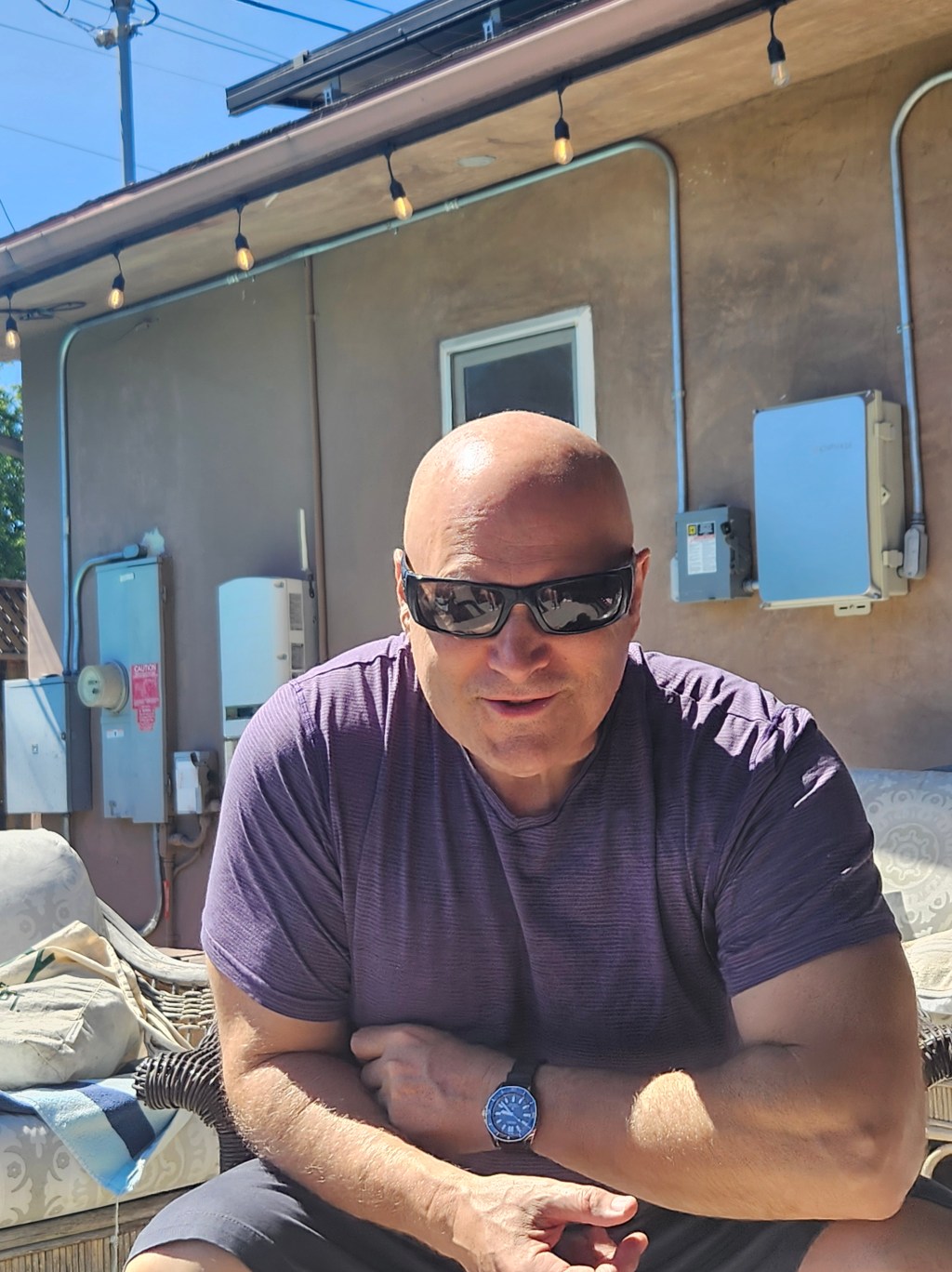
Author: Jeffrey McMahon

  • Tooter Turtle Goes to Gold’s Gym

    Tooter Turtle Goes to Gold’s Gym

    When you’re old, you burn daylight running stupid counterfactuals. Forty years of teaching college writing and now I mutter to myself, “You were never meant to be a professor. You were meant to be a personal trainer.” This fantasy is less revelation than acid reflux—I can’t keep it down no matter how hard I try.

    But let’s be honest about the personal trainer gig. Path A: you scrape together rent money coaching half-motivated clients through limp triceps pushdowns while they whine about kale. Path B: you cater to narcissistic celebrities who want you to count their lunges in a whisper, until their self-absorption has hollowed you out like a dry coconut.

    In this farce, I’m no different than Tooter Turtle, that cartoon sad sack from my childhood. Every week he begged Mr. Wizard to reinvent him as a lumberjack, a detective, a gladiator, a football star. And every week he proved that no matter how much you change the costume, you can’t change the pratfall. His new career always ended in humiliation, panic, and the desperate cry: “Help me, Mr. Wizard!”

    That’s us: eternal college freshmen, forever switching majors, convinced that the next “out there” will be our deliverance. But when the magic portal opens, we loathe ourselves for asking.

    Me, a personal trainer? Please. Within a week I’d be rolling my eyes at clients’ flabby excuses, pawning my kettlebells to cover insurance premiums I don’t have, and slinging creatine tubs from the trunk of my Honda. I wouldn’t be a coach—I’d be a sidewalk prophet of six-pack abs, half-broke, half-starved, and wholly ridiculous.

    Punchline: In short, I’d be Tooter Turtle in gym shorts—begging Mr. Wizard to zap me back to the classroom, where at least the only thing I’m destroying is a freshman’s thesis statement.

  • Religion Is No Kevlar Vest Against the Fear of Death

    Religion Is No Kevlar Vest Against the Fear of Death

    My mother’s people were Ashkenazi Jews from Poland; my father’s, Roman Catholics from Scotland and Ireland. Yet both treated religion like a dusty attic trunk filled with moth-eaten lace. When a TV preacher with the face of a sour prune croaked on about sin, my parents would smirk, as if watching a vaudeville relic wheeze out his final act.

    I wasn’t so quick to sneer. At Castro Valley High, a white-haired Mrs. Hanson, seventy if a day, handed us the Book of Job, and I was caught like a fish. God, suffering, celestial wagers—it was grotesque, terrifying, delicious. I’d drive my Ford Maverick to the gym, sunrays slicing through storm clouds, and briefly imagine a divine presence scanning my biceps. I didn’t know biblical doctrine from dog food, but I felt sure there was an afterlife waiting—an enchanting lounge where the velvet ropes always parted. For a short stretch of adolescence, I even stopped fearing death.

    Then came my Christian classmates, thrusting paperback apocalypse manuals into my hands. Rapture. Beasts. Eternal torment. Overnight my buoyant heaven curdled into a horror show where my Jewish relatives burned forever. Some Christians reassured me that such cruelty wasn’t “real Christianity.” But the deeper I read, the more Paul’s letters stood like theological battering rams against Jews who wouldn’t bend the knee. Supersessionism, they called it—a polite term for spiritual eviction.

    The Church Fathers weren’t gentler. Augustine’s take on eternal damnation? Justice, pure and simple. Billions in flames, and he shrugs: they had their chance. Forgive me if I don’t find that a winning sales pitch.

    Which is why I keep returning to Dale Allison’s Night Comes. Barely 200 pages, but packed with the force of a midnight storm. A Christian, Allison treats hell not as a theological curiosity but as a moral obscenity that collapses under its own weight. He doesn’t stitch loopholes into doctrine—he pokes holes until the absurdity gushes out.

    His stories haunt me. His teenage daughter found annihilation worse than hell; she feared nothingness more than flames. His son, in an email of raw honesty, mourned the idea that “the museum of his mind will be closed.” Not death, but the erasure of memory—the bulldozing of everything tender and beloved—that was the real terror.

    As a teen I believed our cherished moments had permanent residence in some cosmic vault. Allison doesn’t smash that hope, but he makes it more fragile, more complicated. He notes—accurately, grimly—that saints and mystics, when Death shows up in the doorway, often beg and claw like the rest of us. Religious devotion, it seems, is no Kevlar vest.

    And so, in old age, I sit with a religious ambivalence as stubborn as arthritis: no doctrine, no creed, no “blessed assurance” makes the thought of extinction less ghastly. Maybe the fear of death is not a flaw to be cured but a mirror—one that forces us to stop pretending we’re eternal and finally face the finite with our eyes wide open.

  • The Clown in the Rain

    The Clown in the Rain

    It was the late ’60s, and my father and I were swept along with the crowd exiting a circus in San Jose. Rain poured hard and steady, the kind that flattens hair and soaks shoes in minutes. In the chaos of umbrellas and slick pavement, I spotted him—Hocus Pocus, the Bay Area’s clown celebrity, wandering alone through the parking lot.

    His makeup was smudged by the weather, his wig drooping, his posture sagging as though the downpour had stripped him of performance energy. He looked less like a jester than a man burdened by his own melancholy, trudging through puddles without hurry. Then his eyes flicked toward me. For a brief moment, he shook off the fog around him, managed a weary smile, and pulled from his pocket an autographed photograph. He handed it to me silently, a token from a man who seemed at once broken and kind.

    What I remember most is his expression—resigned to sadness, yet somehow still present enough to gift a child a sliver of joy. The photo, worn at the corners, became a reminder that even in rain-soaked despair, generosity can find its way through.

  • Old Age and Father Time’s Frenemies

    Old Age and Father Time’s Frenemies

    I often think back to the summer of 2019 when my wife and twin daughters were vacationing in Maui. There, on the beach, I spotted a short, compact man in his mid-seventies parading around in dark-blue Speedos with a woman at least fifty years his junior — a striking Mediterranean beauty in her twenties. The guy was trim, well-manscaped, scampering confidently on the sand like a millionaire who spends half his life in boardrooms and the other half trying to outrun the Grim Reaper. He dove into the waves with the vigor of someone convinced that as long as he keeps moving, Father Time can’t catch him.

    You could smell the wealth on him. He was probably a CEO with a portfolio big enough to buy the illusion of eternal youth. He worked hard and played harder, to borrow Hugh Hefner’s mantra. Now, I’m not here to pass moral judgment on a man who chooses a partner young enough to be his granddaughter — that’s his business. What fascinates me is the fantasy: money, discipline, and a little manscaping used as talismans against aging, as if youth were a rare potion you could sip to stay forever young.

    The whole tableau, though, felt wrong. He and his youthful companion were mismatched puzzle pieces jammed together by brute will. It was as if two jagged halves of a broken mirror had been glued into place; every forced smile and awkward embrace chipped another sliver off, until all that remained was a pile of glittering shards — the perfect image for the futility of trying to cheat time.

    This rich, fit man is Father Time’s frenemy — the one who insists they’re on friendly terms while secretly plotting a hostile takeover. He may have sold himself a “perfect picture,” but the public sees the mismatch as plainly as a traffic cone in a tuxedo. The spectacle exposes his poverty: an inability to relinquish something that no longer belongs to him, a clinging to youth that reveals fear rather than confidence. That fear, in turn, sabotages his aspiration to curate an enviable life; the attempt to perform eternal youth only underlines the loss he refuses to admit.

    I’m reminded, uncomfortably, of Joe Ferraro from Netflix’s Mafia: Most Wanted. Born in Ecuador in 1962 and raised in Toronto, Ferraro turned to bodybuilding, gambling, and organized crime as a teenager, hungry for money, women, clothes, and respect. He got it all — a Rolex Daytona, gold necklaces, designer sunglasses large enough to require their own zip code — until seven months in prison and eventual deportation stripped him of his infrastructure. In his sixties, he’s a sculpted caricature: tank top, ostentatious sport coat draped like a cape, and penetrating melancholy eyes that reveal he knows the score. He says he wants his life back, but knows he’s too old for the young man’s game and can’t look away from it.

    Both the rich man in Maui and Ferraro in exile put me in mind of Lot’s wife. They cannot relinquish the lifestyle that defines them; youth is their identity, and the thought of being disconnected from it registers as a kind of death. Unable to let go, they calcify into pillars of salt — frozen monuments to a self that no longer exists.

  • The Intruder from the Cypress Gloom

    The Intruder from the Cypress Gloom

    Sometimes you hear stories of horror and the supernatural, and you don’t know what to do with them, especially if the person telling the story seems sane and credible. As a result, the story lingers and haunts you for all your life. For example, I’ve never forgotten a story one of my college students told me back in the fall of 1998. She was a re-entry student—a nurse in her early forties—juggling coursework at UCLA with overnight hospital shifts. The kind of woman who sticks in your memory: short, sturdy, glasses perched low on her nose, with the weary, perceptive eyes of someone who’d seen too much and lips that knew how to pace a punchline.

    Most afternoons, after class let out, she’d linger by my desk and recount episodes from her Louisiana backwoods childhood or from the fluorescent netherworld of her hospital’s VIP wing. Her stories ricocheted between absurdity and horror—tales told with the calm authority of someone who could handle arterial spray with one hand and chart notes with the other.

    But one story gripped me by the spine and never let go. It wasn’t about dying celebrities or ER gore. It was about something far worse. A visitation. A monster.

    She and her cousin Carmen were feral children, raised in the lawless heat of rural Louisiana, where school attendance was optional and adult supervision was more myth than fact. Left to their own devices, the two girls invented what she called “mean games”—they tortured frogs, pulled wings off insects, and hinted at darker cruelties she refused to name. Lord of the Flies in sundresses.

    And then one afternoon, the visitor arrived.

    They were holed up in a decaying house, conspiring over their next cruelty, when the porch door creaked open and something stepped inside. It looked like a man. But it wasn’t. Over six feet tall, it had a tail—thick, muscled, and disturbingly animate. It moved with a will of its own, curling and flicking behind him like a fleshy metronome. His body was bristled with wiry hair. His voice? Low, hoarse, and calm in the most terrifying way. He didn’t threaten. He simply listed.

    Sitting in a rocking chair, the creature, a sort of rat-man, described, in brutal detail, everything the girls had done—every frog mutilated, every insect dissected. Nothing vague. He named the acts like he had them on file. And then he made his offer: Keep going, he said, and I’ll recruit you.

    He stayed for three hours. Just sat there. Breathing. Flicking that tail. Describing their path toward damnation with the steady tone of a bureaucrat explaining retirement benefits. When he finally left, dissolving into the heat shimmer of the Louisiana dusk, the girls were too stunned to move. Carmen whispered, “Did you see that?” My student just nodded.

    They never spoke of it again. But they changed. Overnight. Sunday school. Prayer. Kindness, enforced not by conscience but by fear. The kind that settles in your bones and never leaves. Whatever that thing was, it did its job.

    And this is the part that haunts me: she wasn’t a kook. She wasn’t mystical, manic, or given to exaggeration. She was a nurse—clear-eyed, grounded, more familiar with death than most people are with taxes. She wasn’t telling a ghost story. She was giving a deposition.

    To this day, I see those two girls, wide-eyed and paralyzed, staring down a thing that knew them intimately and promised them a future in hell’s apprenticeship program. Whether it was a demon, a shared psychotic break, or some mythological construct formed by childhood guilt and Southern humidity, I don’t know. But I do know what it meant.

    The creature’s message was brutal in its simplicity: Keep practicing cruelty, and you’ll lose the ability to stop. You’ll become it.

    That’s not just folklore. That’s biblical. The idea that if you repeat your wickedness long enough, God—or whatever you believe in—stops interrupting you. He doesn’t smite you. He simply steps aside and says, Go ahead. This is the life you’ve chosen.

    No wonder Kierkegaard was obsessed with working out your salvation with fear and trembling. There’s nothing more terrifying than the idea that damnation is self-inflicted, not by a thunderbolt, but by repetition. That the road to hell is paved with muscle memory.

  • Zosia Mamet and My Personal Reading Revival

    Zosia Mamet and My Personal Reading Revival

    It’s rare that I fall in love with books these days, but when it happens, I’m grateful because reading reminds me of my glory days, the early 80s when I consumed books with ferocity, imaginative pleasure, and obligation like a bodybuilder taking protein powder and creatine. Three major factors have curtailed my reading of books: One, I’ve grown so cynical over the years that I’ve come to the belief that 99% of books are in actuality just a short story or essay with padding. An author has an intriguing idea, and they sit down with their agent and cook up a book that is mostly chicanery with a dash of substance. 

    Then three days ago, I heard actor Zosia Mamet talking about her memoir Does This Make Me Funny?, a collection of essays, with KCRW host Sam Sanders, and I was so struck by her depth of wit, intelligence, and moral perspective that I immediately bought her book, or I should say the Kindle eBook version of it. Even more rare than buying books as intellectual property, it is even rarer that I buy a hard copy of something, unless it is a kettlebell training book or a cookbook like Miyoko Schimmer’s The Vegan Creamery

    Getting most of my books on Kindle speaks to the second reason my reading has diminished. The physical act of reading is unpleasant. Holding the book, turning the pages, getting into a comfortable position, attenuating my eyes to the various font sizes. I find the whole thing disconcerting and unpleasant, like trying to figure out the seat positions, buttons, and levers of an unfamiliar car. The most comfortable forms of reading are either sitting at my desktop and reading the Kindle on a 27-inch screen or reading while sitting in bed with a 16-inch laptop.

    The third reason I don’t read as much is that the Internet and its attention economy have fried my brain over the decades. The attention muscles inside my cortex have atrophied to a woeful state. 

    But occasionally a rose grows out of the cracks in the cement sidewalk, and such is the case with Zosia Mamet’s memoir, as witty, deep, self-deprecating, and salient as the author speaking to Sam Sanders three days ago. Reading the memoir is to connect with someone for whom her writing voice and the core of her being are the same. The result is something distinctive and salient, something that recoils and then snaps forward to leave its literary fangs inside you. Isn’t that what writing is supposed to be about? Nabokov was like that. So was Kafka. And so is Zosia Mamet.

    I detest some confectionary celebrity memoir reeking of privilege, superfluousness, and mediocrity. None of that is in Zosia’s collection of essays. 

    As we read in Jancee Dunn’s New York Times article “At Least Zosia Mamet Can Laugh About It,” the core of her book is about her mental, physical, and spiritual health. Coming from a family that is deeply entrenched in literature and the arts is a double-edged sword with excruciating pressure to live up to superhuman expectations causing Zosia’s thorn in her side to be the constant sense that she is falling abysmally short. 

    Like the best comedia, she opts out of self-pity for humor as she does a deep dive into her anxiety, depression, body dysmorphia, anorexia, and anhedonia, and all the self-destructive behaviors she succumbed to in order to overcome these afflictions. Because she knows that body dysmorphia is a delusion that hijacks her brain, she says about herself: “I am often an unreliable narrator of my own reality.” 

    Which in a nutshell is the human condition: Can we trust ourselves or are we getting duped by our own fake narrative? 

    What tools from our emotional toolbox can we use to be more reliable? Perhaps comedy is one of them. Think of our irrational states: overcome by maudlin self-pity, vanity, and grandiosity, we spin grotesque narratives about ourselves that compel us to behave in ways that are ridiculous and often result in self-sabotage. Perhaps comedy is the antidote. Perhaps comedy distances us from our preposterous self-mythology and helps us in the arduous process of self-reinvention. That’s the sense I’m getting from Zosia Mamet’s very necessary book, a book that has no padding at all but has been made from a brilliant mind with blood, sweat, and tears. 

  • Last Car Syndrome

    Last Car Syndrome

    I was nearly sixty-four, four decades of teaching college writing having corroded whatever patience I once had, and I found myself drowning in self-disgust. My life, once measured in lectures and essays, had narrowed to a single, grotesque question: Camry or Accord? I fretted over it as if I were choosing a confession—Catholic or Presbyterian—with my eternal soul dangling over the dealership lot. The absurdity didn’t escape me. I had real problems: blood markers creeping upward, a rotator-cuff tear ruining kettlebell workouts, bedrooms that needed painting, twin daughters who needed driver’s training, retirement forms stacked like little gravestones, and the scramble to joint bank accounts so my younger wife wouldn’t face probate nightmares. And yet I could not stop watching YouTube reviews and refreshing Reddit threads that compared the new Camry to the Accord.

    I vacillated like a madman.

    Driving to pick up the girls from high school, I’d spot an Accord and sigh: “Ah, the Accord EX-L in Canyon River Blue. Very peaceful. Not a bad car to die in.” A second voice—practical, bored—would snap back, “It’s a car, not a coffin, dummy!” So I’d argue with myself: “But this will be the last car I ever buy. Surely it is my Death Car.” “God, you’re morbid! How can I live with you? Get away from me!”

    The next day I’d see a Camry SE in Heavy Metal and melt. “Look how it fits that color—everything’s right. Under thirty-three K and it feels Lexus-adjacent.” My inner realist would applaud the improvement: “At least you’re not talking about death. Progress.” Then the skeptic: “But the Accord is quieter. I need quiet. And the Accord dealership is walking distance—drop it off, walk home. That’s handy.” Followed by doubt: “Wait—people say the new Accord looks like a Ford Taurus. Can I live with that kind of ridicule?”

    It went on and on. My wife learned to read my posture: the slight slump, the hand rubbing the back of my neck—the tell that I was about to launch into Camry-Accord hell. She would cut me off before I even opened my mouth: “Stop right there, buster. I don’t want to hear it. Just make your damn decision!”

    For a while I wallowed alone in the torment.

    Then one morning I woke up and declared I didn’t need a car at all. I’d driven, on average, three thousand miles a year for the last decade—hardly the mileage of a man who needed a shiny new vehicle. The decision felt radical: my daughters could take the older Accord, my wife the newer one, and I’d borrow a car when necessary. No purchase. No shiny new vehicle gathering dust like a suburban reliquary in the garage. Why buy something to admire between piano practice and Netflix binges? I told myself the choice was genius. 

    But after snacking on a virtuous bowl of buckwheat groats with unsweetened soy milk, banana slices, pumpkin seeds, cinnamon, and a dash of manuka honey, the energizing snack snapped me out of my delusion.. Suddenly the whole farce of my deliberation looked naked: I was suffering from Last-Car Syndrome: the unconscious understanding that in my mid-sixties, my next car purchase was essentially my Death Car, so I avoided the purchase like I avoided death. 

    Fortified by my power breakfast, I stood up, chest puffed like a man claiming moral clarity, and barked at the ceiling, “Who am I kidding? I’m buying a new car. I deserve it.”
    So now it’s only a scheduling question—six months from now, or next week.

  • The Villages Killed My Florida Dream

    The Villages Killed My Florida Dream

    Recently I dreamed I was in a public park. The grass was cartoonishly green, a kind of chlorophyll utopia, and families sprawled across it like they’d been carefully arranged for a Chamber of Commerce brochure. My suitcase sat at my side like a misplaced airport refugee, and then I looked up.

    Looming above the park was a billboard—a monstrosity of sun-bleached cheer—featuring a leathery couple in their seventies. They were bronzed like overcooked turkeys, grinning wide, basking in the eternal glow of some Florida condo where “Margaritaville” played on an endless loop. This was not their first rodeo: it was their fifth marriage each, the residue of decades spent riding the carousel of lust, liquor, and litigation. Their message was plastered across the sky: hedonism may lead to divorce court, bankruptcy, and sun-damaged skin, but look—if you just keep grinning, it’s practically a lifestyle brand.

    I felt an almost religious revulsion at the billboard. It was hollow cheer dressed up as wisdom, a glossy ad for despair masquerading as joie de vivre. Pulling my luggage closer, I glanced at my watch and felt relief that my wife and daughters would be joining me soon. The counterfeit joy overhead only made me hunger more for the real life that I have.

    The “Margaritaville” billboard—two geriatric smiles frozen in sunlit rapture—reminded me I’d been meaning to watch Some Kind of Heaven, the documentary about The Villages, that gargantuan playground-for-the-aged about forty-five miles from Orlando. If synchronized water ballet to Neil Sedaka and margarita-fueled Parrothead parties sounds like paradise, The Villages will sell you heaven with a tiki umbrella on top. For anyone with taste, patience, or shame, it reads more like an early-onset hell: a tropical gulag where you pay staff to micromanage your leisure until even leisure looks like a job interview.

    The film’s most magnetic human mess is Dennis Dean—an eighty-one-year-old small-time grifter wanted for a DUI in California, living out of a blue van on the edge of The Villages and scheming his way into the bed of a rich widow. He prowls bingo halls and church socials with the persistence of a con man who’s practiced charm until it’s fossilized. When police finally close in, Dennis slips back into Nancy’s apartment and in a scene that sticks with you he lies on her bed while she calls from the kitchen: “Lunch!” He doesn’t move. He stares at the ceiling fan as if it’s a slow, merciless clock—and you can see, plain as day, that comfort can be prison for someone whose last liberty was earned by deceit.

    The director never sneers at the subjects. Pain and longing are shown with a kind of blunt respect. But the portrait of The Villages itself isn’t charitable: it’s a retirement complex caught mid-regression, a carnival mirror that reflects geriatrics clinging to perpetual adolescence until the spectacle curdles into something queasy and cringe-worthy. The architecture of fun—shuffleboard courts, themed parties, and scheduled joy—becomes a machine that demands you perform your own amusement. It’s not freedom; it’s occupation by leisure.

    And yes, I realized, sitting there with my pride intact and my Florida fantasies suddenly damp, that watching this must have been my wife’s brilliant little psy-ops. For a year I’d been nagging her about moving the family to Florida—stilt houses, salt air, a hammock with my name on it. Some Kind of Heaven demolished the fantasy with water ballet and sedated margaritas. The obsession evaporated. Apparently, all it took was Neil Sedaka and a ceiling-fan stare.

  • When It Comes to Swim Trunks the Size of a Hotel Mint, Maybe Opt Out

    When It Comes to Swim Trunks the Size of a Hotel Mint, Maybe Opt Out

    The New York Times article, titled “Skimpy Men’s Swimming Briefs Are Making a Splash,” offers a solemn dispatch from the front lines of GLP-1 drugs, but I would guess that men—having exhausted every form of visible self-optimization—are now expressing their Ozempic-enabled slenderness via tiny, Lycra-clad declarations of status. We’re talking male bikinis, or what I like to call the ego sling.

    Apparently, if you’re dropping $18,000 a year to chemically suppress your appetite and shed your humanity one subcutaneous injection at a time, you deserve the privilege of looking like a Bond villain’s pool boy. I suppose this is the endgame: pay to waste away, then wrap what’s left in a luxury logoed banana peel.

    Luxury underwear companies, never ones to miss a chance to monetize body dysmorphia, are now marketing these second-skin briefs not as mere swimwear, but as power statements. To wear them is to say: “I’ve defeated fat, joy, modesty, and comfort in one fell swoop.”

    I’m almost 64. My aspirations remain high—ideally, I’d like to look like a special-ops operator on vacation in Sardinia. But I know my place. I wear boxer-style swim trunks, the cloth of the pragmatic and the semi-dignified. They’re not exciting, but neither is seeing a sun-leathered septuagenarian adjust a spandex slingshot over a suspicious tan line.

    There’s a difference between being aspirational and being delusional. The former means striving for vitality, strength, and energy. The latter means stuffing yourself into a satirical undergarment and pretending you’re a twenty-two-year-old wide receiver with a sponsorship deal.

    To my fellow older men: sculpt your body like it’s your spiritual obligation—but when it comes to swim briefs the size of a hotel mint, maybe opt out. Not every part of youth is worth reliving. Some of it deserves to be left in the chlorine-stained past, right next to Axe body spray and Ed Hardy tank tops.

  • The Aesthetic Pharmaceutical Complex (a College Essay Prompt)

    The Aesthetic Pharmaceutical Complex (a College Essay Prompt)

    Write a 1,700-word argumentative essay that evaluates this claim: GLP-1 weight-loss drugs (e.g., Ozempic/Wegovy) offer a Faustian bargain–they blunt appetite and deliver rapid results, but at significant cultural, moral, and social costs. Examine whether these drugs simply cure an individual problem or whether they reshape appetite, pleasure, gender and marital dynamics, class inequality, body aesthetics, and personal agency in ways that should alarm us.

    Use Rebecca Johns (“A Diet Writer’s Regrets”), Johann Hari (“A Year on Ozempic…”), Harriet Brown (“The Weight of the Evidence”), Sandra Aamodt (“Why You Can’t Lose Weight on a Diet”), and at least two additional reputable sources of your choice. Address both sides: acknowledge the medical benefits (for diabetes, metabolic disease, disability reduction) while testing the claim that GLP-1s amount to a societal deal with the devil — trading desire, culinary culture, and autonomy for narrow aesthetic and market outcomes.

    Be sure to define terms (e.g., “Faustian bargain,” “GLP-1 drugs,” “body aesthetics”), offer evidence, and include a clear counterargument and rebuttal.


    Five Sample Thesis Statements (with mapping components)

    1. Thesis 1
      GLP-1 drugs are a Faustian bargain: they deliver rapid weight loss and metabolic benefit, but they also erode culinary pleasure, exacerbate social inequality, and replace disciplined habits with pharmaceutical dependence.
    • Mapping: (1) immediate medical and psychological benefits, (2) cultural costs to food and pleasure, (3) social/economic consequences and dependence.
    1. Thesis 2
      While GLP-1 medications can rescue lives in a clinical sense, their mainstreaming industrializes thinness—privileging aesthetics over health, amplifying economic divides, and outsourcing self-control to corporations and prescribers.
    • Mapping: (1) clinical life-saving benefits, (2) commercialization of body aesthetics, (3) economic and ethical fallout.
    1. Thesis 3
      GLP-1 drugs pose an ethical dilemma: they promise to erase cravings and curb addiction, but in doing so they risk flattening human desire, unsettling intimate relationships, and converting a public-health problem into a luxury aesthetic market.
    • Mapping: (1) pharmacological suppression of appetite, (2) impact on relationships and social life, (3) marketization and inequality.
    1. Thesis 4
      The rise of GLP-1s reframes weight management from moral failing to medicalized consumerism—undeniable benefits for some masked by troubling costs: cultural loss, shifting marital dynamics, and a dangerous dependence on biotech fixes.
    • Mapping: (1) medical reframing of obesity, (2) cultural and interpersonal costs, (3) risks of technological dependence.
    1. Thesis 5
      GLP-1 drugs give individuals the power to silence hunger, but that power comes tethered to troubling social outcomes: it amplifies privilege, intensifies pressure for aesthetic conformity, and weakens the role of habit and self-discipline in healthy living.
    • Mapping: (1) appetite suppression and individual gains, (2) exacerbation of aesthetic and class pressure, (3) erosion of habit-based agency.

    Counterargument (fair, strong):
    Proponents of GLP-1 drugs argue that calling them a “Faustian bargain” ignores the very real medical and social benefits these medications deliver. For many patients—especially those with type 2 diabetes, obesity-related hypertension, or mobility-limiting weight—GLP-1s reduce blood sugar, lower cardiovascular risk, and unlock functional gains that years of dieting could not. Early reports also show improvements in mood, self-efficacy, and social participation: when chronic hunger is quieted, people can exercise more, sleep better, and engage with life instead of being consumed by food preoccupation. From this perspective, the drugs restore agency rather than remove it; they are tools that expand options for people trapped by biology, food environments, and limited access to behavioral medicine. To label them morally corrosive risks stigmatizing patients who finally find relief.

    Rebuttal:
    That claim deserves respect—but it doesn’t dissolve the deeper social harms that mainstreaming GLP-1s threatens to produce. Medicine can relieve individual suffering while simultaneously reshaping culture in ways that reward aesthetic conformity and widen inequality: when a pharmaceutical becomes the fastest route to thinness, weight status shifts further from a health metric to a marketable badge of status, attainable first by those with money, time, and prescriber access. The drugs also substitute biochemical fixes for social solutions—affordable nutritious food, safer neighborhoods for exercise, workplace protections—that address root causes of metabolic disease; this medicalization risks absolving policymakers and corporations of responsibility. Finally, the long-term psychosocial costs are real: appetite suppression can blunt pleasure and disrupt food’s role as social glue, and couples who diverge in access to these drugs face novel tensions over desirability, divided resources, and identity. In short, GLP-1s can be miracles for patients; they can also be catalysts for cultural and economic shifts that deserve critical scrutiny before we call the bargain a fair trade.