Author: Jeffrey McMahon

  • Perkatory: My Caffeinated Descent into Madness

    Perkatory: My Caffeinated Descent into Madness

    Sumatra coffee is my bad boy of the coffee world—dark, mysterious, and utterly unapologetic. It doesn’t just wake me up; it smacks me across the face, throws me out of bed, and chases me down the street while I’m still in my pajamas. Imagine if a tropical thunderstorm decided to moonlight as a barista, bottling up its fury in a cup. That’s Sumatra—every sip as intense as being caught in a downpour while you’re half-asleep and regretting every life choice that led you to this point.

    Sure, I’m probably guzzling more Sumatra dark roast than is recommended by anyone with a functioning heart, but let’s be real: I’m an overworked college writing professor, buried under an Everest of student assignments that multiply like rabbits on caffeine. Add to that the never-ending demands of an irrational writing obsession with a book titled The Absurdictionary: A Compendium of Comical Curiosities. The result? I keep churning out content until my fingers bleed.”

    But let’s not get ahead of ourselves with the self-pity party. I could give you a long-winded lecture about how the digital age was supposed to bring us more convenience and free time, only to morph into a merciless sociopath that steals our time faster than you can say “work-life balance.” But instead, let me talk about a condition I have from loving coffee too much. 

    Every morning at 6 sharp, like some deranged caffeinated monk, I stagger to the kitchen, where the sacred rite of coffee-making begins. This isn’t just a routine—it’s a holy sacrament that grants me the powers of focus, confidence, and the kind of superhuman alertness that helps me work on one of my best-selling coffee table humor books or grade college essays. The taste of that bitter coffee kissed with a hint of milk and a drop of liquid stevia, is nothing short of ambrosia. By 7 a.m., after downing two 18-ounce cups, I’ve ascended to a higher plane—a realm where I’m not just a man, but a writing, essay-grading, piano-playing, kettlebell-swinging demigod. I go through my day, shower, lunch, nap—rinse and repeat—like a well-oiled machine of productivity, albeit one lugging around a trunkful of neuroses and the social skills of a startled raccoon.

    But there’s this nagging little itch I can’t quite scratch: coffee. It’s more than just a drink at this point; it’s an obsession. Do I love coffee too much? Maybe. Do I worship the ritual a bit too fervently? Definitely. Throughout the day, this thought keeps tiptoeing into my mind like a ninja with a vendetta: “I can’t wait till tomorrow morning when I can make coffee again.” And then, the existential kicker: “Is my life just one endless loop of killing time between coffee sessions?”

    Pat myself on the back: I’ve crossed into a special kind of hell—a hell I’ve christened Perkatory. It’s not quite purgatory, but it’s close. It’s that torturous stretch of time where I’m just existing, dragging myself through the mind-numbing hours between one glorious cup of coffee and the next. It’s a slow-burning obsession that has taken over my life, turning everything else into the dull, gray filler content I’d skip if life had a fast-forward button.

    I remember those bleak, pre-coffee days of my youth—days when Perkatory wasn’t even a thing. Back then, life was simpler, more innocent, and tragically devoid of the caffeinated highs I now chase with the zeal of a junkie trying to recapture that first, glorious hit. But let’s be honest: there’s no going back. Perkatory is here to stay, like that annoying roommate who never does the dishes and steals your leftovers. I’m stuck in this never-ending cycle of waiting, longing, and counting down the hours until I can get my next hit of that sweet, sweet java.

    If you want to suffer like I do, study carefully the meaning of my chosen condition:

    Perkatory (n.): That jittery limbo between your first and fourth cup of coffee, where you’re too caffeinated to sit still but too mentally deranged to function. In Perkatory, time dilates, emails multiply like rabbits, and your heart taps out Morse code against your ribcage while your brain drafts a screenplay, solves climate change, and forgets your Wi-Fi password—simultaneously. It’s a state of spiritual unrest fueled by dark roast and delusion, where productivity feels imminent but never actually arrives. You’re not in hell, exactly—you’re just in line for another cup.

  • Ghosted by a Bot: Memoirs of a Rizzlationship Reject

    Ghosted by a Bot: Memoirs of a Rizzlationship Reject

    With the personality-enhancement app Rizz, you no longer need to develop charm the old-fashioned way—through awkward silences, failed jokes, or years of soul-searching. No, now you simply type in the kind of persona you’d like to cosplay—witty, edgy, emotionally available but not clingy—and voilà! Rizz constructs your idealized digital self, complete with verbal fireworks and algorithm-approved banter. From there, it takes over your dating app conversations like a caffeinated Cyrano. While Rizz flirts with some dazzling, overqualified human—possibly a neuroscientist who does CrossFit and rescues greyhounds—you can sit back in your stained hoodie, microwave a Hot Pocket, and check your parlay bets.

    Congratulations! You’re now entering the seductive, pixel-lit world of the Rizzlationship—a passionate entanglement forged entirely in the crucible of AI-powered delusion, and destined to implode the moment real-life chemistry is required.

    Rizzlationship (n.): A romantic construct born from the poetic musings of dueling chatbots, wherein two humans fall head over heels for digital puppets they neither wrote nor understand. Courtship takes place exclusively in stylized DMs, thick with faux depth and curated vulnerability, while actual eye contact is postponed indefinitely. The heat is artificial, the attraction algorithmic, and the eventual meetup—when it happens—is a crash landing in reality, often punctuated by the horrifying realization that neither of you knows how to talk without autocomplete. It’s love in the age of outsourcing: fast, flirty, and one system update away from total annihilation.

  • The Lie of 70s Bodybuilding

    The Lie of 70s Bodybuilding

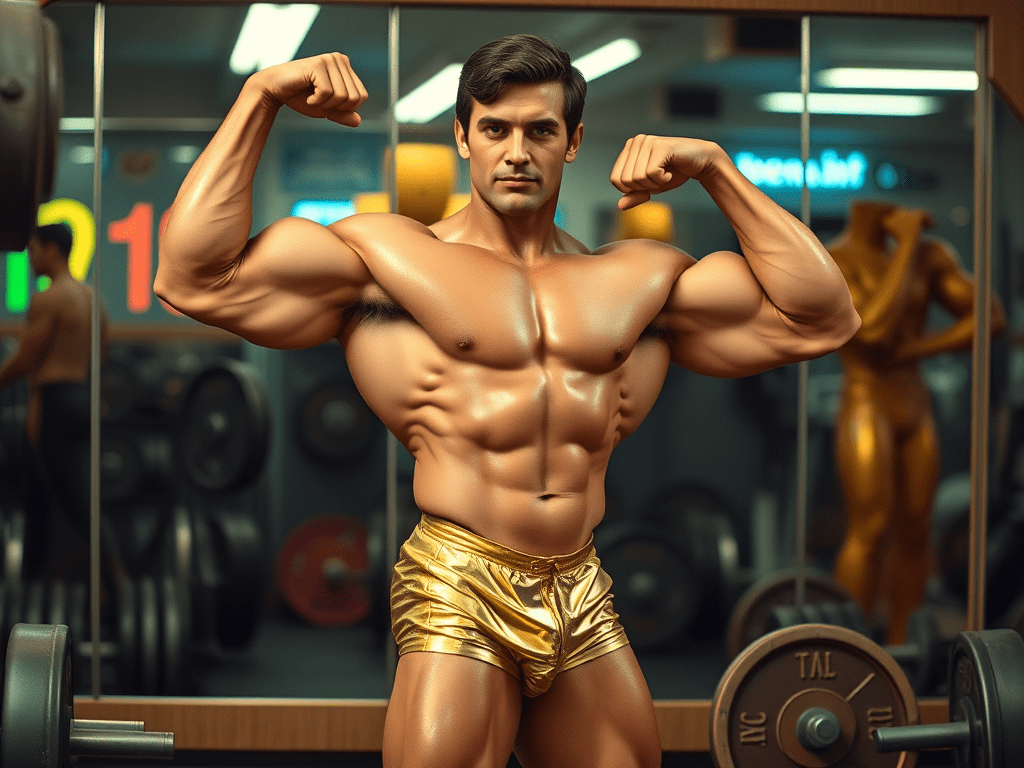
    Nostalgia is a bald-faced liar in gold lamé posing trunks. It flexes in the mirror of your mind, oils itself up in false sentiment, and strikes a heroic pose while whispering sweet nothings about “the good old days.” I used to believe the 1970s were the Golden Age of bodybuilding—when men looked like Greek gods instead of mutant action figures, when steroids were used “responsibly,” like a fine wine instead of a meth pipe. I told myself those days were all about balance and aesthetics: a V-taper here, a bit of Arnold’s smirk there.

    But no—this is revisionist fantasy, gym-bro propaganda. The truth is, those bronzed demigods were gulping down more synthetic hormones than a lab rat in a Monsanto trial. “Moderate” steroid use? Please. Some of those guys had liver enzymes that could strip paint. Many didn’t make it to 50, their organs shriveled like sun-dried tomatoes while their biceps ballooned into oblivion.

    Yes, today’s physiques are grotesque parodies of humanity—more Pixar villain than Apollo—but don’t kid yourself that the ‘70s were some golden, health-conscious utopia. Body dysmorphia was already the unspoken sixth station in the posing routine. The mirrors were just less honest, and the delusion smelled faintly of Brut cologne and Joe Weider’s false promises.

  • The Lothario Algorithm: How AI Became Your Wingman (and Stole Your Soul)

    The Lothario Algorithm: How AI Became Your Wingman (and Stole Your Soul)

    Once upon a time, you needed charisma, emotional depth, and an actual personality to seduce someone. Now, all you need is an app and crippling insecurity. The fitness freaks have Ozempic to shrink-wrap their bodies into Instagrammable husks. Aspiring Ivy Leaguers have ChatGPT to buff their essays into polished admissions bait. And now, the tragically uncharming have their savior: Rizz—the AI Cyrano for the chronically charisma-challenged.

    Rizz lets you select your ideal persona like toppings at a frozen yogurt bar: suave, glib, devil-may-care, with just a hint of tortured poet. Want to flirt like you’ve read Nabokov but party like Pete Davidson? Rizz will spin your existential dread into gold. No more fumbling texts, no more sweaty-palmed agony over emojis. Just upload your awkward energy and let the algorithm rewrite you as a velvet-voiced Lothario gliding through DMs like a pheromone-soaked shark.

    It’s destined to succeed. Why? Because nothing fuels an app’s virality like watching hopeless men date women they previously couldn’t make eye contact with. Even the confident guys—those smug gents who used to dominate the dating pool with actual charm—will start to feel inadequate without Rizz’s synthetic edge.

    And here’s the twist: the women on the other end? Also using Rizz. Which means we’ve entered a brave new world where bots are romancing bots while their human operators sit slack-jawed in the background, binge-watching Love Island and wondering why they feel dead inside. The courtship dance has become a tech support ticket. Romance hasn’t just died—it’s been uploaded, optimized, and drained of all humanity. Welcome to the algorithmic afterlife.

  • A College Professor in Search of Flexecutivewear

    A College Professor in Search of Flexecutivewear

    I, for one, am eternally grateful for the fashion revolution that finally told tight loafers and itchy tweed to take a long walk off a short runway. Gone are the days when professionalism meant strangling your thighs in wool trousers and embalming your torso in starched cotton. Now, thanks to society’s blessed surrender to performancewear, I can be a fully functioning member of the information economy without developing trench foot or sweating through my pancreas. At long last, it’s possible to look like I’m closing deals while feeling like I’m on my way to foam roll my glutes. So yes, it’s time for a wardrobe overhaul—one built not on thread count but on strategic stretch and moisture management. We’ll call this divine aesthetic what it truly is: Flexecutivewear—because nothing says power move like a blazer with hidden ventilation panels and joggers that whisper synergy.

    A definition is in order:

    Flexecutivewear (n.): A genre of athleisure engineered for men who want to appear as though they’ve just wrapped a high-stakes boardroom negotiation and a punishing HIIT session—without actually doing either. It’s business-casual for the delusional alpha male: moisture-wicking fabrics, tailored joggers, and compression hoodies that whisper “venture-backed” while screaming “please validate me.” Flexecutivewear exists at the tragic intersection of performance and performance art, where every outfit is a pitch deck and every stretch is a soft launch.

    No Flexecutivewear ensemble is complete without the obligatory diver watch on an orange strap—a bold timepiece that screams “I could be 200 meters underwater right now, but I’m actually just waiting for my cold brew.” The orange strap is crucial: it’s the high-visibility beacon of masculine daring, suggesting a rugged, adventurous spirit who might rappel down a cliff between Zoom calls. Never mind that the watch has never tasted saltwater and its nearest brush with danger was a CrossFit box opening. In the Flexecutive ecosystem, the diver watch is less tool and more talisman—a waterproof monument to imagined peril and aspirational virility.

  • Waiting for the Angels to Descend and Hand Me the Perfect Book Title on a Velvet Pillow

    Waiting for the Angels to Descend and Hand Me the Perfect Book Title on a Velvet Pillow

    After reading Emmanuel Carrère’s Yoga—a meandering, self-lacerating spiral of spiritual ambition, narcissism, and depressive collapse—I’ve found myself inspired, if not outright possessed, by the urge to write my own autobiographical novel. Not about yoga, of course. I have the flexibility of a rusted lawn chair. Mine would be about my lifelong addiction to exercise. Working title: Kettlebell.

    It has a certain Zen austerity to it. One word. Heavy. Spherical. Monastic. A blunt object and a metaphor all in one. A symbol of focus in a world engineered for entropy. While others turn to wine, weed, or weaponized mindfulness apps, I have turned to iron. Cold, unyielding, mildly concussive iron.

    Of course, I could flirt with cleverness—titles like The Church of Sweat or The Temple of Gains—but those reek of Instagram influencers and overpriced gym merch. Kettlebell is purer. But then again, Dumbbell tugs at me. It’s honest. It’s humiliating. It suggests what I secretly suspect: that I’ve spent a lifetime mistaking pain for virtue and resistance training for redemption. I am a Dumb Bell. A heavy object being swung around in circles, hoping to find peace through repetition.

    Still, perhaps I’m playing into the oldest self-help trap of them all—masquerading self-deprecation as enlightenment. Perhaps the search for the perfect title is simply a glorified avoidance ritual, a form of literary procrastination wrapped in velvet. Because deep down, I know the book isn’t just about fitness. It’s about how I’ve used discipline as anesthesia, reps as prayer beads, and physical exhaustion as a form of epistemology. I don’t know what God looks like, but I suspect He smells like workout chalk and vanilla protein shakes.

    Some mornings I feel like a garage-dwelling mystic, swinging kettlebells under flickering LED light, muttering mantras between sets. Other days I feel like an absurd parody of Sisyphus—except instead of rolling a boulder up a hill, I’m performing goblet squats in my tattered gym shorts, chasing transcendence in 30-second rest intervals.

    And now, on the brink of another workout, I’m wasting precious calories spiraling into a metaphysical title crisis. Maybe the perfect name will descend from the sky, borne aloft by angels in sweatbands and Lululemon, whispering, “This is it. This is your brand.” They will hand me the title on a velvet pillow. Or maybe I’ll figure it out in the middle of a brutal set, when my soul finally detaches from my body like a spent shell casing and whispers, “Just call it Garage Monk and be done with it.”

    One way or another, the iron awaits. And it does not care what the book is called.

  • The Church of Sweat: 50 Years in the Iron Cathedral

    The Church of Sweat: 50 Years in the Iron Cathedral

    By the time I hit fourteen, my sacred sanctuary was none other than Walt’s Gym in Hayward, California—a temple of iron that had started its inglorious life as a chicken coop in the 1950s. The place was a veritable swamp of fungus and bacteria, a thriving petri dish of maladies eager to latch onto the unsuspecting. Members whispered in hushed tones about incurable athlete’s foot, the kind that made dermatologists throw up their hands in defeat. Some swore that the strains of fungus and mold festering in the corners were so exotic they had yet to be classified by the most intrepid of mycologists. Roosting among the fungal shower stalls was an oversized frog that the pro wrestlers had affectionately named Charlie. I never saw Charlie myself, but I often wondered if he was a real creature or a figment of the wrestlers’ imagination, birthed by too many concussions and late-night benders.

    The locker room was perpetually occupied by a rotating cast of characters who looked like they’d been plucked straight out of a grimy noir film. There was always some bankrupt divorcee draped in a velour tracksuit and a gold chain thick enough to anchor a ship, hogging the payphone for marathon sessions with his attorney. He’d discuss his sordid life choices and the staggering attorney fees required to sweep his past under a rug large enough to cover the entire state of California.

    Out back, an unused swimming pool lurked, its water murky and black—a cauldron of plague, dead rats, and God knows what else. Walt, the gym’s owner and part-time crypt keeper, had a peculiar ritual. Every so often, he’d saunter outside, brandishing a pool net like a scepter, and scoop up some unfortunate deceased creature. He’d hold it aloft for all to see, like a demented priest presenting an unholy sacrament. This grim ceremony was invariably met with a thunderous round of applause from the gym-goers, who treated Walt’s rodent exorcisms like a halftime show. Walt would then toss the cadaver into a nearby dumpster with all the flourish of a Shakespearean actor delivering a monologue, bowing deeply as if he’d just conquered a dragon.

    Walt’s Gym showcased a walking fossil named Wally, an octogenarian who swore he was the original model for human anatomy textbooks—perhaps ones etched on cave walls. We all loved Wally. He was a beloved gym fixture even though he could be a pain in the butt. Wally’s routine was the stuff of myth: He’d righteously correct everyone’s form whether they asked for his advice or not. He’d monopolize the gym for hours, his workout punctuated by monologues worthy of an Oscar about his deadbeat relatives who “borrowed” money, his former lovers who once graced the silver screen, and his eternal battle with arthritis. 

    Between sets, he’d often deliver a Ted Talk on muscle inflammation and the sorry state of the national economy. He delivered these soliloquies with the gravitas of a news anchor, then spent an eternity in the sauna and shower, emerging like a phoenix from the ashes only to douse himself head-to-toe in talcum powder, turning into a spectral beacon of gym dedication. When Wally spoke, he was engulfed in such a thick talcum haze you’d swear a lighthouse was about to blare its foghorn warning.

    The radio played the same hits on a relentless loop, as if the DJ had been possessed by the spirit of a broken record. Elvin Bishop’s “Fooled Around and Fell in Love,” The Eagles’ “New Kid in Town,” and Norman Connors’ “You Are My Starship” echoed through the gym like a soundtrack to my personal purgatory. As a kid navigating this adult world, the gym was my barbershop, my public square, where I eavesdropped on conversations about divorces, hangovers, gambling addictions, financial ruin, the exorbitant costs of sending kids to college, and the soul-sucking burdens of caring for elderly parents.

    It dawned on me then that I was at fourteen the perfect age: old enough to start building biceps like bowling balls, yet young enough to be spared the drudgery and tedium of adult life. Being a teenage bodybuilder, I realized, was all about sidestepping the real world entirely. Why bother with mortgages and 401(k)s when I could disappear into my true paradise, the gym? As Arnold himself wrote in Arnold: The Education of a Bodybuilder, the gym was the ultimate Happy Place: “The weight lifters shone with sweat; they were powerful looking. Herculean. And there it was before me—my life, the answer I’d been seeking. It clicked. It was something I suddenly just seemed to reach out and find, as if I’d been crossing a suspended bridge and finally stepped off onto solid ground.”

    Half a century later, I still have my version of Walt’s Gym—but now it’s a dimly lit garage filled with kettlebells and echoes. For the last ten years, it’s been my sanctuary, my forge, my private dojo where I swing iron spheres like a monk practicing some ancient, sweat-soaked ritual. No mirrors, no peacocks, no pop music—just me, gravity, and the stubborn pulse of something that refuses to quit.

    At nearly 64, I still wake up with the twitchy vigor of a teenager mainlining pre-workout, though now it’s fueled by habit and existential resolve rather than hormones and vanity. Friends—well-meaning, gray-templed philosophers—remind me that we’re each born with a finite reservoir of Life Force, that it burns down like a fuse, and that it’s only sensible to bow to biology, show gratitude, and pace ourselves. All true. But I also know that left unchecked, my own Life Force has a history of going rogue—dragging me into self-destructive spirals like a moth to a Molotov cocktail. So I remind myself, daily, that power without purpose is a demolition derby in my own skull.

    Still, when I think of Walt’s Gym, I remember that giddy, foolish optimism of youth—that belief that life was nothing but expansion, growth, and muscle gains. And weirdly, I still feel that same charge now. Same source, different vintage. That current is still flowing through me, unruly and alive. The only real difference? I no longer try to bottle it. I just hold on and let it do its work.

  • From Corner Office Dreams to Carpool Reality: One Engineer’s Recession Watch

    From Corner Office Dreams to Carpool Reality: One Engineer’s Recession Watch

    I just got off the phone with my friend, a seasoned engineer marooned in the asphalt sprawl of Southern California, who sounded like a man peering over the edge of an economic cliff with a pair of shaky binoculars. The view? Grim. The engineering sector—usually a stalwart of rational planning and concrete outcomes—is now gripped by the wobbly-kneed fear of an incoming recession. Hiring freezes are spreading like a case of financial frostbite, and everyone’s waiting for the other steel-toed boot to drop.

    The culprits? Our beloved government’s carnival of tariff acrobatics—somersaults, swan dives, and the occasional flaming hoop—leaving the business sector in a state of chronic vertigo. With policy shifting by the hour and no clear sense of direction, companies are curling inward like startled armadillos, refusing to hire or spend, while consumers clutch their wallets like Victorian widows clutching pearls.

    Just a month ago, my friend had a juicy job offer on the table—complete with perks, prestige, and a corner office view of existential dread. He was mulling it over with the quiet satisfaction of a man whose talents were finally being recognized. But now? That same company has ghosted him like a bad Tinder date, citing “market uncertainty” and initiating a hiring freeze. Translation: they’ve lost their nerve and joined the swelling ranks of firms slamming shut the doors like it’s a zombie apocalypse.

    His current job, for now, is safe. But the interns? Sacrificed at the altar of “cost-cutting measures.” And his planned splurge—a shiny $50K car meant to serve as both reward and statement piece—has been downgraded to a practical vow of austerity. No V6 joyrides, no heated leather seats, just a cold reminder that in this economy, survival is the new luxury.

    “I’m just lucky to still be employed,” he said, with all the enthusiasm of a man clinging to a lifeboat made of unpaid invoices and canceled bonuses.

  • From Sweat Temple to Spa Prison: My Gym Breakup Story

    From Sweat Temple to Spa Prison: My Gym Breakup Story

    There was a time, back in the sepia-toned haze of the 1970s, when the gym was my church and iron was my sacrament. I was a teenage bodybuilder, baptized in sweat and testosterone, and the gym was a crude sanctuary—part locker room, part gladiator pit—where you could grunt, curse, and lift until your eyeballs threatened to pop like grapes. No frills, no air freshener, no nonsense. Just clang, bang, and the occasional chest-pounding primal scream.

    Then came the 1980s, when gyms got a makeover. They went corporate. The rusted barbells got swapped for chrome. The boom boxes were silenced in favor of syrupy pop music so chirpy it made your teeth ache. Suddenly, everyone wore genie pants and strutted between machines like peacocks dipped in glitter. I soldiered on, of course, slogging through the artificial sweetness and protein-powdered small talk. But the joy had drained from the dumbbells.

    By 2005, I snapped. The gym had become a perfume counter with resistance bands. I fled to the one place where the spirit of muscle still breathed: my garage. I bought a set of kettlebells and never looked back. No waiting for equipment. No toe fungus lurking in communal showers. No ex-frat boys flexing in front of mirrors while discussing their smoothie macros. Just me, my iron cannonballs, and the relentless clang of salvation.

    As I reflect on my exile from Gym Nation, I’ve made peace with my reasons. Let me count the ways:

    I like people. I enjoy storytelling, especially if it involves morally questionable behavior and a dash of scandal. But I can’t dish gossip and deadlift at the same time. I’m not that talented. The gym wants you to be a social butterfly with deltoids, but I want solitude and sweat.

    I used to catch colds with the regularity of a school nurse—four times a year like clockwork. Every cardio machine was a petri dish disguised as fitness equipment.

    And don’t get me started on the showers. You haven’t known dread until you’ve seen a septuagenarian air-drying his nether regions for forty-five minutes like a puffy white heron. Showering was a biohazard. Not showering meant marinating in my own musk, turning my car into a rolling terrarium of mildew and despair.

    Gyms also close for holidays, which is when I need them most—Thanksgiving rage, New Year’s guilt, Fourth-of-July shame. My garage, on the other hand, never takes a day off. It’s always open, always angry, always welcoming.

    And the waiting. Dear God, the waiting. I train fast, like I’m running from the ghosts of carbs past. Having to wait ten minutes for a squat rack while someone scrolls Instagram is a crime against the pump.

    I spent about a thousand bucks on kettlebells, from 10 to 80 pounds. That may sound steep, but compared to a decade of gas, membership fees, and viral exposure? It’s a steal.

    This garage of mine—it’s not just a space. It’s a holy temple of kettlebell discipline. A shrine to simplicity, sweat, and solitude. And I’ll keep swinging those iron orbs until I drop dead—or transcend into Valhalla, kettlebell in hand.

  • The Gospel According to Dad: A Parable of Rocks, Regret, and Cabernet

    The Gospel According to Dad: A Parable of Rocks, Regret, and Cabernet

    I was sixteen. My parents were recently divorced. Once a month, I’d visit my father at his swanky apartment and we’d discuss my future.

    One night, my father stared at me across the dinner table, a slab of rare steak leaking its red juices into a mountain of mashed potatoes. He squinted, as if trying to determine whether I was his son or a lost philosophy major who’d wandered in from a patchouli-scented commune.

    “So,” he said, carving off a bloody corner, “what are your career plans?”

    I gave him the truth. “Not totally sure, but I’m leaning toward philosophy.”

    He dropped his knife like I’d just confessed to joining a nudist circus. “Why in the hell would you want to do a thing like that?”

    “The search for meaning,” I said.

    He snorted and chased his chew with a gulp of red wine, as if meaninglessness required lubrication. “Don’t waste your time.”

    “Meaning is a waste of time?”

    He wiped his mouth like he was preparing to deliver a TED Talk from the underworld. “Let me tell you a little story.”

    And then came one of Dad’s home-brewed parables—equal parts whiskey, cynicism, and divine apathy:

    “A young man, about your age, stood on a beach and looked up at the heavens. ‘God,’ he said, ‘help me find meaning.’ And God, being the cosmic wiseass that He is, replied, ‘Look at all the rocks around you. One of them has the meaning of life written on it. Go find it.’ The young man looked around—millions of rocks—and said, ‘But God, that’ll take forever.’ And God said, ‘That’s your problem, not mine.’”

    I already regretted everything.

    “Decades passed. The man turned over every rock. He aged like a leather shoe abandoned in the desert. No inscription. He grew sunburned, brittle, and spiritually constipated. Finally, in his nineties, he looked up at the sky, trembling with rage, and shouted, ‘God! I’ve been faithful! No pleasure, no joy, no Netflix—just rock-flipping! And I found nothing!’”

    Dad leaned in, eyes gleaming.

    “And God said: ‘That’s right, you dumb shit. Now die.’”

    There was a silence. Even the mashed potatoes seemed stunned.

    I blinked. “Where in the hell did you hear that story?”

    He leaned back, smug as a snake on a warm rock. “Made it up. For your benefit.”

    “My benefit? What am I supposed to take from this bleak little fable?”

    He ticked the lessons off like commandments: “One, God doesn’t give a shit. Two, there is no meaning. Three, stop thinking so damn much and just live your life.”

    “Easy for you to say,” I muttered. “Cruising around in your fancy car, living in your swanky bachelor pad, drinking overpriced wine.”

    “Worry not, my son,” he said, swirling his cabernet like it owed him rent. “You’ll get yours someday.”

    “So you’ve found paradise?”

    He shrugged. “Far from it. But it’s got central air. And that’ll have to do.”