Category: Confessions

  • The Man Who Loved Podcasts Too Much

    The Man Who Loved Podcasts Too Much

    Last night, I was in my kitchen, casually sharing shrimp, cocktail sauce, and champagne with public intellectuals Andrew Sullivan and Reihan Salam. As one does. We dove headfirst into the big topics: public policy, identitarianism, the collapse of critical thinking in echo chambers, and the shaky health of democracy. Between bites of shrimp and sips of champagne, we reveled in our status as lifelong learners, trading stories about childhood, lost pets, first crushes, and bouts of existential despair. The shrimp bowl magically replenished itself, and the champagne glasses never emptied. It was glorious—three intellectual heavyweights, solving the world’s problems, toasting to friendship and intellectual curiosity. For a fleeting moment, I felt like I’d reached peak existence: camaraderie, enlightenment, and a deeply inflated sense of self-worth, all in one glorious, shrimp-fueled evening.

    Only it didn’t happen.

    I was dreaming, my subconscious hijacked by The Dishcast. This is my nocturnal routine: When I go to bed at night, I fall asleep to a podcast and, before long, I’m the star guest. There I am, delivering profound manifestos about the human condition, my opinions urgently needed and universally admired.

    When I woke up, the camaraderie still lingered, as if Andrew and Reihan had just slipped out the back door, leaving only a faint echo of laughter.

    This happens all the time. In my dreams, I’m not just a listener—I’m part of the podcast universe, slapping backs, sipping champagne, and dropping truths no one dared to utter. Reality, by comparison, is disappointingly quiet.

    Clearly, podcasts are taking too much bandwidth in my brain. I’m not alone. Like millions of others, I’ve practically taken up residence in the world of podcasts. My life runs on a steady soundtrack of conversations and monologues, piped directly into my ears while I swing kettlebells, pedal my exercise bike, grade uninspired writing assignments, cook, eat, and scrub the kitchen into submission. Podcasts are my companions for post-workout naps, my co-pilots on the commute, and my salvation during middle-of-the-night insomnia—the kind where you wake up at 2 a.m., stare at the ceiling, and hope a familiar voice can lull you back to sleep before dawn.

    In total, I must rack up over a hundred hours of podcast listening every week. I spend more time in the podcast multiverse than in the real one, and inevitably, these voices have taken up permanent residency in my brain. Some of these parasocial relationships I welcome with open arms; others, I tolerate with the resigned grumbling of a bad roommate. And then there are the hosts who commit unforgivable sins—becoming smug, tedious, or worse, preachy—earning themselves a one-way ticket to oblivion. In this universe, the delete button is my only weapon, and I wield it without mercy.

    Living in the podcast world as I do—where most of my waking and sleeping hours are dominated by disembodied voices—I’ve started asking some uncomfortable questions. Have I, like millions of others, surrendered my brain to the podcasters, letting them hijack my mental real estate to my own detriment? Am I so immersed in podcast life that I’ve lost all perspective, like a fish in water, oblivious to how wet it is?

    What am I really after here? Entertainment? Wisdom? A surrogate friend? Or just noise to drown out the endless chatter in my own head? Why do some podcasts stick while others fall by the wayside? Are my favorites truly brilliant, or just slightly less irritating than their competition? Is it their buttery voices, sharp wit, or the fact that they don’t seem to realize they’ve become permanent fixtures in my inner monologue?

    Could I live without podcasts? Would the silence reveal things about myself I’m not ready to confront? What do I call that blissful, cozy state when I’m wrapped in the warmth of a trusted voice? Podcastopia? Earbud Nirvana? Sonic Solace? And is it possible to “love” a podcaster too much, like when I know their pet’s name but can’t remember my sibling’s birthday?

    Am I escaping something? Is this obsession a creative pursuit or an elaborate scheme to avoid existential dread? And most importantly, does this insatiable consumption mean something is deeply, hilariously wrong with me? Or does it point to something more profound—a need for a new word to describe the bottomless, soul-deep immersion of chasing episode after episode like a digital hunter-gatherer?

    Yeah, I’ve got questions. But it might be too late. I may already be The Man Who Loved Podcasts Too Much.

    After waking up from my dream of hanging out with Andrew Sullivan and Reihan Salam, I crept into the kitchen for breakfast–a self-inflicted atrocity of overnight oats. Not just any overnight oats, mind you, but a Trader Joe’s variety touting “ancient grains,” as if the endorsement of long-dead civilizations could somehow redeem the experience. Spoiler: it didn’t. Despite my best attempts at culinary CPR—vanilla protein powder, a smattering of berries, and a dusting of pumpkin spice—the result was still cold, gluey sludge, the breakfast equivalent of a wet handshake.

    Each spoonful felt like a personal affront, a betrayal by my own hands, as though I had willingly prepared the kind of gruel Dickensian orphans would revolt over. The texture was an abominable mix of paste and gravel, and the cold temperature screamed “punishment” rather than “sustenance.” By the end, I wasn’t just eating; I was enduring. Mental note: next time, boil this nonsense into something remotely edible—or toss it and make a proper breakfast for a self-respecting adult. 

  • When We Had to Get Approval from the Attendance Priestess

    When We Had to Get Approval from the Attendance Priestess

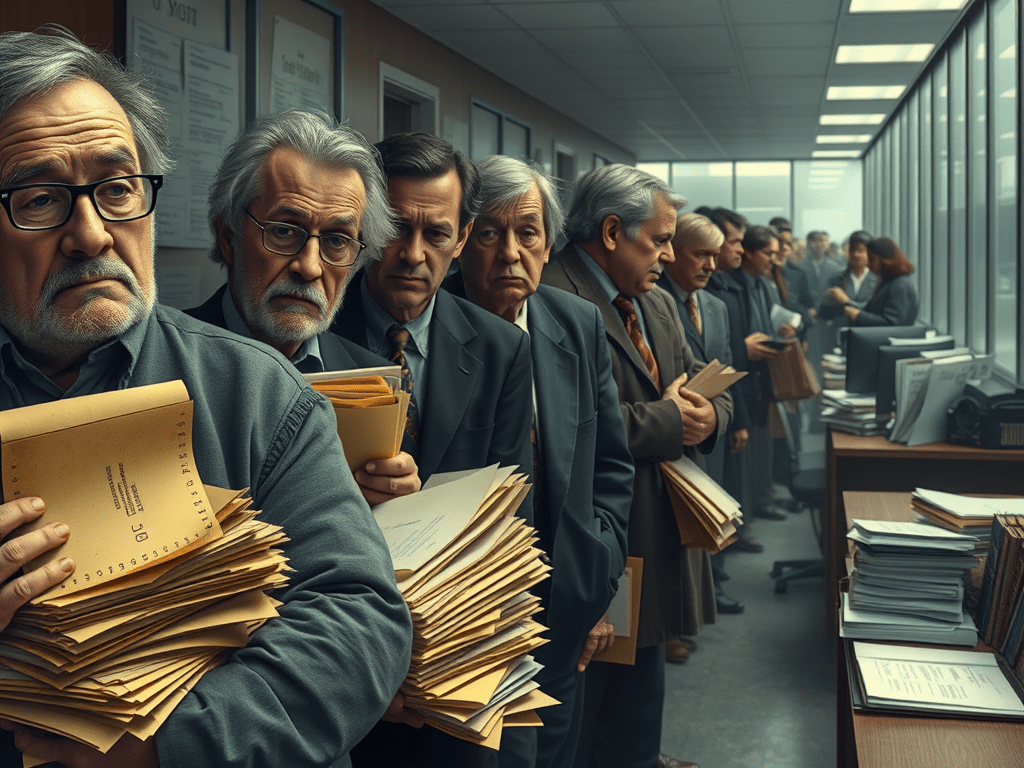
    I don’t miss the pre-digital education era when the semester was over but I still wasn’t finished. I had to drag myself to the campus during the semester break, lugging a mountain of paper that looked like it had survived the apocalypse.

    My stack of grades and attendance records—yellowed, dog-eared, and adorned with enough coffee stains and White-Out smudges to pass as a Jackson Pollock reject—was a bureaucratic nightmare in physical form. I found myself in line with a hundred other sleep-deprived, caffeine-fueled professors, each clutching their own messy masterpieces like they were carrying the Dead Sea Scrolls. The line outside the Office of Records was so long it could have served as an endurance test for Navy SEALs. To stave off starvation and existential dread, I had packed a comically oversized sack of protein bars and apples, as if I were preparing for a month-long siege rather than a simple bureaucratic ritual.

    There I was, supposed to be basking in the sweet, sweet nothingness of semester break, but instead, I was condemned to a gauntlet of waiting that made Dante’s Inferno look like a walk in the park. For what felt like hours, waited for the privilege of sitting at a table and enduring the laser-like glare of humorless bureaucrats who would scrutinize my records as if they were forensic experts analyzing evidence from a high-profile murder case.

    Once I finally managed to wade through the outdoor line, I advanced to the foyer for the second, even more soul-crushing phase of The Great Wait. Inside, rows of desks manned by expressionless drones awaited, each one peering over piles of grading records that seemed to stretch back to the dawn of civilization. Behind the staff of functionaries who examined the professors’ gradebooks were towers of file boxes stacked so precariously that a single sneeze could have transformed them into a cataclysmic eruption of dust and possibly asbestos.

    Eventually, I was summoned to one of the desks where an eagle-eyed Attendance Priestess scrutinized my records with the intensity of a customs officer suspecting I had smuggled contraband. She licked her fingertips with the solemnity of a high priestess preparing for a sacred ritual, only to cast me a look of such disdain you’d think I’d just handed her a wad of toilet paper instead of my gradebook.

    Finally, when the pinch-faced administrator deemed my records sufficiently unblemished and granted me the bureaucratic blessing to leave, it felt like I had just been handed the keys to the Pearly Gates. I then sprinted to my car unless she changed her mind and needed me to edit this or that. I never fully trusted her.

  • Perkatory

    Perkatory

    Every morning at 6 sharp, like some deranged caffeinated monk, I stagger to the kitchen, where the sacred rite of coffee-making begins. This isn’t just a routine—it’s a holy sacrament that grants me the powers of focus, confidence, and the kind of superhuman alertness that helps me work on one of my best-selling coffee table humor books or grade college essays. The taste of that bitter coffee kissed with a hint of milk and a drop of liquid stevia, is nothing short of ambrosia. By 7 a.m., after downing two 18-ounce cups, I’ve ascended to a higher plane—a realm where I’m not just a man, but a writing, essay-grading, piano-playing, kettlebell-swinging demigod. I go through my day, shower, lunch, nap—rinse and repeat—like a well-oiled machine of productivity, albeit one lugging around a trunkful of neuroses and the social skills of a startled raccoon.

    But there’s this nagging little itch I can’t quite scratch: coffee. It’s more than just a drink at this point; it’s an obsession. Do I love coffee too much? Maybe. Do I worship the ritual a bit too fervently? Definitely. Throughout the day, this thought keeps tiptoeing into my mind like a ninja with a vendetta: “I can’t wait till tomorrow morning when I can make coffee again.” And then, the existential kicker: “Is my life just one endless loop of killing time between coffee sessions?”

    Pat myself on the back: I’ve crossed into a special kind of hell—a hell I’ve christened Perkatory. It’s not quite purgatory, but it’s close. It’s that torturous stretch of time where I’m just existing, dragging myself through the mind-numbing hours between one glorious cup of coffee and the next. It’s a slow-burning obsession that has taken over my life, turning everything else into the dull, gray filler content I’d skip if life had a fast-forward button.

    I remember those bleak, pre-coffee days of my youth—days when Perkatory wasn’t even a thing. Back then, life was simpler, more innocent, and tragically devoid of the caffeinated highs I now chase with the zeal of a junkie trying to recapture that first, glorious hit. But let’s be honest: there’s no going back. Perkatory is here to stay, like that annoying roommate who never does the dishes and steals your leftovers. I’m stuck in this never-ending cycle of waiting, longing, and counting down the hours until I can get my next hit of that sweet, sweet java.

  • Transforming into Mope-a-saurus Rex

    Transforming into Mope-a-saurus Rex

    There’s ongoing debate over whether boomers willingly morph into Mope-a-saurus Rex—the scowling relic pacing his lawn and muttering about “kids these days”—or if the transformation is as unavoidable as hair loss and rising cholesterol. Maybe it’s some grim milestone on the aging checklist, or maybe it sneaks up, the natural side effect of realizing your cultural currency has expired while the youth livestream their way into the future. I’ll leave that existential puzzle for the philosophers to untangle.

    What I do know is that by the time Thanksgiving rolled around, I was still carrying the weight of grief like an overstuffed holiday plate. I’d said goodbye to my mother during the pandemic, standing outside a nursing home window and offering her love through a mesh screen, as if I were visiting someone in solitary confinement. Two years later, I watched my father—a proud infantryman in his day—fade to 130 pounds, his body surrendering to cancer. Since their passing, the world felt quieter, smaller, like someone had dimmed the lights without warning.

    So, when hosting Thanksgiving fell squarely on my plate, it wasn’t some Norman Rockwell fantasy. It was more like getting crushed by a baby grand piano dropped from the second floor. And instead of gracefully stepping aside, I just let it hit me—because honestly, moving felt like too much effort.

    The guest list wasn’t exactly daunting—just my perpetually single brother, whose dating apps seemed better at generating cautionary tales than romantic prospects, and two of my wife’s teacher friends, both middle school band directors still recovering from clarinet-induced PTSD. The conversation was polite, though it had all the flavor of plain oatmeal.

    Stuffed to the gills but somehow still shoveling pie like our lives depended on it, we trudged through the ritual of TV show recommendations. Each suggestion was delivered with the gravitas of a public service announcement—skip this series at your own peril. Apparently, failing to watch that one obscure, eight-part masterpiece would leave me culturally destitute, wandering through a desolate landscape devoid of punchlines and plot twists.

    Honestly, I enjoyed the company. The real villain of Thanksgiving wasn’t the guests—it was the dishes. The endless scrubbing that left my hands raw, the dishwashing marathon that stretched into eternity, the mountain of dirty plates multiplying like gremlins in the sink. That’s where the wheels came off.

    My wife, meanwhile, glided through the chaos like some kind of culinary sorceress, humming softly as she orchestrated the entire meal with the grace of a Michelin-starred maestro. She didn’t grumble. Not a single passive-aggressive sigh escaped her lips. She was the picture of serene competence.

    I, on the other hand, hovered around the kitchen like a useless NPC in a video game—occasionally moving a plate from table to sink and acting as though I’d just conquered Everest. At one point, I genuinely felt winded after rearranging the silverware. My contribution was so meager it felt performative, like a child pretending to be tired after “helping” Dad mow the lawn by pushing a plastic toy mower ten feet behind him.

    Somewhere between rinsing the roasting pan and glaring at the pile of silverware, it hit me—I was teetering on the edge of a Mope-a-saurus moment. The only thing preventing my full transformation was the vague sense of shame that my wife, who had just cooked for hours, wasn’t grumbling about the aftermath. That’s when you know you’re in trouble—when someone else’s superior competence and good cheer makes you feel like a defective appliance, sputtering through life with a flickering power cord and a weak motor.

    I’m such a fragile soul that after surviving the harrowing gauntlet of Thanksgiving dishes and the Herculean task of small talk, I felt entitled to a months-long convalescence—something involving soft blankets, intravenous fluids, and a team of specialists monitoring my vitals like I’d just summited Kilimanjaro in flip-flops. Surely, I had earned the right to collapse melodramatically onto a fainting couch and demand chicken soup by candlelight.

  • When I Met the SpaghettiOs Overlord

    When I Met the SpaghettiOs Overlord

    In June of 1999, I did what a college professor cannot do: I lost the classroom key. Yes, the sacred, university-issued key that was supposedly worth more than its weight in gold and was meant to be guarded as if it were the last surviving relic of Atlantis. After a frantic week of turning my Redondo Beach condo upside down—searching under couch cushions, rifling through laundry baskets, and even interrogating the houseplants—I had to admit defeat. I was summoned to face the wrath of the university’s ice queen of administration, who greeted me with a glare that could freeze lava. “The one thing a college instructor does not do,” she said, as if reciting an ancient curse, “is lose his key.” She inspected me as if I were a criminal in a bad noir film, and then informed me that I had to make a pilgrimage to the edge of campus, to the mythical and dreaded realm known as Plant Ops, to pay for a key replacement with cash only. I felt like I was being sent to Mordor to drop off a pizza. 

    So, I embarked on this perilous quest, driving east from campus. At first, the road was a decent pavement. But soon, it disintegrated into a wasteland of dirt, rubble, and potholes the size of small craters. My car bucked and jolted over the rocky path, like an old west wagon on a treasure hunt, as I passed ghostly rows of cow skulls and tumbleweeds rolling by in the wind like some grim, dusty parade. Above me, buzzards circled, perhaps in anticipation of a fresh meal or merely to witness my impending doom.

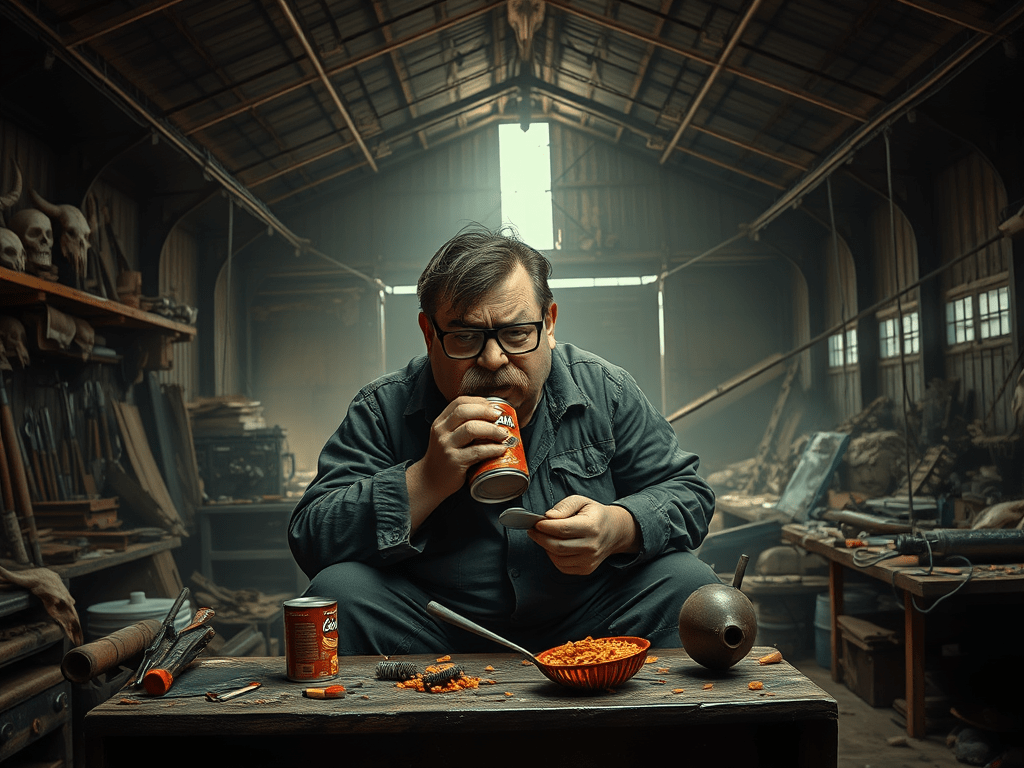
    Just as despair was about to pull me under, a nauseating aroma of glue, pickles, and formaldehyde wafted through the air, signaling the arrival of my destination. I squinted through the gloom to see a structure emerge from the fog—a dilapidated hangar that looked like it had been plucked from a post-apocalyptic movie set. Inside was the world’s most disgruntled handyman, a short, rotund man with glasses thick enough to start a small library, a bushy mustache that looked like it was trying to escape his face, and a head bald enough to use as a landing strip for insects. He was hunched over a workbench, devouring SpaghettiOs straight from the can with the kind of focus usually reserved for nuclear codes. His irritation at being interrupted was palpable, like I’d crashed his private spaghetti party.

    “Twenty dollars cash,” he grunted, extending his hand with the authority of a toll collector in the underworld. I handed him the bill with the reverence of a pilgrim offering gold to a god. He stuffed it into his grease-splattered apron, took another spoonful of his cold, canned meal, and scowled at me like I’d personally betrayed him. With the wind howling through the thin steel walls of the hangar, I half expected the place to take off and join Dorothy’s house in the sky. The handyman delivered his parting words with the gravitas of a crypt keeper: I must never lose a key again, lest I face the incompetence of his replacement, who was, according to him, a veritable nincompoop with the locksmithing skills of a potato. I thanked him, exited the hangar, and raced straight to the nearest hardware store. I bought a keychain made of Kevlar, equipped with a tether reel and a high-density nylon belt loop—basically, a key-keeping apparatus that could survive a nuclear blast. It was clear I’d never let my keys out of my sight again, lest I face another odyssey to the land of a disgruntled Plant-Ops overlord.

  • Before Snack Times

    Before Snack Times

    In the Before Snack Times of the early 70s, we didn’t have helicopter parents hovering over us, micromanaging our every move with a suffocating schedule of dance classes, gymnastics, karate, swim lessons, math tutors, writing coaches, soccer practices, chess clubs, computer coding, mindfulness meditation, and Ashtanga Yoga. We didn’t have smartphones tracking us like we were secret agents with microchips implanted in our necks. For the entire day, our parents had absolutely no clue where we were or what we were up to. We’d saunter off after breakfast, either on foot or aboard our trusty bicycles, and were expected to return only by dinner. During that endless stretch of freedom, we’d navigate through construction sites strewn with lumber, nails, electrical wires, and bottomless ditches, all of which screamed, “Adventure awaits!” We gravitated toward mud, streams, and rivers like moths to a flame, setting up wooden ramps to perform Evel Knievel-level stunts over bodies of water. The messier and more perilous the terrain, the more irresistible it became. These hazardous playgrounds were usually bordered by rusty barbed-wire fences and “Do Not Enter” signs, which not only failed to deter us but ignited our rebellious spirits to trespass with even more gusto. Inside these danger zones, we’d be chased by furious steers, territorial cows, and muscle-bound guard dogs. Occasionally, a disgruntled landowner would fire warning shots at us with a pellet gun, a token gesture that barely fazed us. In the ravines behind our homes, we crafted forts, swung from vines, ignited firecrackers, and leaped into piles of poison oak. We encountered black widows, rattlesnakes, bobcats, coyotes, and even the occasional mountain lion. After a day of flouting every conceivable health and safety code, we’d trudge home at night, our bodies caked in filth, bruises, and scratches. But our parents, bless their oblivious hearts, never inquired about our whereabouts or escapades. As long as we took a bath and cleaned up, they were content to feed us hearty helpings of turkey pot pies, meatloaf, chili, and tacos. They knew we needed the energy to wake up the next morning and dive headfirst into another day of mayhem. Back then, we had little time for snacking. Our days were filled with wilderness adventures, where our imaginations ran wild. This level of playfulness, chaos, and enchantment is as extinct as the dinosaurs in today’s Snack Age, where parents meticulously micromanage their children’s activities and pacify their appetites with chips, juice boxes, chocolate chip granola bars, fruit rolls, and Happy Meals.

  • WALTER CRONKITE AND FRANK SINATRA WERE THE TRUSTED PROPHETS OF MY YOUTH

    WALTER CRONKITE AND FRANK SINATRA WERE THE TRUSTED PROPHETS OF MY YOUTH

    At four years old, a pocket-sized philosopher in footie pajamas, I’d often find myself stationed in the living room like a tiny sentinel, transfixed by the glow of our hulking television set. The air was thick with the comforting aroma of my mother’s lasagna or spaghetti, a scent that promised warmth and stability, while my father and I tuned in to the evening sermon of Walter Cronkite. Cronkite, that square-jawed oracle of truth, delivered the news with the gravitas of a benevolent yet exhausted deity. His voice—measured, slightly weary—wrapped around the day’s events like a woolen blanket, equal parts reassurance and obligation, as necessary as a nightly dose of cod liver oil or a reluctant gulp of Ovaltine.

    But Cronkite, for all his journalistic divinity, did not hold the title of Supreme Voice in our household. That honor belonged to Frank Sinatra, whose velvet baritone floated from our Fischer Hi-Fi console stereo with the omnipresence of a household deity. Sinatra wasn’t merely a singer—he was a prophet, a sage in a sharp suit, the Cronkite of melody, issuing dispatches on love, loss, and longing with a conviction that made it clear: this was the stuff of life. His voice had the eerie authority of a celestial news anchor, forewarning me of adulthood’s looming weather patterns—storms of responsibility, gales of regret, hurricanes of heartbreak.

    At an age when my greatest concern should have been whether I got the last Nilla Wafer, I found myself drowning in premature nostalgia, gripped by the weight of Sinatra’s melancholic musings. “It Was a Very Good Year” hit my preschool psyche like an existential anvil—suddenly, I was an ancient soul trapped in a toddler’s body, debating whether to pair my Triscuits with a port wine cheddar spread or just give in and sip on some prune juice like a man resigned to his fate. Sinatra had me feeling so prematurely adult, I half-expected a cigar to materialize in my hand or to receive a personal invitation to an exclusive stockholder’s meeting.

    I wasn’t just waiting for dinner. I was reckoning with life’s grand metaphysical dilemmas, wrestling with the realization that the world was vast, unknowable, and, worst of all, drenched in longing. And yet, as I sat there, absorbing the gospel of Ol’ Blue Eyes, I couldn’t help but suspect that Sinatra had the answers—the ones I wouldn’t fully understand until I was old enough to toast my regrets with a stiff drink and a knowing smirk.

  • NOT THE GREATEST AMERICAN HERO

    NOT THE GREATEST AMERICAN HERO

    When I was a nineteen-year-old bodybuilder in Northern California, I stumbled into a gig at UPS, where they transformed the likes of me into over-caffeinated parcel gladiators. Picture this: UPS, the coliseum of cardboard where bubble wrap is revered like a deity. My mission? To load 1,200 boxes an hour, stacking them into trailer walls so precise you’d think I was defending a Tetris championship title. Five nights a week, from eleven p.m. to three a.m., I morphed into a nocturnal legend of the loading dock. Unintentionally, I shed ten pounds and saw my muscles morph into something straight out of a comic book—like the ones where the hero’s biceps could bench-press a car.

    I had a chance to redeem myself from the embarrassment of two previous bodybuilding fiascos. At sixteen, I competed in the Mr. Teenage Golden State in Sacramento, appearing as smooth as a marble statue without the necessary cuts. I repeated the folly a year later at the Mr. Teenage California in San Jose. I refused to let my early bodybuilding career be tarnished by these debacles. With a major competition looming, I noticed my cuts sharpening from the relentless cardio at UPS. Redemption seemed not only possible but inevitable.

    Naturally, I did what any self-respecting bodybuilder would do: I slashed my carbs to near starvation levels and set my sights on the 1981 Mr. Teenage San Francisco contest at Mission High School. My physique transformed into a sculpted masterpiece—180 pounds of perfectly bronzed beefcake. The downside? My clothes draped off me like a sad, deflated costume. Cue an emergency shopping trip to a Pleasanton mall, where I found myself in a fitting room that felt like a shrine to Joey Scarbury’s “Theme from The Greatest American Hero,” the ultimate heroic anthem of 1981.

    As I tried on pants behind a curtain so flimsy it could’ve been mistaken for a fogged-up windshield, I overheard two young women employees outside arguing about which one should ask me out. Their voices escalated, each vying for the honor of basking in my bronzed splendor. As I slid a tanned, shaved calf through a pants leg, I pictured the cute young women outside my dressing room engaged in a WWE smackdown right there on the store floor, complete with body slams and flying elbows, all for a dinner date with me. This was it—the ultimate validation of my sweat-drenched hours in the gym. And what did I do? I froze like a deer in headlights, donning an aloof expression so potent it was like tossing a wet blanket on a fireworks show. They scattered, muttering about my stuck-up demeanor, while I stood there in my Calvin Kleins, paralyzed by the attention I had so craved.

    For a brief, shining moment—from my mid-teens to my early twenties—I possessed the kind of looks that could make a Cosmopolitan “Bachelor of the Month” seem like the “Before” picture in a self-help book. But my personality? Stuck in the same developmental phase as a slab of walking protein powder with the social finesse of a half-melted wax figure.

    I had sculpted the body of a Greek god but inhabited it with the poise of a toddler wearing his dad’s shoes. In this regrettable state, I found that dozens of attractive women threw themselves at me, and I responded with the enthusiasm of a tax auditor on Xanax. Look past the Herculean exterior, and you’d find a hollow shell—a construction site abandoned mid-project, complete with rusted scaffolding and a sign that said, “Sorry, we’re closed.”

  • TRAINING WITH THE WRESTLING STARS ON TV FELT LIKE A FEVER DREAM

    TRAINING WITH THE WRESTLING STARS ON TV FELT LIKE A FEVER DREAM

    Training at Walt’s Gym in the mid-70s wasn’t just about lifting weights—it was an unfiltered, sweat-drenched fever dream where my adolescent reality collided head first with the muscle-bound mythology of Big Time Wrestling. For two years in the early 70s, I had religiously watched Big Time Wrestling on Channel 44, glued to my TV screen, captivated by the larger-than-life personas of Pat Patterson, Rocky Johnson, Kinji Shibuya, Pedro Morales, and Hector Cruz. Then, as if fate had decided to prank me, a few years later I found myself sharing dumbbells with these very same legends as a clueless, starstruck thirteen-year-old Olympic weightlifter.

    At first, it was thrilling—until my big mouth turned the dream into a farce. Despite carrying a respectable amount of muscle for my age, I had the survival instincts of a gazelle on tranquilizers. Take, for example, the time I was doing cable lat rows next to Hector Cruz, a man whose forehead looked like a war zone of scar tissue. In a stunning act of idiocy, I casually mentioned that I’d heard rumors that wrestling might, gasp, be fake.

    Cruz, mid-rep, snapped his head toward me with the kind of stare that could curdle milk. “Look at these scars on my face! Do they look fake to you?” he growled, his voice carrying the weight of a man who had spent years being thrown into turnbuckles for a living. I nodded solemnly, silently wondering if plastic surgery had advanced to the point of replicating decades of chair shots and steel cage matches.

    Then there was the Great Towel Incident, in which my ignorance of gym etiquette nearly got me suplexed into another dimension. Spotting a towel draped over the calf raise machine, I assumed—like a naive idiot—that it was communal property, perfect for mopping my sweat-drenched forehead. A fraction of a second later, a mountain of muscle erupted from a nearby bench press, veins bulging, eyes locked onto me like a heat-seeking missile.

    “That YOUR towel, kid?” he snarled, his biceps twitching in a way that suggested he resolved most disputes with his fists. Before I could sputter out an excuse, he made it abundantly clear that swiping another man’s gym towel was the equivalent of stealing his car, his wife, and his dog in one fell swoop. Lesson learned: gym towels are sacred artifacts, and touching one without permission is an offense punishable by immediate death or, worse, public humiliation.

    But the crowning jewel of my social missteps at Walt’s Gym was my commitment to primal, theatrical grunting—a misguided attempt to add some dramatic flair to my workouts. I thought my earth-shaking screams made me sound like a warrior; in reality, they made me sound like someone having an exorcism mid-bench press.

    One day, my sound effects finally pushed a competitive bodybuilder—who looked like a bronze statue of vengeance—to his breaking point. He pulled me aside, his stare filled with enough hostility to burn a hole through my skull. “Kid,” he said, his voice dangerously low, “if you don’t cut the screaming, someone’s going to shut you up permanently. And trust me, they’ll get a standing ovation for it.”

    That was my wake-up call. Surviving Walt’s Gym wasn’t just about lifting heavy—it was about mastering the unspoken social codes that separated the seasoned warriors from the clueless rookies. The iron jungle had rules, and I was learning them one near-death experience at a time.

  • DREAMING OF BARBARA EDEN

    DREAMING OF BARBARA EDEN

    I grew up in VA housing, transplanted army barracks rebadged “Flavet Villages,” in Gainesville, Florida. The barracks were close to an alligator swamp and a forest where a Mynah bird was always perched on the same tree branch so it was a favorite pastime before bedtime for my father and me to visit the bird on the edge of the forest and converse with it. At dusk, there was a low tide so the alligator dung was particularly pungent. While the smell repelled most, I found the strong aroma strangely soothing and stimulating in a way that made me feel connected to the universe. One evening while my father and I visited the Mynah bird, we could hear a distant radio playing “Bali Ha’i,” sung so beautifully by Juanita Hall. From the Rodgers and Hammerstein musical South Pacific, “Bali Ha’i” is about an island paradise that seems so close but always remains just out of reach by those who are tantalized by it, causing great melancholy. But I suffered no such melancholy. Paradise was in my presence as my father and I stood by the enchanted forest and spoke to the talking Mynah bird. 

    The ache of an elusive paradise didn’t afflict me until I discovered I Dream of Jeannie in 1965. The blonde goddess Barbara Eden lived in her genie bottle, a luxurious enclosure with a purple circular sofa lined with pink and purple satin brocade pillows and the inner wall lining of glass jewels shining like mother of pearl. More than anything, I wanted to live inside the bottle with Jeannie. To be denied that wish crushed me with a pang of sadness as deeply as Juanita Hall’s rendition of “Bali Ha’i.” That Jeannie’s bottle was in reality a painted Jim Beam Scotch Whiskey decanter speaks to the intoxication I suffered from my incessant dreams of Barbara Eden. 

    Living in the bottle with Barbara Eden was my unconscious wish to never grow up, to live forever in the womb with my first crush. I realized I had the personality of a man-child who never wanted to enter the adult world in 1974 when as a thirteen-year-old bodybuilder, I had started my training at Walt’s Gym in Hayward, California. Converted from a chicken coop in the 1950s, the gym was a swamp of fungus and bacteria. Members complained of incurable athlete’s foot and some claimed there were strains of fungus and mold that had not yet been identified in scientific journals. Making a home in the fungal shower stalls was an oversized frog. The pro wrestlers had nicknamed the old-timer frog Charlie. The locker always had a bankrupt divorcee or other in a velour top and gold chain hogging the payphone while having a two-hour-long talk with his attorney about his bleak life choices. There was an unused outdoor swimming pool in the back with murky water black with plague and dead rats. A lonely octogenarian named Wally, who claimed to be a model for human anatomy textbooks, worked out for several hours before spending an equal time in the sauna and shower, completing his grooming with a complete-body talcum powder treatment so that when he spoke to you, he did so embalmed in a giant talcum cloud. The radio played the same hits over and over: Elvin Bishop’s “Fooled Around and Fell in Love” and The Eagles’ “New Kid in Town.” What stood out to me was that I was just a kid navigating in an adult world, and the gym, like the barbershop, was a public square that allowed me to hear adult conversations about divorces, hangovers, gambling addictions, financial ruin, the cost of sending kids to college, the burdens of taking care of elderly parents. I realized then that I was at the perfect age: Old enough to grow big and strong but young enough to be saved from the drudgery and tedium of adult life. It became clear to me then that I never wanted to grow up. I wanted to spend my life luxuriating inside the mother of pearl bottle with Barbara Eden in a condition of perpetual adolescence.

    Wanting to live in Jeannie’s bottle wasn’t just about being joined to the hip with the one I loved. It was about protection from evil. This became apparent in 1972 when I was ten, and I watched an ABC Movie of the Week, The Screaming Woman. Based on a Ray Bradbury short story, the movie was about a woman buried alive. Her screams haunted me so much that I could not sleep for two weeks as I imagined the mud-covered lady under my bed crying for my help. I swore I would never watch a scary movie again, but a year later when my parents had left for a party, I was bored, so I watched Night of the Living Dead. What I learned from watching these scary movies is that when you see depictions of evil, you can’t “unsee” them. Those visions leave a permanent mark so that nothing is ever the same again. What was once the happy, innocent sound of the neighborhood jingle of the ice cream truck is now a jalopy full of devil-clowns ready to exit the vehicle and kidnap me from my room. I tried to remedy my trauma by watching The Waltons and Little House on the Prairie, but these wholesome depictions of family life could not bring back the innocence that was lost forever, so at age eleven, I was already conceiving my elaborate bunker for the Great Zombie Apocalypse. And that bunker, of course, was Jeannie’s bottle.

    In my early teens, my life became a futile quest to find substitutes for living inside Jeannie’s bottle. For example, in 1974 I visited several friends and neighbors who had recently purchased waterbeds, tried them out, and became convinced that waterbeds would afford me a life of luxury, unimagined pleasures, and relaxation that life had so far denied me. I persuaded my parents to buy me one. My love affair with the contraption proved to be short-lived. Its temperature was either too hot or too cold. It leaked. It often smelled like a frog swamp. I remember if I moved my body, there would be a counterreaction, like some invisible wave force fighting me as I tried to get comfortable. One day the waterbed leaked so badly that the floorboards were damaged and my bedroom looked like something out of Hurricane Katrina. What was supposed to be a revolution in sleep proved to be a nightmare, and my quest to find a substitute for Jeannie’s bottle had to be started afresh.

    The longing to be inside Jeannie’s bottle is a regression impulse, and I can’t talk about regression without mentioning Cap ‘N Crunch. My mother indulged my appetite for this sugary cereal and bought me all its variations: Cap ‘N Crunch with Crunch Berries, Peanut Butter Cap ‘N Crunch, and then the renamed versions of the same-tasting cereal: Quisp, Quake, and King Vitamin. Quaker cereals took their winning formula of corn and brown sugar flavors and sold several variations with different mascots and names. 

    As a kid watching these cereals being advertised on TV, it was clear that too much of a good thing was not a problem. On the contrary, I felt compelled to taste-test all these cereal varieties the way a sommelier would taste dozens of Zinfandel wines from the same region or a musicologist would listen to hundreds of different versions of Rachmaninoff’s Second Symphony.

    Eating six versions of Cap ‘N Crunch afforded me the illusion of variety while eating the same cereal over and over. I was a seven-year-old boy who wanted to believe I had choices but at the same time didn’t want any choices. 

    You will sometimes hear about the man who is in his sixth marriage and his wives in terms of appearance, temperament, and personality are all more or less the same. The man keeps going back to the same woman but wants to believe he has “found someone new” to give him the hope of a new life. 

    That was essentially my relationship with Cap ‘N Crunch. Not only was I stagnant in my food tastes, but I was also regressing into sugar-coated pablum. My love of cereal, which endures to this day, was the equivalent of finding comfort in Jeannie’s bottle. 

    In addition to sweetened cereal as evidence of my emotional stagnation was my choice of damaged role models. While I was fixated on I Dream of Jeannie, my bodybuilding partner Bull was fixated on Gilligan’s Island. Choosing Bull as my role model must have prolonged my delayed development. Bull was not known for his social decorum and gallantry. One example that stands out is that one night we were swimming at the Tanglewood apartments swimming pool when Bull found a giant orange fluorescent bra hanging by its strap on the diving board. It practically glowed in the dark. Bull grabbed the bra and twirled it above his head as if he were going to fling it. Then he stopped and said it was his sister’s birthday the next day, and he had forgotten to buy her a present. He didn’t even wrap it. He just gave his sister this orange bra, and she wasn’t even shocked. For her, it was just another day in the life of having a crazy brother. When I think back to my delayed development in the world of dating and relationships, I have to attribute much of that delay to my misguided choices of male role models. It would be unfair, after all, to lay all the blame on Jeannie. The fact was that I was in love with Jeannie as a fantasy, but as a real woman she terrified me.

    This was evident on one warm California spring afternoon in 1973.  After sixth-grade classes were over and the bus dropped us off at Crow Canyon Road, we would often walk across the street to 7-Eleven to get a Slurpee before trekking up the steep hill that was Greenridge Road. I was standing inside 7-Eleven with my friends listening to “Brandy, You’re a Fine Girl” playing on the store radio when the Horsefault sisters, both freckled with long blonde hair and beaming, mischievous blue eyes, came into the store and asked me if I wanted to see a rabbit inside their cage. One was an eighth-grader and the other a high school sophomore. They lived in a farmhouse behind the 7-Eleven. I had no interest in seeing a rabbit inside a cage, but the girls had high cheekbones and figures that reminded me of my first crush, Barbara Eden, so I told them I was very interested in seeing their caged rabbit. I exited 7-Eleven with the girls, and we walked about a hundred yards on a trail that was covered with dry horse dung and surrounded by a field of grass before we reached the outskirts of their farmhouse. Behind a thicket of bushes was a large cage, with the door slightly ajar. A heavy chain lock hung on the door latch. I looked inside the cage, but I saw that there was no rabbit. At this point, the sisters, cackling like witches, grabbed me and tried to drag me into the cage. It was clear that they were attempting to prank me, put me inside the cage, lock the door, and make me their prisoner. But I was too strong for them, and as we wrestled outside the cage and rolled on the grass, we became enveloped in a cloud of dust and hay. In a nearby coop, chickens were clucking and flapping their wings with great alarm and alacrity. When the sisters, now covered in sweat, realized they did not have the strength to carry on with their mission, I fled them and rushed home. I was outraged that they had tried to steal my freedom,  and I diverted myself by watching my favorite TV show, I Dream of Jeannie, starring the gorgeous Barbara Eden, who played a lovelorn genie trapped in a bottle except when summoned by her master. Clearly, I was still too young to understand the exquisite pleasures of irony.