Category: Confessions

  • Every Watch Obsessive Has an Origin Story

    Every Watch Obsessive Has an Origin Story

    Every watch obsessive has a Watch Origin Story. It doesn’t matter whether the story is accurate, exaggerated, or stitched together from selective memory. What matters is that it explains everything. It gives the madness a beginning, a cause, a moment when fate tapped you on the shoulder and said, This is who you are now.

    The story functions as psychological ballast. Instead of admitting that the obsession grew slowly—from curiosity to habit to compulsion—the collector points to a single event: a grandfather’s heirloom, a childhood Casio, a promotion gift. A messy accumulation of impulses becomes a clean narrative arc. The hobby feels chosen, even destined, rather than accidental. That is the power of the Watch Origin Story: not historical accuracy, but emotional stability. It anchors the collector to a version of reality that makes the obsession feel meaningful instead of absurd.

    My own origin story began not with romance, but with humiliation.

    Years ago, I lost my classroom key at a university. This was not treated as a minor inconvenience. It was treated as a character defect.

    I was summoned before an administrator whose expression suggested I had been caught plagiarizing Aristotle. She informed me—slowly, ceremonially—that the one thing a college instructor does not do is lose his key. Her eyes moved over me the way airport security studies a suitcase that hums. My carelessness, she implied, had finally exposed my true nature: a professional lightweight, a man one misplaced stapler away from total institutional collapse.

    When the character autopsy concluded, I asked how one replaces a lost key.

    “You don’t just get a replacement,” she said. “It’s a process.”

    The word process fell like a prison door.

    I was instructed to drive to a remote facility on the outer rim of campus known only as Plant-Ops. There I would locate a locksmith. I would give him my personal information and twenty dollars in cash. No check. No receipt. The arrangement sounded less like facilities management and more like a controlled exchange of classified documents.

    “How will I know who he is?” I asked.

    “You’ll know him,” she said. “He’s the only person there.”

    Dismissed and morally diminished, I began the journey.

    The pavement gave way to dirt, then rubble, then a surface best described as geological suggestion. My car rattled through a landscape of sun-bleached debris and slow-moving tumbleweeds. Buzzards circled with professional interest. Without a watch, I had no sense of time, direction, or civilization. I was no longer in Southern California. I had entered a pocket dimension where entropy was the dominant administrative philosophy.

    At last, I reached Plant-Ops: a collapsing metal hangar that appeared to be losing its structural will to live.

    Inside stood the locksmith.

    He was small, skeletal, and deeply offended by my existence. Grease-stained apron. Glasses. A mustache clinging to his face like a final act of resistance. He glared at me while eating cold SpaghettiOs straight from the can, as if my arrival had interrupted a carefully scheduled moment of despair.

    I apologized for losing the key. I apologized for arriving. I apologized, indirectly, for modern society.

    He demanded twenty dollars in cash—up front—cut the key, and then leaned close to deliver a warning: he was retiring soon. His replacement, he said, was an idiot who could not make a proper key.

    I believed him.

    I fled.

    And on the drive back, a realization settled over me: life is unpredictable, systems fail, competence is fragile, and the world contains entire zones where time, direction, and institutional mercy disappear.

    I drove straight to a watch store and bought a G-Shock Rangeman.

    Compass. Altimeter. Barometer. Thermometer. Solar power. Tactical readiness.

    Because the next time I entered the Plant-Ops Zone, I intended to know exactly where I was—and how long I had left.

    That was the day I stopped wearing a watch.

    And started wearing equipment.

  • The Three-Watch Fantasy: Why Collectors Dream of Starting Over

    The Three-Watch Fantasy: Why Collectors Dream of Starting Over

    One of the most unsettling truths about my watch collection is how replaceable it really is. You would think that the hours of research, the hunting, the unboxings, the strap experiments, and the late-night lume checks would have forged something permanent—an extension of identity, a museum of the self. But that story doesn’t survive contact with honesty. Beneath the sentiment lies a colder fact: I could take a wrecking ball to the entire collection and feel a surge of relief.

    In fact, the demolition fantasy is strangely appealing. Clear the box. Sell the nine. Start over with three. If forced to rebuild today, I know exactly what would rise from the rubble: a Grand Seiko GMT SBGM221 for quiet elegance, the Seiko 62MAS SLA043 for historical gravity, and the G-Shock Frogman GWF-D1000B-1JF for operational indifference to reality. Three watches. Three roles. Order restored. Anxiety reduced. Narrative purified.

    Somewhere out there, I’m certain, a mischievous benefactor is reading this as a challenge. He wants to test the theory. He wants to see whether I—and collectors like me—are governed by what can only be called the Reset Fantasy: the recurring belief that happiness lives on the other side of total liquidation and a smaller, more perfect lineup. The purge promises clarity, discipline, renewal. It also quietly assumes that desire itself will behave once the environment is simplified. History suggests otherwise.

    The outcome would be predictable. I would miss pieces like the SLA055 and SLA023 for a week or two. Then I would adapt. The new trio would feel inevitable, even destined. And the community would be left with a sobering lesson: what we call “bonding” is often just attachment to a role in the narrative. Watches feel permanent. The feelings are not.

    This is why collectors regularly flirt with consolidation. When the box grows heavy, the mind reaches for the cure: the Three-Watch Salvation Myth—the conviction that the right trio will end the churn, quiet the wanting, and deliver lasting contentment. It is minimalism as therapy, discipline as redemption, and wisdom as a purchasing strategy. In truth, it’s simply the Exit Watch fantasy wearing a smaller suit.

  • The Illusion of Variety: Why All My Watches Look the Same

    The Illusion of Variety: Why All My Watches Look the Same

    My wife looks at my watch box and delivers her verdict with the efficiency of a forensic accountant: they’re all the same. Dark dials. Rotating bezels. Nuclear lume. Rubber straps. To her, I don’t own a collection—I own nine copies of the same idea. A redundancy with slightly different logos.

    I protest, of course. This one has a warmer dial tone. That one wears thinner. The other has superior bezel action and lume that could guide aircraft at night. To me, each piece has a personality, a purpose, a place in the rotation. But the uncomfortable truth remains: they are all divers. I am not merely a watch enthusiast. I am a subtype addict. Once the diver aesthetic locked onto my brain, every future desire began passing through that single filter.

    The roots of this pathology go back to childhood, where my mother enabled my early training in the Illusion of Variety. My diet revolved around Cap’n Crunch in all its alleged diversity: plain, Crunch Berries, Peanut Butter, plus the rebranded cousins—Quisp, Quake, King Vitamin—each promising novelty while delivering the same sugar-coated destiny. I approached these cereals with the seriousness of a sommelier comparing vintages, convinced I was exploring nuance while eating the same bowl under different costumes. It was freedom without risk, choice without change. A sugary Groundhog Day.

    Looking back, the pattern is obvious. I didn’t want options; I wanted reassurance disguised as options. Real variety carries danger—the possibility of regret, mismatch, or disappointment. Sameness offers safety. Familiar shapes, familiar flavors, familiar outcomes. Bliss with guardrails.

    That same psychology now lives in my watch box. Different brands, different cases, different shades of black—but always the same architecture, the same toolish language, the same emotional terrain. To outsiders, monotony. To me, refinement.

    This is the Category Fixation Loop: the moment a collector discovers the one design language that feels right and thereafter interprets every new desire through that narrow lens. The hobby doesn’t expand; it tunnels. Each purchase feels like exploration, but the geography never changes.

    On one level, my watches are identical. On another, they are infinitely different. The contradiction is the point. Variety, safely contained inside sameness—the Cap’n Crunch strategy, now rated to 200 meters.

  • The Art of Managing Excess Without Reducing It

    The Art of Managing Excess Without Reducing It

    At some point in the life of a watch obsessive, the collection crosses a quiet but decisive border. You no longer own the number of watches you once imagined as tasteful, disciplined, and sane. The ideal was five. Seven felt like a firm upper limit. Then one day you open the watch box and discover you’re living with nine, twelve, perhaps seventeen small mechanical dependents staring back at you like polite, expensive houseguests who have no intention of leaving.

    This is the moment when pride turns to pressure. The collection is no longer a source of simple pleasure but a low-grade psychological obligation. Each piece wants wrist time. Each one carries a memory, a justification, a story you once told yourself about why it was necessary. Selling is theoretically an option, but in practice it’s a bureaucratic ordeal for a financial return that feels insulting relative to the emotional investment. These watches are not inventory. They are artifacts. They are also, inconveniently, permanent.

    In my case, the number is nine. My comfort zone is seven. Two extra watches may not sound like a crisis, but in the obsessive mind, those two pieces push the collection into the Anxiety Zone—a territory defined less by quantity than by the feeling that ownership has quietly outrun intention.

    When reduction feels impossible, the mind does what it does best: it invents management strategies. Not to shrink the collection, but to make the collection feel smaller. We call this Inventory Anxiety Mitigation: a set of mental and logistical tactics designed to dull the psychological pressure of owning more watches than one believes is reasonable.

    The first maneuver is the Comparative Relief Loop. You soothe yourself by looking outward. Yes, nine feels excessive—until you visit a forum where someone casually posts a photo of forty-seven watches arranged like a jewelry store liquidation. Perspective arrives. Your excess becomes restraint.

    Next comes Taxonomic Downsizing. You divide the herd into categories: mechanical, quartz, solar, titanium, G-Shock. Each subgroup feels modest. Nothing has actually been reduced, but complexity has been repackaged into smaller mental containers, which creates the comforting illusion of discipline.

    Then there is Scheduled Rotation Rationalization. You build a calendar. Monday is the diver. Tuesday is the G-Shock. Wednesday is titanium day. Structure transforms abundance into a system. The problem is no longer “too many watches.” The problem has been reframed as operational logistics.

    Inventory Legitimization follows naturally. Tracking, cataloging, planning, rotating—these activities convert accumulation into something that feels curated. The collection acquires moral authority. It is no longer excess. It is a program.

    Underneath all of this lies Cognitive Load Camouflage. Lists, spreadsheets, categories, and schedules do not reduce the mental weight of ownership. They conceal it. Administration becomes a mask for complexity, allowing the collector to feel in control without actually simplifying anything.

    And then there is the internal voice I call Kevin O’Leary Scolding. When you stand before the watch box feeling faintly overwhelmed, you hear the imaginary Shark Tank verdict: “Stop whining about your watches. Get out of the house and make some money.”

    Together, these strategies reveal the collector’s central paradox. When reduction feels unrealistic, the mind does not shrink the collection. It redesigns the story. The watches stay the same. The narrative gets smaller.

  • Beware of The Grim Reaper Watch

    Beware of The Grim Reaper Watch

    The New York Times article, titled “Skimpy Men’s Swimming Briefs Are Making a Splash,” offers a solemn dispatch from the front lines of GLP-1 drugs, but I would guess that men—having exhausted every form of visible self-optimization—are now expressing their Ozempic-enabled slenderness via tiny, Lycra-clad declarations of status. We’re talking male bikinis, or what I like to call the ego sling.

    Apparently, if you’re dropping $18,000 a year to chemically suppress your appetite and shed your humanity one subcutaneous injection at a time, you deserve the privilege of looking like a Bond villain’s pool boy. I suppose this is the endgame: pay to waste away, then wrap what’s left in a luxury logoed banana peel.

    Luxury underwear companies, never ones to miss a chance to monetize body dysmorphia, are now marketing these second-skin briefs not as mere swimwear, but as power statements. To wear them is to say: “I’ve defeated fat, joy, modesty, and comfort in one fell swoop.”

    I’m almost 64. My aspirations remain high—ideally, I’d like to look like a special-ops operator on vacation in Sardinia. But I know my place. I wear boxer-style swim trunks, the cloth of the pragmatic and the semi-dignified. They’re not exciting, but neither is seeing a sun-leathered septuagenarian adjust a spandex slingshot over a suspicious tan line.

    There’s a difference between being aspirational and being delusional. The former means striving for vitality, strength, and energy. The latter means stuffing yourself into a satirical undergarment and pretending you’re a twenty-two-year-old wide receiver with a sponsorship deal.

    To my fellow older men: sculpt your body like it’s your spiritual obligation—but when it comes to swim briefs the size of a hotel mint, maybe opt out. Not every part of youth is worth reliving. 

    When I think of old guys clinging to their youth by wearing undersized swim trunks, I often think back to the summer of 2019 when my wife and twin daughters were in Maui and I was treated to one of life’s great grotesques: a compact man in his mid-seventies parading the beach in dark-blue Speedos with a woman young enough to be his granddaughter. She was Mediterranean gorgeous, twenty-something, and clearly imported as the ultimate accessory. He was trim, shaved, strutting across the sand like a hedge-fund satyr who believed that constant motion kept the Grim Reaper wheezing in his wake. He dove into the surf not like a man swimming, but like a man negotiating—bargaining with Time.

    You could smell his wealth before you could smell the salt air. A CEO, no doubt—half his life in boardrooms, the other half clawing at immortality. His creed was Hefner’s: work hard, play harder, and Botox anything that betrays the passage of time. I’m not here to moralize about his May-December arrangement. What fascinated me was the fantasy: money, discipline, and a bit of manscaping as talismans against entropy, as if youth could be distilled into a cologne.

    But the tableau reeked of mismatch—two puzzle pieces jammed together with superglue. Forced smiles, awkward touches: every moment chipped another sliver from the illusion until they looked less like lovers and more like hostages. This was not youth preserved; this was youth taxidermied. His confidence read as terror. His curated life, meant to inspire envy, collapsed into a sad performance—a tuxedo on a traffic cone.

    This kind of mismatch exists for the man who tries to force an oversized, loud watch that he could have worn with pride in his youth, but now looks like a desperate attempt to hold on to something that is long gone. His intent in wearing such an ostentatious watch is to curate a life of youth and virility, but the opposite occurs: The inappropriate piece of gauche jewelry reminds the world that this man is close to death and therefore this shiny monstrosity on his wrist is The Grim Reaper Watch: the oversized, hyper-loud timepiece worn not to express taste or confidence, but to wage a visible, losing war against aging—a last-ditch signal of youth, virility, and relevance that lands with the opposite effect, announcing not vitality but panic. Like the seventy-year-old in neon swim briefs or the hedge-fund satyr sprinting through Maui as if motion alone could outrun mortality, the wearer treats titanium, ceramic, or fluorescent rubber as a talisman against entropy. But the mismatch gives the game away. Instead of projecting power, the watch reads as youth taxidermy—a glittering performance of denial that makes Time, the very thing the watch measures, feel suddenly louder. The Grim Reaper Watch does not stop the clock; it amplifies it, ticking on the wrist like a tiny, expensive memento mori.

  • Romance vs. Readiness: The $5,000 Watch Identity Test

    Romance vs. Readiness: The $5,000 Watch Identity Test

    If you had five thousand dollars to spend on a watch, would you buy a Tudor Black Bay or an apex G-Shock? Take a breath. This isn’t a trap. It’s a diagnostic. The question isn’t about taste, brand, or even watches. It’s about which story you want time to tell you when you look at your wrist.

    Because this isn’t a comparison. It’s a philosophical knife fight.

    What you’re buying with an MR-G is not nostalgia, prestige, or a century-old founder with a heroic mustache. You’re buying engineering density. The case is forged from exotic alloys—multi-layer titanium, Cobarion, DAT55—hardened, coated, and sealed like something designed to survive atmospheric reentry. The surfaces are finished with Zaratsu polishing, the same distortion-free technique used on high-end mechanical pieces, except here it’s applied to something that actually deserves the word precision.

    Inside, sentimentality has been removed for weight savings. Solar power eliminates battery anxiety. Multi-Band 6 pulls atomic time out of the sky. Bluetooth or GPS keeps it aligned with the planet. Perpetual calendar. Shock resistance. Magnetic resistance. Water resistance. This is not jewelry. This is equipment.

    In the real world, the result borders on the unsettling. The watch is essentially never wrong. It requires almost no maintenance. You don’t protect it; it protects itself. Decades pass. Nothing breaks. Nothing drifts. Nothing needs attention. Emotionally, the message is clear: you are wearing aerospace hardware. The subtext isn’t romance. It’s operational readiness.

    A Swiss mechanical watch lives in a different universe entirely.

    Here, you’re paying for inefficiency elevated to art. Hundreds of miniature parts dance together, powered by springs and friction, keeping time the way humans kept time before electricity. The movement is decorated with Geneva stripes, anglage, perlage—beautiful flourishes that improve nothing and mean everything. A large portion of the price isn’t metal or labor. It’s heritage, mythology, brand gravity, and the comforting knowledge that your purchase occupies a recognized tier in the luxury food chain.

    In practical terms, the performance is charmingly mediocre. The watch may gain or lose several seconds a day. Every five to ten years, it will require a service that costs the price of a respectable vacation. It’s durable, but not indestructible. You don’t live in it. You care for it. You wind it. You set it. You worry about it.

    And that’s the point.

    A Swiss mechanical watch is a tiny opera on your wrist. It hums with history and human effort. It suggests a world where time was slower, tools were permanent, and craftsmanship mattered more than optimization. It is gloriously unnecessary and emotionally persuasive. It doesn’t promise control. It promises meaning.

    The G-Shock, by contrast, does not care about your inner life.

    It assumes the world is hostile, gravity is inevitable, and precision is non-negotiable. Solar-powered. Atomically synchronized. Shockproof. Magnet-resistant. Overqualified for your most dangerous mission, which today will likely involve email, errands, and a conversation about air fryers. Where the Swiss watch whispers, “I honor tradition,” the G-Shock states, “Systems nominal.”

    One is a mechanical heirloom from a civilized past.
    The other is a wrist-mounted survival platform from a future that expects competence.

    This is the Romance–Reliability Divide: the tension between loving the poetry of imperfection and choosing the comfort of absolute performance. One approach treats timekeeping as an experience to be savored. The other treats it as a problem to be solved.

    There is no correct answer.

    But there is one mistake: not realizing which philosophy you’re buying when you open your wallet.

  • When the World Updates Without You: The Quiet Power of Mechanical Time

    When the World Updates Without You: The Quiet Power of Mechanical Time

    No one warned me, but I should have seen it coming: creeping toward your mid-sixties is less a rite of passage than a crisis of competence. Or, to be precise, it’s a progressive misalignment with the modern world. You drop references to Danish Go-Rounds, Screaming Yellow Zonkers, Tooter Turtle, Super Chicken, and All in the Family and watch blank faces stare back at you. You still assume that appliances are built with the sturdiness of yesteryear, only to find that today’s models disintegrate if you breathe on them sideways. This misalignment breeds a special kind of incompetence—egregious, preventable, humiliating.

    You can swallow vats of triglyceride omega-3 fish oil, but the short-term memory still slips away without mercy. You forget where you parked your socks (on the couch), that you meant to watch the final episode of that crime docuseries on Netflix, that a Costco-sized case of 12-gallon trash bags lurks in the garage, or that you already ground tomorrow’s coffee beans. The indignities pile up like unopened mail.

    These lapses, coupled with your fossilized references to extinct foods and beloved TV shows, render you a creature out of phase with the universe—an alien with wrinkles, blinking in confusion, flashing your unearned senior discount at the box office like it’s a badge of relevance.

    You can flex all you want against this verdict. Wolf down 200 grams of protein daily, clang kettlebells in the garage, and polish yourself into the semblance of a beaming bodybuilder who could pass for forty-four instead of sixty-four. But that delusion ends the second you get behind the wheel at night. Your depth perception is a cruel joke. The glare of headlights and streetlamps slices into your worn irises like laser beams, reminding you that biology—not discipline—is running the show.

    Like it or not, you’re aging in real time, a public spectacle of decline, the unwelcome prophet of mortality who shatters the younger generation’s illusion that time is indefinite. To them, you are as pleasant a presence as a neighbor’s dog barking at a squirrel at six a.m.—loud, unnecessary, and impossible to ignore.

    Congratulations–you’ve become the world’s unwanted alarm clock.

    But all is not lost. You have your watches. While the larger world moves faster than your reflexes and updates itself without your consent, the watch box waits patiently, offering a language you still speak fluently. You wind the crown. You change a strap. You turn the bezel and count the clicks like a monk fingering prayer beads. No notifications. No software patches. No judgment.

    This is Therapeutic Realignment: the quiet restoration that occurs when a man drifting out of phase with modern life anchors himself in a domain he can still master. Mechanical watches obey touch, attention, and ritual. Set the time and the movement responds. Rotate the collection and the day acquires structure. Flip the caseback toward the light and there it is—a small, disciplined universe of gears and springs, working without complaint, without irony, without asking you to download anything.

    These tactile routines create a sanctuary of competence in a world that increasingly makes you feel like a beta tester for your own existence. Where memory falters, the ritual holds. Where technology alienates, mechanics reassures. In this ecosystem, time stops behaving like a predator and becomes a companion. You move, if only briefly, from obsolescence to equilibrium. You are no longer behind. You are simply keeping time.

    Which is why the watch hobby is never just a hobby. It is a romance with mechanized time—a private jurisdiction where order still answers to your hand. While the young glance at their phones and treat time as a background utility, you study the slow sweep of a seconds hand or the living heartbeat inside your Grand Seiko. Through the sapphire caseback, time is no longer something slipping away. It is something alive, something contained, something you can hold steady—your own small sphere of Sacred Time in a loud and impatient world.

  • The Watch Honeymoon Is Just a Press Release

    The Watch Honeymoon Is Just a Press Release

    The Watch Honeymoon lasts a month, maybe two. It feels like euphoria, but don’t be fooled. This isn’t chemistry. This is public relations.

    You strap on the new Grail and wear it relentlessly, day and night, as if removing it might expose doubt. The rest of your collection is demoted overnight—relics from a lesser era, reminders of your former ignorance. You speak in absolutes now. This watch cured you. The search is over. You’ve reached equilibrium. You tell your audience you’re riding into the sunset, shutting down the channel, stepping away from the noise, living at last in a quiet garden of horological contentment while the poor souls of the watch world continue clawing at the glass of desire.

    It’s a convincing performance. You almost believe it yourself.

    Then, one evening, the watch feels… normal. The shine dulls—not physically, but psychologically. You catch yourself browsing. Just looking. Just curious. A new release appears. A different dial color. A slightly thinner case. And just like that, paradise evaporates. The Grail becomes a watch. The cure becomes a memory. You step back onto the Hamster Wheel of Crazy without ceremony.

    What happened was predictable. You passed through the Grail Justification Cycle—the phase in which enthusiasm is amplified, loyalty is proclaimed, and public devotion is performed to defend the financial and emotional cost. The intensity wasn’t peace; it was narrative control. This wasn’t impulse, you told yourself. This was wisdom. This was destiny.

    And when you return to the forums, the videos, the late-night comparisons, no one raises an eyebrow. No one calls you out. Why would they? There is no failure here. Only membership.

    You’re one of us.

  • The G-Shock Exemption Doctrine: Why Some Watches “Don’t Count”

    The G-Shock Exemption Doctrine: Why Some Watches “Don’t Count”

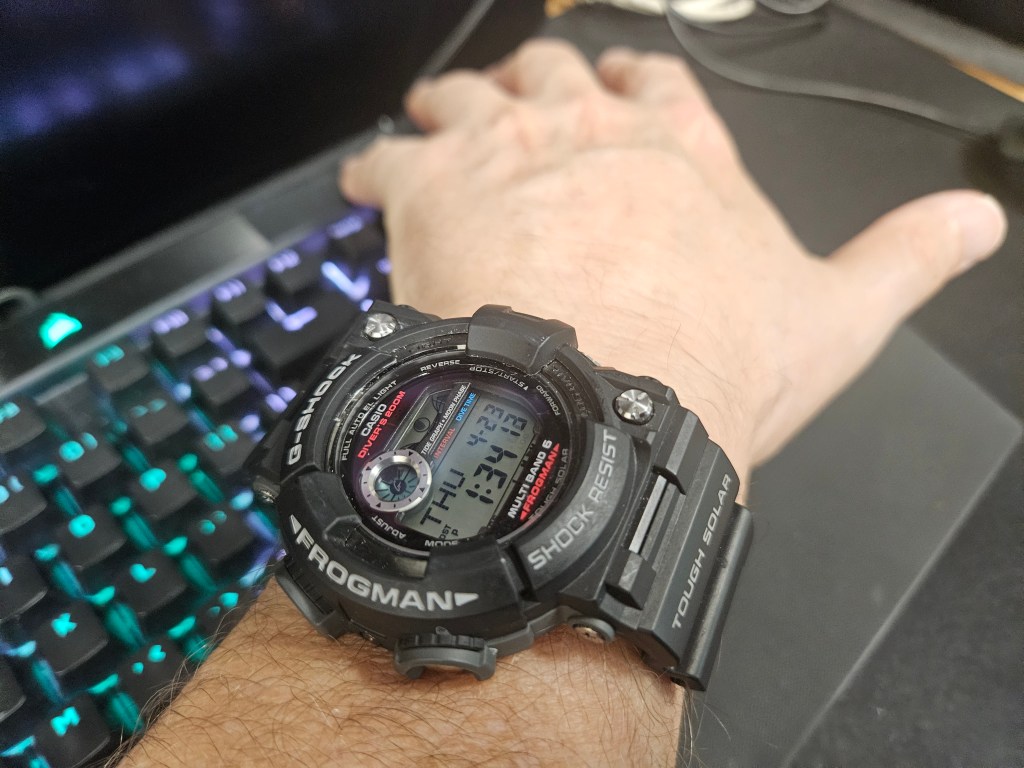
    I have friends in the watch community who insist that “G-Shocks don’t count.” When they tally their collections, the squares and Frogmen are quietly left off the ledger. This is the G-Shock Exemption Doctrine—the unwritten rule that allows a collector to treat a G-Shock not as a watch, but as equipment, like a flashlight or a multi-tool. By this accounting magic, the collection remains disciplined, curated, respectable—untainted by the bulky, indestructible contraption sitting in the sock drawer, waiting for duty.

    The doctrine creates a bright border. On one side: mechanical divers, chronographs, heirlooms, objects of taste and tradition. On the other: the G-Shock. Yes, it tells time. But in the same way a Swiss Army knife contains scissors—it’s almost beside the point. To call a G-Shock a watch, in their view, is like calling a tricycle a bicycle. It operates in a different category of the brain, one less concerned with heritage and more concerned with survival, utility, and the quiet thrill of overcapacity.

    The psychology isn’t new. In the mid-1970s, the same reverence surrounded Texas Instruments calculators. They didn’t just crunch numbers; they conferred identity. The kid holding one wasn’t merely doing math—he was running systems. The G-Shock carries the same voltage. Atomic time. Solar charging. World time. Shock resistance. It doesn’t just tell you the hour; it implies operational readiness. You are synchronized, optimized, prepared—never mind that your most hazardous assignment today is grading essays or standing in line for almond milk. Press a button, and disorder yields to data. The fantasy is intoxicating: beneath the ordinary exterior lives a man quietly managing advanced capabilities.

    And the appeal goes deeper. The G-Shock is engineered for soldiers, divers, and field operators. It speaks not only to the analytical mind but to the tactical imagination. This is the fusion of Intellectual Man and Action Man—the spreadsheet warrior who is also, at least psychologically, deployment-ready.

    That’s the real divide. Mechanical watches point backward—to history, romance, and the comforting gravity of tradition. The G-Shock points forward. It belongs to the future, a small armored console strapped to the wrist, promising that whatever comes next, you will be ready for it.

  • When Bold Becomes Desperate: The Toxic Green Frogman I Didn’t Buy

    When Bold Becomes Desperate: The Toxic Green Frogman I Didn’t Buy

    The limited-edition G-Shock Frogman GW-8200TPF-1 is called the “Three-Striped Poison Dart Frog,” a name that tells you everything you need to know. Its case and bezel are streaked in oily black and radioactive neon green, a visual homage to the rainforest amphibians whose skin carries enough toxin to tip a hunting arrow. The watch doesn’t whisper. It hisses. It looks less like a timepiece and more like something that escaped from a biohazard lab. And I have to admit: I could see it on my wrist.

    Which is precisely the problem.

    I am sixty-four years old. This watch belongs on the arm of a young man who still believes the world is a stage and he is the headliner. On me, it risks reading like a cautionary tale. I picture myself as the suburban retiree on a zebra-striped Harley, shirtless under a leather vest, ponytail fluttering, ears weighed down with fishing-lure jewelry. Not rebellion—neediness. Not confidence—pleading. In this light, the Poison Dart becomes what I now recognize as a Final Cry Watch: the late-career purchase meant to shout, I’m still dangerous, when the quieter truth is that one is negotiating a truce with time.

    And yet the attraction persists. That’s the uncomfortable part. Awareness does not cancel desire; it merely narrates it. A part of me even welcomes the idea of restraint—the sedation that comes from declining the spectacle, choosing dignity over fluorescent self-advertisement.

    In the end, what saved me was not wisdom but suspicion. That dramatic spray coating—how long before it fades, chips, or peels? And when the neon begins to die, what remains? Not a bold statement. Not a heroic relic. An Insult Watch—a once-loud object aging badly, like a midlife impulse left out in the sun.

    So the purchase died where many impulses should: in the quiet courtroom of anticipated regret. The Poison Dart remains what it probably was all along—not destiny, not transformation, just a bright, dangerous flirtation with caprice.