Category: Confessions

  • Reginald, Kent, and the Shark-Infested Sea of Self-Improvement

    Reginald, Kent, and the Shark-Infested Sea of Self-Improvement

    Last night, I dreamed I was twenty again. I was in attendance at a spectral dinner party filled with strangers and vague regret. I was young again, which is to say, raw and restless, clutching a satchel full of unformed ambitions and unfiltered loneliness. 

    A wealthy young man appeared, oozing charisma and vaguely European cheekbones, a demigod of fashion and cosmetics, the kind of person whose cologne smells like entitlement. He leaned in and offered me a revelation disguised as skincare: two miracle creams. One, to be applied to the crown of my head, was called Reginald. The other, for my back, was Kent. He spoke of them with the hushed reverence usually reserved for ancient scrolls or Swiss watches. These weren’t mere moisturizers—they were spiritual lubricants. Balms that promised not just hydration, but orientation. 

    Then, as if summoned by a higher capitalist calling, he vanished mid-conversation, leaving me with a business card and a lead on where to find a lifetime supply—somewhere by the sea. And so began the quest.

    To be worthy of Reginald and Kent, one had to wear formal attire, because of course one did. I found myself in a tailored black suit, wading through surf with fellow seekers, sharks gliding around our ankles like corporate anxieties. I held my leather dress shoes in hand, lest the saltwater stain them—a fool’s hope, given the bloodthirsty tide. Later, I caravanned with aging rock royalty—Peter Gabriel, Jackson Browne, Boz Scaggs—who casually discussed their rendezvous plans in Capri or St. Barts. For a moment, I basked in the illusion of belonging. But as the conversation turned to private jets and generational wealth, the truth descended: I was no musician. I had no bookings. My only claim to transformation lay in acquiring my precious creams.

    The journey devolved into a surreal slog. It rained as I crossed a deserted college courtyard. My business shoes were doomed. A younger version of S—someone I wouldn’t meet until decades later—appeared like a ghost from my professional future, pointing the way with a sense of urgency. I ran, I hitchhiked, I boarded phantom trains, only to land back at the shark-infested beach, no closer to the mythic Land of Body Cream. 

    Then, through the humid haze of beachside commerce and quaint seaside cafes, I saw Rachel—yes, that Rachel—from a hot tub party in Livermore, 1988. 

    Seated at a weathered café table under a string of flickering patio lights, I unspooled my sorrow before her, pouring it out like a battered thermos with a cracked seal—dripping, lukewarm, and uninvited. I mistook my own rawness for profundity, believing that the sheer weight of my unfiltered confession would conjure tenderness, maybe even love. But Rachel didn’t flinch. She studied me like a dissection project and began her work with clinical precision. Her words carved deep and clean, a verbal autopsy that exposed every rot-soft corner of my character. And just when I thought the vivisection complete, she found new organs of dysfunction to prod and slice. Her fury wasn’t wild—it was righteous, surgical, sustained.

    She stormed off, heels tapping out a verdict on the pavement. I sat stunned in the wreckage of myself, staring at the space she had vacated, still warm with contempt. That’s when the restaurant owner appeared—a woman with the weary kindness of someone who’s witnessed too many romantic collapses and kept score. She told me she’d filmed the entire scene. “You’ll want to study this,” she said, handing me the video with a nod toward the attic stairs. “It might help.” I obeyed without a word.

    I climbed into that attic, its rafters bowed with time, and watched the footage on an aging monitor. Again and again. I rewound every insult, paused on each flinch of mine, cataloged every truth she hurled like a polished blade. It became my gospel of failure. I spent the rest of my life up there—alone with my ghosts and her voice—striving to earn back something I’d never really had: the right to reenter the world and claim Reginald and Kent, the sacred creams of redemption I still believed might set me right.

  • Open House: A Dream of Chaotic Enlightenment

    Open House: A Dream of Chaotic Enlightenment

    Last night, I dreamt that my wife and twin daughters converted our quiet domestic haven into a full-blown educational commune for the neighborhood. The front door was flung open like we were hosting a TED Talk and a bake sale simultaneously. Strangers streamed through the kitchen in orderly lines, signing up for courses with the brisk determination of people enrolling in Pilates or personal enlightenment. No one had asked me. No one had told me what the curriculum was. My role? Apparently, ornamental.

    But oddly enough, I didn’t throw a tantrum or fake a migraine. Instead, I adapted. I bought a new outfit—something suitably intellectual yet vaguely cinematic—and began holding spontaneous salon-style lectures in the bedroom, where I engaged in hushed conversations with film critics about the forgotten brilliance of F. Scott Fitzgerald. I planted my flag on “Winter Dreams,” declaring it the Rosetta Stone of his genius. While chaos bloomed in the kitchen and children shrieked over multiplication tables or modern dance or whatever anarchic pedagogy my family had cooked up, I stood in front of my closet planning my next wardrobe change like a one-man off-Broadway production.

    My lectures—always held in the bedroom, never the common areas—became my sanctum. The rest of the house was a beehive of subjects I neither taught nor understood. Adults hunched over tables. Kids ran mock elections. My family presided over it all with evangelical confidence, while I stayed in my curated corner, delivering monologues in crisp linen. The living room had been repurposed into something between a Montessori lab and a call center. It was, frankly, terrifying.

    What astonished me most was not the unannounced academic uprising, but my unexpected willingness to go along with it—as long as I could dress the part. Normally, I recoil from hosting so much as a dinner party, but here I was, participating in a family-led movement to educate the masses. Maybe I was possessed. Or maybe I’ve reached a stage in life where purpose can be borrowed, like a blazer, so long as it fits well and looks good under good lighting.

  • Groats, Greens, and the Gospel of Self-Control

    Groats, Greens, and the Gospel of Self-Control

    I’m a man prone to obsessions. Not in a cute, quirky, Wes Anderson way, but in the full-blown, white-knuckled grip of irrational fixations that orbit around some grand illusion of self-improvement. These fixations rarely tether themselves to anything as vulgar as reality, which means I have to approach them like a man handling live wires—gingerly, skeptically, with rubber gloves and a fire extinguisher nearby. My latest obsession? A brutally austere, monastic eating plan masquerading as discipline but smelling faintly of madness.

    The rules are simple, almost religious in tone: three meals a day. No snacks. Breakfast is a steaming bowl of steel-cut oats doped with vanilla protein powder and berries. Lunch: buckwheat groats, same protein powder, same berries, different bowl. Dinner: a joyless, crunchy salad of cucumber and bell pepper crowned with sauteed tofu and doused in a dressing so puritanical it could double as penance—balsamic vinegar, Greek yogurt, nutritional yeast, and a blizzard of righteous herbs. To add some zing, I’ll dump a tablespoon of Trader Joe’s Italian Hot Bomba Sauce to give me a lifeline to joy and pleasure. 

    But here’s the rub: the long, harrowing stretch between lunch and dinner. That’s when the madness starts to whisper. Could green tea keep me afloat? Coffee? A heretical diet soda or two? These are the thoughts of a man trying to barter with his own obsession, bargaining with the jailer who’s taken his afternoon hostage. I pretend it’s hunger, but what I’m really feeling is the hollow buzz of addiction to a narrative: that if I follow this sacred routine, I will unlock a better, lighter, more transcendent version of myself.

    Of course, it’s likely just another chimera—one more shimmering lie I chase like a half-crazed mystic in a Whole Foods aisle. I suspect I don’t actually change. I just trade compulsions. Some people devour cheesecake. I devour grand narratives of control, discipline, and spiritual rebirth through groats and greens. My real diet isn’t food—it’s fantasy. And I am a glutton.

  • Royal Palm Mirage: A Midlife Fantasy in Flip-Flops

    Royal Palm Mirage: A Midlife Fantasy in Flip-Flops

    I am in agony—real, soul-bruising agony—because for the past few months, I have been drunk on the seductive fumes of a dream: early retirement in Royal Palm Beach, Florida. Not Palm Beach proper—no, that would be too garish, too Gatsby. I mean the inland cousin, fifteen humid miles from the Atlantic, nestled inside a gated community with a neighborhood pool, a bubbling hot tub, and the promise of palms swaying while my family lounges like extras in a Jimmy Buffett fever dream.

    This fantasy has infected my sleep, crept into the margins of my Google Maps history, and left me hypnotized by listing photos of stucco homes with outdoor ceiling fans and screened-in lanais. I dared to believe I could trade my overworked California existence for a new life—a life of 5 a.m. swims, grocery runs in flip-flops, and the quiet joy of hearing my daughters say, “I’m bored,” while floating in chlorinated bliss.

    And then—smack. My wife crushed the dream with one phrase: “Florida’s a big no.”

    Just like that, the mirage dissolved. I am at the age—let’s not name it—where the idea of fleeing to a tropical holding cell with reliable AC and an HOA that enforces silence after 9 p.m. sounds not just reasonable but romantic. But maybe that’s the trick. Maybe Florida isn’t salvation. Maybe it’s a siren song crooned by real estate agents with perfect teeth and mosquito-resistant tans.

    Next week we fly to Oahu, and yes, I hope my family finds some version of the enchantment I’ve been chasing. But let’s be honest: deep in the humid corners of my heart, I’ll still be yearning for Royal Palm Beach—a gated Eden with pool rules and a hot tub that works.

  • Chunky: The Candy Bar That Gaslit My Taste Buds

    Chunky: The Candy Bar That Gaslit My Taste Buds

    Of all the confections that have ever graced my palm, none haunts my imagination quite like the Chunky bar. It’s not a candy bar so much as a relic—an absurd, silver-foiled ingot you’d expect to pry loose from a cursed dwarven mine, guarded by balrogs and bureaucracy.

    Let’s start with the shape. The Chunky is a squat, lumpy pyramid—a candy bar built like it wants to be a paperweight. Peanuts and raisins form the bulk of its crude alchemy, though earlier iterations flaunted Brazil nuts and cashews, adding to its ancient mystique.

    The taste? Off. Not bad exactly, but certainly not seductive. Its faintly bitter, vaguely disappointing flavor has a curious effect: you start to convince yourself that this underwhelming mouthful must be good for you. A health food in disguise. A sweet for contrarians. Like chewing on moral fiber.

    Then there’s the weight. The Chunky carries mass. It sits in your hand with the cold confidence of a Seiko diver watch on a stainless-steel bracelet. There’s a heft to it—an aura of seriousness. No one double-fists a Chunky on a whim. You eat one as an act of personal philosophy.

    To deepen its enigma, the Chunky has become scarce. Since the ’90s, it’s been largely exiled from gas station shelves, spotted only in the digital wilds of the Internet. It’s no longer a candy bar—it’s a rumor. A memory. A grail. And even when you do track one down and unwrap it in a moment of nostalgic triumph, you’re struck with the bitter realization: you’re not reliving a taste. You’re chasing a ghost.

    The truth is, you’re more in love with the idea of the Chunky bar than the thing itself. Its greatest ingredient is projection. It is candy-as-concept. The chunky grail.

    And so, like a certain kind of watch obsessive—those who hunt for the mythical One Perfect Timepiece, the Holy Grail Diver that will satisfy all wrist cravings—you may find that what you’re after is not an object, but an ideal. The Chunky isn’t a candy bar. It’s a mirror. A reminder that the real addiction lies not in sugar or steel, but in fantasy.

  • The Pool of Sorrow, the Magic Towel, and the Heavy-Duty Radio

    The Pool of Sorrow, the Magic Towel, and the Heavy-Duty Radio

    Last night, I dreamed I was nineteen again—muscular, misfit, and miserably alone. In this grim redux of my youth, I spent my days floating in what I now call The Pool of Sorrow, a sunlit rectangle of water where I wept at the shallow end, pressed against the concrete like a man sentenced to purgatory via chlorination. Beside me sat a black labrador, nameless but noble, whose soft howls echoed my despair. I stroked his damp fur. He leaned into my touch. We were two abandoned souls, bound by melancholy and mutual need.

    Something changed. Maybe it was the dog’s quiet loyalty, or the absurd beauty of the moment. I returned to bodybuilding with manic fervor and resumed clean eating as if redemption could be measured in grams of protein. My body sculpted itself back into its mythic prime, and soon I was posing poolside in black-and-white glamour shots—oiled up like a Greek statue, grinning with an almost religious clarity. The dog watched my transformation with admiration, tail thumping like a metronome of approval.

    Now that I looked like a well-oiled demigod, I needed to promote myself. I searched the streets of San Francisco for an influencer. I found him in a San Francisco alley behind a velvet curtain. Tom Wizard. Pale, lanky, vaguely elfin, Tom agreed to help me make my photos go viral. But there was a catch. “You love the dog too much,” he warned. “Be more aloof.”

    Naturally, I did the opposite. I hugged the dog. Whispered sweet canine nothings. Called him my soulmate. Tom watched this display of defiance and smiled like a gatekeeper pleased with an unexpected answer.

    “You’ve passed the Dog Test,” he said, handing me two gifts. The first: a large, coral-orange Magic Towel, woven with healing properties. It could dry you off and erase your deepest psychological wounds. The second: admittance to a Harvard night class where I’d learn to wield the towel’s powers properly.

    Harvard, it turns out, was a dump. The class was run by Professor Kildare, a stout bureaucrat with the warmth of a refrigerator. He vanished often—wrapped up in legal issues—leaving the course in the calloused hands of three grad students who resembled hungover dockworkers. They smoked indoors, bickered about their failed marriages, and offered nothing resembling instruction.

    In that dimly lit classroom, I met a woman who looked exactly like Sutton Foster. She whispered that her eczema came from childhood trauma. I swore on my Magic Towel I’d cure her. She believed me. That was enough.

    One day, one of the grad students—Jimbo, a lemon-faced scowler in sun-bleached overalls—presented a radio. “Useless junk,” he said. “Dead as a doornail.”

    I stood, seized the radio, adjusted its telescopic antenna, and revealed its miraculous clarity. Music blared. Static disappeared. Everyone gawked like I’d just raised Lazarus with a dial.

    Jimbo lunged for it. I blocked him. “You had your chance,” I said. “This radio is mine now.”

    I flapped the Magic Towel with dramatic flair. A colossal truck, part semi, part spaceship, pulled up outside. Sutton and I climbed its twenty-foot ladder toward the cockpit. Jimbo and his cronies gave chase, but I yanked the ladder up behind us, sending them tumbling like sitcom villains. The truck roared to life.

    Sutton sat beside me, silent but radiant with hope. The Heavy-Duty Radio crackled softly behind us, the Magic Towel folded in my lap like a relic of prophecy. We barreled into the night. I didn’t know if I could cure her eczema or heal her past, but I knew this: I had a truck, a towel, a miracle radio, and a mission. And sometimes, that’s enough.

  • Heaven, Apparently, Has a Library

    Heaven, Apparently, Has a Library

    A month ago, I dreamed I was already in heaven—which is to say, I was somewhere astonishing and didn’t realize it, because apparently that’s the human condition.

    It started in a classroom, naturally. I was teaching at a college that felt familiar but off—like a liberal arts Hogwarts or a Wes Anderson remake of Dead Poets Society. The students were unnervingly sharp. Not freshmen. These were postgrads of the soul—opinionated, caffeinated, and engaged with the material in ways that implied they’d actually done the reading.

    We were knee-deep in discussion when I glanced out the window and saw the rain falling—not pelting, but gliding, like silk scarves from the sky. I drifted for one moment. That was all Tim Miller needed.

    Tim, a student and part-time podcast prophet, seized the room like a man born to lecture. He told everyone to open the expensive blue textbook. The one I assigned. The one I had never read. I stared at the cover like it was an unfamiliar casserole I’d brought to a potluck. “What did you think?” I asked, bluffing. “It’s okay,” they said. The academic equivalent of a shrug at your own funeral. I nodded, defeated, and dismissed them early—a mercy for us all.

    Outside the door, a nearsighted colleague half my age pushed a convoy of book carts like a noble foot soldier. I offered help. He smiled, already finished. I was obsolete, politely.

    I wandered the campus like a ghost who hadn’t been told he was dead. Then I saw it: a green coffee mug I’d left behind earlier, now glowing like a sacred artifact on a forgotten table. I snatched it and jogged through the rain to the library. I placed it on a windowsill with reverence, and two librarians appeared—silent, reverent, stunned. I’d returned the Holy Mug. They smiled as if I’d cured blindness.

    Still raining. Still warm. Still beautiful. I pulled out my phone—also green, because apparently I was living inside an emerald dream. It was dusted with beach sand, and I wiped it down like it was a relic I wasn’t worthy to hold.

    I wasn’t driving. I never drove. Why ruin the moment? I walked. Five miles, barefoot, maybe. The rain was gentle, more sacrament than storm.

    Then, through the mist, I saw my home.

    Three pyramids, each one the size of a small mountain, woven from stone in purple and gold. They spiraled into the sky like something the gods forgot to take with them. I’ve always loved purple. It makes sense now. But the gold—that was new. I’ve spent a lifetime disliking gold. Too gaudy. Too Trump Tower. Too cheap. But this gold wasn’t decoration—it was divine. It pulsed. It whispered. It glowed like it remembered being forged in the heart of stars.

    And it hit me.

    I lived there. In that zigzagged trio of pyramids, tucked in the mist. It was mine. I’d always been there. Somehow, until that moment, I’d failed to see it.

    Then I woke up.

    No rain. No pyramids. Just me, blinking in the early gray, stunned by the feeling that I’d glimpsed something holy and managed to mistake it for Tuesday.

    And I wondered: How much of life am I sleepwalking through? What miracles have I mislabeled as mundane? What if heaven isn’t a reward but a frequency we forget to tune in?

  • Welcome to Kayfabe Nation: A Field Guide for Curious Aliens

    Welcome to Kayfabe Nation: A Field Guide for Curious Aliens

    This morning, somewhere between my second cup of coffee and the fourth grim scroll through the news, I found myself pondering a hypothetical: If a space alien—curious, polite, perhaps with a clipboard—landed in my front yard and asked me, a nearly 64-year-old American, “What’s it like living in your country right now?,” I wouldn’t start with the Constitution or the national parks. I’d hand them a copy of James B. Twitchell’s Carnival Culture: The Trashing of Taste in America, a book I read back in 1992 when I was thirty and still believed things might get better.

    Twitchell’s argument was that television had ushered in a golden age of vulgarity—mainstreaming spectacle, flattening culture, and celebrating the lowest common denominator. What was once fringe now strutted center stage. That was 1992. It feels almost quaint now.

    This week, I’ve been soaking in evidence that Twitchell was merely outlining the overture.

    This morning, I read Tyler Foggatt’s New Yorker piece, “‘South Park’ Skewers a Satire-Proof President,” which examines how Trey Parker and Matt Stone are still hacking away at American grotesquery with their chainsaw of satire. 

    After watching Season 27, Episode 1, I found myself genuinely wondering how they haven’t yet been exiled to some kind of digital gulag. The episode’s venom is so precise, so nihilistically cheerful, it left me staring at the screen with a mixture of admiration and dread. How do you parody a culture that’s already parodying itself?

    That same night, my wife and I watched Shiny, Happy People: A Teenage Holy War—Season 2, Amazon Prime. Enter Ron Luce, a religious demagogue who recruits teenagers into his personal holy war by dressing them in camo and screaming at them through bullhorns as they crawl through canals full of hissing cockroaches. I turned to my wife and said what I now believe is the most accurate possible take: “Ron Luce is the Vince McMahon of religion.”

    Because here’s the thing: Vince McMahon isn’t just a wrestling promoter. He’s the high priest of American kayfabe—the architect of performative outrage, cosplay masculinity, and spectacle-for-spectacle’s-sake. He’s built an empire on screaming, sweating, soap opera buffoonery, and somehow, that aesthetic now defines everything: politics, YouTube, fringe churches, presidential rallies, TikTok evangelists. 

    McMahon didn’t just influence culture—he became it. If aliens really want a crash course in America, forget Mount Rushmore. Start with Mr. McMahon, the Netflix docuseries. Then draw a direct line to our histrionic politics, our teen-traumatizing spiritual boot camps, our screaming demagogues who mistake performative frenzy for moral clarity.

    The real problem with cosplay—whether it’s in the ring, the pulpit, or the Senate—is that eventually, the performers forget they’re performing. They fall into kayfabe coma. They live the lie so long they forget how to take off the mask, and eventually, they become the mask. What starts as theater curdles into delusion.

    I used to mock the NPR crowd—those genteel sippers of Bordeaux and tote-bagged reason—but I’ve come around. The quiet, the moderate, the civil? They may be our last tether to sanity. Watching Parker and Stone slap their thighs in manic glee may give us a few much-needed laughs, but it’s not curing anything. It’s not even slowing the spiral. It’s gallows humor on a tilt-a-whirl.

    If the aliens ask me what America’s like, I’ll tell them: It’s a deeply unserious country drunk on its own cosplay, where the line between performance and reality has vanished, and where kayfabe is our national religion.

    And then I’ll offer them a donut and a copy of Carnival Culture.

  • How a Seiko Stole My Attention Poolside

    How a Seiko Stole My Attention Poolside

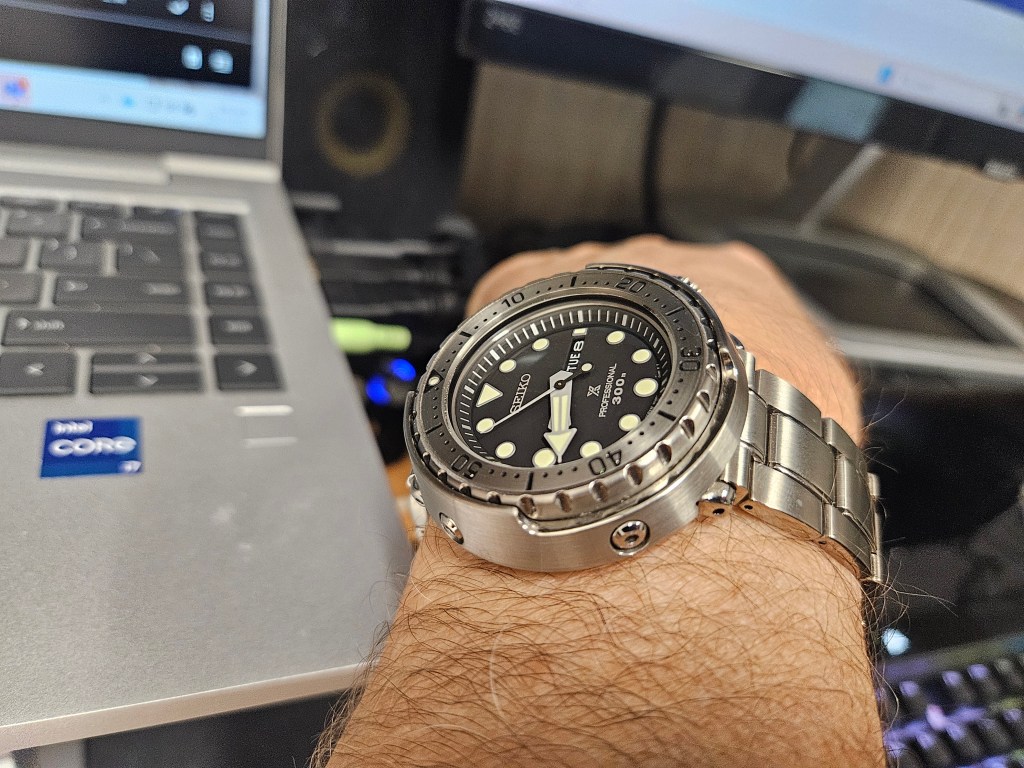
    Yesterday at high noon, the DHL courier arrived like a horological Santa Claus, delivering my latest obsession: the Seiko SBDC203, better known—if not memorably—as the Coastal Wave Diver. The timing was perfect. With the watch in hand (and on wrist), I could head to my in-laws’ pool in Long Beach with the appropriate mix of family warmth and flex-worthy wrist presence.

    Naturally, I strapped it on immediately, opting for the black Divecore, a pairing so tasteful I nearly congratulated myself aloud. Once poolside, however, I became utterly useless to the people around me. The watch, that seductive little chameleon, kept shifting shades in the light—silvery, gunmetal, ocean deep. Every glint felt like a private epiphany. Conversations swirled, but I absorbed none of them. Someone could’ve told me they were moving to Croatia—I wouldn’t have noticed unless they wore something with brushed stainless steel.

    And yet, my biggest existential crisis wasn’t aesthetic—it was numerical. The model number: SBDC203. My brain, already cluttered with references to my MM300 SLA023, couldn’t process another Seiko sequence. The digits tangle in my head like a bad dream about filing taxes or trying to memorize your kid’s Wi-Fi password. It’s as if my watch obsession has now spawned a case of reference number dyslexia.

    Still, I believe I’ll recover. In the meantime, I’ll keep staring at this radiant beast and pretending that SBDC203 isn’t just a random string of characters from a parts manual—but a sacred sigil on the bezel of happiness.

  • Calories in a Dream Don’t Count: A Glutton’s Redemption Story

    Calories in a Dream Don’t Count: A Glutton’s Redemption Story

    Last night I dreamed myself into a surreal mashup of The Great British Bake Off, Yellowstone, and a calorie-induced nervous breakdown.

    It began at a retirement party for D, a former colleague who had apparently left academia behind to study gourmet pastry arts in Europe. Now reborn as a culinary goddess, she presided over a dining room that looked like it had been styled by a Michelin-starred fever dream: trays of deconstructed brownies arranged like abstract sculpture, sourdough donuts with the texture of warm clouds, cinnamon rolls coiled with existential menace, and a chocolate cake so dense it might have had its own gravitational field.

    In the corner sat a magical grand piano, humming with faint luminescence. I was meant to play it—perhaps to provide ambiance for the pastry rapture—but I never made it past the donuts. They called to me. I answered with both hands and minimal dignity.

    Mid-binge, I was struck with a bolt of dietary guilt. I remembered I had a dinner date with my wife at her best friend C’s house. Worse, it wasn’t just any dinner—it was a social obligation. I arrived in C’s oversized dining room to find the ghost of a party long gone. Tables were abandoned like an upscale Pompeii, the air buzzing with lazy flies circling over still-warm piles of food: chicken pot pies glowing under golden crusts, French dips bleeding delicious regret, carne asada tacos wafting guilt into the air, and blueberry pie with a lattice crust so precise it looked like it had been braided by angels.

    I ate. With one hand I fed myself; with the other, I held my phone to my ear, explaining the situation to my wife. She responded with calm detachment: “When you’re done, meet us in Montana.”

    Of course. Montana.

    I was then transported—no explanation needed, dream logic intact—to a bustling Montana restaurant. I wandered from table to table in search of my wife, passing clusters of archetypes: the Trust Fund Cowboy, the Patagonia-clad Nutrition Mystic, the Ex-Brooklyn Homesteader. They were deep in conversation about the social fault lines of modern Montana. At one table, a blonde woman lectured an enraptured audience. “There are only two kinds of people in Montana,” she declared. “Old-comers and New-comers. And the old-comers don’t want anyone else coming.”

    Enter my friend Mike—ex-Navy SEAL, tropical city-builder, and walking rebuttal to provincial snobbery. He appeared like the Deus ex Machina he is, still radiating heat from his last humanitarian war-zone operation.

    I turned to the blonde know-it-all. “Mike’s a new-comer,” I said, “but he built an entire city in the tropics in under forty-eight hours. Not only could he settle in Montana—he could govern the state.”

    Silence fell. Victory was mine.

    But before I could savor the moment, I was ambushed by a different horror: the specter of calories consumed. The desserts at D’s party, the savory gluttony at C’s—how much damage had I done? Had I ruined months of progress? Was I now one sourdough donut away from emotional collapse?

    And then I woke up. The sweat was real. The calories were not.

    Relief washed over me like cold Montana spring water. My body was intact. My diet undisturbed. I had survived the sugar apocalypse, and all of it—Mike, Montana, the magical brownies—had happened in the safe, consequence-free realm of REM sleep.