Category: Confessions

  • The Gospel of Iron: How Weightlifting Became My Religion

    The Gospel of Iron: How Weightlifting Became My Religion

    In 1974, at the age of thirteen, I began weightlifting under the guidance of Lou Kruk, my junior high P.E. teacher and Junior Olympic weightlifting coach. Lou wasn’t just teaching kids to hoist iron—he was shaping futures. He handed me a barbell and lit the fuse. Soon, I was consuming protein powders and flipping through Strength & Health and Muscle Builder, the gospel according to Bob Hoffman and Joe Weider.

    From garage gyms to commercial ones, from clunky bench presses to rusted barbells, I trained. I flirted briefly with gimmicks—a Bullworker here, a Power Yoga phase there—but nothing kept me grounded like the iron. Eventually, I found kettlebells: odd, compact, brutally effective. And fifty-one years later, I’m still at it. The protein, the lifting—they’re no longer habits; they’re rituals.

    I don’t work out to chase aesthetics or to stave off decay. I train because not training feels like suffocating. My routine gives shape to my days, the way grammar gives shape to language. Without it, life would collapse into chaos. I marvel at those who drift through their hours without structure, snacking at whim, binge-watching shows, darting between texts and chores like pinballs. A life without scaffolding feels not just unsatisfying—it feels dangerous.

    Sometimes I wonder: what if I’d never met Lou Kruk? What if weightlifting had never entered my life? Would I have found some other sacred structure to cling to, or would I have been swallowed by drift? Yes, I play piano. Yes, I write. But I’m no professional writer unless you count me as a “professional navel-gazer.” These activities are merely sidelines—dilettante pursuits. It’s the iron that makes me whole.

    Maybe weightlifting saved my life. Maybe it still does. I could psychoanalyze this, wax poetic about addiction to ritual and the fear of entropy. Or I could walk into the garage, chalk my hands, and get lost in goblet squats and Turkish Get-Ups until the world makes sense again. I think you already know what I’m going to choose.

  • Camry vs. Accord: A Meditation on Spec Sheets, Obsession, and the Art of Manspreading

    Camry vs. Accord: A Meditation on Spec Sheets, Obsession, and the Art of Manspreading

    One of my favorite pastimes—oddly specific and strangely soothing—is watching YouTube comparison videos of the Toyota Camry vs. the Honda Accord. I’m not car shopping. I don’t need a car. I may never buy another car. But these videos are my digital comfort food. They’re as satisfying to me as fine wine is to a sommelier or apple pie tastings are to a pastry chef—only instead of tasting notes, I savor engine specs and torque curves.

    There’s something singular about the Camry-Accord rivalry. In the sedan world, these two are the Goliaths. It’s not just another car comparison. It’s the comparison. Watching these two go head-to-head year after year is like seeing the best Steelers team take on the peak Patriots in a Super Bowl that never ends. Everything else—BMW vs. Mercedes, Rolex vs. Omega—feels less pure. BMW and Mercedes aren’t in the same pricing tier. Rolex exists in a brand vacuum. And while coffee maker comparisons have their niche charm, they lack the existential gravity of Camry vs. Accord.

    No rivalry inspires more content—or more heated debate. YouTube is flooded with these matchups, and if you scan the view counts, it’s clear: Camry vs. Accord is the king of consumer showdowns. Reviewers comb over the details with forensic intensity—fuel economy, powertrain specs, road noise, trunk space, rear-seat legroom, infotainment ergonomics, ride comfort, styling. They break it down like seminary students parsing Greek New Testament syntax.

    But what really fascinates me is the comments section, where strangers proclaim their loyalty with righteous conviction. Owners justify their purchase with religious fervor, deploying cherry-picked data to reinforce their superiority. It’s a textbook case of post-purchase rationalization: that psychological reflex where we inflate the virtues of what we bought to feel smarter, savvier, and self-assured.

    One commenter might praise the Accord’s refined cabin and roomier interior—but add that its exterior is so bland, driving one is akin to living as an NPC. Another insists Camry’s superior sales figures are proof of its aesthetic and mechanical dominance. Some dismiss the Accord entirely, predicting its extinction in five years. Others proudly declare they’re on their fifth generation of the same car, with brand loyalty woven into the fabric of their identity. For these drivers, the car isn’t a tool—it’s family.

    Ultimately, this rivalry isn’t really about cars. It’s about identity, tribalism, and the human need to choose a side and be right. It’s a Dr. Seussian fable in metallic paint: one team wears Honda badges, the other wears Toyota, and both believe their side represents reason, taste, and truth.

    For those of us with no appetite for political tribalism, this is our outlet. Camry vs. Accord is safer ground—less polarizing than politics, but don’t tell that to a diehard on either side. Watch how they argue: calmly, firmly, methodically—as if their livelihood depends on selecting the superior midsize sedan. They approach the debate with the solemnity of theologians discussing substitutionary atonement or post-mortem salvation.

    And me? I’m both relaxed and riveted. The debate calms my nerves and sharpens my focus. For a glorious hour, as I parse suspension tuning and rear-seat headroom, my worries dissolve. My thoughts narrow into something blissful. I study the specs like they’re verses from Leviticus. And in that deep focus, my anxiety lifts.

    Then it hits me: I don’t actually want the car—I want the focus. The Camry and Accord are just proxies for obsession. They’re placeholders in the temple of hyper-attention. Some people do yoga. I watch two middle-aged men compare infotainment systems like Cold War arms inspectors.

    And I do this with full self-awareness. I said earlier I might never buy another car. That wasn’t entirely true. My wife owns a 2014 silver Honda Accord Sport. I drive a 2018 gunmetal gray Accord Sport. We’re a two-Accord household. When it comes to car-buying, I’m conservative by nature—and what’s more conservative than buying a Camry or an Accord?

    I’m nearly certain our next car—whether hers or mine—will be one of the two. Likely an Accord, given that I’m six feet tall, 230 pounds, claustrophobic, and deeply committed to driver’s seat manspreading. The Accord gives me room to sprawl. The Camry? Not so much. I know this because, during a San Francisco vacation, an Uber driver picked us up in a brand-new Camry. It looked sleek from the curb, but once inside I felt like I was strapped into a fetal position. The experience ruined the car for me.

    And yet, I want to love the Camry. I really do. In my ideal life, my driveway would have both: the Camry and the Accord parked side by side like yin and yang. One the smooth operator, the other the sensible sibling. Their competition makes each better. Their rivalry sustains them both—and keeps me obsessively circling the rabbit hole.

    Because in the end, the Camry vs. Accord battle isn’t just about choosing a car. It’s about longing for clarity in a world of noise. It’s about choosing sides, rationalizing decisions, and pretending—for a few hours on YouTube—that the world makes sense if you can just pick the right sedan.

  • Watch Ownership Is a Letdown; Research Is the High

    Watch Ownership Is a Letdown; Research Is the High

    One of my favorite pastimes is watching YouTube comparison videos of the Toyota Camry vs. the Honda Accord. I’m not shopping for a car. I don’t need a car. I may never buy another car. 

    But these videos? They soothe the savage beast inside of me. They go down like a smooth bourbon, with notes of ABS braking and a smoky finish of fuel economy.

    While others go to YouTube to meditate or do yoga, I fall into the hypnotic cadence of two grown men comparing rear-seat legroom and infotainment systems with the solemnity of Cold War negotiators. 

    I’m riveted. Parsing the pros and cons of these two sedans gives me a focus so intense it borders on religious ecstasy. I study engine specs like they’re verses from Leviticus. My concentration sharpens, my anxiety fades. I am, for a brief and blissful moment, free.

    And then it hits me: I don’t want the car. I want the focus. The Camry and Accord are just placeholders in the temple of obsession.

    This revelation sheds light on my watch obsession. It helps me realize that acquiring a watch in most cases is a bitter letdown. A $3,000 watch on the wrist is like a Tinder date at Denny’s: out of place and super embarrassing. 

    I’ve worn $5,000 watches while taking my daughters to YogurtLand and I’ve said to myself, “Dude, you’ve lost the plot.”

    How did I get here with expensive watches that I wear when I’m buying pretzels and diet soda at Target?

    And then I realize. The same drive to focus on Camry-Accord comparisons is the same drive that makes me do “timepiece research.”  Watching my fellow timepiece obsessives drool over bezels and lume shots is the real high. That’s what lights me up. That’s what gets the adrenaline surging through my veins. 

    I’ve spent years confusing consumer acquisition with personal transformation. Getting this thing or that thing will change me inside. I want to be courageous, dignified, courteous, disciplined, fit, and healthy. A watch can’t redeem me. It can’t make me whole. It can’t make me the person I wish I were. Not once have I ever put a new watch on my wrist, gave my wife a wrist shot, and said, “Look, honey, I’ve achieved a metamorphosis.”

    She’ll just look at me and say, “Dude, clean the leaves out of the rain gutters.”

    The material thing in my hands is a letdown because what I really want is the chase and the intense focus. The glorious plunge down a rabbit hole lined with brushed stainless steel and leather-wrapped dashboards. My consumerism isn’t about consumption—it’s about cultivating a state of intense obsession that drowns out the shrieking absurdity of modern life.

    So no more mistaking adrenaline for fulfillment. No more clicking “Buy Now” hoping for transcendence in a shipping box. 

    I’ll keep researching. That’s my Prozac. That’s my monastery. 

    But buying something has proven to be a fool’s errand. And if doing so-called research inflames my consumer appetites, then I should probably put my foot on the brakes when it comes to the research because it can be a prelude to making a purchase I don’t want to make.

    Let me give you an analogy. Let’s say you’re back in high school and you’re at the high school dance, but your girlfriend isn’t there because she’s on a ski trip. While bored at the dance, your ex shows up. She looks more beautiful than you remember her. She approaches you and asks you to dance. “Nothing will happen,” she says. “It will be completely innocent.” You dance with her and something happens. 

    That’s what watch research is like. You tell yourself the research is innocent. You’re just reading forums. Watching a video or two. Maybe checking inventory. 

    But then you wake up and you’re shopping at Target with a $5,000 watch on your wrist and you feel both embarrassed and ashamed.

    Doing research on watches is like having that dance with your ex-girlfriend: Something is going to happen. And it’s not going to be pretty. 

    Have a wonderful day, everyone. Don’t forget to smash that Like button of your soul.

  • The Phantom in the Mirror: On Becoming an NPC

    The Phantom in the Mirror: On Becoming an NPC

    The Non-Player Character—or NPC—was born in the pixelated void of video games. It is a placeholder. A background hum. A digital ghost whose job is to stand in a market, repeat a scripted line, or walk in endless circles without complaint. The NPC has no hunger for freedom, no dreams of becoming more. It exists in the half-life of interactivity—a cardboard cutout propped up by code. It’s “there,” but not there. You see it. Then you forget it. And that, in essence, is the horror.

    Somewhere along the way, the term slipped out of the screen and into real life. “NPC” became shorthand for a human who seems hollowed out—emotionally neutralized, culturally sedated, and spiritually declawed. Not stupid. Not evil. Just disengaged. The light behind the eyes? Gone dim. What was once an ironic jab at background characters is now a chilling metaphor for people who’ve surrendered to the most generic, algorithm-approved version of themselves.

    What’s grimly poetic is that NPCs in video games are often controlled by artificial intelligence. And so, too, are many modern humans—nudged by dopamine, entranced by endless scrolls, soothed by the hypnotic rhythms of consumption. The Roman formula of bread and circuses has merely been rebranded. Netflix. DoorDash. TikTok. It’s all the same anesthetic. As therapist Phil Stutz would say, we’re stuck in the “lower channel”—an emotional basement filled with numbing comforts and artificial highs.

    And yet, here’s the twist: even the brilliant can become NPCs. The anxious. The depressed. The overworked. The soul-sick. Sometimes the smartest people are the most vulnerable to emotional collapse and digital retreat. They don’t become NPCs because they’re shallow. They become NPCs because they’re hurting.

    There are, perhaps, two species of NPCs. One is blissfully unaware—sleepwalking through life without a second thought. The other is terrifying: self-aware, but immobilized. The mind remains active, but the body slouches in the chair, feeding on stale memories and reruns of past selves. Think of Lot’s Wife, gazing back at a past she couldn’t let go. She wasn’t punished arbitrarily; she was frozen in time—literally—a statue of salt and sorrow. The original NPC.

    Middle age is particularly fertile ground for NPC-ism. Nostalgia becomes narcotic. We mythologize our former selves—thinner, bolder, brighter—and shrink in the shadow of our own legend. Why live in the present, when the past is easier to romanticize and the future is too much work? Just ask Neddy Merrill from John Cheever’s “The Swimmer,” paddling from pool to pool in a daze, believing in a youth long gone, burning every real connection he had on the altar of delusion. An NPC in swim trunks.

    Today, we’re incentivized to become NPCs. Social media trains us like lab rats, handing out dopamine pellets in the form of likes, follows, and artificial intimacy. The real world—messy, unfiltered, full of awkward silences and genuine risk—is rejected for the smoother contours of algorithmic approval. Our souls are curated, our emotions trimmed to fit the timeline.

    The NPC, then, is not a throwaway gag. It’s a portrait of the modern condition. A spirit trapped in a basement, scrolling for meaning, addicted to memory, afraid of action. A being slowly turning into vapor, still breathing but no longer alive.

    And the true terror? Sometimes I feel it in myself. That quiet moment when I trade meaning for ease, purpose for distraction, vitality for sedation. That’s when I hear the whisper: You’re becoming one of them. That’s when I feel the NPC, not on my screen, but inside my skin.

  • The Comedians of Cell Block B

    The Comedians of Cell Block B

    Last night I dreamed I was in a bustling, overlit restaurant packed with the usual suspects—people chewing too loudly, waitstaff dodging elbows, silverware clinking like wind chimes in a windstorm. I was halfway through what I assumed was risotto when I realized two of my teeth had come loose, flapping in my gums like faulty hinges.

    Panicked, I waved down a waiter. He listened gravely, nodded with theatrical sympathy, then pointed toward a man in a white coat weaving through the crowd like a prophet leaving a revival. “That’s Dr. Beltrán,” he said. “Fixes teeth. Fixes lives. If you move now, you might catch him before he ascends to the exit sign.”

    So I followed. Fast forward to the next day: I’m in a waiting room that looked more like a casting call for eccentric sitcom roles. Among the crowd sat a married couple, both comedians. Raffi, a Canadian import with the weary charisma of someone who’s done too many festivals, and Tina, his statuesque, golden-haired wife, radiantly pregnant and visibly amused by the absurdity of her own life.

    Turns out Raffi and I had gone to college together, which gave our small talk the sheen of nostalgia. Tina, meanwhile, was the sort of woman you describe as a “former beauty queen” only because it sounds more manageable than “mythical being with a driver’s license.”

    Then the tone shifted. They told me they were serving life sentences. Yes—life sentences—for misreading pesticide instructions. About five years ago, they’d tried to fumigate their house for fleas and spiders but sprayed an industrial outdoor poison all over their bedroom carpet. Their organs liquefied. They almost died. When they recovered, they were arrested. The terms of their punishment? Eternal residence in a dungeon—an actual pitch-black basement beneath a towering apartment block. They were allowed out only for comedy gigs. Art, apparently, still mattered to the state.

    Dental work complete, Raffi left for Canada to perform at a club. Tina, contractions ticking in her belly like a countdown timer, insisted on showing me the dungeon. The space was a horror. Not just black-as-night oppressive, but physically punishing—an absurdly low ceiling crisscrossed by thick beams of lumbar that made it feel like you were crawling through a collapsed IKEA warehouse.

    So I did what any good houseguest-slash-dream hero would do: I went to the nearest hardware store, returned with a comically oversized saw, and spent the afternoon hacking through beams like a man possessed. Tina cheered me on from a folding chair, one hand on her belly, the other clutching her flip phone, waiting for Raffi’s call.

    When I finished, the dungeon felt ever so slightly less apocalyptic. She looked at me and said, “I think the baby’s coming.” I nodded like I’d just finished installing a light fixture. My work here was done.

  • Boots, Pie, and Nostalgia: Dispatch from Mortimer Farms

    Boots, Pie, and Nostalgia: Dispatch from Mortimer Farms

    Last night we time-traveled to a Norman Rockwell fever dream: a retro barn dance at Mortimer Farms in Dewey-Humboldt, Arizona, where about 500 people—sunburned, denim-clad, and wholly unironically patriotic—gathered to eat, dance, and mainline nostalgia.

    The soundtrack? A whiplash blend of twangy country and 70s rock that made you want to two-step and tailgate at the same time. Dinner was an unapologetic heartland spread: cheeseburgers grilled to smoky perfection, heirloom salad straight from the farm, and homemade blueberry and apple pies so rustic they practically came with a grandmother.

    As I looked around—kids doing cartwheels in the dust, old men tapping their boots in rhythm, teenagers pretending not to enjoy themselves—I realized I hadn’t tasted this much deep-fried Americana since trick-or-treating in San Jose in 1967, pillowcase in hand, chasing sugar highs under suburban streetlights.

    So yes, we took a family portrait. Not just to capture the night, but to memorialize the moment we voluntarily stepped into a live-action postcard, brazen nostalgia and all.

  • Post-Vacation Penance: A Dietary Manifesto in Four Meals

    Post-Vacation Penance: A Dietary Manifesto in Four Meals

    There’s something bleakly comical about spiraling into despair on vacation—the kind that sets in when you’re no longer tethered to your sacred rituals of productivity, restraint, and the sweet, tight belt of routine. Out here, in this plush exile of self-indulgence, I’ve become a man who stares into a plate of hotel hash browns and thinks, This ends when I get home.

    And so, to soothe the spiritual rot that sets in after too many mornings without my normal suffering, I’ve started building a plan—a post-vacation austerity program disguised as wellness.

    First, the coffee. I will reclaim my morning dignity with the $89 Ninja 12-cup glass carafe coffee maker. No plastic pod disgrace. I will grind dark roast beans with the solemnity of a monk at matins, using my burr grinder like a weapon forged for righteousness.

    Breakfast will not be an act of contrition but one of redemption: buckwheat groats or steel-cut oats, topped with protein powder, berries, walnuts, and chia seeds—like an edible TED Talk on anti-inflammation.

    Lunch will be a spartan affair: arugula so bitter it judges you, and tofu braised until it forgets it was once bland. Dressing? A holy trinity of balsamic vinegar, spicy mustard, and nutritional yeast. This is not food—it’s penance with flavor.

    Afternoon snack? Greek yogurt, protein powder, and berries. The combination is reliable, unexciting, and doctrinally correct.

    Dinner is where things get unhinged in a good way. I will reach for my Le Creuset Dutch oven (color: colonial blue, attitude: smug) and conjure quinoa with zucchini, fire-roasted tomatoes, nutritional yeast, and a whisper of coconut milk. I will mix in braised tofu until the pan hisses in agreement.

    And yes, there will be protein pancakes, crafted from oats, baking powder, protein powder, eggs (or applesauce, if I’m feeling woke), yogurt, cinnamon, honey, chia seeds, and vanilla extract. The batter will feel like spackle. The result will feel like victory.

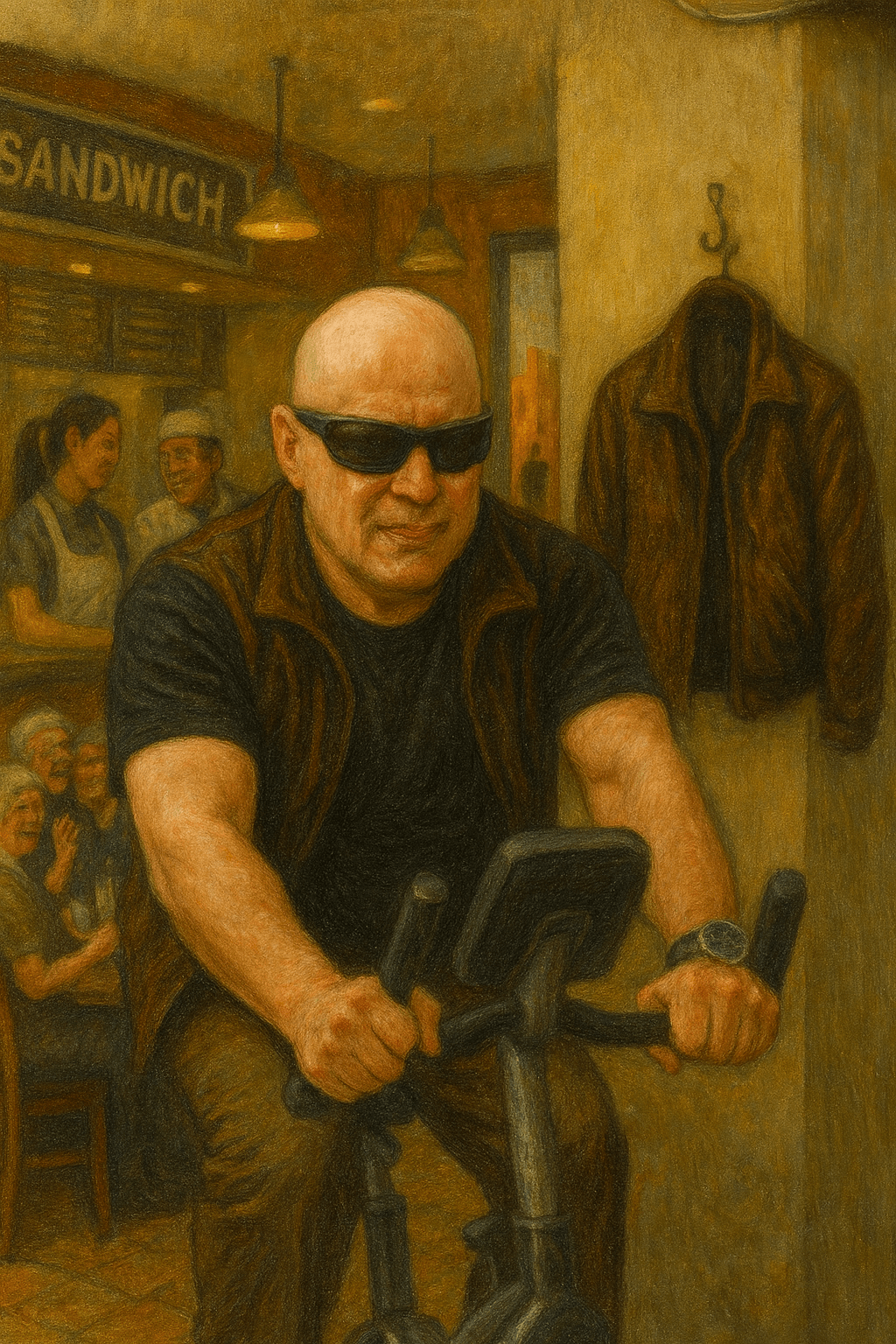
    Exercise? Four days of kettlebells instead of five—because joints are finite, and ego is not a medical plan. On my “off” days, I’ll alternate between the exercise bike and power-flow yoga, both of which will mock me in their own way.

    Diet soda? Dead to me. I’ve seen what happens when it wins: a family friend guzzles it by the gallon, her health circling the drain like a cautionary fable. I will swap it out for sparkling water and the moral superiority it confers.

    This is not about orthorexia or self-hate disguised as wellness. This is about escaping confusion, that modern affliction where “healthy” means both everything and nothing. I will eat four times a day. I will consume 160 grams of protein. I will not exceed 2,400 calories. I will fight entropy with routine, bloat with balance, and preserve the image of myself I still—somehow—believe is possible.

  • The Manuscript Awakens: A Dugout Vision from the Collective Unconscious

    The Manuscript Awakens: A Dugout Vision from the Collective Unconscious

    Last night I dreamed I was striding across a wind-blown grassy knoll, the kind of landscape that smells faintly of unresolved ambitions and freshly cut ego. Out of nowhere—because where else do these things happen?—a panel of vaguely official-looking figures appeared, cloaked in bureaucratic smugness, and awarded me the managerial reins of a baseball team unlike any other: it was helmed, inexplicably yet inevitably, by Leonardo DiCaprio.

    Yes, that DiCaprio—Oscar-winner, yacht philosopher, professional man-child. He looked fantastic in cleats.

    Suddenly, the gentle slope of the grassy knoll rippled like a stage set being pulled away, and in its place emerged a full-fledged baseball diamond, etched into the earth as if by divine groundskeepers. The green gave way to precisely mowed outfield grass, bordered by crisp white chalk lines that glowed with supernatural brightness. Dugouts pushed up from the soil like subterranean bunkers, complete with splintered benches and battered Gatorade coolers. Bleachers unfolded in rows, metallic and sun-bleached, teeming with phantom spectators whose shadows twitched in anticipation. The air smelled of dust, pine tar, and something mythic.

    As I issued cryptic signals from a dugout made of dark oak and existential dread, DiCaprio tore around the bases with uncanny precision. But this wasn’t just sport. Oh no. With every base he stole, something stirred beneath the soil. From the Earth, like some hallucinatory literary harvest, lost manuscripts erupted like weeds on speed—scrolls, journals, forgotten novels. Some of them were mine, written decades ago in youthful fits of desperation and pretension. But they were no longer mine. They belonged to the collective unconscious, that vast psychic compost heap where dead dreams go to reincarnate as New York Times bestsellers or cult manifestos.

    As DiCaprio sprinted toward third, the text of the manuscripts began rewriting themselves, transforming into the ideological scripture of a new world order dictated by stolen bases and film star footwork.

    Enter Lanai, a high school friend I hadn’t seen since dial-up internet. She appeared on the dugout steps like a ghost of poor choices past and announced that she had reformed her life through the Quincy Jones Art Club, a kind of gospel-jazz cult devoted to self-mastery, syncopation, and the sacred key of B-flat minor.

    “You should join,” she said, her eyes glowing with the fervor of someone who had clearly renounced sugar, sarcasm, and casual sex.

    “I might,” I lied, “but I’m managing DiCaprio right now and the stakes are cosmically high.”

    Before she could argue, Quincy Jones himself descended like an archangel in a powder-blue zoot suit, easily seven feet tall, smelling faintly of vinyl records, Chanel Bleu, and omniscience. He shook my hand. Electricity pulsed through my forearm. His voice—equal parts gravel, genius, and benevolent threat—delivered a sermon about his artistic path: discipline, vision, excellence.

    I tried to listen. Truly. But my attention was being hijacked by the spectacle on the field: DiCaprio sliding into home as epic sentences unfurled from the ground like flaming banners, edited in real-time by forces unseen. The crowd roared, their faces blurred like a dream I was about to forget.

    And through it all, I wondered: Was I the manager, or just another rewriter of forgotten dreams?

  • The Last Tick: Breaking Up with My Watch Addiction

    The Last Tick: Breaking Up with My Watch Addiction

    Chapter 7 from The Timepiece Whisperer

    It struck me as odd—how unmoved I was by the Watch Master’s death. No sadness, no shock. Just a dry acceptance, like hearing the mail didn’t arrive. The man was in his late seventies, had chain-smoked his way through the golden age of studio recording, and looked like he’d been exhaling Marlboro ghosts for decades. Of course he died. It was inevitable, like quartz battery failure.

    And yet… I felt I should have felt more. But I was too deep in my own wrist-bound psychodrama. I wasn’t mourning a mentor—I was clawing for freedom from the slow, obsessive spiral of watch addiction. The Watch Master had passed the baton, and in his place stood a new sherpa on my horological hell-hike: Josh, the so-called Timepiece Whisperer.

    The next evening, Josh opened the door with a look that said get ready to be offended gently.

    “Bad news,” he said.

    I followed him into the kitchen. Same table. Same tension. He poured me a mug of mint tea, then hit me with it:

    “You want to add the Seiko Astron. I’ve thought about it. The answer is no. Absolutely not. You’re done. No more watches. Not now, not ever.”

    I blinked. “That’s… a bit harsh.”

    Josh didn’t blink. “It’s the truth. One more blue-dial beauty will not complete your collection—it’ll fracture it. You don’t wear formalwear. You don’t attend black-tie galas. That Astron won’t elevate your life—it’ll mock it. You’ll feel guilty for not wearing your other watches, they’ll collect dust and resentment, and you’ll spiral again. The result? Misery.”

    I looked at the floor. I already knew this. I’d said the same things to myself, in a dozen internal arguments that always ended with but maybe just one more…

    “You needed to hear it from someone else,” Josh said.

    “I hate myself for being so weak. I should have handled this alone.”

    He shrugged. “That’s what I’m here for. Left to your own devices, you’d still be googling ‘best summer watches for men over 60.’ I saved you a year of torment in two days. You’re welcome.”

    Then he pulled out a sugar cube shaped like a butterfly—absurdly whimsical for such a hardline intervention—and dropped it into my tea.

    “Close your eyes. Make a wish. Drink it down.”

    I did as instructed. The mint tea was scalding and sweet.

    He asked, “What did you wish for?”

    “That I be free from this watch-collecting hellhole and never go back.”

    He nodded. “Excellent wish.”

    I never saw Josh again.
    And I never bought another watch.

  • Vacation Nihilism: The Existential Price of That $28 Margarita

    Vacation Nihilism: The Existential Price of That $28 Margarita

    Vacation nihilism is the uniquely modern despair that creeps in when you’re supposed to be relaxing. You’re sprawled on a rental bed, digesting overpriced novelty food, staring at the ceiling fan, and asking yourself: What am I even doing with my life? The break from your daily routine doesn’t recharge you—it exposes you. With your rituals on hold, your ambitions start to look ridiculous, your projects meaningless, and your belief in humanity’s forward march into reason and tech-fueled glory? Laughable.

    You’re not wrong, entirely. The world has gone a bit mad. But your despair isn’t just philosophical—it’s biochemical. You’ve sabotaged your sleep schedule. You’ve eaten five experimental meals in three days and haven’t seen a vegetable since the airport salad bar. Your gut is staging a coup. You’re bloated, irritable, and haven’t had ten consecutive minutes alone since the trip began. Naturally, you begin to suspect your entire existence is a long-running joke with no punchline.

    Then comes the knock: Nihilism, that smug little parasite, invites himself in. And you’re too tired to fight him off. He plops down beside you and begins dismantling your life, piece by piece: your goals, your routines, your little morning affirmations—all reduced to performance art for an indifferent universe.

    For most people, this existential fog lifts after a few days back in the saddle. The routine reboots. Coffee tastes like salvation again. But not always. Sometimes you bring it back with you, like a psychological bedbug infestation. Tiny, persistent thoughts that burrow into your habits. Questions you can’t un-ask. You might look the same on the outside, but internally, the scaffolding is rusting.

    You went on vacation to unwind. Instead, you came back with nihilism spores. And no, TSA does not screen for them.