Category: Confessions

  • Flex, Regret, Repeat: My Midlife Crisis, Sponsored by Conor McGregor

    Flex, Regret, Repeat: My Midlife Crisis, Sponsored by Conor McGregor

    My life as an aspiring narcissist hit a new low when my wife and I got home, plopped down on the couch, and decided to indulge in the cinematic masterpiece Road House. This film, if you can call it that, stars a Jake Gyllenhaal so chiseled that he looks like Michelangelo got bored and decided to make an action hero. In this gripping tale, Gyllenhaal plays a tough-as-nails fighter scraping a living in a Key West bar, doing what any self-respecting muscle mountain would do—protecting the bar and its lovely owner, played by Jessica Williams, from corrupt mob bosses. Naturally, this leads to the inevitable showdown with their number-one heavy, played by none other than a bulked-up, foaming-at-the-mouth Conor McGregor, who looks like he’s been subsisting on a diet of raw meat and anabolic steroids.

    The plot is thinner than a strand of dental floss—a Western rehash where an outsider rides into town to clean up the mess. But let’s be real: the story is just window dressing for the film’s true agenda, which is to showcase sweaty, glistening muscles and fight montages that could double as a fitness competition highlight reel. The camera lingers on every bulging bicep and rock-hard ab like a love-struck teenager, turning what should be an action movie into a high-budget commercial for protein powder, creatine, and whatever the hell UFC fighters are injecting these days.

    As Gyllenhaal and McGregor flexed and fought their way through scene after scene, I found myself reaching for my phone, not to check the time—oh no—but to Google “What is Conor McGregor’s diet?” Because watching this movie is less about enjoying a plot and more about realizing you’re a gelatinous blob compared to the human marble statues parading around on screen. Road House isn’t so much a movie as it is a two-hour reminder that you’re one donut away from needing a forklift to get off the couch.

    When the credits finally rolled, and I managed to peel my eyes away from the testosterone-soaked spectacle, I turned to my wife, feeling more deflated than a balloon at a porcupine convention. “I wish I could lose forty pounds and look the way I did when I entered Mr. Teenage San Francisco,” I lamented as if my sad sack of a body was just a protein shake away from making a comeback. I had the muscle once, I swear! But now it’s hidden under layers of adiposity that could cushion a fall from a ten-story building. If they ever invented an advanced generation of Ozempic that came in a pill form, had no side effects, and was covered by my insurance, I’d be the first in line, elbowing grannies out of the way to get my hands on it.

    My wife, however, had zero interest in my nostalgic waxing about the “great body” of my youth. This was not her first rodeo. In fact, she could probably recite my entire “glory days” speech from memory, down to the last calorie of the diet I used to follow. Rolling her eyes with the practiced ease of a wife who’s heard it all before, she suggested we watch a rerun of Northern Exposure—her go-to escape from my never-ending lament about the “Greek god” I used to be. But the seafood restaurant ordeal had left me more drained than a used dishrag, and I waved the white flag of surrender. “Nope, I’m hitting the sack,” I muttered, retreating to the bedroom like a defeated warrior, leaving my wife to her beloved reruns while I dreamed of a time when I was ripped, instead of just ripping on myself.

  • The Fisherman’s Stew Massacre: One Man’s Descent into Bibless Madness

    The Fisherman’s Stew Massacre: One Man’s Descent into Bibless Madness

    I still feel the stink of embarrassment from three years ago when we celebrated our twin daughters’ birthday by venturing to an upscale seafood joint—the kind of place where the prices are more bloated than the waitstaff’s sense of self-importance. As usual, I asked the waiter for his recommendation. His eyes lit up with the kind of zeal you usually reserve for cult leaders and pyramid scheme recruiters. He practically waxed poetic about the Fisherman’s Stew, describing it as if it had been lovingly ladled straight from a beautiful peasant’s cauldron of culinary magic in some idyllic coastal Italian village. Like a sucker, I bought into the fantasy, completely unaware that I’d just ordered a one-way ticket to an all-you-can-eat nightmare served with a heaping side of public humiliation.

    When the dish finally arrived, I didn’t get the warm, comforting bowl of seafood nirvana I’d envisioned. Instead, I was presented with what can only be described as a DIY surgery kit. This wasn’t silverware—they handed me actual surgical tools. A scalpel? Check. Serrated forceps? Check. Shell-crusher and lancet knife? Double check. At that moment, I wasn’t sure if I was supposed to eat the meal or perform an emergency appendectomy on a crab.

    Naturally, I asked for a bib because even gladiators need armor before going into battle. But no, they were fresh out of bibs. So there I was, defenseless and metaphorically naked, staring down a bowl that looked like it had been dredged up from the deepest, darkest corner of the ocean—probably after losing a fight with Cthulhu. The stew was a boiling pit of doom, brimming with spiky, hostile shellfish that seemed to have a stronger will to live than I did at that moment.

    What followed wasn’t so much a meal as a desperate struggle for survival. I found myself locked in mortal combat with crabs that clung to their shells like they were auditioning for a role in Jurassic Park: The Seafood Edition. I stabbed at shrimp with the precision of a neurosurgeon on his fifth Red Bull, and I tried to crush lobster claws that mocked my feeble human strength. Sweat poured down my face, mingling with brine, cioppino sauce, and random bits of squid that had escaped their doomed fate. By the end, I looked like I’d just gone twelve rounds with a giant squid—and lost every single one of them.

    The waiter, blissfully oblivious to the war zone he’d created, strolled over and had the audacity to ask how my meal was going. With my face and bald head smeared in a ghastly mix of perspiration, tomato sauce, and assorted shellfish shrapnel, I told him I’d be happy to provide feedback as soon as I finished the American Gladiators obstacle course that apparently came with my entrée. I then kindly asked him to fetch me a spare pair of pants, a T-shirt, a power drill, and some safety goggles, because clearly, I had gravely underestimated the intensity of this dining experience.

    Meanwhile, my daughter—bless her little heart—had commandeered my wife’s phone and was gleefully documenting my descent into madness. She snapped photos like some twisted paparazzo, each one capturing another level of my mental disintegration. Naturally, these shots were uploaded to Snapchat in real-time, complete with captions that probably read, “Watch Dad Lose His Dignity, One Crab Claw at a Time.”

    The whole point of taking your family out to dinner is to relax, to enjoy a pleasant evening, right? Wrong. Instead, I found myself in what felt like a cage match with an octopus that had no intention of going down without a fight. By the end of it all, I wasn’t just exhausted—I was a shell-shocked survivor of the Great Seafood Massacre of 2024, wondering how what was supposed to be a simple dinner had turned into an episode of Survivor: Shellfish Edition.

    But the true coup de grâce of the evening? My daughter proudly showed me the photos she’d posted online. In every shot, my face looked like it had been smeared with an abstract painting made entirely of sauces and cheeses. My chin had tripled, my eyes were glazed over like a stale doughnut, and I resembled nothing less than a bloated corpse that had washed ashore after a particularly rough night. The image I once held of myself as a halfway decent human being? Long gone. In its place, a digital monstrosity for all the world to see.

  • The Monster with a Tail: A Southern Gothic Confession

    The Monster with a Tail: A Southern Gothic Confession

    I’ve never forgotten the story one of my students told me in the fall of 1998. She was a re-entry student, a nurse in her early forties juggling UCLA coursework with night shifts at the hospital, and the kind of woman you remember: short, sturdy, bespectacled, with tired eyes that had seen too much and lips that knew how to tell a good story. Most afternoons after class, she’d linger and share dispatches from her Louisiana backwoods childhood or from the VIP wing of her hospital job—tales that ping-ponged between the hilarious and the horrifying.

    But one story chilled me to the marrow and stuck in my head like a burr under the skin. It wasn’t about celebrity patients or ER gore. It was about a monster.

    She and her cousin Carmen were unsupervised children raised in the heat-choked, school-optional outskirts of rural Louisiana. Left to their own devices, the two girls played what she called “mean games”—tormenting frogs and bugs, and doing other things she refused to describe. They were feral, wild, borderline Lord of the Flies with hair ribbons.

    And then came the visitor.

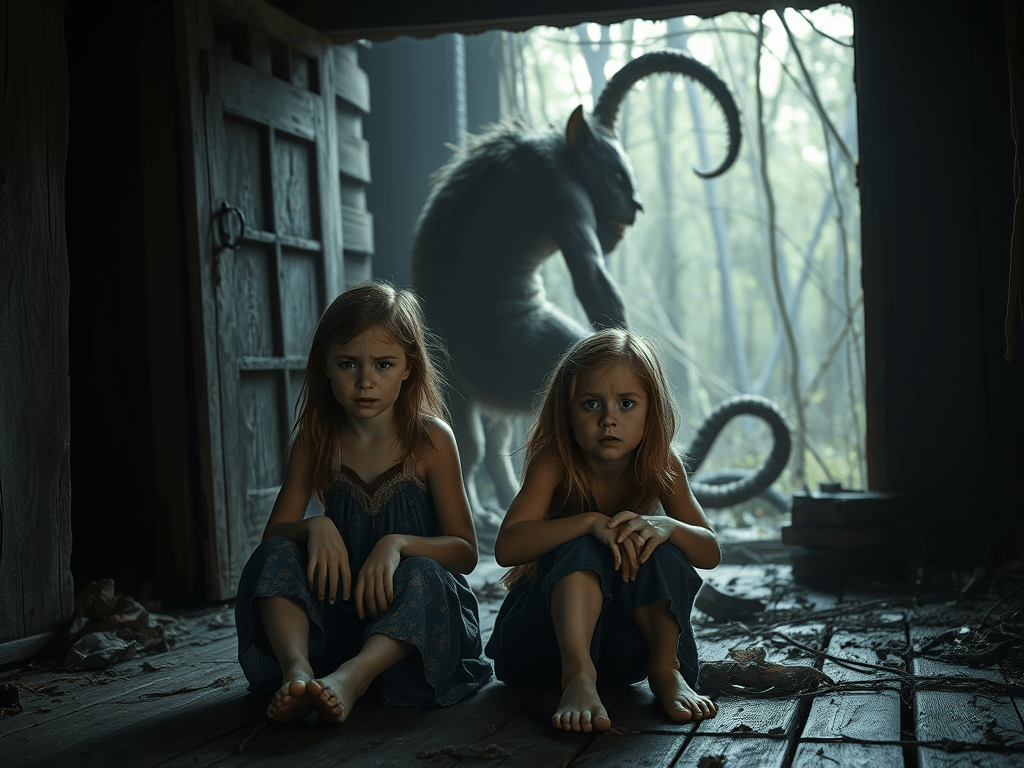
    It was an average swampy afternoon when he arrived. The girls were inside an old ramshackle house, probably scheming new atrocities, when the porch door creaked open and in walked a man. Except he wasn’t a man. He had a tail—thick, heavy, and grotesquely alive. It coiled behind him like a muscular question mark, flicking as he made his way into the living room. His body was matted with bristly fur. His voice was low, scratchy, and deeply wrong. He didn’t yell. He didn’t threaten. He spoke, calmly and with dreadful precision, cataloging every evil thing the girls had done to the frogs and insects. Every cruelty committed under the sweltering sun. He ended with a promise: Keep going, and I’ll recruit you.

    The thing sat in their house for three hours, its tail twitching as it detailed their future in hell’s internship program. The girls were petrified. When it finally left, slinking back into the thick air and cicada scream of Louisiana summer, they sat in silence. Eventually, Carmen whispered, “Did you see that?” My student nodded, mute.

    From that day on, they reformed. Sunday School. Prayer. Fear-based virtue. They never spoke of it again. But the thing had done its job.

    My student wasn’t a flake or a mystic. She was a veteran nurse—sharp, sane, and not prone to flights of fantasy. That’s what made it worse. She wasn’t selling me a ghost story. She was delivering testimony.

    To this day, I can’t shake the image: two children, alone in a creaky house, visited by a thing with a tail and an agenda. Whether it was a literal demon, a shared hallucination, or a supernatural PSA sent by the universe, I’ll never know. But I do know this: after that story, I never looked at childhood mischief—or Louisiana—in quite the same way again.

  • Teaching College Writing in the Pre-Canvas Days

    Teaching College Writing in the Pre-Canvas Days

    I’m glad academia has gone digital. No more heavy boxes of printed essays to lug home. No more gradebooks with smeared records.

    I remember we used to have to bring our grade and attendance records to campus during the semester break and get our records approved before we were truly free to enjoy our vacation.

    Like a beleaguered instructor sent on a doomed mission, I had to drag myself to the campus, lugging a mountain of paper that looked like it had survived the apocalypse.

    My stack of grades and attendance records—yellowed, dog-eared, and adorned with enough coffee stains and White-Out smudges to pass as a Jackson Pollock reject—was a bureaucratic nightmare in physical form. I found myself in line with a hundred other sleep-deprived, caffeine-fueled professors, each clutching their own messy masterpieces like they were carrying the Dead Sea Scrolls. The line outside the Office of Records was so long it could have served as an endurance test for Navy SEALs. To stave off starvation and existential dread, I had packed a comically oversized sack of protein bars and apples, as if I were preparing for a month-long siege rather than a simple bureaucratic ritual.

    There I was, supposed to be basking in the sweet, sweet nothingness of semester break, but instead, I was condemned to a gauntlet of waiting that made Dante’s Inferno look like a walk in the park. For what felt like hours, waited for the privilege of sitting at a table and enduring the laser-like glare of humorless bureaucrats who would scrutinize my records as if they were forensic experts analyzing evidence from a high-profile murder case.

    Once I finally managed to wade through the outdoor line, I advanced to the foyer for the second, even more soul-crushing phase of The Great Wait. Inside, rows of desks manned by expressionless drones awaited, each one peering over piles of grading records that seemed to stretch back to the dawn of civilization. Behind the staff of functionaries who examined the professors’ gradebooks were towers of file boxes stacked so precariously that a single sneeze could have transformed them into a cataclysmic eruption of dust and possibly asbestos.

    Eventually, I was summoned to one of the desks where an eagle-eyed Attendance Priestess scrutinized my records with the intensity of a customs officer suspecting I had smuggled contraband. She licked her fingertips with the solemnity of a high priestess preparing for a sacred ritual, only to cast me a look of such disdain you’d think I’d just handed her a wad of toilet paper instead of my gradebook.

    Finally, when the pinch-faced administrator deemed my records sufficiently unblemished and granted me the bureaucratic blessing to leave, it felt like I had just been handed the keys to the Pearly Gates. I didn’t walk to my car. I windsprinted because I feared the Attendance Priestess may have found fault with my records and would call me back to start the whole process all over again.

  • I Need to Talk to You About Neighborplexity

    I Need to Talk to You About Neighborplexity

    Sumatra coffee is my bad boy of the coffee world—dark, mysterious, and utterly unapologetic. It doesn’t just wake me up; it smacks me across the face, throws me out of bed, and chases me down the street while I’m still in my pajamas. Imagine if a tropical thunderstorm decided to moonlight as a barista, bottling up its fury in a cup. That’s Sumatra—every sip as intense as being caught in a downpour while you’re half-asleep and regretting every life choice that led you to this point.

    Sure, I’m probably guzzling more Sumatra dark roast than is recommended by anyone with a functioning heart, but let’s be real: I’m an overworked college writing professor, buried under an Everest of student assignments that multiply like rabbits on caffeine. Add to that the never-ending demands of being an author of coffee table humor books—books that, according to my editors, need constant revision and expansion to “stay relevant” and “generate a healthy revenue stream.” Translation: “Jeff, we need you to keep churning out content until your fingers bleed and your soul shrivels up like a raisin.”

    But let’s not get ahead of ourselves with the self-pity party. I could give you a long-winded lecture about how the digital age was supposed to bring us more convenience and free time, only to morph into a merciless sociopath that steals our time faster than you can say “work-life balance.” But instead, let me start my story before the Sumatra kicks in too hard, and I start ranting like a madman on a caffeine bender. Buckle up, because this ride is about to get bumpy.

    My tale begins with the Pattersons, my dear, respectable neighbors. For years, I lived in blissful harmony with these upstanding citizens—the kind of people who proudly displayed their New Yorker subscriptions and NPR tote bags like badges of intellectual honor. We had an unspoken pact, a mutual understanding that we were members of the Smart People’s Society, where the TV was reserved for documentaries, award-winning dramas, and the occasional indie film that required subtitles and a dictionary to understand.

    But then, one evening, as I casually glanced out my window—just a harmless peek, really—I saw something so grotesque, so utterly incomprehensible, that it shook me to my core. There, through the open window of my once-revered neighbors, I saw them glued to the screen—not just any screen, but one streaming a TV show so mind-numbingly lowbrow it made reality itself seem like a parody. My brain went into full-blown meltdown. Could it be? Were they actually watching Love Island?

    I blinked, hoping I’d misinterpreted the scene, but no—the horror was all too real. My neighbors, those paragons of taste and intellect, were indulging in what could only be described as televised garbage. I was struck down by a case of Neighborplexity: that gut-wrenching, mind-twisting moment when you realize you might not know the people next door at all. Suddenly, my world was flipped upside down. Had they always been this way? Were those book club meetings just a ruse, a clever cover-up for their secret love affair with trash TV? I felt like I’d just discovered that the Michelin-starred chef who lived down the block actually preferred dining on Spam straight out of the can.

    I thought we were united in our disdain for anything that wasn’t at least 95% fresh on Rotten Tomatoes. But now? Now, I wasn’t so sure. How could they betray me like this? Was every dinner party, every casual chat about the latest literary masterpiece, just a well-orchestrated charade? My mind spun as I tried to reconcile the image of these seemingly cultured, well-spoken people with the reality of them willingly watching—gasp—that show.

    What do I do now? How do I move forward? Can I ever look them in the eye again, or will I be forever haunted by this dark revelation, this unraveling of the fabric of my once-idyllic neighborhood? All because of one dreadful, unforgivable act of poor taste on TV. Love Island, of all things. The horror! The betrayal! The absolute audacity! I might need more Sumatra just to get through this.

  • Return to Purgatory: A Packing Dream from Hell

    Return to Purgatory: A Packing Dream from Hell

    Last night, I found myself trapped in a sprawling compound of crumbling houses that looked like they were built during the Carter administration and never cleaned since. A communal frenzy was underway: the packing of thousands—yes, thousands—of food items and random clothing for a temporary exodus. Why the mass exodus? Unclear. Fumigation? Apocalypse? A reboot of The Grapes of Wrath? Whatever the reason, it was purgatorial.

    The mood? Moronic cheer. My fellow inmates—let’s not flatter them by calling them neighbors—were sipping drinks, cackling, and treating this Herculean labor like a godforsaken block party. Meanwhile, I hovered at the edge of the scene, paralyzed by the Sisyphean logistics of it all. Every cabinet I opened unleashed another avalanche of expired beans and mismatched Tupperware lids. The collective merriment felt obscene, as if they were toasting the Titanic’s elegant descent into the sea.

    And just when I thought salvation had arrived—in the form of a 2 a.m. bathroom break—I awoke, staggered to the toilet, and stumbled back to bed hoping to reset my brain. No such luck. The dream resumed exactly where I left off, like I’d hit pause on Netflix and walked back into my own streaming nightmare. There I was again, back in the compound, surrounded by half-drunk revelers blissfully ignoring the sheer futility of their packing, while I stood, a one-man FEMA unit, dreading every box and can like they were symbols of existential despair.

    I suppose, in some Jungian corner of my subconscious, this was meant to be cathartic. Maybe a soul purge. Maybe a late-night psychological CrossFit session designed to wring out my nervous system like a filthy sponge. All I know is, I woke up feeling like I’d done emotional burpees for eight hours straight—but to my surprise, I was eager to get out of bed, made a pot of coffee like it was a holy sacrament, and gleefully planned a one-hour kettlebell workout. 

  • Kettlebells, Groats, and the Ghost of Cardiac Doom

    Kettlebells, Groats, and the Ghost of Cardiac Doom

    I’m 63, and my body is a museum of movement trends. I’ve done Olympic weightlifting, bodybuilding, power yoga, and for the last 12 years, kettlebells—because nothing says “midlife stability” like swinging a cannonball on a handle five days a week while trying not to herniate a disk. I eat well—if by “well” you mean “like a disciplined wolf at a cheat-day buffet.” Animal products still feature in my diet, usually in portions that would make a cardiologist raise one eyebrow and reach for their prescription pad. I’m a good 30 pounds overweight and have cut back recently but perhaps not enough. 

    Lately, I’ve started worrying about the future: namely, a heart stent. The idea of threading a balloon through my groin to unclog a bacon-clogged artery isn’t my preferred retirement plan. So I’m contemplating a semi-vegan diet—not for virtue-signaling, but for vascular survival. Greek yogurt and whey powder will stay, though. I refuse to shrivel into a human twig for the sake of purity. Sarcopenia can go pound tempeh.

    My dream breakfast resembles a Pinterest board curated by a monk with delusions of grandeur: steel-cut oats, yogurt, whey, berries, walnuts, and dark roast coffee. Lunch is the same symphony with the oatmeal swapped for buckwheat groats, in honor of my Polish great-great grandmother who, I’m certain, could crush a man’s spirit with one glance and a bowl of groats. Dinner? A nutritional yeast-drenched, spice-blasted tempeh tableau, with beans, roasted vegetables, and maybe a solemn scoop of cottage cheese followed by an apple—the dessert equivalent of a tax deduction.

    Snacks? Don’t speak to me of snacks. They are the sneaky saboteurs of caloric creep, the grinning goblins that ruin otherwise virtuous intentions. Between meals, I’ll drink water, and maybe a diet soda or two to convince myself I’m still living on the edge.

    Of course, this plan risks collapsing under the crushing weight of its own monotony. Worse, I dread becoming that guy at family events—the joyless dietary specter haunting the buffet table with his lentil sermon. I don’t want pity, nor do I want to be admired for abstaining from Costco sheet cake while others live in reckless, frosted bliss.

    To preserve my sanity and prevent my relatives from staging a flavor intervention, I may allow one restaurant meal a week—a carefully sanctioned culinary parole. A sanity-saving bite of indulgence before I return to the tofu mines.

  • The Consumer Comedown: Life After the Perfect Purchase

    The Consumer Comedown: Life After the Perfect Purchase

    Here’s a champagne-flavored tragedy for the modern shopper: you spent days spelunking through the caves of YouTube reviews, waded through audiophile forums run by people named “BassGod69,” weighed driver specs like you were decoding the Rosetta Stone—and then, against all odds, you bought the damn thing. In my case, a pair of Sony WH-CH720N noise-canceling headphones for a criminally reasonable $89. And here’s the kicker: they’re perfect.

    They cancel noise. They soothe my brain like a white-noise monk whispering sweet nothings into my temporal lobes. I nap like a Roman emperor after a wine-soaked orgy. They do exactly what they promised—and I hate them for it. Because now, the thrill is gone. The obsessive hunt, the maddening delight of indecision, the dopamine jolt from a new Amazon tab—vanished. I am cursed with satisfaction.

    I miss the chaos. I miss pretending I knew what a “neodymium magnet” was or why I suddenly cared about the acoustic impedance of earcups. I miss the parasocial arguments with review bros who spoke of “soundstage” like they were discussing string theory. My afternoons are now unburdened, and I am quietly enraged by the calm.

    So here I sit, encased in perfect audio bliss, gnawing on the bone of my own post-purchase emptiness. The headphones work. My contentment is complete. And I feel, tragically, restless.

  • How to Pretend You’re Still Alive at Week Eleven

    How to Pretend You’re Still Alive at Week Eleven

    After ninety minutes of hammering out lesson plans in my academic cave—also known as my college office—I realized my legs had entered that special purgatory between rigor mortis and a blood clot. So I stood up, performed a stretch that felt like a rusty marionette being yanked upright, and took a walk down the hallway.

    Out in our little shared faculty suite, I found my colleague from Foreign Languages hunched behind a desk like a war-weary translator decoding enemy communiqués. She looked up briefly from a pile of student papers, and when I asked how she was holding up, she gave the most honest answer academia ever produces: “Exhausted.” It was 2 p.m., and she still had a five-hour sentence left on her campus shift. I nodded grimly. The semester was two-thirds over, the point in the academic calendar when everything begins to sag—mood, posture, faith in humanity.

    “I get it,” I told her. “The late-semester ennui is baked into the profession.” I’ve been battling it for decades. It seeps into your bones and makes your students shuffle into class like underfed extras from a Civil War hospital drama—late, listless, and visibly haunted by their own poor decisions. Their faces are a collage of sleep deprivation, existential dread, and the dawning realization that the syllabus waits for no one.

    This is when you have to throw them a curveball. You can’t coast on grammar worksheets and MLA citation reviews. The status quo is the problem. I tell them to try yoga, breathing exercises, isometrics. If they’re feeling especially apocalyptic, I might even roll a zombie movie and spin it as a cautionary tale about pandemics and the erosion of civic trust. It’s a reach—but sometimes you need to swing for the fences, even if all you hit is a foul ball.

    Most of these tricks will fail. The semester will end the way all semesters do—in caffeine, chaos, and emotional triage. But at least you went down swinging. At least you reminded yourself, in that bleak final inning, that you’re not just a grading machine—you’re still alive.

  • Why I Refuse to Journal Like a Good Little Introvert

    Why I Refuse to Journal Like a Good Little Introvert

    One of my most cherished moments of accidental transcendence happened somewhere between the cow-scented fields of Bakersfield and the fog-choked sprawl of San Francisco in the spring of 1990. I was climbing the Altamont Pass in a battered 1982 Toyota Tercel that handled like a shopping cart when The Sundays’ “Here’s Where the Story Ends” crackled to life on the radio. Harriet Wheeler’s voice—equal parts cathedral and confession booth—floated through the speakers, and suddenly I wasn’t commuting through California; I was levitating above it. I wasn’t driving—I was ascending. In that moment, I stumbled into something bigger than myself, gifted by two Brits, David Gavurin and his partner Wheeler, who recorded their luminous dispatches, then vanished from the stage like saints escaping the tabloid apocalypse.

    They made beauty, and then they walked away. No farewell tour, no social media mea culpas, no sad attempts at reinvention. Just a few perfect songs and the audacity to say, that’s enough. They’re my heroes—not for what they did, but for what they didn’t do. They resisted the narcotic of attention. They said no to the stage and yes to obscurity, which in our fame-gluttonous culture is the moral equivalent of monkhood.

    I, by contrast, never quite shut up.

    I’ve been peddling stories since high school, where I’d hold court at lunch tables, unspooling feverish tales of misadventure like a cracked-out bard. At 63, I still haven’t kicked the habit. But unlike the craven influencer class, I hope I’m not just hustling dopamine hits. I tell stories because I need to make sense of this deranged carnival we call modern life. It’s an instinct, like blinking or checking the fridge when you’re not even hungry.

    Some stories are survival tools disguised as art. Viktor Frankl wrote to preserve his sanity in a death camp. Phil Stutz prescribes narrative like medicine. And when I hear a brilliant podcaster dissect the absurdity of daily life, it feels like eavesdropping on salvation. It’s not just performance—it’s connection. Human beings, after all, are just gossiping apes trying to explain why the hell we’re here.

    Storytelling is the futile, glorious act of forcing chaos into coherence. It’s pinning butterflies to corkboard. Life is all noise—emails, funerals, fast food, missed calls—and stories give it a beat, a structure, a moral, even if it’s just “don’t marry a narcissist” or “never trust a man who wears sandals to a job interview.”

    So why not keep it to myself? Why not scribble in a journal and hide it in the sock drawer next to my failed dreams and mismatched batteries? Because I find journaling about as appealing as listening to my own Spotify playlist on repeat in a sensory deprivation tank. No thanks. I don’t want to be alone with my curated echo chamber. I want a café. A digital one, maybe, with only a few scattered patrons. But still—voices, questions, and the hum of others trying to make sense of it all.

    I’ll never be famous. I’ll never go viral. But if someone reads my ramblings and thinks, me too—then that’s enough. I’m not trying to be an algorithm’s golden child. I’m just trying to find some order in the mess. Just like I always have.