
Category: fiction

  • The Man Who Moved to G-Shock Avenue

    The Man Who Moved to G-Shock Avenue

    Paul McCartney once admitted that after the Beatles broke up, he couldn’t bring himself to play their songs. Too much history. Too much emotion packed into every chord. The music wasn’t just music—it was a former life. That’s how you feel about your mechanical divers. They now sit in what you’ve come to call the Box of the Abandoned Past—not discarded, not unloved, but too heavy with memory to wear without reopening old chapters.

    Then the G-Shock Frogman arrived, and with it came a revelation: you hadn’t just bought a new watch—you had moved cities. For more than twenty years, you’d been living in Mechanical Town, polishing bezels and monitoring seconds like a municipal duty. Suddenly you realized you belonged somewhere else entirely. You packed your emotional bags and relocated to G-Shock Avenue. First the Frogman. Then the Rangeman. Then the high-end Square. No ceremony. No farewell speech. Just a quiet change of address.

    Years passed. Occasionally, you tried to revisit the old neighborhood. You’d take out a mechanical diver, strap it on, and see if the feeling returned. But like McCartney staring at a piano and deciding “Yesterday” could stay in the past, you always drifted back to the Frogman. It was lighter. Simpler. Emotionally frictionless. The past had craftsmanship. The present had peace.

    Still, you refuse to sell the mechanicals. They’re not watches anymore; they’re chapters. Expensive bookmarks in the autobiography of your former self. Once a year, you conduct the ritual. You open the Box of the Abandoned Past. You shine a small, theatrical light across the rows. You offer a quiet apology while Paul McCartney’s “Uncle Albert” plays in the background, the soundtrack of dignified transition.

    Your wife and daughters evacuate the premises during this ceremony, treating it with the same enthusiasm reserved for releasing an aerosol flea bomb in the living room.

    But alone in the room, you sing along, close the box, strap on the Frogman, and step back into the present—no longer a resident of the mechanical past, but a citizen, fully and permanently, of G-Shock City.

    You have entered painful terrain for the watch enthusiast: Emotional Migration. It is the moment a watch enthusiast changes allegiance not by selling a collection, but by quietly moving his identity to a new territory. The old watches may still sit in the box, polished and respectable, but the emotional address has changed. What once felt essential now feels historical; what once felt like an experiment now feels like home. There is no announcement, no dramatic purge—just the slow realization that your wrist no longer reaches for the past. Emotional Migration isn’t about acquiring something new. It’s about discovering that your center of gravity has relocated, and the watches you once loved now live where you used to live.
  • The Watch Ninja and The Great Deepening

    The Watch Ninja and The Great Deepening

    If you stay in the watch hobby long enough, you must accept a hard truth: your identity will betray you.

    One morning you wake up and the mechanical divers—the watches that once defined your taste, your discipline, your personality—feel distant. Cold. Decorative. In their place sits a small, efficient triumvirate of atomic, solar G-Shocks that refuse to leave your wrist.

    You feel guilty. Disloyal. Untethered. Who are you if the romance of gears and springs no longer moves you? What kind of man replaces craftsmanship with digital certainty?

    This is not a question for forums.

    This requires the Watch Ninja.

    The fee is $1,000. Nonrefundable. Trusted members of the community blindfold you and load you into an unmarked van, because enlightenment, like limited editions, requires exclusivity.

    When the blindfold comes off, you find yourself in the stone-walled basement of a respectable hotel. Above you, restaurant workers clatter through the dinner rush. Below, time slows.

    The Watch Ninja sits on a high stool.

    He wears a white chef’s jacket, a wide-brimmed cavalry Stetson pulled low, dark aviators, and a G-Shock Frogman. The hat’s high crown gives him the posture of authority; the brim throws his eyes into shadow. He does not occupy the room. He commands it.

    Then the realization lands.

    He looks exactly like Robert Duvall as Lt. Col. Kilgore in Apocalypse Now—a man who would order helicopters for the sound alone.

    You confess your crisis. The abandonment of mechanical divers. The seduction of atomic precision. The creeping sense that you have betrayed your former self.

    He listens, stroking his chin like a man evaluating air support.

    Then he speaks.

    “There is no such thing as a single conversion,” he says. “There are only conversions within conversions. Your life as a watch obsessive is not defined by loving watches. It is defined by the subconversions that follow.”

    He leans forward.

    “A man builds a collection of mechanical divers. He exhausts their enchantment. Then he pivots—to G-Shocks, to atomic time, to solar autonomy. This is not betrayal. This is the Great Deepening.”

    He lets the words settle.

    “You did not lose your passion. You accelerated it. When one category is worn out, the serious enthusiast expands. You are not unstable. You are evolving.”

    He pauses.

    “Do not mourn the divers. Become the Expanding Man.”

    You leave the basement changed. Lighter. Forgiven. Your G-Shocks no longer feel like a betrayal. They feel like destiny.

    The Watch Ninja has taught you the central doctrine of serious collecting: The Great Deepening.

    This is the phase when the easy pleasure of broad collecting gives way to excavation. “I like dive watches” becomes metallurgy analysis, bezel resistance debates, production-year archaeology, and solemn arguments about whether the 2018 lume possessed greater emotional warmth than the 2020 revision.

    And somewhere in that tunnel, many collectors encounter an unexpected chamber: G-Shocks.

    What once looked crude now reveals its own austere beauty—atomic accuracy, solar independence, tool-first design, the moral clarity of a watch that does its job without pretending to be art.

    To outsiders, the Great Deepening looks like fixation.

    To the enthusiast, it feels like refinement.

    In truth, it is the hobby’s survival instinct.

    When breadth stops thrilling, depth takes over. When one identity fades, another emerges. And if the process works as intended, there is always one more layer to study, one more doctrine to adopt, and one more watch that finally—this time—feels exactly right.

  • I Am the Frogman

    I Am the Frogman

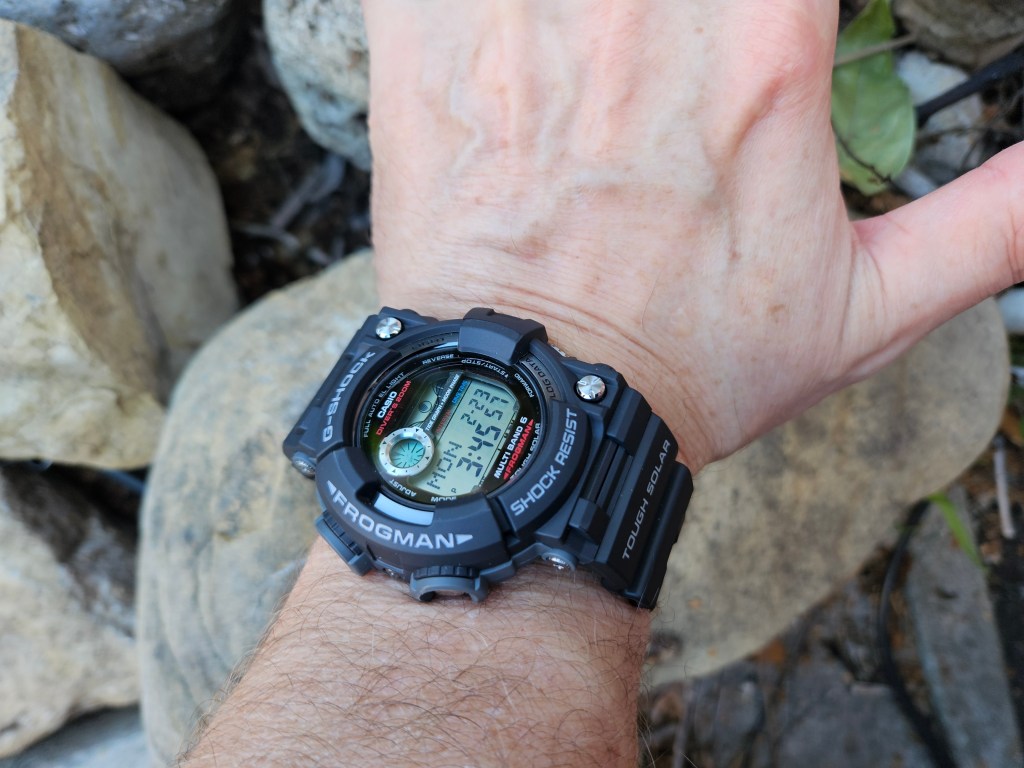
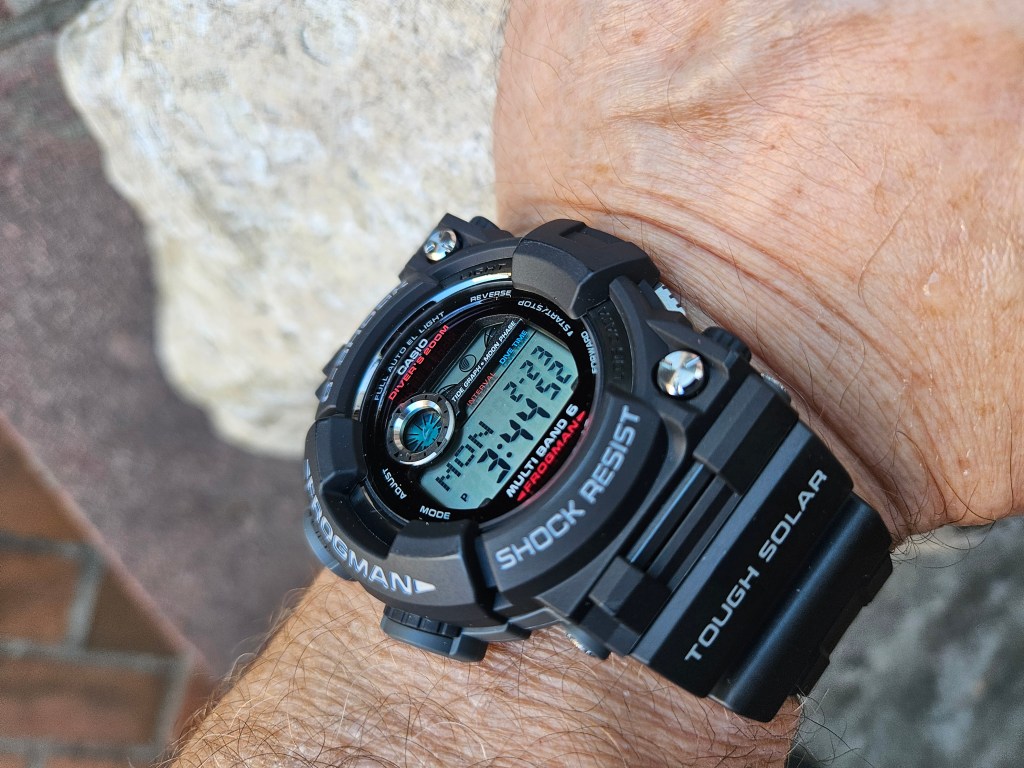
    I used to tell people I didn’t like the G-Shock Frogman GWF-1000.

    It’s oversized. It’s digital. It looks like something the wardrobe department would strap onto a second-tier superhero—Aquaman’s anxious cousin, assigned to guard the aquarium gift shop. On a 64-year-old man, it doesn’t whisper confidence. It screams midlife distress—the horological equivalent of jet-black hair dye and a motorcycle you’re afraid to start.

    And yet, for the past six months, it hasn’t left my wrist.

    My mechanical divers—polished steel, sapphire crystals, analog dignity—sit untouched, lined up in their box like former lovers trying to understand what went wrong.

    “How could you do this to us?” they seem to ask.

    “You are dead to me,” I reply.

    At this point, the relationship between my wrist and the Frogman is no longer metaphorical. It is psychological. Possibly spiritual. There may be paperwork involved.

    Let me be clear: this attachment is not based on taste. On a man my age, the Frogman doesn’t look stylish. It looks like evidence being quietly assembled by concerned family members.

    But it is not coming off.

    Because something happened.

    Not gradually. Not subtly.

    Change.

    When I started wearing the Frogman, I felt different—sharper, more contained, more adult. My appetite shrank. My focus tightened. I developed the kind of self-control normally associated with retired Marines and monks who eat lentils without complaint.

    Three meals a day. No snacks. No “kitchen reconnaissance missions.”

    Then something even stranger happened.

    My wife and daughters didn’t say a word, but their behavior shifted. The eye-rolling stopped. The subtle household demotion—from “head of family” to “eccentric roommate”—quietly reversed.

    Somehow, I had acquired gravity.

    I was no longer the suburban performance artist of half-finished plans and questionable purchases. I had become a man whose decisions suggested forethought rather than impulse.

    A man who appeared, alarmingly, to be in charge.

    But the real change was this:

    My nightmares stopped.

    Not reduced. Not improved.

    Stopped.

    For decades I lived with them—night after night, a private theater of dread that never closed. Then the Frogman arrived, and the nightmares scattered into darkness like silverfish when the lights come on.

    Now my dreams are peaceful. I run through fields of berries. In the voice of John Lennon, I sing, “I am the Frogman.”

    Explain that.

    A resin watch—battery, rubber strap, digital display—accomplished what therapy, discipline, and time could not.

    Part of me wants to leave the miracle alone. When something rescues you from overeating, ridicule, and nocturnal terror, you don’t interrogate it. You say thank you and keep your mouth shut.

    If it isn’t broken, don’t fix it.
    If you don’t understand the blessing, don’t analyze it.

    Unfortunately, I am a curious man.

    I want mechanisms. Theories. Experts. I want to understand how a mass-produced object rewired my habits, my household_toggle status, and my sleep cycle.

    That investigation is the project ahead—the study of what I can only call the Frogman Elixir Effect: a transformation so complete that the man who bought the watch no longer quite exists.

    I am no longer the wearer.

    I am the Frogman.

    Before we go further, I should correct something.

    Earlier, I said I thought the Frogman was ugly.

    That was a lie.

    Why I lied is a matter for future therapy—some mixture of denial, self-protection, and the fear of becoming the man who falls in love with industrial resin.

    The truth is this:

    The moment I saw it, I loved it.

    Not liked. Loved.

    It was, and remains, the most beautiful thing I have ever seen.

    Now that the truth is out, we can proceed honestly.

    At work, my colleague Dave noticed the change. One afternoon he suggested I attend a support group in the basement of a nearby church—men, he said, who believed they had also become Frogmen.

    Out of curiosity, I went.

    There were two dozen of us. Same age. Same watch.

    When the meeting began, we introduced ourselves the only way that felt accurate:

    “I am the Frogman.”

    Our counselor, Terry, immediately informed us that this was impossible. Only one of us could be the Frogman.

    Complicating matters, Terry was wearing the same model. There were rumors he believed he was the authentic Frogman and was using the group to establish theological authority. None of us trusted him.

    Still, we met every Wednesday.

    And something was undeniable.

    We had all changed.

    Better habits. Better focus. Better discipline. The same quiet upgrade in self-command. It was like taking creatine for the psyche. A testosterone booster for decision-making. Samson’s weapon—though one member insisted Samson actually used a donkey’s jawbone and demonstrated this point by raising his Frogman like a sacred artifact.

    The group is going well.

    Because the journey is no longer about wearing a watch.

    It is about fusion.

    What Terry eventually helped us name was Horological Identity Fusion—the state in which the boundary between wearer and object dissolves. The watch is no longer an accessory. It is a psychological extension. Removing it would feel less like changing gear and more like abandoning a role.

    Or losing a limb.

    And once that fusion occurs, something strange happens.

    You don’t wear the tool.

    You become the person the tool assumes you are.

  • The Man Who Broke Time: A Watch Obsession Goes Viral

    The Man Who Broke Time: A Watch Obsession Goes Viral

    Because I am known around The New Yorker offices as someone whose interest in watches occasionally elicits polite concern and the kind of side-eye usually reserved for men who won’t stop explaining cable management, it was perhaps inevitable that I would be assigned the Jeff McMahon story. When word spread that a 64-year-old writing instructor at Prospect College in Redondo Beach had triggered a watch-related disturbance of almost mythic proportions—drawing hundreds, then thousands of people into a crusade to “fix” his collection—I was dispatched to investigate how a private obsession metastasized into a civic emergency.

    I visited McMahon during winter break. His wife, a middle-school teacher, and his twin daughters, high-school sophomores, were safely elsewhere, leaving him alone with his thoughts, his watches, and whatever demons had learned to tell time. He answered the door wearing black travel pants with zippered pockets and a black T-shirt. Nearly six feet tall, close to 230 pounds, bald, square-jawed, with the squint of a man perpetually assessing lug-to-lug ratios, McMahon resembled a retired linebacker who had traded blitz packages for forum debates.

    Naturally, I clocked the watch immediately: a third-generation Seiko MM300 with a blue dial on a waffle strap.

    “It looks right on you,” I said, gesturing toward his forearm. “Especially given your build.”

    He shrugged. “It’s too late for me. I’m past swag. And honestly, the watch makes me miserable. I can’t decide if it belongs on a strap or a bracelet. I’ve switched so many times I no longer trust my own judgment. The only thing consistent about me is my inconsistency.”

    He led me into a bright, tile-heavy kitchen flooded with Southern California light. On the windowsill sat several shortwave radios, arranged among scattered lemons like some improvised altar.

    “Not just watches,” I observed. “Radios too.”

    He nodded, as if admitting to a second addiction was no longer worth defending.

    We sat at the kitchen table eating garlic hummus and rye crackers, drinking dark-roast coffee with soy milk and molasses.

    “Welcome,” he said with a tired smile, “to the House of Seiko. My man cave of madness.”

    I asked him why an entire community had mobilized to help solve his watch problem.

    “I have no idea,” he said. “It’s ridiculous. There are causes that matter. This doesn’t. I’m useless, over the hill, and fully Gollumified.”

    The saga began, he explained, at monthly meetups at Mimo’s Jewelry and Watches in Long Beach—friendly gatherings that escalated when he confessed the hobby no longer brought him joy. He wasn’t short on money; he was paralyzed by decision. Every choice felt wrong. The cognitive load became unbearable. He went to bed thinking about watches. He woke up thinking about watches.

    “Why not walk away?” I asked.

    “Because obsession doesn’t issue exit visas,” he said. “Once you’re in, the riddle feels existential. Solving it felt as urgent as founding a religion. I wanted to crack the code and then preach the gospel of happiness.”

    The intervention only made things worse. Camps formed. Seiko purists. Swiss loyalists. Minimalists. Maximalists. Arguments erupted. Then fights. A friend named Manny filmed the altercations. The videos went viral. Suddenly McMahon was a cause célèbre.

    “That’s when the watches started arriving in the mail,” he said.

    Luxury pieces worth more than his cars. None of them helped. He sold them and donated the money to charity. This, too, became content. More watches arrived. Then robberies. Burglaries. A P.O. box. A manager to process donations and deflect thieves.

    Millions eventually went to good causes. The silver lining, as they say.

    McMahon stared into his coffee. “I wish I felt redeemed. Mostly I feel disturbed—not just by my obsession, but by how easily the internet turned it into a farce. Sometimes I wonder if it had been anything else—stamps, guitars, fountain pens—would it have played out the same? Or is there something uniquely deranged about watches? Time itself? Father Time? Somehow my fixation feels disrespectful to him.”

    He paused, then added, “I have a friend who sold all his luxury watches. He wears a twenty-dollar Casio. Every day he thanks it for keeping him humble. He’s sane. That makes him my hero.”

    “You could follow his example,” I suggested. “Salvation is just a Casio away.”

    “And sell my divers?” he said flatly. “Not happening.”

    “You’d rather be miserable with expensive watches than happy with a cheap one.”

    “Exactly. Happiness is irrelevant now.”

    I studied him. “I don’t buy it,” I said. “This misery feels performative. A kind of cosplay.”

    He nodded slowly. “You’re right. But if I stop playing the miserable man, I have no idea who I’m supposed to be next. And that scares me more than any watch ever could.”