Category: Literary Dispatches

  • A Confederacy of Dunces Ruined My Life

    A Confederacy of Dunces Ruined My Life

    If I was indeed possessed by a misguided writing demon in the mid-’80s—courtesy of reading A Confederacy of Dunces on repeat and subsequently squandering decades chasing a fool’s errand to capture some fraction of Toole’s novelistic splendor—then one could argue, with a certain tragic flair, that A Confederacy of Dunces ruined my life. Of course, that’s a spectacular oversimplification, but it has a nice literary ring to it, the kind of statement that cries out for a memoir deal. A perfect hook for a writing addict who, in theory, is supposed to have sworn off writing books but is secretly mainlining one on the side. It’s theatrical, adolescent, irresistibly neat. But let’s indulge the idea for a moment: a novel ruined a young man’s life. Decades later, the question remains—what do we do with this squandered life? Do we ignore it, dismiss it as a useless souvenir, or can something be salvaged from the wreckage?

    If there’s anything worth extracting from my own literary misadventures, it’s a warning to younger, equally deluded souls who might be possessed by the same demon of ambition. And make no mistake—ambition alone will not get you anywhere worth going. Yes, it will drag you through years of toil, ensure you hit your daily word count, and convince you that sheer willpower equals literary success. But ultimately, ambition alone will lead you into a tunnel with no exit. You’ll work hard—but not the right way. You’ll write, but without joy, without connection, without meaning. You will produce, but you will not matter.

    So instead of chasing the illusion of grandeur, you should be asking yourself four crucial questions. First, are you having fun with the creative process? If not, why are you doing this? The comedian Tiffany Haddish once said that Eddie Murphy pulled her aside and told her that if she wasn’t having fun on stage, the audience would sense it—and once she embraced that, her career took off. The same applies to writing. If your joy doesn’t translate onto the page, don’t expect anyone else to find it. Ambition will get words onto the page, but it won’t make them worth reading. Second, are you the only person in the world who could write this book? What unique gifts, obsessions, or quirks of personality make you the best person to write this, or are you forcing an idea simply because you think it’s marketable? If the demon of ambition is blinding you to your weaknesses, rest assured that agents and editors will see them clearly—and they will tell you to go home. The demon, of course, won’t listen. He never does.

    Third, why this book? Can you articulate—persuasively—why your book matters? Will it survive in an attention economy where a two-minute TikTok can go viral while your ten-year opus sells six copies? Do you know what your book is competing against? Can you justify its existence? 

    Imagine, for a moment, that you’ve never been published and have no social media following to catapult your debut novel into relevance. How exactly do you think this book is going to survive? Picture a horde of baby sea turtles, freshly hatched, flopping their way toward the ocean. Before they even touch the surf, they’re picked off by seagulls, crabs, raccoons, foxes, coyotes, frigatebirds, herons, egrets, snappers, jacks, barracudas, dolphins, sharks—the list of assassins is endless. The ones that do make it into open water face even worse odds. And yet, statistically, they still have a better shot at survival than your novel has at flourishing into a living, breathing piece of art that embeds itself in millions of imaginations.

    So before you get too deep into your literary fever dream, you need to ask yourself a sobering question: Is there enough juice for the squeeze? Best-selling author Sam Harris certainly asked himself that before shifting his focus away from books to his wildly successful Making Sense podcast. I remember him breaking it down with ruthless efficiency: writing a book can take five grueling years—writing, editing, publishing, book tours—and even after all that, sales might not justify the effort. Meanwhile, he can record a podcast in a few hours and reach millions instantly. No torturous rewrites, no endless editing loops, no begging the world to care.

    And that’s a best-selling author speaking. You’re not one. You’re a nobody with a dream, convinced that your fragile little hatchling of a book will somehow defy the gauntlet and fulfill your delusions of literary immortality. You have lost your mind. More than likely, the book won’t be read. Which brings us to your final, painful reckoning.

    Will your book actually connect with anyone? Or will it be yet another tree falling in the forest with no one around to hear it? Failure to connect isn’t bad luck—it’s bad writing. If your prose exists in a silo of delirious echoes, unread and unloved, then it isn’t literature—it’s literary vapor, ghostly and weightless, doomed to drift into oblivion. And here’s the cruelest truth of all: your writing demon won’t make this distinction. He’ll tell you that writing is writing, that piling up pages is progress, that if you just keep going, success is inevitable.

    It isn’t.

    Had I asked myself these questions before chasing my writing demon down every blind alley, perhaps I would have written with purpose instead of compulsion. But I was too busy obeying the demon to pause and think. If you’re an aspiring writer, don’t make the same mistake. Ambition can drive you forward, but only if it’s tethered to something real—joy, originality, necessity, and connection. Otherwise, you’re just manufacturing words, filling pages with the sound and the fury, signifying nothing.

  • The Urge to Write Is the Urge to Dominate

    The Urge to Write Is the Urge to Dominate

    Looking back, I’m torn between admiring my audacity and filing a restraining order against my judgment. How, exactly, did I manage to pin so much hope on novels that, despite their half-decent opening chapters, quickly spiraled into the literary equivalent of a stalled elevator—going nowhere and deeply uncomfortable for everyone involved?

    In contrast, my short essays were clearly sharper, more potent—but I refused to let reality intrude on my mission. No, I was going to write the comic novel.

    This compulsion was never about art. It was about pain—the kind so deep that Jonathan Franzen famously coined Ache to describe the existential condition of adulthood: the rude awakening that we are not, in fact, the center of the universe and that our desires will always outrun our ability to satisfy them.

    Manuscriptus Rex feels this Ache acutely and has embarked on a fool’s errand to silence it with literary fame. But why this brand of glory? Why not build a real estate empire, become a movie heartthrob, or invent the perfect bed that guarantees twelve uninterrupted hours of blissful, coma-grade sleep? Because Manuscriptus Rex is too much of a narcissist for mere wealth, beauty, or utility. Writing a book—one that matters—offers something more intoxicating: the power to hijack people’s brains.

    And that’s what you really crave—not just admiration, but full cognitive occupation. You want your words burrowed into the minds of millions, your dream world dictating their thoughts. Your need for validation is so bottomless that only mass literary infiltration will mollify you. That this ambition is wildly improbable, driven by pathology, and guaranteed to bring more suffering than satisfaction? Irrelevant. The mission is all that matters. And the mission is literary dominance.

    My wife once observed that men, with their colossal egos, often wake up with sudden revelations, epiphanies so grand they feel compelled to start religions. She’s not wrong. The novelist, the polemicist—what are they really doing but trying to ignite a movement, disrupt the world, and bask in the glow of their own importance? Their gospel isn’t about some grand truth—it’s about them, standing center stage, ablaze with self-appointed brilliance.

    Religion is the ultimate expression of literary dominance. I think of the Apostle Paul himself, scribbling his epistles in a manic frenzy, waging rhetorical war in the bustling marketplace of spiritual ideas, demolishing rival orators, and confessing his own unhinged nature in Romans—his theological magnum opus, a mini-Bible inside the Bible. Only eighty pages in total. That was the sum of his obsessive writing, and yet his literary dominance is established. He’s been the talk of the town for over two thousand years. Whether they like him or not, people still want to hear what he has to say about the human condition. 

    This was the novelist’s role five decades ago, back when novelists were secular prophets, summoned to The Dick Cavett Show to pontificate on the issues of the day—because, once upon a time, their opinions mattered.

    And that’s what I loved about Cavett. Even as a ten-year-old, I grasped the show’s implicit assumption: the intellectual life was its own parallel universe, just as electrifying as Paul’s eschatological one—except with better punchlines.

    Perhaps Cavett planted the seeds of my literary delusion, setting the stage for a demon that would fully blossom into madness a decade later when I read A Confederacy of Dunces—then Portnoy’s Complaint and The Ginger Man. If I could write something as riotously funny as those masterpieces, I wouldn’t just be funny—I’d be brilliant, important, part of the conversation. My name would be etched into the pantheon of literary wit, my shattered self-esteem miraculously restored. I would find completion.

    And lest you think this was mere posturing, let me be clear: my aspirations weren’t some carefully curated cool pose. I was, without question, funny—not in the “guy who recycles late-night monologue jokes” way, but in the gimlet-eyed, take-no-prisoners way that slices through the world’s absurdities like a scalpel. I was an ally of Kafka, wielding my literary axe to shatter the frozen ocean of human folly. My quest was real, my voice authentic, my success inevitable.

    Except, of course, it wasn’t.

    I failed. Repeatedly. The novels kept coming, and to my credit, they got better—sharper, wittier, good enough to attract literary agents, which was dangerous because it fed the delusion. This wasn’t a phase. It became a lifelong affliction. In my twenties, thirties, forties, fifties—hell, even my sixties—the novels kept churning, like those chocolates on the conveyor belt in I Love Lucy, coming faster than I could process, devour, or even appreciate.

    The demon was still in business.

    And how good were these books as the result of all my literary effort? “Just okay.” Which, in an attention economy, is about as useful as a dial-up modem in the age of fiber optics. “Just okay” might sell 300 copies—a number so pitiful that the editor who championed your book could lose their job over it.

    But sure, let’s keep the dream alive.

    Having failed to write my grand, world-shaking book and having let A Confederacy of Dunces derail my life, I am left standing amid the wreckage of my literary ambitions, clutching at whatever scraps of wisdom I can salvage. Something must be redeemed, after all. And what better way to salvage a wreck than by turning it into yet another book? The Confessions of a Recovering Writing Addict.

    But of course, that’s just the demon running its mouth again. The same devious little imp that once whispered sweet nothings about my inevitable literary greatness now insists that my failure is my brand, my gimmick, my golden ticket to the book that will finally rock the world.

    And what is this seismic masterpiece, this literary game-changer? Oh, just a book about aspiring writers so starved for attention that they write not as artists, but as junkies, chasing the next fix of validation. A cautionary tale wrapped in a confession, packaged as a sales pitch—because irony, it seems, is the one thing I have mastered.

    Writing with an ego hellbent on domination, we writing junkies reveal an uncomfortable truth—we all have a little Paul in us. We insist we write out of sincerity, fueled by a pure, burning need to communicate something true. But let’s not kid ourselves. Deep down, what we really crave isn’t truth—it’s importance. Recognition. Veneration. And, above all, relevance.

    We aren’t just stringing words together; we’re mounting a last-ditch offensive against oblivion, hammering out prose as if sheer verbosity might hold off the reaper a little longer.

    In the end, we place our hope in something as fragile as a glue-and-paper book in the digital age, believing—despite all evidence to the contrary—that it will elevate us, transcend us, and make us immortal.

  • The Great American Fashion Mistake

    The Great American Fashion Mistake

    The breeding ground for writing my many unreadable novels was the California desert, where my catastrophic literary judgment was rivaled only by my crimes against fashion. Allow me to paint you a picture of excess so garish that even Liberace would have staged an intervention.

    There I was—a freshly minted full-time professor in a sun-scorched town, drunk on a heady cocktail of naïveté, unresolved teenage angst, and the disastrous influence of International Male and Urban Gear catalogs. To my 27-year-old mind, these catalogs weren’t mere collections of overpriced polyester; they were sacred texts, blueprints for the modern alpha male—or at least a man who looked like he managed a European nightclub and occasionally fled the country under mysterious circumstances.

    But even my delusions had their breaking point. The pinnacle of my sartorial madness arrived in one final, glorious misstep—an outfit so egregious that it shattered the patience of my English Department Chair, a man whose tolerance, until that moment, had been almost biblical.

    At first, my colleagues generously excused my increasingly bizarre wardrobe as “youthful exuberance” from a Bay Area transplant trying to assert some “big city” flair in a desert outpost where fashion trends arrive three decades late. But one fateful day, I pushed the boundaries beyond reason. I strutted into the campus like a peacock ready for a ballroom dance-off, dressed in tight Girbaud slacks that practically screamed, “I’m here to give a lecture, but I might also break into interpretive dance.” My feet were clad in Italian loafers, complete with tassels and tiny bells—yes, bells. Who needs socks when you’ve got bells? 

    But the crown jewel of this sartorial disaster—was the sage-whisper green pirate shirt. And when I say “pirate shirt,” I’m not talking about a whimsical Halloween costume. I’m talking about a translucent, billowing monstrosity that looked like it was plucked from the wardrobe of Captain Jack Sparrow after a particularly wild night of plundering. My bulging pecs were practically hosting their own TED Talk through the sheer fabric, and the effect was more Moulin Rouge than Macbeth.

    Word of my fashion blunder made it to Moses Okoro, our distinguished Chair, a no-nonsense scholar in his fifties who had traded the vibrant streets of Lagos for the dull sands of this backwater town. Moses prided himself on being a man of deep thought, the kind who savored life’s complexities and relished philosophical debates like a connoisseur of fine wine. In the rarefied circles he once frequented, he had been celebrated for his intellectual rigor, a reputation largely sustained by an essay he penned two decades earlier on a celebrated Nigerian novelist. The essay, which dissected themes of post-colonial identity with surgical precision, had been lauded as groundbreaking in its time, securing Moses’s place as a respected voice in academic and literary discussions. But the years had passed, and that once-prominent essay had become a relic—he still leaned on it like a crutch, bringing it up whenever the opportunity presented itself, hoping to rekindle the admiration it had once inspired. 

    By the time I got the midday summons to his office, I knew I was about to get the fashion red card. I walked in, and there was Moses—feet ensconced in some sort of luxurious foot-warmer device, a necessary accessory for his gout. He flashed me a grin that was half-amused, half-pitying like a man witnessing someone try to cook a steak with a hairdryer.

    “Jeff,” he began, in a tone that suggested he was both fond of me and horrified by me. “You’re a striking figure, I’ll give you that. But this—” he gestured vaguely at the shimmering monstrosity draped over my torso—“is taking things too far. I can see more than I care to.” 

    I glanced down at my exposed chest and, for the first time, realized that my pecs were starring in their own soap opera under that filmy fabric. Moses continued, “I get it—a man with your bodybuilding prowess wants to flaunt it. But, Jeff, this is an academic setting, not Studio Fifty-Four. Be more of a professor and less of a Desert Peacock.”

    He then instructed me to march straight home, ditch the pirate couture, and return dressed in something befitting a person who isn’t auditioning for a Vegas show. Before I could slink away in shame, Moses added with a smile, “Jeff, I like you. You’ve got potential. But let me remind you, this town is a fishbowl. Whatever you do in the morning, the whole town knows by lunchtime.”

    That was the small-town way—a place where the smallest fashion faux pas became a full-blown scandal before the sun hit noon. As I left his office, I knew that my pirate shirt days were over, along with my delusions of dressing like the love child of Captain Morgan and Don Juan.

    With a sigh, I trudged home to swap my dreams of high fashion for something a bit more… professorial.

    ***

    I had no clue back then, but my tragic fashion choices as a young professor in the desert in the early ‘90s were the desperate impulses of a kid who’d missed his shot at feeling special and was clawing to reclaim a glory he’d fumbled away when he was a teenage bodybuilder. 

    As a recovering writing addict, I feel duty-bound to interrogate the roots of my affliction. I suspect my obsession with literary fame was a desperate attempt to fill the void left by a glory that always felt just out of reach. Surely, if I could be famous, I’d finally be whole. The restless gnawing inside me would stop.

    This fantasy—this belief that success would grant me some grand, existential healing—must be the defining delusion of Manuscriptus Rex, the pitiful beast I have become. Like Linus in the pumpkin patch, I waited, not for the Great Pumpkin, but for the Great American Novel to descend and bless me with meaning.

    I convinced myself that basking in literary fame would erase the sting of a squandered youth, a time when I was too clueless, too underdeveloped, too timid to seize life with the lust and gusto it demanded. That lost youth left a wound, and Manuscriptus Rex clung to the belief that writing—great writing—would be the magic salve. If I couldn’t reclaim my past, I could at least immortalize myself on the page.

    It was a beautiful, seductive lie.

    Flashback to 1981: I was working a job loading parcels at UPS in Oakland, on a low-carb diet that shredded me down to the bone. I was this close to contending for the Mr. Teenage San Francisco title. With a perfectly bronzed 180-pound frame, my clothes started hanging off me like a bad costume. That meant one thing: new wardrobe. Enter a fitting room at a Pleasanton mall, where I was trying on pants behind gauzy curtains when I overheard two attractive young women debating who should ask me out. Their voices escalated, full of hunger and competition, as if I was the last slice of pizza at a frat party. I pictured them throwing down on the store carpet, pulling hair and clawing at each other’s throats, all for the privilege of walking out with the human trophy that was me.

    It was the golden moment I’d always dreamed of, my chance to bask in the attention and seize my shot at feeling like a demigod. So, what did I do? I froze like a deer in headlights, slapping on a look of such exaggerated indifference it was like laying out a welcome mat that said “Stay Away.” They took one look at my aloof facade and staggered off, probably mumbling about how stuck-up I seemed. But here’s the truth: I wasn’t a man full of myself—I was a coward hiding behind muscle armor.

    For a short, fleeting period—from my mid-teens to early twenties—I was the kind of guy who could’ve sent Cosmopolitan’s “Bachelor of the Month” candidates sobbing into their pillows. But my personality was still crawling in the shallow end of the pool while my body was busy competing for gold medals. I had sculpted a physique that would make Greek gods nod in approval, but socially? I was like a houseplant that wilts if you talk too loudly. Gorgeous women practically threw themselves at me, and I responded with the warmth and enthusiasm of a mannequin. Behind all that bronzed, chiseled muscle was a scared little boy trapped in a fortress of self-doubt.

    The frustration that consumed me as I stood there, watching those two retail employees squabble over me, was the same frustration that hit me like a truck a week later at the contest. I entered Mr. Teenage San Francisco as a “natural”—which is just a polite way of saying I didn’t juice and therefore shrank down to a point where I looked more like a wiry special-ops recruit than a bodybuilder. At six feet and 180 pounds, I had the lean, aesthetic “Frank Zane Look” just well enough to snag runner-up. But the guy who beat me was a golden-haired meathead pumped full of steroids and Medjool dates, which gave him muscles that looked inflated by a bike pump and a gut that seemed ready to explode from cramping. 

    The day after the contest, I was laid out at home, basking in the almost-victory and recovering from the Herculean effort of flexing through a nightmare lineup. Then the calls started pouring in. Strangers who’d gotten my number from the contest registry wanted me to model for their sketchy fitness magazines. Some sounded more like basement-dwelling creeps than actual photographers. I turned them down with all the enthusiasm of a nightclub bouncer dealing with fake IDs. But then one call stood out—a woman claiming to be an art student from UCSF, asking me to pose for her portfolio. Tempting, sure, but I politely declined. 

    Why? The reasons were as predictable as they were pathetic. First, I was drained from cutting down to 180 pounds and just wanted to curl up in a hole. Second, I was lazy. The thought of expending energy to meet a stranger sounded about as fun as a root canal. But the main reason? I was a professional neurotic, a certified worrywart who avoided human interaction like it was an airborne disease. The idea of meeting this mysterious woman in a San Francisco coffee shop filled me with a dread so profound that I felt like a cat eyeing a room full of rocking chairs.

    By turning down those offers, I was throwing away the golden advice handed down in Arnold Schwarzenegger’s Arnold: The Education of a Bodybuilder. According to the Gospel of Arnold, I should’ve been leveraging my physique into acting gigs, business ventures, and political fame. But here’s the thing—I didn’t have Arnold’s larger-than-life charisma, his zest for adventure, or his overpowering drive to turn everything into a money-making opportunity. While Arnold was out charming Hollywood and turning flexing into fortune, I was content to crawl under a rock and avoid all forms of adventure and new connections. If there had been a way to market my body without ever leaving my room, I would’ve been the undisputed king of the fitness world.

    Instead, I took a different path—one paved with introversion and leading straight to a career as a college writing instructor in a backwater desert town. By the time I hit twenty-seven, I was finally catching up socially—just in time to fantasize about all the chances I’d blown. Strutting around the desert in flamboyant outfits like a peacock trying to reclaim lost glory, I was determined to make up for all the opportunities I’d wasted, finally embracing the ridiculousness of who I’d become.

  • Confessions of a Recovering Writing Addict

    Confessions of a Recovering Writing Addict

    I’ve been given the most self-defeating assignment imaginable: I must write a book about my recovery from compulsive writing so that the telling of my recovery violates the terms of my sobriety.

    The first symptoms of my affliction emerged in 1984, when I made the catastrophic mistake of reading A Confederacy of Dunces. John Kennedy Toole’s masterpiece introduced me to Ignatius J. Reilly—a bloated, hot dog–devouring medievalist in a world that had tragically moved on from the 14th century. With the conviction of a deranged prophet, Ignatius stomped through New Orleans, denouncing modernity as if civilization itself were a personal affront. His absurdity was electrifying, a revelation. That was the moment I became possessed.

    This wasn’t some harmless creative itch. This was a full-blown psychosis, the kind that whispers in your ear late at night and tells you this is your purpose. Worse, it took root at the exact moment I was an impressionable young man, inflated with the kind of intellectual vanity that only a 23-year-old can achieve. Watching Ignatius clash with reality, I had an epiphany—comedy wasn’t just entertainment; it was a weapon, a higher calling.

    And then came the real disaster: I became convinced that I was meant to be a satirical novelist. Not in a vague, “wouldn’t that be cool” way, but in a divinely ordained, words-branded-into-my-flesh-with-a-cattle-prod kind of way. It was not a career choice. It was fate.

    And so began my decades-long descent into literary madness.

    ***

    To understand the bloated sense of self-importance that fueled my literary delusions, we need to revisit my place of employment—a temple of pretension where my ego found fertile ground. In the early 1980s, I funded my college education by peddling fine wines and imported beers at Jackson’s Wine & Spirits in Berkeley, conveniently nestled just up the street from the Claremont Hotel on Ashby Avenue. It was the perfect setting for a young man to marinate in delusions of grandeur—surrounded by cork-sniffing sophisticates, armchair sommeliers, and the kind of clientele who believed a well-aged Bordeaux could double as a personality.

    My coworkers were the sort of intellectual show-offs who could reduce an Oxford don to a stammering fool. They held advanced degrees in everything from literature to linguistics, chemistry to musicology, and they wore their academic pedigrees like badges of honor, brandishing them in a booze emporium as if the walls were lined with first editions rather than bottles of Chianti. They’d read Flaubert in the original French and sneered at English translations with the kind of disdain usually reserved for bad table wine. To them, working for any corporation that might dare to track their time was an act of existential surrender. Instead, they peddled fine spirits with an elitism so thick you could bottle it, cork it, and slap a vintage label on it. Their motto? “Service with a smirk.” 

    I wanted to fit in, so I read voraciously, parroting these cultural heavyweights who could debate the nuances of two French Beaujolais for an entire shift while tossing out quotes from Kierkegaard or Camus. Soon enough, I was well on my way to becoming a full-blown snob, the kind who could turn a simple idea into a verbal labyrinth designed to impress rather than clarify. Slow hours found us planted by the registers dissecting the finer points of Nietzsche’s existential dread, Wagner’s bombastic compositions, and Kafka’s literary conundrums. I became intoxicated with my own intellect (mostly because I couldn’t afford the good wine) and used every fifty-dollar word in the book to convince myself I was superior to anyone with a steady paycheck. Working alongside this oddball crew was comfortable and, let’s face it, easy, but it lulled me into a delusion: I might not be wealthy or gainfully employed, but I was intellectually rich, or so I told myself.

    By my mid-twenties, I was perfectly content to be the Nerf football-throwing, Borges-quoting slacker clerk who waxed poetic about the existential themes of Alberto Moravia and the tragic pessimism of Miguel de Unamuno while restocking shelves with Chianti. 

    To further swell my already bloated ego, I spent my early twenties teaching college writing part-time, fancying myself some sort of literary prodigy destined for greatness. Whether I was regaling my students with pompous insights—laced with Nabokovian verbosity—or delivering the same drivel to wine store customers, I reveled in the delusion that I was the gravitational center of the universe. Every word I uttered, every pretentious quip, felt like a gift to the world—never mind that no one had asked for it.

    Thus mired in a fever swamp of self-regard, I began my holy quest, an epic pilgrimage of delusion. Throughout the ’80s and ’90s, I churned out novels at a terrifying speed, convinced that sheer productivity equaled genius. Wow, I must be good at this! I thought, mistaking volume for talent, like a man believing that eating more hot dogs makes him a Michelin-star chef.

    The novels blur together now, a vast landfill of ambition outpacing execution, but three stand out for their sheer absurdity.

    In 1989, I wrote Herculodge, a dystopian satire in which being overweight or displaying cellulite was illegal. This premise, better suited for a five-minute SNL skit, somehow sprawled into a 60,000-word novella, proving that even bad ideas can be tediously stretched to novel length.

    In 1991, I produced Omnivore, the tragic tale of a man who could never find satisfaction eating his own food, forcing him to break into houses and devour leftovers from strangers’ refrigerators. Only through cat burglary could he achieve satiety—a premise that sounds brilliantly unhinged in a John Cheever short story but unbearable at novel length. Unfortunately, I chose the latter, cramming 10 percent story into 90 percent padding, like an overstuffed burrito of literary excess.

    In 1992 while teaching college in the California desert, I lived next to a man who was less a neighbor and more an anthropological oddity—a legal brief-reading, Kenny G-blasting exhibitionist who pranced around the apartment pool in custom-print Speedos while slowly tanning himself into a deep mahogany hue. He became the unwitting inspiration for The Man Who Stopped Dating, my novel about an uncouth playboy who receives a vengeful fruit basket from one of his scorned lovers. A single bite from a deliquescing mango leaves him cursed with a permanent stench, a condition suspiciously similar to fish odor syndrome (trimethylaminuria, for the medically inclined). His hero’s journey becomes a desperate quest to rid himself of the smell, find redemption, and maybe—just maybe—salvage his soul.

    Convinced I had spun pure gold, I went all in—I adapted the story into a screenplay and shelled out a cool two grand to have Hollywood script guru Linda Seger take a scalpel to it. Her verdict? Great premise. Catastrophic structure. Apparently, my masterpiece wasn’t so much a movie as a sprawling narrative train wreck, gasping for subplots, character depth, and the basic bones of a coherent story.

    But did that deter me? Of course not. In my fevered delusion, the mere act of consulting with Hollywood’s premier script doctor meant I was practically in—one fortuitous lunch meeting away from a bidding war over my genius. I could already hear studio execs brawling over my brilliance, assuming they could hold their breath long enough to endure a script about a man who smells like low tide.

    In reality, I wasn’t Hemingway. I wasn’t even a second-rate Elmore Leonard. I was Rupert Pupkin, the delusional failure from The King of Comedy, rehearsing for a fame that was never coming. The difference? At least he had the decency to keep his fantasies in his mother’s basement.

  • College Essay Prompt for the Netflix TV Show Adolescence

    College Essay Prompt for the Netflix TV Show Adolescence

    Essay Prompt Title:
    The Crisis of Modern Masculinity: Examining the Roots, Expressions, and Consequences of Male Disaffection

    Prompt:
    In recent years, a growing body of journalism, academic inquiry, and media storytelling has focused on the increasing anger, alienation, and identity crises among young men. In “The Rage of Incels” by Jia Tolentino, “What’s the Matter with Men?” by Idrees Kahloon, “The Narcissism of Angry Young Men” by Tom Nichols, and the Netflix 4-part series Adolescence, we see portraits of disaffected males navigating a volatile mix of social rejection, economic disempowerment, and identity confusion. Some interpret this crisis as a failure of modern masculinity to adapt to shifting norms, while others view it as the backlash of entitlement, narcissism, or even latent misogyny in decline.

    Write a 1,700-word argumentative essay that answers the following question:

    To what extent is the male disaffection explored in these texts rooted in social and economic displacement versus personal entitlement and narcissism—and what are the consequences for society?

    In your response, you must:

    • Use all four required sources to support your claims:
      • Jia Tolentino’s “The Rage of Incels”
      • Idrees Kahloon’s “What’s the Matter with Men?”
      • Tom Nichols’ “The Narcissism of Angry Young Men”
      • Netflix’s Adolescence
    • Develop a clear thesis statement that articulates your position on the causes and implications of male alienation.
    • Organize your essay with well-developed body paragraphs that analyze textual evidence and provide insightful commentary.
    • Include at least one counterargument that challenges your position.
    • Offer a rebuttal to that counterargument, defending your thesis and strengthening your position.
    • Connect your analysis to broader social, cultural, or political implications, showing why this issue matters beyond the texts themselves.
  • 95% of books are just bloated short stories and essays with unnecessary padding

    95% of books are just bloated short stories and essays with unnecessary padding

    As part of my rehabilitation from writing novels I have no business writing, I remind myself of an uncomfortable truth: 95% of books—both fiction and nonfiction—are just bloated short stories and essays with unnecessary padding. How many times have I read a novel and thought, This would have been a killer short story, but as a novel, it’s a slog? How often have I powered through a nonfiction screed only to realize that everything I needed was in the first chapter, and the rest was just an echo chamber of diminishing returns?

    Perhaps someday, I’ll learn to write an exceptional short story—the kind that punches above its weight, the kind that leaves you feeling like you’ve just read a 400-page novel even though it barely clears 30. It takes a rare kind of genius to pull off this magic trick. I think of Alice Munro’s layered portraits of regret, Lorrie Moore’s razor-sharp wit, and John Cheever’s meticulous dissections of suburban despair. I flip through my extra-large edition of The Stories of John Cheever, and three stand out like glittering relics: “The Swimmer,” “The Country Husband,” and “The Jewels of the Cabots.” Each is a self-contained universe, a potent literary multivitamin that somehow delivers all the nourishment of a novel in a single, concentrated dose. Let’s call these rare works Stories That Ate a Novel—compact, ferocious, and packed with enough emotional and intellectual weight to render lesser novels redundant.

    As part of my rehabilitation, I must seek out such stories, study them, and attempt to write them. Not just as an artistic exercise, but as a safeguard against relapse—the last thing I need is another 300-page corpse of a novel stinking up my hard drive.

    But maybe this is more than just a recovery plan. Maybe this is a new mission—championing Stories That Eat Novels. The cultural winds are shifting in my favor. Attention spans, gnawed to the bone by social media, no longer tolerate literary excess. Even the New York Times has noted the rise of the short novel, reporting in “To the Point: Short Novels Dominate International Booker Prize Nominees” that books under 200 pages are taking center stage. We may be witnessing a tectonic shift, an age where brevity is not just a virtue but a necessity.

    For a failed novelist and an unapologetic literary wind-sprinter, this could be my moment. I can already see it—my sleek, ruthless 160-page collection, Stories That Eat Novels, four lapidary masterpieces gleaming like finely cut diamonds. Rehabilitation has never felt so good. Who says a man in his sixties can’t find his literary niche and stage an artistic rebirth? Maybe I wasn’t a failed novelist after all—maybe I was just a short-form assassin waiting for the right age to arrive.

  • Shifting from literary delusion to real work

    Shifting from literary delusion to real work

    Much of my so-called rehabilitation boiled down to admitting the humiliating truth: I wasn’t just a failed writer—I was the lowest form of literary life, a wannabe. A person who didn’t write so much as perform the idea of being a writer. A cosplay novelist, strutting around in the costume of a tortured genius while producing little more than pretentious drivel and a growing pile of abandoned manuscripts. It wasn’t just about impressing others; it was about impressing myself, clinging to the illusion that I was part of some grand tradition of suffering scribes.

    True rehab meant ditching the farce, but not the writing itself. That would have been its own brand of self-sabotage—flipping the table and storming off because I couldn’t be Tolstoy. No, the real challenge wasn’t quitting writing; it was quitting the wrong kind of writing, the one that had wasted decades of my life. What that left me with, I wasn’t sure. But I knew one thing: I had to approach writing with a level of honesty and discipline my past posturing had never allowed.

    To guide this shift from literary delusion to something resembling actual work, I turned to Steven Pressfield’s manifesto The War of Art: Break Through the Block and Win Your Inner Creative Battles. If anyone understood the difference between real work and creative self-deception, it was him. And if I was going to claw my way out of my own nonsense, I needed a drill sergeant, not another enabler.

    Steven Pressfield does not sugarcoat the reality of writing. Sit down at the keyboard, and you’re not just typing—you’re waging a spiritual war. The enemy? A malevolent, shape-shifting force hellbent on keeping you from producing anything meaningful. It doesn’t want you to write. It doesn’t want you to create. It doesn’t even want you to try. Instead, it wants you lulled into the soft coma of complacency, soothed by self-indulgence, and sedated by excuses. Pressfield has a name for this insidious saboteur: Resistance.

    And Resistance isn’t just out to destroy your writing career. It’s an all-purpose wrecking ball, ready to demolish anything of value in your life. Want to exercise? Resistance whispers, “Tomorrow.” Want to eat healthy? Resistance hands you a menu and points at the nachos. Thinking of saving your marriage, reconnecting with an old friend, or simply being a functional human being? Resistance assures you that Netflix is easier. Resistance thrives on inertia, feeding off your lowest instincts until your grand ambitions are reduced to doomscrolling and DoorDash. As far as Resistance is concerned, there is no higher self—only Bread and Circus, perpetual comfort, and a well-padded existential void.

    But then Pressfield throws a curveball, one that had me stop mid-page, coffee cup hovering in midair. He insists that each of us has been gifted by the divine with “our own unique genius.” A talent, a calling, something only we can do. A mission we’re supposed to fulfill.

    Which led me to a harsh realization: If I wasn’t the brilliant comic novelist I had once deluded myself into believing I was—if my grand literary dreams had been little more than feverish cosplay—then what the hell was my so-called genius? Because, according to Pressfield, if I wasn’t meant to write the next Confederacy of Dunces, then surely I had something up my sleeve. Right?

    Unless, of course, Resistance had already won.

    As I read Pressfield’s case studies in human self-sabotage, it dawns on me: Resistance isn’t just some minor inconvenience—it’s a full-blown existential heist, engineered to ensure we squander our brief time on this planet in a haze of cheap dopamine and deferred dreams. It doesn’t just want us to fail; it wants us to fail happily, lulled into a state of passive indulgence, too numbed by distraction to notice the slow-motion car wreck of our own potential.

    The real danger? Not taking it seriously. Resistance thrives on skepticism. It wants you to roll your eyes, to dismiss it as some overblown metaphor. Pressfield, however, has a blunt rebuttal for the doubters: “You think Resistance isn’t real? Resistance will bury you.” And judging by the graveyard of abandoned projects and untapped ambitions littering my past, I’d say he’s got a point.

    Pressfield doesn’t tiptoe around Resistance—he paints it as nothing short of a demonic force hellbent on sabotaging your higher self. It doesn’t just nudge you toward procrastination; it actively conspires to keep you from doing anything meaningful. It thrives on your fear, swells with power whenever you’re on the cusp of finishing something worthwhile, and works tirelessly to convince you that life is a low-stakes game of distractions and indulgence.

    Interestingly, therapist Phil Stutz arrives at the same conclusion, albeit with a different branding. He calls this malevolent force Part X, but the function remains identical: an invisible saboteur that keeps you stuck in mediocrity, endlessly scrolling, doom-looping, and putting off your real work until tomorrow—which, of course, never arrives. Like Pressfield, Stutz insists that Resistance is baked into the human condition and that pretending it doesn’t exist is the surest way to let it consume you.

    In this sense, Pressfield and Stutz aren’t just self-help gurus; they’re high priests of a secular, no-nonsense religion: You are broken. The world is against you. And your only path to salvation is relentless discipline. Where many pop psychologists coddle their audiences with affirmations and vague pep talks about “self-care,” these two take a more Calvinist approach: Get to work. Expect suffering. Resist Resistance. The stakes, as they present them, are nothing short of existential—fail to fight back, and you risk not only losing your dreams but your very humanity.

    While Stutz takes a broader view, Pressfield zeros in on the artist, especially the writer. According to him, Resistance manifests in a litany of self-destructive behaviors: compulsive procrastination, fixation on meaningless relationships, and a penchant for creating unnecessary chaos—all to avoid sitting down and doing the real work. He argues that many of us invite drama into our lives simply because it provides an excuse not to write. The more absurd, the better.

    Case in point: Pressfield would have a field day with the stories I see on the medical drama The Pitt, where patients flood the ER for spectacularly self-inflicted disasters. One woman flew across the country to let a TikTok stranger inject industrial-grade silicone into her backside—only to end up fighting for her life. Another, a social media influencer, poisoned herself with black-market beauty products laced with mercury, resulting in a psychotic break. These people didn’t just stumble into chaos; they practically RSVP’d to it. Pressfield would argue that their tragicomic misfortunes weren’t just poor decisions but acts of subconscious sabotage—distractions from the real, difficult work of self-improvement.

    And if I’m being honest, I see shades of my own dysfunction in these cautionary tales. For years, I convinced myself I was a comic novelist, spinning out unreadable manuscripts like a literary assembly line worker with no quality control. But was I really writing novels? Or was I just using the idea of writing as a nervous tic, a way to avoid more meaningful work? The answer is painfully clear.

    By Pressfield’s definition, I wasn’t an artist—I was a graphomaniac. If trichotillomania is the compulsive need to pluck out your own hair, Graphomania Nervosa is the compulsive need to churn out unpublishable novels, deluding yourself into thinking you’re “making progress” while really just spinning your wheels. The symptoms? Excessive keyboard abuse, delusions of literary grandeur, and an uncanny ability to ignore decades of failure. I wasn’t battling Resistance; I was collaborating with it. And that, I now realize, was the ultimate act of self-sabotage.

    How insidious is Resistance? According to Pressfield, it’s the invisible puppet master behind an entire industry of syndromes, disorders, and afflictions—many of which, he argues, are little more than theatrical productions staged by our own subconscious. It’s so pervasive that most people don’t miss work because of actual illness, but because of what he calls self-dramatized ailments. In other words, Resistance isn’t just an obstacle; it’s a world-builder. It conjures up entire pathologies, complete with a supporting cast of “experts,” a library of bestselling self-help books, and a pharmaceutical buffet of magic pills designed to “treat” the very conditions it invents.

    These manufactured miseries feed into a culture of victimhood, where suffering—real or imagined—becomes a lifestyle brand. The narcissist doesn’t just endure their personal afflictions; they curate them, transforming their burdens into a kind of tragic, self-congratulatory art. Pressfield published The War of Art in 2002, long before TikTok turned self-diagnosis into an Olympic sport. But if he were writing it today, he’d have a field day watching an entire generation swap productivity for performative ailments, trading ambition for an endless loop of “What obscure mental illness do you have?” quizzes. Resistance has upgraded—now it comes with filters, hashtags, and a monetization strategy.

    The passage in The War of Art that truly floored me—the one that made me put the book down and stare into the abyss—was Pressfield’s take on choosing a mate. He writes: “Sometimes, if we’re not conscious of our own Resistance, we’ll pick as a mate someone who has or is successfully overcoming Resistance.” He admits he’s not entirely sure why this happens, but speculates that perhaps we’re drawn to those who radiate the strength we so conspicuously lack, as if their sheer competence might rub off on us through prolonged exposure.

    That hit a little too close to home. My wife, for example, is a master of keeping Resistance at bay. She doesn’t get derailed by distractions, doesn’t spiral into existential meltdowns over minor inconveniences, and certainly doesn’t spend years chasing some ill-fated literary delusion. She’s disciplined, focused, and—here’s the real kicker—consistently gets things done. Meanwhile, I have the emotional resilience of a soufflé in an earthquake. One unexpected hiccup in my day, and I’m either catastrophizing or indulging in some elaborate form of procrastination disguised as “creative struggle.”

    Pressfield argues that when an underachiever pairs up with an overachiever, the real villain isn’t just personal inadequacy—it’s Resistance itself, warping love into a lopsided power dynamic. He writes: “This is how Resistance disfigures love. The stew it creates is rich, it’s colorful; Tennessee Williams could work it up into a trilogy. But is it love? If we’re the supporting partner, shouldn’t we face our own failure to pursue our unlived life, rather than hitchhike on our spouse’s coattails?”

    Translation: if you’re the slacker in the relationship, maybe instead of basking in your partner’s competence like a freeloading houseplant, you should actually do something with your life. The hard truth is, Pressfield doesn’t just suggest that people like me might be hitchhiking on our spouse’s ambition—he flat-out states it. And honestly? He’s right. Maybe instead of cranking out unreadable novels no one asked for, I should grab a ladder and start clearing the rain gutters.

    Facing the reality of my failed novelist career doesn’t mean I should retire my keyboard and resign myself to a life of watching my rain gutters fill with leaves. Yes, I lingered in the fiction world like an uninvited guest at a dinner party, well past the point where someone should have taken my coat and quietly ushered me to the door. But if Pressfield’s The War of Art has taught me anything, it’s that surrendering to Resistance—believing its insidious whisper that I have nothing to contribute—is the fastest way to irrelevance.

    Resistance tried to pull the same trick on Pressfield himself. It told him he was a novelist, not a self-help guru, and had no business writing a manifesto on creativity and spiritual stamina. But he ignored that voice, wrote The War of Art anyway, and watched it outsell every other book he’d ever written. Resistance took a brutal loss that day—but like a bad ex, it never really disappears. It always circles back, lurking in the shadows, waiting for the perfect moment to convince you that quitting is the rational choice. The trick is seeing it for what it is: a con artist with the same tired sales pitch. And I, for one, refuse to buy in.
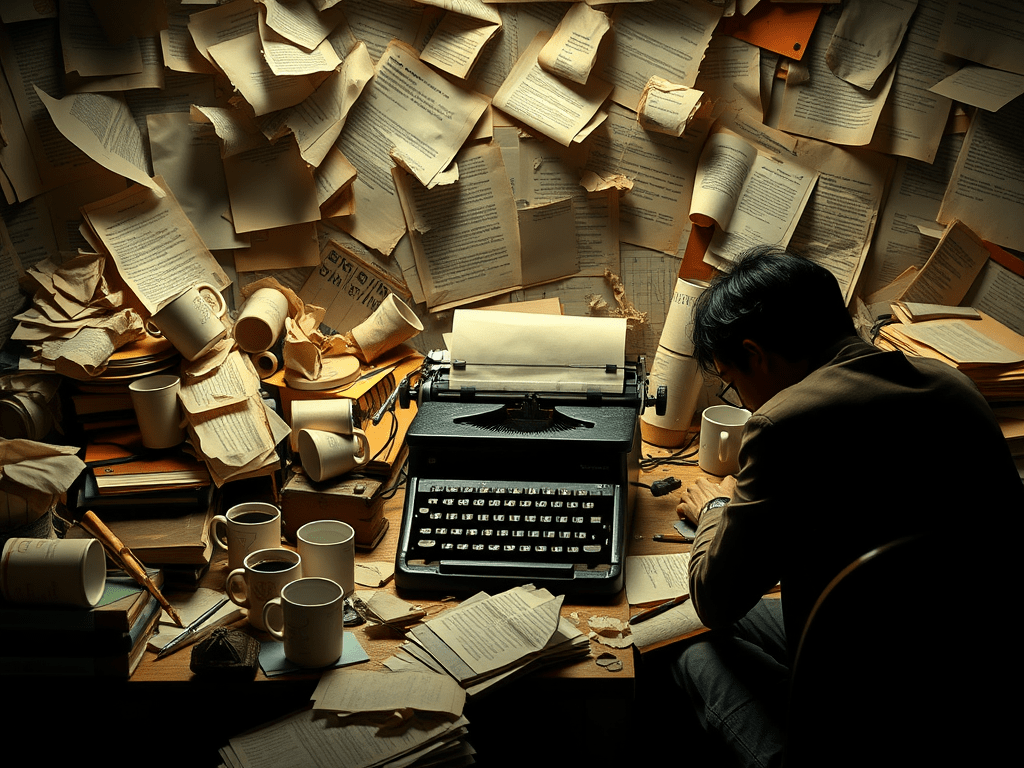

  • What does it feel like to be crushed beneath decades of writing addiction?

    What does it feel like to be crushed beneath decades of writing addiction?

    What does it mean to be pinned down for decades by some vast, crushing force, an unmovable, soul-flattening monolith that convinces you of your own helplessness? More importantly, do we even want to be free from it, or is that liberation its own special kind of agony?

    This takes me back to 1970, watching Adam-12, one of my favorite TV shows, though I only remember one episode. A man was trapped under a fallen telephone pole, the weight pressing into his ribs. When paramedics arrived, they informed him they’d be using a crane to lift it off. “Funny,” the man remarked. “I don’t even feel any pain.” The paramedic’s response? You don’t feel pain now—but once we lift it, you will.

    That moment lodged itself in my brain like a splinter. Because, really, what is breaking free from an addiction if not having a telephone pole lifted off your chest? You think you’re ready for freedom, but then the weight is gone, and suddenly, every nerve in your body starts screaming. You had learned to live with the oppression, adapted to its limits, made peace with your own captivity. And now, you have to face everything that weight once shielded you from—all the wounds you ignored, all the realities you deferred, all the choices you never had to make because you were conveniently immobilized.

    That’s where I am now. My recovery means staying in my lane, so I have to admit that I will never write A Confederacy of Dunces. I don’t have the genius to write something like The Ginger Man. I won’t be crafting an autofictional masterwork à la Emmanuel Carrère’s Kingdom. What I do have is a lifetime spent crushed under the telephone pole of writing addiction, a weight that once gave my life structure—even as it kept me from actually living it.

    So, I had to be the crane operator, the paramedic, and the doctor all at once. I had to lift the damn pole, endure the pain, and figure out how to move forward. 

    Lifting the telephone pole off my ribs did indeed hurt like hell. By the time the 2024 Thanksgiving rolled around, I could feel the weight of grief like an overstuffed holiday plate. I’d said goodbye to my mother during the pandemic, standing outside a nursing home window and offering her love through a mesh screen, as if I were visiting someone in solitary confinement. Two years later, I watched my father—a proud infantryman in his day—fade to 130 pounds, his body surrendering to cancer. Since their passing, the world felt quieter, smaller, like someone had dimmed the lights without warning.

    So, when hosting Thanksgiving fell squarely on my plate, it wasn’t some Norman Rockwell fantasy. It was more like getting crushed by a baby grand piano dropped from the second floor. And instead of gracefully stepping aside, I just let it hit me—because honestly, moving felt like too much effort.

    The guest list wasn’t exactly daunting—just my perpetually single brother, whose dating apps seemed better at generating cautionary tales than romantic prospects, and two of my wife’s teacher friends, both middle school band directors still recovering from clarinet-induced PTSD. The conversation was polite, though it had all the flavor of plain oatmeal.

    Stuffed to the gills but somehow still shoveling pie like our lives depended on it, we trudged through the ritual of TV show recommendations. Each suggestion was delivered with the gravitas of a public service announcement—skip this series at your own peril. Apparently, failing to watch that one obscure, eight-part masterpiece would leave me culturally destitute, wandering through a desolate landscape devoid of punchlines and plot twists.

    Honestly, I enjoyed the company. The real villain of Thanksgiving wasn’t the guests—it was the dishes. The endless scrubbing that left my hands raw, the dishwashing marathon that stretched into eternity, the mountain of dirty plates multiplying like gremlins in the sink. That’s where the wheels came off.

    My wife, meanwhile, glided through the chaos like some kind of culinary sorceress, humming softly as she orchestrated the entire meal with the grace of a Michelin-starred maestro. She didn’t grumble. Not a single passive-aggressive sigh escaped her lips. She was the picture of serene competence.

    I, on the other hand, hovered around the kitchen like a useless NPC in a video game—occasionally moving a plate from table to sink and acting as though I’d just conquered Everest. At one point, I genuinely felt winded after rearranging the silverware. My contribution was so meager it felt performative, like a child pretending to be tired after “helping” Dad mow the lawn by pushing a plastic toy mower ten feet behind him.

    Somewhere between rinsing the roasting pan and glaring at the pile of silverware, it hit me—I was teetering on the edge of a Mope-a-saurus moment. The only thing preventing my full transformation was the vague sense of shame that my wife, who had just cooked for hours, wasn’t grumbling about the aftermath. That’s when you know you’re in trouble—when someone else’s superior competence and good cheer makes you feel like a defective appliance, sputtering through life with a flickering power cord and a weak motor.

    The lethal cocktail of self-loathing and forced sociability had drained me to the marrow. By the time the guests finally took their leave, I should have collapsed straight into bed, preferably into a coma-level sleep.

    But as a writing addict, I stayed up deep into the night and wrote a book proposal. 

    Surviving Thanksgiving: The Essential Guide

    A Memoir of Grief, Dysfunction, and the Existential Terror of Dishes

    Author: Jeff McMahon, recovering member of Write-a-holics Anonymous, part-time Manuscriptus Rex, full-time over-thinker.

    Overview:
    The holidays are supposed to be about gratitude, togetherness, and the warm glow of familial love. But let’s be honest—Thanksgiving is a psychological endurance test wrapped in a turkey-scented mirage of Norman Rockwell propaganda. You either come out of it spiritually enriched or barely clinging to sanity, drowning in a sea of gravy-stained regrets.

    This book is for those of us who, instead of basking in holiday joy, find ourselves staring into the abyss of mashed potatoes, contemplating the futility of existence while our hands prune in dishwater. It’s for the people who, somewhere between the third helping of stuffing and the forced enthusiasm over TV show recommendations, realize they are hurtling toward their final transformation: a hollow version of their former selves.

    Through dark humor, painfully relatable anecdotes, and some uncomfortably personal self-reflection, Surviving Thanksgiving: The Essential Guide will navigate the holiday’s perils—family dysfunction, grief-laden nostalgia, the crushing disappointment of dry turkey, and the passive-aggressive Olympics that inevitably break out over pie. Along the way, I’ll explore the psychology of holiday meltdowns, the delusions of tradition, and why washing dishes can trigger a full existential crisis.

    Target Audience:
    This book is for:

    • Burnt-out hosts who wonder why they agreed to this in the first place.
    • Perpetually single siblings trapped in the “Any Special Someone?” interrogation.
    • Grief-stricken folks realizing the empty chairs at the table hurt more than expected.
    • Introverts who barely survived the social gauntlet.
    • Writing addicts who turn all their misery into book proposals.

    Tone & Style:
    Think David Sedaris meets Kitchen Confidential with a side of A Confederacy of Dunces. It’s part memoir, part cultural critique, and entirely fueled by existential dread and too much pie.

    Managing my anxieties over Thanksgiving, I had conceived a preposterous memoir, a premise clearly more suitable for an essay than a book, but I couldn’t help it. Conceiving of these “comic memoirs” and providing a book proposal was a compulsion. Stopping one addiction didn’t make my compulsions disappear. They simply rerouted, popping up in new, mutated forms, like a literary game of whack-a-mole.

    Now, instead of writing doomed novels, I found myself obsessing over my own struggles, crafting fractured hero tales where I was the comic fool, perpetually failing forward, stumbling through existence like a man who just had a telephone pole yanked off his chest—and is still waiting for his ribs to stop throbbing.

  • If you want to lose all your friends, write a memoir

    If you want to lose all your friends, write a memoir

    Things didn’t get off to a great start with Meredith Maran’s Why We Write About Ourselves, a collection of essays on memoir writing. She kicks things off with a dire warning: if you want to lose your friends and nuke your marriage, just go ahead and write a memoir. I had been hoping for a beacon to guide me out of my existential writing crisis and into the Promised Land, but instead, I found myself in a flashing red-light district of Proceed at Your Own Peril.

    Maran dives deep into the murky waters of writerly motivation and resurfaces with the least flattering answer possible: we’re all a bunch of nosy, voyeuristic gossip hounds who want the dirt—preferably dished out in the raw, unfiltered voice of the first-person narrator. It reminds me of Truman Capote’s observation that all literature is just well-dressed gossip, and in the world of memoir, it seems the clothes are optional.

    With the motivations for reading memoirs sufficiently dragged into the light, Maran turns to the reasons people write them. She notes that some see the memoir as nothing more than a narcissistic circus—a playing field where “attention-craving, sensationalistic, crass, and craven” egomaniacs head-butt and navel-gaze their way onto the bestseller list. It’s a bleak portrait, and one that left me momentarily concerned that I, too, might just be another sideshow act in this literary funhouse.

    Fortunately, the writers in Maran’s book offer more redeeming perspectives. Not everyone approaches memoir as a vehicle for public self-adoration or a passive-aggressive airing of grievances. Some actually—brace yourself—write for reasons that are noble, even sympathetic.

    Ayelet Waldman, for instance, delivers a reality check: a memoir cannot simply be a glorified diary, a raw and unfiltered regurgitation of emotions. It must be processed—shaped by craft, analysis, and a clear point of view. In other words, if your memoir reads like the fevered pages of a high school journal, you’re doing it wrong. Writing may be therapeutic, but unless it’s been refined into something resembling art, it has no business being read by anyone who isn’t legally obligated to love you.

    As I devoured the memoirists’ writing advice, one truth became undeniable: The elements that make a great memoir are the same ones that make a great novel—world-building, fearless truth-telling, a well-defined character arc, an engaging narrative, a distinct point of view, and above all, a damn good story.

    But memoir comes with a steeper price. In fiction, a character’s deepest secrets are spilled without hesitation—because, after all, they’re not real. A memoir, however, deals in cold, hard reality, which means that privacy is collateral damage. That’s the rub of memoir: The death of discretion. In a world where people already complain about “too much sharing,” a memoirist must trample that boundary without apology. No holds barred, no skeletons left in the closet.

    So why not just slap a fictional label on it and dodge the ethical landmines? Why not camouflage the truth in a novel and spare yourself (and others) the public exposure? Sometimes, that’s the smarter move. But not always.

    There’s a reason we say, “You can’t make this stuff up.” Some real-life events have an organic absurdity, a cosmic cruelty, or an accidental genius that fiction could never replicate. In some cases, stranger than fiction isn’t just a phrase—it’s a mandate. If a story loses its raw power by being fictionalized, then you have no choice but to write it as it happened, bruises and all.

    Then things get even messier. What happens when you dress a memoir in fictional clothing—using an unreliable narrator, injecting autobiographical flourishes, blending novelistic techniques into something that isn’t quite memoir, isn’t quite novel, but floats in that murky realm of autofiction?

    I considered all of this and still chose memoir. Because for me, writing about a young man whose life was warped, reshaped, and essentially hijacked by comic novels—especially A Confederacy of Dunces—wasn’t just an artistic decision. It was the spine of my existence. It wasn’t just about paying the bills, meeting obligations, or navigating life’s banal logistics. It was about inhabiting two parallel universes at once, toggling between reality and the kind of aspiring literary dream world Steely Dan’s melancholy narrator longs for as a musician in “Deacon Blues.”

    Because for some of us, living in two worlds is the only way to manage ourselves.

  • It’s impossible to overestimate Hugh Hefner’s Influence on 70s Culture

    It’s impossible to overestimate Hugh Hefner’s Influence on 70s Culture

    Mario Vargas Llosa opens his memoir about Flaubert’s masterpiece Madame Bovary with a startling confession: fictional characters have shaped his life more than real people. And among these literary phantoms, none has haunted him like Emma Bovary.

    He first encountered her as a broke student in Paris in 1959, reading Madame Bovary in his cramped, dimly lit apartment, where the novel consumed him like a “magic spell.” This wasn’t just a passing literary crush—Flaubert’s novel hardwired his taste in fiction. Llosa craves symmetry, structure, and bold architecture—stories that begin, unfold, and close like a perfectly executed aria, not those meandering, open-ended narratives that wander aimlessly like a lost tourist in a foreign city. He wants novels that sum up an entire existence, not ones that leave you guessing where the rest of the pages went.

    But his obsession with Madame Bovary isn’t just about its structural perfection. Llosa delights in its savage portrayal of stupidity, hypocrisy, cowardice, and self-complacent mediocrity. He sees Emma Bovary as a tragic hero, a woman who refuses to rot inside the coffin of bourgeois chastity, instead reaching for sensuality, opulence, and a life less suffocating. She fails, of course—spectacularly—but Llosa admires the rebellion even as he watches it collapse.

    His connection to Madame Bovary runs deeper than admiration. He sees himself in Emma. He shares her “stubborn despair, a profound distaste for life,” and her reckless excesses as an emotional counterattack against a cruel, indifferent world. Reading about Emma’s slow, agonizing suicide didn’t just illuminate the novel’s merciless social critique—it gave Llosa a new understanding of his own misery. In that sense, the book wasn’t just a masterpiece—it was a form of catharsis, a lifeboat thrown to him in turbulent waters.

    I recognize this kind of literary possession all too well. I had my own Madame Bovary moment—except it came in the form of A Confederacy of Dunces. When I read it, I saw the excesses of a young man crushed by his own emotional impoverishment, who built a fortress of grandiosity to shield himself from reality. Like Llosa with Emma, I saw a grotesque reflection of my own worst instincts. And, like him, I couldn’t look away.

    Recognizing the worst instincts in others—and in myself—was the fuel behind my ill-fated quest to be a comic novelist, a misadventure that, sadly, yielded nothing but abandoned drafts and existential nausea.

    Still, like Llosa, I found a perverse kind of clarity in my compulsion to chronicle human excess—a knack for spotting the gaudy, the grotesque, and the tragically misguided, then trapping it on the page like a butterfly pinned to a display case.

    If nothing else, I could always recognize an Emma Bovary type—vulgar, kitschy, overdosing on fantasies of grandeur—and I knew how to turn their delusions into cautionary tales, even if my own delusions proved immune to the lesson.

    I’m thinking of Playboy media magnate Hugh Hefner who fancied himself a rebel against bourgeois prudishness. Hugh Hefner, the prophet of smarmy male entitlement and silk-robe swagger. Hefner preached a gospel of unrepentant pleasure-seeking and Playboy-approved cosplay, designed to hypnotize women and soothe fragile male egos.

    And in the sweltering summer of 1977, I met one of Hefner’s most devout disciples: Glenn Leidecker.

    Every Saturday that summer, I practically melted into the scorched earth at Cull Canyon Lake, basted in Hawaiian Tropic Dark Tanning Oil—SPF Zero, because back then skin cancer was just a rumor. The sticky perfume of coconut and bananas was the scent of youth and poor decisions.

    Then there was Leidecker.

    Late twenties. Wavy brown hair, feathered to perfection. A thick, manicured mustache that could have been insured for thousands. An even, leathery tan stretched over a frame wearing nothing but blue Speedo briefs, a gold chain, and a white puka shell necklace draped over his hairy chest. His arsenal of seduction included a white Frisbee, a Playboy-logo cooler, and a boombox blasting the smooth seduction of Foreigner, Fleetwood Mac, and K.C. and The Sunshine Band.

    His moves were choreographed to the point of absurdity. Every Saturday, Leidecker ran the same pickup script on an endless rotation of bikini-clad women. I knew every line by heart: the $500 custom paint job on his Camaro, the humblebrag about his dad’s Bay Area clothing stores, the claim that he’d been managing those stores since high school, and the cherry on top—he was this close to landing a role in a Hollywood martial arts movie. Oh, and let’s not forget the constant invocation of “Parsons Estates,” which he dropped like it was some enchanted kingdom instead of a generic middle-class neighborhood.

    Leidecker wasn’t just a cliché. He was a valedictorian of Smarmy Male University, graduating magna cum laude in Playboy Posturing. His thesis? A cover-to-cover study of Eric Weber’s How to Pick Up Girls!, a sleazy manifesto that encouraged men to relentlessly harass women under the delusion that persistence equals success.

    Week after week, Leidecker reeled in a fresh catch, tossing Frisbees on the grassy knoll with women who didn’t yet realize they were extras in his sad little production. He wasn’t a man; he was a walking Playboy advertisement, the answer to that smug caption, “What sort of man reads Playboy?” Apparently, the kind of man who thinks speedos and gold chains are a mating call.

    I watched the mating ritual from my towel, pretending to read my parents’ dog-eared copy of The Happy Hooker while keeping a close eye on Leidecker. He was mid-Frisbee toss with two blonde girls in matching white bikinis when he let out an alarming, almost comical howl.

    “Oh my God, you stepped on a bee!” one of the girls gasped.

    Sure enough, the poor insect spun helplessly in the grass, stinger spent. But it was Leidecker who was spiraling. Sweat beaded on his bronzed skin, his Playboy cool starting to crack.

    But of course, he couldn’t just admit he was in agony. The kind of man who reads Playboy doesn’t crumble over a bee sting.

    “No big deal,” he puffed, wobbling on his rapidly swelling foot. “Just a little bee sting.”

    By now, his foot had ballooned into something resembling a Christmas ham, and a shiny coat of sweat slicked his once-confident swagger. Still, he insisted, “I’m fine. Really. Let’s keep playing.”

    Because the kind of man who reads Playboy is a warrior. He doesn’t show weakness. He doesn’t feel weakness.

    Until he did.

    Leidecker’s tough-guy act evaporated in an instant. His eyes bulged with panic, his breath turned ragged, and then—like a poorly written action hero meeting his karmic comeuppance—he crumpled to the ground, hyperventilating into anaphylactic shock.

    Did he survive? No idea. But if this were fiction, he’d be stone-cold dead—a sacrificial lamb on the altar of poetic justice: Death by vanity, wrapped up with a neat moral bow. 

    Like Llosa, I’ve always gravitated toward narratives with crisp, decisive endings—no ambiguity, no loose threads, no “life just goes on” cop-outs. I crave stories with bold structures and brutal symmetry, because, deep down, I need them. I need fables, cautionary tales, and tragic blueprints to ward off the self-destructive instincts swirling inside me. If life refuses to provide a clean conclusion, then dammit, fiction will.