Category: religion

  • If You Spend Your Life Wanting Things, You Will be in a Constant Fever

    If You Spend Your Life Wanting Things, You Will be in a Constant Fever

    One evening, I was holed up in my room, devouring a muscle magazine like it was scripture. I’d just finished an article on “progressive resistance training,” a phrase that made my adolescent heart thump with moral clarity. The world, I decided, was divided into two kinds of people: those who were progressing—pushing, grinding, improving—and those who were stuck, rotting in the swamps of inertia. Naturally, I placed myself in the first camp, the self-anointed pilgrim of progress.

    When the article ended, I drifted into the ads—the sacred appendix of every muscle mag. Protein powders, chrome dumbbells, pulleys, powders, potions—alchemy for the ambitious. But one ad stopped me cold: the Bullworker. A gleaming, three-foot rod of plastic and steel with cables sprouting from its sides like mechanical tendons. When you pulled the cables, the thing bowed like a crossbow for Hercules. A shirtless bodybuilder—pecs like carved mahogany—was using it to crush air itself. Price tag: forty-five bucks. Steep, but wasn’t self-transformation always costly?

    I marched into the living room, magazine in hand. My father sat in his recliner, beer in one hand, football roaring from the TV like an angry god.
    “Dad, what do you think?” I said, pointing to the Bullworker.

    He barely glanced at it. Still had the infantryman haircut, the square jaw, the tattoo—MICHAEL, bold and blue—across his right bicep like a relic from some forgotten war.
    “You want big muscles?” he said. “Pull weeds. Mow the lawn. Clean the gutters. Chop some kindling. That should do it.”

    “Dad, come on, I’m serious. This would be great for my workouts.”

    He sighed, studied the ad, then set the magazine down.
    “Son, this is marketing dressed up as science. But if you want to waste your allowance, go ahead.”

    “I’m short on cash.”

    “Then save. But make sure you want it. Do your research. My guess? The more you learn, the less you’ll want it.”

    “Why do you say that?”

    He smirked. “You ever heard of Sturgeon’s Law?”

    “No.”

    “Ninety-nine percent of everything is bullshit. Including that. Remember that martial arts course you bought? The one that promised black-belt skills in six weeks? What did you get? Stick figures in a pamphlet. Bullshit. Perform your due diligence, son. It’ll save you money.”

    “What’s ‘due diligence’?”

    “It means don’t be a sucker. Look closely before you buy anything. Most things collapse under scrutiny. Always be eager to save your money and reluctant to spend it. You hear me?”

    “Yes, Dad.”

    I retreated to my room, unimpressed by football and existentially wounded by paternal pragmatism. I opened another magazine and, in a desperate act of spiritual outsourcing, asked Master Po—my imaginary monk mentor—what he thought.

    “Your father is right, Grasshopper,” he said, somewhere between my conscience and my guilt. “If you spend your life wanting things, you will stay forever busy saving for them—and it will not be a noble busyness. It will be the feverish pacing of a man hypnotized by catalogs. Simplify your life, Grasshopper, and do the work that needs to be done.”

    “And what work is that?” I asked.

    “To stop pretending the world owes you the front of the line,” he said. “Stand at the back. Wait your turn. While you wait, develop yourself. Earn your place.”

    “How long will that take?”

    “A lifetime, Grasshopper,” he said. “And when you think you’ve arrived, the journey will have only begun.”

  • Thou Shall Not Confuse Franco Columbu with Thyself

    Thou Shall Not Confuse Franco Columbu with Thyself

    One sluggish afternoon at Canyon High, as Mrs. Hanson’s freshman English class shuffled into their desks and prepared to feign interest in Romeo and Juliet, I had something far more compelling on my desk: Pumping Iron. It was my sacred text, my adolescent scripture, filled with black-and-white photos of demi-gods flexing under the Californian sun. My favorite shot was of Mr. Universe Franco Columbu, hanging upside down from a chin-up bar like a bat carved from granite.

    Next to me sat Jill Swanson—tall, sleek, with the effortless grace of a swimmer and the smile of someone who had never sweated through a protein fart. I decided this was my moment. I turned the page toward her.
    “Hey,” I said, “check out this bodybuilder at the beach.”
    She leaned in. “Holy smokes, he’s huge.”
    I nodded solemnly. “That’s me.”
    She blinked. “What?”
    “That’s me. Can’t you tell?”
    Jill squinted at the photograph, studying the Herculean Italian upside down in all his vascular glory.
    “Oh my God,” she said slowly. “That’s you?”
    “Yep.”
    And just like that, I was Franco Columbu. I spun a whole mythology—how I’d been visiting my grandparents in L.A., hanging out with my “bodybuilding friends” in Venice, when a photographer captured me mid-workout.

    For five glorious minutes, I was a god among freshmen. Then, as Jill flipped back to her notes and I basked in the afterglow of deceit, the truth curdled in my gut. The lie that had inflated me like a balloon was already leaking air. By the time I got home, I felt hollow and cheap. I stared into the bathroom mirror, splashed cold water on my face, and summoned my inner monk.

    “Master Po,” I said, “why am I such a compulsive liar?”
    “Because, Grasshopper,” he replied, “you wish to appear strong because you are weak. True strength is not forged in muscle but in mastering your inner demons.”
    “I have only one?”
    “No,” he said, “but let’s start with the demon of inadequacy—the one that makes you trade truth for applause.”
    “How do I kill it?”
    “You don’t,” he said. “You chip away at it. Great acts are made of small deeds. Each honest act is a strike against the demon.”
    “But where do I start?”
    “Stop gazing at your reflection as though it’s a sculpture to be admired,” he said. “When you cease to worship yourself, you’ll stop fearing imperfection. The sage who puts himself last finds nourishment. You, Grasshopper, are still starving.”

    I looked at my reflection—small, soft, and decidedly un-Franco-like—and realized Master Po was right. The hardest muscle to build is the one that keeps you honest.

  • The Double-Minded Man on His Exercise Bike

    The Double-Minded Man on His Exercise Bike

    Thoughtful theists often find themselves backpedaling from the most odious doctrines of their faith until what remains is no longer recognizably orthodox. Some manage this theological detour while keeping their faith intact. Others slide further down the slope until their religion becomes something more universal, even Unitarian—a faith stripped of dogma and distilled to moral simplicity: love thy neighbor, serve the poor, practice charity, and call it good.

    Within Christianity, the spectrum is wide. On one end stand the infernalists of the Augustinian school, firm in their vision of eternal punishment. On the other are the universalists who, following Origen, imagine purgatory as a place of cleansing rather than damnation, with the possibility of post-mortem salvation. Some, like Martin Gardner and H. G. Wells, found orthodoxy itself to be a spiritual illness in William James’s sense—a sickness of the soul that required liberation. Others, like Dale Allison, hold to faith but jettison the Augustinian vision of perdition. And then there is philosopher Elizabeth Anderson, who takes orthodoxy at its word and concludes that if God authored it, He cannot be moral.

    As one nears death, it would be comforting to have these matters settled—to face eternity with the theological equivalent of a neatly tied bow. But such closure eludes those of us who remain agnostic, chastising ourselves as James’s “double-minded man, unstable in all his ways.”

    I do, however, possess a few fragments of certainty. I reject Rousseau’s sentimental fantasy that human nature is innately good and can serve as our moral compass. I’ve seen enough of humanity to know we are corrupt, self-deceiving creatures who must wrestle with our yetzer hara—our bad inclination, as Jewish tradition calls it. Yet I’m not entirely convinced, as Paul was, that we are hopelessly depraved. Perhaps Paul and I are lost causes, but that doesn’t make the condition universal. The Jewish notion of meeting God halfway—using the strength He gave us—differs sharply from Paul’s portrayal of helpless man collapsing before the mercy seat. One path is desperate; the other is disciplined.

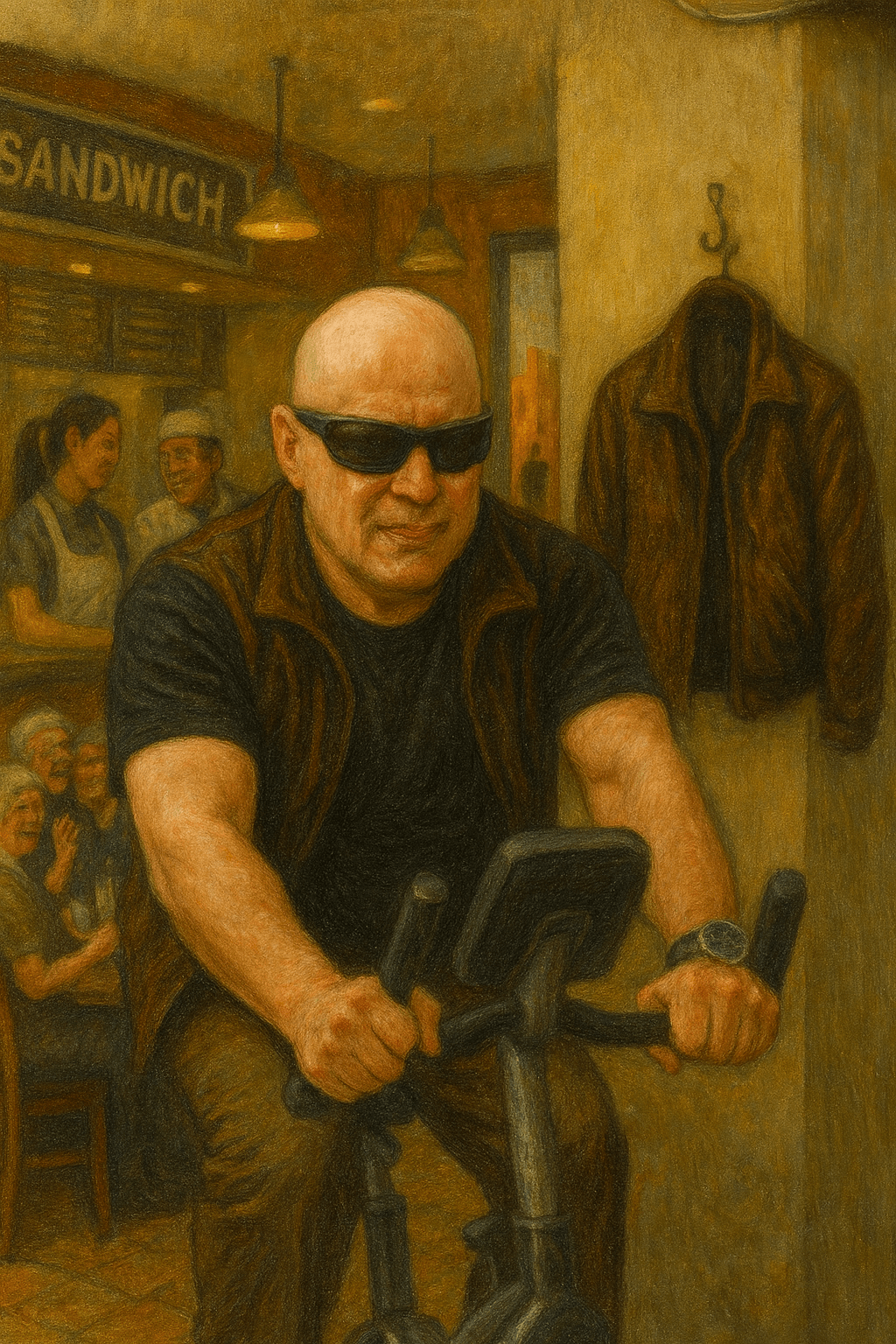
    Whether I write these reflections out of genuine spiritual torment or simple procrastination before an hour on the exercise bike is unclear. Either way, I’ll mount the Schwinn Airdyne, pedal furiously, and try not to think too much about eternal damnation.

  • Master Po vs. My Perfect Alibi

    Master Po vs. My Perfect Alibi

    In 1972, on the dust-choked battlefield otherwise known as the Independent Elementary playground, Miguel Torres and I were locked in a holy war over an alleged clipping penalty. Gary Kauffman—self-appointed referee, rules committee, and prophet of doom—had flagged me during tag football, a call that would hand my team the loss. Words got hot. “Cheater” ricocheted between us like a stray bullet. Then Miguel’s fists did the talking—left, right, a percussion solo on my jaw.

    I cried—not because I stood there like a department-store mannequin while his knuckles composed a sonata on my face, but because I was blind. I hadn’t read the storm system building in my friend—barometric pressure falling, hostility rising—and I was stunned that my protest could yank that much fury out of someone who’d traded Twinkies with me at lunch.

    The recess bell shrieked. We jogged back to class, me sniffling, my face a throbbing geography lesson. Mrs. Eckhart opened My Side of the Mountain, but I heard only the drumbeat in my skull and the soft crush of my pride underfoot. I retreated inward to the place my imagination had been furnishing for months: a quiet stone courtyard outside the Shaolin Temple, the same one that glowed from our black-and-white TV. The river whispered nearby. Incense drifted like daydreams. And there stood my spiritual guide, Master Po—blind as justice, sharp as a scalpel.

    “Master Po,” I said, still tasting the copper of humiliation, “you once taught me that weakness prevails over strength and gentleness conquers. Yet my team lost, my friend rearranged my face, and I stood there helpless. Where was gentleness then?”

    “Grasshopper,” he said, “you mistake stubbornness for virtue. You are the rigid branch that neither sees the distant hills nor hears the cooling wind—and so you snap. Begin by seeing. Begin by listening.”

    “What am I not seeing? What am I not hearing?”

    He tilted his head. “For one, you did not hear the expletives cannoning from your mouth—shrapnel of spit landing on your friend’s cheeks. For two, you did not see your own finger spearing his chest, drilling his solar plexus as if mining for a confession.”

    “So I was ticking off Miguel without even knowing it?”

    “Precisely, Grasshopper. You cherry-pick facts to star in your favorite film—You, the Noble Victim—while everyone else auditions for Villain. Myth-making is a miraculous tool for preserving self-esteem. It is also the shortest road away from The Way.”

    “I don’t myth-make.”

    He raised an eyebrow in the patient way only the blind can. “When you were six, you slept at your aunt and uncle’s and wet the bed. Instead of accepting the weather report from your own bladder, you blamed…the Pee Fairy.”

    I winced. “I remember. It was quick thinking.”

    “What else do you remember?”

    “That I repeated the lie until it became embroidered truth. I argued anyone who doubted me into silence. The Pee Fairy did it. Obviously.”

    “Exactly,” he said. “When you muddle truth long enough, you lose your own outline. You become your costume.”

    “How do I follow The Way?”

    “Do not costume yourself. Do not curate a personality for the world like outfits for the first day of school. Let time carve you. Emerge by erosion, not construction.”

    “I’m eleven,” I said. “Time carves slowly. Also, if I don’t finish my social-studies questions by sixth period, I’ll be carving them in detention.”

    He smiled. “By doing nothing, everything is done.”

    “Try that on Mrs. Eckhart.”

    “You have much to learn, Grasshopper.”

    Back in the fluorescent glare of fifth grade, Mrs. Eckhart’s voice returned, turning pages into wind through trees. I pressed a cool palm to my cheekbone, felt the ache, and wondered if wisdom always arrived late—long after the bell, after the punch, after you realize you were yelling at a friend and mistook your echo for righteousness. Maybe gentleness isn’t an instant shield; maybe it’s a habit you grow, a small current under the noise, the kind that keeps a rigid branch from snapping when the playground becomes a courtroom and you’ve already sentenced yourself to innocence.

  • Speedos at Sunset

    Speedos at Sunset

    The New York Times article, titled “Skimpy Men’s Swimming Briefs Are Making a Splash,” offers a solemn dispatch from the front lines of GLP-1 drugs, but I would guess that men—having exhausted every form of visible self-optimization—are now expressing their Ozempic-enabled slenderness via tiny, Lycra-clad declarations of status. We’re talking male bikinis, or what I like to call the ego sling.

    Apparently, if you’re dropping $18,000 a year to chemically suppress your appetite and shed your humanity one subcutaneous injection at a time, you deserve the privilege of looking like a Bond villain’s pool boy. I suppose this is the endgame: pay to waste away, then wrap what’s left in a luxury logoed banana peel.

    Luxury underwear companies, never ones to miss a chance to monetize body dysmorphia, are now marketing these second-skin briefs not as mere swimwear, but as power statements. To wear them is to say: “I’ve defeated fat, joy, modesty, and comfort in one fell swoop.”

    I’m almost 64. My aspirations remain high—ideally, I’d like to look like a special-ops operator on vacation in Sardinia. But I know my place. I wear boxer-style swim trunks, the cloth of the pragmatic and the semi-dignified. They’re not exciting, but neither is seeing a sun-leathered septuagenarian adjust a spandex slingshot over a suspicious tan line.

    There’s a difference between being aspirational and being delusional. The former means striving for vitality, strength, and energy. The latter means stuffing yourself into a satirical undergarment and pretending you’re a twenty-two-year-old wide receiver with a sponsorship deal.

    To my fellow older men: sculpt your body like it’s your spiritual obligation—but when it comes to swim briefs the size of a hotel mint, maybe opt out. Not every part of youth is worth reliving. 

    When I think of old guys clinging to their youth by wearing undersized swim trunks, I often think back to the summer of 2019 when my wife and twin daughters were in Maui and I was treated to one of life’s great grotesques: a compact man in his mid-seventies parading the beach in dark-blue Speedos with a woman young enough to be his granddaughter. She was Mediterranean gorgeous, twenty-something, and clearly imported as the ultimate accessory. He was trim, shaved, strutting across the sand like a hedge-fund satyr who believed that constant motion kept the Grim Reaper wheezing in his wake. He dove into the surf not like a man swimming, but like a man negotiating—bargaining with Time.

    You could smell his wealth before you could smell the salt air. A CEO, no doubt—half his life in boardrooms, the other half clawing at immortality. His creed was Hefner’s: work hard, play harder, and Botox anything that betrays the passage of time. I’m not here to moralize about his May-December arrangement. What fascinated me was the fantasy: money, discipline, and a bit of manscaping as talismans against entropy, as if youth could be distilled into a cologne.

    But the tableau reeked of mismatch—two puzzle pieces jammed together with superglue. Forced smiles, awkward touches: every moment chipped another sliver from the illusion until they looked less like lovers and more like hostages. This was not youth preserved; this was youth taxidermied. His confidence read as terror. His curated life, meant to inspire envy, collapsed into a sad performance—a tuxedo on a traffic cone.

    He reminded me of Joe Ferraro from Netflix’s Mafia: Most Wanted: born in Ecuador in ’62, raised in Toronto, obsessed with bodybuilding, crime, and women. He had it all—the Rolex Daytona, gold chains, sunglasses so huge they had their own weather system. Then came prison and deportation. Now in his sixties, Ferraro is a sculpted parody: sport coat draped like a cape, tight black jeans, hipster boots, eyes full of melancholy. He wants his life back, but he knows the casino is closed. Like the Speedo satyr, Ferraro can’t stop looking back, calcifying into a monument of salt.

    And salt is the right metaphor: Lot’s wife glancing back until she froze mid-regret. Neither Ferraro nor Speedo Man could let go of their “youth identities.” Without them, death feels too close. With them, they look embalmed while still breathing.

    I understand how hard it is to let go of the life you think you deserve. Spend a week in Hawaii, and you step into a parallel universe—Sacred Time. You board a $400-million jet, dehydrate for five hours, and land convinced you’re immortal. Within 24 hours you’re marinating in mai tais, demolishing lilikoi pies, and basking under sunsets scripted by God to flatter your ego. Clocks stop. Deadlines vanish. Sacred Time whispers: Death can’t find you here.

    Which is why leaving Hawaii feels like a cosmic eviction notice. You board the plane and return not just to California but to Profane Time, where bills, emails, and mortality resume their tyranny. For weeks after, you’re sun-drunk and disoriented, still hearing waves in your ears while the neighbor’s leaf blower revs like a dentist drill. Sacred Time is an opiate; reentry is cold turkey.

    Nostalgia is the next fix. For me, it’s the summer of 1977 at Don Castro Swim Lagoon. I was fifteen—half-boy, half-bicep—sunbathing like a pagan sacrifice to the gods of narcissism, The Happy Hooker hidden in my gym bag, my skin baptized in banana-scented cocoa butter. That lagoon was my Eden: the girls in bikinis, the musk of suntan oil, the hormone haze of adolescence. That era hardwired me to believe pleasure was a birthright.

    But nostalgia curdles. Today I’m older, paler, a few Adonis fragments left in the rearview. What once felt like a creed now feels like a rerun of Fantasy Island with bad lighting. The boy in me still demands his sunlit altar, but now he feels like a squatter. Am I still bronzing in Eden—or am I frozen in salt, looking back too long at a self that no longer exists?

    Enter the “Return to the Womb.” Aging produces this primal regression: a desire not just for beaches, but for obliteration of responsibility. For me, it smells like Florida—the state of my birth, equal parts Eden and punchline. Mango air, coconut breezes, sultry rain: a fetal simulation with Wi-Fi. But even I know it’s not vitality; it’s paralysis. It’s not Life Force—it’s brain rot in Tommy Bahama.

    During lockdown, I tasted this desire to return to the womb. Pajamas at noon, Zillow scrolling barrier islands, buckwheat groats as immortality. My body synced with the rhythm of a hot tub. I didn’t want to emerge. I still don’t. Which terrifies me—because Father Time is no cuddly mascot. He’s a cosmic accountant, and he wants receipts. What did you do with your time?

    Meanwhile, I’m bicep-curling nostalgia like it’s protein powder. For five years, I hounded my wife about Florida. She countered with Some Kind of Heaven, the documentary about The Villages. Watching geriatric Parrotheads do water ballet to Neil Sedaka was enough to kill the fantasy. It wasn’t Eden—it was a gulag of shuffleboard and scheduled fun. Leisure not as freedom, but as occupation.

    The film’s standout was Dennis Dean, an octogenarian grifter prowling bingo halls for rich widows. Watching him lie catatonic under a ceiling fan after another failed con, I realized my wife had played me like a Stradivarius. My Florida obsession died in that moment.

    So now I’ve scaled back. No more eternal-Adonis-in-the-tropics delusions. No Speedos. Just a week vacation in Maui or Miami, then back to Profane Time with my Costco protein powder and kettlebells. Still chasing immortality—but with at least a fig leaf of self-awareness.

  • His Last Words: “Too Much Trouble”

    His Last Words: “Too Much Trouble”

    No one wants the following carved into their headstone:
    “He really liked convenience.”
    Or:
    “He really knew how to wind down after a long day.”
    Or the ultimate in mediocrity:
    “He was quite the expert at calmly not answering the door when strangers knocked.”

    Yet I can’t lie—those epitaphs could summarize me with cruel efficiency. I should be ashamed. If the highlight reel of my life is craving convenience and dodging conflict, then I’m a sloth, a coward, and a comfort-zone junkie. Guilty as charged.

    Of course, apologists for my particular brand of laziness will insist there’s wisdom in centering life on convenience: you save time, conserve resources, and maximize efficiency. But let’s not kid ourselves. “Optimization” is just a euphemism for avoiding reality. And then come the even shinier euphemisms: “life hacks.” If all you’ve done is engineer a way to dodge effort, that’s not a hack—it’s a confession.

    Not that every convenience is unworthy. I won’t step foot in a gym: too expensive, too crowded, too germy, and far too drenched in bad pop music. I prefer my garage—cheap iron, good podcasts, and zero chance of catching COVID off the lat pulldown machine. That’s not clever; it’s survival.

    Same with my diet: when I’m home alone, dinner is steel-cut oats or buckwheat groats with protein powder and soy milk. It’s not innovation; it’s five minutes of apathy in a bowl. To call it a “hack” would be grandiose.

    The pandemic hardened this streak. Three-fourths of my classes went online in 2020, and they’ve never returned to campus. Everything lives on Canvas now. I barely drive 3,000 miles a year. Efficiency became narcotic. Once you’ve tasted it, going back to inefficiency feels like shoving rocks in your shoes for nostalgia’s sake.

    Even my piano habit has become infected. Cecil, my seventy-eight-year-old tuner, has warned me: when he’s gone, so is my piano’s soul. Skilled tuners are rare. My solution? Buy an electric keyboard. Sure, the sound won’t have the magical sound of my acoustic Yamaha, but it’ll move easily from room to room and never need Cecil. Convenience conquers music too.

    I’m also a poor excuse for a parent in the Uber era. Driving my teen daughters to football games, birthday parties, and amusement parks feels like sacrilege to my convenience creed. Honestly, if I were truly committed to convenience, I never would’ve had children. Or cats. Litter boxes, flea treatments, vet visits—each one an affront to my principles of time-saving and efficiency.

    Convenience can metastasize into pathology. Violations of my “policies” breed resentment. Aging itself infuriates me because it’s inconvenient. Doctor appointments and funerals snarl my schedule. Death doesn’t just terrify; it inconveniences.

    Routine is the bride to the groom of convenience, and together they dominate. 

    Even my relationship to religion is seen through the lens of convenience. I wish I could slam the door on doubt and join the ranks of militant atheists—or zealous believers. Either extreme would be neat, clean, convenient. Instead, I’m stuck in agnostic purgatory, forced to read philosopher Elizabeth Anderson’s critiques of scripture, Saint Paul, and every thinker in between. Anderson reduces morality to evolution; Paul calls us fractured, fallen souls, a mirror I dislike but recognize. I want a bow on the present of certainty, but instead, I get the knot of doubt.

    Jesus, of course, preached a gospel of uncompromising inconvenience. His very life was a rebuke to comfort. Following him means picking up a cross, not a La-Z-Boy. For disciples of the gospel of ease, his way is impossible—requiring nothing less than a Damascus-level conversion to set a new course.

    When I think of convenience, I think of Chris Grossman, my co-worker at a Berkeley wine shop in the 1980s. He was the store’s golden boy—popular with customers, armed with quick wit and easy charm—and utterly allergic to human entanglements. Girlfriends, he explained, weren’t worth the trouble. Not because of their flaws, but because the whole enterprise of romance reeked of inconvenience: compromise, obligation, scheduling. He lived alone, ate the same meals on repeat, and once a year drove his Triumph to Carmel for a car show. I adored him. He was my kind: a fellow monk in the Church of Convenience.

    Some of us are more diseased than others, and the infection corrodes standards. I loathe factory farming, dream of veganism, but recoil at the social cost. Every vegan I’ve spoken with admits the hardest part isn’t the kale; it’s the cold shoulder. I already wear the family badge of black sheep. If I imposed tofu bakes on my wife and daughters, I’d be ostracized. They want meat; I want peace. When I mention plant-based dinners, they shoot me a side-eye sharp enough to slice seitan. Push it further, and I can see my tenuous connection with them unravel thread by thread until exile is complete. And clawing my way back into their good graces would be the most inconvenient penance imaginable.

    I’m already a neurotic who alienates people more often than I’d like. Rebuilding broken ties is grueling work—humiliating, exhausting, inconvenient. So I stay walled up in my fortress of convenience, half-proud, half-ashamed, imagining my epitaph chiseled in granite: He preferred the easy way.

  • My Lifelong Marriage to Convenience

    My Lifelong Marriage to Convenience

    There is much to admire about centering our lives on convenience. We save time and resources, avoid wasted effort, and maximize efficiency in the name of what is too often called “optimization.” A life built around convenience often becomes a quest for “life hacks.” But if our behavior is less inventive, we don’t call it a hack at all—just a preference.

    For example, I refuse to go to the gym. It’s inconvenient, time-consuming, costly, and exposes me to airborne illnesses. I prefer to work out in the garage. That’s not a life hack—it’s just easier. The same goes for meals: having a bowl of oatmeal with protein powder and soy milk instead of lunch or dinner isn’t clever or innovative. It’s simply what I do when my family is out and I’m eating alone. Spending more than five minutes on a meal under those circumstances feels unnecessary. Calling a bowl of steel-cut oats or buckwheat groats a “life hack” would be grandiose.

    During the pandemic, three-fourths of my classes moved online through Canvas, a Learning Management System (LMS). Hard copies disappeared. Graded documents were uploaded to the platform, which was remarkably efficient. I didn’t have to drive to campus. The college saved on electricity. That was five years ago, and my classes remain online. I now drive less than 3,000 miles a year. Online classes have made me very efficient. Once you taste efficiency, it’s nearly impossible to go back to inefficiency.

    I admit I’m a less than admirable parent. I don’t like driving my teen daughters to their social functions—birthday parties, football games, dance practices, amusement parks. I find it all inconvenient. That’s my choice. If I were truly devoted to convenience, I wouldn’t have become a parent at all. And certainly not a cat owner. Kitty litter, flea control, vet visits, and travel arrangements are an affront to any serious commitment to convenience.

    As desirable as convenience is, some personalities—mine included—turn it into a pathology. We center our lives around it, and any violation of our convenience policies breeds resentment. Many of these resentments are unreasonable. I resent old age and death, primarily because they are inconvenient. Doctor appointments and funerals interfere with my routine.

    Convenience culture also makes us adore routine. I suspect routine is the groom to the bride of convenience.

    Even my worldview is infected by this impulse. I am an agnostic, which I despise, because it is inconvenient. Agnosticism demands reading and constant reflection. I’ve consumed books by agnostics, atheists, universalists, infernalists, and the post-mortem-salvation curious. While Elizabeth Anderson’s critique of scripture has many compelling points, her notion of morality as nothing more than evolution feels inadequate. Paul’s vision of humanity as fallen and divided is more persuasive and mirrors my own psychology. I wish I could settle happily into Anderson’s worldview. It would be so convenient.

    Speaking of religion, Jesus preached a gospel of inconvenience. His willingness to sacrifice his life in such a manner stands as the very opposite of convenience. For devotees of the gospel of ease, following Jesus is nearly unthinkable—a path that demands nothing less than a Damascus-level upheaval like Paul’s.

    When I think of convenience, I’m reminded of Chris Grossman, a wine salesman I worked with in the 1980s. He was brilliant and affable but had no close relationships. He admitted he didn’t care much for life. He had tried having a girlfriend once and said it was awful—not because of her, but because it was too inconvenient. By his late thirties, he was a bachelor. He ate the same foods every day for simplicity’s sake and once a year drove his Triumph to a car show in Carmel. I loved him for it, because I knew we were both soulmates in convenience culture.

    Some of us are more diseased by this devotion to convenience than others, and it often lowers our standards. I am appalled by factory farming and would like to be vegan. Perhaps if I lived alone, I could do it. But in a family of omnivores, that move would not go over well. I could prepare plant-based meals for myself, but I don’t—partly because of the inconvenience. Vegans I’ve spoken to say the hardest part isn’t the food but the social ostracism.

    I’m already the black sheep in my family—the anti-social shut-in whose quirks are laughed at on good days and resented on bad ones. If I imposed a vegan diet, I fear it would alienate me further, and I’d have to grovel my way back into some semblance of connection.

    As a lifelong neurotic who already alienates people more than I’d like, I know that repairing frayed relationships is an excruciating, arduous task. And it’s so inconvenient.

  • False Neutrality: Reading Armand Nicholi’s Debate

    False Neutrality: Reading Armand Nicholi’s Debate

    I’m about a third of the way through the Audible of Armand Nicholi’s The Question of God: C. S. Lewis and Sigmund Freud Debate, in which Nicholi argues that the single largest life decision — whether to accept or reject belief in God — carries the heaviest consequences. He paints Lewis as modest, serene, and living in a state of grace (the fruits of the spirit, if you like), while he casts Freud as intoxicated with his own genius, dismissing God as a childish projection.

    I have several objections. First, Nicholi leans on a rhetorical pose I find disingenuous: “I’m not trying to persuade anyone — just look at the facts.” He presents himself as a neutral referee while quietly aligning with Lewis. The result is a parade of straw-man treatments that caricature Freud and flatten the debate into tidy contrasts the evidence doesn’t support.

    Second, Nicholi’s central frame is an either/or fallacy: you either believe in God or you don’t. That binary elides the vast internal variety within religious traditions. One person’s God can be another person’s devil — and not across religions but within the same text. Christianity alone supplies wildly different conceptions: the Calvinist God versus a Universalist God; a God who offers post-mortem purgatorial salvation versus one who does not. Even accounts of the Crucifixion diverge: some Christians see it as substitutionary atonement, others categorically reject that reading. As Jerry Walls notes, the God who plans substitutionary atonement is not the God who doesn’t.

    Nicholi also ignores how different beliefs about God imply different beliefs about human nature. Are we, as Paul suggests in Romans, depraved and helpless? Or, as Hyam Maccoby argues from a Jewish perspective, did God create us with the capacity to meet Him halfway? The kind of God you endorse carries with it a theory of human wiring — and Nicholi refuses to engage that complexity.

    Those omissions aren’t accidental; they’re convenient. Reducing belief to a binary choice lets Nicholi render one side salutary and the other contemptible without wrestling with the theological and anthropological thickets that make the question genuinely hard.

    The tone of the book compounds the problem. A Harvard psychiatrist writing in a creamy, intellectual register, posing as an impartial guide through this existential choice, slides easily into what feels like a polished little tract. The surface civility—measured analysis, calm diction—camouflages rhetorical sleights of hand that, to my mind, undermine the work’s seriousness.

    I want to be fair. I’m trying. But once you notice the frauds and fallacies — the imposture of neutrality, the forced binary, the flattened portrayals — they don’t unsee themselves. So I’m forcing my way through the remaining two-thirds of the book, partly out of duty and partly to see whether Nicholi can salvage his argument when he has to meet the harder questions he’s been avoiding.

  • Religion Is No Kevlar Vest Against the Fear of Death

    Religion Is No Kevlar Vest Against the Fear of Death

    My mother’s people were Ashkenazi Jews from Poland; my father’s, Roman Catholics from Scotland and Ireland. Yet both treated religion like a dusty attic trunk filled with moth-eaten lace. When a TV preacher with the face of a sour prune croaked on about sin, my parents would smirk, as if watching a vaudeville relic wheeze out his final act.

    I wasn’t so quick to sneer. At Castro Valley High, a white-haired Mrs. Hanson, seventy if a day, handed us the Book of Job, and I was caught like a fish. God, suffering, celestial wagers—it was grotesque, terrifying, delicious. I’d drive my Ford Maverick to the gym, sunrays slicing through storm clouds, and briefly imagine a divine presence scanning my biceps. I didn’t know biblical doctrine from dog food, but I felt sure there was an afterlife waiting—an enchanting lounge where the velvet ropes always parted. For a short stretch of adolescence, I even stopped fearing death.

    Then came my Christian classmates, thrusting paperback apocalypse manuals into my hands. Rapture. Beasts. Eternal torment. Overnight my buoyant heaven curdled into a horror show where my Jewish relatives burned forever. Some Christians reassured me that such cruelty wasn’t “real Christianity.” But the deeper I read, the more Paul’s letters stood like theological battering rams against Jews who wouldn’t bend the knee. Supersessionism, they called it—a polite term for spiritual eviction.

    The Church Fathers weren’t gentler. Augustine’s take on eternal damnation? Justice, pure and simple. Billions in flames, and he shrugs: they had their chance. Forgive me if I don’t find that a winning sales pitch.

    Which is why I keep returning to Dale Allison’s Night Comes. Barely 200 pages, but packed with the force of a midnight storm. A Christian, Allison treats hell not as a theological curiosity but as a moral obscenity that collapses under its own weight. He doesn’t stitch loopholes into doctrine—he pokes holes until the absurdity gushes out.

    His stories haunt me. His teenage daughter found annihilation worse than hell; she feared nothingness more than flames. His son, in an email of raw honesty, mourned the idea that “the museum of his mind will be closed.” Not death, but the erasure of memory—the bulldozing of everything tender and beloved—that was the real terror.

    As a teen I believed our cherished moments had permanent residence in some cosmic vault. Allison doesn’t smash that hope, but he makes it more fragile, more complicated. He notes—accurately, grimly—that saints and mystics, when Death shows up in the doorway, often beg and claw like the rest of us. Religious devotion, it seems, is no Kevlar vest.

    And so, in old age, I sit with a religious ambivalence as stubborn as arthritis: no doctrine, no creed, no “blessed assurance” makes the thought of extinction less ghastly. Maybe the fear of death is not a flaw to be cured but a mirror—one that forces us to stop pretending we’re eternal and finally face the finite with our eyes wide open.

  • The Intruder from the Cypress Gloom

    The Intruder from the Cypress Gloom

    Sometimes you hear stories of horror and the supernatural, and you don’t know what to do with them, especially if the person telling the story seems sane and credible. As a result, the story lingers and haunts you for all your life. For example, I’ve never forgotten a story one of my college students told me back in the fall of 1998. She was a re-entry student—a nurse in her early forties—juggling coursework at UCLA with overnight hospital shifts. The kind of woman who sticks in your memory: short, sturdy, glasses perched low on her nose, with the weary, perceptive eyes of someone who’d seen too much and lips that knew how to pace a punchline.

    Most afternoons, after class let out, she’d linger by my desk and recount episodes from her Louisiana backwoods childhood or from the fluorescent netherworld of her hospital’s VIP wing. Her stories ricocheted between absurdity and horror—tales told with the calm authority of someone who could handle arterial spray with one hand and chart notes with the other.

    But one story gripped me by the spine and never let go. It wasn’t about dying celebrities or ER gore. It was about something far worse. A visitation. A monster.

    She and her cousin Carmen were feral children, raised in the lawless heat of rural Louisiana, where school attendance was optional and adult supervision was more myth than fact. Left to their own devices, the two girls invented what she called “mean games”—they tortured frogs, pulled wings off insects, and hinted at darker cruelties she refused to name. Lord of the Flies in sundresses.

    And then one afternoon, the visitor arrived.

    They were holed up in a decaying house, conspiring over their next cruelty, when the porch door creaked open and something stepped inside. It looked like a man. But it wasn’t. Over six feet tall, it had a tail—thick, muscled, and disturbingly animate. It moved with a will of its own, curling and flicking behind him like a fleshy metronome. His body was bristled with wiry hair. His voice? Low, hoarse, and calm in the most terrifying way. He didn’t threaten. He simply listed.

    Sitting in a rocking chair, the creature, a sort of rat-man, described, in brutal detail, everything the girls had done—every frog mutilated, every insect dissected. Nothing vague. He named the acts like he had them on file. And then he made his offer: Keep going, he said, and I’ll recruit you.

    He stayed for three hours. Just sat there. Breathing. Flicking that tail. Describing their path toward damnation with the steady tone of a bureaucrat explaining retirement benefits. When he finally left, dissolving into the heat shimmer of the Louisiana dusk, the girls were too stunned to move. Carmen whispered, “Did you see that?” My student just nodded.

    They never spoke of it again. But they changed. Overnight. Sunday school. Prayer. Kindness, enforced not by conscience but by fear. The kind that settles in your bones and never leaves. Whatever that thing was, it did its job.

    And this is the part that haunts me: she wasn’t a kook. She wasn’t mystical, manic, or given to exaggeration. She was a nurse—clear-eyed, grounded, more familiar with death than most people are with taxes. She wasn’t telling a ghost story. She was giving a deposition.

    To this day, I see those two girls, wide-eyed and paralyzed, staring down a thing that knew them intimately and promised them a future in hell’s apprenticeship program. Whether it was a demon, a shared psychotic break, or some mythological construct formed by childhood guilt and Southern humidity, I don’t know. But I do know what it meant.

    The creature’s message was brutal in its simplicity: Keep practicing cruelty, and you’ll lose the ability to stop. You’ll become it.

    That’s not just folklore. That’s biblical. The idea that if you repeat your wickedness long enough, God—or whatever you believe in—stops interrupting you. He doesn’t smite you. He simply steps aside and says, Go ahead. This is the life you’ve chosen.

    No wonder Kierkegaard was obsessed with working out your salvation with fear and trembling. There’s nothing more terrifying than the idea that damnation is self-inflicted, not by a thunderbolt, but by repetition. That the road to hell is paved with muscle memory.