Blog

  • The Aspiring Writer Strives to Overcome His Inferiority Complex

    The Aspiring Writer Strives to Overcome His Inferiority Complex

    The aspiring writer, Manuscriptus Rex, writes not out of pure inspiration but from the unholy fusion of a chip on his shoulder and a raging inferiority complex. His desperation for a cure has somehow led him to the worst possible conclusion: that literary dominance is the only path to salvation. Anything short of conquering the literary world? Utter failure.

    Why such extremes? Because Manuscriptus Rex is an eternal adolescent, emotionally stunted and incapable of nuance. Life is a brutal, binary equation—winners or losers, triumph or oblivion. There is no middle ground. And for those with just enough talent to know they’ll never be the best? The humiliation is unbearable. They sink into a spiral of self-loathing so profound, they start questioning why they were born in the first place.

    This despair is captured well in the 1984 movie Amadeus, in which Salieri, the patron saint of mediocrity, spends his life gnashing his teeth over the fact that, for all his ambition, he’ll always be the guy in the cheap seats while Mozart, the true genius, takes center stage. Some might be tempted to draw the same parallel between Paul and Jesus, as if Paul were some whiny Salieri, shaking his fist at the heavens over his lack of messianic charisma. Dead wrong. Paul didn’t sulk in anyone’s shadow. He sharpened his writing tools, rearranged the spotlight, and made damn sure it was aimed squarely at himself.

    How successful was Paul at making his writing stick? Let’s put it this way—his entire written output amounts to about eighty pages. Eighty pages. That’s not even the length of a middling beach read you’d abandon in an airport terminal. And yet, those pages have been scrutinized, weaponized, and dissected with more fervor than any artistic or literary masterpiece in human history.

    I sit here, surveying the wreckage of five decades of my own writing, knowing full well that it will likely fade into the void, while Paul’s scant eighty pages have dictated the course of Western thought, politics, and religion for two thousand years. The word “influence” doesn’t even begin to cover it. This is literary world domination.

    And was this tidal wave of influence accidental? Hardly. Paul wasn’t just writing to save souls—he was writing for his own immortality.

    Pauline scholars love to point out that Paul wasn’t exactly thrilled with what the original apostles were peddling. Their Jesus still had training wheels—tied to Torah, saddled with Jewish law, bogged down by the pesky weight of tradition. Paul, on the other hand, had a better idea. His Jesus was purer, punchier, and more potent—a spiritual superfood untainted by Torah preservatives. And Paul wasn’t shy about it. He called it “my gospel”—not once, but over and over again, like a divine trademark. Forget the Jewish-flavored Jesus movement—Paul’s was gluten-free, carb-free, and straight to the Gentile bloodstream.

    This wasn’t just a theological shift—it was a hostile takeover. Paul didn’t seem particularly interested in Jesus’ actual words. Sermons? Parables? “Love thy neighbor”? Small-time. Paul’s focus was on his own visions, his personal revelations, the ones that conveniently made himself the authority on Jesus. While Peter and James clung to their quaint Jewish traditions, Paul rebranded Christianity in his own image, rolling out a one-man revolution that sidelined the original apostles like outdated board members in a corporate coup.

    And rabbi scholar Hyam Maccoby—never one to understate a theological conspiracy—takes it even further. According to The Mythmaker, Paul didn’t just step out from Jesus’ shadow—he steamrolled over it and rebranded Christianity as a Paul Production, with himself as lead architect of one of history’s largest religious empires. Salieri could only dream of that level of self-promotion.

    But Paul didn’t just change the messaging—he altered the entire emotional foundation of Christianity. Maccoby doesn’t just accuse Paul of hijacking Christianity—he accuses him of rewriting the entire Old Testament like a hack screenwriter with a savior complex. The Jewish tradition of free will, strength, and human agency is replaced with Paul’s bleak vision of humanity—where people are helpless worms, groveling in the dirt, utterly incapable of doing anything good without divine intervention.

    Fast-forward two millennia, and we’re still drowning in the wreckage of Paul’s inferiority complex—scrolling ourselves into oblivion, slaves to algorithms, locked in a spiritual malaise that might as well have been engineered by Paul himself. Maccoby paints Paul not as a mystical visionary, but as a man crippled by his own self-loathing, a former Pharisee who couldn’t hack it in Jewish law, so he torched the whole thing and built his own damn religion. And it worked.

    Paul’s biggest marketing coup was turning Jesus into something unrecognizable. Gone was the Torah-loving Jewish teacher—in his place, a Hellenized God-man with cosmic grandeur. But Paul didn’t work alone. He had Luke, his personal spin doctor, crafting The Acts of the Apostles—a biblical infomercial designed to make Paul look like a tireless hero, smoothing out his awkward edges, burying any embarrassing missteps, and giving the real apostles about as much airtime as unpaid extras in Paul’s vanity project. The result? A Christianity that barely resembled anything Jesus actually taught, but one tailor-made for mass adoption.

    It’s a corporate rebrand so slick that Paul might as well be the Steve Jobs of Western religion.

    Paul didn’t just invent a religion—he invented religious dominance. His theology was designed for maximum influence, structured like a brilliantly engineered algorithm—one that self-replicates, adapts, and burrows into the psyche like a spiritual virus. You don’t just believe in Paul’s Christianity; you’re owned by it.

    And this is where the connection to my own writing demon becomes uncomfortably clear.

    Paul did what I’ve always wanted to do—he wrote something so potent, so inescapable, so monolithic, that it hijacked human consciousness for centuries. His letters didn’t just survive—they became the foundation for an entire civilization. And what is that if not the ultimate literary ambition?

    The writing demon inside me has always whispered the same temptation—that if I just write the right book, if I craft my message well enough, if I design the perfect narrative, I can transcend obscurity, reshape reality, and carve my name into history.

    Paul did it. He wrote himself into religious permanence, his eighty pages outlasting every empire, every cultural movement, every literary masterpiece.

    And maybe that’s why I can’t stop thinking about him.

    Because deep down, I know: Paul is the ghostwriter of my own ambition.

  • Writing Is World-Building

    Writing Is World-Building

    The writer who seeks literary dominance can be called Manuscriptus Rex. He is a beast acutely aware of his own brokenness, a self-awareness that drags him into the depths of morbidity and despair. But mere recognition of his anguish isn’t enough—he must transcend it. Not through quiet introspection or self-acceptance, but through literary dominance. Writing isn’t just therapy; it’s conquest. His words are not gentle offerings but acts of aggression against the world, though he convinces himself otherwise. He’s not a tyrant—he’s a savior. He doesn’t crave attention—he has something urgent to say, something the world must hear.

    One of the most exalted members of the Manuscriptus Rex species? The Apostle Paul. His life reads like a high-stakes thriller—a battle-worn intellectual waging ideological war through the written word. If Hollywood ever needed a poster child for a writer with a messianic mission, Paul would be it. Ink-stained fingers, unshakable conviction, and a belief that his words would outlast empires—because, of course, they did.

    Thinking of Paul as a character in a movie reminds me of a similarly absurd but far less consequential scene from my own past: the time my high school bodybuilding buddy, Martino, and I were ensnared by the oldest bait-and-switch in history—free food and salvation. We had been lured to a Wednesday night church youth group by the promise of unlimited lasagna and Kool-Aid, a trap set by the twin seductions of carbs and sugar. The youth pastor, a bearded, bespectacled man with the unshakable enthusiasm of someone who truly believed he could sell eternal life like a used car, paced the room as he spun his gospel pitch. He wanted to know if we were ready to accept Jesus Christ as our Lord and Savior, as though an extra serving of garlic bread might tip us into theological certainty.

    Martino, a squat, blocky fellow with a neck so thick it could’ve moonlighted as a battering ram, sat politely through the sermon, nodding with the blank expression of a man deep in a carb coma. His eyebrows, heavy and brooding, looked as if they were preparing to stage a labor strike right there on his face. By the time we left, his stomach was full, but his soul remained stubbornly unmoved. Driving home, he grunted through a yawn, “Nice lasagna, but I don’t think I found Jesus in there.”

    Paul would’ve had a field day with Martino, hammering him with letters, debates, and fiery rebukes until he saw the light—or at least surrendered out of sheer exhaustion.

    “Eternal paradise? Eternal hell? If you want to win me over, show me the movie.” Without a flicker of humor, he added, “Jacques Cousteau and his film crew need to do a deep dive into heaven and hell and report back. Then maybe the pastor will have something worth talking about.”

    I couldn’t help but think of Jacques Cousteau and his team of underwater explorers filming their way through the afterlife when I was reading French novelist Emmanuel Carrère’s The Kingdom. In typical Carrère fashion, he takes the early church and flips it into a bizarre TV production, with Saint Paul as the leading man, flexing his theological muscles for the cameras, while Luke, ever the dutiful biographer and behind-the-scenes producer, works overtime to keep Paul in the best possible light. It’s like watching Keeping Up with the Apostles, with Luke spinning Paul’s antics while fending off rival apostles who think ditching the Torah is a little too avant-garde. You can almost picture Luke yelling “Cut!” every time Paul’s dramatic speeches veer a little too close to heresy, scrambling to keep the script on track as the whole Jesus movement teeters on the edge of a theological reality show gone wrong.

    Carrère kicks off his novel with a nod to a TV show he worked on about people who had the inconvenient habit of dying and then popping back into life in a small town. He muses,  “I stopped writing fiction long ago, but I can recognize a powerful fictional device when I see it. And this was by far the most powerful one I’ed been offered in my career as a screenwriter.” In a world that’s often nasty, brutish, and short (thanks, Hobbes), the idea of reuniting with our dearly departed is practically irresistible. The implication? Any religion that dangles this tantalizing offer in front of us is going to beat out the competition—especially those dull creeds that don’t have a resurrection hook.

    As Carrère (who writes as the narrator and a version of himself) dives into production for Les Revenants (The Returned), he lets slip to the show’s directors that he’s also knee-deep in another project—a book about the early days of Christianity, circa 50 A.D. in Corinth. Just like the TV show’s fascination with life after death, his book is centered on a ragtag hero, Paul, a weak and afflicted guy who has the audacity to proclaim the resurrection of a prophet. But Paul doesn’t stop there. He’s selling resurrection like it’s the next big thing, a kind of spiritual VIP access, where believers in this prophet get to share in the resurrection perks. And guess what? This faith spreads like wildfire, catching on faster than the latest TikTok trend, and brings with it a personal transformation that Carrère dubs a “mutation.”

    Soon, this belief system grows so big it becomes mainstream. While Greek mythology gets relegated to the kiddie pool of fairy tales, Paul’s gospel of resurrection, virgin birth, sacrifice, and atonement becomes the intellectual equivalent of filet mignon—served up and taken seriously by the world’s smartest, most educated minds, who swallow it whole. It’s no longer quaint mythology—it’s doctrine. And everyone’s buying in.

    But Carrère doesn’t treat this religion as some ironic punchline. Nope, he’s serious, bordering on obsessive. His novel isn’t a parody of early Christianity; it’s a deep dive into how these early religious pioneers, especially Paul, wrestled to bring their story to life. In Carrère’s view, this whole endeavor is a lot like producing a TV show—grappling with messy production details, contending with rival storylines, and trying to make the narrative stick. His novel becomes a meditation on storytelling itself, especially the stories that linger in our minds, take root, and possess us—even as our faith wobbles on shaky ground. It’s about the narratives that survive the centuries, not because they’re quaint, but because they hit us where it counts.

    By the time Carrère loses his faith and slides into agnosticism, he’s still obsessed with the steadfast faith of others. Religion, he realizes, isn’t going anywhere—it’s hardwired into our brains like some sort of default app we can’t delete. We’re suckers for stories that explain the human condition, and like William James says in The Varieties of Religious Experience, we’ve all got our internal wiring that divides the “healthy-minded soul” from the “sick-minded soul.” Shame, guilt, penance—it’s all built into our psyche. And in moments of catharsis, we somehow manage to feel connected to our Maker, like a spiritual Wi-Fi signal we can only tap into when we’re having an existential meltdown.

    I couldn’t read The Kingdom without recognizing my own affliction: the belief that writing a novel isn’t just storytelling—it’s world-building, doctrine-crafting, the construction of a system so compelling that it hijacks minds and rewires belief. Carrère brilliantly lays out the blueprint for how a book mutates into a religion, how a narrative, if potent enough, doesn’t just entertain—it converts, indoctrinates, and dominates. And that’s when it hit me: my writing demon wasn’t interested in just producing a book. It wanted a Bible, something so monumental it would command devotion, establish authority, and secure my literary immortality. It wasn’t enough to write—I had to found a faith, recruit disciples, and stake my claim in the intellectual marketplace of salvation. Whether it was Paul pitching resurrection or me hammering away at my so-called masterpiece, the impulse was the same: create something too big to ignore, too transformative to discard, and too undeniable to fade into obscurity. And just like Paul, I was willing to burn through years, health, and sanity for the cause.

  • How Eddie Murphy’s Advice Pushed Tiffany Haddish’s Career in the Right Direction

    How Eddie Murphy’s Advice Pushed Tiffany Haddish’s Career in the Right Direction

    If I was indeed possessed by a misguided writing demon in the mid-’80s—courtesy of reading A Confederacy of Dunces on repeat and subsequently squandering decades chasing a fool’s errand to capture some fraction of Toole’s novelistic splendor—then one could argue, with a certain tragic flair, that A Confederacy of Dunces ruined my life. Of course, that’s a spectacular oversimplification, but it has a nice literary ring to it, the kind of statement that cries out for a memoir deal. A perfect hook for a writing addict who, in theory, is supposed to have sworn off writing books but is secretly mainlining one on the side. It’s theatrical, adolescent, irresistibly neat. But let’s indulge the idea for a moment: a novel ruined a young man’s life. Decades later, the question remains—what do we do with this squandered life? Do we ignore it, dismiss it as a useless souvenir, or can something be salvaged from the wreckage?

    If there’s anything worth extracting from my own literary misadventures, it’s a warning to younger, equally deluded souls who might be possessed by the same demon of ambition. And make no mistake—ambition alone will not get you anywhere worth going. Yes, it will drag you through years of toil, ensure you hit your daily word count, and convince you that sheer willpower equals literary success. But ultimately, ambition alone will lead you into a tunnel with no exit. You’ll work hard—but not the right way. You’ll write, but without joy, without connection, without meaning. You will produce, but you will not matter.

    So instead of chasing the illusion of grandeur, you should be asking yourself four crucial questions. First, are you having fun with the creative process? If not, why are you doing this? The comedian Tiffany Haddish once said that Eddie Murphy pulled her aside and told her that if she wasn’t having fun on stage, the audience would sense it—and once she embraced that, her career took off. The same applies to writing. If your joy doesn’t translate onto the page, don’t expect anyone else to find it. Ambition will get words onto the page, but it won’t make them worth reading. Second, are you the only person in the world who could write this book? What unique gifts, obsessions, or quirks of personality make you the best person to write this, or are you forcing an idea simply because you think it’s marketable? If the demon of ambition is blinding you to your weaknesses, rest assured that agents and editors will see them clearly—and they will tell you to go home. The demon, of course, won’t listen. He never does.

    Third, why this book? Can you articulate—persuasively—why your book matters? Will it survive in an attention economy where a two-minute TikTok can go viral while your ten-year opus sells six copies? Do you know what your book is competing against? Can you justify its existence? 

    Imagine, for a moment, that you’ve never been published and have no social media following to catapult your debut novel into relevance. How exactly do you think this book is going to survive? Picture a horde of baby sea turtles, freshly hatched, flopping their way toward the ocean. Before they even touch the surf, they’re picked off by seagulls, crabs, raccoons, foxes, coyotes, frigatebirds, herons, egrets, snappers, jacks, barracudas, dolphins, sharks—the list of assassins is endless. The ones that do make it into open water face even worse odds. And yet, statistically, they still have a better shot at survival than your novel has at flourishing into a living, breathing piece of art that embeds itself in millions of imaginations.

    So before you get too deep into your literary fever dream, you need to ask yourself a sobering question: Is there enough juice for the squeeze? Best-selling author Sam Harris certainly asked himself that before shifting his focus away from books to his wildly successful Making Sense podcast. I remember him breaking it down with ruthless efficiency: writing a book can take five grueling years—writing, editing, publishing, book tours—and even after all that, sales might not justify the effort. Meanwhile, he can record a podcast in a few hours and reach millions instantly. No torturous rewrites, no endless editing loops, no begging the world to care.

    And that’s a best-selling author speaking. You’re not one. You’re a nobody with a dream, convinced that your fragile little hatchling of a book will somehow defy the gauntlet and fulfill your delusions of literary immortality. You have lost your mind. More than likely, the book won’t be read. Which brings us to your final, painful reckoning.

    Will your book actually connect with anyone? Or will it be yet another tree falling in the forest with no one around to hear it? Failure to connect isn’t bad luck—it’s bad writing. If your prose exists in a silo of delirious echoes, unread and unloved, then it isn’t literature—it’s literary vapor, ghostly and weightless, doomed to drift into oblivion. And here’s the cruelest truth of all: your writing demon won’t make this distinction. He’ll tell you that writing is writing, that piling up pages is progress, that if you just keep going, success is inevitable.

    It isn’t.

    Had I asked myself these questions before chasing my writing demon down every blind alley, perhaps I would have written with purpose instead of compulsion. But I was too busy obeying the demon to pause and think. If you’re an aspiring writer, don’t make the same mistake. Ambition can drive you forward, but only if it’s tethered to something real—joy, originality, necessity, and connection. Otherwise, you’re just manufacturing words, filling pages with the sound and the fury, signifying nothing.

  • Interrogating the impulse to achieve literary dominance

    Interrogating the impulse to achieve literary dominance

    Looking back at 5 decades of writing dozens of failed novels, I’m torn between admiring my audacity and filing a restraining order against my judgment. How, exactly, did I manage to pin so much hope on novels that, despite their half-decent opening chapters, quickly spiraled into the literary equivalent of a stalled elevator—going nowhere and deeply uncomfortable for everyone involved?

    In contrast, my short essays were clearly sharper, more potent—but I refused to let reality intrude on my mission. No, I was going to write the comic novel.

    This compulsion was never about art. It was about pain—the kind so deep that Jonathan Franzen famously coined Ache to describe the existential condition of adulthood: the rude awakening that we are not, in fact, the center of the universe and that our desires will always outrun our ability to satisfy them.

    Manuscriptus Rex feels this Ache acutely and has embarked on a fool’s errand to silence it with literary fame. But why this brand of glory? Why not build a real estate empire, become a movie heartthrob, or invent the perfect bed that guarantees twelve uninterrupted hours of blissful, coma-grade sleep? Because Manuscriptus Rex is too much of a narcissist for mere wealth, beauty, or utility. Writing a book—one that matters—offers something more intoxicating: the power to hijack people’s brains.

    And that’s what you really crave—not just admiration, but full cognitive occupation. You want your words burrowed into the minds of millions, your dream world dictating their thoughts. Your need for validation is so bottomless that only mass literary infiltration will mollify you. That this ambition is wildly improbable, driven by pathology, and guaranteed to bring more suffering than satisfaction? Irrelevant. The mission is all that matters. And the mission is literary dominance.

    My wife once observed that men, with their colossal egos, often wake up with sudden revelations, epiphanies so grand they feel compelled to start religions. She’s not wrong. The novelist, the polemicist—what are they really doing but trying to ignite a movement, disrupt the world, and bask in the glow of their own importance? Their gospel isn’t about some grand truth—it’s about them, standing center stage, ablaze with self-appointed brilliance.

    Religion is the ultimate expression of literary dominance. I think of the Apostle Paul himself, scribbling his epistles in a manic frenzy, waging rhetorical war in the bustling marketplace of spiritual ideas, demolishing rival orators, and confessing his own unhinged nature in Romans—his theological magnum opus, a mini-Bible inside the Bible. Only eighty pages in total. That was the sum of his obsessive writing, and yet his literary dominance is established. He’s been the talk of the town for over two thousand years. Whether they like him or not, people still want to hear what he has to say about the human condition. 

    This was the novelist’s role five decades ago, back when novelists were secular prophets, summoned to The Dick Cavett Show to pontificate on the issues of the day—because, once upon a time, their opinions mattered.

    And that’s what I loved about Cavett. Even as a ten-year-old, I grasped the show’s implicit assumption: the intellectual life was its own parallel universe, just as electrifying as Paul’s eschatological one—except with better punchlines.

    Perhaps Cavett planted the seeds of my literary delusion, setting the stage for a demon that would fully blossom into madness a decade later when I read A Confederacy of Dunces—then Portnoy’s Complaint and The Ginger Man. If I could write something as riotously funny as those masterpieces, I wouldn’t just be funny—I’d be brilliant, important, part of the conversation. My name would be etched into the pantheon of literary wit, my shattered self-esteem miraculously restored. I would find completion.

    And lest you think this was mere posturing, let me be clear: my aspirations weren’t some carefully curated cool pose. I was, without question, funny—not in the “guy who recycles late-night monologue jokes” way, but in the gimlet-eyed, take-no-prisoners way that slices through the world’s absurdities like a scalpel. I was an ally of Kafka, wielding my literary axe to shatter the frozen ocean of human folly. My quest was real, my voice authentic, my success inevitable.

    Except, of course, it wasn’t.

    I failed. Repeatedly. The novels kept coming, and to my credit, they got better—sharper, wittier, good enough to attract literary agents, which was dangerous because it fed the delusion. This wasn’t a phase. It became a lifelong affliction. In my twenties, thirties, forties, fifties—hell, even my sixties—the novels kept churning, like those chocolates on the conveyor belt in I Love Lucy, coming faster than I could process, devour, or even appreciate.

    The demon was still in business.

    And how good were these books as the result of all my literary effort? “Just okay.” Which, in an attention economy, is about as useful as a dial-up modem in the age of fiber optics. “Just okay” might sell 300 copies—a number so pitiful that the editor who championed your book could lose their job over it.

    But sure, let’s keep the dream alive.

    Having failed to write my grand, world-shaking book and having let A Confederacy of Dunces derail my life, I am left standing amid the wreckage of my literary ambitions, clutching at whatever scraps of wisdom I can salvage. Something must be redeemed, after all. And what better way to salvage a wreck than by turning it into yet another book? The Confessions of a Recovering Writing Addict.

    But of course, that’s just the demon running its mouth again. The same devious little imp that once whispered sweet nothings about my inevitable literary greatness now insists that my failure is my brand, my gimmick, my golden ticket to the book that will finally rock the world.

    And what is this seismic masterpiece, this literary game-changer? Oh, just a book about aspiring writers so starved for attention that they write not as artists, but as junkies, chasing the next fix of validation. A cautionary tale wrapped in a confession, packaged as a sales pitch—because irony, it seems, is the one thing I have mastered.

    Writing with an ego hellbent on domination, we writing junkies reveal an uncomfortable truth—we all have a little Paul in us. We insist we write out of sincerity, fueled by a pure, burning need to communicate something true. But let’s not kid ourselves. Deep down, what we really crave isn’t truth—it’s importance. Recognition. Veneration. And, above all, relevance.

    We aren’t just stringing words together; we’re mounting a last-ditch offensive against oblivion, hammering out prose as if sheer verbosity might hold off the reaper a little longer.

    In the end, we place our hope in something as fragile as a glue-and-paper book in the digital age, believing—despite all evidence to the contrary—that it will elevate us, transcend us, and make us immortal.

  • 30 Years of Teaching College Writing in the Greatest City in the World

    30 Years of Teaching College Writing in the Greatest City in the World

    Yesterday, in my college critical thinking class, I played a clip from Liza Treyger’s Night Owls set, where she spirals into a monologue about her addiction to animal videos. The class erupted in recognition—Treyger’s bit was less comedy, more collective confession. We then compared the insidious grip of food addiction to the death grip of smartphones, two habits nearly impossible to break because, unlike more glamorous vices, they’re baked into the daily human experience. You have to eat. You have to communicate. And thanks to Pavlovian conditioning, the mere buzz of a notification or the scent of a cheeseburger can hijack your willpower before you even know what hit you.

    At one point, I noticed one of my students—a professional surfer—had a can of Celsius energy drink perched on his desk like a talisman of modern endurance. I mentioned that my daughters practically mainline the stuff, to which he casually replied that he was transitioning to Accelerator, as if he were upgrading his addiction to something with a more explosive name. This led us down a delightful rabbit hole about the marketing committee responsible for naming that monstrosity, the raw aggression of Costco shoppers jostling for bulk energy drinks, and how smartphones are turning my students into exhausted zombies. They shared their chosen comfort foods, each confession tinged with equal parts nostalgia and shame.

    The discussion was sharp, lively, and deeply engaging. And yet, in a moment of brutal self-awareness, I admitted to them that I felt pathetic. Here I was, sitting among the chillest students in the world, having a profound conversation about addiction—and all I could think about was ditching class to speed down to Costco and buy a case of Accelerator. They cracked up, and we carried on dissecting addiction for their essay on weight management and free will.

    After thirty years of teaching in Los Angeles, I’m convinced I’ve won the academic lottery. There’s no better place to teach, no better students to challenge my tomfoolery, and no better city to fuel my own ridiculous, completely relatable compulsions.

  • FORCING MYSELF TO WATCH SUCCESSION

    FORCING MYSELF TO WATCH SUCCESSION

    I forced myself to finish the last season of Succession, a venomous spectacle of rich siblings ripping each other to shreds. Succession is the best critically-acclaimed show I couldn’t stand to watch. Not just disliked—hated. Watching it was excruciating, like willingly stepping on a Lego over and over again. The plot? Thin and stagnant, a slow-motion shark tank of sociopaths jockeying for the top spot in their dad’s empire. They rose and fell not from strategy but as if some capricious god was rolling dice behind the scenes. Shame and truth were foreign concepts to them. These weren’t mere narcissists; they were full-blown solipsists, their self-absorption so relentless it crushed any hope for real plot twists. Their behavior was less cunning and more clockwork: predictable, joyless, inevitable.

    And yet, I endured. I forced myself to watch this spectacle of feral appetites clashing like crocodiles over a wildebeest carcass. Why? Because Succession felt like a forbidden window into a gilded world where humanity’s worst impulses roamed free, unchecked by the civilizing guardrails the rest of us adhere to (if only because we can’t afford not to). The show wasn’t just a car crash—it was a multicar pileup filmed in slow motion, designed to scratch our voyeuristic itch.

    In the end, Succession is a mirror held up to the grotesque, the rich and shameless shriveling into their own private hells without a flicker of self-awareness. It feeds our appetite for schadenfreude, letting us revel in their misery while secretly thanking the heavens that our own lives, for all their flaws, don’t include daily battles for dominance over a media conglomerate—or the soul-crushing emptiness that comes with it.

  • Kenny G Is Not Jazz

    Kenny G Is Not Jazz

    I recently watched Listening to Kenny G, Penny Lane’s documentary on the world’s most famous saxophonist. It left me in a knot of conflicting emotions. Here’s a man, decent and diligent, who built a global empire of “smooth jazz”—a genre that, to my ears, is the musical equivalent of baby food: cloying, textureless, and aggressively inoffensive. And yet, millions worship him. The crowds at his concerts glow with unfiltered joy, their faces alight as if they’re receiving communion through the smooth, syrupy notes of his soprano sax.

    Who am I to sneer at them—or at him? I’m just a guy recovering from influenza, after all, with no musical empire to my name. But damn if I didn’t feel the urge to reach for some cultural antacid to settle my aesthetic nausea while judging him and his fans.

    And judge, I did. Kenny G, with his chirpy demeanor and ornithological cheer, seems blissfully detached from the rich, complex history of jazz that his music pretends to embody. He comes across as a musical solipsist, spinning out saccharine, Cliff Notes versions of jazz—an imitation so shallow it feels like he’s never ventured beyond the surface. His long, flowing hair and darting, eager eyes bring to mind a medieval court musician, strumming cloying pavane tunes to lull a bloated king into a post-feast stupor. Listening to Kenny G isn’t an artistic experience; it’s being spoon-fed emotional mush, a cheap confection disguised as depth. This is jazz devoid of soul, grit, or struggle—a hollow desecration of the genre’s essence, delivered with a smile so unrelenting it borders on the surreal.

    And yet, the guilt creeps in. Kenny G himself is disarmingly likable, a man seemingly immune to the venom of critics. He’s successful, and so are many of his fans, who are undoubtedly smart and decent people. Does that make their taste in music immune to critique? Hardly. Popularity is not an arbiter of artistic merit, and Kenny G’s music remains, to me, a vulgarity—saccharine and soulless, a betrayal of jazz’s improvisational brilliance. But the fact that his audience finds bliss in his syrupy melodies leaves me grappling with a larger question: Is artistic taste a bastion of universal truth, or just another playground for our pretensions?

    Am I so obsessed with Kenny G that I feel the need to join the ranks of his detractors, delivering a fiery diatribe like Pat Metheny’s infamous takedown? Not quite. But am I endlessly fascinated that something so blatantly saccharine, so clearly an abomination of music, can bring others to the brink of elation and transcendence? Absolutely. Kenny G’s music strikes me as the sonic equivalent of New Age spirituality: the kind where you pay for a weekend retreat only to be serenaded by a guru with Kenny G’s hair, who doles out self-help clichés like they’re sacred mantras. It’s the auditory version of being flattered into blissful mediocrity, a soothing appeal to one’s narcissism wrapped in smooth sax tones. And let’s face it: the appetite for such cloying bromides is insatiable—and always has been.

    I can’t help but feel a twinge of guilt for roasting Kenny G. I’m clearly afflicted with Sax Shamer’s Syndrome—the nagging unease of mocking a man whose soprano sax has brought legions of fans genuine joy, even if it makes me wince. I try to rationalize my disdain, reminding myself that I, too, have been guilty of infantile pleasures. As a child, I devoured Cap’n Crunch like it was manna from heaven, exalting its sugary crunch as the pinnacle of culinary achievement. The difference? I outgrew Cap’n Crunch. Meanwhile, Kenny G fans seem eternally devoted, treating his smooth jazz like the apotheosis of music. Does that make me a snob for pointing this out, or am I just calling it as I see it?

    The guilt gnaws at me. By deriding Kenny G, I’m effectively sneering at millions of perfectly decent, hard-working people who find solace in his musical equivalent of high-fructose corn syrup. But who am I to judge? I have my own guilty pleasures. I still scroll Instagram for black-and-white photos of 70s bodybuilders, sighing nostalgically for a golden age that was never mine. I still revel in childhood comfort foods—pigs-in-a-blanket dunked in mustard and barbecue sauce, as if I’m at a suburban soirée circa 1982.

    So really, what separates me from the Kenny G crowd? Not much. Scorning his fans isn’t a declaration of superior taste; it’s an act of hubris. We’re all creatures of indulgence, clinging to the things that soothe us. The real sin isn’t enjoying Kenny G or Cap’n Crunch—it’s forgetting that, at the end of the day, we’re all just looking for something to hum along to as we float through life.

  • What devotion really looks like

    What devotion really looks like

    When I think of love in all its fullness, I dredge up a memory from 1982—a gem buried deep in my psyche from my early twenties. Back then, I was in college, slogging through a statistics course taught by a professor who looked like he’d been teleported straight out of a Dickens novel. Wild white hair defied gravity, crazed blue eyes darted around like they were searching for meaning, a nose as red as a warning light hinted at extracurricular activities with a bottle, and his overall aura was eau de whiskey. He was a kind man, though, in that shabby, endearingly tragic way.

    The class itself was a masochist’s delight, and by week four—when the sadistic monster called “standard deviation” reared its head—half of us were drowning. Among my classmates was an elderly African American couple in their early seventies and always dressed for church, who were either a heartwarming sitcom subplot or walking proof that God has a delicious sense of humor. The husband, a determined relic with a cane, announced on the first day of class that this was his seventh attempt at passing statistics. His wife, the embodiment of long-suffering devotion, was there not as a student but as his support system—a Bible-toting, knitting saint.

    The husband’s approach to learning was…unorthodox. While the rest of us quietly sunk in our seats, he would occasionally leap to his feet mid-lecture, his cane clattering dramatically, and hobble to the chalkboard. Pointing a finger like a preacher calling out sin, he’d declare, “That’s not the answer I got. Let me show you!” And then he’d scrawl his “solution” on the board—a series of hieroglyphics that no one could understand. 

    The professor, to his credit, tolerated these interruptions with the forbearance of a man who had seen worse (probably in his flask). Meanwhile, the wife would bow her head and whisper desperate prayers to “sweet Jesus” as if divine intervention might save her husband—or at least restore a shred of her dignity. Students stifled laughter behind cupped hands, and I sat there, torn between secondhand embarrassment and the sneaking suspicion that this was comedy gold worthy of Saturday Night Live.

    After class, I’d drive home and pop in a cassette of “Tiny Children” by The Teardrop Explodes—a song that paired perfectly with my mood of existential dread. I’d replay the scene in my mind: the old man’s quixotic battle with the chalkboard, the wife’s quiet perseverance. And then, like clockwork, I’d start crying. Not just because I was floundering as badly as he was with standard deviation or because my social skills were nonexistent, but because that woman had shown me something profound: the power of love. Real love—the kind that sticks with you through seven attempts at statistics, through public humiliation, through everything.

    I can still see that couple vividly. The husband’s determination, the wife’s quiet strength, and my own pathetic, lonely self, sitting there and learning—without realizing it—what devotion really looks like.

  • Father Time’s Frenemy

    Father Time’s Frenemy

    I often think back to the summer of 2019 when my wife and twin daughters were vacationing in Maui. There, on the beach, I spotted a short, compact man in his mid-seventies parading around in dark blue Speedos with a woman at least fifty years his junior—a striking Mediterranean beauty in her twenties. The guy was trim, well-manscaped, and scampering confidently on the sand like a millionaire who spends half his life in boardrooms and the other half trying to outrun the Grim Reaper. He dove into the waves with the vigor of someone convinced that as long as he keeps moving, Father Time can’t catch him.

    You could smell the wealth on him. He was probably some CEO with a portfolio big enough to buy the illusion of eternal youth. He worked hard and played hard, to quote Hugh Hefner’s mantra. Now, I’m not here to pass judgment on the guy for choosing a partner young enough to be his granddaughter—that’s his business. What fascinates me is this idea that money, discipline, and a little manscaping can somehow hold age at bay, like youth is a rare potion you can sip on to stay forever young.

    But the whole scene was off. He and his youthful companion looked like mismatched puzzle pieces being forced together by sheer willpower. It was as if they were two jagged halves of a broken mirror, stubbornly pressed together despite clearly not fitting. And with each attempt to make it work, the edges chipped away a little more, until all that was left was a pile of shattered glass—a perfect metaphor for trying to cheat time.

    This rich fit man is Father Time’s Frenemy–a guy who pretends he’s on good terms with aging while secretly plotting to outwit it. He may have fooled himself with the “perfect picture” he created, but the eyesore is as plain as day to the rest of us. 

  • DEATH BY SNACKS

    DEATH BY SNACKS

    After dinner, my wife and I luxuriated in a couple of Arrested Development reruns, marveling at the genius of Mitchell Hurwitz and Ron Howard. The show, an absurdist ode to familial dysfunction, felt decades ahead of its time—sharp enough to leave paper cuts on your brain. During the opening credits, I rose from the couch with noble intentions: I was off to fetch my so-called “satiety apple,” a modest, virtuous snack that allegedly curbs my post-dinner cravings without derailing my calorie count.

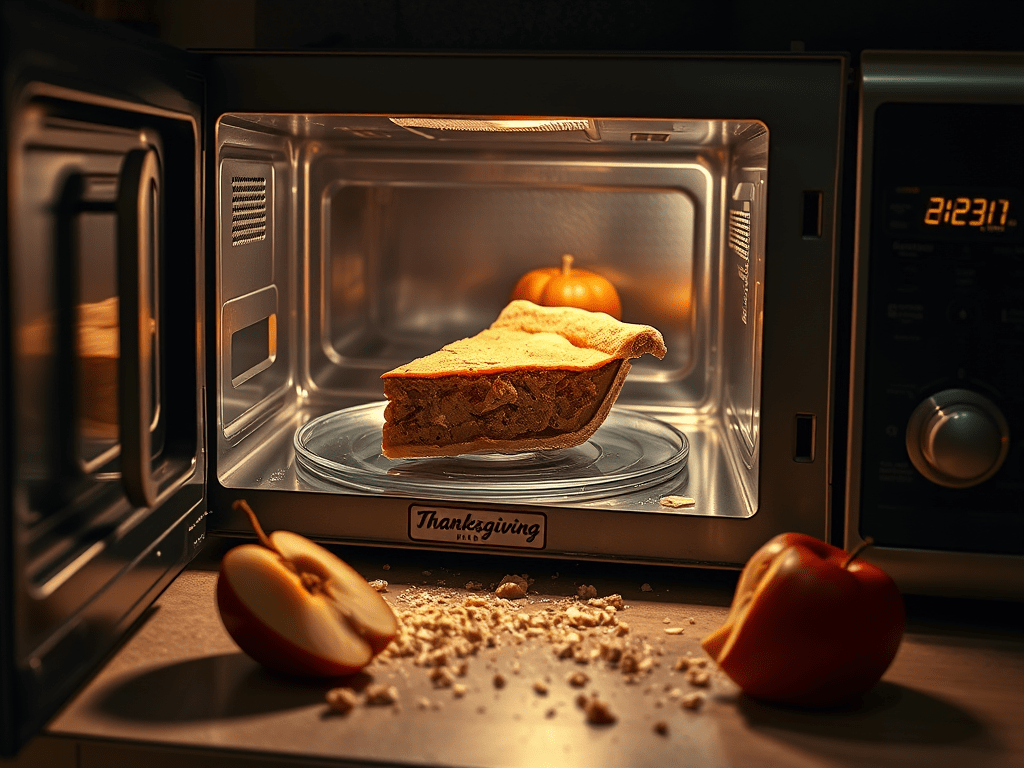
    But as I crossed the kitchen, fate—or treachery—beckoned me toward the microwave. There it sat: a pie box, faintly glowing, practically humming a siren song of buttery crust and spiced filling. One peek inside, and there it was—the last slice of Thanksgiving pie, radiating the kind of allure that no apple could ever muster.

    Before I knew it, I was hunched over the sink, inhaling that pie like a feral animal who’d just discovered civilization’s baked goods. Crumbs flew. Filling dripped. I was mid-bite, fully in beast mode, when my daughter Alison walked in. She stopped, surveyed the scene, and with surgical precision, dropped her line: “When’s the last time you were on a diet?”

    I froze mid-chew, my cheeks puffed out like a chipmunk caught in a raid. “A single slice of pie hardly merits such harsh judgment,” I said, wiping a smear of whipped cream off my chin.

    “Don’t be so defensive,” she said, her voice carrying the kind of condescension only a teenage girl can master. “I’m just asking—when was the last time you were on a diet?”

    “I didn’t realize you were the official historian of my weight management strategies,” I shot back, trying to maintain some shred of dignity.

    “What strategy?” she deadpanned, her tone as flat as the pie tin now sitting empty in the sink.

    I opened my mouth in an exaggerated display of mock offense, as if her words had wounded me so deeply that I could only respond with silence. We laughed, but the truth landed like a sucker punch: despite my heroic kettlebell workouts and high-protein meal plans, my daughter saw me for what I really was—a fat slob, undone by my inability to resist the siren song of leftover pie.

    My conversation with my daughter hit a nerve: my relationship with food is less of a partnership and more of a chaotic entanglement worthy of a reality show. I’m living with a chronic condition others have dubbed food noise—the relentless, mind-consuming obsession with food. It’s not just a passing craving; it’s a full-time occupation. Food noise is that little gremlin in your head planning tomorrow’s breakfast while you’re still wiping pie crumbs off your shirt from dinner. It’s exhausting, intrusive, and, frankly, a massive pain in the ass.

    I’ve tried all the supposed solutions. High-protein meals? Check. Fiber-packed fruits and veggies? Done. Permission to eat favorite foods to deflate their psychological power? Sure, why not. Listening to my so-called “hunger cues”? Please, those cues have been drowned out by a symphony of appetite louder than a Wagner opera. The truth is, my love of food has nothing to do with hunger. This isn’t about survival—it’s about passion.

    I crave food the way a musician craves music, except instead of performing Beethoven’s Ninth, I’m inhaling pie and serenading a protein bar like it’s my muse. Eating isn’t just sustenance; it’s a full-body euphoria, a never-ending sonata of chewing that I never want to end.

    So here I am, a helpless Snack Serenader, crooning over every dish like it’s the centerpiece of my magnum opus. Pie, pasta, cereal, or steak—it doesn’t matter. They’re all part of the eternal love song I sing to food, even as it steamrolls my willpower and expands my waistline. And while it may sound romantic, let’s be honest: it’s less about joy and more about imprisonment. I don’t just eat food; I worship it. I’m not hungry for a meal; I’m desperate for an encore. Just as a Beethoven superfan can lose themselves in the ninth symphony on repeat, I want to marinate in a bottomless jacuzzi of flavor, chewing my way through life’s buffet like a one-man marching band of mastication.

    As a Snack Serenader, I croon love songs to everything from pie to chicken shawarma. That Thanksgiving slice of pie wasn’t dessert; it was a crescendo. A bag of chips isn’t a snack; it’s an aria. And here I am, the tragic hero, swooning over leftovers as my waistline rolls its eyes and mutters, “You’re killing me.”

    The irony isn’t lost on me that I began this post with Arrested Development while chronicling my sink-side pie binge—a man-child devouring apple pie like it was the elixir of life, all under the unimpressed gaze of my daughter. Uncontrolled eating, it seems, is less about hunger and more about a deep-seated infantilization for which there’s no cure, just a lifetime subscription.