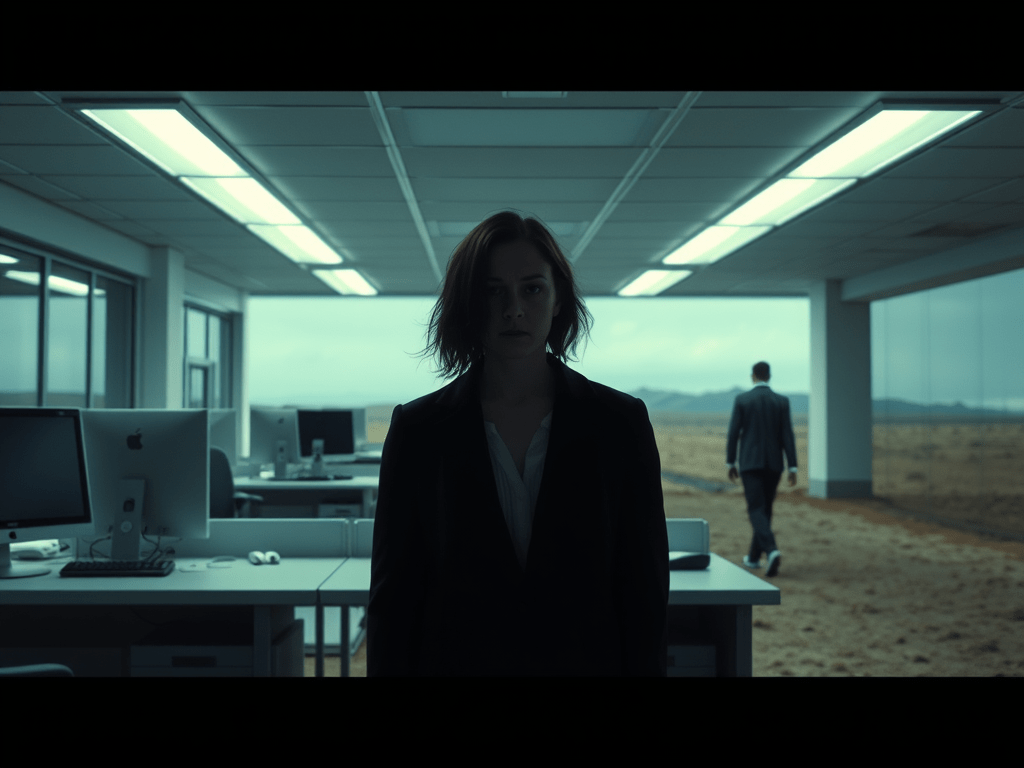
The employees of Lumon in Severance don’t just clock in and out—they’re vivisected by a corporate lobotomy that splits their souls in two. Each character exists in a bifurcated purgatory, trapped in a fluorescent-lit purgatory where one version of themselves (the “innie”) never leaves the office, and the other (the “outie”) floats through life with no memory of work. This isn’t just workplace alienation—it’s mutterseelenallein in its purest form: the kind of bone-deep loneliness where even your own psyche ghosts you. These poor saps are so severed from continuity, connection, and selfhood that they may as well have been orphaned by their own existence. It’s not just alienation from the world—it’s abandonment by the very person you’re supposed to trust most: yourself.
Blog
-

Gogol’s The Overcoat and Kafka’s Metamorphosis Foreshadowed the Apple TV Hit Severance
Long before Severance turned corporate soul-splitting into Emmy bait, Nikolai Gogol’s The Overcoat quietly laid the groundwork for the genre of bureaucratic horror. Akaky Akakievich is the proto-Severed worker—his life split cleanly between a dead-eyed office existence and a home life that’s somehow even more depressing. Like the Lumon employees, Akaky finds solace not in human connection but in the numbing repetition of meaningless tasks—he copies documents with the same reverence others reserve for sacred texts. And when he finally dares to dream—by saving for a coat, not a promotion—his brief taste of identity is crushed under the weight of systemic cruelty. If Severance is about carving a clean boundary between work self and home self, The Overcoat is about never having had a self to begin with—just a threadbare shell, waiting for a little wool and meaning.
Franz Kafka’s The Metamorphosis, like Gogol’s The Overcoat, is an early blueprint for Severance—a corporate fever dream where identity disintegrates under the crushing weight of routine. Gregor Samsa wakes up as a giant insect, which is really just Kafka’s polite way of saying, “Congratulations, you’ve officially been dehumanized by your job.” Much like the Innies at Lumon, Gregor is trapped in a world where personal agency has been revoked and his worth is measured solely by productivity. His family, like a passive-aggressive middle manager, barely bats an eye as he spirals into irrelevance—because what matters isn’t who you are, but what you produce. Metamorphosis doesn’t just foreshadow Severance—it’s the spiritual prequel, complete with bug eyes, locked doors, and the existential dread of being rendered obsolete by the very system you once served.
-

The Dopamine Dumpster Fire: How I Went from Literary Scholar to Algorithm Addict
In 1979, I went to college—back when students still read entire books and didn’t skim Nietzsche between TikTok scrolls. By 1986, I had a master’s degree in English and a reading habit so fierce it could scare a librarian. This was the Pre-Digital, Pre-Illiterate Age, and I was both smarter and, dare I say, happier. Then came the internet, like a radioactive vending machine of constant stimulation, and within a decade my attention span was fried, my dopamine receptors scorched, and my brain felt like a squirrel on meth.
Reading Anna Lembke’s Dopamine Nation: Finding Balance in the Age of Indulgence was like holding a mirror up to my own cognitive and emotional decline—except the mirror was cracked and buzzing with notification pings. Lembke, a Stanford psychiatrist with a scalpel-sharp intellect, writes that we live in a world of “overwhelming abundance,” where the smartphone is the modern hypodermic needle, delivering micro-hits of dopamine at all hours like a dealer with unlimited supply and no off switch. Her message is clear: addiction isn’t a fringe problem—it’s the central operating system of modern life.
Lembke’s insight that “pleasure and pain are processed in the same part of the brain” makes you rethink every moment of scrolling, snacking, shopping, and spiraling. The more dopamine you chase, the more pain you invite in through the back door. It’s like sprinting on a treadmill made of banana peels—every gain is followed by a crash. According to Lembke, addiction rewires your brain to seek shortcuts, and in the process, you become a hollowed-out shell of your former self, one push notification away from an existential crisis.
I didn’t need convincing. Twenty-five years of living online has made my mind a junk drawer of fragmented thoughts and snack-sized emotions. Lembke explains that many addicts live a double life, a private underworld of shame and secrecy that eats away at their integrity. That rang uncomfortably true. She points to risk factors like having a parent with addiction or mental illness. Bingo. Both my parents were alcoholics, and my mother had bipolar disorder—my genetic cocktail came shaken, stirred, and garnished with a panic attack.
But the biggest risk factor, Lembke argues, is access. We’re all mainlining the internet every day. The supply has become the demand. The dopamine economy, she says, thrives on overconsumption, normalized by the fact that everyone else is doing it. If your entire community is obsessed with likes, outrage, and FOMO-fueled consumerism, it starts to feel… reasonable. Normal. Even patriotic.
Social media isn’t just a distraction; it’s a full-blown Outrage Machine, built to keep our emotional hair on fire 24/7. We are like feral raccoons pawing at glowing rectangles, convinced that salvation lies in another dopamine hit—another comment, another package, another numbing episode of low-stakes content. Our collective descent is so absurd it would be funny if it weren’t so bleak.
Lembke leans on the wisdom of cultural critic Philip Rieff, who observed that we’ve moved from “religious man” to “psychological man”—from seeking salvation to chasing pleasure. Add to that Jeffrey Rosen’s The Pursuit of Happiness, which reminds us that classical philosophy defined happiness not as feeling good, but as being good—the moral life, not the moist towelette of consumer satisfaction.
But that idea, in our current therapeutic culture, sounds about as appealing as a cold shower in February. We’ve been taught to medicate our moods, sedate our angst, and wrap our trauma in soft blankets of “self-care” that often amount to binge-watching and overeating. Our modern mantra is: “If it hurts, scroll faster.” The result? A crisis of meaning, a society allergic to discomfort, and a spiritual vacuum that smells faintly of Axe Body Spray.
Lembke calls this the paradox of hedonism: the more you chase pleasure, the less capable you become of feeling it. Hedonism leads to anhedonia—a state in which nothing satisfies. You eat the cake, buy the thing, get the like, and feel… nothing. It’s like winning a prize that turns into a cockroach when you unwrap it.
Ever since reading Dopamine Nation, I’ve been haunted by a single, searing thought: Maybe I shouldn’t try to feel good. Maybe I should try to be good. But this, in a consumer culture built on instant gratification, feels like a betrayal of the social contract. We’re not just addicted—we’re indoctrinated.
So here I am, a relic of the Pre-Digital Age, nursing my overstimulated brain, trying to claw my way out of the dopamine pit with a few dog-eared paperbacks and a shortwave radio. Because the real question isn’t how to feel better—but how to live better in a world that confuses stimulation for meaning and pleasure for purpose.
And if that makes me sound like a cranky monk with Wi-Fi, so be it. I’d rather be a lucid cynic than another dopamine casualty with a glowing screen and dead eyes.
-
CAR T-Cell Therapy Helped My Brother Beat a Rare Cancer
In 2021, my younger brother faced a grim diagnosis: Burkitt lymphoma, a rare and aggressive cancer that left him with a mere three months to live. As if that wasn’t enough, he was recently divorced, his finances were in tatters following the collapse of his tech start-up, and the weight of stage-4 cancer was crushing him. The doctor, in a rare moment of compassion, suggested he create a bucket list. But fate had one last twist in store: my brother was accepted as the final participant in a groundbreaking UCSF experimental treatment known as CAR T-cell therapy.
For three weeks, he underwent this miracle treatment, and as his recovery began, he was supposed to stay at the nearby Koz Hospitality House, a sanctuary for cancer patients. But he needed more than just a place to stay—he needed someone to help him navigate this harrowing chapter. Enter me. My college courses had all shifted online due to the pandemic, so I was able to handle my remote office hours from the Koz House. I moved in with my brother for two weeks, and though it was a challenge, it felt like a moral imperative to be by his side.
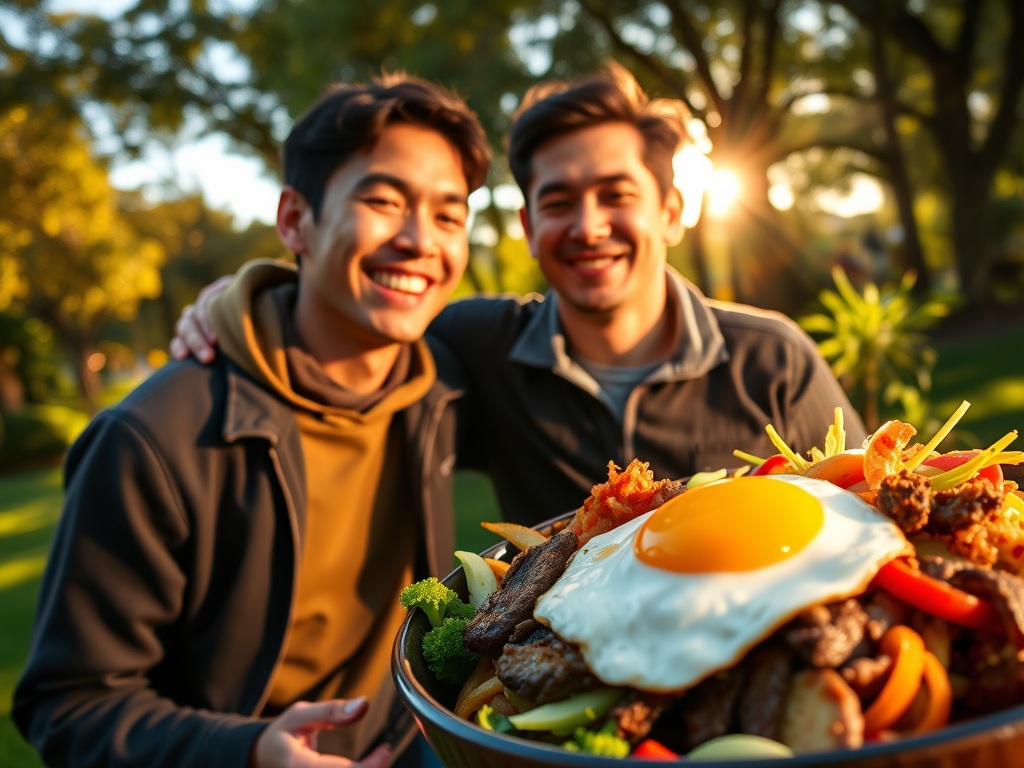
What followed was nothing short of miraculous. Not only did my brother defy the odds and beat the cancer—the enormous tumor in his chest vanished—but the absence of chemotherapy meant he was full of energy. We walked several miles a day in the warm embrace of the Golden Gate Park sunshine, and dined out at local restaurants, with our absolute favorite being the Bibimbap from a charming Korean café within walking distance of the Koz House.
Imagine, if you will, a plate that could make the gods weep with joy: the luxurious Bibimbap. At its core is a steaming mound of jasmine rice, each grain perfectly cooked and slightly caramelized around the edges, promising a delightful crunch. This foundation is adorned with a vibrant array of vegetables that seem to dance in a riot of color. There are tenderly crisp shredded carrots, their bright orange sweetness a contrast to the emerald-green spinach, delicately sautéed to perfection. Thin strips of julienned shiitake mushrooms lend an earthy umami, while sautéed zucchini adds a touch of sweetness, and crunchy bean sprouts offer a refreshing snap.
Amid this colorful tableau, slices of seasoned beef—tender and juicy, marinated in a rich blend of soy sauce, garlic, and sesame oil—rest in harmonious balance with the vegetables. Atop this culinary masterpiece is a perfectly fried egg, its golden yolk a glossy orb of creamy richness, its edges crisply caramelized for a delightful textural contrast. A bold dollop of gochujang, a spicy-sweet fermented chili paste, sits at the center, its fiery kick slicing through the richness with vibrant heat.
A sprinkling of sesame seeds, their nutty aroma mingling with the dish’s complex flavors, completes the ensemble. Thinly sliced scallions add a touch of freshness, and a drizzle of toasted sesame oil imparts a deep, nutty undertone. Every bite of this artful creation is a testament to the balance of textures and flavors—a celebration of umami, sweetness, and spice that transforms each meal into a joyous feast.
Watching my brother relish every bite of this extraordinary Bibimbap was more than just a culinary delight—it felt like witnessing a healing miracle. It was as though this renowned Korean dish held within it a secret power, a savory balm that not only nourished his body but also rejuvenated his spirit, making him heal before my very eyes.
-

The Reuben Sandwich Standoff
In 1983, I was a humble college student working at Jackson’s Wine & Spirits, conveniently located next to the illustrious Claremont Hotel in Berkeley. This wasn’t just any wine store—it had a deli too, where the drama unfolded like a soap opera on rye bread.
One fateful afternoon, a man in his fifties, who had the unmistakable air of a New Yorker transplanted to the west coast, waltzed in and ordered a Reuben sandwich.
Enter George, our deli manager and fellow New Yorker, who was a 300-pound titan with a penchant for thick black-framed glasses and a cigar stub that seemed permanently fused to his lips. George was the kind of guy who could turn ordering a sandwich into a WWE smackdown. George, in his infinite deli wisdom, asked the customer what kind of cheese he wanted on his Reuben.
This question, apparently, was a direct assault on the customer’s very essence. With all the drama of a Shakespearean tragedy, the customer launched into an impassioned monologue. “A Reuben sandwich is rye bread, corned beef, Swiss cheese, sauerkraut, and Russian dressing!” he proclaimed, as if he were revealing the secret formula to eternal life.
George, unimpressed by this unsolicited lecture and clearly unamused by the customer’s attempt to rewrite Reuben history, repeated his question: “What kind of cheese do you want?”
The customer’s face turned the color of a cherry tomato as he launched into his tirade once more, listing the sacred ingredients with the fervor of a man defending his homeland. The two New Yorkers engaged in an epic standoff, a duel of stubbornness, each more entrenched in their own version of Reuben orthodoxy.
The debate reached such a fever pitch that the customer exploded in a flurry of expletives that could have given a sailor pause and stormed out, declaring he would never do business with a deli that dared question his Reuben expertise.
To this day, I marvel at the sheer audacity of these two colossal egos. One was denied his lunch, and the other was deprived of a sale, all because neither would concede an inch. It was a lesson in culinary pride and stubbornness—a Reuben sandwich standoff for the ages.
-

When a Granola Belly Was a Political Statement
When I was in my early teens in the 1970s, my family shopped at a San Francisco Bay Area grocery store that “was owned by the people.” It was called Co-Op. The workers were friendly; the men were often bearded and wearing survival gear from Co-Op’s “Wilderness Supply Store.” I would say the affable employees were all somewhere on the Hippy Spectrum. Co-op offered the first day care center for kids while the parents shopped and the first recycling center in town. In addition to organic wholesome foods, the store had a modest book section featuring Robert M. Pirsig’s Zen and the Art of Motorcycle Maintenance, Peter Tompkins’ The Secret Life of Plants, Erich Von Daniken’s Chariots of the Gods, Laurence J. Peters’ The Peter Principle, and the store’s grand jewel and Vegetarian Bible–Frances Moore Lappe’s Diet for a Small Planet.
The store had an ample supply of countercultural foods. You could buy carob honey ice cream, wheat germ, granola, alfalfa sprout home kits with mason jars, brown rice, Japanese yams, and tofu. With its book section of countercultural reading, organic ingredients, and wilderness store, Co-Op was more than just a store. It was a sanctuary for those rebelling against The Man. Eating heaping bowls of granola, wheat germ, and organic honey was not just a self-indulgence; it was a political statement. However, this self-righteous certitude also created a condition known as Granola Belly. Scarfing down calorie-dense granola, wheat germ, and honey throughout the day, these valiant warriors raged against corporate food tyranny, their bellies growing rounder with each virtuous bowl of granola and honey. As I shopped at Co-Op with my parents, I observed these granola-loving rotund revolutionaries as they waddled through the aisles, their expanding girth a testament to the blind spots that mar even the most well-intentioned pursuits.
Granola lovers of the Co-Op era were, without question, a species defined by the contradictory cocktail of high ideals and self-defeating habits. These self-proclaimed countercultural warriors strutted through the aisles of their people-owned utopia, scooping granola by the pound as if it were the holy grail of rebellion, all while sporting survival gear that screamed I’m off to fight the establishment…right after I finish this bowl of carob ice cream. The granola bowl was more than breakfast; it was a badge of moral superiority, a defiant middle finger to The Man served with a side of organic honey. But their noble intentions were undone by their own indulgence. They railed against corporate tyranny with their mouths full, their burgeoning bellies proof that even the most righteous ideals can be upended by an inability to count calories. Their expanding waistlines were not just ironic; they were emblematic of their tendency to cling to virtue while ignoring inconvenient truths—because nothing says rebellion like eating your way to Granola Belly while preaching the gospel of moderation.
-

When the DJ Lost His Mind & Played The Beatles’ “Hey Jude” for Three Hours Straight
It was a sweltering summer night in 1970, the kind of heat that melts your popsicle before you’ve unwrapped it and turns your family barbecue into a gladiator pit of passive-aggressive banter and steak smoke. Somewhere between my dad arguing about grill temps and my aunt trying to turn potato salad into a personality, the true spectacle of the evening wasn’t the charred meat or the mid-century familial dysfunction—it was what erupted over the airwaves.
KFRC 610 AM, the mighty Top 40 beacon of San Francisco, had apparently been hijacked by a disc jockey teetering on the edge of reality. This radio shaman, perhaps emboldened by a bad acid trip or simply possessed by the spirit of Lennon and McCartney, played The Beatles’ “Hey Jude” on an endless loop for three solid hours.
Not once. Not twice. Dozens of times.
It was as if he’d discovered a wormhole in the Na-na-na-na-na-na-na dimension, and he was determined to drag the entire Bay Area through it, kicking and screaming—or, more likely, humming along with mounting psychosis. By the 12th replay, “Hey Jude” didn’t sound like music anymore; it was a mantra, a chant, a psychological experiment conducted in real time on unsuspecting citizens.
At the time, DJs weren’t expected to be sane. Sanity was a liability.
In fact, if your grip on reality was too tight, you probably worked in banking. Radio was for the unhinged, the beautifully deranged, the guys who played 9-minute prog-rock odysseys just to go smoke a joint or use the bathroom.
One DJ at a rival station had a nightly tradition: every time he had to take a leak or inhale an entire bag of Cheetos, he’d cue up The Moody Blues’ “Nights in White Satin.” At nearly ten minutes long, it was the perfect alibi for sloth and snack breaks. And get this—listeners loved it. They called in and demanded it. That song didn’t just chart; it ascended like a slow-moving fog of existential poetry and flute solos.
Suddenly, the 3-minute pop single was passé. Listeners wanted long, indulgent, vinyl-drenched feasts of music. “Suite: Judy Blue Eyes” wasn’t a song—it was an epic. It was our Ninth Symphony, a sprawling, self-important masterpiece that dared to be longer than your average sitcom episode.
This was the golden era of the musical buffet, where DJs weren’t just tastemakers—they were lunatic conductors of cultural excess. Every drawn-out bridge and psychedelic outro was a sign that we had transcended the 45-rpm world of bubblegum pop and entered a new, freeform temple of indulgence.
And if your DJ didn’t go off the rails every now and then, frankly, what the hell were you listening for?
-
The Great, on Hulu, is your TV Mount Everest
So, you’ve just finished watching the complete 3 seasons of The Great on Hulu, and now you’re a broken shell of a human being. This “anti-historical” comedy about Empress Catherine the Great, penned by the devilishly talented Tony McNamara, is hands-down the best thing you’ve ever seen on television. And now, you’re plunged into a depression so deep that not even Elle Fanning’s radiant smirk or Nicholas Hoult’s glorious, sociopathic wit can pull you out of it. Why? Because you know, deep in your soul, that you’ll never see a script with such biting humor, impeccable cadence, and penetrating insight again. Ever.
The Great is your TV Mount Everest, and the air up there is so thin that coming back down to the ground feels like an existential freefall. Desperate for solace, you decide to drown your sorrows in another “costume comedy,” because clearly, nothing soothes the soul like more ruffles and wigs.
Enter The Decameron on Netflix—a comedy about the bubonic plague in 14th Century Italy. Yes, someone thought it would be a good idea to wring laughs out of a pandemic that killed a third of Europe. And the shocking part? They actually pulled it off. You’re impressed. Sort of. But at the same time, let’s not kid ourselves—the writing is not even in the same universe as The Great. It’s like comparing a Michelin-starred meal to the tastiest TV dinner you’ve ever had. Sure, it’s good, but come on—it’s not The Great. But here’s the kicker: you can’t trust your judgment anymore. You’ve entered a full-blown Post-Masterpiece Meltdown. On one hand, you’re bending over backward to be generous toward The Decameron, because you know deep down it’s unfair to compare anything to the sheer brilliance of The Great. On the other hand, you’re haunted by the suspicion that your generosity might be blinding you to the show’s actual merits—or lack thereof. You’re like someone who’s just lost the love of their life and is now attempting to date again by swiping right on Tinder with tears streaming down their face.
Can you really trust your post-Great heart to judge anything properly? To make matters worse, The Decameron features the enigma that is Tanya Reynolds, an actress whose face is a bafflingly delightful conundrum—one moment goofy, the next serenely beautiful, as if she’s somehow tapped into a facial time machine that can travel between awkward adolescence and timeless beauty at will. Her intoxicating, elastic pulchritude is the final nail in the coffin of your short-circuited judgment. Your critical faculties, once sharp as a chef’s knife, now resemble a spoon trying to slice through steak. And you used to take pride in your TV criticism! Now you’re floundering in a sea of existential doubt, questioning everything—your taste, your standards, your very identity as a TV aficionado. So here you are, a once-confident critic, now reduced to a quivering mass of uncertainty, all because you stumbled upon Tony McNamara’s masterpiece, The Great. It’s like finding out you’ve been living in Plato’s cave all along, and now you’ve seen the light, you’re doomed to spend the rest of your days in the shadows, longing for the brilliance you can never unsee. Welcome to your new life in the Post-Masterpiece Meltdown. Enjoy the view—such as it is.
-
How I dealt with an overrated restaurant in Mammoth Lakes
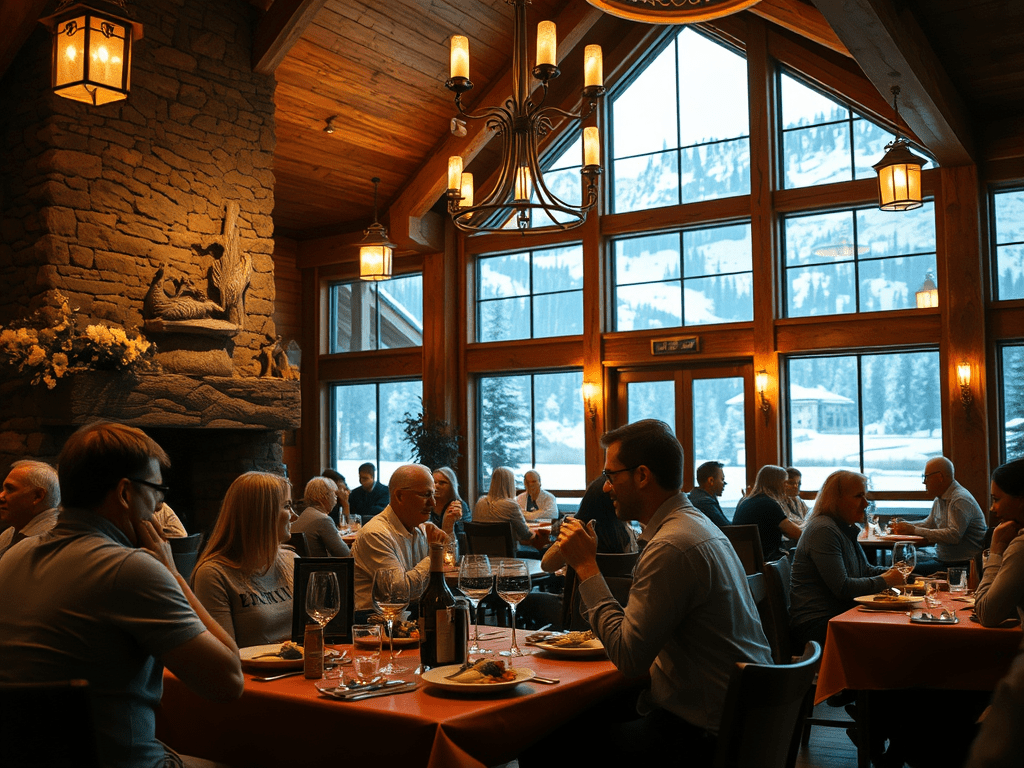
While visiting Mammoth Lakes last summer, we made the mistake of visiting a so-called “celebrity chef” Italian restaurant in downtown Mammoth, housed in a lodge so stunning it looked like it had been airlifted straight from the Swiss Alps. The place was dripping with rustic charm—vaulted ceilings, crackling fireplaces, and oversized windows offering a view of the mountains that could bring a tear to your eye.
But all that ambiance couldn’t hide the fact that the food was an absolute trainwreck. The chef, once a big deal on some cooking show a decade ago, was now milking his fifteen minutes of fame for all they were worth. He strutted around the dining room like a peacock, soaking up the adoration of diners who clearly had no idea they were about to be served what could only be described as gourmet garbage.
We only had one good dish, the ratatouille pizza. Feeling a newfound sense of duty, I took it upon myself to warn other diners. I went from table to table, declaring that everything on the menu was a culinary disaster except the ratatouille pizzas. To my surprise, the customers were delighted with my advice, nodding in appreciation as they changed their orders. Meanwhile, my wife and daughters were absolutely mortified. They sat there pretending not to know me, faces buried in their napkins, probably wishing they could vanish into thin air.
-

I found my true life purpose at a McDonald’s in Mojave
Coming home from Mammoth last summer, I had naively believed that my children would be sated from their breakfast at the McDonald’s in Bishop, allowing us to drive straight home without further interruptions.
But by the time we reached Mojave around noon, my daughters swore they would perish on the spot if they didn’t have lunch immediately. So, we found ourselves pulling into yet another McDonald’s in Mojave. The thought of visiting two McDonald’s in a single day felt like a deep plunge into the abyss of self-debasement, a loss of dignity on par with other legendary acts of self-humiliation. I began to think this might be the modern-day equivalent of wearing a sandwich board that reads, “I have given up.” Yet, amid my indignation, I secretly thanked the universe for my daughters’ insatiable appetites because I desperately needed to use the bathroom.
However, fate—or rather the cruel architects of this establishment—had installed combination locks on the bathroom doors, and the workers guarding these sacred numbers were about as generous with them as a dragon hoarding gold. I had to persuade them that my family of four would be forking over more than fifty dollars for the world’s most lackluster cuisine, and thus, I was surely deserving of the golden code.
After securing the coveted combination, I made a beeline for the bathroom, practically kicking the door open like a cowboy in a saloon. The relief was so immense that it felt as if I had just liberated a small nation from tyranny. Afterward, I returned to the counter to wait for our food, feeling light as a feather. As I stood there, I observed dozens of men rattling the bathroom doorknob with the desperation of someone who had just spotted an oasis in the desert, only to find it locked. Their faces were contorted in pain, and their eyes begged for mercy but the cruel workers were unmoved.
Seeing their plight, I realized I had the power to make a difference. I could be their savior. In an act of defiance against the oppressive bathroom code policy, I began shouting the combination with a gusto that could only be described as revolutionary. “Two-four-six-eight!” I bellowed, as if each digit was a bullet in the war against bladder injustice. The relief that spread across their faces was almost spiritual. I had become a mythical prophet, a modern-day Moses leading the oppressed to the Promised Land of Bladder Relief.
Meanwhile, as I basked in the glory of my newfound role, my wife and daughters sank deeper into their chairs, their faces a mix of horror and embarrassment. They pretended not to know me, as if I were some wild-eyed lunatic who had wandered in from the Mojave Desert. But I didn’t care. I had found my spiritual calling, even if it was in the unlikeliest of places—shouting bathroom codes at a McDonald’s in Mojave.
 Cinemorphosis