Blog

  • How to Shut Up a Yacht Critic: Feed Them Into Oblivion

    How to Shut Up a Yacht Critic: Feed Them Into Oblivion


    My wife and I have been watching the current season of Below Deck Mediterranean and have been impressed with the consistent food preparation of the eccentric chef Josh Bingham. He stormed off the boat when one of the charter guests, Carlos, lectured Josh on his inferior vegan fare. Too much starch, not enough creativity, not enough this, not enough that. One of the excruciating pleasures of this show is watching people whose expectations run so high that they become obnoxious. They spent so much money, they feel entitled to push the chef and other crew members to extremes in order to justify the price of a premium yacht adventure. 

    Josh’s food on this charter looked disappointing, a melange of mediocrity. The meals had no identity. He was trying to please too many palates. 

    One thing occurred to me: There are always a few vegans who charter these yachts. Some are more fake than others. They want the vegan halo but not the vegan austerity. In other words, they want rich, decadent meals, just as inviting as steak and lobster. They crave butter-rich sauces, glazed proteins, and seductive textures, only delivered via tofu and oat milk so their consciences remain stainless.

    Therefore, if I were Josh or any chef on one of these luxury yachts, I would have an emergency toolkit of go-to rich and decadent vegan meals. One that immediately comes to mind would be Thai peanut Satay with fried tofu and white rice. Serve it with Sichuan green beans and broccoli lacquered in sesame oil, give them some fresh sesame rolls dipped in olive oil and garlic, and that would surely shut them up and induce them into a long, satisfying nap. 

    If I were a chef on this show, I would want to create food so luxurious, decadent, and soothing, it would induce the charters into a deep sleep and thereby allow me and my fellow crew members to take a well-deserved break. 

  • A Diagnosis is a Weapon: My First Step Toward Shoulder Recovery

    A Diagnosis is a Weapon: My First Step Toward Shoulder Recovery

    Yesterday I met with a sports medicine physical therapist at Kaiser for the first time. The kind nurse took my vitals, and to my surprise my blood pressure wasn’t bad at all: 127 over 84. My blood pressure always spikes a bit at the doctor’s. 

    Then I met the sports doctor. She was affable, direct, and clearly passionate about her work. She examined my left shoulder, noted that the swelling was visible even through my T-shirt, pressed along the biceps groove, and tested my range of motion. After watching me perform several movements, she diagnosed me with rotator cuff syndrome and biceps tendinopathy. She immediately ordered an X-ray (results pending) and scheduled an ultrasound in five weeks to gather more detail. 

    Her initial verdict was cautiously optimistic: with proper rehab, she believes I can recover in three months. I told her that unlike my old gym injury—when I tore my rotator cuff doing heavy bench presses and spent nine months in purgatory—this one didn’t begin with trauma. I was simply doing my normal kettlebell chest presses, felt a little tightness, and woke up the next morning with a shoulder that felt like it belonged to someone else. That incident was three months ago. 

    She has me on Motrin three times a day to bring down the inflammation so I can tolerate the rehab movements. To my relief, she didn’t ask me to abandon muscle training; she understands the realities of aging and the need to protect lean mass. I just have to avoid chest presses, shoulder presses, and curls. My work will shift to legs, glutes, traps, and lat activation, with shoulder and pec stimulation coming indirectly through rehab. She gave a handout of exercises, some I can do and others I can’t. I also consulted some doctors who do shoulder rehab on YouTube and told her about some, and she agreed I could do them.

    So far, I have a long list of rehab exercises I can choose from: cat–cow yog pose, broomstick flexion, wall push-ups, wall flexion, planks, plank taps, narrow push-ups on the knees, light dumbbell rotations, and others. 

    Some overhead movements are currently impossible. Hanging from a chin-up bar, the internet’s magic cure, feels like medieval torture. 

    I’ll do the exercises that I can tolerate for fifteen minutes daily: integrated on kettlebell days, standalone on the rest. Also, on my non-kettlebell days, the doctor agrees I should take an hour-long walk.

    Psychologically, this appointment mattered. A diagnosis means I’m not inventing pain or collapsing mentally. It gives me a plan, an organizing principle, a weapon. When my body fails, I can live with discomfort; what I cannot tolerate is drifting in uncertainty. Seeing this doctor was the first step in taking back control.

  • Three Months of Shoulder Pain and the Art of Not Panicking

    Three Months of Shoulder Pain and the Art of Not Panicking

    This afternoon I’ll see a doctor about my three-month shoulder ordeal. I’m hoping for clarity: bursitis or a torn rotator cuff. The injury didn’t begin with a dramatic moment. I remember doing single-arm chest presses on the garage mat with a 50-pound kettlebell. There was a subtle tightness in the left shoulder—no alarm bells. The next morning I woke as if someone had rearranged the joint overnight. Side raises and reaching behind became nearly impossible. I cut out all chest and shoulder presses. Some days the pain flared after training; I blamed curls and single-arm swings, so I eliminated them too, and the pain eased.

    To make up for the reduced kettlebell volume, I doubled down on the Schwinn Airdyne, grinding through hour-long sessions that combine pedaling and lever rowing. No pain—until three days ago, when the movement set off a nerve fire down my arm. That told me I was no longer dealing with simple irritation. Something was pinched and inflamed. The bike is now retired. I’ll walk the neighborhood for cardio until further notice. I’ve experimented with rehab exercises: cat-cow yoga poses help; so do wall push-ups from shoulder rehab videos. Side lateral raises, though medically recommended, feel like sabotage. I refuse them.

    I made a video about the injury yesterday. The floodgates opened. Dozens of comments from people who had surgery, magnets, injections, or long stretches of physical therapy. One old friend emailed: he never recovered and has lived with pain and restricted motion for a decade. The road, it seems, is long and indifferent to optimism. I don’t enjoy the pain, the limited workouts, or the hypervigilance required to avoid reinjury. The mental effort—combined with physical discomfort—wears me down. Right now the shoulder aches at a low level, probably from the idiotic attempt to sling on a backpack this morning. Starting next week, I’m switching to a messenger bag over my healthy shoulder.

    When I speak to the doctor today, I’ll try to be calm, give a clear narrative, and resist letting anxiety pull me into melodrama. I want to hear the data, not force my fantasy of “no surgery” onto the facts. I had hoped to write about something else this morning—anything other than this shoulder—but obsession has its own gravity. It will not be ignored.

  • Has AI Broken Education—or Did We Break It First?

    Has AI Broken Education—or Did We Break It First?

    Argumentative Essay Prompt: AI, Education, and the Future of Human Thinking (1,700 words)

    Artificial intelligence has entered classrooms, study sessions, and homework routines with overwhelming speed. Some commentators argue that this shift is not just disruptive but disastrous. Ashanty Rosario, a high school student, warns in “I’m a High Schooler. AI Is Demolishing My Education” that AI encourages passivity, de-skills students, and replaces authentic learning with the illusion of competence. Lila Shroff, in “The AI Takeover of Education Is Just Getting Started,” argues that teachers and institutions are unprepared, leaving students to navigate a digital transformation with no guardrails. Damon Beres claims in “AI Has Broken High School and College” that classrooms are devolving into soulless content factories in which students outsource both thought and identity. These writers paint a bleak picture: AI is not just a tool—it is a force accelerating the decay of intellectual life.

    Other commentators take a different approach. Ian Bogost’s “College Students Have Already Changed Forever” argues that the real transformation happened long before AI—students have already become transactional, disengaged, and alienated, and AI simply exposes a preexisting wound. Meanwhile, Tyler Austin Harper offers two counterpoints: in “The Question All Colleges Should Ask Themselves About AI,” he insists that institutions must rethink how assignments function in the age of automation; and in “ChatGPT Doesn’t Have to Ruin College,” he suggests that AI could amplify human learning if courses are redesigned to reward original thinking, personal insight, and intellectual ambition rather than formulaic output.

    In a 1,700-word argumentative essay, defend, refute, or complicate the claim that AI is fundamentally damaging education. Your essay must:

    • Take a clear position on whether AI erodes learning, enhances it, or transforms it in ways that require new pedagogical strategies.
    • Analyze how Rosario, Shroff, and Beres frame the dangers of AI for intellectual development, motivation, and classroom culture.
    • Compare their views with Bogost and Harper, who argue that education itself—not AI—is the root of the crisis, or that educators must adapt rather than resist.
    • Include a counterargument–rebuttal section that addresses the strongest argument you disagree with.
    • Use at least four credible sources in MLA format, including at least three of the essays listed above.

    Your goal is not to summarize the articles but to evaluate what they reveal about the future of learning: Is AI the villain, the scapegoat, or a tool we have not yet learned to use wisely?

  • Does AI Destroy or Redefine Learning?

    Does AI Destroy or Redefine Learning?

    Argumentative Essay Prompt: The Effects of AI on Education (1,700 words)

    Artificial intelligence has raised alarm bells in education. Critics argue that students now rely so heavily on AI tools that they are becoming users rather than thinkers—outsourcing curiosity, creativity, and problem-solving to machines. In this view, the classroom is slowly deteriorating into a culture of passivity, distraction, and what some call a form of “communal stupidity.”

    In his Atlantic essay “My Students Use AI. So What?” linguist and educator John McWhorter challenges this narrative. Instead of treating AI as a threat to intelligence, he examines the everyday media consumption of his tween daughters. They spend little time reading traditional books, yet their time online exposes them to sophisticated humor, stylized language, and clever cultural references. Rather than dulling their minds, McWhorter argues, certain forms of media sharpen them—and occasionally reach the level of genuine artistic expression.

    McWhorter anticipates objections. Books demand imagination, concentration, and patience. He does not deny this. But he asks whether we have elevated books into unquestioned sacred objects. Human creativity has always existed in visual, auditory, and performative arts—not exclusively on the printed page.

    Like many educators, McWhorter also acknowledges that schooling must adapt. Just as no teacher today would demand students calculate square roots without a calculator, he recognizes that assigning a formulaic five-paragraph essay invites AI to automate it. Teaching must evolve, not retreat. He concludes that educators and parents must create new forms of engagement that work within the technological environment students actually inhabit.

    Is McWhorter persuasive? In a 1,700-word argumentative essay, defend, refute, or complicate his central claim that AI is not inherently corrosive to thinking, and that education must evolve rather than resist technological realities. Your essay should:
    • Make a clear, debatable thesis about AI’s influence on learning, creativity, and critical thinking.
    • Analyze how McWhorter defines intelligence, skill, and engagement in digital environments.
    • Include a counterargument–rebuttal section in which you address why some technologies may be so disruptive that adapting to them becomes impossible—or whether that fear misunderstands how students actually learn.
    • Use evidence from McWhorter and at least two additional credible sources.
    • Include a Works Cited page in MLA format with at least four sources total.

    Your goal is not to simply summarize McWhorter, but to weigh his claims against reality. Does AI open new modes of literacy, or does it train us into passive consumption? What does responsible adaptation look like, and where do we draw the line between embracing tools and surrendering agency?

    Building Block 1: Introduction Paragraph:

    Write a 300-word paragraph describing a non-book activity—such as a specific YouTube channel, a TikTok creator, an online gaming stream, or a subreddit—that entertains you while also requiring real engagement and intellectual effort. Do not speak in broad generalities; focus on one example. Describe what drew you to that content and what makes it more than passive consumption. If you choose a subreddit, explain how it operates: Do members debate technical details, challenge arguments, post layered memes that reference politics or philosophy, or analyze social behavior that demands you understand context and nuance? If you choose a video or stream, describe how its pacing, humor, visual cues, or language force you to track patterns, notice subtle callbacks, or recognize sarcasm and satire. Show how your brain works to interpret signals, anticipate moves, decode cultural references, or evaluate whether the creator is being sincere, ironic, or manipulative. Explain how this activity cultivates cognitive skills—pattern recognition, strategic thinking, language sensitivity, humor literacy, or cultural analysis—that are not identical to reading but still intellectually substantial. Then connect your experience to John McWhorter’s argument in “My Students Use AI. So What?” by explaining how your engagement challenges the assumption that screen-based media turns young people into passive consumers. McWhorter claims that digital content can sharpen minds by exposing viewers to stylized language, comedic timing, and creative expression; show how your chosen activity illustrates (or complicates) this point. Conclude by reflecting on whether the skills you are developing—whether from decoding layered Reddit discussions or following complex video essays—are simply different from the skills cultivated by books, or whether they offer alternative paths to intelligence that schools and parents should take seriously.

    Building Block 2: Conclusion

    Write a 250-word conclusion in which you step back from your argument and explain what your thesis reveals about the broader social implications of online entertainment. Do not summarize your paper. Instead, reflect on how your analysis has changed the way you think about digital media and your own habits as a viewer, gamer, or participant. Explain how your chosen example—whether a subreddit, a content creator, a gaming channel, or another digital space—demonstrates that online entertainment is not automatically a form of distraction or intellectual decay. Discuss how interacting with this media has trained you to interpret tone, decode humor or irony, follow complex narratives, or understand cultural signals that are easy to miss if you are not paying attention. Then consider what this means for society: If students are learning language, timing, persuasion, and nuance in digital environments, how should teachers, parents, and institutions respond? Should they continue to treat online entertainment as a threat to literacy, or as an alternate path to it? Draw a connection between your growth as a thinker and the larger question of where intelligence is cultivated in the 21st century. End your paragraph with a reflection on how your relationship to digital media has changed: Do you now view certain forms of online entertainment as trivial distractions, or as unexpected arenas where people practice rhetorical agility, cultural awareness, and cognitive skill?

  • Comma Splices and Other Endangered Species

    Comma Splices and Other Endangered Species

    I’ve been grading college essays for nearly forty years, and for most of that time, spotting a comma splice was like being a tennis umpire catching an out-of-bounds serve: instant whistle, raised flag, righteous indignation. A run-on sentence was not merely a mistake—it was a moral offense. A fragment was a cry for divine intervention. I was the Grammar Constable, badge polished, citation pad ready.

    But something has shifted. I look at a comma splice now and instead of reacting like a hall monitor on Red Bull, I simply ask: What’s the point? In a world where students increasingly treat AI like an in-house copyeditor, how long will “grammar errors” even exist? Am I really supposed to send them to syntax jail when a few prompts and a grammar model will sand off their linguistic rough edges? Policing grammar suddenly feels as antiquated as lecturing people about proper carburetor maintenance. The role I’ve played for decades—keeper of the mechanical rules—feels obsolete.

    This morning I graded a paper with a textbook comma splice. A few years ago, I’d have winced like I’d bitten into a lemon rind. Today? I barely blinked. The author will eventually click a button and let a machine fix it. My outrage, like the comma splice itself, is becoming a relic of the combustible-engine era.

  • How Cupertino Became the Daycare of Computing

    How Cupertino Became the Daycare of Computing

    George Carlin used to riff on the difference between baseball and football. Baseball, he said, was bucolic and innocent, all sunshine and fresh grass, a place where no one ever really got hurt. Football, by contrast, was a mechanized assault: helmets, blitzes, aerial bombardments, and strategic violence. If Carlin were alive and tormenting the tech world on YouTube, he’d have the same bit about Windows and Apple.

    Windows is adult golf in Florida. You’re on a sprawling course with crosswinds, hurricane alerts, gator-infested water hazards, and snakes hiding in the reeds. Everything is dangerous, unpredictable, and just a little thrilling. You’re free out there. You’re a professional. You drive a ball into the storm with the confidence of someone who believes he belongs in the arena.

    Apple OS, on the other hand, is miniature golf. The obstacles are neon dragons, ceramic elves, and snowmen with friendly smiles. The path is fenced so the ball doesn’t roll anywhere interesting. The course is supervised by Cupertino kindergarten teachers who hand you a juice box and a blanket every time you panic. It’s safe. It’s adorable. It’s a padded cell with a “magic ecosystem” label slapped on top.

    Pride might tempt you to leave the kiddie course. You might fantasize about playing Windows golf with the adults—until the day a ten-foot alligator rises out of a swamp and clamps down on your leg, leaving you hobbling back to Apple, clutching your MacBook Air like a teddy bear.

    The lesson is simple: when you’re about to spend two grand on a computer, know who you are. Buy the machine that fits your temperament, not the fantasy persona you conjured on Reddit at 1 a.m.

  • The Cult of the Desktop Shrine

    The Cult of the Desktop Shrine

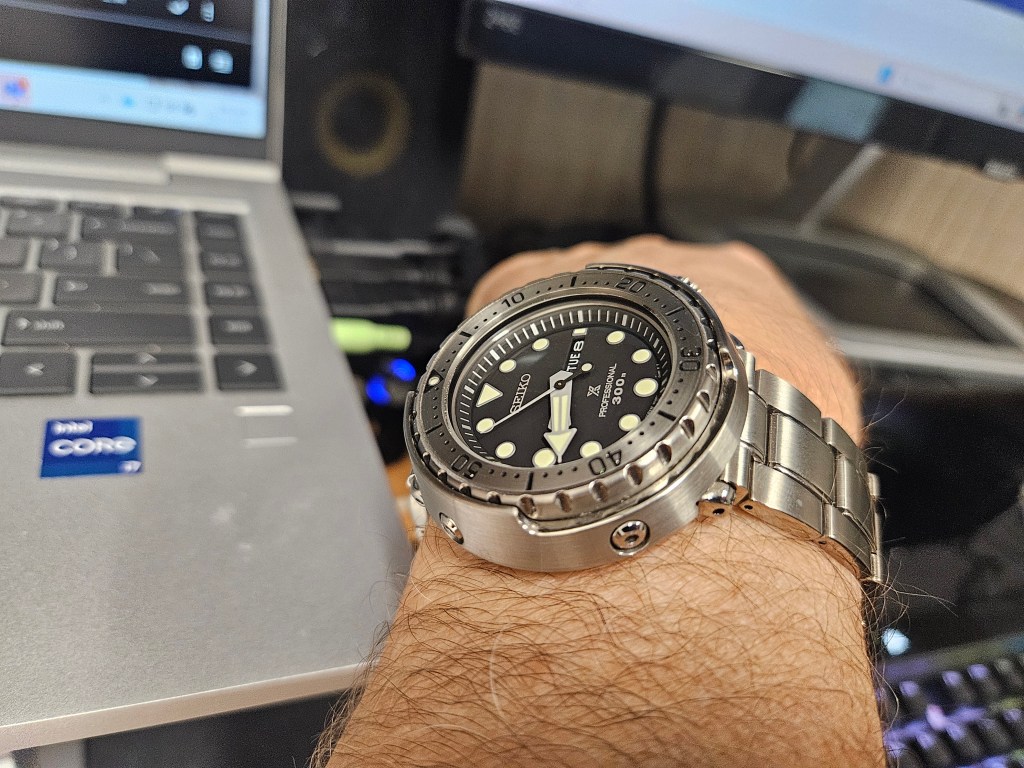
    There is a particular species of human for whom a new computer is not a tool — it’s a religious conversion. The desktop isn’t a workspace; it’s a cockpit for a future self, the glamorous avatar of the writer, artist, or content sorcerer they imagine they will become. People like this do not simply buy machines. They curate private shrines. A desk becomes an escape pod: LED lights humming like temple candles, two monitors glowing like stained-glass windows, and the mechanical keyboard serving as a holy relic. Once seated, the outside world ceases to exist — or so the fantasy goes — until an eBay tab opens and suddenly a $2,500 dive watch begs for attention, or a pair of ergonomic walking shoes on sale becomes a spiritual priority. Sacredness is delicate; it collapses at the first whiff of retail dopamine.

    I speak as one of these zealots. I live in a small home with a wife and two teenage daughters, so I protect the illusion of solitude with the devotion of a medieval monk. My desktop setup has become my monastery. For seven years, I have sat beside the same computer: a 15.6-inch Acer Predator Triton 500 with an RTX 2080, perched like a retired fighter pilot on a wooden pedestal. Beside it stands a 27-inch Asus Designo 4K monitor. My keyboard is an Asus Rog Strix Scope II fitted with “quiet snow” switches — though I still regret not choosing switches that click like a typewriter possessed by Bukowski.

    Here’s the problem: the machine refuses to die. It doesn’t slow down, wheeze, or show symptoms of electronic mortality. It handles everything I throw at it. This stubborn longevity has become an accusation. If I truly mattered — if I were a world-crushing content creator — surely I would need M4 silicon or a Windows Ultra 9. But here I am, a humble i7 and RTX 2080 carrying my entire life on its back like a mule. The message is humiliating: you produce so little that even an elderly predator laptop barely notices your existence. I am not a digital gladiator. I am an NPC.

    One half of me wants to honor the Acer’s absurd durability. I want to see how long it lasts: eight years? Ten? Will it run until I am eighty and my daughters sell it on Facebook Marketplace to a grad student writing her dissertation? The other half of me yearns for a new identity — a fresh cockpit. I fantasize about a Lenovo ThinkPad P16, a machine with the aesthetic of a NATO command center. In my imagination I would sit before it, efficient and unstoppable, a productivity samurai. Then I read about thermals, swollen batteries, and the corporate decay of ThinkPad build quality, and the fantasy curdles.

    Mini PCs tempt me, too — elegant little cubes promising freedom from laptop fan noise. But then I scroll deeper and learn about overheating, BIOS drama, firmware rituals, and mysterious Windows gremlins that exist only for people who try to “optimize.” This is when I confront the truth: Windows PCs are for people fluent in Linux, the jiu-jitsu masters of tech. These individuals have tattoos of penguins on their forearms and spend weekends customizing drivers the way normal people mow their lawns. They don’t “use computers.” They tame them.

    I am not that creature. I am a man who gets nervous updating his router. This leaves me with one path: the Mac Mini. Not because I am enlightened, but because the walls of Apple’s walled garden keep me from accidentally burning the place down. Windows is a vast golf course stretching to the horizon. MacOS is miniature golf: enclosed, guarded, brightly colored obstacles that keep your ball out of the swamp. I must accept who I am — a timid, high-functioning idiot — and pick the putter.

    And yet, when people complain about laptops dying after three years, I can raise a hand and say: “Seven years. RTX 2080. Still alive.” It is not greatness, but it is a kind of glory.

  • The Monster in the Ravine and the Moon Over the Suburbs

    The Monster in the Ravine and the Moon Over the Suburbs

    Last night I dreamed I was wandering through a house I didn’t recognize. The world outside was pitch black. A small family dog pressed its nose to the sliding glass door and barked toward the backyard, desperate to escape. I opened the door and watched the little creature trot behind the bushes to relieve itself. That’s when a monster rose out of the ravine—some hulking mastiff with the skull of a bull, as if a guard dog from the underworld had crawled up to inspect the living. It ignored the pet and fixed its gaze on me. Without hesitation, it entered the house and began to contort into different shapes of malice. At first, I trembled. Then anger boiled in me like a furnace. This thing wasn’t just ugly; it was the source of suffering and rot in the world. I begged God to purify me so I could destroy it, but heaven stayed silent. What I received instead was a strange consolation: a feeling that at least my rage was righteous, and that I still knew where my moral compass pointed.

    Eventually the creature disappeared and daylight arrived. I made a long trek back toward what I understood to be “home.” Across the street, my neighbors were ecstatic, pointing skyward. Hovering above their house was a massive white dome—like a camper shell the size of a Costco, a fallen moon with decorative crenellations. Soon crowds formed. It was a city attraction, a spectacle engineered to “bring excitement.” Snowflakes—artificial, slow-motion confetti—drifted through the air. People gasped, laughed, and posed for photos, thrilled by the distraction.

    The beast was gone, but the problem of evil remained unsolved. In its place, my city embraced pageantry, gimmicks, and civic cheerleading. I touched my aching left shoulder, the one crippled by a three-month rotator cuff tear, and wondered what I would become—a broken man, a burden, a questionable member of society. Fake snow drifted onto the jubilant crowd, and their rosy smiles suggested that change, or at least the illusion of it, was already underway.

  • Heroes and Living Dead: What Douglass and Chekhov’s Nikolai Teach Us About the Meaning of a Good Life

    Heroes and Living Dead: What Douglass and Chekhov’s Nikolai Teach Us About the Meaning of a Good Life

    College Essay Prompt

    We often assume that the pursuit of freedom and happiness is a universal human impulse, shared across eras, cultures, and personal histories. Yet the paths individuals take toward those goals can be radically different, and those differences reveal whether one’s concept of happiness liberates or destroys. Few figures illustrate this divide more clearly than Frederick Douglass and Nikolai Ivanovitch from Anton Chekhov’s short story “Gooseberries.” Douglass’s character and trajectory embody a moral code that turns hardship into purpose: through literacy, community, courage, and a refusal to internalize oppression, he transforms enslavement into a platform for human dignity—not only for himself, but for others. By contrast, Nikolai pursues a narrow, adolescent fantasy of happiness, one built not on self-growth or empathy but on domination, comfort, and the myth of personal entitlement. His life becomes a grotesque parody of fulfillment—an existence of empty pleasures, self-deception, parasitic dependence, and spiritual decay beneath the veneer of material abundance.

    In a 1,700-word essay, analyze how Douglass’s journey to freedom stands as a model of healthy, ethical happiness while Nikolai’s descent exposes a warped, toxic version of happiness rooted in narcissism and self-indulgence. Your essay should do the following:

    1. Compare the moral foundations of Douglass and Nikolai’s pursuits.
      Explain how Douglass’s “Bushido-like” moral code—discipline, responsibility, representation, courage, and community—shapes his identity and empowers those around him. Contrast this with Nikolai’s rejection of accountability, his obsession with land ownership, and his willingness to deplete others—emotionally, financially, and spiritually—to maintain his fantasy of contentment. Discuss how each man’s vision of freedom manifests in their treatment of other people.
    2. Analyze the role of community vs. isolation in each character’s development.
      Douglass’s path is paradoxically individual and communal: he cultivates internal strength, but he locates freedom in solidarity—those who teach him to read, abolitionists who elevate his voice, and the enslaved people whose suffering he speaks for. Meanwhile, Nikolai constructs a private empire that excludes others, even the brother who once supported him. Consider how their relationships either amplify or erode their humanity.
    3. Examine the symbolic images of transformation and degradation.
      Use key passages from Douglass’s Narrative to show how literacy, speech, political action, and public representation transform him from an enslaved boy into a moral and political leader. Then show how Nikolai’s physical and spiritual decay—his swollen body, the petty rituals of comfort, the stagnant gooseberries—reflect the collapse of his inner self. Avoid plot summary; instead interrogate how each author uses these symbols to define what “freedom” looks like in practice.
    4. Discuss how each figure embodies or violates a healthy definition of happiness.
      What does Douglass’s version of happiness require? Effort, growth, sacrifice, connection, and the willingness to uplift others even when it hurts. What does Nikolai’s version require? Exploitation, avoidance of reality, refusal to change, and the delusion that comfort equals fulfillment. Describe how a life built on purpose creates meaning, while a life built on selfish gratification becomes spiritually unlivable.
    5. Address at least one counterargument.
      Consider why Nikolai might be appealing to some readers. Isn’t his dream of having a small estate, comfort, and peace understandable? Why might some view Douglass’s path as impossibly heroic—too demanding, too painful, or too noble for the average person? Engage with these viewpoints seriously, and rebut them using evidence from the texts.
    6. End with a conclusion that points to broader implications.
      Connect your contrast to the world we live in now. What do Douglass and Nikolai teach us about modern definitions of success, happiness, and the “good life”? Can happiness exist without social responsibility? Does personal freedom become toxic when it is purchased at the expense of others? Ask yourself what moral code has the power to sustain a person—and why some forms of comfort inevitably rot the soul.

    Your essay should not merely compare two characters; it should interrogate the meaning behind their choices. You are ultimately making an argument about what counts as real freedom and real happiness. Your goal is to show that the paths we choose do not simply determine the lives we build—they determine the kind of people we become.