Blog

  • The Night the Mechanical Diver Stayed Home

    The Night the Mechanical Diver Stayed Home

    Last night I escorted my family and in-laws to a breezy bistro in Redondo Beach, the kind of place where the ocean air does half the marketing. We sat on the patio while a two-man cover band—guitar and bass, faces cured by sun and time—worked their way through the canon: Gordon Lightfoot, Jim Croce, James Taylor. Their voices had the texture of driftwood. The songs arrived like postcards from a quieter century.

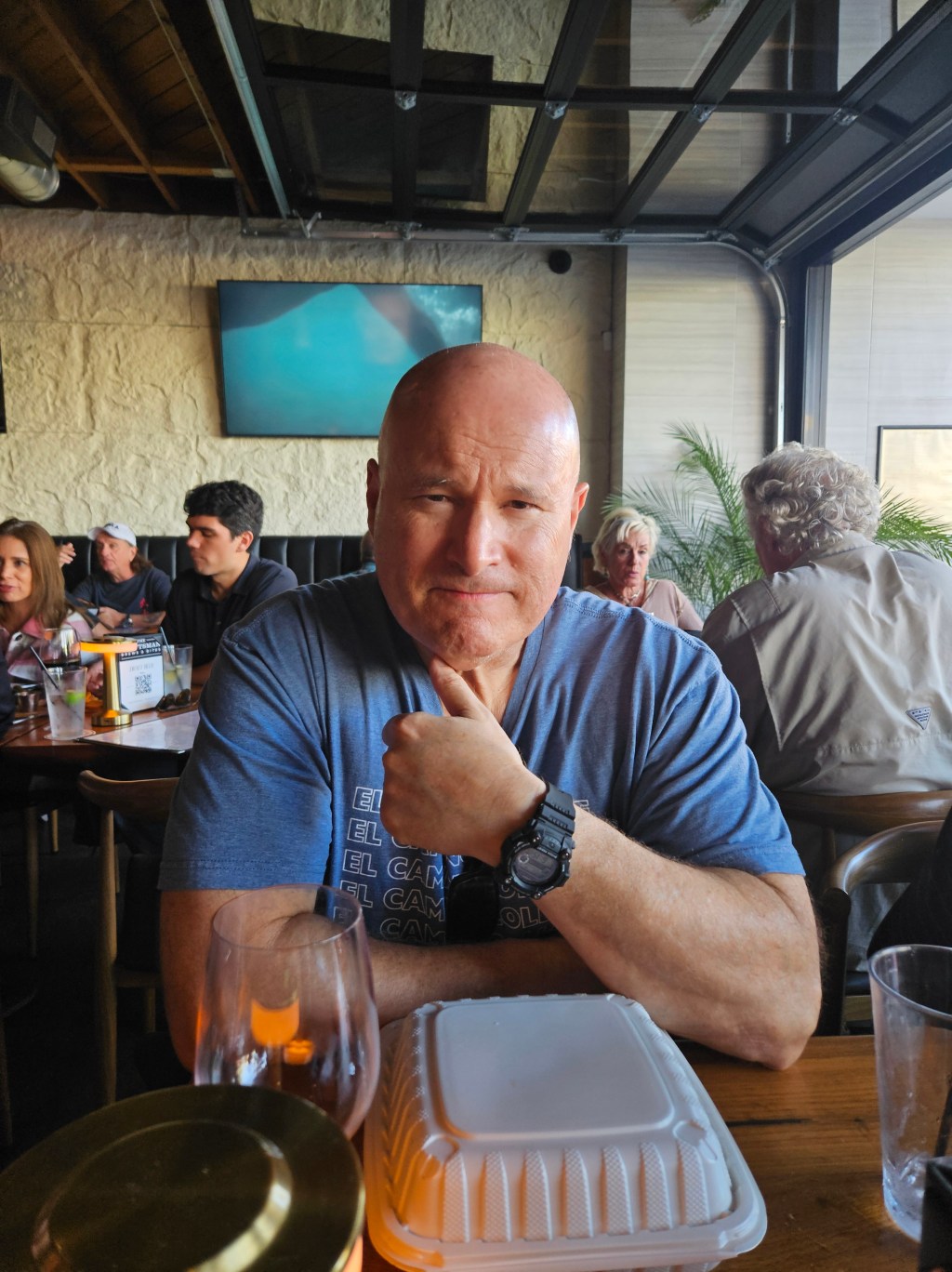
    For twenty years, a restaurant meant ceremony. I would strap on an expensive mechanical diver—the horological equivalent of cufflinks—and let it glint under low lighting as if I were auditioning for a role called “Man of Taste.” Five weeks ago, that instinct died without a funeral. In its place: a $110 Casio G-Shock GW-7900. No romance, no pretense, just a blunt instrument that tells time with the indifference of a wall clock. I wore it and felt, not diminished, but strangely settled. Our server had on a Casio Pro Trek. We exchanged a nod—the quiet recognition of two men who had defected from the same aesthetic regime.

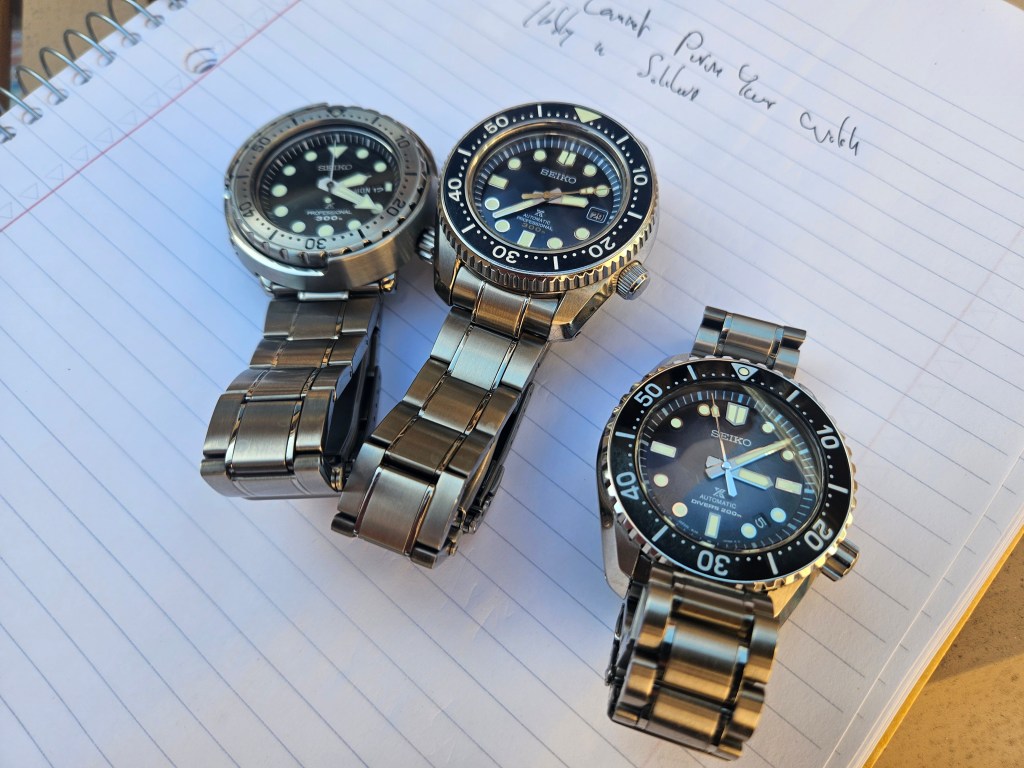
    Two weeks ago, I sold off a pair of mechanical divers. The absence registered as silence, not loss. Five weeks ago, I bought my first Tough Solar, Multiband-6 G-Shock—a Casio G-Shock Frogman GWF-1000. It feels like I’ve owned it for a decade. Time has warped, stretched, lost its usual proportions. My working theory is this: when an obsession mutates—when it takes a hard, unexpected turn—the brain lingers over the wreckage and the new terrain at once. Every moment gets over-processed, as if your mind is trying to reconcile two incompatible identities. The result is temporal inflation. Five weeks feel like ten years. Meanwhile, the watches I once coveted sit in their box like artifacts from a civilization I can’t quite remember belonging to.

    I’ve made a few videos documenting this conversion. To my mild alarm, a handful of people have followed suit—buying the GW-7900, aiming their watches toward the Fort Collins signal tower like amateur astronomers chasing a frequency instead of a star. It’s absurd, and yet there it is: evidence that I may have drifted, however briefly, into the low orbit of influence. Not authority. Not expertise. Influence—the most accidental and least deserved of modern currencies.

    The question now hovers: is this a phase or a verdict? Will some future mood—call it nostalgia, call it vanity—dust me with longing and send me back to my mechanical divers? Or have I crossed a line I can’t uncross, sealed inside a G-Shock logic that values precision over poetry? I don’t know. The future, like the tide, refuses to take requests.

    What I do know is this: today I’ll need to punish myself with extra work in the garage gym. Last night I demolished a crispy chicken sandwich on brioche while listening to “If You Could Read My Mind,” and the song’s quiet sorrow did nothing to slow me down. If anything, it provided a soundtrack for excess—the softest possible music for a thoroughly unrestrained appetite.

  • Santa by Accident, Employee by Design

    Santa by Accident, Employee by Design

    Last night I dreamed that some friends and I staged an ad hoc production so slick it deserved syndication. I was invited to a holiday party—one of those corporate affairs where irony does the heavy lifting—and, on a whim, I put on the Santa suit for a toy company that merchandised its own cartoon characters. It was meant to be a joke–something to be forgotten along with the eggnog.

    Instead, someone filmed it.

    The footage went viral. What began as a throwaway bit turned into an annual television event with ratings that could humble prime time. Every December, there I was—jovial, booming, absurd—beamed into living rooms as if I had been engineered for it. Checks arrived with the regularity of a season: generous, unearned, almost accusatory. 

    To capitalize on the accident, the company staged yearly reunions—cast gatherings dressed up as nostalgia, broadcast to a nation that now insisted we mattered. More ratings. More money. More of me, whether I intended it or not.

    At first, I drifted into these reunions like a tourist in my own life—late, amused, faintly embarrassed. Then the terms clarified. I wasn’t a guest. I was talent. I wasn’t attending; I was reporting for duty. Somewhere in the fine print of success, I had become an employee of an entity I never remembered joining. The arrangement produced a tidy moral shrug: the checks fed my family, so what right did I have to object? Freedom had quietly converted itself into obligation, and the conversion rate was excellent.

    There was, however, a fracture line running through the whole enterprise. By sheer accident, I had chosen Santa—the apex role, the gravitational center. My friends had chosen elves: diligent, decorative, forgettable. Hierarchy, once introduced, does its work without permission. One friend stopped speaking to me altogether. When he finally did, it was not to reconcile but to issue a verdict. I was too thick to see what had happened to him, he said. Years of playing the lesser figure had hollowed him out. The easy talker was gone; in his place stood a sullen, rationed version of a man. We were no longer friends. I was no longer welcome to pretend otherwise.

    Others were kinder, even grateful. They insisted my Santa had ignited the whole spectacle—that without it, there would have been no show, no checks, no ritual of reunion. They thanked me as if I had designed the machine rather than stumbled into its engine.

    But gratitude doesn’t cancel damage; it merely coexists with it. The money was real. The applause was real. So was the loss. Watching a friend calcify into bitterness has a way of stripping glamour down to its wiring. Fame, even the accidental kind, doesn’t just elevate. It arranges people. It assigns altitude. And someone, inevitably, is left breathing thinner air.

  • The Price of Your Work Exit

    The Price of Your Work Exit

    Retirement was supposed to feel like a gentle descent. Instead, it arrives with an invoice. For years, your college played the role of benevolent patron: five hundred dollars a month to insure a family of four at Kaiser Permanente, with a co-pay so small it felt almost ceremonial. Now the curtain lifts. Your wife’s middle school, thrifty to the point of cruelty, hands you the real number—nearly triple. At the same time, your paycheck shrinks to about eighty-five percent of its former self. The vise tightens from both ends: less coming in, far more going out. Retirement, it turns out, is not an exit but a recalibration of anxiety.

    On a Saturday morning, under the fluorescent calm of Trader Joe’s, you confess this arithmetic of dread to the cashier who has watched you age in weekly installments for two decades. He listens, nods, and then offers a solution with the confidence of a man suggesting a new brand of hummus: get a part-time job here. Be a cashier. Let the paycheck subsidize your health insurance. You have the build, the stamina, the conversational ease. In his telling, the transition is almost heroic—a late-life pivot, sleeves rolled, dignity intact.

    But you can already see the other version. You, sixty-five, standing in a Hawaiian shirt that once signaled leisure and now reads as camouflage, being told in a quarterly review that your tone lacks “warmth.” That you cleared the line too efficiently, failed to linger, failed to affirm. That your sarcasm—once a badge of intellect—needs to be diluted into something safer, sweeter, more compliant. You imagine the language of correction: more honey, less acid. You imagine nodding while someone half your age explains emotional calibration. The phrase writes itself in your head: a Late-Life Vocational Humility Crisis—the moment when accumulated status collides with the small, bright humiliations of starting over at the bottom, where friendliness is a metric and personality is a deliverable.

    You float the idea at home. Your wife laughs—not cruelly, but decisively. The verdict is clear: you are not built for this theater. The fantasy collapses on contact with reality. It was never a plan, only a flattering daydream in which you played the rugged provider, stacking pinto beans beside water-packed albacore, funding your family’s security with cheerful competence.

    So you stand in front of the mirror and deliver the final ruling: Trader Joe’s is a no-go. The new discipline will be quieter, less cinematic. No convertibles. No Swiss watch indulgences. No Cabo timeshare fantasies dressed up as investments. Just a narrower life, lived within its means, spared the indignity of proving—too late—that you can still take orders and smile about it.

  • The Man Who Refused to Retire and Learned to Fly at Costco

    The Man Who Refused to Retire and Learned to Fly at Costco

    You will be sixty-five in less than a year—fifteen months from your last day of work—and you would be wise to bury the word “retirement” before it buries you. It is a feeble, anemic term, a linguistic sedative that disguises the collapse of identity as leisure. Nothing about what lies ahead deserves that kind of small thinking.

    What you are approaching requires a name with altitude, velocity, and a touch of myth.

    You are entering the Sovereign Phase.

    In the Sovereign Phase, you do not keep a schedule—you issue one. You do not await approval—you render decisions. This is not an ending ceremonially dressed in khakis and early dinners; it is a coronation. You are not stepping away. You are stepping above.

    Your final act has begun, and it demands a certain boldness. The first order of business is symbolic but essential: you will upgrade your Costco membership to Executive. No committees. No approvals. No memos. You will simply decide—and it will be done.

    And then, one morning, before the doors officially open to the masses, you will enter.

    The aisles are empty. The pallets stand fresh and untouched. The air itself feels newly issued. You move through this cathedral of abundance with first access, first choice, first claim. Something happens to you here—something disproportionate to the act itself. A quiet but unmistakable inflation of the self. A sense that you have not merely arrived early, but ascended.

    You feel it in your chest first, then in your stride. The strange conviction that you are no longer bound by ordinary constraints. That you have, somehow, earned this.

    You have entered Executive Aisle Rapture.

    It is a near-mystical condition in which logistical privilege is mistaken for existential elevation, where empty aisles and shrink-wrapped towers of goods produce a sensation that borders on the divine. You begin to suspect that wings—actual wings—may be forming beneath your shirt, preparing you for a short, ill-advised flight toward the sun.

    This is not a side effect of the Sovereign Phase. It is a requirement.

    So when your last day of work arrives, do not mark it with melancholy or relief. Mark it with a transaction. Upgrade the membership. Secure your access. Step into the early light of the warehouse.

    And when the doors part and the aisles open before you, walk forward without hesitation.

    You are no longer a worker.

    You are sovereign.

  • RAMageddon and the Art of Not Buying Another Laptop

    RAMageddon and the Art of Not Buying Another Laptop

    At home, my technology situation is already bordering on the absurd. I own a three-month-old Mac Mini with 32 gigs of RAM—a machine so overqualified for my needs it might file a grievance with HR. I also have a one-year-old Acer Chromebook 516 GE with 8 gigs of RAM and a generous 16-inch display. Around the house lurk a few older laptops assigned to my daughters, though “assigned” is generous. They sit abandoned behind desks like forgotten relics while the real action unfolds on their phones.

    And yet, I find myself eyeing two more 14-inch laptops: the Asus Zenbook Ultra 9 and the Lenovo Chromebook Plus 14.

    Need has nothing to do with it.

    But if I were desperate for a rationalization, I could cite Hana Kiros’ recent Atlantic essay, “If You Need a Laptop, Buy It Now,” which reads less like consumer advice and more like a dispatch from a looming tech famine. According to the piece, RAM demand has gotten so out of hand that “RAM harvesters” are allegedly stripping memory from display units at Costco—a detail so dystopian it sounds like a deleted scene from Mad Max: Silicon Valley. Prices tell the same story: a 64GB stick of RAM that cost $250 in September now flirts with four figures.

    The culprit, of course, is the AI gold rush. As Amazon, Alphabet, Meta, Microsoft, and Oracle collectively torch half a trillion dollars chasing artificial intelligence, a staggering portion of that budget is devoured by memory. The result is a shortage so acute that gamers—never known for understatement—have dubbed it “RAMageddon.”

    The downstream effect is predictable: laptops, phones, anything with memory will creep upward in price. Kiros calls it the “AI tax,” which sounds polite until you realize you’re the one paying it.

    Right now, temptation is priced with surgical precision. The Asus Zenbook 12 OLED Ultra 9—32GB RAM, 1TB SSD—sits at $1,399, practically daring me to mistake desire for foresight. The Lenovo Chromebook Plus 14, with its surprisingly stout 8GB of RAM, hovers at $659, whispering sweet nothings about practicality.

    I could buy one. I could buy both.

    But panic buying has a smell, and I recognize it. It smells like 2020, like empty shelves and people hoarding toilet paper as if civilization were one flush away from collapse. I’ve lived through that particular madness once. I don’t need a sequel starring RAM.

    So I’ll hold the line. The Mac Mini will continue to perform its quiet heroics. The Acer Chromebook will do its job without complaint. And I will resist the urge to confuse market anxiety with personal necessity—at least until the next wave of technological hysteria rolls in.

  • The Psychological Mess of Wanting Things We Neither Need Nor Intend to Use

    The Psychological Mess of Wanting Things We Neither Need Nor Intend to Use

    One of the strangest features of materialism is the spectacular mismatch between what we imagine an object will do for us and what it actually does. In the mind, the object arrives polished, transcendent—an emblem of taste, discipline, even identity. In reality, it often sits there, unnecessary and faintly ridiculous, like a prop waiting for a performance that never begins. 

    I own an eight-year-old Accord with fewer than 30,000 miles on it—a statistic that quietly announces I neither drive much nor particularly enjoy driving. And yet I can picture, with embarrassing clarity, a brand-new Accord or Camry resting in my garage, gleaming like a sacred artifact I would prefer not to disturb by actually using it.

    Watches operate under the same spell. I can easily imagine owning a Tudor Black Bay or a Tudor Pelagos, each one promising a kind of quiet authority on the wrist. But my habits betray me. I’m not roaming public spaces, not projecting presence, not leveraging this object as a social signal. The watch would sit, admired in theory, unused in practice. I know dozens—no, hundreds—of watch enthusiasts who live in this same contradiction, accumulating pieces they rarely wear because the idea of ownership is more intoxicating than the act of use.

    This gap between having and being is hardly new. I was reminded of it while thinking about Erich Fromm and his book To Have or To Be?, which argues that materialism quietly erodes the possibility of a meaningful life grounded in connection and experience. The argument is persuasive—almost obvious once stated. And yet, knowing this changes very little.

    That’s the part that unsettles me. You can understand the critique, agree with it, even teach it, and still find yourself browsing for the next unnecessary object with the focus of a predator. Clarity does not neutralize desire. It merely observes it, like a detached narrator watching the same old plot unfold. There’s something almost comical about it—this split between the thinking self and the acquisitive impulse. If you wanted to document the absurdity of human behavior, you could dedicate an entire season of Dirty Jobs to it: not the grime of physical labor, but the psychological mess of wanting things we neither need nor intend to use.

  • From Lecture Hall to Checkout Line: A Better Second Act

    From Lecture Hall to Checkout Line: A Better Second Act

    Over the past several years, I’ve watched a pattern unfold. A colleague retires, disappears for a while, and then—two years later—reappears in the writing center as a volunteer. On paper, it looks noble. In person, it looks something else.

    They don’t return with ease or quiet confidence. They return looking unsettled—eyes fixed forward, posture stiff, like deer caught in headlights that never turn off. I’ve seen them alone on the writing lounge couch, staring straight ahead, as if waiting for something that never quite arrives. The impression is hard to shake: retirement didn’t liberate them; it hollowed something out. And so they came back to the place where their sense of worth once had structure and witnesses.

    Students, however, are not sentimental. They don’t greet these returnees as beloved elders. They approach them the way one approaches a last option—politely, cautiously, and only when necessary. The exchange feels inverted. Instead of giving value, the retiree seems to be extracting it: a little affirmation, a little proof of continued relevance, a small ration of being needed.

    The idea of volunteering after retirement sounds admirable in theory. In practice, it reminds me of Lot’s wife—turning back, unable to release the past, even when the mandate is to move forward.

    And I say all this with some unease, because I’m about fifteen months away from retirement myself. My job has kept my mind engaged for decades—lectures, lesson plans, essays, the constant friction of thinking. I can’t pretend I’m immune to the same forces that seem to have pulled my colleagues back: the slow creep of isolation, the loss of structure, the quiet erosion of purpose. Sloth and complacency don’t arrive dramatically; they seep in.

    Still, I’m fairly certain of one thing: I won’t be returning as a volunteer tutor. I see too much of Lot’s wife in that gesture and not enough of a forward-facing project that justifies it.

    There’s also the matter of audience. Students gravitate toward youth. My own teen daughters regard “Boomers” like me with a mix of mild embarrassment and occasional alarm, as if we are well-meaning but out of date. I’m not eager to test that perception in a room where attention is already scarce.

    If pride is a vice, it’s at least an honest one here. My read on younger students, combined with my own instincts, tells me that the writing center would not be my best second act.

    There may be other roles. I’ve entertained, half-seriously, the idea of working part-time at my local Trader Joe’s. I know the staff. I could use the income for health insurance. And I have a skill set that would actually translate: I can talk to people, keep a line moving, and bag groceries without turning it into a philosophical crisis. There’s dignity in that—perhaps more than in hovering around a former life, waiting to be needed.

    One thing I do know: wherever I land, I don’t intend to sit there staring into the middle distance, hoping someone will give me back a version of myself I’ve already lived.

  • Cherry-Picking Does Not Make a Persuasive Book

    Cherry-Picking Does Not Make a Persuasive Book

    Kathryn Paige Harden left the evangelical church of her childhood and is now a behavioral geneticist at the University of Texas at Austin. She is also the author of the insightful, compelling Original Sin: On the Genetics of Vice, the Problem of Blame, and the Future of Forgiveness. After enjoying her long conversation with Andrew Sullivan, I picked up her book on Audible.

    In it, Harden distinguishes between two kinds of sin. Sin with a small “s” refers to individual acts that violate one’s moral code. Sin with a capital “S,” however, describes our enduring tendency to make a mess of things over time—what might be called the arc of human fallibility. To clarify this idea, she quotes Francis Spufford from his book Unapologetic: Why, Despite Everything, Christianity Can Still Make Surprising Emotional Sense, where he famously defines sin as the “Human Propensity to Fuck Things Up,” or HPtFTU.

    I was surprised that Harden, an ex-evangelical, would draw on a self-described Christian apologist, so I decided to read Spufford’s book myself. It quickly became clear that he is an exceptional writer with sharp insights into the Christian faith. He captures what he sees as the core message of Jesus: that one must give of oneself freely and without limit, loving and serving others with a pure heart. Intention, in his view, is everything.

    Still, something triggered my skepticism. Spufford repeatedly claims that Judaism and Islam, unlike Christianity, emphasize rule-following over inner intention. He uses the term orthopraxy—right action—as opposed to orthodoxy, or right belief. But this struck me as a reductive and biased claim, especially given the abundance of Jewish and Islamic teachings that stress sincerity, purity of heart, and the dangers of hypocrisy. The more he pressed this point, the harder it became to see him as merely insightful; he began to seem like a brilliant writer with a credibility problem.

    That problem deepened as I read on. Spufford appears willing to sidestep or reinterpret scripture when it conflicts with his more liberal views, particularly on issues like gay marriage and eternal damnation. There is a certain irony here. He praises Christianity for its emphasis on inner transformation and intention, yet he cherry-picks the Bible and reshapes Jesus to align with his own sensibilities. That project—recasting a religious tradition in one’s own image—strikes me as a task that calls for more self-scrutiny, especially before critiquing other religions for lacking moral depth.

    I say this as an agnostic. I’m not troubled by Spufford’s liberal commitments. In fact, I wish the Augustinian notion of eternal damnation were not true. But Spufford seems to want both the moral authority of traditional Christianity and the freedom to revise it at will. He presents the demanding ethical vision of Jesus—love without limits—while setting aside inconvenient passages that might complicate that vision.

    Harden, for her part, had the clarity and courage to leave the faith of her upbringing. Spufford also left his childhood religion, but his return to it—on his own carefully edited terms—would benefit from a bit more humility.

  • The Tape Tyrant of Postmaster Plus

    The Tape Tyrant of Postmaster Plus

    I went to Postmaster Plus this morning to ship a defective camera back to Kodak—a routine errand, the kind you knock out between coffee and whatever comes next. I’ve been going there for years. The place is run by a family from Bombay, and over the last decade they’ve shipped more of my watches than I care to admit. It’s a familiar, efficient operation. Or at least, it usually is.

    When I walked in, the rhythm was off.

    At the counter stood a couple in their mid-sixties, locked in some elaborate transaction with M, the family patriarch, a man in his seventies who has the calm of someone who has seen everything and survived it. Behind the couple stood a woman clutching a stack of flattened cardboard, her face arranged in a quiet expression of despair. She looked at me as if to say, You’re seeing this too, right?

    I was.

    The woman at the counter—a redhead with severe bifocals and a face that seemed permanently braced against disappointment—had taken possession of M’s tape roller and was using it with the zeal of someone preparing artifacts for burial. Her husband hovered nearby, a classic Palm Springs Q-Tip: white hair under a baseball cap, mouth slightly open, limbs thin as dowels, torso betraying a fondness for buffets. He contributed nothing except presence.

    “I’ve seen these packages break before,” the redhead announced, as she wrapped the parcels in what could only be described as a second skin of tape. Not a practical layer—no, this was ceremonial. A kind of adhesive exorcism. When the tape ran out, she didn’t pause, didn’t apologize. She demanded another roll with the urgency of a field commander low on ammunition.

    The woman behind them caught my eye again. This time the look was unmistakable: We are both trapped here. I returned the glance with equal solemnity. Yes, we were sharing this moment. No, there was no escape.

    Then came the breaking point. The cardboard woman asked M when his son W would return from break.

    “Twenty minutes or so,” M replied.

    She nodded, made a decision, and fled. A wise woman. She chose freedom.

    I stayed.

    The redhead, now fully committed to her role as High Priestess of Packaging Integrity, began lecturing the room about the fragility of parcels and the absolute necessity of excessive tape. She spoke as if we were all negligent amateurs, one poorly wrapped box away from societal collapse.

    I opted out.

    I pulled out my phone, photographed my Casio G-Shock GW-7900, and posted it to Instagram. If I was going to be held hostage, I might as well document something worthwhile.

    Eventually—mercifully—the couple completed their transaction. Eighty dollars later, their packages were no longer parcels but laminated relics, ready to withstand not just shipping, but geological time. I stepped forward, paid for my own shipment, and shared a brief, knowing laugh with M about the spectacle we had just endured.

    We thought it was over.

    It wasn’t.

    The door opened. The couple returned.

    The redhead, unsatisfied with her previous efforts, declared that a third layer of tape was necessary for her “peace of mind.” At this point, the packages were less shipments and more mummies awaiting a sarcophagus.

    I gave M a look—the kind of look that conveys sympathy, disbelief, and resignation all at once. He nodded, the stoic veteran of countless such encounters.

    I left.

    As I walked out, I knew two things. First, those packages would survive anything short of a volcanic eruption. Second, I had just acquired a story—one that would be waiting patiently for me to tell my wife the moment I got home.

  • Escape from Seikotraz: Starring Jeff McMahon

    Escape from Seikotraz: Starring Jeff McMahon

    This morning I woke up with a small, undeserved victory. My second shingles shot had not flattened me into a feverish heap of aches and regret. No vaccine hangover. No sack-of-muscle soreness. Just a functioning body and a clear head. I glanced down at my Casio G-Shock GW-7900 before swinging my legs out of bed, and as I reached for the coffee ritual, a thought crept in—quiet at first, then strangely intoxicating:

    What if I owned only G-Shocks?

    What if I were free of my Seiko divers?

    Free from what, exactly? That part remains stubbornly undefined.

    Three years ago, the fracture began. I developed an aversion to bracelets—not a mild preference, but a full-blown irritation, as if every metal link were conspiring against my wrist. I moved my Seiko divers onto straps, experimenting like a man searching for ergonomic salvation, until I discovered Divecore FKM. Suddenly, everything clicked. The watches felt right—balanced, secure, almost inevitable. For a brief moment, I thought I had solved the problem.

    Then came the contamination.

    August 2025. A message. A study. PFAS—“forever chemicals”—lurking in FKM. The phrase alone sounded like a villain in a low-budget sci-fi film. Dutifully, almost piously, I removed the straps. The watches went back onto inferior substitutes, and with that small act, something essential drained out of them. They were no longer “just right.” They were tolerable.

    Divecore, to their credit, pivoted—hydrogenated rubber, safer materials, a new Waffle strap on the way. I’m waiting for it now, like a man waiting for a repaired marriage.

    But in that interim, I did something careless. Or revealing.

    On a lark, I bought a Casio G-Shock Frogman GWF-1000.

    And I didn’t just like it. I fell for it immediately.

    Its design wasn’t elegant—it was aggressively industrial, almost defiant. Its timekeeping wasn’t approximate—it was absolute. Atomic. Unquestionable. It didn’t ask for attention; it delivered certainty. One watch became three. The Rescue. The incoming Casio G-Shock GW-9500 Mudman. A quiet shift became a migration.

    This morning, still basking in my vaccine survival, I entertained a more radical thought: eliminate the Seikos entirely. Replace them with two final pieces—the sapphire Frogman D1000 and the GW-5000U Square, my so-called “dress watch,” a term that feels almost satirical in this context.

    At what point does a preference become a slide?

    Was it the PFAS scare that loosened the foundation? Or something deeper? Do the Seiko divers now carry the residue of an older obsession—one tied to acquisition, to the promise that the next watch would finally complete the picture? And if so, what exactly is this new G-Shock phase? Liberation? Or simply addiction in a more utilitarian costume?

    There are a few things I can say with certainty. I prefer atomic time to mechanical approximation. I prefer digital clarity to analog interpretation. Yes, the digital display demands a slight tilt of the wrist, a negotiation with the light, but I’ve made peace with that. It’s a small concession in exchange for precision.

    Maybe there is no grand psychological drama here. Maybe I’ve grown lazy in the most practical sense. I like convenience. I like certainty. I like not having to set the time like a monk tending to a ceremonial clock. Perhaps this is not a crisis of identity but a simple shift toward ease.

    But then I hear from others.

    Men who made this transition years ago. Men who, after watching my videos, bought a G-Shock out of curiosity and quietly abandoned their mechanical collections. No fanfare. No farewell. Just a gradual, almost polite disappearance.

    It suggests something larger. A quiet exodus.

    You could make a documentary about it: aging watch obsessives laying down their expensive mechanical relics and walking into the sunset wearing Squares and Mudmans, relieved, unburdened, and slightly confused about how it happened.

    Meanwhile, my own collection sits in a kind of purgatory. The Seiko divers wait, their fate undecided. Two have already been sold—the Captain Willard Ice Diver and the 62MAS—and their absence has not registered as loss. That’s the unsettling part. Watches that once felt essential have vanished without leaving a dent.

    And here I was, thinking of myself as a careful curator, a man assembling a coherent, meaningful collection.

    The truth is less flattering.

    My hobby is governed not by principle, but by impulse. By shifting preferences, passing anxieties, and the occasional well-timed scare about “forever chemicals.” I would prefer to believe in a deeper logic, a narrative of refinement and evolution.

    But honesty requires a different conclusion.

    I am not curating.

    I am drifting.

    I look into the mirror. “Oh my God,” I scream. “I am a capricious watch collector.”

    Meanwhile, my YouTube subscribers are making cogent remarks in the comment section. A gentleman who goes by the name of MDchaz recently wrote: “Coming to a theater near you “Escape from Seikotraz” starring Jeff McMahon.” I wrote back, “I’ll have to steal your idea for my next YouTube video.”

    And this blog post.