Blog

  • Weight Loss as Blood Sport: The Dark Legacy of a TV Hit

    Weight Loss as Blood Sport: The Dark Legacy of a TV Hit

    I just finished Netflix’s docuseries Fit for TV: The Reality of The Biggest Loser, and let’s be clear: what passed for “inspiration” was little more than a gulag in spandex. Vulnerable, overweight contestants were paraded into a sadistic bootcamp where caffeine pills stood in for nutrition, starvation was the weight-loss plan, and bleeding urine was treated as a milestone. Their bodies were ground down in training regimens that no orthopedic surgeon in their right mind would sanction.

    The cruelty wasn’t a side effect; it was the business model. NBC made hundreds of millions while America shoveled popcorn, mesmerized by the weekly spectacle of people being berated, broken, and publicly humiliated—all in the name of dropping a few pounds on a scale. It wasn’t education. It wasn’t health. It was Schadenfreude masquerading as wellness, a moral strip show where the only thing thinner than the contestants was the producers’ conscience.

    Of course, the spin was that the show “raised awareness” about obesity. The reality? Obesity rates ballooned from 25% to 45% since its debut. The real awareness raised was that Americans harbor a deep hostility toward fat bodies and an insatiable appetite for televised cruelty. We got our fix of humiliation, and then went straight back to our drive-thru dinners.

    Two decades later, the docuseries hands the microphone back to the scarred veterans of that circus. Some regained the weight. Others shed it with Ozempic and other GLP-1s. What unites them isn’t their waistline but their clarity: they now see the show as the exploitation racket it always was. Listening to their hard-won wisdom—painful, sardonic, and damning—was the main reason the docuseries was worth watching.

  • Rising Above the Wreckage: Finding Meaning in the Broken Phase

    Rising Above the Wreckage: Finding Meaning in the Broken Phase

    For the last several years, I have been haunted by the lines of Yeats’s poem The Second Coming: the center will not hold; anarchy is loosed upon the world.” A.I., deepfakes, the social media fever swamp, and deranged populists seem to have splattered into a chaotic universe. It’s tempting to surrender to nihilism, declare it all over, and use that declaration as an excuse to live with reckless disregard—eat chocolate cake three times a day and go completely to pot.

    But I know that impulse is folly. Viktor Frankl is right: we don’t get to choose the meaning of our lives. Life presents challenges within our particular circumstances that force us to rise up, stand to attention, and embrace the meaning laid before us. To live this way is to live in kairos—meaningful time.

    So what does it mean to rise above? What are the circumstances we now inhabit? These questions animate Alana Newhouse’s essay Everything Is Broken.” Written ten months after the pandemic, in January 2021, Newhouse and her husband know something is wrong with their newborn son but cannot get answers from the medical establishment as they undergo what she calls a Kafkaesque medical mystery journey.” By sheer luck, they finally discover their son’s rare disease. When they ask a family friend, physician Norman Doidge, why so many medical “experts” failed to diagnose it, he delivers the following diatribe:

    “There are still many good individuals involved in medicine, but the American medical system is profoundly broken. When you look at the rate of medical error—it’s now the third leading cause of death in the U.S.—the overmedication, creation of addiction, the quick-fix mentality, not funding the poor, quotas to admit from ERs, needless operations, the monetization of illness vs. health, the monetization of side effects, a peer review system run by journals paid for by Big Pharma, the destruction of the health of doctors and nurses themselves by administrators, who demand that they rush through 10-minute patient visits, when so often an hour or more is required, and which means that in order to be ‘successful,’ doctors must overlook complexity rather than search for it . . . Alana, the unique thing here isn’t that you fell down so many rabbit holes. What’s unique is that you found your way out at all.”

    After diagnosing the ills of medicine, Norman pivots to journalism. Aware he is speaking to two journalists, he asks: Now, can I ask you two something? How come so much of the journalism I read seems like garbage?”

    Realizing the truth of Norman’s rant, Alana wonders if not just medicine and journalism, but everything, is broken. She resists the thought as hyperbolic, even doomsday, but after reflection she concludes: the center isn’t holding; anarchy has indeed been loosed upon the world. The institutions that once gave us sense, order, and trust are fractured.

    When did the fracturing begin? She traces it back to the 1970s, when business lowered labor costs with “labor-saving technology” and offshore jobs. The tech revolution followed, making the American Dream more precarious than ever. As workers were paid less and less, they entered what she calls a condition of flatness—a hollowed uniformity in which institutions persist yet fail in eerily similar ways.

    We now live in an age of commodified experience—flat, Uncanny Valley-like, predictable. In a state of flatness, critical thinking atrophies and people can be led to believe almost anything: that Iran is trustworthy, that there are no biological differences because gender is purely social construction, or that tech lords can transfer massive assets to themselves and polarize society without consequence. She writes, “Seduced by convenience, we end up paying for the flattening of our own lives.” Stupid ideas proliferate because flatness produces stupidity.

    Newhouse reserves most of her ire for the Woke as the source of stupidity, which to my consternation means she leaves equally idiotic Right-wing trolls comparatively unscathed. Still, her central thesis—that we are in a Broken Phase, that cycles of collapse are part of the human condition, and that our current state is not permanent—gives me a measure of comfort. It reminds me to be strong, to rise up, and to embrace a life of meaning.

  • The Lost Sheep at the Seminar of the Righteous

    The Lost Sheep at the Seminar of the Righteous

    Last night I found myself in yet another car caravan—a rolling circus of teachers, family, and friends—headed to a theater where the menu promised seminars in education, literature, foreign languages, drama, and music. True to form, I got lost. I always get lost. I am the perennial lost sheep, straying from the flock into some bewildering subplot of my own.

    So there I was, standing on the roadside in the afternoon, my car behind me, a forest looming nearby. I spoke to Jesus. Not the Sunday-school Jesus, not the icon in stained glass, but the listener—the one who stood silent while I unloaded my cargo of afflictions. I told him I was a broken misfit toy before reciting my litany of shame: the failures, the addictions, the gnawing self-loathing that had colonized my soul for as long as I could remember. He didn’t argue. He didn’t console. He didn’t offer fortune-cookie wisdom about turning lemons into lemonade. He simply listened. No contempt, no pity. Just a stillness that was almost unnerving. I’ll give him credit: he listened.

    When I finally returned to the caravan’s destination, the theater greeted me with the cold reception I’d been expecting. Some people ignored me outright, others tolerated me with polite condescension, a few withheld judgment like collectors deciding whether to keep or discard a flawed coin. I was there, technically present, but still the lost sheep—the outlier drifting through a gathering where belonging was never mine to claim.

  • Stepford Dreams and Other Diseases

    Stepford Dreams and Other Diseases

    “Our culture denies the nature of reality,” therapist Phil Stutz declares in one of his chapters from Lessons for Living. In denial, we drift through a fantasy world—a frictionless utopia where everything turns out perfectly with minimal effort, unpleasantness is airbrushed away, and immediate gratification flows like tap water. If you fail to thrive in this Instagram-ready Eden, well, clearly it’s your fault.

    Reading Stutz’s dissection of this mythical paradise—one that entitlement and cleverness supposedly guarantee—I’m reminded of family vacations to Hawaii. The trip’s curated perfection feels ripped straight from pop culture’s catalog of false realities. I start imagining myself as a minor Polynesian god, which makes returning home to laundry, bills, and chores feel like divine demotion.

    Stutz’s mission is to break our addiction to the idea that life is a permanent Hawaiian vacation. His blunt truth: life is pain and adversity, the future is uncertain, real accomplishments require sweat and discipline, and—brace yourself—you are not special enough to escape these rules. These principles don’t expire.

    This is not, Stutz insists, a gospel of misery. Love, joy, surprise, transcendence, and creativity are woven into life’s fabric—but so are conflict, loss, and uncertainty.

    Why, then, do we cling to the fantasy? In part, because the media keeps showing us people who appear to have escaped reality’s terms. Movie stars and influencers are lit like Renaissance portraits, perfectly curated, radiating supreme happiness. Their romances are operatic, their sex lives cinematic. They seem universally adored and gracious enough to share the “secrets” of their bliss. They look as if they’ve broken free of pain, adversity, and doubt—and they promise we can do the same if we just buy the right products and mimic their lifestyle.

    It doesn’t matter where you sit in the social pecking order; the fantasy assures you can ascend to the influencer’s Olympus.

    This is a mass delusion. Stutz writes, “When everyone acts as if a fantasy is real, it begins to seem real.” But for you, it never arrives. Your bank account wheezes. Your waistline ignores your best intentions. Your body refuses to flatter you. Your parenting is a gamble at best. Your life often feels like it’s running you.

    Because you believe in the fantasy, you think you’re defective. You look in the mirror and mutter, “Loser.”

    That’s the invoice for believing in perfection: when it inevitably collapses, you’re left with self-loathing. Stutz warns, “The problem is that the other group has become the standard, and self-esteem starts to depend on being like them. An adverse event feels like something is happening that is not supposed to be happening. The natural experiences of living make you feel like a failure.”

    His solution? Total reorientation. Replace the static images of perfection—what I call “Magical Moments Frozen in Time”—with the truth: life is a messy, moving process. Stutz explains: “The ideal world with the superior people is like a snapshot or a postcard. A moment frozen in time that never existed. But real life is a process; it has movement and depth. The realm of illusion is an image, dead and superficial. Still, these images are tempting. There is no mess in them.”

    If media has brainwashed us into aspiring to be perfect Stepford spouses, how do we reject these static ideals and embrace life in its raw, dynamic, and inconvenient fullness? Stutz says we must accept this: “Life is made up of events. The only real way to accept life is to accept the events that comprise it. And the flow of events never stops. The driving force of the universe reveals itself via the events of our lives.”

    This flow connects us to life’s energy, making us fully alive. The downside? It leaves us feeling small, exposed, and out of control. The false paradise promises to free us from that vulnerability, but in doing so, it severs our connection to life’s current and leaves us in “spiritual death.”

    Mental health, Stutz argues, depends on accepting this unstoppable flow of events. He compares it to good parenting: “It is not good enough to just show up. You need a point of view and a set of tools. It is impossible to deal with events constructively without being prepared.” If you’re clinging to Magical Moments Frozen in Time, you’re unprepared when reality slaps you.

    The preparation, he says, is a philosophy—one that lets you redefine negative events. Stutz writes, “Preparing yourself with a philosophy enables you to change the meaning of a negative event. With a specific philosophy, you can aggressively change your perception of events.” That philosophy rests on three pillars:

    • Adverse events are supposed to happen; they don’t mean you’re broken.
    • Every negative event is a growth opportunity.
    • Spiritual strength matters more than positive outcomes.

    When you accept life as a series of crises, you stop throwing toddler-level tantrums every time something goes wrong. People addicted to Magical Moments tend to overreact to challenges—often making their reaction worse than the original problem.

    Reading this, I recall when my wife and I had twins fifteen years ago. She handled meltdowns with calm; I met a child’s tantrum with one of my own. A therapist told me, “When you get angry, you go zero to ten in under a second, and your body chemistry changes in a way that fills the room with toxic energy. That escalates your children’s tantrums. Your wife, on the other hand, stays calm. She has a calming effect on the twins. You need to learn how to calm down in a crisis.”

    Stutz is right. Being a spiritual person means maturing as a parent. Being a devotee of Magical Moments Frozen in Time means being a spoiled child yourself—an extra in Idiocracy. A society enthralled by fake perfection can’t sustain itself; it’s destined for regression, chaos, and entropy.

  • The Terrarium of the Gods

    The Terrarium of the Gods

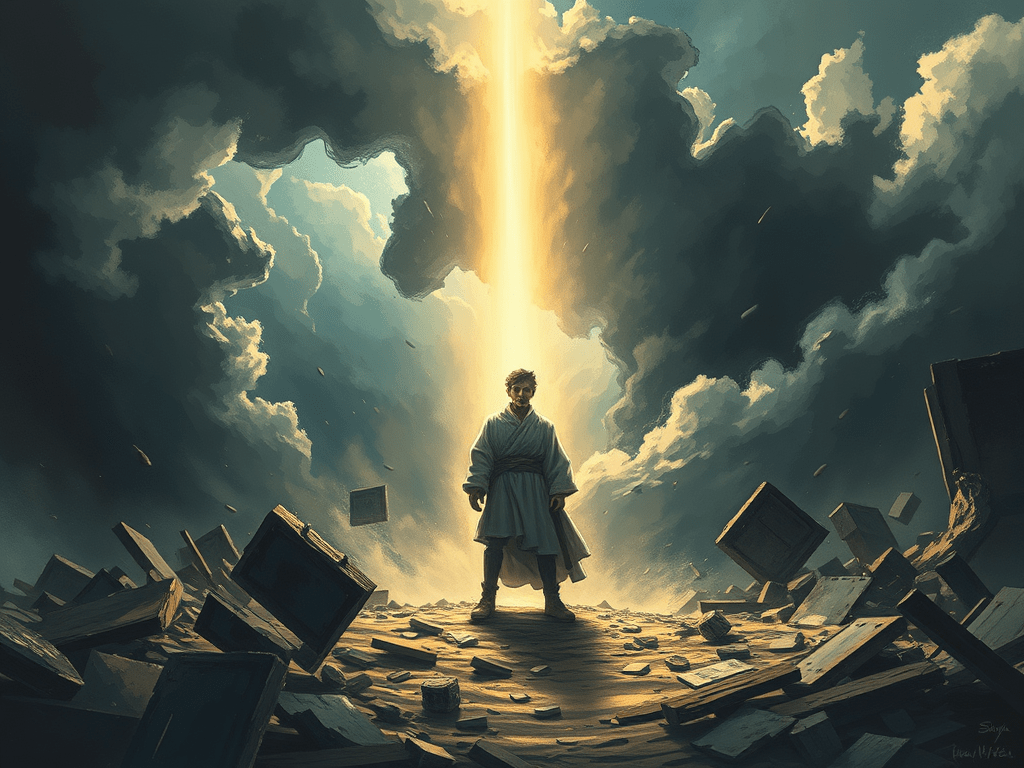
    Last night I dreamed I was prowling for beachfront property in the dead of night when I stumbled upon a terrarium the size of several football fields—an absurd, glass-walled Eden under artificial light. Some plots were shameless cons, swindler specials dressed up with tacky lawn ornaments and fake palm trees. Others, however, had loamy, dark soil that practically hummed with fertility. Over the PA system, an NPR announcer’s warm, soporific voice guided prospective dreamers like me, pointing out which plots were worth my attention.

    I claimed a plot perfect for herbs, tomatoes, and peaches, imagining future harvests under this climate-controlled dome. Then I set off to find my family, who were dining on the rooftop of a nearby hotel, high above the night and the surf. When I arrived, they were lit with merriment, clinking glasses with friends, laughter rolling across the table like a tide.

    Leo, a family friend with the generosity of a man who’s just inherited a brewery, pressed a frosty glass stein of amber beer into my hand. I’m not much of a beer drinker, but curiosity won, and I took a long pull. It was cold, crisp, and shockingly delicious—like a liquid reprieve from all earthly woes. Before I could savor the moment, a teenage boy with only the flimsiest link to Leo snatched the stein from my hand and drained it with feral efficiency. I seethed but swallowed my annoyance.

    Leo, undeterred, promised reinforcements: more beer, plus sandwiches from “the downstairs stash.” He led me to a cold-storage room the size of a cathedral. Inside, shelves groaned under the weight of sandwiches—no ordinary deli fare, but hand-crafted masterpieces assembled by World Series legends of the 1970s. Every sandwich bore a tag in looping script: Dave Winfield. Reggie Jackson. Willie Stargell. Dave Parker. Jim “Catfish” Hunter. Preserved by refrigeration so perfect, the bread seemed freshly baked, the lettuce still crisp, as though the ballplayers had just stepped away from the cutting board.

    We loaded up on sandwiches and pitchers, returned to the rooftop, and feasted under the city lights. The beer was endless, the view intoxicating. For a fleeting moment, I felt like I had not only bought the best plot in the terrarium but inherited the whole ridiculous world.

  • The Warm Bath and the Higher Forces

    The Warm Bath and the Higher Forces

    Therapist Phil Stutz, in Lessons for Living: What Only Adversity Can Teach You, identifies the most insidious adversity we face daily: the lure of immediate gratification. This dopamine-charged, compulsive, addictive pull consigns us, he says, to “the lower channel,” the “Warm Bath,” the comfort zone. Its source is the inner saboteur he calls Part X.

    In Steven Pressfield’s The War of Art, the same force appears as “The Resistance,” the invisible enemy that diverts us from lives of creativity and meaning. Sometimes it takes the form of “unwholesome activities”—scouring the internet for smut or indulging in materialistic temptations that pull us away from hard work. Cal Newport warns that when we return from such addictive detours, our brains are still coated in “lower channel” residue—mental detritus that dulls our clarity and compromises our work.

    Confronting Part X—or the Resistance—is not a one-time victory. We never ascend to a nirvana where the demon vanishes; it is always nearby, waiting for an opening.

    Rejecting the endless circuit of traditional talk therapy, Stutz arms his patients with Tools—practical methods to counter the bad habits born of Part X. His patients are often “either trapped in a past that no longer existed or living in fantasy about a future that hadn’t arrived yet—and might never.” The Tools, he says, “open the door to the infinite wisdom of the present.”

    His therapy hinges on three elements:

    1. Homework—daily exercises outside of sessions.
    2. Forward Motion—steps away from the past and repetitive stagnation toward a new life.
    3. Connection to Higher Forces—a necessary change, not an optional one, to avoid the self-destruction that leads to death.

    “We are only a tiny part of an infinite universe,” he writes. “On our own we can do nothing. But, in a silent miracle, the universe puts its energies at the service of human evolution.” Higher Forces help us escape personal hell and learned helplessness. When his patients connect with them, they find hope and the power to change—here, in the present.

    Before going further, I have to pause and unpack this. First, I believe Stutz’s framework offers a real way out of the wide path to self-destruction and onto the narrow path of meaning. Second, I can’t help but think of Christianity, Judaism, and A.A.

    In Christianity, especially Pauline theology, we are compulsive creatures, helpless before our sinful drives. Only surrendering to Higher Powers—in this case, the cosmic Christ—can break our demonic impulses. Paul spells this out in the Epistle to the Romans.

    Judaism, at least as Rabbi Hyam Maccoby describes it in The Mythmaker: Paul and the Invention of Christianity, rejects this helplessness. We do have self-agency. When we cry to God for rescue from our self-destruction and abasement, He meets us halfway—we move toward Him, and He moves toward us.

    In A.A., the principle is stripped to its core. Comedian Marc Maron has spoken about his recovery from substance abuse: every day, he got on his knees and told a Higher Power he could not free himself from addiction alone.

    Across these three traditions, I see more similarities than differences. I’m confident that anyone who sincerely applies these principles will improve.

    But here’s the sticking point: belief in a Higher Power without religious baggage is not the same as belief in a specific deity. The Jewish God—open to debate, vague about the afterlife—is quite different from the Christian God who, under Pauline influence, recasts Judaism into a universal religion for gentiles, condemns Jews as cut off from the vine, and adopts Augustine’s stark vision of eternal paradise or eternal damnation.

    Three notions of deity—each with profound implications.

    As an addict and an agnostic, I wonder: am I letting these theological questions distract me from the urgent need to connect with Higher Powers so I can face my own demons? This question burns in me. Will these Higher Powers help me navigate my dense jungle of doubts? Will they help me find clarity?

    Stutz notes that many of his patients backslide. Why? Because they stop using the Tools. Why stop? Complacency. Or disbelief in the stakes.

    Which brings me to the core of my own struggle: faith in a doctrinal God versus a personal God without doctrine. The doctrinal God comes with teachings—eternal perdition, the Virgin Birth, a literal resurrection—that can be difficult to swallow. For a fuller exploration of the problems with doctrine, see Elizabeth Anderson’s essay “If God Is Dead, Is Everything Permitted?”

    The personal God without doctrine might be more palatable, but perhaps lacks the high-stakes edge that some people need to stay committed to their daily battle with Part X, the Resistance, or whatever name we give this destructive force.

    So what’s the path forward? Should I call life a nihilistic joke and live recklessly? Certainly not. Even with my doubts, I must press ahead, use the Tools, and seek communion with Higher Powers. I can only hope such a life will yield answers—and remind myself that giving in to immediate gratification only strengthens the lower channel, leading, inevitably, toward darkness, confusion, and death.

  • The Woman in the Corner

    The Woman in the Corner

    Last night’s dream stripped me bare. I was at a beach compound that seemed to stretch forever, the waves pacing back and forth like guards. My companions drifted in and out of focus—sometimes they were cops in rumpled uniforms, sometimes professors in tweed, and sometimes both at once. I alternated between the two roles without effort, my badge turning into a fountain pen and back again.

    Then the letter arrived. The envelope was the weight of a confession. Apple headquarters. Inside, a memo on paper so white it seemed to hum. In the upper right corner, a photograph of a woman: steel-gray hair, bifocals balanced on the edge of her nose, eyes fixed on me as if she could see through my ribs. Her expression carried the inevitability of gravity.

    The memo stated plainly: You are a fraud. Your life will be dismantled.

    I looked up from the page and the dismantling had already begun. My invitation to a retirement party—revoked. Chairs scraping, conversations halting, faces turning away. The compound’s air grew thick and briny, as if the ocean were climbing into the rooms to watch.

    I woke with the letter still in my hand, though it dissolved before I could read it again. The feeling remained: the certainty that I had been living in two incompatible worlds and the border guards had finally compared notes.

    I sat up and reached for a book, any book, to hold onto something real. It was Phil Stutz. I reread his words on “the lower channel,” that slow, dirty current of short-term gratification. I could almost hear it lapping at the shore, waiting for me to wade in again.

  • Will Optimization Kill the Joy of Mechanical Watches?

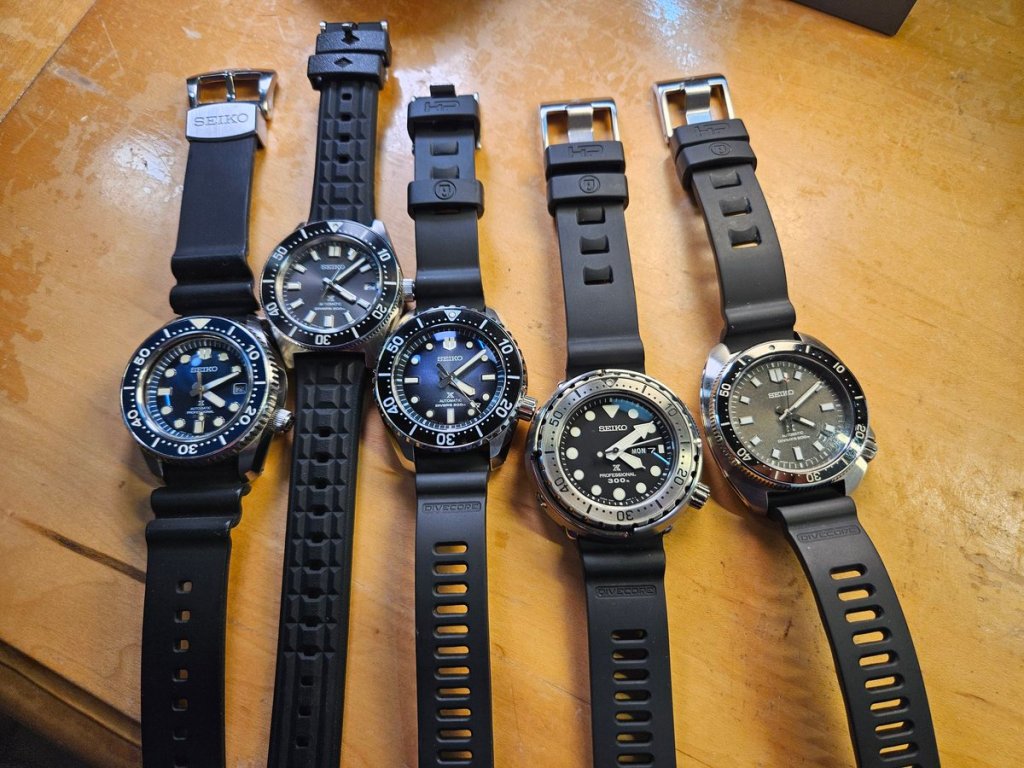
    Will Optimization Kill the Joy of Mechanical Watches?

    Sometimes I wonder how technology might assassinate my love for timepieces. Picture this: a $200 spool of 3-D printer feedstock spits out your $10,000 grail watch. Eight years later, when the mechanical movement needs servicing, you don’t take it to a watchmaker—you print another.

    If watch-printing is as easy as making pancakes, I’d have thousands. Would I be happy? No. I’d be the spoiled rich kid sulking in his palatial bedroom because Mom and Dad bought him every toy but a bazooka.

    “Son, I bought you everything.”
    “But I want a bazooka.”
    “They’re illegal.”
    “I don’t care!”

    When everything is instant, the “holy grail” becomes an inside joke. The magic dies in the flood of abundance. Just ask the diamond industry. Lab-grown stones are flawless, cheap, and undetectable to the human eye—obliterating the romance of bankrupting yourself for an engagement ring. Watches could be next.

    And that’s just one front. On another, tech billionaires are funding biohackers to keep us ticking for 900 years. If I’m going to live to 85, time feels urgent. If I’m going to live to 900, time is a leisurely brunch. Chronological time starts to matter less than biological time—the wear and tear written in my cells.

    In that world, your Rolex Submariner won’t tell you what matters. Your doctor-prescribed smartwatch will, tracking cardiovascular vitality, antioxidant levels, and the sorry truth of your lifestyle choices. Refuse to wear it, and your insurance premiums explode tenfold or you’re cut off entirely. Privacy? Gone. Your vitals are known to your insurer, employer, spouse, dating app matches, and the guy at your gym checking your actuarial risk.

    When the mechanical watch dies, so does your privacy. And somewhere, Dale Gribble from King of the Hill is finding the conspiracy angle.

    Give it five years. Our “watch collector meet-up” will look more like group therapy for mechanical-watch dinosaurs funding their therapists instead of their ADs. But fear not—obsession never dies, it just changes costume. Post-watch, your new drug will be optimization.

    You’ll strap on your OnePlus Watch 3, buy a $2,600 CAROL resistance bike, and simulate being chased by a saber-toothed tiger because “hormesis”—that holy word—demands mild ordeals to make you live forever. Resistance intervals, intermittent fasting, cold plunges. Goodbye winding bezels; hello gamified cell stress.

    Our poster boy? Bryan Johnson—the billionaire fasting himself pale, zapping his groin nightly to maintain the virility of a high school quarterback. Critics say he looks like a vampire who’s just failed a blood test. I say he’s the future. Picture him at 200, marrying a 20-year-old and siring a brood. Male Potency and Reproductive Success: the distilled recipe for happiness.

    Except I’m kidding. The truth: peer-reviewed science says we might beat the big killers before 90—heart disease, cancer, stroke, Alzheimer’s—but the biological ceiling is still ~100. Eventually your organs quit. All the optimization in the world won’t rewrite that.

    As a watch obsessive, I know the tyranny of time. The biohackers are fixated on biological time as if it’s the only kind that matters. But the Greeks knew a third: kairos—the moment saturated with meaning, purpose, connection. All the Bryan Johnsons in the world can’t 3-D print that.

    Live 200 years without kairos and you’re not a winner; you’re a remake of Citizen Kane with a garage full of exotic cars and no friends.

    A long time ago, a friend told me about the night cocaine hollowed him out so completely that he didn’t care his best friend was kissing his girlfriend. Then a voice in his head said, “Dude, you should care.” He went to rehab the next day. That’s soul work.

    And that’s what’s missing from the longevity cult: soul work. Without it, all the tech, watches, and optimized mitochondria in the world are just a shiny grift.

  • Will Living Forever Affect Your Timekeeping?

    Will Living Forever Affect Your Timekeeping?

    Like most people, I want a long life. Every morning, no matter my mood, I spring from bed eager to make dark-roast coffee and buckwheat groats with vanilla protein powder, soy milk, and berries. The more miles on my life odometer, the better—so long as those miles are smooth: no bureaucratic migraines, no addictions, plenty of income, spiritual ballast, connection with others.

    That’s why I read Tad Friend’s essay “How to Live Forever and Get Rich Doing It” with interest. Friend profiles 64-year-old Peter Diamandis, an optimist convinced we’re on the brink of breakthroughs: blood filters to block cancer, sound waves to detect strokes, mood-zapping tech for depression. He calls Diamandis “an emissary from the realms of possibility.”

    Tech billionaires have practically built vacation homes in the land of eternal youth, wiring obscene sums into anti-aging startups like it’s Monopoly money. Sure, the wealthy already get a 12-year head start on the poor, but most scientists insist the afterparty ends around 90. We’ve smacked into the “biological ceiling.” As for the 900-year marathons of Noah and Methuselah—please. They were breathing alpine air untainted by lead, cadmium, or mercury, not commuting through rush-hour smog in a Tesla.

    Diamandis and his circle press ahead anyway, bankrolled by billionaires who can’t resist the dream. Along the way, I learned a new term: hormesis—mild ordeals that supposedly trigger cellular resilience. Exercise? Fine, because it comes with endorphins. Semi-starvation? No thanks—I’m not interested in being hungry and cranky for decades. Cold plunges? Too much Instagram posturing. I’ll splash my face with cold water. That’s good enough for me.

    Some biohacks drift so far into self-parody they could headline at a comedy club. Take CAROL, a resistance bike that has you pretend a saber-toothed tiger is on your tail, all in the name of channeling your inner Neanderthal sprinter. As Tad Friend drily notes, Neanderthals weren’t exactly poster children for longevity—they usually tapped out before 30.

    Then there’s Bryan Johnson, the longevity poster boy, on a semi-anorexic diet, flexing for the camera, and blasting sound waves through his loins to reclaim teenage virility—an evidence-free vanity project if ever there was one.

    Friend notes that many biohackers avoid the news entirely; Diamandis calls it “amygdala-stimulating dystopian clickbait.” Conveniently, this shields him from rebuttals—odd, since science supposedly thrives on them.

    Some predictions verge on male fantasy: 100-year-old moguls marrying women half their age and siring fresh broods as proof of potency. Joe Polish, a former collaborator, nails the pitch: “A compelling offer is ten times more powerful than a convincing argument.” Translation: they’re selling a dream, not a reality.

    Don’t get me wrong—I want research that crushes heart disease, cancer, stroke, and Alzheimer’s. But even if we slay those dragons, organ and metabolic failure will still get us before 100. Immortality, as marketed here, is mostly grift, mostly ego.

    The essay veered into timekeeping, which I track as a watch obsessive. Longevity researchers distinguish between chronological time—the calendar—and biological time, measured through DNA methylation, blood biomarkers, organ imaging, and physical function. Dave Asprey claims his 52-year-old body is 18. I doubt it. Maybe 40 on a good day.

    Still, biological age matters. Functional strength predicts survival: slow-walking 85-year-old men die sooner than the fast walkers; those who can bathe themselves outlive those who can’t.

    But what does a long life mean? Picture a greedy, paranoid recluse with 5,000 luxury watches, 12 cars, and a private jet, living to 200. That’s not winning—that’s a remake of Citizen Kane.

    In the end, spiritual rehab beats the obsessive tinkering of physical micromanagement. Back in the ’80s, a friend told me how cocaine had sandblasted his capacity to care—about his life, his girlfriend, even himself. One night, he woke up under a heap of half-conscious bodies in a party’s stale, smoky gloom. In the corner, through a haze of spilled beer and burnt-out joints, he saw his glassy-eyed girlfriend making out with his equally blitzed best friend. He felt nothing—no jealousy, no rage, just a numb vacancy. Then, from somewhere deep inside, a voice cut through the chemical fog: “Dude, you should care.” The next morning, he checked into rehab and began the slow, grueling work of putting his soul back together.

    That’s the missing piece in the longevity movement: not more years, but more humanity. Health matters. Exercise matters. But without soul work, you’re just buying time for an empty vessel.

  • The Paradise Hangover

    The Paradise Hangover

    Yesterday I posted a 24-minute video on my YouTube channel about my family’s trip to Oahu—about slipping into what I call Sacred Time—and about the sullen resentment that comes when you’re yanked back into Profane Time. In Sacred Time, there are no utility bills, no kitchen repairs, no inbox choked with memos. In Profane Time, there’s nothing but.

    There’s a lag between the two realms. The body may be back at the desk, moving through the motions of Profane Time, but the mind and heart are still on an island, half-convinced they’ve found a loophole in the laws of mortality.

    In that sacred dimension, we become a mythic version of ourselves—effortless raconteurs, irresistible charmers. The hotel bartender laughs at your jokes. The maître d’ nods in worldly agreement when you talk about sunsets and seared ahi. Their warmth feels real, not transactional. And you start believing the PR you’ve written for yourself. Then you fly home, and the whiplash from god-king to bill-payer is too much to bear.

    It reminded me of a woman I met nearly twenty years ago in a frozen-yogurt shop in Torrance. My wife and I were waiting in line when she appeared: tall, angular, maybe in her sixties, the ghost of a former beauty. Short blonde hair with a whiff of style still clinging to it, smeared red lipstick, tight leopard-print pants, and high heels that had seen better decades. She carried her currency—hundreds of pennies—in a crumpled paper bag.

    She spilled them, along with her dessert, across the tile floor. I bent to help her, feeling the full weight of her story without knowing any details. I imagined her as a former starlet who once walked red carpets, who’d been adored, flattered, invited everywhere—until one day she wasn’t. She’d never made the identity shift from somebody to nobody, and that inability had swallowed her whole.

    Self-mythologizing is dangerous. Whether you’re a faded Hollywood beauty or a sun-dazed tourist just off the plane from paradise, you have to face the comedown. Adult life demands it. The mythical and the mundane need each other—without the grind, the magic loses its shine.

    So yes, I’m sulking about my return from Hawaii. Yes, I’d rather be sipping mai tais than buying new blinds and a desk for my daughter. But that’s the deal. Profane Time pays for Sacred Time. You can’t live in one without surviving the other.