Blog

  • The Confessions of a Hot Tub Messiah

    The Confessions of a Hot Tub Messiah

    You were twenty-six in the hot August month of 1998 and for a shimmering chlorinated hour at a friend’s pool party at a lavish apartment complex in Livermore, California, you became the mythical, magical Hot Tub Stud. Your girlfriend wasn’t there. It was August, and she had already packed her bags to start her fall semester at Scripps College in Claremont California. It was ridiculous that you and your girlfriend Pamela would attempt a long-term relationship. You were each other’s first romance. You both were surely naive. Neither of you knew how doomed and unhealthy your relationship was. There were things about you–your neediness and lack of spontaneity to name two–that Pamela hated about you. Deep down, you knew she hated you, but you were too needy to acknowledge how repulsed she was by your neediness. You were also too needy to acknowledge that you weren’t so hot about her either. Sure, the chemistry was great. You guys desired each other every second, but it was impossible for you to truly love someone who recoiled at your broken, immature self. Deep down, you wanted to be admired and adored, and you knew Pamela would never be that person.

    Around 3 p.m., in the steamy, chlorine-scented haze of suburban hedonism, she appeared: Rachel, a petite brunette with long, flowing hair, skin like burnished chestnut, and dark, soulful eyes that suggested she’d read Anna Karenina and wept at the right parts. She wore a green bikini. She had depth. She had presence. And she was—unbelievably—into you.

    And not just into your pecs and biceps. She was drawn to your languid ease, your temporary state of post-Pamela serenity, that rare moment when you weren’t apologizing for your existence or scanning the horizon for emotional threats. You exuded something you rarely possessed: confidence. You didn’t try to be charming. You just were.

    You talked. She was an Ashkenazi Jew, like you—except fully, whereas you were only half, your dad a gruff Irish Catholic whose idea of spiritual intimacy was yelling at the TV. You told her it was a miracle you weren’t in therapy. She laughed. The real kind. She told you about growing up in a Jewish enclave in Dallas, her econ degree from San Francisco State, and the Marina District apartment she shared with roommates and dreams.

    In the swirling warmth of the hot tub, you slowly cradled her as she floated on her back, spinning gently in your arms like a sun-drunk naiad. You gazed into each other’s eyes like characters in a perfume commercial—if the perfume were melancholy, the top note regret.

    And in that moment, Pamela ceased to exist. You were ready to let Pamela become a dot receding into the horizon, propose to Rachel, adopt a rescue dog, and buy Rachel a two-bedroom Marina District condo with French doors and jasmine on the balcony. Your soul whispered scripture: “And the two shall become one flesh.”

    But just as you leaned into that soon-to-be-legendary kiss, your guilt, or maybe your emotional cowardice, threw a wrench into fate. You stood her upright and mumbled something about having a girlfriend.

    The look on Rachel’s face—that soft, diplomatic devastation—has haunted you ever since. She gave you a gentle out: “You’re probably confused.” And then she disappeared into the changing room like Eurydice stepping into the underworld, and you never saw her again.

    Years passed. Decades. And when life feels like a cruel joke told by someone with bad timing—when you’re depressed, flabby, or existentially irrelevant—you return to that hot tub. You imagine yourself sweeping Rachel off her feet, performing impromptu piano recitals, meeting her doting parents, and becoming the man you wanted to be in that moment: the Hot Tub Stud who followed through.

    But you didn’t. You blinked. You let Eden slip through your fingers, and like all paradise stories, it ended with exile.

    Still, for one hour, you were perfect. You were desired. You were whole.

    And you’ve been chasing that hour ever since.

  • “This Is the Other Place”: Twilight Zone Parenting and the Parking App of Doom

    “This Is the Other Place”: Twilight Zone Parenting and the Parking App of Doom

    Of all the Twilight Zone episodes that have taken up residence in my psyche, none clings more tenaciously than “A Nice Place to Visit.” A petty crook named Rocky Valentine gets gunned down during a botched robbery and wakes up in what appears to be paradise. He’s greeted by Pip, a genial, rotund guide played by Sebastian Cabot, who grants him everything his larcenous heart ever wanted: money, women, luck, luxury. No struggle, no stress. Every desire fulfilled on command.

    At first, Rocky revels in this frictionless dreamscape. It’s Vegas without losing streaks, heaven without requirements. But gradually, pleasure without purpose curdles into a thick, syrupy dread. He realizes that gratification without resistance is just another form of punishment. Bored out of his mind and desperate for meaning, Rocky pleads with Pip to send him “to the other place.”

    Pip laughs and delivers the gut punch: “Heaven? Whatever gave you the idea that you were in Heaven, Mr. Valentine? This is the other place!” And then, with glee, Pip cackles like the well-fed devil he is.

    Which brings me to paid parking.

    There is a hell, and it lives in the infrastructure of modern urban parking. It’s a realm of QR codes, license plate entries, and apps that want your soul—or at least your email and billing zip code. Some kiosks accept coins, others demand smartphone apps, two-step verification, and an MFA code just to stand still without being ticketed. My wife, tech-literate and cool-headed, usually handles this logistical hellscape while I loiter nearby, pretending to study the map of downtown like it’s a sacred text.

    But this week she’s out of town at a teaching convention, and I’m taking our twin daughters to Laguna Beach. This means I have to drive, find a parking structure, and—here’s the true horror—navigate the digital rigmarole of paid parking without her guidance. The thought of it has me sweating harder than Rocky in his silk suit.

    The absurd part? It’s not the traffic, the tides, or the teenagers that unnerve me. It’s the parking meter. The existential shame of standing in front of a digital payment kiosk, poking at it like a confused ape while my daughters wait patiently (or impatiently) beside me. I don’t fear the unknown. I fear looking like an idiot in front of my kids.

    But here’s the deeper, darker realization: this is just a symptom. My wife, through years of effort and mental load, has become the de facto logistics commander of our household. She knows which airport lines move faster. She’s the one strangers approach at terminals, sensing her Jedi-level calm. Meanwhile, I shuffle behind her like an NPC in a bad video game—directionless, frictionless, practically translucent.

    Frictionless living has a cost. It breeds detachment. It robs you of engagement, resilience, and presence. And like Rocky Valentine, I’ve grown too used to being served instead of showing up.

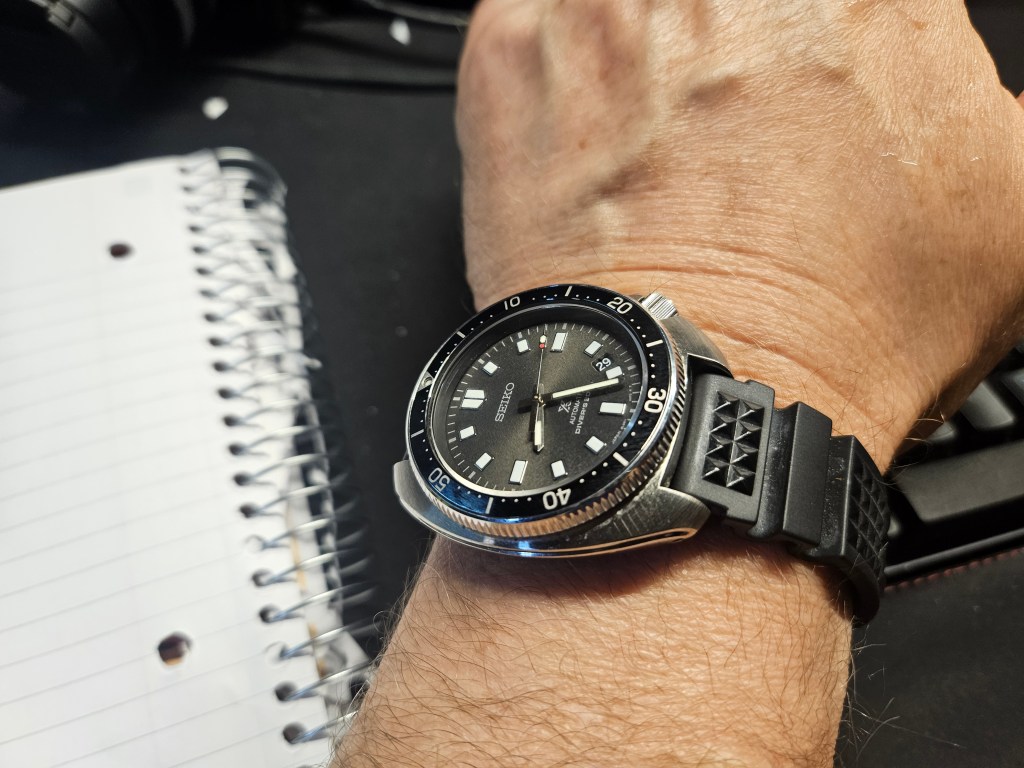
    Ironically, I’m obsessed with watches—those exquisite tools designed to remind you where you are in time. And yet, I’ve spent years drifting, distracted, floating outside the dial. It takes a solo day trip with my daughters—an hour drive, some shopping, a good lunch, and possibly a tantrum or two—to pull me back into the present.

    When my wife heard about my plan, she said, “You don’t know how happy this makes me.” And I believed her. She wasn’t just relieved that I was giving her a break. She was glad to see me step into the friction. To stop spectating and start parenting in real time.

    No, I don’t want to be Rocky. I don’t want a life where every parking spot is perfect, every line is short, and every meal arrives on time. I want the chaos. I want the curveballs. I want the real thing.

    Even if it means downloading the stupid parking app.

  • A Portrait of the Artist as a Sweaty Young Man

    A Portrait of the Artist as a Sweaty Young Man

    In the fall of 1979, I was seventeen years old, a freshman in college, and already trapped in the tragicomic theater of my own self-regard. My deltoids were large, my ego fragile, and my sense of fashion—catastrophic. I had shown up that day to the cafeteria in a tight black turtleneck, the kind of garment that might look sleek on a Parisian intellectual but looked positively deranged on a teenage bodybuilder seated alone under sun-drenched plate-glass windows. The sun baked through the glass like a punishment from Apollo himself, and there I sat, moping in a puddle of my own sweat and self-loathing while Jimmy Buffett’s “Margaritaville” chirped mockingly from the jukebox.

    The song, a hymn to sloth and sangria, might as well have been composed to ridicule me personally. I didn’t know how to be carefree. I didn’t sip margaritas or laugh at spilled salt. I sat there glowering at my hamburger like it owed me money.

    College wasn’t a choice; it was a parental ultimatum. My mother, newly divorced and perpetually exasperated, had threatened to eject me from the house if I didn’t enroll. My father, who fed me barbecued steak at his bachelor pad and treated my emotions like a disease he couldn’t contract, declared that my ego—his exact word—was too “delicate” for a job with the sanitation crew. “You’re not built for trash,” he said between bites. “You need a title.” I agreed. I said I needed something white-collar, something that sounded mobile—like it wore loafers and got invited to cocktail parties.

    Yet there I sat, jobless, broke, sweating through a wool turtleneck like a fool in a Russian novel. Just a few weeks earlier, I had been juggling job offers like a hustler on the make. One gig was as a bouncer at a teenage disco called Maverick’s in San Ramon, a temple of polyester and hormonal chaos where high schoolers writhed to the anesthetizing thump of K.C. and the Sunshine Band. I hated everything about that job—the music, the fake glamour, the pretense of authority as I stalked the aisles flexing my lats like I was auditioning for a sequel to Saturday Night Fever: The Security Guard Chronicles.

    My mother’s revolving door of boyfriends didn’t help. One, a Raiders defensive coordinator, had promised me a job moving pianos, which somehow never materialized. Another, Sid Briggs, was allegedly a “businessman” with Teamsters connections and the vague scent of federal indictment. He too promised me a job managing a health club. That never happened either. The only real employment I had was at Maverick’s, which came to a dramatic end during a riot. My fellow bouncer Martino and I decided we were too precious to die for three bucks an hour, so we walked out mid-melee and drove off down Crow Canyon Road. Martino repeated like a monk reciting scripture, “I’m not going to risk my life for three dollars an hour.”

    We were fired. Unceremoniously. I was left with $300 in my checking account and a 1971 metallic brown Ford Galaxy that had just drained me dry with repairs. That car had the elegance of a Soviet tank and handled like one too.

    And now here I was, sulking under the cruel sunlight, marinating in Buffet’s faux-Carribbean nihilism. “Wasting away,” he sang. No kidding.

    At six feet tall and 210 pounds of resentful muscle, I radiated a kind of lonely menace. My professors were afraid of me. People steered clear. I was a human bug zapper. But then came John O’Brien.

    He walked right up to my isolated table like he was planting a flag. Set down his tray, extended a hand, and introduced himself. A compact redhead from Boston with the kind of fast-twitch charisma that usually belongs to politicians or cult leaders. He had moxie, confidence, and a girlfriend who looked like a shampoo commercial. But unlike most people with that kind of glow, he wasn’t a narcissist. He had radar. And he picked up my signal loud and clear: lost kid, no job, no love life, no clue.

    John decided to fix me.

    First, he got me a job. He worked at Jackson’s Wine & Spirits in Berkeley and said, “They need a guy. You’re the guy.” He called me that night with the details. Two days later, I was on the floor learning about merlot and discount vodka.

    Then, with the subtlety of a Vegas magician, he decided to address my romantic failure. He looked across the cafeteria, spotted two stunning nineteen-year-olds, and summoned them with a whistle so loud and precise it could’ve herded cattle. They glided over—one blonde, one with honey-colored hair—and I immediately began sweating like a man having a cardiac episode in church. It was flop sweat, and I couldn’t stop it. I tugged at the neck of my turtleneck like it was trying to strangle me and muttered, “It’s not hot in here.”

    The girls smiled politely, and I squirmed in my own skin like a teenage werewolf caught mid-shift. John watched it all with the amused detachment of a man inspecting a fixer-upper. He had found a dilapidated house—me—and now he was assessing the structural damage.

    He had his work cut out for him.

  • Dorian Gray Wears a Diver

    Dorian Gray Wears a Diver

    I turn 64 this October. By all logic—and illogic—I should reward myself with a seventh watch. Something different. Something elegant. Something that whispers, you’re still in the game. Not another diver—I already have six of those aquatic symbols of masculine resolve. Maybe a sleek Grand Seiko. Or a snotty, sapphire-dialed Euro snob with just enough heritage to make me feel like I matter. Or more likely, a Citizen Satellite Wave Attesa Chronograph.

    But here’s the rub: I don’t have time.
    Literally.

    Buying another timepiece at this stage of life feels like auditioning for a band that stopped playing decades ago. The idea of adding yet another horological trophy to my drawer feels less like celebration and more like denial—of mortality, of limits, of the inconvenient truth that, like it or not, I’m on the back nine. The dopamine buzz of acquiring another shiny object is no longer innocent. It reeks of delusion. It’s a middle-aged man’s sugar pill. A form of spiritual Botox.

    Desire at this age should mellow. Shouldn’t it? Shouldn’t I have graduated to some Zen-like state of detachment, where I sip tea and listen to birdsong and chuckle softly at the foolishness of wanting things?

    Instead, I find myself lusting after lacquered dials and ceramic bezels with the unbridled thirst of a teenage boy at a mall kiosk. It makes me feel like Dorian Gray—but in reverse. I strap youth onto my wrist while the portrait in the basement, the one of my soul, grows grotesque. Not just wrinkled, but warped. A decaying ghoul of greed and vanity, clutching a watch roll and whispering, just one more.

    Another sobering thought: Getting another beautiful watch won’t make me happy. It will make me bitter because as pleasurable as it will be to behold it on my wrist, I will know deep down that this pleasure pales in comparison to the dopamine-rush I get from watching it displayed on YouTube videos. Much of the pleasure is in my head, not on my wrist. 

    These are not healthy thoughts for a birthday.

    And yet, here we are. When you’re a consumer with a conscience, you live in a state of cognitive dissonance. You want the toy. You hear the whisper of death. You long to be mature. You also want the damn Seiko. Buying stuff, especially beautiful, useless stuff, is supposed to be fun—frivolous, even. But once you’ve glimpsed the truth—the metaphorical rot in the basement—you can’t unsee it.

    That’s the thing about aging: it doesn’t always give you peace. Sometimes it just gives you clarity. And clarity can be a buzzkill.

  • Lost at the Light: A Dream of Unfinished Witness

    Lost at the Light: A Dream of Unfinished Witness

    Last night I dreamed I was flung through time to witness the Crucifixion—not once, but over and over again, as if history were caught in an eternal loop. It wasn’t a single event but a kaleidoscope of perspectives: I viewed it from the ground, from a hillside, even from above. The landscape shifted with each new angle—sometimes the sky was slate gray, sometimes scorched bronze, sometimes bruised with orange light like an eternal dusk.

    I was obsessed with seeing it clearly, as though clarity itself were salvation. But the method of execution began to morph. The Cross, once tall and stark on a mountaintop, gave way to a giant catapult. I watched as faceless figures were hurled skyward like rag dolls flung by fate. I couldn’t tell if they were victims, martyrs, or simply vanishing into the void.

    There was mention—or maybe just a sensation—of a third method of sacrifice, one hidden, unnamed, and deeply unsettling. Its very vagueness gnawed at me, filling me with a dread I couldn’t explain.

    Realizing that perfect understanding was impossible—that I would never grasp the full shape of this cosmic agony—I finally surrendered. The moment I did, I was somewhere else.

    Now I was behind the wheel of a car, trying to follow a caravan of friends along an unfamiliar road. They all made it through a green light; I didn’t. I was left behind, lost beneath a concrete overpass, disoriented and doubting whether these friends were friends at all.

    Eventually, I caught up. We arrived at our destination: a picnic by the sea. No one spoke of what had happened. We passed around barbecued trout and fresh fruit, relieved more than joyful. We were just glad to be there, to eat together in silence. The chaos of the journey was forgiven in the quiet rhythm of chewing and the sound of waves.

  • Don’t Feed the Soul-Hole: 4 Rules for Making YouTube Content Without Losing Your Mind

    Don’t Feed the Soul-Hole: 4 Rules for Making YouTube Content Without Losing Your Mind


    Here’s what I’ve learned while preparing my latest YouTube video essay—”Don’t Confuse a Watch Collector with a Watch-Hoarding Demon”—which, by the way, still sits unrecorded because I haven’t found a quiet moment required to talk to a camera.

    Lesson One: Open with Housekeeping—But Make It Deranged.
    Begin your video not with a dry agenda but with something ridiculous and revealing. Tell your viewers how a simple search for watch straps turned into a midnight rabbit hole of vintage Camry trim packages or why you contemplated buying a Tudor Pelagos just to avoid folding laundry. Let them see your obsessions in their full neurotic bloom. Self-disclosure laced with comedy is more potent than any clickbait title.

    Lesson Two: Stop Feeding the Soul-Hole.
    The point of making videos is not to audition for emotional validation from strangers on the internet. That’s a black hole with no floor and no mercy. Seeking approval from the algorithmic gods only deepens the void. Instead, aim to share something real—stories, absurdities, and small slices of insight—with humility, clarity, and a firm grip on the absurdity of it all. You’re not here to be liked. You’re here to connect.

    Lesson Three: In the Age of Dopamine Overload, Be Useful.
    We live in an attention economy that’s basically a carnival of shrieking hucksters promising eternal youth through vitamin gummies and AI lifehacks. Most of it ends up being digital noise. Your job isn’t to out-scream them; it’s to offer substance. My strength is argumentative essays, so that’s where I stake my claim. Find your strong suit, sharpen it, and share it—preferably without a TikTok dance.

    Lesson Four: Welcome Dissent Like a Grown-Up.
    The comment section should not be a food fight. It should be a place where people can politely disagree without biting each other’s heads off. We live in a culture where disagreement is taken as a personal attack—like someone spit in your oat milk latte. But real disagreement, handled well, is a gift. It forces us to clarify, refine, and rethink. Without opposition, your ideas become flabby and self-congratulatory. Iron sharpens iron—just make sure it’s civil.

  • Death by Convenience: The AI Ads That Want to Rot Your Brain

    Death by Convenience: The AI Ads That Want to Rot Your Brain

    In his essay for The New Yorker, “What Do Commercials About A.I. Really Promise?”, Vinson Cunningham zeroes in on the unspoken premise of today’s AI hype: the dream of total disengagement. He poses the unsettling question: “If human workers don’t have to read, write, or even think, it’s unclear what’s left to do.” It’s a fair point. If ads are any indication, the only thing left for us is to stare blankly into our screens like mollusks waiting to be spoon-fed.

    These ads don’t sell a product; they sell a philosophy—one that flatters your laziness. Fix a leaky faucet? Too much trouble. Write a thank-you note? Are you kidding? Plan a meal, change a diaper, troubleshoot your noise-canceling headphones? Outrageous demands for a species that now views thinking as an optional activity. The machines will do it, and we’ll cheerfully slide into amoebic irrelevance.

    What’s most galling is the heroism layered into the pitch: You’re not shirking your responsibilities, you’re delegating. You’re optimizing your workflow. You’re buying back your precious time. You’re a genius. A disruptor. A life-hacking, boundary-pushing modern-day Prometheus who figured out how to get out of reading bedtime stories to your children.

    But Cunningham has a sharper take. The message behind the AI lovefest isn’t just about convenience—it’s about hollowing us out. As he puts it, “The preferred state, it seems, is a zoned-out semi-presence, the worker accounted for in body but absent in spirit.” That’s what the ads are pushing: a blissful vegetative state, where you’re physically upright but intellectually comatose.

    Why read to your kids when an AI avatar can do it in a soothing British accent? Why help them with their homework when a bot can explain algebra, write essays, correct their errors, and manage their grades—while you binge Breaking Bad for the third time? Why have a conversation with their teacher when your chatbot can send a perfectly passive-aggressive email on your behalf?

    This is not the frictionless future we were promised. It’s a slow lobotomy served on a platter of convenience. The ads imply that the life of the mind is outdated. And critical thinking? That’s for chumps with time to kill. Thinking takes bandwidth—something that would be better spent refining your custom coffee order via voice assistant.

    Cunningham sees the bitter punchline: In our rush to outsource everything, we’ve made ourselves obsolete. And the machines, coldly efficient and utterly indifferent, are more than happy to take it from here.

  • Buy Now, Cry Later: A Watch Addict’s Morning Routine

    Buy Now, Cry Later: A Watch Addict’s Morning Routine

    This morning, I sprang from bed at 5:50 like a man trying to outrun his own restlessness. Coffee in one hand, buckwheat groats in the other—my monkish morning ritual. By 6:20, I was deep into David Brooks’ New York Times lament over the death of the novel, parsing his elegy like a coroner looking for signs of life in a genre comatose under TikTok’s reign.

    I then pivoted to writing a YouTube essay on how to discover your watch identity without torching your bank account or your sanity. This required revisiting my own horological spiral, which could be summarized as: “I bought all the watches so you don’t have to.”

    Then, somewhere between the second paragraph and the first pangs of self-loathing, a thought struck me with the force of a stale TED Talk: I despise one-word-title books. You know the type—Grit, Blink, Regret, Drive, Trust—as if a single syllable can carry the weight of human experience. These are not books; they are glorified blog posts wearing a lab coat. They stretch one mediocre insight across 300 pages like butter scraped over too much toast. Malcolm Gladwell may not have invented this genre, but he certainly weaponized it.

    To be fair, a few have earned their keep: Testosterone, Breathe, and Dopamine Nation didn’t insult my intelligence. But the rest? They’re just placebo pills for the terminally curious.

    By 8:30, my family was still asleep, and I had hit the boredom wall with a dull thud. To numb the ennui, I began configuring a Toyota Camry online—my version of sniffing glue. I checked Southern California inventory as if I were a buyer, even though I won’t be pulling the trigger for at least a year. Classic FOMO, no doubt stirred by my best friend’s recent $70K Lexus purchase. His automotive flex triggered my inner consumer gremlin.

    Next came the Seiko browsing—Astrons, King Seikos, shiny little lies I tell myself in stainless steel form. I’m a man pushing into his 60s. I should be downsizing my neuroses, not accessorizing them.

    Right on cue, a depression fog rolled in. The psychic hangover of retail fantasy. I remembered a dream I’d had the night before: I was adding tofu to someone’s salad to increase their protein. They devoured it like they hadn’t eaten in days. Later in the same dream, I was at a party, where a couple asked me to mentor their autistic daughter. I smiled politely, feeling like a fraud. Me? A mentor? I can barely manage my own dopamine addiction.

    That’s when the epiphany hit like a steel bracelet to the skull: the urge to buy a watch hits hardest when you’re bored, self-pitying, or both. In those moments, a $2,000 watch becomes emotional currency—a metal antidepressant disguised as self-expression. And like all impulsive purchases, it cures nothing but your momentary discomfort.

    I hovered over the “Buy Now” button. Then, mercy. I pulled back.

    At 9:00, one of my twin daughters wandered into the kitchen and asked what happened to the leftover buttermilk pancakes from yesterday. I told her the truth: she’d left the door open when she went to ask the neighbors about babysitting their granddaughter, and a massive fly invited itself in. I saw it licking the pancakes like a dog at a water bowl. Into the trash they went. She laughed. I suggested Cheerios with a scoop of strawberry protein powder. She agreed. In that small, domestic exchange—an absurd fly, a ruined pancake, a shared laugh—I found myself re-entering the land of the living.

    Gratitude, not consumption, had done the trick.

    So now, I prepare for my kettlebell workout, towel in hand, wondering which podcast will offer the most delicious repartee to sweat by. My soul has steadied, for now.

  • The Disappearing Novel and the Culture That Forgot How to Read

    The Disappearing Novel and the Culture That Forgot How to Read

    In his New York Times column “When Novels Mattered,” David Brooks laments the slow vanishing of the novelist as a public figure. Once, the release of a new novel—especially by the likes of Saul Bellow or Toni Morrison—was a cultural event. Now it barely causes a ripple.

    The novel no longer commands attention. The digital age has crushed the reader’s patience, fractured our attention span, and flooded our minds with the shallow stimuli of TikTok, endless texts, and algorithmic rabbit holes. Where once we waited for a new Roth novel with the same anticipation reserved today for a Marvel sequel, we now swipe past literature as if it were spam.

    For Brooks, this is not just a loss—it’s a tragedy. The decline of the novel signals something deeper: a society losing its capacity for moral complexity, nuance, and emotional depth. The great literary writers, he argues, once served as our secular prophets, our social conscience. They told the truth—harsh, beautiful, layered. They gave us characters who were flawed, human, and real—not two-dimensional avatars chasing dopamine hits on social media.

    One of Brooks’ most compelling insights is that this decline is not simply the result of technological distraction, but of cultural timidity. Great literature, he reminds us, requires audacity. The ability to speak outside the safe lanes. To challenge the dominant orthodoxy. And today, particularly among the liberal elite, that audacity is wilting. Brooks argues that young people, especially on college campuses, whisper their opinions in fear. The social cost of independent thinking has grown too high.

    Interestingly, Brooks—who has recently skewered the excesses of the political right—spares them from scrutiny here. His focus is firmly on the left, on the performative virtue and self-censorship that, while well-meaning, suffocates creative risk. In this climate, it’s easier to be righteous than original. Virtue signaling may win you applause online, but it doesn’t lead to great art.

    Yet the most persuasive moment in the essay arrives late, when Brooks describes the collective psychic damage of the last decade. “Our interior lives,” he writes, “are being battered by the shock waves of public events. There has been a comprehensive loss of faith.” That line lands hard. It names something many of us feel: that we are living in a Bosch-like hellscape of noise, cruelty, and absurdity—a fever dream of moral exhaustion.

    Brooks doesn’t say this, but I will: perhaps literature isn’t dead, just stunned. In shock. In digestion. Maybe we can’t write the great novels of this era because we haven’t fully metabolized the era itself. The story hasn’t ended, and we’re still trying to make sense of the firestorm.

    Is the novel dead? I doubt it. It’s sleeping off the chaos. There are still serious novelists out there—unhyped, uncelebrated—doing the slow, unsexy work. One who deserves more recognition is Sigrid Nunez, whose clear, intimate prose hits as hard as anything in Bellow’s canon.

    The talent remains. The novels are still being written. What’s missing is the cultural infrastructure that once elevated them to necessity. We don’t need more influencers—we need readers with stamina. We need a culture willing to wrestle with meaning again.

  • Demoted Dad: A Suburban Fall from Instructional Grace

    Demoted Dad: A Suburban Fall from Instructional Grace

    This morning, mid-swing in a blissful kettlebell session in my garage—a sacred temple of sweat, steel, and solitude—I glanced out to see a domestic drama playing out on the asphalt stage of my street.

    There he was: a dad in safari shorts and a floppy bucket hat, walking ten feet behind his five-year-old son, who was waging war with a two-wheeled bike. The boy had the wild energy of someone determined to conquer balance through sheer will. He fell. Got up. Fell again. But on the third tumble, he’d had enough. He plopped down in the middle of the road like a pint-sized union striker, arms crossed, lips pursed, radiating silent defiance. He wasn’t hurt. He was done.

    The dad—poor man—begged him to rise. Pleaded. Offered bribes, probably. But the child had entered the iron-willed resistance phase that all seasoned parents recognize: the Sit-In of Doom.

    I considered emerging from my kettlebell cave to offer peace offerings. Coffee for the dad. Lemonade for the boy. Something to cut the tension. But reason—and David French’s podcast on the masculinity crisis—pulled me back into my dungeon. I resumed my Turkish Get-Ups as the father stood in the street, trying to lead someone who refused to be led.

    Thirty minutes passed.

    When I looked again, the scene had shifted.

    Now the father was on his own bike, trailing behind his son and wife. The boy, steadier now, was pedaling confidently while the mother jogged beside him, holding the handlebars like a Secret Service agent shielding the President. The boy beamed, triumphant. The mother wore a face that said, without saying a word, “This is how it’s done.”

    And the father?

    He wore the same sullen expression his son had half an hour earlier. He looked demoted. Not from fatherhood, but from a very specific rank: Lead Bike Instructor.

    He was now an observing sidekick. A support staffer. An unpaid intern in his own household. Whether he’ll regain his instructor’s license remains to be seen, but one suspects the road back will involve bureaucratic hoops, penance, and perhaps a formal review board chaired by his wife.

    Such is the quiet theater of suburbia—played out between fallen bikes, bruised egos, and the eternal struggle for parental credibility.