Blog

  • The Gospel of Manuscriptus Rex: Confessions of a Failed Novelist and Reluctant Exorcist

    The Gospel of Manuscriptus Rex: Confessions of a Failed Novelist and Reluctant Exorcist

    In my quest to diagnose the writing demon that refuses to release me from its grip, I turned to Why We Write: 20 Acclaimed Authors on How and Why They Do What They Do, edited by Meredith Maran. In her introduction, Maran paints a bleak portrait of the literary life: writers waking before dawn, shackling themselves to their craft with grim determination, all while the odds of success hover somewhere between laughable and nonexistent.

    She lays out the statistics like a funeral director preparing the bereaved: out of a million manuscripts, only 1% will find a home. And if that doesn’t crush your soul, she follows up with another gut punch: only 30% of published books turn a profit. Clearly, materialism isn’t the primary motivator here. Perhaps masochism plays a role—some deep-seated desire for rejection that outstrips the mere thrill of self-rejection. Or maybe it’s just pathology, an exorcism waiting to happen.

    For those unwilling to embrace despair, Maran brings in George Orwell’s “four great motives for writing”: egotism, the pleasures of good prose, the need for historical clarity, and the urge to make a political argument. Sensible enough. No surprises.

    Where things get interesting is Joan Didion’s take. Didion, never one for sentimentality, strips the writer’s motives bare: “In many ways writing is the act of saying I, of imposing oneself upon other people, of saying listen to me, see it my way, change your mind. It’s an aggressive, even hostile act.”

    Reading that, my eyes lit up with recognition. Didion had just sketched Manuscriptus Rex in perfect detail—the secret bully, the compulsive brain-hijacker who isn’t content to write in solitude but needs to occupy the minds of others, to install his worldview in their most private spaces.

    Terry Tempest Williams, on the other hand, writes to confront her ghosts, a sentiment that deeply appeals to me. The idea of the writer as a haunted creature, forever pursued by stories that demand exorcism, feels not only true but inescapable.

    But here’s the kicker—Maran makes it clear that the twenty writers in her book aren’t failures like me. They’re not Manuscriptus Rexes, howling into the void. No, they are the anointed ones, welcomed by publishers with open arms, bathed in the golden light of editorial gratitude.

    And yet, they didn’t land on Mount Olympus by accident. They fought. They clawed their way up, word by painful word, which means they have something to teach—not just to their fans but to me, a self-aware Manuscriptus Rex still trying to understand what, exactly, makes him tick.

    There is no shortage of delicious tidbits in Why We Write. Isabel Allende talks about the necessity of writing like a growing tumor that has to be dealt with or will simply grow out of control. She adds that even if she begins with a germ of an idea, the book has a life of its own. It grows from her unconscious obsessions and preoccupations, so that in the beginning she has not yet discovered what story she is going to tell. Also, she is a writer of ritual and routine. Every January seventh is the day before she starts writing a new book. She gathers all her materials in her “little pool house,” which she uses as her office. It is her sacred space to work, just “seventeen steps” from her home. 

    The idea of having two separate spaces—one for writing, one for everything else—fascinates me. It reminds me of something Martin Amis once told Charlie Rose: he needed to be a writer because toggling between the world of the novel and the earthly world created a kind of necessary duality, a parallel existence where imagination could thrive. For someone wired for storytelling, living between those two realities wasn’t just a luxury—it was a survival mechanism.

    At home, Isabel Allende straddles two universes, one sacred, the other profane. And it calls to mind the lesson my college fiction professor, N.V.M. Gonzalez, drilled into us: a fiction writer must know the difference between sacred and profane time.

    A great writer conducts these two temporal forces like an orchestra. Sacred time—mythic, timeless, symbolic—stretches beyond the clock, charging pivotal moments with fate, destiny, and the weight of history. It’s the crossroads where a single decision echoes through eternity. Profane time, by contrast, is the ticking metronome of daily existence—the coffee that goes cold, the unpaid bills, the search for a parking spot.

    A great novel moves between the two—one moment steeped in cosmic significance, the next trapped in the drudgery of real life. A character might wrestle with divine purpose—but that won’t stop their Wi-Fi from cutting out mid-revelation.

    Allende enters her writing enclave in a state of terror and exhilaration, grappling with ideas—some brilliant, some best left in the trash bin—while navigating stress, disappointment, and suspense. Her process feels high-stakes, and really, what is life without high stakes? A slow, numbing descent into low expectations, inertia, and existential boredom—a fate worse than failure.

    Maybe writing addiction is just the relentless drive to keep the stakes high. Without it, life shrinks into a provisional existence, where survival boils down to the next meal, the next fleeting pleasure, the next song that momentarily sends a tingle up your spine—a desperate Morse code from the universe to confirm you’re still alive.

    The writers in this book all share the same unshakable compulsion to write. For them, writing isn’t just a craft; it’s therapy, oxygen, a way to make sense of chaos. They write because they can’t not write—because failure to do so would send them spiraling into an existential crisis too dark to contemplate. Writing gives them self-worth, wards off insanity, and serves as the only acceptable coping mechanism for their undying curiosities. It isn’t a choice—it’s a chronic condition.

    These successful authors write relentlessly, enduring the agony of writer’s block, self-loathing, and the horror of their own bad prose, all while clawing their way toward something better. And while I share their compulsions, I lack their stamina and focus. Reading about Isabel Allende’s fourteen-hour writing binges was my moment of clarity: I am not a literary gladiator. These novelists can paint vast landscapes of story without crapping out halfway. I, on the other hand, am a wind-sprinter—a lunatic exploding off the starting block, only to collapse in a gasping heap a hundred yards later, curl into the fetal position, and slip into a creative coma.

    And this, I suspect, is the great torment of Manuscriptus Rex—an insatiable hunger to write the big book, clashing violently with a temperament built for sprints, not marathons. This misalignment fuels much of my artistic misery, my chronic dissatisfaction, and my ever-expanding graveyard of unfinished masterpieces.

    Still, whatever envy and despair I felt reading about these elite warriors of the written word, this book offered a cure—I will never again attempt a novel unless divine intervention forces my hand. I’ve seen too many of my failed attempts, the work of a man pretending to be a novelist rather than one willing to endure the necessary rigor. But I do have another calling: identifying unhinged, demonic states in others.

    Like a literary taxidermist, I want to capture these wild, self-destructive compulsions, mount them for display, and present them with maximum drama—not for amusement, but as cautionary tales. This is my work, my rehabilitation, the writing I was meant to do. And unlike novel-writing, it actually feels like a necessity, not a delusion.


  • Left Behind in a Dream: How Grunge Crushed My Jangle-Pop Heart

    Left Behind in a Dream: How Grunge Crushed My Jangle-Pop Heart

    In 1990, I was standing under the humming fluorescents of a dusty T-shirt and poster shop on Hollywood Boulevard, flipping through faded images of Morrissey, when a song hit me like a velvet brick: Obscurity Knocks by the Trashcan Sinatras.

    A wall of shimmering guitars spilled out of the speakers—jangly, melancholic, and so clearly descended from the holy Johnny Marr school of emotional resonance. It was as if Heaven Knows I’m Miserable Now had been reincarnated in a Scottish bedroom, passed through a reverb pedal, and handed to someone just wounded enough to understand.

    That same year, I fell headfirst into The Sundays’ Reading, Writing, and Arithmetic, and I’ve never quite crawled out. You’re Not the Only One I Know” may still be my favorite song of all time—part lullaby, part confessional, sung by someone who sounded like they were trying not to wake the ghosts in the room.

    In those moments, I was sure I was witnessing the dawn of a new musical epoch—an era where introspective, literate guitar pop would inherit the emotional crown left by The Smiths. I imagined mixtapes stretching into the next decade, filled with chiming guitars and lyrics that quoted Yeats and quietly ruined you.

    But then the mood changed.

    Nirvana showed up, kicked in the door, and everyone suddenly wanted to scream into the void instead of whisper into the ache. Nevermind dropped, and within what felt like minutes, everyone moved to Seattle, grew out their hair, and baptized themselves in feedback and flannel. The dreamy pop I loved didn’t just fall out of fashion—it was buried in a landslide of Grunge.

    The prophecy had already been written in “Obscurity Knocks”—and it delivered.

    But I refused to let go. While the world air-guitared to “Smells Like Teen Spirit,” I doubled down on Lloyd Cole, The Cocteau Twins, Lush, Chapterhouse, and The Go-Betweens. I curated sadness. I polished it. I stayed loyal to the bands that sounded like rain and minor chords and unspoken longing.

    Grunge? Too growly. Too aggro. Too much boot-stomping and not enough sighing into the mist.

    So what carries the flickering torch of that era for me today? What band whispers instead of roars, dreams instead of demands? One song comes to mind: Love Yourself by Lovejoy.

    It’s not a perfect mirror of those early ’90s tracks, but it has the same fragile DNA—the ache, the beauty, the subtle drama folded into melody. It’s as if someone reached back into my old shoebox of mixtapes, pulled out a strand of sound, and stitched it into something new.

    Call me stubborn. Call me sentimental. But I’ll be here, still thumbing through my old CDs, still worshipping at the altar of bittersweet jangle-pop, long after the amplifiers of Grunge have gone quiet.

  • Teaching Writing in the Age of the Machine: Why I Grade the Voice, Not the Tool

    Teaching Writing in the Age of the Machine: Why I Grade the Voice, Not the Tool

    I assume most of my college writing students are already using AI—whether as a brainstorming partner, a sentence-polisher, or, in some cases, a full-blown ghostwriter. I don’t waste time pretending otherwise. But I also make one thing very clear: I will never accuse anyone of plagiarism. What I will do is grade the work on its quality—and if the writing has that all-too-familiar AI aroma—smooth, generic, cliché-ridden, and devoid of voice—I’m giving it a low grade.

    Not because it was written with AI.
    Because it’s bad writing.

    What I encourage, instead, is intentional AI use—students learning how to talk to ChatGPT with precision and personality, shaping it to match their own style, rather than outsourcing their voice entirely. AI is a tool, just like Word, Windows, or PowerPoint. It’s a new common currency in the information age, and we’d be foolish not to teach students how to spend it wisely.

    A short video that supports this view—“Lovely Take on Students Cheating with ChatGPT” by TheCodeWork—compares the rise of AI in writing to the arrival of calculators in 1970s math classrooms. Calculators didn’t destroy mathematical thinking—they freed students from rote drudgery and pushed them into more conceptual terrain. Likewise, AI can make writing better—but only if students know what good writing looks like.

    The challenge for instructors now is to change the assignments, as the video suggests. Students should be analyzing AI-generated drafts, critiquing them, improving them, and understanding why some outputs succeed while others fall flat. The writing process is no longer confined to a blank Word doc—it now includes the strategic prompting of large language models and the thoughtful revision of what they produce.

    But the devil, as always, is in the details.

    How will students know what a “desired result” is unless they’ve read widely, written deeply, and built a literary compass? Prompting ChatGPT is only as useful as the student’s ability to recognize quality when they see it. That’s where we come in—as instructors, our job is to show them side-by-side examples of AI-generated writing and guide them through what makes one version stronger, sharper, more human.

    Looking forward, I suspect composition courses will move toward multimodal assignments—writing paired with video, audio, visual art, or even music. AI won’t just change the process—it will expand the format. The essay will survive, yes, but it may arrive with a podcast trailer or a hand-drawn infographic in tow.

    There’s no going back. AI has changed the game, and pretending otherwise is educational malpractice. But we’re not here to fight the future. We’re here to teach students how to shape it with a voice that’s unmistakably their own.

  • The Guru in the Mini-Fridge: A Miami Manifesto

    The Guru in the Mini-Fridge: A Miami Manifesto

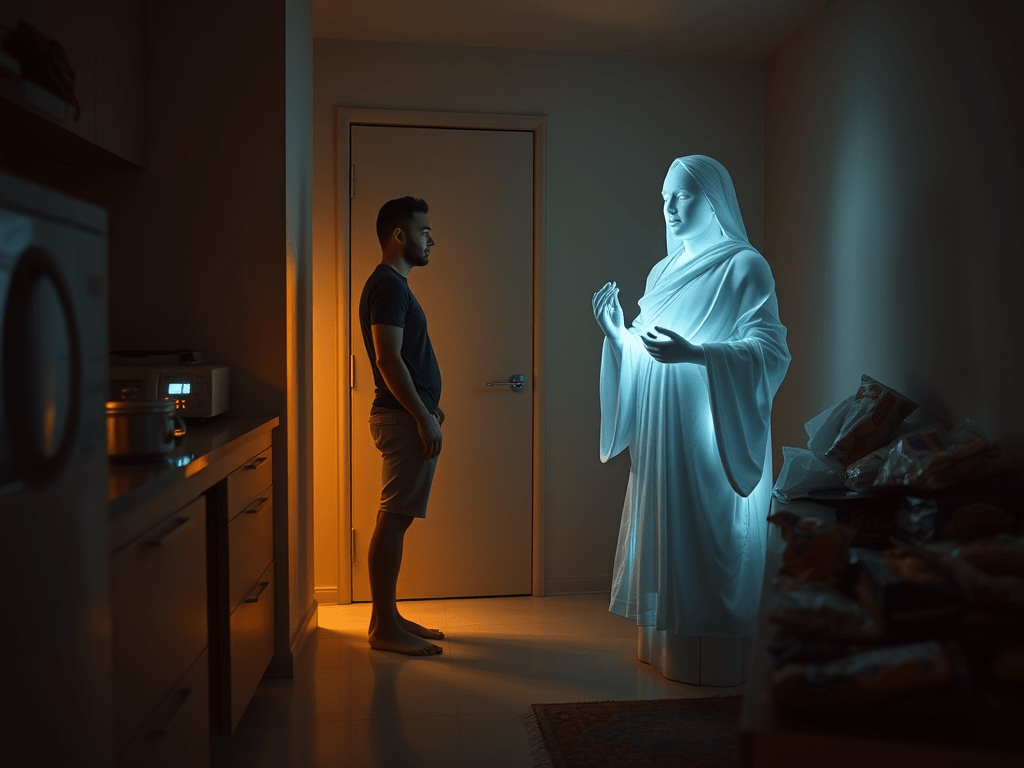
    I’m standing barefoot in the dim kitchenette of our Miami hotel room, illuminated by the dull glow of a microwave clock and the soft snoring of my family behind a paper-thin wall. I am overweight, overserved by anxiety, and currently marinating in a mix of guilt and existential fatigue. I miss Southern California, where I can at least pretend the ocean breeze is part of some reinvention montage.

    Then, out of nowhere—perhaps summoned by my elevated cortisol levels—my invisible guru appears. You know the type: part stoic monk, part irritated life coach, part inner drill sergeant with a taste for poetic slogans.

    He looks at me with eyes that have seen too many late-night snacks and says:


    “Repeat after me—less coffee, less food means more dignity. More focus, more humility, more gratitude, more work means less regret and despair. Are we clear?”

    It’s a slogan so clean and self-righteous it should be stenciled on a CrossFit wall. But fine, I play along. I nod. I even feel a flicker of hope—that slightly delusional warmth that hits right before you decide you’ll never eat bread again.

    But I level with him. “Look,” I say, “I love the aphorism. Truly. But here’s the problem. I forget everything the moment a cookie enters the room. My brain turns into a Vegas slot machine when I’m tired. There’s this compulsive, despairing little imp inside me who waits for just the tiniest whiff of sugar, sloth, or social media to hijack the controls and turn me into a ruinous parody of myself. What do I do with that guy?”

    My guru, undisturbed and frankly unimpressed, delivers the gospel:


    “As you live in accordance with the plan, you will grow stronger. The old ways will become repulsive. The deeper you root yourself in the good, the weaker the bad becomes. Got it?”

    I nod again. Less certain this time, but willing to try. Maybe it’s the humidity. Maybe it’s the quiet. Or maybe, just maybe, it’s the faint hope that I can still wrestle my wreckage into something resembling a life worth living.

    At the very least, I’ll try it out—until breakfast.

  • When Books Were Gods: Nostalgia for a Lost Era

    When Books Were Gods: Nostalgia for a Lost Era

    Alice Flaherty opens The Midnight Disease: The Drive to Write, Writer’s Block, and the Creative Brain with a quote from Roland Barthes: “A creative writer is one for whom writing is a problem.”

    Problem? That word hardly does justice to the affliction. A problem is misplacing your car keys or forgetting to pay the water bill. What I have is more like a life swallowed whole, a case study in obsession so severe it borders on the pathological. Writing isn’t just a habit; it’s an all-consuming parasite, a compulsion that, in a just world, would require a 12-step program and a sponsor who confiscates my pens at night.

    But since no one is shipping me off to a remote cabin with nothing but an axe and a survival manual, I’ll have to settle for less extreme interventions—like seeking solace in Flaherty’s musings on the so-called writing “problem.”

    As it turns out, my affliction has a clinical name. Flaherty informs me that neurologists call this compulsion hypergraphia—the unrelenting urge to write. In their view, I suffer from an overactive communication drive, a neurochemical malfunction that ensures my brain is forever churning out words, whether the world wants them or not.

    Yet Flaherty, a physician and a neuroscientist, doesn’t merely dissect the neurology; she also acknowledges the rapture, the ecstasy, the fever dream of writing. She describes the transformative power of literature, how great writers fall under its spell, ascending from the mundane to the sacred, riding some metaphorical magic carpet into the great beyond.

    For me, that moment of possession came courtesy of A Confederacy of Dunces. It wasn’t enough to read the book. I had to write one like it. The indignation, the hilarity, the grotesque majesty of Ignatius J. Reilly burrowed into my psyche like a virus, convincing me I had both a moral duty and the necessary delusions of grandeur to bestow a similarly deranged masterpiece upon humanity.

    And I wasn’t alone. Working at Jackson’s Wine & Spirits in Berkeley, my coworkers and I read Dunces aloud between customers, our laughter turning the store into a kind of literary revival tent. Curious shoppers asked what was so funny, we evangelized, they bought copies, and they’d return, eyes gleaming with gratitude. Ignatius, with his unhinged pontifications, made the world seem momentarily less grim. He proved that literature wasn’t just entertainment—it was an antidote to the slow suffocation of daily life.

    Before Dunces, I thought books were just stories. I didn’t realize they could act as battering rams against Plato’s cave, blasting apart the shadows and flooding the place with light.

    During my time at the wine store, we read voraciously: The Ginger Man, One Hundred Years of Solitude, Moravia’s Contempt, Camus’ Notebooks, Borges’ labyrinthine tales. We never said it out loud, but we all understood—life was a dense fog of absurdity and despair, and books were our MREs, the intellectual rations that kept us alive for another day in the trenches.

    Books were our lifeline. They lifted our spirits, fortified our identities, and sharpened our minds like whetstones against the dull blade of existence. They turned us into a ragtag band of literary zealots, clutching our dog-eared pages like relics, singing the praises of Great Literature with the fervor of the Whos in Whoville—except instead of roasting beast, we feasted on Borges and Camus.

    Which brings us to Flaherty’s lament: the Internet is muscling books out of existence, and when books go, so does a vital piece of our humanity.

    What would my memories of Jackson’s be without the shared reverence for literature? It wasn’t just a passion; it was the glue that bound us to each other and to our customers. The conversations, the discoveries, the camaraderie—none of it could be replicated by an algorithm or a meme.

    How can I not think of this in the context of a country still staggering through its post-pandemic hangover of rage, paranoia, and despair? Where the love of books has been trampled beneath an endless scroll of digital sludge, and where human connection has been reduced to strangers launching spiteful grenades at each other across social media—those lawless arenas ruled by soulless tech lords, their pockets fat with the profits of our collective decline?

    Flaherty confesses that her need to dissect the spark of writing—the thing that makes it so irrepressibly human—was an uncontrollable urge, one that made her question whether she suffered from hypergraphia, postpartum mania, or some deeper compulsion to explore what she calls the “Kingdom of Sorrow” after the devastating loss of her prematurely born twin boys. Her search for the root of her writing obsession reminded me of Rainer Maria Rilke’s advice in Letters to a Young Poet: the only writing worth doing is that which one cannot not do.

    Beyond hypergraphia—an affliction rare enough to keep it from becoming a trendy self-diagnosis—Flaherty also tackles the more mundane but far more common malady of writer’s block. She attributes it to mood disorders, procrastination, repressed anxieties, and perhaps a sprinkle of nihilism. I used to wrestle with writer’s block myself, particularly between short stories, back when I entertained the delusion that I might carve out a name for myself in literary fiction. But whenever I think of writer’s block, I think of the one person I’d most like to share a meal with: Fran Lebowitz.

    Lebowitz’s writer’s block has lasted for decades, so long, in fact, that she’s upgraded it to a “writer’s blockade.” If Blaise Pascal was an acid-tongued intellectual defending faith, Lebowitz is the sharp-tongued patron saint of the New York literati, delivering high-caliber cultural commentary with the precision of a diamond-tipped drill. That she doesn’t write is a cosmic joke. That people care she doesn’t write is part of her legend. That her off-the-cuff witticisms are more electrifying than most books in print makes her, without question, my literary idol.

    And yet, my devotion to Lebowitz only reveals the terminal nature of my writing affliction. If a genie granted me the chance to swap lives with her—to tour the world, bask in standing ovations, and deliver effortless, unfiltered cultural critique to sold-out crowds—but on the condition that I could never write another book, I would turn it down without hesitation. This refusal confirms the depths of my sickness. In this hypothetical scenario, books themselves are mere shadows compared to the brilliance of Lebowitz’s conversation. And yet, here I am, clinging to the shadows, convinced that somewhere in those pages, I will find the thing that makes existence bearable.

    Surely, no specialist can diagnose a disease like this, much less cure it.

    Reading Flaherty’s sharp and introspective book, I found myself circling a familiar question: is the urge to write both a pathology and a gift? This led me straight to The Savage God, A. Alvarez’s bleak yet compelling account of depression, suicide, and literature. Across history, writers afflicted by melancholy, madness, or sheer existential despair have been cast as tragic geniuses, indulgent sinners, or misunderstood romantics, depending on the prevailing religious and literary winds.

    Take Sylvia Plath, the confessional poet who sealed her fate at thirty, or John Kennedy Toole, the tortured author of A Confederacy of Dunces, who asphyxiated himself at thirty-one. Conventional wisdom holds that Toole’s despair stemmed from his inability to publish his novel, but Tom Bissell, in “The Uneasy Afterlife of A Confederacy of Dunces,” suggests a more tangled story—one of creeping paranoia and the pressures of academia, where Toole, at twenty-two, was the youngest professor in Hunter College’s history.

    Like his doomed creator, Ignatius J. Reilly is possessed by the need to write. His screeds, stitched together from the wisdom of Boethius, function less as arguments and more as the existential flailings of a man convinced that writing will bring him salvation. He writes because he must, the way a fish swims—to stay alive.

    Bissell’s most cutting insight isn’t about Toole’s life, but about his novel’s fundamental flaw: Dunces is riddled with indulgences—flabby with adverbs, allergic to narrative structure, and populated with characters so exaggerated they teeter on the edge of cartoonhood. He argues that Dunces is “a novel that might have been considerably more fun to write than it is to read.” This line stopped me cold.

    Why? Because Dunces was my Rosetta Stone, my gateway drug to the idea of becoming a comic novelist. And yet here was the brutal truth: the very book that set me on this path was a wreck of undisciplined excess. If Dunces ruined my life, it did so not because it failed, but because I absorbed its flaws as gospel. I inhaled its bloated exuberance, its unshackled absurdity, and made it my literary template.

    To undergo a religious experience from a flawed book is to risk a kind of artistic contamination—you don’t just inherit its brilliance, you inherit its sins. My writing compulsion is perhaps nothing more than Dunces’ worst tendencies metastasized in my brain.

    And so, as a recovering writing addict, I am forced to sit with this painful revelation and digest it like a bad meal—one that demands an industrial-strength antacid.

  • The Gospel According to Lalo: Watches, Inadequacy, and the Quest for a Better Self

    The Gospel According to Lalo: Watches, Inadequacy, and the Quest for a Better Self

    Yesterday, the tour bus wheezed to a stop and dumped us in Little Havana like a sack of reluctant tourists. We wandered through downtown under a punishing sun, the air thick with the scent of café Cubano and bravado. That’s when I saw him: a man who looked exactly like Lalo Salamanca, minus the drug empire—crisp white shirt, swagger in his step, and two kids in tow. He wasn’t just crossing the street; he was gliding, chin up, radiating unfiltered, unstudied masculinity. And he wasn’t alone. Little Havana was teeming with these men—fathers who looked like they’d stepped out of a sepia-toned photo labeled Pride, circa Always.

    Meanwhile, there’s me—63 years old, 30 pounds overweight despite daily exercise and good intentions. My daughters joke that I look like Charlie Brown, and not in the charming, animated special way—more in the “existential dread in khakis” sense. I don’t walk across intersections like Lalo. I trudge. And if I’m holding hands, it’s probably because I’m being led away from a pastry counter.

    But as I watched those fathers—their confidence, their presence—I began to realize the true pathology behind my watch obsession. I wasn’t just collecting watches. I was searching for transformation. If I could find the watch, the perfect timepiece, it might just alchemize my Charlie Brown soul into something closer to Lalo—proud, magnetic, quietly heroic.

    Enter the Seiko Astron Nexter—$1,700 of satellite-synced wizardry and horological lust. It gleams. It commands respect. It’s whispering, “Buy me, and become the man you were meant to be.” But let’s be real: I barely go anywhere these days. My public appearances are limited to grocery store aisles and accidental mirror encounters. I’m not a man about town; I’m a man about tuna salad and ibuprofen.

    At 63, how many years of wrist real estate do I even have left? How long before I’m just another well-accessorized ghost, my legacy a drawer of luxury regret? The whole ritual—buying, flipping, rationalizing, repenting—is starting to feel less like a hobby and more like a slow, polished breakdown. This isn’t taste. It’s compulsion with a tracking number.

    Maybe it’s time to quit. I’ve got five watches already—each one a chapter in the memoir of my delusions. Maybe the next chapter isn’t about adding to the collection, but about burning the altar down.

    Here’s a wild idea: make self-denial the new dopamine hit. Let the new obsession be calorie restriction instead of case diameter. Let others chase sapphire crystals and ceramic bezels—I’ll chase a slimmer waistline, a clean mind, and the kind of inner quiet no chronograph can measure.

    Because maybe happiness isn’t behind a glass display case. Maybe it’s not ticking on my wrist. Maybe it’s the empty space where the craving used to be.

    Still… the Astron is beautiful. And it would look damn good on Lalo.

  • Too Old for the Peacock Parade: Notes from a Miami Beach Exile

    Too Old for the Peacock Parade: Notes from a Miami Beach Exile

    From our apartment wedged beside a Hampton Inn in Miami Beach, the morning soundtrack is a symphony of honking horns—angry, insistent, and deeply personal, as if each driver believes their rage will somehow part the traffic like the Red Sea. I’m grateful we didn’t rent a car. Instead, we’ll wander on foot like civilized tourists and hop a trolley to today’s grand event: a five-hour tour of Miami’s greatest hits—its islands, its excess, and its curated chaos. Dinner and a boat ride are promised, which sounds either romantic or like a timeshare presentation with ocean views.

    For my family, it’s all new—the pastel Art Deco, the swampy opulence, the omnipresent scent of tanning oil and ambition. But for me, a native Floridian, this is a strange pilgrimage, a nostalgia trip filtered through Botox and Beats headphones. Miami hasn’t changed—it’s just doubled down. This isn’t a city. It’s a humid runway where the rich and surgically sculpted flex their flesh like currency. I feel like I’m attending a party I wasn’t invited to, wearing the wrong shoes and ten years too late.

    This morning, my wife and I walked the edge of the Atlantic, and I was struck by how different it smells from the Pacific. The Pacific has that cold, salty hush. The Atlantic? It smells lush—warm, sweet, almost suggestive. Like a pineapple cocktail is about to glide down from the clouds and whisper, “Welcome, darling.” There’s something in the air here that makes you believe life is one long poolside flirtation—until you check your bank account or your blood pressure.

    Still, I’m looking forward to going home. Say what you will about Los Angeles—it’s neurotic, performative, and addicted to traffic—but compared to Miami Beach, it’s practically Amish.

  • The Santa Claus of Donuts Must Die

    The Santa Claus of Donuts Must Die

    Let’s start with the obvious: your family bonds over food because food is reliable. It doesn’t argue with you about politics, it doesn’t criticize your life choices, and it doesn’t ask to borrow your car. It just shows up, warm and sugary, like a friend who never judges. And when you show up holding that pink box of donuts? You’re not just a guy walking through the front door—you’re the Santa Claus of Donuts, bearing gifts that turn your living room into a dopamine theme park. Everyone lights up. You are loved. You are admired. You are a hero.

    Until the sugar crash hits and you’re lying on the couch wondering how a simple box of pastries turned into a hostile takeover of your waistline. Again.

    You, my friend, have what polite society calls an “addictive personality,” but let’s not sugarcoat it (pun intended). You go overboard like it’s your patriotic duty. One treat turns into three. One bite into a blackout. You need boundaries, not Pinterest recipes.

    So here’s your prescription. It’s boring, brutal, and blessedly effective:

    Breakfast: Plain Greek yogurt, a scoop of protein powder, flaxseeds, chia seeds, and a handful of berries. Also, coffee. Strong enough to slap you awake and maybe shake loose some of your delusions.

    Lunch: A salad—yes, a salad—with actual protein in it. Maybe chicken. Maybe tuna. Add a scoop of cottage cheese if you hate joy a little less that day. Have some fruit so you don’t hallucinate cookies.
    Dinner: Protein again. Vegetables. Herbal tea, like the sad monk you are becoming. Cap it off with an apple and the faint memory of dessert.
    Snack Defense Protocol: If you start prowling like a raccoon between lunch and dinner, shove a carrot in your mouth, sip some green tea, and crack open a diet root beer. It’s not a thrill, it’s a strategy.

    And let us not forget why you had to slam the snack door shut like it owed you money: snacks are traitors. They pretend to be innocent little diversions—just a handful here, a nibble there—but they’re silent assassins. Those calories accumulate like guilt after a Vegas weekend, slowly padding your frame while you’re busy telling yourself you’re “cutting back.”

    Now, let’s address the hard truth, as spoken by the philosopher-king of overweight comedians, Tom Segura: “You don’t lose weight until you hate your fatness more than you love food.” Yes, it’s harsh. But he’s not wrong.

    Still, let’s reframe it with a little less bile and a touch more clarity:
    You won’t change until you prefer discipline to chaos. Until your craving for stability outweighs your need for a dopamine hit. Until your love of self-respect outweighs your love of Cheez-Its.

    You don’t need another meal plan—you need a code. A way of eating that doesn’t just fill your stomach, but recalibrates your priorities. Food is not your therapist. Food is not your friend. Food is fuel. And you? You’re not Santa Claus anymore. You’re something better: a man in control of his appetite, his identity, and his damn life.

    Now go make that yogurt bowl like it’s a holy ritual and not a punishment. The rest will follow.

  • An Argument for Healthy Denial: A Self-Help Sermon for the Self-Indulgent

    An Argument for Healthy Denial: A Self-Help Sermon for the Self-Indulgent

    Let’s be honest. You’ve tried the soft-glow Instagram mantras and the overpriced journaling apps. You’ve danced with dopamine like a lab rat in a Vegas casino, chasing every ping, snack, scroll, and retail hit like it was divine revelation. And where has it gotten you? Nowhere worth photographing.

    So here’s your wake-up call, preacher-style, minus the tambourine: take care of your damn self. Not in that syrupy “self-care” way that means binge-watching prestige TV while mainlining DoorDash and calling it therapy. No, I mean the kind of care that involves discipline, boundaries, and strategic discomfort—also known as healthy denial.

    Phil Stutz is right: your relationship with your body, your soul, and the people around you depends on your ability to say “no” like your life depends on it—because it does. Not “no” out of self-loathing or ascetic performance art, but “no” because you actually give a damn about the human being you’re becoming.

    You don’t skip the donut because you hate yourself. You skip it because you respect yourself enough not to let your biology, your boredom, or your bastardized idea of “treat culture” run your life. You are not a French bulldog in a baby stroller. You are a fully grown adult with responsibilities and, presumably, a spine.

    And no, this isn’t some narcissistic glow-up project. You’re not chiseling your abs to become a thirst trap or launching your “healing journey” vlog. This is not a TED Talk in the making. This is about getting better because the people who count on you deserve more than your bloated, distracted, half-baked self. Society doesn’t need another dopamine junkie sucking on algorithmic pacifiers while pretending to be “living their truth.”

    Yes, some will tell you denial is toxic, puritanical, even abusive. These are the same people who believe “treating yourself” five times a day is a human right. But let’s get something straight: healthy denial is not self-hatred—it’s self-respect with a steel backbone. You deny yourself garbage because you’re aiming for gold. You crave meaning, not just muffins. You want to die with fewer regrets, not a legacy of half-eaten potato chips and unread terms of service.

    So here’s what you’re going to do.
    You will stop snacking. Period.
    You will stop scrolling like a brainless peasant begging for dopamine crumbs from tech oligarchs.
    You will stop curating materialistic trinkets—yes, even the “limited edition” timepieces—and broadcasting your conspicuous consumption like a status-starved magpie.

    Instead, you will create.

    You will write.
    You will make music.
    You will work out with the devotion of a monk in a burning temple.
    You will show up for your family like it matters—because it does.
    And you will treat your time on this spinning sphere not as an entitlement but as the limited-edition miracle it is.

    This is not about being better than others. This is about being better for others. And if that sounds corny to you, maybe you’ve been swimming in irony so long you’ve forgotten what sincerity feels like.

    Here’s your new gospel: eat clean, think clearly, serve humbly, and waste nothing—not even time.

    Now get to it. The clock is ticking, and you’re not getting any younger.

  • The Night Irony Beat the Monkees

    The Night Irony Beat the Monkees

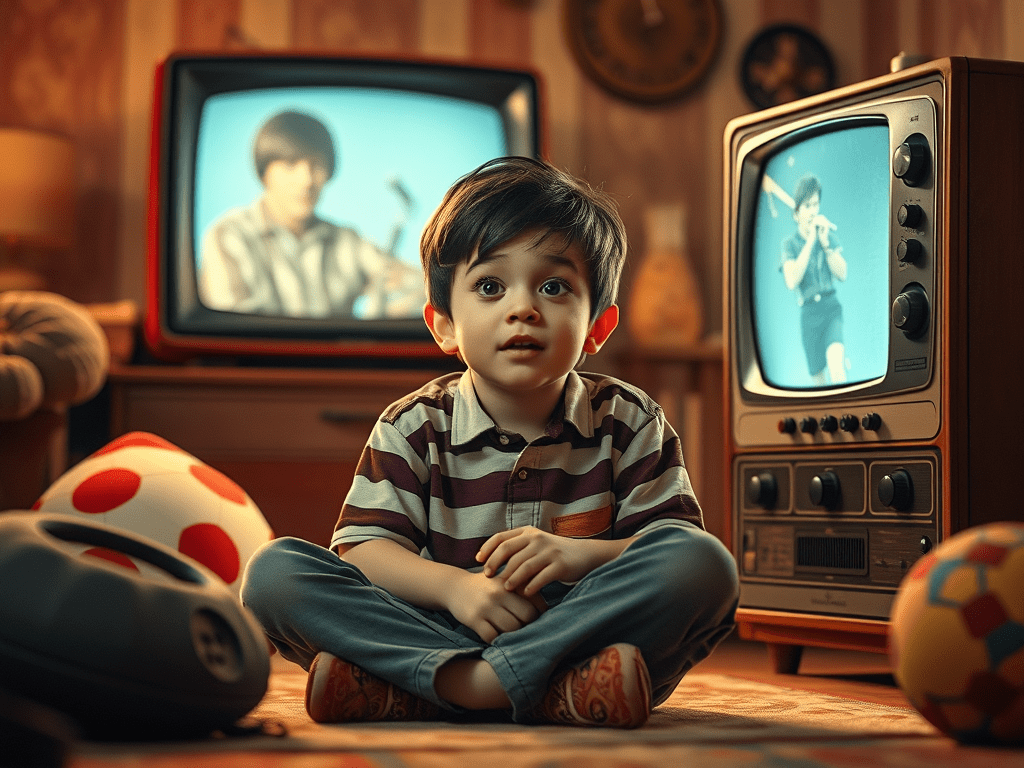
    On the night of October 16, 1967—just twelve days shy of my sixth birthday—the universe shoved my head in the toilet and flushed. I could hear the sound of childhood innocence circling the drain. Up to that moment, I was a full-time subscriber to the gospel of positive thinking. Life was fair. Good guys won. If you tried hard and smiled big, the world smiled back. Norman Vincent Peale had basically written the owner’s manual for my inner world.

    That illusion shattered during an episode of The Monkees.

    The episode was called “I Was a 99-lb. Weakling,” and I had parked myself cross-legged in front of the TV, popcorn in lap, expecting hijinks and musical numbers. Instead, I got a masterclass in betrayal and the savage laws of ironic detachment. My hero, Micky Dolenz—the clumsy, lovable soul who made failure seem like a jazz solo—was brutally outmuscled by Bulk, a flexing monolith of a man played by real-life Mr. Universe, Dave Draper. Bulk didn’t walk—he heaved himself through scenes, a sculpted rebuke to every noodle-armed dreamer in America.

    And right on cue, Brenda—the beachside Aphrodite with hair that shimmered like optimism—dropped Micky like a sack of kittens for Bulk, never once looking back.

    This wasn’t just sitcom plot; this was emotional sabotage. I watched, frozen, as Micky enrolled in “Weaklings Anonymous,” embarking on a training montage so grotesquely absurd it veered into tragedy. He lifted dumbbells the size of moon rocks. He drank something called fermented goat milk curd, a substance that looked like it had been skimmed off a medieval wound. He even sold his drum set—his very soul—to chase the delusion that muscles would win her back.

    And then came the twist.

    Just as Micky completed his protein-fueled crucible, Brenda changed her mind. She didn’t want Bulk anymore. She wanted a skinny guy reading Remembrance of Things Past. A man whose pecs had clearly never met resistance training, but whose inner life pulsed with French ennui. The entire narrative pirouetted into absurdity, and I watched my belief system crack like a snow globe under a tire.

    That’s when I first met irony.

    Not the schoolyard kind where someone says “nice shirt” and means the opposite—but the bone-deep realization that the universe isn’t fair, that effort doesn’t guarantee reward, and that life doesn’t play by the moral arithmetic taught in Saturday morning cartoons.

    It was that night I realized muscles weren’t the secret to power—language was. Not curls, not crunches, but craft. Syntax. Prose so sharp it could reroute the affections of beach goddesses and turn the tide of stories. That was the moment my childish faith in “try hard and you’ll win” collapsed, and in its place rose a darker, more potent creed: the pen is mightier not just than the sword, but than the bench press.

    That night, my writing life began—not with celebration, but with betrayal. A glittering lesson delivered in the cruel, mocking tone only irony can wield. And though it hurt, I never forgot it. Because the truth is: irony teaches faster than optimism. And it remembers longer, too.