Blog

  • Qodosen DX-286: Purchased Twice, an Update

    Qodosen DX-286: Purchased Twice, an Update

    (originally posted on my Herculodge blog (on the defunct Typepad platform. I’m including an update on this post.)

    The Qodosen DX-286 arrived last Sunday, Day 5 of the Los Angeles Fires, and I wasted no time putting it under the microscope. I scrutinized its build quality, tested its FM and AM performance, and after some thoughtful listening, I decided it was going back.

    To be fair, music sounded pleasant enough on the small mono speaker—soft, inoffensive, like background noise in a coffee shop. But voices? Hollow, thin, and oddly distant. It quickly became clear that this radio would only be tolerable if tethered to a pair of headphones. As for the physical design, the kickstand and battery door felt flimsy, as if one wrong move would snap them clean off. They inspired about as much confidence as a paper umbrella in a hurricane.

    AM reception? Surprisingly solid. FM? Good but not amazing. Despite all the hype about the Qodosen’s so-called super-powerful radio chip, it was no better than the Degen/Kaito 1103 I had over a decade ago. Sure, it effortlessly locked onto 89.3 from Pasadena, but it fumbled with the weaker college station 88.9, struggling like a kid lifting his first dumbbell.

    That’s when it hit me: I was never going to fall in love with this pint-sized radio. It felt like driving a rattling Mazda Miata through a wind tunnel—fun in theory, but exhausting in practice. So, I packed up the Qodosen and sent it back. I don’t blame Qodosen. I blame my unrealistic expectations and my failure to realize I didn’t want a radio this small for my bedroom. 

    In its place? The Tecsun PL-990X. Seven and a half glorious inches of luxury radio, a true cruiser compared to the jittery compact Qodosen. Don’t get me wrong—the DX-286 is a decent radio. I just realized I wanted something bigger, smoother, and built for the long haul. 

    Update:

    I rebought the Qodosen about a month after writing my original Herculodge review. I realized the speaker is excellent, its AM is superior to my Tecsun radios, and that it’s a keeper. One issue: The kickstand broke, so I play it flat on its back.

  • How I Tricked Myself Into Reading Dostoevsky

    How I Tricked Myself Into Reading Dostoevsky

    The irony gnaws at me: I’ve been a college writing instructor for forty years, yet thanks to what I’ll politely call “Internet poisoning,” I can barely read anymore. In the ’80s, I devoured Nabokov the way bodybuilders slam protein shakes—voraciously, obsessively, as if prose itself were anabolic fuel. Now? Most books I start end up abandoned halfway through, like gym memberships in February.

    It’s not just the degraded Internet brain. There’s a physical component, too. Try cracking open a hard copy of Dostoevsky—his books are printed in fonts so microscopic they might as well be Morse code. But last night, I pulled a stunt: Crime and Punishment on my Kindle app, magnified in glorious large print across my 16-inch laptop. And I thought, “Hey, this isn’t half bad.” Almost breezy. Practically Dean Koontz with Russian orthodoxy.

    Sure, it’s lugubrious. A brooding, handsome nihilist—today we’d label him an Incel—is plotting a crime that amounts to little more than a cry for a hug. Why did Dostoevsky obsess over this guy? What subterranean morbidity haunted the man?

    So I play my mind a trick. I whisper: “This isn’t Russian gloom. This is metaphysical pop fiction. Dean Koontz with samovars.” That little spoonful of honey lets me swallow the medicine.

    Maybe next I’ll tackle Demons. Then The Brothers Karamazov. Then The Idiot. And who knows? I may one day become a Dostoevsky scholar—simply by convincing myself I’m binging airport thrillers.

  • Safari Hats and Leviathan Eyes

    Safari Hats and Leviathan Eyes

    Last night I dreamed my wife and I were walking along a South African beach at twilight, the sky streaked with salmon and violet, the horizon shimmering as if we had stumbled into a myth rather than a place on any map.

    The coastline was no ordinary shore. Instead, a massive conveyor belt rattled along the sand, carrying an endless parade of women from every corner of the globe. Each time one of them reached my wife, the belt shuddered to a halt. The woman—frumpy, froggy, apologetic, swaddled in baggy safari khakis and hats that looked like they had been flattened in a suitcase—would plead for my wife’s opinion on her outfit.

    With gentle authority, my wife made her adjustments—a tuck here, a trim there—and declared the woman presentable. At once, the supplicant would bow effusively, glowing with gratitude, before the conveyor belt whisked her off into the twilight. This was my wife’s destiny, her sacred vocation, and she bore it with effortless grace.

    Behind us, the ocean brooded. From the waves, leviathan shapes drifted in the gloom, colossal witnesses to this human pageant of absurdity. Their eyes glowed with the cold contempt of ancient gods, as if to say: This is what civilization amounts to—hats and hemlines, endlessly corrected.

    The dream inspired me to write a song this morning, “The Sadness of Summer Fashion”:

  • When Music Turns Against You

    When Music Turns Against You

    Nearly twenty years later, I’m still haunted by a radio interview with a musician whose name I’ve long forgotten. She wasn’t a star, but she’d carved out modest success as a songwriter and performer—until she stopped cold. Her lifelong depression had once been soothed by music, but eventually the very act of making it turned corrosive. What had been balm became poison. The emotions beneath her songs were too raw, too jagged to face. She not only put down her guitar; she banished all music from her life. While others found sweetness and solace in melody, she heard only torment. For her, silence was the only refuge. She spoke as someone exiled, barren, cut off from a source of joy she could never imagine welcoming back.

    Most music, for me, carries happy and nostalgic weight. When a song pulls me back to a moment when I was unbearably lonely or making a fool of myself, I may wince—but I don’t hold the song responsible. Instead, I value it as a powerful marker, a bookmark that divides my life into bold chapters, each melody reminding me exactly where one ended and the next began.

  • Beyond Believers and Unbelievers

    Beyond Believers and Unbelievers

    In Reflections on the Existence of God, Richard E. Simmons insists on a binary vision of reality: you either believe in God through the Judeo-Christian tradition, or you reject God altogether, joining the ranks of atheists in the mold of Freud or the New Atheists. A committed Christian, Simmons even agrees with atheist Sam Harris that “atheism and Christianity compete on the same playing field.” In this framing, the contest is nothing less than a duel for human souls, with consequences both temporal and eternal. As Simmons puts it: “The question of God’s existence, in my opinion, is the most significant issue in all of life.”

    Drawing on Armand Nicholi’s The Question of God, which stages a philosophical match between C.S. Lewis and Sigmund Freud, Simmons argues that if Lewis is wrong, then Freud must be right: the universe is empty, silent, and loveless. In that case, we are forced to embrace this “harsh reality,” stripping away “false hopes and unrealistic expectations.”

    But Simmons’ stark either/or feels more like caricature than clarity. Not all who reject Christianity are Freud’s disciples. Many non-Christian seekers believe in benevolent spiritual forces larger than themselves. Phil Stutz in The Tools and Steven Pressfield in The War of Art both describe transcendent realities—love, creativity, solace—that hardly resemble Freud’s existential bleakness.

    Even within Christianity, belief is hardly monolithic. The theology of a Calvinist and that of a Universalist are galaxies apart. To affirm substitutionary atonement is to worship a very different God than the believer who rejects it. The label “believer” is too blunt to capture these divergences. Hyam Maccoby, the Jewish scholar who wrote The Mythmaker: Paul and the Invention of Christianity, is a believer in God, yet he spends his book dismantling Paul, another believer. Sometimes believers are harsher with each other than with atheists.

    Framing the world as a cosmic battlefield of believers versus unbelievers oversimplifies both camps. Reality is more complex, and spiritual life cannot be reduced to an either/or ultimatum.

  • Maybe There’s a Friendship Renaissance Waiting for Retirees, Or Maybe There Isn’t

    Maybe There’s a Friendship Renaissance Waiting for Retirees, Or Maybe There Isn’t

    In a recent conversation with Mike Moynihan on The Moynihan Report, media analyst Doug Rushkoff described social media life as a kind of self-inflicted madness: we willingly lobotomize ourselves into shrill binaries, flattening nuance until the “other side” is little more than a demon enemy. His words echoed Jaron Lanier’s decade-long dirge about how the online hive mind debases us into cheap caricatures.

    After fifteen years inside this funhouse, I can vouch for Rushkoff. Chasing likes and subs is a direct pipeline to despair. The algorithm isn’t designed for truth or connection — it’s a slot machine that spits out dopamine crumbs in exchange for outrage and hype. And yet, podcasters like Rushkoff and Moynihan point to a counterargument: in the right hands, social media can host intelligent conversations. But it’s a fragile victory, like surviving on a vegan diet — possible, but you’ll work twice as hard and swallow twice as much chalk.

    Socially, though, the medium is barren. Scroll long enough and the promise of “connection” curdles into loneliness.

    This hits me harder as retirement creeps closer — twenty-one months and counting. I’ve spent forty years teaching face-to-face, and I’ll miss it desperately. This semester I have student-athletes: sharp, disciplined, driven, engaging. Those classroom connections have been the marrow of my career, and they won’t be replicated by a Facebook feed.

    I’ll still have a family. I’ll still have two best friends in Torrance. But unlike my wife, who maintains a weekly social circuit of concerts, trips, dinners, and parties, my friendships are skeletal. Months-long “friendship fasts” punctuated by rare meetups. Husbands, as the cliché goes, lean too heavily on their wives for connection — a weight she may already feel pressed under. An isolated husband becomes a burden.

    You reap what you sow. Neglect friendships for decades, and you retire into isolation, wondering if you can still course-correct. Maybe it’s too late. Maybe habit calcifies into solitude.

    Or maybe not. Maybe there’s a friendship renaissance waiting out there: gray-haired amateur philosophers huddled at gritty diners, pickleball warriors at dawn, retirees solving the world over coffee. Maybe the beach yoga crowd will embrace me.

    Or maybe that’s just wishcasting. We’ll see.

  • SZA in Our House: Why My Daughters and I Sigh When Taylor Swift Comes On

    SZA in Our House: Why My Daughters and I Sigh When Taylor Swift Comes On

    In my freshman writing class, I recently staged a little spectacle about thesis statements. To illustrate contrast, I pulled out two cultural heavyweights: SZA and Taylor Swift. Hyperbole was the hook. My admiration for SZA was real; my critique of Swift was exaggerated for theatrical effect. Still, my tirade sounded more like a roast than a teaching tool:

    “While Taylor Swift may rack up 25% more Spotify streams than SZA, numbers don’t tell the whole story—unless, of course, you mistake a stadium chant for art. SZA sings with depth and raw emotion, while Swift wheezes through her catalog like an underfed Victorian orphan. SZA’s sound is bold, kaleidoscopic, and alive, drawing from the lush soul of the ’70s. Swift, meanwhile, serves up limp sonic garnish—music with the texture and excitement of a wilted celery stalk rescued from beneath the fridge. SZA makes adult art; Swift makes musical mac and cheese for the kid’s menu at Chili’s.”

    In reality, I don’t think Swift is a wasteland of celery stalks and Victorian wheezing. I admitted to my students that Swift is likely a good person, a competent artist, and that I wish her well. My guilt lingered, though. Bombast is a teaching trick, but sometimes the fire singes the wrong target.

    That guilt sharpened when I stumbled across Spencer Kornhaber’s “How Did Taylor Swift Convince the World That She’s Relatable?” over morning coffee. One line hit me like a cold shower: “The most consequential American singer of the past 20 years, Swift can claim commercial achievements that equal or surpass those of the Beatles, Madonna, and Michael Jackson.”

    Relatability is her true superpower. Swift has broadcast her heartbreaks, doubts, and longings in ways that make her sound like a big sister or Greek chorus to her fans’ lives. Her brand isn’t just pop—it’s therapy with a backbeat.

    Kornhaber nails it: “Listening to a Swift song is like eating a candy bar that transmits a personal essay into your memory. If you eat enough candy bars, it becomes a novel, and then a series of novels, and then (this is when you become a Swiftie) a virtual-reality, open-world video game you play with friends and strangers.” It’s a metaphor that could apply to any great artist. I thought of The Truman Show, where daily life becomes the commodity, the spectacle, the art.

    Swift deserves her accolades. She is a master craftsman of polished, radio-ready memoir-pop. But her songs still strike me as a touch bland, like a dependable frozen dinner—satisfying but forgettable. My twin daughters agree. When a Swift track seeps out of SiriusXM Coffee House, we sigh in unison and silently wish it were SZA.

  • The Sandwich Shop of Eternal Regret

    The Sandwich Shop of Eternal Regret

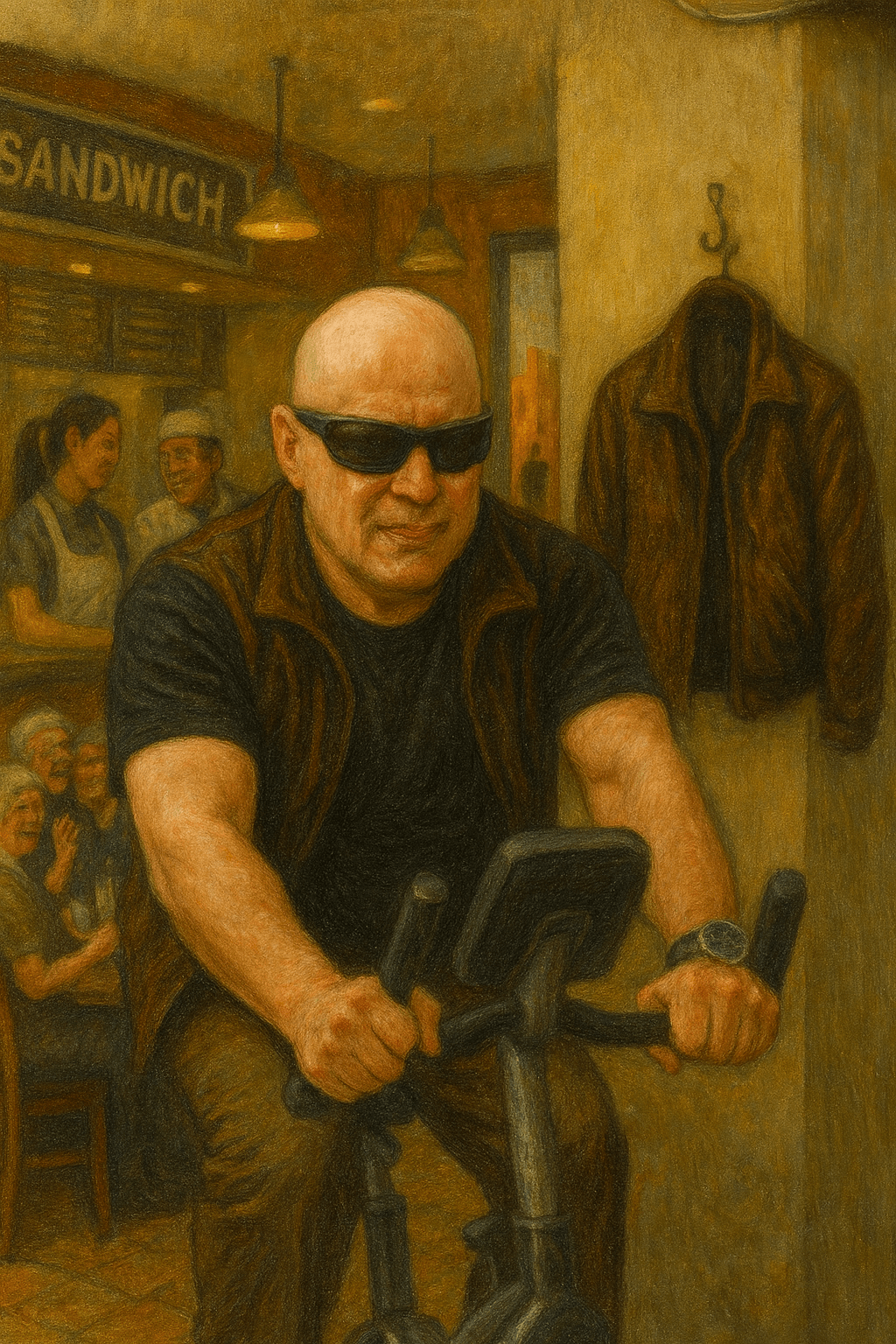
    Last night, I dreamed I retired too early, lost my tenure, and found myself cobbling together two humiliating jobs to survive. By day I was a part-time writing instructor, hustling between second-rate colleges. By night I was reduced to a takeout delivery boy for the sandwich shop where my wife cheerfully worked.

    If there was a silver lining, it was this: while waiting for her to assign me deliveries, I could pedal furiously on a stable of exercise bikes provided by the restaurant. Because, naturally, this wasn’t just a sandwich joint — it was part health club, part tourist mecca. At one point, a gaggle of Danish tourists descended, cackling in a booth for hours, treating the sandwich shop as though it were the Eiffel Tower of their itinerary.

    My wife flourished. She collaborated with the shop’s original owners, a warm couple from Hong Kong, brainstorming new sandwiches and ambitious upgrades, while I sweated like a condemned man on the bikes. Fortunately, I had a secret weapon: a dark brown leather jacket with supernatural properties. Each time I donned it before a delivery, every bead of sweat, every impurity, vanished as though I’d been baptized anew.

    But there was more. To scrape together a living, I also moonlighted in a third job — mysterious manual labor in a basement with a nameless partner. To reach this purgatory, I rode a bus into the “forbidden city,” a nightmare realm painted in muted oranges, where the architecture sulked in jagged, miserable shapes and its citizens were shackled to endless toil. It was a geometry lesson in despair.

    I was heartsick, regretting my decision to retire early. Only when the bus carried me back to the sandwich shop did relief arrive. There, I could mingle with long-lost friends and international tourists, ride the exercise bikes, and cling to the reassuring thought that my leather jacket would always purge me of sweat and shame.

  • The Pea Protein Plague

    The Pea Protein Plague

    For three days, I flirted with the fantasy of going vegan in the protein department. Out went my dependable whey; in came Orgain’s peanut butter-flavored vegan powder ($32), built on the gritty backbone of pea protein. Waiting in the wings was OWYN Pro Elite in dark chocolate ($47), still sealed, still smug.

    But curiosity didn’t last. It curdled into resolve — the kind of resolve born from three days of gut-twisting cramps so vicious they stole my ability to work out. Imagine the irony: my protein obsession, meant to fuel training, knocked me out of the gym entirely. Not just any protein, but vegan protein, embraced in part to end my petty larceny of cow’s milk from calves. My humanitarian mission dissolved in a haze of bloating and despair.

    So I texted my neighbor Holly, handed over $80 of organic powders, and felt as if I were banishing demons. She was delighted. Her family loves vegan protein powder for their smoothies. I was both exorcised and relieved. Good riddance to powders that turned my insides into a war zone.

    Looking forward, I’ll still be a thief — but only a petty one. A scoop of whey stirred into my morning buckwheat groats. Two modest helpings of plain Greek yogurt with honey at lunch and after my nap. A splash of stolen milk here and there. I hope the calves understand: my theft is not egregious, just survivable.

    Still, my diet is 90 percent plants, enough to keep my conscience propped up. My protein intake will slide from 180 grams to about 140, and so be it. I’ll trade hypertrophy for digestive peace.

    Because let me say it clearly: some of us must never touch pea protein again. It expands inside us like an alien organism, leaving us to wish for death’s consoling embrace. Never again.

  • When the Levees Broke, So Did the Nation

    When the Levees Broke, So Did the Nation

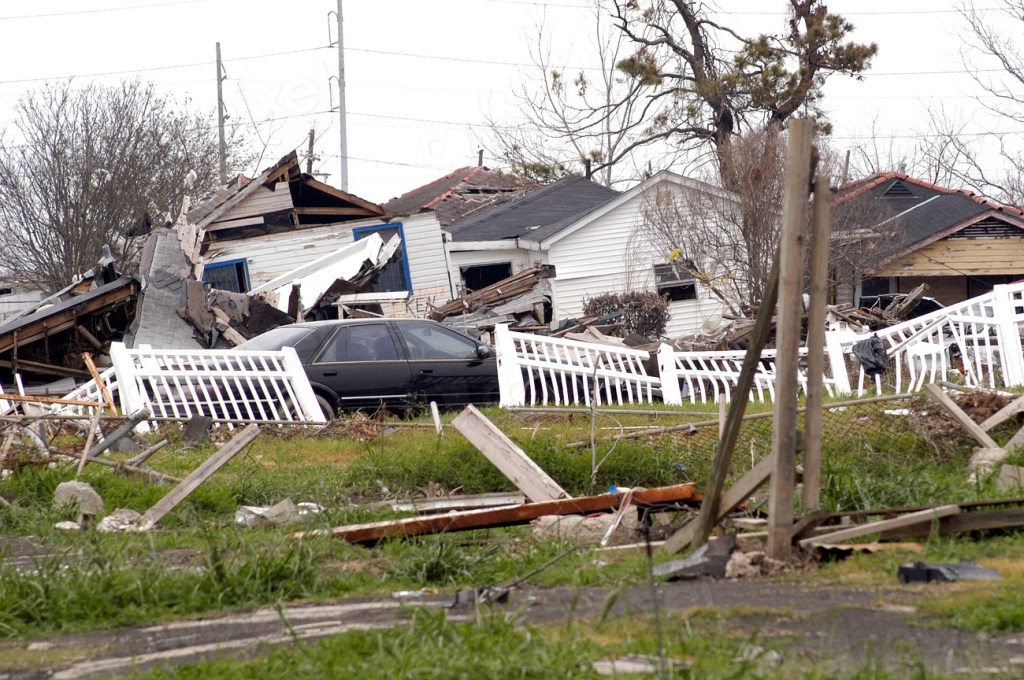
    The documentaries Hurricane Katrina: Race Against Time (Hulu) and Katrina: Come Hell and High Water (Netflix) are searing indictments as much as they are testaments to survival. They tell the story of a singular city—New Orleans, a cultural jewel—betrayed and abandoned by its own nation.

    Told through the voices of those who endured the storm in 2005, these films lay bare a fourfold sin against the people of New Orleans.

    First sin: red-lining. Decades of discriminatory housing policies corralled Black families into neighborhoods below sea level—neighborhoods left exposed to catastrophe—while white families secured higher, safer ground. Yet out of this coerced geography bloomed community, kinship, jazz, art, and a way of life so distinctive that New Orleans became not just a city but a state of mind.

    Second sin: neglect. The protective marshlands were carved away, the levees shoddily built, the safeguards ignored. What should have been natural resilience was dismantled piece by piece, until a storm became a man-made massacre.

    Third sin: abandonment. When the waters rose, thousands of citizens waited for rescue that never came. They suffered hunger, thirst, illness, despair. Bureaucracies paralyzed by incompetence and poisoned by political rivalry left them stranded—leaders too intent on humiliating one another to save lives.

    Fourth sin: defamation. Media outlets, infected with racism, painted Black survivors as looters and criminals while white survivors were depicted as resourceful and brave. Rumors of sniper fire and marauding gangs turned aid missions into militarized standoffs, with the National Guard pointing rifles at the very people they were sent to save. These lies fueled white vigilantes who hunted Black residents as if the collapse of law gave them license to kill.

    This fourfold betrayal is almost unbearable to watch, yet threaded through the grief is a resilient beauty: the music, the food, the language, the humor, the love of place that make New Orleans irreducible. Katrina remains one of America’s most shameful chapters—but also a reminder that the soul of New Orleans is larger than its wounds.