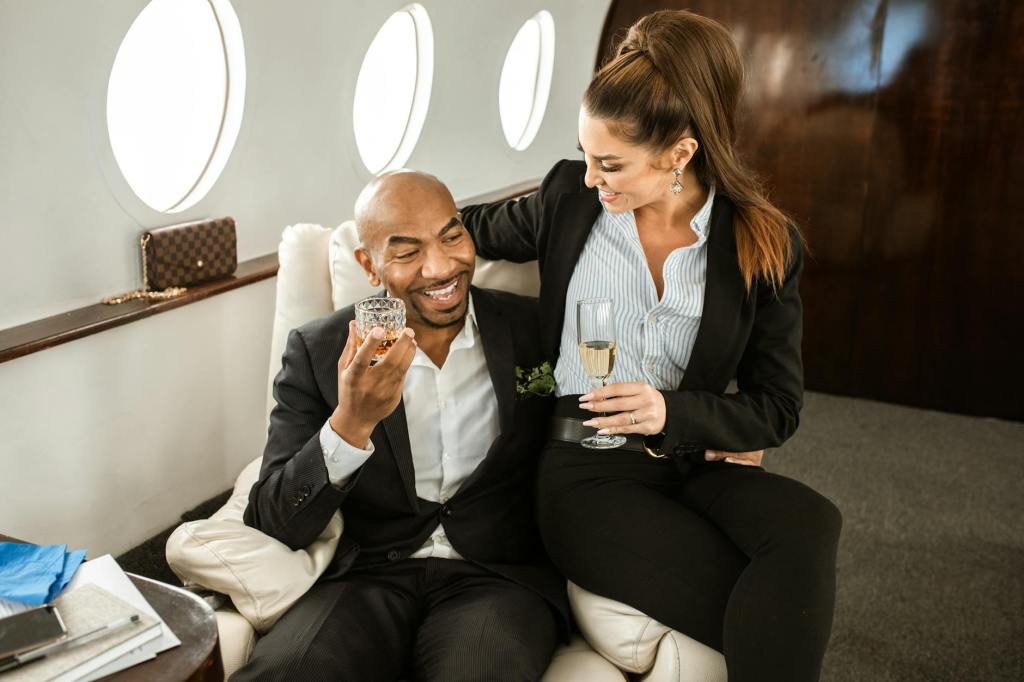
I was born in America in 1961, and if I had to explain this country to a foreigner in one image, I wouldn’t reach for the flag or the Statue of Liberty. I’d point to flying first class. Not the policy of it, not the logistics—just the concept. First class is America in an airline cabin. It grabs you by the collar and says, This is how we do hierarchy. We don’t hide it. We parade it down the aisle.
Yes, we have our obnoxious luxury cars and coastal dream houses, but nowhere is class difference so intimate as on an airplane. You’re breathing the same recycled air as the people sipping champagne up front. You share the same narrow aisle, the same claustrophobic bathrooms, the same airborne flu incubator.
The difference is ceremonial. The first-class passenger is already settled—wrapped in a sherpa blanket, nibbling brie, greeted by flight attendants who address them the way courtiers addressed minor royalty.
Then comes the procession: coach passengers filing past, stealing glances, marching toward the back where crying babies, bare feet with ambitious toenails, and circulation-threatening seat pitch await. This is the real luxury—not the champagne, but the ceremony and the choreography. The pleasure is sharpened by contrast. As a first-classer, you’re not cruel. You don’t wish misery on anyone. But your comfort glows brighter because someone else is uncomfortable ten feet away.
And that glow whispers. Not “you’re lucky.” Not “you’re comfortable.” It whispers the more dangerous phrase: you’re special. That’s the real drug of first class—not legroom, but psychological elevation. The sense that you cracked some hidden code of life, that you’ve unlocked a cheat mode where ordinary frustrations can’t touch you.
I once heard a comedian joke that in a plane crash, first-class passengers would survive while the rest of us perished. It’s absurd. And yet… it sounds exactly like something we want to believe.
This is America. You don’t just earn money here. You earn the right to hear that whisper.
I’ll confess something anticlimactic: I flew first class once, in 1994, thanks to my father, who sent me to his condo in Maui. I remember almost nothing about it. No ecstasy. No glow. Maybe I suffer from flight anhedonia—the inability to experience joy at 30,000 feet.
But I have felt the first-class sensation elsewhere. A friend once let me borrow his Omega Planet Ocean. I wore it to Trader Joe’s and found myself standing in line with organic arugula and the faint, ridiculous thrill of superiority. A luxury watch did what a luxury airline seat never could.
I could afford such a watch. I owned a Tudor Black Bay once. I sold it quickly, like someone who realized halfway through a costume party that he’d come dressed as the wrong person.
Now I’m sixty-four, and the urge to gloat has evaporated. I don’t want status anymore. I want clarity. I want restraint. I want a temperament that doesn’t need applause from inanimate objects. Wearing an expensive watch I don’t need feels less like success and more like cosplay—me auditioning for the role of a man who’s made it. The problem is, I know the actor too well. Under the costume is not a titan of confidence but an anxious, fractured soul with the spiritual DNA of Franz Kafka and the comedic timing of Richard Lewis. No amount of Swiss engineering is going to fix that. And pretending otherwise would only make me feel like a fool in very fine clothes.

 Cinemorphosis