Tag: antennas

  • Blast from the Past: From Russia with Love: Angelo’s Ocean 214 Radio

    On the topic of radios with a wooden case…presenting the Ocean 214—from Russia with love!  I bought it from a seller in the Ukraine, so shipping was on the high side, but surprisingly, I didn’t have much competition bidding on the radio.  I’ve been wanting to try a Russian/Soviet radio for quite a while, but simply couldn’t get excited about the VEF series, because…how can I put this nicely…”they ugly…butt ugly!” 

    The VEFs look like a big block of plastic with little or no imagination in the design.  They might be great performers and high quality—I don’t know, because I’ve never played with one—but I’m not excited by the looks.  Enter the Okeah—I saw a couple different ones from this manufacturer, and settled on the 214.  I like the wooden case and the various surfaces and colors used to make up the package. 

    Mine is in good shape except for an antenna problem—the smaller top portions of the antenna pull out of the base.  But it still receives well on all bands.  Oh, but that’s the other problem—the writing is in Russian and I’m totally unfamiliar with the frequencies they use.  So I push buttons and turn knobs until I hear people talking or I hear music.  It’s an adventure. 

    The sound is good—in a way, similar to my Lloyd’s, supporting the argument that the wooden cabinet does have its own sound.  In fact, the Okeah has more tone controls to play with and I can get a very satisfying deep sound for music, or a clearer, high pitched sound for talk.  The shortwave bands do pull in stations nicely as well.  I’m still figuring things out with regard to how these bands translate from radios I’m used to using.

    I can recommend this radio if you have interest in getting an Eastern European manufactured radio.  From the little I could find on Google, it seems the factory for this brand might be located in Belarus.  There is much more information on VEF, who must have been a much bigger company.  But I like the Okeah—I like the looks, I like the woodgrain and I’m satisfied with the performance.  I will say that it appears to be old, and wasn’t babied as it was dirty when I got it, and apparently not extremely well maintained.  But a few shots of tuner spray brought it to life and it sounds great.  At some point, I might try my luck on E-Bay to see if I can turn a profit.  But for now, I’m having too much fun with the radio.   

  • Blast from the Past: Grundig Satellit 750

    IMG_3672


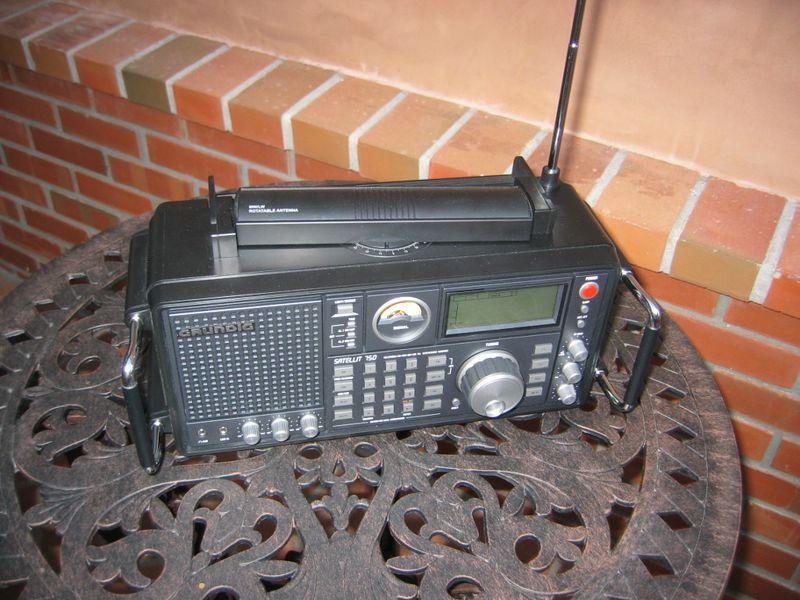
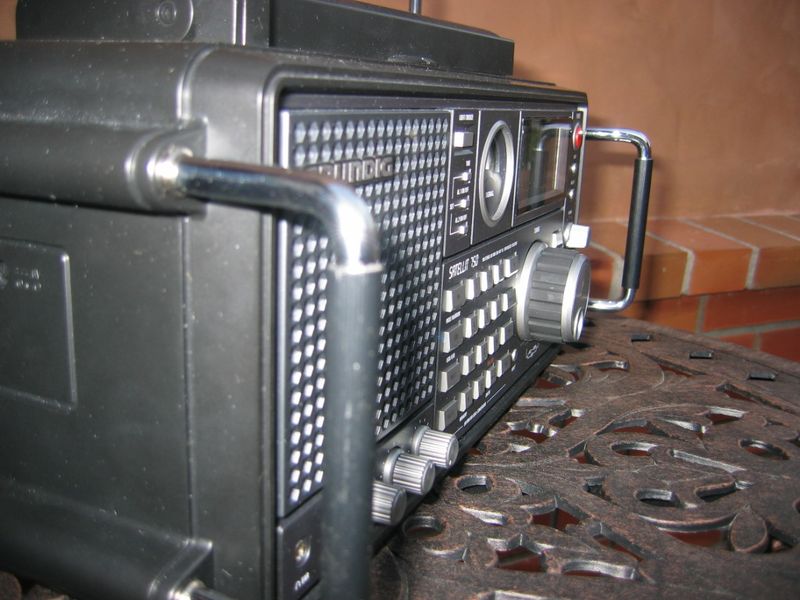
    Greg, a reader from Ann Arbor, Michigan, was kind enough to Fed Ex me his Grundig Satellit 750, which has a Kiwa speaker upgrade. Therefore, I have to assume the stock 750 speaker sound has less fidelity than the one I’ll be using by my bedside for the next two weeks. 

    As I will be using the 750 as a bedside radio, I’m not too worried about fidelity since I’m not cranking the thing up by any means. All that I ask is that its AM sound not be as harsh and punishing as my C.Crane CSW. Thankfully, the 750 is easier on the ears. 

    IMG_3674

    When I took out the 750, I was amazed like other Tecsun radios at how light the radio is (Tecsun makes many Grundig and Eton radios, including the GS750). I prefer my radios to be heavy like tanks, which is why several months ago I went on a vintage radio spree, getting my grubby hands on some classics so that I could use them as a point of comparison for some of today’s radios. 

    IMG_3675

    Here’s the bright side of the GS750’s light weight: It makes a very good portable radio, much better than I initially thought. It’s easy to handle and not as big in person as you might think. If you’re a camper or do a lot of outdoor radio listening, I can recommend the GS750. 

    IMG_3679

    One thing I like about the 750 is the way it looks on my bedside table. Its cockpit control styling makes me feel like a little kid on a toy airplane or flying in a pretend rocket to Mars. 

    The 750 by your bed says boldly, “You have arrived at the Mothership.” Before I geek-out too much, let me transition to function and performance.

    The learning curve for time controls, direct key entry, and presets is fairly easy. It took me about five minutes to comprehend the manual; however, I have toyed around with Tecsun radios before, so I am fairly familiar with their functions.

    As a bedside radio, it’s nice that you can toggle through your stations with the up and down arrow buttons. 

    I haven’t used this radio at night yet and doubt it is illuminated sufficiently without my needing a pen flashlight. Clearly, the 750 is more of a general table radio than a clock radio, but I’m using it by my bedside because that is where I listen to radio most often and I want to get as many hours in as possible during my two-week loan.

    What about performance? Excellent on FM and AM. I was able to eliminate birdy on weak AM stations by rotating the rotational antenna, called a Gyro on vintage Panasonics. 

    The FM antenna is huge and can be rotated 360 degrees. There is also an FM antenna button that gives you varying degrees of attenuation to maximize reception. 

    I’d say FM was as strong as my current FM champion, my C.Crane CSW. Better yet, the GS 750’s AM sounds much better. 

    Truth be told, I am more impressed with the GS750 than I thought I’d be. I love its look, its performance is excellent, its functions and options are plentiful without being too busy. 

    I think if I were to buy one on Amazon for their sale price of $220 and free shipping, I’d have to put it in the workout room and move the Boston Acoustics Horizon Duo, a completely different kind of radio, in my bedroom. The question is will I buy a GS750? Hard to say. For about $150, I should be able to get a C.Crane CCRadio 2, which may be a better fit in my bedroom. While I am confident the CCRadio 2, made by Sangean, will match the GS750’s AM performance and have richer speaker sound, I am not convinced that its FM will be able to compete with the GS750’s.

    IMG_3680

    In any event, I don’t have to make a decision now. I have another two weeks with the GS750 to think it over.   

  • Blast from the Past: First Look at the Panasonic RF-877


    IMG_3460

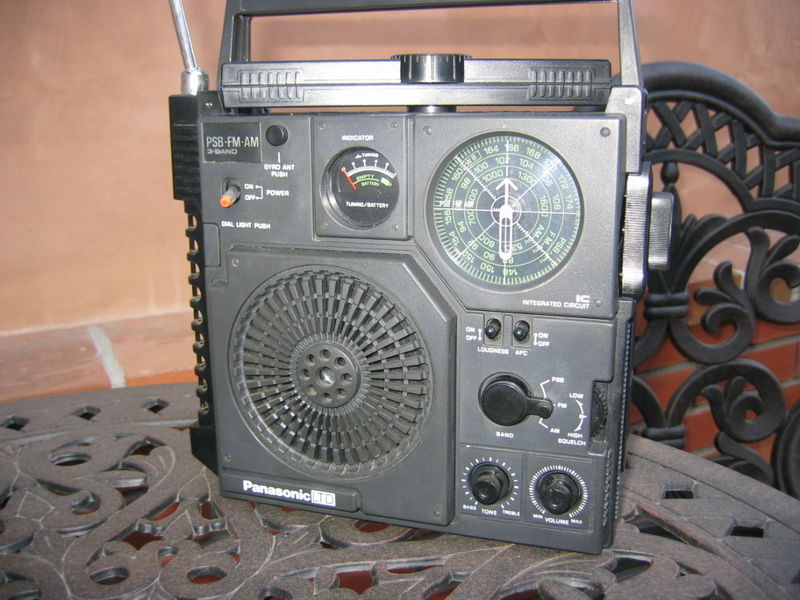
    Measuring nine inches across and almost ten inches high, the Panasonic RF-877 emerged from its box looking rather small. Something about its military bearing that suggested a larger size, but no matter, its looks did not disappoint. Evoking a past era when materials were of a higher grade and the distinction between phoniness and authenticity was sharply drawn, the sturdy RF-877 proved to be an apex performer. 

    Disclosed flaw was a missing antenna tip, which kept the bidding low. I bought the RF-877 for a parsimonious $62 plus $18 shipping. The question is does the missing tip compromise FM performance? A little, maybe. FM performance on weak stations such as 89.3, 88.9, 103.1 seemed only slightly compromised based on the tuning/battery indicator. The compromise is so negligible however that I do not feel compelled to replace or repair the telescopic FM antenna.

    IMG_3463

    AM sound, enhanced with the Gyro pop-up antenna, is the real standout here. The notorious 710 ESPN comes in with nor birdy background noise. 

    IMG_3466

    The speaker is clear and full, but does not offer as much sound as the RF-888. In terms of pure volume, the RF-888 appears to be three times stronger than the RF-877. Comparing the two, I find the heavier, more stout 888 to be a superior radio. I really like the RF-877, but I truly love the RF-888. Of course, the RF-888 cost me a handsome $210. While I prefer the RF-888, I give the RF-877, especially one with a fully-extending FM antenna, the highest recommendation. 

    Update: My esteem for the RF-877 has increased as I’ve become more familiar with it. As I write, the speaker sound is really filling my office rather well. I must say I was guilty of exaggerating the disparity of sound between the RF-877 and the RF-888.  I’m listening to the pennant match between the Rays and the Red Sox on the dreaded “birdy” station 710 AM. I popped up the Gyro AM antenna (6.5 inches long) and moved it until the birdy was completely gone. If you can find one of these “GI Joe” radios in mint condition for $150 or so, snatch it. 

  • Comparing the Qodosen DX-286 with the Tecsun PL-330 (Which I Absolutely Did Not Need)

    Comparing the Qodosen DX-286 with the Tecsun PL-330 (Which I Absolutely Did Not Need)

    Tecsun 330 & Qodosen

    Let’s get one thing straight: I had no business buying the Tecsun PL-330. None. I already own the Tecsun Four Horsemen—660, 680, 880, and 990—all brilliant in their own right, all lovingly hoarded. I even own the Qodosen DX-286, a small-footprint miracle that punches above its weight with a speaker that sounds like it’s packing 3 watts of sonic muscle, though the specs remain elusive. That radio even beats the Tecsuns on AM shielding, filtering out the urban electrical swamp that makes most radios wheeze and crackle like they’re being exorcised.

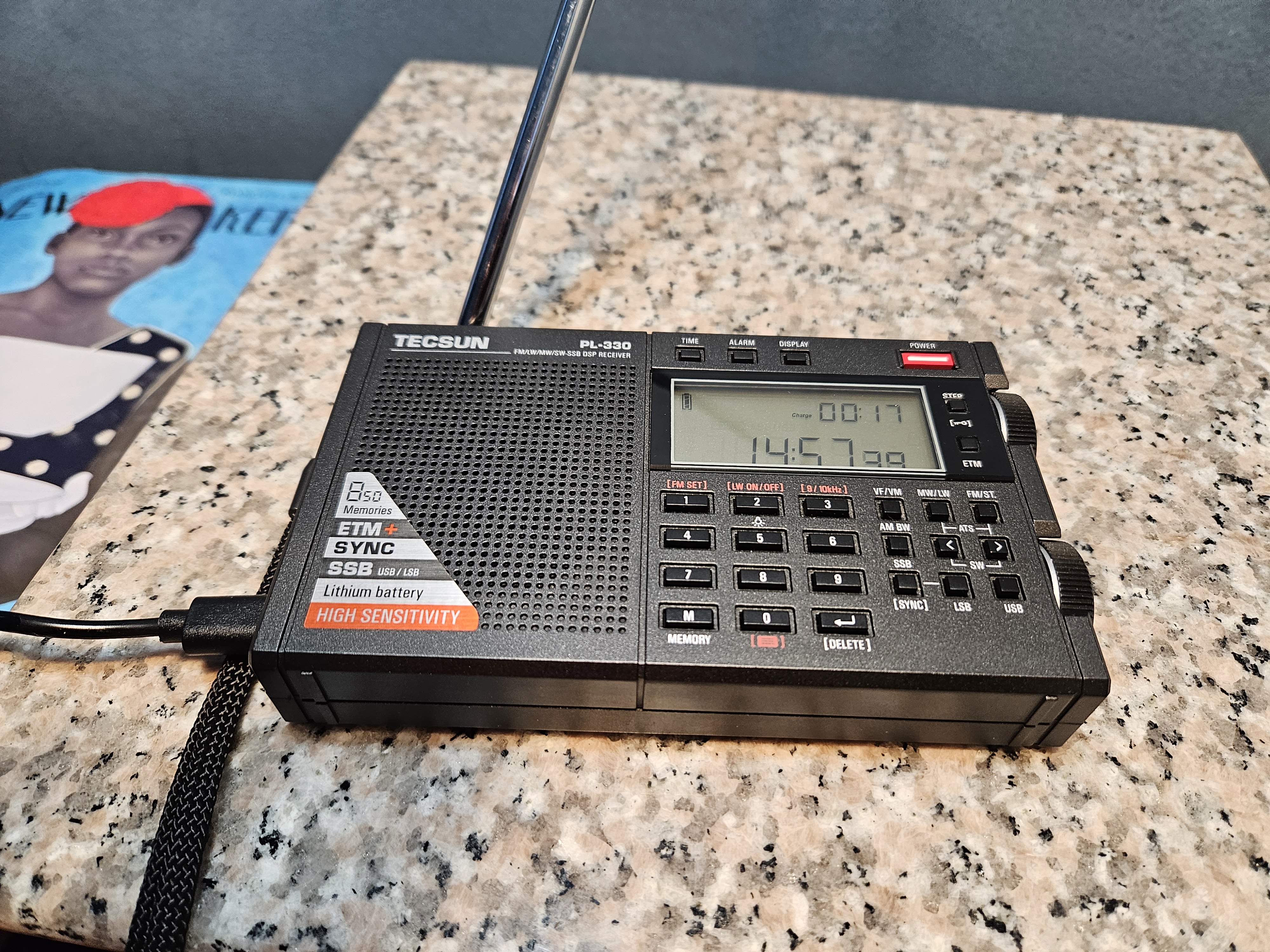
    And yet… the PL-330, a compact, .25-watt whisper of a radio, somehow seduced me. Maybe it was the open-box discount—$50 for a radio with a good reputation and a slightly rumpled box? Resistance was futile. I hit “Buy Now” faster than a dopamine junkie in a Black Friday frenzy.

    I didn’t even need the manual. Owning this many Tecsuns means I’m essentially fluent in Tecsunese. Clock setting? Presets? I could do it blindfolded while flossing.

    But let me be honest: The PL-330 is sleek. It has the crisp, militaristic geometry of something NASA might issue to interns. The buttons are snug and precise, unlike the Qodosen’s oversized, Playskool-style layout that screams “Designed by someone who just discovered ergonomics last Tuesday.”

    That said, Qodosen wins on practicality—it has a kickstand. The PL-330, bafflingly, does not. A design oversight or a cruel joke? We may never know.

    I don’t dabble in shortwave, but word on the street is that the 330 handles it like a champ. For FM, both radios are impressively sensitive, but I give a hair-thin edge to the Qodosen. On AM, the Qodosen’s clarity and noise control make it the better choice. For music, the Qodosen delivers a richer, more textured experience. But for talk radio, the PL-330 is sharper and cleaner—great for absorbing Madeleine Brand or NPR in the quiet of dawn.

    Verdict? The Qodosen stays bedside, loyal and boomy. The PL-330 earns a home in the master bath or kitchen, a quiet companion for 5 a.m. when the world still sleeps.

    Did I need it? Absolutely not. Am I keeping it? Absolutely.

    Tecsun PL-330 1