Tag: art

  • Tragedy Laundering in the Age of Vibes

    Tragedy Laundering in the Age of Vibes

    Shirley Li takes aim at what she calls the CliffNotes treatment of classic films—works shaved down, sweetened up, and repackaged for audiences who want the aura of culture without the burden of confronting it. Shakespeare, once a blood-soaked anatomist of ambition and ruin, now gets rinsed through the aesthetic of Taylor Swift. In this new register, tragedy doesn’t end in death; it stalls just long enough for a handsome savior to materialize on cue. Consider “The Fate of Ophelia,” where despair is airbrushed into rescue, and consequence dissolves into a soft-focus finale. The title lingered with me because I’d joked to my students a month earlier that I’d heard the song on Coffee House and found it embarrassingly overwrought—an avalanche of sentiment masquerading as profundity.

    Hollywood, never one to miss a profitable dilution, has joined the exercise. Emerald Fennell’s take on Wuthering Heights and Maggie Gyllenhaal’s reworking of Bride of Frankenstein into The Bride! arrive pre-softened, their rough edges filed down to avoid drawing blood. The originals demanded something of the audience—patience, discomfort, moral stamina. The remakes offer a tour: quick, glossy, and politely unchallenging.

    Li names the trend with surgical accuracy: “the rise of CliffNotes Cinema—watered-down transformations that offer glossy but thin summaries of the originals and strip away the challenging material that helped turn them into cultural mainstays in the first place.” That sentence does the autopsy. What’s left after the procedure is a body that looks intact from a distance but has been emptied of organs.

    Should we be alarmed? Yes, because the sweetness isn’t accidental; it’s diagnostic. These remakes signal a culture inching toward infantilization—hungry for reassurance, allergic to ambiguity, and convinced that gravity can be outsourced to wardrobe. Give the audience a fairy tale that flatters its appetites, but dress it in canonical clothing so it can pretend it just attended a seminar. Call this Tragedy Laundering: the conversion of moral difficulty into marketable comfort, where death becomes a scheduling inconvenience and ambiguity a branding problem.

    A culture marinated in TikTok loops, cute-animal dopamine, and the immaculate emotional arcs of Taylor Swift’s pop maximalism will predictably resist the adult weather systems of the classics. It wants its cod liver oil chased with honey—and increasingly, it wants the honey first, the oil omitted. The result is a literature of safety: all vibe, no verdict; all sheen, no sting.

  • The Travails of Horological Identity Drift

    The Travails of Horological Identity Drift

    To have a hobby is to cultivate an identity. The longer you grow in the hobby, the more you learn about yourself, your likes, dislikes, and inclinations. If you’re a watch collector, as I am, you gravitate to certain types of watches and retreat from others. You cannot explain your inclinations. When fellow watch collectors notice you share a proclivity for a type of watch, there is both a bond and a fellowship. When the fellow watch collectors notice your tastes clash with theirs, disappointment and even hurt feelings can ensue. Within the larger watch hobby, there are subcategories, where collectors branch off and form tight alliances, tribes, and deeply-forged bonds. A sense of loyalty ensues. We call this Taste Tribalism: the formation of tight-knit subgroups within a hobby, bound not by logic but by shared aesthetic instincts. These tribes generate loyalty, belonging, and, when challenged, a surprising capacity for disappointment.

    Woe, however, to the watch collector who, for reasons he can’t explain, departs from what was once his favorite watch type and ventures into fresh waters. Such a transition can bring disorientation and confusion. To abandon one watch category and embrace another creates what is called Horological Identity Drift: the slow, almost imperceptible shift in a collector’s taste in which objects once central to identity begin to feel like artifacts from a previous self. The watches haven’t changed; the wearer has. What once signaled meaning now feels like a costume left over from a role no longer being played.

    While this new adventure from “watch drift” gives fresh blood to his hobby, it leaves his fellow collectors feeling betrayed and abandoned. What offends them is their sense of Aesthetic Apostasy: the moment a collector abandons a once-defining preference—crossing from one horological faith to another—provoking confusion, quiet resentment, and the sense that something sacred has been violated.

    In my case, the “drift” occurred two months ago when I started wearing G-Shocks at the exclusion of my Seiko divers. I did all I could do to return to my mechanicals, including the act of putting steel bracelets on them, in the hope that giving them a luxury look would make them more appealing, but this measure failed. The Seiko divers remain in the box, largely unworn. As a result, I am a watch drifter. 

    What does this “drifting” collector do? Retreat to his old watch type and return to his fellow collectors? What folly. He would simply be betraying himself to please others. Such an act would be a violation of a hobby that brought him joy and authenticity. He must therefore let his true tastes govern his watch journey and the desire to please others take a back seat. Otherwise, his hobby will be a superficial affair, a desperate act to belong while his authentic self withers on the vine. 

  • The Clean Split: Seiko Romance vs. G-Shock Precision

    The Clean Split: Seiko Romance vs. G-Shock Precision

    For more than two decades, I lived inside the cathedral of Seiko divers—mechanical, muscular, faintly mythic. Then, without warning, I developed a taste for G-Shock. Not the entire sprawling catalog—just a narrow, almost doctrinal subset: Tough Solar, Multiband-6, digital display. Precision without ceremony. Time as a solved problem.

    Strangely, this new fixation didn’t dethrone the old one. If anything, it refused to engage it. My Seikos–SLA051, SLA023, SLA055, SBDC203, the Tuna SBBN049–continue their analog romance, ticking away with artisanal stubbornness. The G-Shocks, by contrast, operate with cold, atomic certainty. They don’t drift; they don’t charm; they don’t ask for admiration. They simply tell the truth. I find myself wearing them more often, yet the two categories never compete. They inhabit parallel realities, each complete unto itself.

    What used to be a single, coherent hobby has split into two clean domains. Not a conflict–more like a continental drift. The G-Shocks don’t diminish the Seikos, and the Seikos don’t dignify the G-Shocks. They coexist without conversation. The complication, if it can be called that, has the feel of an upgrade: a second language acquired late in life, one that doesn’t replace the first but sharpens your sense of what each can do.

    And once you see the line, you want to ink it in.

    I’ve started returning my Seikos to their bracelets, restoring them to their native uniform—steel on steel, no ambiguity. Only the Seiko SLA051 gets a pass; it belongs on a waffle strap the way certain truths belong in plain speech. The rest will click back into their bracelets like soldiers resuming formation. The goal isn’t function; it’s taxonomy. I want the collection to declare itself in two voices, not one muddled chorus.

    This is the quiet compulsion at work: the need to clarify, to separate, to keep categories from bleeding into one another. Call it Horological Bifurcation Syndrome–the clean split of a once-unified obsession into two ecosystems with incompatible logics and equal appeal. On one side, mechanical romance: weight, history, the seduction of imperfection. On the other, digital precision: light-powered, atom-synced, immune to drift. They don’t compete. They refuse to integrate. And the more I indulge them, the more I prefer it that way.

  • Freedom in a Thong: The Theater of Letting It All Hang Out

    Freedom in a Thong: The Theater of Letting It All Hang Out

    Yesterday I watched the final episode of HBO’s Neighbors, and it delivered a character who refuses to be ignored: Danny Smiechowski, seventy-two, sunburned into leather, hair cascading past his shoulders, and dressed—if that’s the word—in a fluorescent yellow-green thong that assaults the eye like a traffic cone with delusions of grandeur. He conducts his workouts in his front yard, a one-man parade of defiance, and reacts to criticism the way a cornered animal does—snarling one minute, weeping the next.

    To his neighbors and the churchgoers across the street, decency means restraint, a baseline agreement about how to occupy public space without turning it into a spectacle. To Danny, decency is the opposite: the right to strip away all constraints, to declare the body sovereign territory. His creed echoes a distant era—the hazy, incense-soaked optimism of the early 1970s, when “freedom” often meant discarding clothing along with inhibition and calling it enlightenment.

    Danny believes the world has failed him by refusing to catch up. He swings between belligerent bravado and wounded self-pity, neither of which strengthens his argument. The result is less a philosophy than a performance—loud, erratic, and increasingly lonely.

    Exiled in spirit from his San Diego suburb, he seeks refuge in Eden, a Florida nudist enclave populated largely by fellow Boomers who seem preserved in amber from the Age of Aquarius. It’s a place where retired engineers and former professionals shed not only their clothes but their timelines, reliving a moment when rebellion felt like revelation. Add cheap wine, a little chemical haze, and a game of naked water polo, and you have a community convinced it has outsmarted the system.

    At the colony’s karaoke bar—equal parts nostalgia lounge and social experiment—Danny encounters a young woman with the clarity of someone who has no illusions about the transaction she’s proposing. She wants a sponsor, not a soulmate. Danny, eager for validation, obliges: shoes, dinner, the usual gestures of misplaced hope. She exits with efficiency. He is left with the bill and a deflated sense of destiny.

    Back in San Diego, Danny does what any committed ideologue would do—he builds his own Eden in his backyard, a private republic of one, governed by the constitution of his own stubbornness.

    The episode raises a question that refuses to stay trivial: why do some people feel compelled to be naked as a permanent state, not an occasional choice? Nostalgia plays a role. For many in that generation, nudity carries the residue of a time when breaking rules felt like breaking through. To be unclothed was to signal membership in a select tribe—the enlightened, the unshackled, the ones who had slipped past the guards of convention.

    There’s also a theatrical element. Just as children dress as superheroes to feel invincible, adults can costume themselves as liberated sensualists. The wardrobe is minimal, but the identity is elaborate. It promises transformation without requiring much beyond attitude.

    And yet, beneath the surface, something feels off. At Eden, I saw intelligent, accomplished people—engineers, inventors, individuals who had clearly mastered complex systems. One man, surrounded by photos of extraterrestrials, warned of a creature called Draconian poised to devour humanity. He seemed to believe that rejecting society’s norms—walking naked within the colony’s borders—offered a kind of existential protection. It was as if the abandonment of convention could ward off forces far larger than decorum.

    That’s the paradox. These people are not fools. Many are thoughtful, even admirable in their way. But the lifestyle strikes me less as freedom and more as a carefully maintained illusion—a soft-focus rebellion that never quite matures into anything durable.

    I can observe it with curiosity, even a touch of amusement. But I can’t inhabit it. To me, freedom isn’t the absence of clothing or the indulgence of every impulse. It’s something quieter, less theatrical. What I saw in Eden felt less like liberation and more like a well-rehearsed fantasy—Peter Pan with a pension plan, still refusing to land.

  • From Muscle Monsters to Ken Doll Tyrants

    From Muscle Monsters to Ken Doll Tyrants

    When I was a teenage bodybuilder in the 1970s, the weight room was full of boys with the same secret: we were trying to fix ourselves. Our cure for insecurity was iron. We trained like men preparing for war, convinced that if we grew large enough—huge traps, bulging biceps, necks like bridge cables—we could terrify the world into respecting us. We fantasized about becoming “monsters” or “gargoyles,” grotesque statues of muscle that would scare away humiliation and banish our private doubts. Of course, the plan never worked. Just as the chronic overeater cannot outrun gluttony, we could not out-muscle low self-esteem. The demons we tried to crush with barbells simply followed us out of the gym.

    Nearly fifty years later, bodybuilding’s old delusion has been replaced by a stranger one: looksmaxxing, the obsessive attempt to engineer physical perfection through cosmetic intervention and digital-age narcissism. In Becca Rothfeld’s New Yorker essay “The Captivating Derangement of the Looksmaxxing Movement,” we meet a new breed of self-improvement fanatic embodied by an influencer who calls himself Clavicular. Testosterone injections, rhinoplasty, double-chin surgery, pharmaceutical regimens, manic diet protocols, and relentless “biohacking” have sculpted him into something resembling a laboratory-grown Ken doll. The goal is not merely attractiveness but algorithmic perfection: a human face optimized to survive the merciless scrutiny of social media.

    Yet beneath this glossy surface lies something dark. Rothfeld observes that the movement often overlaps with the internet’s most antisocial subcultures—incel forums, misogynistic grievance factories, and communities obsessed with ranking human worth according to facial symmetry and bone structure. Technology theorist Jaron Lanier warned years ago that social media algorithms reward content that appeals to our most primitive impulses, dragging public discourse downward toward the brain stem. Looksmaxxing appears to be the logical endpoint of that descent: a digital coliseum where identity, masculinity, and human dignity are reduced to metrics of jawline geometry.

    Ironically, the men who pursue this transformation claim they are trying to become more attractive to women. Instead, they often cultivate the personality of a malfunctioning action figure: narcissistic, performative, and incapable of genuine intimacy. They rehearse “alpha male” poses, brag about their surgical upgrades, and sneer at the supposedly inferior masses who lack their aesthetic discipline. What emerges is not confidence but solipsism—individuals who can admire their reflection indefinitely but seem constitutionally incapable of love.

    When broken misfit toys acquire millions of followers and begin shaping cultural and political attitudes, the spectacle stops being merely ridiculous. It becomes ominous. Movements fueled by resentment, aesthetic purity, and tribal grievance have a long and ugly history. The looksmaxxing phenomenon, with its blend of cosmetic obsession, internet radicalization, and juvenile power fantasies, bears the unmistakable scent of decadence—and perhaps something worse. A healthy society cannot thrive when its young men aspire not to become human beings but to become action figures.

  • Why the Small G-Shock Square GW5000 Beats the Giant Rangeman GW-9400

    Why the Small G-Shock Square GW5000 Beats the Giant Rangeman GW-9400

    I am not a delicate man. I’m built like Larry Csonka charging through a defensive line—thick wrists, burly forearms, the kind of limb geometry that usually demands “wrist presence.” On paper, the Rangeman GW-9400 should be my natural habitat: big, armored, survivalist, ready to rappel down a canyon at a moment’s notice. The smaller GW-5000U Square, by contrast, looks modest—almost restrained. If you were casting the role of “watch for the large man,” you would hand me the Rangeman without hesitation. And yet, I may very well buy the Square.

    Because this decision has nothing to do with testosterone per millimeter. It comes down to the most ruthless metric in watchmaking: how quickly your eye extracts the time without negotiation. The Rangeman is a dashboard—altimeter, barometer, compass—a field manual wrapped around your ulna. It is physically larger, louder, more armored. But its time display is portioned into compartments, trimmed down, crowded by supporting actors. The numerals are not the star of the show; they are part of an ensemble cast. The GW-5000U, by contrast, clears the stage. Big, centered digits. High contrast. No clutter. It understands something fundamental: a watch’s first job is legibility, not cosplay. Size without clarity is just acreage.

    Now, the Rangeman does offer more capability. Triple Sensor technology. Tactical presence. Expedition energy. All true. But capability is irrelevant if the core function requires squinting, tilting, or activating a backlight like you’re cracking a safe. A watch that grows in diameter while shrinking its time display commits a design sin. It mistakes bulk for usability. The GW-5000U may be smaller, but it is proportionally optimized. Its screen serves the hour, not the ego. It doesn’t pretend to be base camp. It tells the time—immediately, decisively, without drama.

    This is the lesson of the Bloat Paradox: the absurd condition in which a larger watch delivers smaller, less legible time information, proving that increased case size can inversely correlate with functional clarity. In the hierarchy of horology, clarity outranks spectacle. The square wins. The giant loses.

  • When Giving a Watch to Someone Is the Ultimate Selfishness

    When Giving a Watch to Someone Is the Ultimate Selfishness

    Core members of G-Shock Nation revere the GW-5000U because it represents the moment the Square stopped flexing and started aging well. It carries the 1983 blueprint, but underneath the familiar shape lives grown-up engineering: steel inner case, screwback, soft resin that disappears on the wrist, solar power, Multiband 6. No tactical cosplay. No feature inflation. No desperate attempt to look extreme. It sits there dense, quiet, perfectly accurate, and emotionally undemanding. To the initiated, that restraint signals maturity. The owner is no longer chasing the next G-Shock. He has arrived. The GW-5000U isn’t admired for excess; it’s admired for restraint. In a hobby addicted to novelty, the greatest watch is the one that makes novelty feel unnecessary.

    Collectors buy the GW-5000U the way serious readers buy a hardbound classic they’ve already finished online. The object represents a principle. It is the philosophical center of the Square ecosystem—the pure form. Screwback steel, operational silence, atomic precision, no theatrics, no gimmicks. Owning it signals allegiance to a worldview: function over spectacle, permanence over churn, competence over excitement. The purchase isn’t about need. It’s about completion. Without the 5000U, the collection feels like a conversation circling its point. With it, the argument finally lands. The watch becomes less a tool than an anchor—an idea made physical, a quiet declaration that you are no longer collecting features; you are collecting coherence.

    And yet, as you contemplate its greatness, a physical reality intrudes. The watch is small. Your eight-inch wrists and decades of barbell diplomacy have produced forearms that turn the Square into a polite suggestion of a watch. You no longer care about wrist presence, but wearing something that looks like a borrowed child’s timepiece crosses a line. Philosophical perfection is one thing. Visual credibility is another.

    Then comes the rationalization. Your twin daughters. The GW-5000U would look perfect on them. It would teach them punctuality, discipline, operational thinking. It would introduce them to the beauty of silent precision. It would, naturally, make them chips off the old block. You present the idea with the enthusiasm of a man offering enlightenment. They respond with the facial expression normally reserved for unexpected homework. In that moment, clarity arrives. This isn’t mentorship. This is Proxy Justification—the collector’s sleight of hand, where a purchase he cannot defend for himself is reassigned to someone else while quietly serving his own emotional agenda. The language is generosity. The motive is displacement. He isn’t buying a gift. He’s buying wrist time by proxy.

    The realization lands hard and fast. The box remains unpurchased. The daughters remain uninterested. And you step back, a little embarrassed, a little wiser, and briefly sober. In a hobby built on elegant rationalizations, the rarest achievement isn’t the right watch. It’s the moment you recognize a bad story—and don’t tell it to yourself.

  • The Theology of the Watch Addict

    The Theology of the Watch Addict

    You cannot understand watch obsession without understanding religious conversion. At some point, the hobby stops being about objects and starts behaving like faith.

    No one would seriously claim a timepiece is divine. And yet the devoted enthusiast approaches the hobby with the discipline, ritual, and emotional seriousness of a Trappist monk. This is not shopping. This is vocation.

    Every serious collector eventually enters the desert.

    There comes a period of withdrawal—no forums, no influencers, no hype lists—just the quiet work of figuring out what you actually like. The goal is purity. To borrow from René Girard, mimetic desire is heresy. Buying what the tribe loves is imitation. Discovering your own taste is revelation.

    But the desert is temporary. No believer practices alone forever.

    Soon enough, the enthusiast returns to the congregation: YouTube channels, forums, group chats, wrist-shot threads. What gets called “research” becomes a daily ritual. Hours pass in a fever swamp of comparisons, debates, rumors, and release speculation.

    The information is secondary.

    The real function is Research Communion—the comfort of shared obsession, the quiet reassurance that you belong to a fellowship that speaks your language and validates your concerns about case thickness and lume performance.

    Like any conversion, the watch enthusiast lives in two eras: Before Watches and After Watches.

    Before was vague. Time passed unnoticed. Evenings disappeared into the fog.

    After is different. The day has structure. The wrist has meaning. Life feels sharper, more intentional, more alive—because something small and precise is always there, quietly marking your existence.

    But faith has its trials.

    There are dark nights: compulsive buying, financial regret, obsessive comparison, the creeping suspicion that you’ve become what outsiders call a Watch Idiot Savant. Friends don’t understand. Some quietly decide you’ve become strange.

    If the devotion is real, this doesn’t weaken the believer. It deepens the bond with the tribe.

    An us-versus-them mentality emerges. Non-watch people become a separate species—citizens of a dull world where time is checked on phones and meaning is measured in convenience. Meanwhile, a private conviction grows stronger: the world doesn’t understand your discernment, your discipline, your eye.

    But beneath all the brands, movements, and materials lies the true object of devotion.

    The enthusiast is not chasing watches.

    He is chasing order.

    He is chasing the feeling that somewhere, something is precise, aligned, and under control. He is searching for the pure and absolute in the form of Sacred Time.

    This condition has a name: Sacred Time Syndrome.

    It is the quiet belief that a watch is not merely a tool but a wearable altar where chaos is subdued and existence ticks in disciplined submission. The wearer does not simply check the hour; he consults it. Atomic synchronization feels like divine correction. A perfectly regulated movement suggests moral virtue. Drift becomes an existential failure.

    Underneath the talk of lume, tolerances, and finishing lies the real motive: the hope that if time on the wrist is exact, then life itself might also be brought into alignment.

    Because the deeper fear is this:

    Time is vast.
    Time is indifferent.
    Time is not impressed by your collection.

    So the enthusiast keeps buying, adjusting, comparing—not for status, not for craftsmanship, not even for pleasure.

    He is purchasing small, precise moments of reassurance that the universe, at least on his wrist, still answers to order.

  • The G-Shock Frogman and the Bureaucratic State

    The G-Shock Frogman and the Bureaucratic State

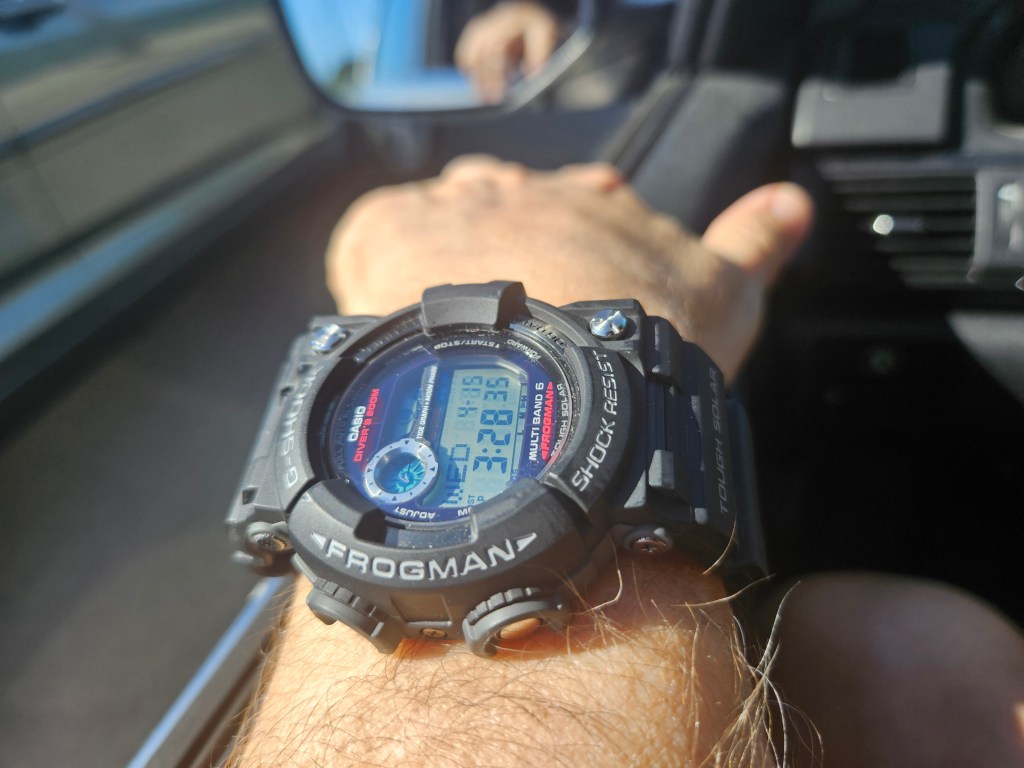
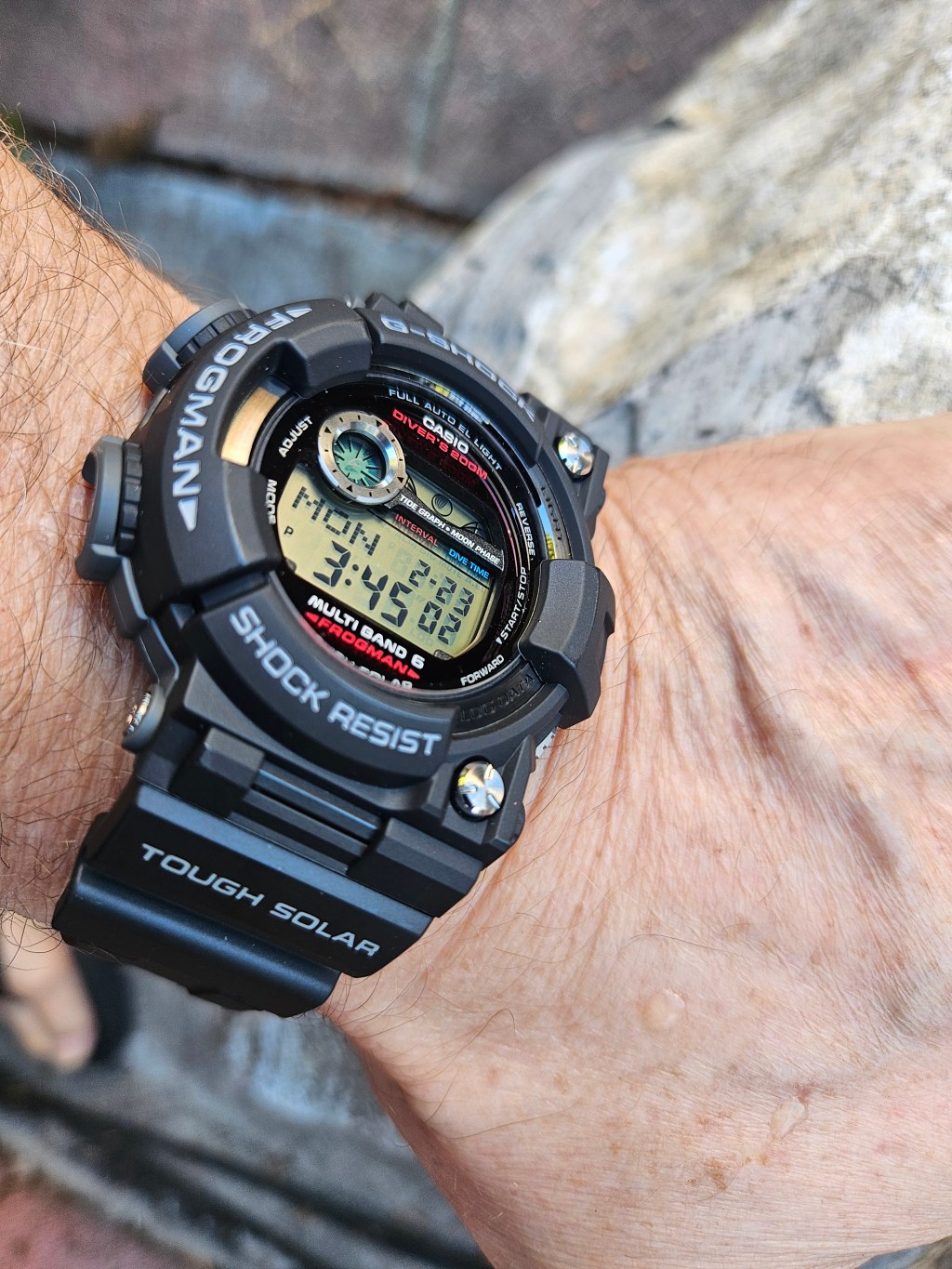
    Over the past forty-eight hours, DHL has sent me approximately two dozen updates about my G-Shock Frogman GWF-1000. Each message arrives with the urgency of a geopolitical crisis, as if the watch were a sensitive diplomatic asset being escorted through a chain of unstable regimes.

    Update received.
    Status changed.
    Action required.

    At one point, a text informed me that I needed to verify my identity—name, address, confirmation that I am indeed the lawful civilian awaiting a rubber-strapped amphibious instrument. I complied immediately. Filled out the form. Submitted the data. Received confirmation.

    Case closed, I thought.

    Case not closed.

    The Frogman is now stranded in customs, apparently under suspicion of either espionage, tariff evasion, or unauthorized aquatic activity.

    I contacted DHL customer service. A courteous representative informed me that my shipment would be “investigated” and that I should expect an email within a few hours. At this stage, I am waiting to learn what additional documentation, declaration, or ceremonial tribute will be required before the watch is released back into the general population.

    The order was placed eleven days ago through Sakura. I’ve purchased from them before without incident. This time, however, the experience feels less like shipping and more like applying for a mid-level government clearance. Whether the delay is caused by tariffs, enforcement changes, or the invisible hand of bureaucratic entropy, I cannot say.

    What I do know is that the process introduces a new emotional variable into overseas buying: friction. Not the minor inconvenience of delay, but the slow accumulation of uncertainty—the growing suspicion that any international purchase may evolve into a procedural endurance event.

    Buying a watch is supposed to generate anticipation.

    This generates vigilance.

    The promise of modern commerce is frictionless efficiency: click, ship, deliver. What I’m experiencing is its bureaucratic inverse. Identity verification. Clearance holds. Investigation windows. Status alerts arriving like play-by-play commentary from a logistics obstacle course.

    This isn’t tracking.

    This is surveillance—of my own anxiety.

    I appear to be suffering from Customs Suspense Syndrome: a condition in which a routine shipment becomes a serialized drama of ambiguity and delay. The buyer no longer follows a package; he refreshes a timeline the way a patient checks for lab results, searching for signs of life.

    Ordering a watch should not feel like running a gauntlet.

    Yet here we are.

    This is not frictionless commerce.

    This is American Gladiators: Customs Edition.

  • Beauty Isn’t Enough: The Moment Desire Meets Reality

    Beauty Isn’t Enough: The Moment Desire Meets Reality

    We are, most of us, walking around with a quiet fracture. Something missing. Something we believe can be restored if only we find the right object, the right achievement, the right arrangement of circumstances. The trouble is that the very strategies we use to make ourselves whole often deepen the crack.

    Citizen Kane is the classic case study. Charles Foster Kane acquires everything—wealth, art, palaces, influence—only to die alone, whispering “Rosebud” like a man calling into an empty room. For all his possessions, he never possessed what he actually wanted: love. The sled was not valuable. It was a memory of unconditional belonging, the one thing money could not purchase.

    Once the unconscious decides that objects can deliver emotional completion, the trap is set. The shopping becomes symbolic. The acquisition becomes therapeutic. And the disappointment becomes inevitable.

    I would like to believe I’m immune to this logic. I am not.

    I’m not trying to buy love, exactly. What captures me is beauty. A gunmetal sports car. A finely finished watch. Once the image enters my field of vision, it begins to work on me. Beauty has a narcotic quality. It doesn’t argue. It persuades.

    When I was nine, my father and I would slow the car to stare at Corvettes and my personal holy object, the Opel GT. We didn’t own them. That hardly mattered. Looking was enough to induce a quiet intoxication.

    Some forms of beauty age well. Twenty years ago my wife and I bought a framed Botticelli Primavera from an antique store. It hangs in our living room today. I still find myself studying the figures, pulled into the scene as if it were unfolding in slow motion. The painting asks nothing from me except attention.

    Watches work differently.

    A beautiful watch does not merely sit on the wall. It demands a relationship. It asks to be worn, justified, integrated into daily life. And here the problem begins.

    I’m drawn to intricate designs—chronographs, textured dials, bold contrasts, mechanical drama. These pieces photograph beautifully. They mesmerize under good lighting. They whisper, You are a man of taste.

    But then I put them on.

    The dial is busy. The legibility suffers. The weight feels wrong. The watch stays in the box.

    That’s the gap—the quiet but decisive chasm between aesthetic admiration and lived use. Many of the most beautiful watches I’ve owned became box queens: admired, respected, and essentially abandoned.

    A fellow collector once told me he doesn’t mind owning watches he never wears. He thinks of them as wall art. People collect paintings for beauty; he collects watches the same way.

    I can’t do that.

    Unworn watches don’t calm me. They make me uneasy, like unfinished obligations. A watch that isn’t part of daily life feels less like art and more like a small, expensive mistake.

    Years ago, a neighbor let me drive his black Corvette—a childhood Rosebud made real. Within minutes, the spell broke. The cabin was cramped. The ride was harsh. Every bump transmitted directly into my spine. I handed back the keys with relief.

    The car looked magnificent. Living with it would have been miserable.

    That experience clarified something I’ve come to accept across watches, cars, and most objects of desire:

    Beauty alone is not enough.

    At some point, every enthusiast discovers a personal boundary—what might be called a Functional Integrity Threshold. It’s the moment when aesthetic appeal loses its authority because the object fails in comfort, usability, or daily harmony.

    Below that threshold, beauty is intoxicating.
    Beyond it, beauty becomes irrelevant.

    Give me both—form and function in alignment—or give me neither. Anything else is just another Rosebud waiting to disappoint.