Tag: blog

  • How Zombies Taught Me to Do the Dishes

    How Zombies Taught Me to Do the Dishes

    I was in sixth grade when I made the worst procrastination decision of my young life: I watched Night of the Living Dead instead of doing the dishes.

    I didn’t even want to watch it. My parents were out for the evening and issued a single, modest commandment: Do whatever you want—just do the dishes. The sink was stacked with plates, bowls, pots, and pans, a greasy jungle daring me to enter. I took one look and decided I deserved a short rest before battle. I collapsed into a yellow bean bag chair, turned on the TV, and landed on Creature Features, which was broadcasting one of the most psychologically devastating films ever made.

    I’d heard about the movie at school. Kids spoke of it in hushed, reverent tones, as if surviving it were a rite of passage. Fear, apparently, was proof of greatness. How bad could it really be? I told myself this while enjoying the immediate relief of not scrubbing forks. Then the movie started: a brother and sister visiting a grave. The atmosphere curdled instantly. Something was wrong. I should have changed the channel. I didn’t. I couldn’t. Fear and curiosity locked arms and dragged me forward.

    Minutes turned into hours. I watched bodies fall apart, social order dissolve, and hope get eaten alive. The gore wasn’t just gross—it was existential. By the time the credits rolled, something essential in me had been misplaced. Innocence, for starters.

    It was nearly midnight. My parents still weren’t home. I wandered into the kitchen and stared at the sink, now radiating menace of a different kind. I was in no psychological condition to clean anything. Zombies had ruined that option. I retreated to my room, crawled into bed, and slept with the covers pulled over my head like a man hiding from the apocalypse.

    Morning arrived with consequences. My parents were furious. The dishes remained undone. I tried to explain that I had endured profound trauma at the hands of George A. Romero, but this defense carried no legal weight. I had failed on all fronts: my psyche was scarred, my parents were enraged, and the dishes were still filthy.

    That night taught me a lesson I’ve never forgotten. Procrastination lies. It promises comfort and ease but delivers a punishment far worse than the task you avoided. I could have spent thirty dull minutes cleaning plates. Instead, I spent the night traumatized by the collapse of civilization and woke up grounded. Avoiding the dishes cost me about a hundred times more than doing them ever would have.

  • The Shingles Shot, the Vanishing Kettlebell Workout, and a Brief Descent Into Strap Madness

    The Shingles Shot, the Vanishing Kettlebell Workout, and a Brief Descent Into Strap Madness

    I got my shingles vaccine yesterday at noon and felt absolutely nothing afterward—so nothing, in fact, that I woke up the next morning feeling smugly invincible. I went to Trader Joe’s, bantered with the employees about the collective psychosis surrounding their limited-edition mini tote bags, came home, unloaded the groceries, and mentally penciled in a righteous kettlebell session in the garage. Then, right around 10 a.m., my immune system cleared its throat. A slow, heavy wave of fatigue rolled in, the kind that doesn’t ask permission. I took what I told myself was a “precautionary” nap. I made a deal with my body: if I felt fine in an hour, the kettlebells were back on. By 11, the aches had arrived, lethargy had unpacked its bags, and the deal was quietly voided. The iron would have to wait.

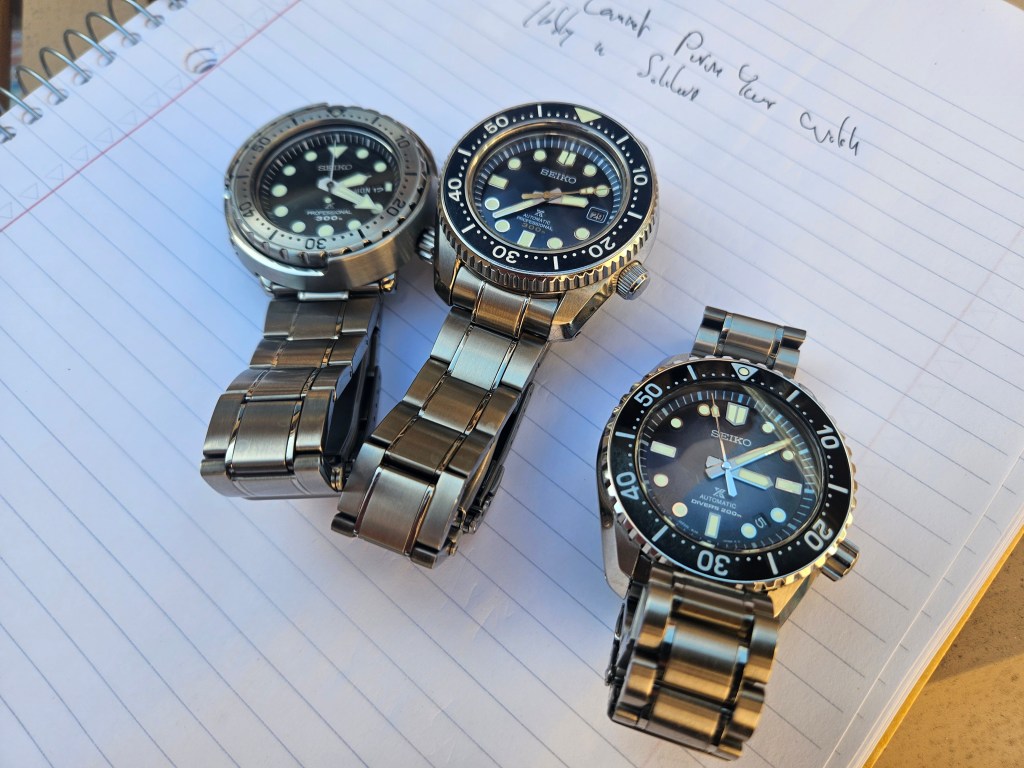
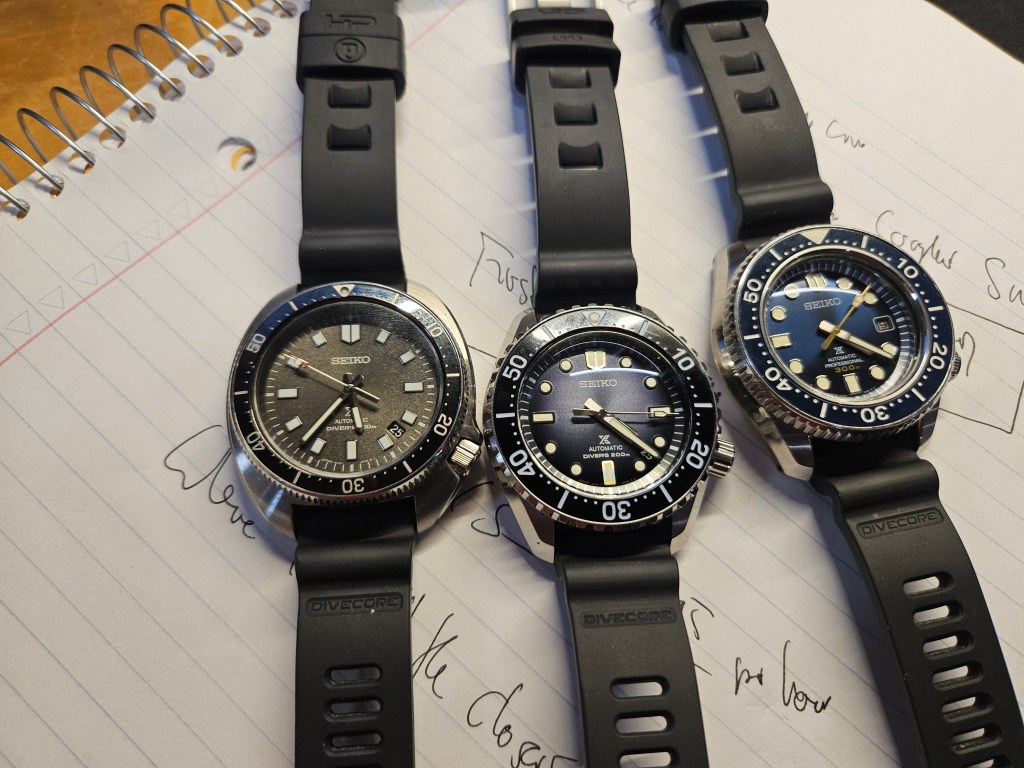
    Now, 28 hours post-shot, I’m more tired than I was this morning, which feels like a violation of some unspoken contract. In what I can only describe as a low-grade vaccine fever fugue, I apparently decided this was the perfect moment to perform strap surgery on my watch collection. The Seiko SLA051, 055, and 023 all lost their OEM waffle straps and emerged reborn on Divecore FKM. Yes, I’m aware that FKM is rumored to whisper chemical lullabies into the bloodstream. No, I’m not persuaded that wearing these watches a few hours a week is going to tip me into a Superfund site.

    In any case, I’m already planning to swap the FKMs for Divecore’s hydrogenated waffle straps in a few months. If there’s any exposure happening, it’s brief, intermittent, and vastly overshadowed by whatever biochemical fireworks the shingles vaccine is currently setting off inside me. For now, I’ll rest, hydrate, and let my immune system do its thing—apparently with a side hobby in horological rearrangement.

  • Doing Everything, Feeling Nothing: The Age of Engagement Dilution

    Doing Everything, Feeling Nothing: The Age of Engagement Dilution

    In “Ebooks Are an Abomination,” Ian Bogost delivers a needed slap across the face of our collective reading habits. His charge is simple and devastating: ebooks haven’t expanded reading—they’ve hollowed it out. People believe they’re reading because their eyes are sliding across a screen, but most of what’s happening is closer to grazing. The scandal isn’t that we skim; it’s that we’ve started calling skimming “reading” and don’t even blush. Bogost nails the fraud when he points out that the word reading has become a linguistic junk drawer—used to describe everything from doomscrolling Instagram captions to actually wrestling with dense prose. If the same word covers both scanning memes and grappling with Dostoevsky, then the word has lost its spine.

    It reminds me of people who announce they’re going to the gym to “work out.” That phrase now covers a heroic range of activity—from Arnold-style flirtations with death to leaning on a treadmill while watching Jeopardy! and gossiping about coworkers. Same building, radically different realities. One is training. The other is loitering with athletic accessories.

    Reading and working out have this in common: they are not activities so much as states of engagement. And the more soaked we become in technology, the more that engagement drains away. Technology sells convenience and dependency—the kind where you feel faintly panicked if you’re five feet from a device and not being optimized by something. But being a reader is the opposite of that nervous dependence. It’s happy solitude. It’s the stubborn pleasure of being absorbed by a book, of sinking into hard ideas—the epistemic crisis, substitutionary atonement, moral ambiguity—without needing an app to pat you on the head and tell you how you’re doing. Real readers don’t need dashboards. Real lifters don’t need Fitbits. If you’re truly engaged, you feel the work in your bones.

    And yet technology keeps whispering the same seduction: optimization. Track it. Measure it. Quantify it. But what this gospel of efficiency often delivers is something uglier—disengagement dressed up as progress, laziness rebranded as smart living. The name for this decay is Engagement Dilution: the slow thinning of practices that once demanded effort—reading, training, thinking—into low-grade approximations that still wear the old labels. What once meant immersion now means mere exposure. We haven’t stopped doing these things. We’ve just stopped doing them seriously, and we’re calling that evolution.

    To help you interrogate the effects of Engagement Dilution, you will do the following writing prompt.

    600-Word Personal Narrative That Addresses Engagement Dilution

    We live in an age where everything looks like participation—but very little feels like engagement. We “read” by skimming. We “work out” by standing near machines. We “study” by copying and pasting. We “connect” by reacting with emojis. The actions remain, but the depth is gone. This condition has a name: Engagement Dilution—the process by which practices that once demanded sustained attention, effort, and presence are thinned into low-effort versions that keep the same labels but lose the same meaning.

    For this essay, you will write a 600-word personal narrative about a time when you realized you were going through the motions without being truly engaged. Your story should focus on a specific experience in which you believed you were participating in something meaningful—school, work, fitness, relationships, creativity, reading, faith, activism, or personal growth—only to later recognize that what you were doing was a diluted version of the real thing.

    Begin with a concrete scene. Put the reader inside a moment: a classroom where you nodded but didn’t think, a gym session where you scrolled more than you lifted, a relationship where you listened with your phone in your hand, a book you “read” but can’t remember, a goal you claimed to care about but never truly invested in. Use sensory detail—what you saw, heard, felt, avoided—to make the dilution visible. Don’t explain the idea yet. Show it happening.

    Next, introduce the realization. When did it dawn on you that something essential was missing? Was it boredom? Frustration? Guilt? Emptiness? Did someone confront you? Did you fail at something you thought you had prepared for? Did you suddenly notice how different real engagement feels—how tiring, how uncomfortable, how demanding it is compared to the easy version you had settled for?

    Then widen the lens. Reflect on why engagement diluted in the first place. Was it technology? Fear of failure? Desire for comfort? Pressure to appear productive? Lack of confidence? The culture of optimization? Be honest here. Avoid blaming abstract forces alone. This essay is not about what society did to you; it is about the choices you made within that environment.

    Finally, confront the cost. What did engagement dilution take from you? Skill? Confidence? Meaning? Relationships? Momentum? And what did it teach you about the difference between looking active and actually being alive inside your actions? End not with a motivational slogan but with clarity—what you now recognize about effort, attention, and the price of avoiding difficulty.

    Guidelines

    • This is a narrative, not a sermon. Let the story do the thinking.
    • Avoid clichés about “finding balance” or “doing better next time.”
    • Do not turn this into a tech rant or a productivity essay. Keep it human.
    • Use humor if it fits—but don’t hide behind it.
    • Your goal is not self-improvement branding. Your goal is insight.

    What this Essay Is Really About

    Engagement Dilution is not laziness. It is the quiet substitution of comfort for commitment, convenience for courage, motion for meaning. Your task is to show how that substitution happened in your own life—and what it revealed about what real engagement actually costs.

    Write the essay only you could write. The more specific you are, the more universal the insight becomes.

  • Optimized to Death: When Improvement Outruns Personal Growth

    Optimized to Death: When Improvement Outruns Personal Growth

    Optimization without integration produces a lopsided human being, and the AI age intensifies this distortion by overrewarding what can be optimized, automated, and displayed. Systems built on speed, output, and measurable performance train us to chase visible gains while starving the slower capacities that make those gains usable in real life. The result is a person who can execute flawlessly in one narrow lane yet falters the moment the situation becomes human—ambiguous, emotional, unscripted. The body may be sculpted while the self remains adolescent; the résumé gleams while judgment dulls; productivity accelerates while meaning evaporates. AI tools amplify this imbalance by making optimization cheap and frictionless, encouraging rapid improvement without requiring maturation, reflection, or integration. What emerges is not an unfinished person so much as an unevenly finished one—overdeveloped in what can be measured and underdeveloped in what must be lived. The tragedy is not incompetence but imbalance: strength without wisdom, speed without direction, polish without presence. In an age obsessed with optimization, what looks like progress is often a subtler form of arrested development.

    To encourage you to interrogate your own tendencies to achieve optimization without integration, write a 500–word personal narrative analyzing a period in your life when you aggressively optimized one part of yourself—your body, productivity, grades, skills, image, or output—while neglecting the integration of that growth into a fuller, more functional self.

    Begin by narrating the specific context in which optimization took hold. Describe the routines, metrics, sacrifices, and rewards that drove your improvement. Use concrete, sensory detail to show what was gained: strength, speed, recognition, efficiency, status, or validation. Make the optimization legible through action rather than abstraction.

    Then pivot. Identify the moment—or series of moments—when the imbalance became visible. What failed to develop alongside your optimized trait? Social competence? Emotional maturity? Judgment? Confidence? Meaning? Show how this lack of integration surfaced in a lived encounter: a conversation you couldn’t sustain, an opportunity you mishandled, a relationship you sabotaged, or a realization that exposed the limits of your progress.

    By the end of the essay, articulate what optimization without integration cost you. Do not reduce this to a moral lesson or self-help platitude. Instead, reflect on what this experience taught you about human development itself: why improving a single dimension of the self can create distortion rather than wholeness, and how true growth requires coordination between capacity, character, and context.

    Your goal is not confession or nostalgia but clarity. Show how a life can look impressive on the surface while remaining structurally incomplete—and what it takes to move from optimization toward integration.

    Avoid clichés about “balance” or “being well-rounded.” This essay should demonstrate insight through specificity, humor, and honest self-assessment. Let the reader see the mismatch before you explain it.

    As a model for the assignment, consider the following self-interrogation—a case study in optimization gone feral and integration nowhere to be found.

    At nineteen, I fell into a job at UPS, where they specialized in turning young men into over-caffeinated parcel gladiators. Picture a cardboard coliseum where bubble wrap was treated like a minor deity and the only sacrament was speed. My assignment was simple and brutal: load 1,200 boxes an hour into trailer walls so tight and elegant they could’ve qualified for Olympic Tetris. Five nights a week, from eleven p.m. to three a.m., I lived under fluorescent lights, sprinting on concrete, powered by caffeine, testosterone, and a belief that exhaustion was a personality trait. Without meaning to, I dropped ten pounds and watched my body harden into something out of a comic book—biceps with delusions of automotive lifting.

    This mattered because my early bodybuilding career had been a public embarrassment. At sixteen, I competed in the Mr. Teenage Golden State in Sacramento, smooth as a marble countertop and just as defined. A year later, at the Mr. Teenage California in San Jose, I repeated the humiliation, proving that consistency was my only strength. I refused to let my legacy be “promising kid, zero cuts.” Now, thanks to UPS cardio masquerading as labor, I watched striations appear like divine handwriting. Redemption no longer seemed possible; it felt scheduled.

    So I did what any responsible nineteen-year-old bodybuilder would do: I declared war on carbohydrates. I starved myself with religious fervor and trained like a man auditioning for sainthood. By the time the 1981 Mr. Teenage San Francisco rolled around at Mission High School, I had achieved what I believed was human perfection—180 pounds of bronzed, veined, magazine-ready beefcake. The downside was logistical. My clothes no longer fit. They hung off me like a visual apology. This triggered an emergency trip to a Pleasanton mall, where I entered a fitting room that felt like a shrine to Joey Scarbury’s “Theme from The Greatest American Hero,” the soundtrack of peak Reagan-era delusion.

    While changing behind a curtain so thin it offered plausible deniability rather than privacy, I overheard two young women working the store arguing—audibly—about which one should ask me out. Their voices escalated. Stakes rose. I imagined them staging a full WWE brawl among the racks: flying elbows, folding chairs, all for the right to split a breadstick with me at Sbarro. This, I thought, was the payoff. This was what discipline looked like.

    And then—nothing. I froze. I adopted an aloof, icy expression so effective it could’ve extinguished a bonfire. The women scattered, muttering about my arrogance, while I stood there in my Calvin Kleins, immobilized by the very attention I had trained for. I had optimized everything except the part of me required to be human.

    For a brief, shimmering window, I possessed the body of a Greek god and the social competence of a malfunctioning Atari joystick. I looked like James Bond and interacted like a background extra waiting for direction. Beneath the Herculean exterior was a hollow shell—a construction site abandoned mid-project, rusted scaffolding still up, a plywood sign nailed crookedly to the entrance: SORRY, WE’RE CLOSED.

  • The Expiration Date of the Fitness Influencer

    The Expiration Date of the Fitness Influencer

    Parasocial Fatigue

    noun

    Parasocial Fatigue describes the emotional and cognitive exhaustion that sets in when an audience becomes overexposed to an influencer’s performative intimacy and relentless self-presentation. What begins as a one-sided relationship built on usefulness, inspiration, or trust curdles as the influencer’s need for attention, validation, and monetization becomes increasingly visible. The constant uploads, recycled insights, manufactured urgency, and naked thirst for engagement erode the illusion of authenticity that sustained the bond in the first place. Viewers no longer feel informed or inspired; they feel harvested. At that point, familiarity turns to irritation, admiration hardens into disdain, and the influencer’s presence in the feed triggers avoidance rather than curiosity—a quiet severing of a relationship that was never mutual to begin with.

    In the beginning, your favorite influencer feels like a gift. They offer sensible advice on nutrition, a workout routine that doesn’t insult your intelligence, a body that seems to testify to discipline rather than sorcery. You follow them in good faith. For a while, the content delivers. Then the expiration date quietly approaches. The useful insights thin out, replaced by a slurry of hype, urgency, and alarmist drivel—“You’re poisoning yourself unless you stop eating this one food today.” Clickbait metastasizes. The signal is buried under noise. What once felt like guidance now feels like a carnival barker shouting through a megaphone.

    Eventually you see the machinery. This isn’t a lone truth-teller sharing wisdom from a garage gym; it’s a small content factory with payroll to meet. Ideas are skimmed from journals, stripped of nuance, and polished with influencer saliva until they’re shiny enough to go viral. The real giveaway, though, isn’t the dubious science—it’s the thirst. You can see it in their eyes: the desperation to stay relevant, the exhaustion of feeding the algorithm daily, the hollow confidence of someone trapped in their own posting schedule. The charm collapses. When they appear in your feed now, it’s not curiosity you feel, but a reflexive flinch. Parasocial fatigue sets in, and disdain follows close behind.

  • Robinson Crusoe Mode

    Robinson Crusoe Mode

    Noun

    A voluntary retreat from digital saturation in which a knowledge worker withdraws from networked tools to restore cognitive health and creative stamina. Robinson Crusoe Mode is triggered by overload—epistemic collapse, fractured attention, and the hollow churn of productivity impostor syndrome—and manifests as a deliberate simplification of one’s environment: paper instead of screens, silence or analog sound instead of feeds, solitude instead of constant contact. The retreat may be brief or extended, but its purpose is the same—to rebuild focus through isolation, friction, and uninterrupted thought. Far from escapism, Robinson Crusoe Mode functions as a self-corrective response to the Age of Big Machines, allowing the mind to recover depth, coherence, and authorship before reentering the connected world.

    Digital overload is not a personal failure; it is the predictable injury of a thinking person living inside a hyperconnected world. Sooner or later, the mind buckles. Information stops clarifying and starts blurring, sliding into epistemic collapse, while work devolves into productivity impostor syndrome—furious activity with nothing solid to show for it. Thought frays. Focus thins. The screen keeps offering more, and the brain keeps absorbing less. At that point, the fantasy of escape becomes irresistible. Much like the annual post-holiday revolt against butter, sugar, and self-disgust—when people vow to subsist forever on lentils and moral clarity—knowledge workers develop an urge to vanish. They enter Robinson Crusoe Mode: retreating to a bunker, scrawling thoughts on a yellow legal pad, and tuning in classical music through a battle-scarred 1970s Panasonic RF-200 radio, as if civilization itself were the toxin.

    This disappearance can last a weekend or a season, depending on how saturated the nervous system has become. But the impulse itself is neither eccentric nor escapist; it is diagnostic. Wanting to wash up on an intellectual island and write poetry while parrots heckle from the trees is not a rejection of modern life—it is a reflexive immune response to the Age of Big Machines. When the world grows too loud, too optimized, too omnipresent, the mind reaches for solitude the way a body reaches for sleep. The urge to unplug, disappear, and think in long, quiet sentences is not nostalgia. It is survival.

  • The Cult of the Desktop Shrine

    The Cult of the Desktop Shrine

    There is a particular species of human for whom a new computer is not a tool — it’s a religious conversion. The desktop isn’t a workspace; it’s a cockpit for a future self, the glamorous avatar of the writer, artist, or content sorcerer they imagine they will become. People like this do not simply buy machines. They curate private shrines. A desk becomes an escape pod: LED lights humming like temple candles, two monitors glowing like stained-glass windows, and the mechanical keyboard serving as a holy relic. Once seated, the outside world ceases to exist — or so the fantasy goes — until an eBay tab opens and suddenly a $2,500 dive watch begs for attention, or a pair of ergonomic walking shoes on sale becomes a spiritual priority. Sacredness is delicate; it collapses at the first whiff of retail dopamine.

    I speak as one of these zealots. I live in a small home with a wife and two teenage daughters, so I protect the illusion of solitude with the devotion of a medieval monk. My desktop setup has become my monastery. For seven years, I have sat beside the same computer: a 15.6-inch Acer Predator Triton 500 with an RTX 2080, perched like a retired fighter pilot on a wooden pedestal. Beside it stands a 27-inch Asus Designo 4K monitor. My keyboard is an Asus Rog Strix Scope II fitted with “quiet snow” switches — though I still regret not choosing switches that click like a typewriter possessed by Bukowski.

    Here’s the problem: the machine refuses to die. It doesn’t slow down, wheeze, or show symptoms of electronic mortality. It handles everything I throw at it. This stubborn longevity has become an accusation. If I truly mattered — if I were a world-crushing content creator — surely I would need M4 silicon or a Windows Ultra 9. But here I am, a humble i7 and RTX 2080 carrying my entire life on its back like a mule. The message is humiliating: you produce so little that even an elderly predator laptop barely notices your existence. I am not a digital gladiator. I am an NPC.

    One half of me wants to honor the Acer’s absurd durability. I want to see how long it lasts: eight years? Ten? Will it run until I am eighty and my daughters sell it on Facebook Marketplace to a grad student writing her dissertation? The other half of me yearns for a new identity — a fresh cockpit. I fantasize about a Lenovo ThinkPad P16, a machine with the aesthetic of a NATO command center. In my imagination I would sit before it, efficient and unstoppable, a productivity samurai. Then I read about thermals, swollen batteries, and the corporate decay of ThinkPad build quality, and the fantasy curdles.

    Mini PCs tempt me, too — elegant little cubes promising freedom from laptop fan noise. But then I scroll deeper and learn about overheating, BIOS drama, firmware rituals, and mysterious Windows gremlins that exist only for people who try to “optimize.” This is when I confront the truth: Windows PCs are for people fluent in Linux, the jiu-jitsu masters of tech. These individuals have tattoos of penguins on their forearms and spend weekends customizing drivers the way normal people mow their lawns. They don’t “use computers.” They tame them.

    I am not that creature. I am a man who gets nervous updating his router. This leaves me with one path: the Mac Mini. Not because I am enlightened, but because the walls of Apple’s walled garden keep me from accidentally burning the place down. Windows is a vast golf course stretching to the horizon. MacOS is miniature golf: enclosed, guarded, brightly colored obstacles that keep your ball out of the swamp. I must accept who I am — a timid, high-functioning idiot — and pick the putter.

    And yet, when people complain about laptops dying after three years, I can raise a hand and say: “Seven years. RTX 2080. Still alive.” It is not greatness, but it is a kind of glory.

  • State of the Misalignment Situation

    State of the Misalignment Situation

    I had hoped my blog, Cinemorphosis, would feed my video essays—serve as a compost heap of half-baked thoughts that could later bloom into something cinematic and worthy of making video essays. Instead, the blog has swallowed the energy that once went into my videos. What was meant to be a support system has become a rival ecosystem. The crossover I imagined—the blog fueling the videos and the videos enriching the blog—never happened. It turns out writing and filming come from different parts of the brain, and those parts refuse to share the same neural conference room.

    Friends say, “Don’t sweat it, McMahon. Just lean into the blog and let the videos go.” Easy advice for people who aren’t haunted by the specter of irrelevance. I can’t shake the feeling that the video essays keep me sharper—more visible, more alive. The blog satisfies my mind; the camera keeps me from turning into dust.

    Sam Harris once said he can spend five years writing a book, agonizing over edits and the publishing gauntlet, only to reach a few thousand readers—if he’s lucky. Meanwhile, a one-hour podcast can reach millions overnight, and snippets of it go viral before the author’s espresso cools. That line haunts me. The medium matters. The way we reach people has become part of the message.

    I see the same logic in my own small way. A blog post I’m proud of might earn a few dozen engagements. A decent video essay? Thousands of views, maybe more. But numbers only tell part of the story. The real draw is the vitality the videos demand—something performative, almost athletic. When I’m on camera, I feel like I’m “getting my reps in,” keeping mentally limber. The blog is therapy; the videos are training.

    Still, there’s a fine line between vitality and vanity. Part of me believes the videos keep me youthful, engaged, even relevant. Another part suspects it’s all just a resistance workout against mortality. Staying fit is one thing; refusing to age gracefully is another. Desperation doesn’t wear well on men over sixty, even under good lighting.

    So maybe writing suits me better now. Maybe the written word is the right pace for a man learning to accept that his eyesight, patience, and tech literacy are all in slow retreat. Maybe I should only return to video when I have something worth saying—something that isn’t just a performance of endurance.

    Which brings me to the real question: what do I still have to contribute?

    For over a decade, my YouTube channel orbited around my watch obsession. That obsession gradually narrowed until it became monastic—just diver watches, all on straps. I convinced myself that a collection larger than seven would doom me to spiritual ruin. I also stopped flipping watches like a Wall Street day trader, deciding it was bad for my mental health. That slowdown siphoned the manic energy that used to fuel my videos. The creative rush didn’t vanish—it simply rerouted into blog posts about my newest fixation: alignment. Or more precisely, misalignment.

    Because if I’m honest, I feel increasingly out of sync with the modern world. I adapt to new technology at the pace of continental drift. TikTok bewilders me. Smartphones offend my thumbs. Driving at night now feels like a scene from Apocalypse Now. My relevance, visibility, and patience are fading in a culture that worships youth and touchscreens.

    My anxieties about self-worth and mortality are now on the front burner, while watch collecting—the “Watch Potency Principle,” the “wrist-rotation anxiety”—has been moved to the back burner where it is simmering to a lukewarm stew.

    To illustrate my current state: two weeks ago, I bought a new LG OLED TV, which was fine—until I broke two Samsungs in one day trying to move them. I manhandled the first 55-inch like it was a kettlebell, frying half its pixels in a single jerk. Then I jammed my thumb straight through the second screen while relocating it from my daughter’s room. My wife, the household adult, had to carry the new Roku replacement into our bedroom as I stood there looking like a Neanderthal who’d just discovered electricity—and promptly electrocuted himself.

    My war with technology didn’t end there. The new garage door opener came with instructions written in a dialect of cruel mockery. The installer vanished without explaining how to sync it with my phone, so my wife once again had to step in and figure it out. Now I open the garage door through an app, and every time I hear the alert that the door is moving, I step back in awe—half-terrified, half-mesmerized—like a caveman who’s just invented fire.

    I feel both too old for this world and too infantile to function in it. A man-baby marveling at his gadgets, bewildered by his own house. Think about that. My house has become a museum for technology of the future while I wander through it like a mesmerized tourist. My mouth is agape and my daughters say to me, “Relax, Dad, this is our house.” I respond by saying, “No it’s not. It’s a museum of strange and wonderful things that I don’t know how to use.” 

    These are the moments that give me content for my blog Cinemorphosis. I post almost daily, while it takes me weeks to metabolize these experiences into something coherent enough for a video essay. Writing helps me think; filming helps me pretend I’m still current.

    So that’s my current state of affairs. This channel used to be State of the Watch Collection. Now it’s more like State of the Man Who Can’t Sync His Garage Door Opener.

  • How Soon Is Theft?

    How Soon Is Theft?

    In 1990, I was in my late twenties, a newly minted college writing instructor drifting through life with the ethereal soundtrack of The Smiths, the Cocteau Twins, The Trash Can Sinatras, and The Sundays rattling in my head. One afternoon on Hollywood Boulevard with my girlfriend, I did what any self-respecting young melancholic would do: I bought Smiths T-shirts and posters like sacred relics. The crown jewel was my “How Soon Is Now” poster, a portrait of an angst-drenched youth in a gray cable-knit sweater, gazing downward as if staring into the abyss. I taped it proudly to my office door, a shrine to my tribe. Within a week, it was gone—stolen.

    The theft still smolders decades later. It wasn’t just the insult of having something ripped from my door; it was the betrayal of the faith I placed in The Smiths’ congregation. Their music was heartbreak bottled into beauty, sadness transmuted into community. To love The Smiths, I believed, was to be incapable of theft. Fans were supposed to be fellow pilgrims on the same road to melancholy salvation. You don’t rob your brother of his relics. You light a candle with him and hum “There Is a Light That Never Goes Out.”

    But there it was: my poster ripped away not by a barbarian from the outside, but by a fellow initiate. The irony was unbearable. If The Smiths could not protect us from base impulses, if their music could not ennoble even their most ardent listeners, then what was art worth? Wasn’t it supposed to make us better, kinder, less brutish? The theft of that poster wasn’t just petty larceny. It was the murder of a principle.

    To this day, I remember the empty rectangle of tape marks left on my office door, staring back at me like a smirk from the abyss. The thief didn’t just pocket a poster; they handed me a lesson in nihilism, gift-wrapped in Morrissey’s sorrowful croon. And I’ve been suspicious of beauty ever since, knowing it can inspire devotion and betrayal in the same breath.

  • The Love of Radios and the Power of Gezelligheid

    The Love of Radios and the Power of Gezelligheid

    20250226_132117

    The Love of Radios and the Power of Gezelligheid

    I’m fully aware that my love for radios borders on the irrational. When I see a certain type—say, the Tecsun PL-680 or PL-660—something in my brain short-circuits. I’m instantly enchanted, as if I’ve just glimpsed an old friend across a crowded room, and at the same time, I’m comforted, as if that friend just handed me a warm cup of coffee and told me everything was going to be alright.

    A radio isn’t just a device; it’s a symbol, though I haven’t quite worked out of what exactly. Maybe it represents the art of slowing down—of sitting in a quiet room, wrapped in a cocoon of music or in the company of voices so familiar they feel like beloved houseguests. Or maybe it’s something more primal, a sanctuary against the chaos of the world, a frequency through which I can tune out the profane and tune into something sacred.

    The word that comes to mind when I hold a radio is cozy—but not in the kitschy, scented-candle, novelty-mug kind of way. This is deeper than that, more akin to the Dutch word gezelligheid—a term that encompasses coziness, warmth, companionship, and the ineffable comfort of simply being. Radios don’t just play sound; they create atmosphere. They transport me back to Hollywood, Florida, sitting on the porch with my grandfather, the air thick with the scent of an impending tropical storm, the crackle of a ball game playing in the background like a heartbeat of another era.

    Many have abandoned radio for the cold efficiency of streaming devices and smartphones. I tried to do the same for over a decade. I failed. Because gezelligheid—that feeling of simple, enduring pleasure—isn’t something you can replace with an algorithm. Some things, no matter how old-fashioned, still hum with life.