Tag: book-review

  • From the Literary Golden Age to Algorithmic Wasteland

    From the Literary Golden Age to Algorithmic Wasteland

    In On Writing and Failure, Stephen Marche dismantles the fantasy that writers can transform themselves into entrepreneurs and save the craft through hustle. He has watched brilliant minds waste their genius on branding decks and content calendars, convinced that a marketing plan can substitute for a literary life. Everyone, he notes, now arrives armed with a social-media strategy; even legacy writers chase streaming deals. Yet the “digital ad revenue” that was supposed to be salvation barely buys groceries. This notion of self-promotion on a social media platform may work for a handful, but for most of us, this plan is all chicanery. Most  writers would earn more working part-time at Starbucks than posting their book excerpts on Instagram. 

    And still writers persist, driven by an ancient question: How do you make a living by thinking? In a world where platforms shift beneath your feet, young writers must reinvent themselves with exhausting frequency—editing careers as relentlessly as they edit sentences.

    Marche reminds us that postwar America once had sturdy literary institutions: robust magazines, influential newspapers, university presses, publishers willing to cultivate voices rather than chase viral heat. That era nurtured Boomer writers who could achieve cultural celebrity and economic stability. But those scaffolds have collapsed. We live among the ruins of that golden age. Institutions fray, readership declines, and the professional writer now sits on the same endangered-species list as the white rhinoceros.

    With writing now fully digital, the terrain resembles a lawless frontier. The deep, contemplative reading that literature requires has been replaced by rapid-fire commentary. Instead of essays and books, the culture rewards short-form skirmishes and performative certainty. As Marche put it to Sam Harris, America’s most profitable export is now “the peddling of moral outrage.” Rage scales. Nuance suffocates.

    This erosion of the writing life carries consequences beyond the page. When outrage becomes the ambient air, critical thinking dries up, public trust decays, and democratic habits atrophy. To lose serious writing isn’t merely to lose an art; it is to endanger the civic imagination that sustains a republic. The crisis of literature is not an aesthetic inconvenience—it is a political warning flare.

  • What True Crime Teaches That Fiction Won’t

    What True Crime Teaches That Fiction Won’t

    For the past few months, I’ve been devouring true crime docuseries with tireless fascination. The more I watch, the deeper my appetite grows—not for gore, but for the raw human stories that unspool behind every case. There is, of course, a price for such voyeurism. Nearly every episode revisits the same dark origins: homes scarred by domestic abuse, children numbed by neglect, and adults who turn to drugs and alcohol to quiet the pain. Whole worlds of criminality form around these wounds—ecosystems where cruelty becomes normal, even rational.

    Then there’s law enforcement. Most detectives and officers I see in these stories are decent, sharp-minded people pursuing justice through an endless fog of human wreckage. They face so much depravity that it exacts a psychic toll. They carry the collective sorrow of others, walking the earth with hearts cracked open by everything they’ve witnessed.

    There’s a strange repetition to these lives of crime—an awful sameness—but also a singular fingerprint on each story. Some criminals are narcissists, intoxicated by their own chaos. Others are the broken offspring of violence, haunted by demons they now unleash on others. Many strike out in panic, wielding a mallet where a scalpel would have sufficed.

    I’m reminded of Tolstoy’s line: “All happy families are alike; each unhappy family is unhappy in its own way.” I’d transpose it this way: All paths to decency share a pattern—discipline, love, structure—but the paths to ruin twist in countless variations, each marked by a wound that never healed.

    This is what keeps me watching. Too many fictionalized crime dramas can’t resist the tidy seduction of redemption—some tearful confession, some sentimental coda of forgiveness. True crime spares me that. It denies me comfort. No background music softens the horror, no clever dialogue redeems it. These stories show the human condition not as we wish it to be but as it is: excruciating, broken, and endlessly complex.

    In that sense, I find myself siding less with Steven Pinker’s optimism and more with Robert Kaplan’s realism. Pinker argues that humanity is improving—that violence is receding and irrational behavior is on the decline. Kaplan, in Wasteland: A World in Permanent Crisis, sees something else entirely: that the struggle between good and evil is eternal, and evil often enjoys the advantage because it fights without restraint and acts as if it has nothing to lose. Kaplan isn’t a pessimist. He’s a realist.

    If I’m to prepare for life, I’d rather confront the world as Kaplan does—without illusion, without sentimentality, without anesthetic. Pinker’s optimism feels like comfort food for the mind. Kaplan, like true crime, gives me the bitter taste of reality—and that’s the kind of nourishment that lasts.

  • Zosia Mamet and My Personal Reading Revival

    Zosia Mamet and My Personal Reading Revival

    It’s rare that I fall in love with books these days, but when it happens, I’m grateful because reading reminds me of my glory days, the early 80s when I consumed books with ferocity, imaginative pleasure, and obligation like a bodybuilder taking protein powder and creatine. Three major factors have curtailed my reading of books: One, I’ve grown so cynical over the years that I’ve come to the belief that 99% of books are in actuality just a short story or essay with padding. An author has an intriguing idea, and they sit down with their agent and cook up a book that is mostly chicanery with a dash of substance. 

    Then three days ago, I heard actor Zosia Mamet talking about her memoir Does This Make Me Funny?, a collection of essays, with KCRW host Sam Sanders, and I was so struck by her depth of wit, intelligence, and moral perspective that I immediately bought her book, or I should say the Kindle eBook version of it. Even more rare than buying books as intellectual property, it is even rarer that I buy a hard copy of something, unless it is a kettlebell training book or a cookbook like Miyoko Schimmer’s The Vegan Creamery

    Getting most of my books on Kindle speaks to the second reason my reading has diminished. The physical act of reading is unpleasant. Holding the book, turning the pages, getting into a comfortable position, attenuating my eyes to the various font sizes. I find the whole thing disconcerting and unpleasant, like trying to figure out the seat positions, buttons, and levers of an unfamiliar car. The most comfortable forms of reading are either sitting at my desktop and reading the Kindle on a 27-inch screen or reading while sitting in bed with a 16-inch laptop.

    The third reason I don’t read as much is that the Internet and its attention economy have fried my brain over the decades. The attention muscles inside my cortex have atrophied to a woeful state. 

    But occasionally a rose grows out of the cracks in the cement sidewalk, and such is the case with Zosia Mamet’s memoir, as witty, deep, self-deprecating, and salient as the author speaking to Sam Sanders three days ago. Reading the memoir is to connect with someone for whom her writing voice and the core of her being are the same. The result is something distinctive and salient, something that recoils and then snaps forward to leave its literary fangs inside you. Isn’t that what writing is supposed to be about? Nabokov was like that. So was Kafka. And so is Zosia Mamet.

    I detest some confectionary celebrity memoir reeking of privilege, superfluousness, and mediocrity. None of that is in Zosia’s collection of essays. 

    As we read in Jancee Dunn’s New York Times article “At Least Zosia Mamet Can Laugh About It,” the core of her book is about her mental, physical, and spiritual health. Coming from a family that is deeply entrenched in literature and the arts is a double-edged sword with excruciating pressure to live up to superhuman expectations causing Zosia’s thorn in her side to be the constant sense that she is falling abysmally short. 

    Like the best comedia, she opts out of self-pity for humor as she does a deep dive into her anxiety, depression, body dysmorphia, anorexia, and anhedonia, and all the self-destructive behaviors she succumbed to in order to overcome these afflictions. Because she knows that body dysmorphia is a delusion that hijacks her brain, she says about herself: “I am often an unreliable narrator of my own reality.” 

    Which in a nutshell is the human condition: Can we trust ourselves or are we getting duped by our own fake narrative? 

    What tools from our emotional toolbox can we use to be more reliable? Perhaps comedy is one of them. Think of our irrational states: overcome by maudlin self-pity, vanity, and grandiosity, we spin grotesque narratives about ourselves that compel us to behave in ways that are ridiculous and often result in self-sabotage. Perhaps comedy is the antidote. Perhaps comedy distances us from our preposterous self-mythology and helps us in the arduous process of self-reinvention. That’s the sense I’m getting from Zosia Mamet’s very necessary book, a book that has no padding at all but has been made from a brilliant mind with blood, sweat, and tears. 

  • Words of Wisdom in a World of Publishing Hallucinations

    Words of Wisdom in a World of Publishing Hallucinations

    Last night I dreamed I was at the Aspen Institute, where I took the stage as a guest speaker while snowflakes pirouetted past the classroom windows like bored ballerinas. Dozens of young writers—already published, already duped—sat before me, waiting to be enlightened. I told them the truth their publishers had concealed with a smile and a contract: the marketing promises were fairy dust, the royalty checks were jokes, and their “book deals” were little more than elaborate scams. They would earn a pittance, and the betrayal would sting worse than any bad review.

    Some of them glared at me like I’d just blasphemed against their gods, but others—emboldened by rage—shouted the names of their novels and memoirs into the snowy air. A nineteen-year-old tech billionaire from India cried out the title of his memoir: The Gunther Effect. I made him repeat it three times, as if conjuring a spell, so the words wouldn’t slip away. Against my better judgment, I was intrigued.

    By popular demand, I returned for a second sermon. This time, I was flanked by professors and “established” writers who knew the game as well as I did. Their lectures weren’t brilliant, but they didn’t have to be. For me, just focusing on one speaker, narrowing the scattered kaleidoscope of my mind into a single lens, felt like mental hygiene—a purging of the Internet’s endless distractions. I thought, This is what I miss: the monastic joy of being a student, concentrating on one voice instead of chasing dopamine scraps.

    And slowly, the room shifted. The students began to understand that my colleagues and I weren’t cynics but keepers of the ugly gospel. We had the keys to the vault, the passwords to real power. We were the Priests and Priestesses of Light and Success, consecrated by disillusion. Hands shot up like candles in a vigil, their questions burning against the snowfall outside, and we were exalted, gratified, almost holy in the glow of their hunger.

  • The Warm Bath Illusion: Why Pleasure Culture Kills Relationships

    The Warm Bath Illusion: Why Pleasure Culture Kills Relationships

    When you’re married, you’ve closed the deal. You’ve made your public and private commitment to another person. Yet, as Phil Stutz points out in Lessons for Living, this loyalty oath collides with a culture that insists there’s always a better deal waiting. It’s our supposed “divine right” to find that deal, to “look outside ourselves for more.” In other words, FOMO infects the way we relate to our spouses. Stutz writes: “The result is a frenzy of activity, powered by the fear of missing something, which exhausts us emotionally and leaves us spiritually empty.”

    As a therapist to Hollywood’s wealthy actors and producers, Stutz sees people in perpetual pursuit of “bigger and better”—newer houses, flashier careers, younger spouses once they’ve “made it.” They want to “trade up,” convinced they deserve it. But what they crave isn’t a flesh-and-blood partner. It’s a “fantasy companion,” a frozen image of perfection that bears no resemblance to real life. As Stutz notes of one patient, a successful actor: “What he was really looking for was someone with the magical ability to change the nature of reality.”

    Why do so many of us want to change reality? Because reality is messy, uncertain, painful, and demands labor of mind and spirit. Consumer culture promises to scrub away that mess and deliver a “frictionless” existence. It sells us the Warm Bath: a world of perpetual pleasure and no conflict. But the Warm Bath is an adolescent fantasy—an illusion that reality will mold itself to our most immature notions of happiness.

    This fantasy always collapses. No “fantasy companion” exists, and even if one did, the Warm Bath curdles into hell. Experiences flatten, pleasures dull, the hedonic treadmill spins us into numbness, and from numbness we fall into rage—blaming the fantasy companion for failing to save us.

    Stutz argues we must abandon the fantasy of love—a stagnant “perfect” photograph—for the messier, real version: alive, unpredictable, and demanding effort. “To put it simply,” he writes, “love is a process. All processes require endless work because perfection is never achieved. Accepting this fact is not thrilling, but it is the first step to happiness. You can work on finding satisfaction in your relationship the same way you’d work on your piano playing or your garden.”

    So if you spend your days marinating in salacious fantasies and stoking your FOMO with consumer culture, you’re killing reality while feeding fantasy. And because you’re putting no work into your relationship, entropy sets in. Bonds fray, affection curdles, and instead of taking responsibility, you blame your partner and draft your exit strategy.

    To keep his patients from falling into this trap, Stutz prescribes three tools.

    The first is Fantasy Control. Fantasies, he warns, can grow “long and involved” until they compete with real relationships. Steely Dan’s “Deacon Blues” comes to mind. Its narrator is a suburban mediocrity who dreams himself into an edgy artist and seducer of women. Fans saw themselves in him, but the song is ironic: a portrait of a fallen man propping up a drab life with self-mythology. Such fantasies, Stutz says, “hold a tremendous amount of emotional energy.” The more energy you pour into a phantom partner, the less you have for your real one. When fantasies become sexual, the drain is worse. Stutz insists that when fantasies consume you, you must learn to interrupt them. “You’ll resent this at first,” he writes, “but each time you come down to earth you’re telling yourself that you are a committed adult who is strong enough to face reality. This will make you more satisfied with yourself, a precondition to becoming satisfied with any partner.”

    If you’re a boomer like me, this may sound like heresy. Raised in the 60s and 70s, we were taught to unleash the Id, to celebrate fantasies as expressions of the “true self.” The musical Hair didn’t just glorify wild locks but turned them into a metaphor of rebellion against authority. Hugh Hefner and Xaviera Hollander gave us ribald lifestyles to envy. Thomas Harris’s I’m Okay, You’re Okay blessed us with permission to indulge. And the cultural mantra was simple: “Let it all hang out!”

    But Stutz, a boomer himself, has watched fantasies devour his patients. His conclusion is blunt: curbing sexual fantasy is a crucial step toward adulthood and a stronger bond with one’s partner.

    The second tool is Judgment. Fixate on a fantasy partner and you suspend critical thought, surrendering to false perfection. You also sharpen your critique of your real partner until both fantasy and reality are grotesquely warped. To break free, Stutz says, you must recognize this distortion and choose a loving path over a fantasy path. “The process of loving requires that you catch yourself having these negative thoughts and dissolve them from your mind, replacing them with positive ones. You must actively construct thoughts about their good attributes, and let these thoughts renew feelings of attraction toward them.” This habit builds gratitude, restores attraction, and replaces helplessness with control.

    Reflecting on this, I recall Tim Parks’s essay “Adultery,” in which he describes a friend’s affair that destroyed his marriage. Parks likens sexual passion to a raging river that demolishes everything in its path, while domestic life is the quieter work of nest-building. The two impulses are locked in eternal conflict. Some people cannot resist hurling themselves into the river, even knowing it will consume them.

    To pull people out of that river, Stutz prescribes his third tool: Emotional Expression. Here self-expression works in reverse. Just as smiling can make you happier, acts of tenderness can make you feel tender. Stutz advises: when you’re alone with your partner, speak and touch them as if they are desirable. Do this consistently and not only will you find them more attractive, they’ll begin to find you more attractive too.

    It may sound counterintuitive. Who “works” for attraction? But that is Stutz’s point: love is work. Excessive fantasy, meanwhile, is infidelity—not only to your spouse, but to your adult self. Stay shackled to your adolescent hedonist, and like Lot’s wife, you’ll turn into a pillar of salt.

  • There Is No Such Thing as a Holy Grail Watch

    There Is No Such Thing as a Holy Grail Watch

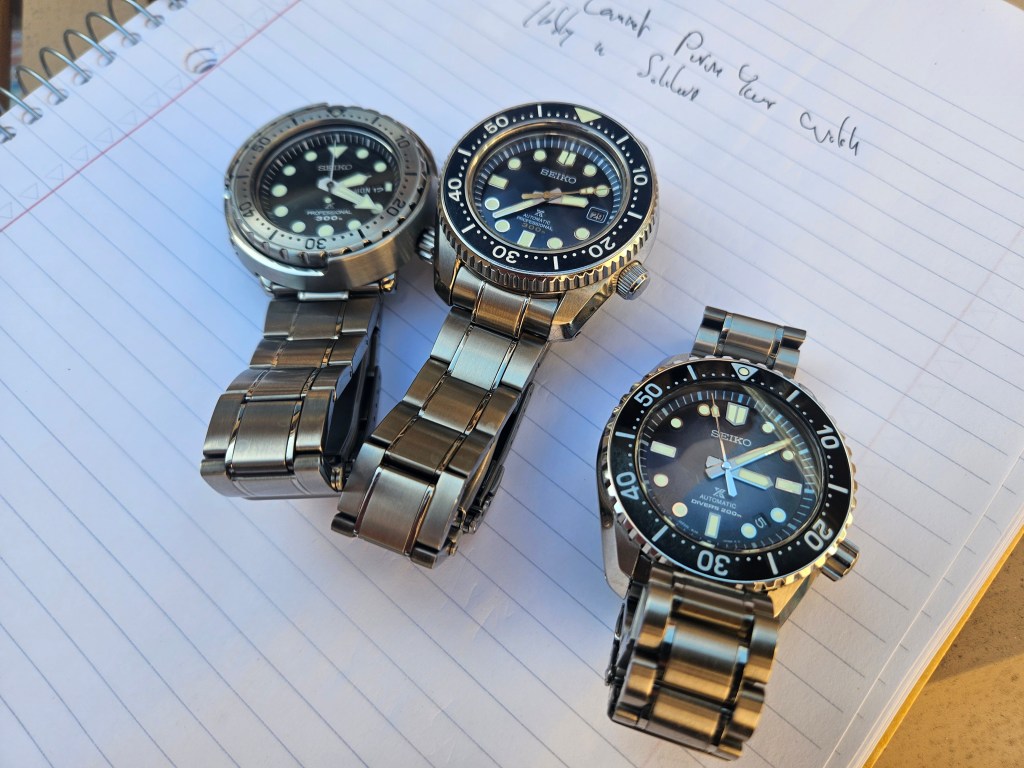
    The watch-obsessive’s quest for the so-called Holy Grail of watches is not heroic—it’s theatrical, maudlin, and embarrassingly earnest. He speaks of it with reverence, as if he’s Sir Galahad in a NATO strap. But what he’s chasing isn’t a singular object of desire—it’s a shapeshifting chimera, a delusion dressed in brushed stainless steel.

    Today’s grail is a bronze diver with gilt indices. Tomorrow it’s a minimalist field watch with a sandwich dial. By the weekend it’ll be a 41mm titanium chronograph with a “stealth” finish. Each new acquisition is preceded by the familiar declarations: This is it. The one. The final piece. And yet, within weeks—days, even—that “final piece” becomes just another stepping stone in a never-ending wrist safari.

    There is no grail. There is only motion sickness.

    The watch obsessive, in his tortured enthusiasm, is less knight and more Tantalus. In Greek mythology, Tantalus is doomed to stand waist-deep in a pool of cool water beneath a tree dripping with ripe, fragrant fruit. But as he reaches out—just a bit more—the water recedes, the fruit retreats. His thirst is never quenched. His hunger never satisfied. Only the illusion of satisfaction persists.

    And so it goes with the watch addict. His fingertips brush the bezel. His nostrils catch a whiff of Horween leather. His YouTube thumbnails promise “GRAIL ACHIEVED” in all caps. But it’s never real. The moment fades. The watch, once unboxed and adored, begins its quiet drift into mediocrity. It no longer sings. It just ticks.

    And like a fool with a ring light, he’ll sit in front of his camera, describing the myth of Tantalus with tragic flair—his voice trembling as if he’s reciting Homeric verse—while wearing a watch he no longer loves, but can’t yet admit has failed him.

    Because admitting that would mean facing the truth: the grail isn’t late—it’s a lie.

  • The Portrait of the Artist as a Sweaty Young Man

    The Portrait of the Artist as a Sweaty Young Man

    The Portrait of the Artist as a Sweaty Young Man
    by Jeff McMahon

    Jeff McMahon was supposed to be a titan—or so he believed. His father, a man so dominant he once stole McMahon’s future mother from none other than General John Shalikashvili with the cold-blooded finesse of a Komodo dragon, radiated command like a halogen lamp. In the long shadow of that military bearing, McMahon sought to carve out his own myth—one barbell at a time.

    As a competitive Olympic weightlifter and golden-era bodybuilder in the 1970s, McMahon sculpted not just muscle, but identity. He was a Greek statue in motion, a walking promise of masculine potential. But while others were flexing in the mirror, he was gasping for air in a high school locker room, undone not by physical strain, but by panic attacks, a Nabokov fixation, and a Kafkaesque obsession with grammar. This was not ascension to Mount Olympus. This was implosion.

    The Portrait of the Artist as a Sweaty Young Man is a semiautobiographical novel in two acts. The first unfolds in the sun-drenched, protein-soaked Bay Area of the 1970s, where McMahon trained alongside a tribe of emotionally stunted muscleheads. The second takes place decades later, when he emerges as a reluctant intellectual—still jacked, still haunted—teaching college writing in a desert town where ambition goes to die and office politics are played with knives.

    Told in the second person, the novel is both an interrogation and a darkly comic trial of McMahon’s younger self—a character he observes with a mix of horror, sympathy, and disbelief. This is not a story of triumph, but the brutally funny autopsy of one. With merciless wit and an eye for the absurd, McMahon dismantles the treacherous myth of transformation and the masculine delusion that biceps can shield one from existential despair.

    For Gen X and Boomer men raised on Schwarzenegger and Bukowski, now softening into middle age and Googling blood pressure medication, Sweaty Young Man punctures the performance-driven culture of the gym, the classroom, and the self-help aisle. What begins as a memoir of obsession and physicality ends as a meditation on identity, shame, nostalgia, and the slow, bewildering shift from symbol to person.

    This is McMahon’s offering to the younger man he once was—the sweaty, striving, half-mad lifter who believed that heroism could be bench-pressed. He was wrong. But he was trying.

    And that’s where the story begins.

  • The Timekeeper’s Curse: Why You’ll Never Be Satisfied with Your Watch Collection

    The Timekeeper’s Curse: Why You’ll Never Be Satisfied with Your Watch Collection

    To understand the tortured psyche of the modern Timekeeper, you must first meet his most conniving organ: the Cavebrain. This primal relic, forged in an age of spear tips and saber-toothed tigers, was never designed for eBay, Instagram wrist shots, or limited-edition dive watches with meteorite dials. And yet, here he is in the 21st century, a man both blessed and cursed with opposable thumbs, a PayPal account, and a psychological need for existential renovation every time he clicks Buy It Now.

    A high-ticket watch purchase for the Timekeeper is not a simple act of consumer indulgence—it is a rite of passage, a narrative arc, a full-blown identity reboot. He isn’t just buying a watch; he’s staging a personal renaissance, performing emotional alchemy with brushed titanium and spring-drive movements. He craves the sensation of getting something done—and if he can’t change his life, he’ll change his wrist.

    But a new acquisition can’t simply squeeze into the old watch box like another hot dog in an overstuffed cooler. No, it demands sacrifice. One or more watches must be winnowed down, exiled like loyal but unremarkable lovers who just didn’t “spark joy.” There is drama here—drama more potent than remodeling a kitchen or repainting the bedroom a daring eggshell white. This is a domestic upheaval that matters. The arrival of a new timepiece—let’s call it “the new kid in town”—requires a realignment of the soul.

    Now, for those poor souls unacquainted with Timekeeper theology, let me explain: He cannot simply collect indiscriminately. He is bound by the Watch Potency Principle, a dogma revered by enthusiasts. This principle states that the more watches a man owns, the less any of them mean. Like watering down bourbon, or stretching a heartfelt apology into a TED Talk, the essence gets lost. The once-sacred grails—the unicorns he hunted with obsessive glee—go sour in the dilution of excess. Only by restricting the herd to five to eight carefully curated specimens can he maintain potency and fend off emotional ruin.

    Of course, there’s a devil in the details. The Timekeeper suffers from a chronic affliction known as Watch Curiosity. He’s always sniffing around the next shiny object, eyes darting at macro shots on forums, lurking on Reddit, and falling prey to influencers wearing NATO straps and faux humility. Inevitably, he pulls the trigger on yet another must-have diver, thus initiating the ritual purge. A watch he once swore eternal fidelity to must now be cast out—not because it’s inadequate, but because he has convinced himself that it is. This self-gaslighting feeds a demonic loop known as Watch Flipping Syndrome, wherein watches are bought, sold, and rebought with the desperation of a man trying to time-travel through retail therapy.

    If the Timekeeper is lucky, if he can wrestle his impulses into a coherent, lean collection, he may briefly find peace. But peace is not his natural state. Beneath his curated restraint lies a restlessness, a gnawing sense that time—his most feared adversary—is standing still. His desire for a new watch is not about telling time; it’s about rewriting it. When he buys a new watch, he isn’t updating his collection—he’s updating himself. He wants change, achievement, rebirth.

    Enter the Honeymoon Period—a temporary euphoria where the new watch becomes a talisman of transformation. He floats, rhapsodizes, posts gushing tributes on enthusiast forums. He becomes a preacher in the Church of the Chronograph, recruiting others to experience this miracle. The watch didn’t just change his wardrobe—it changed his life.

    But, as all honeymoons do, the enchantment fades. The novelty rusts. What was once a grail becomes just another object—another timestamp on the long and winding road of emotional substitution. He finds himself, once again, alone with his Cavebrain, who, ever the unreliable life coach, whispers, “Maybe there’s something better out there.”

    Thus, the cycle repeats—endless, compulsive, costly. The Timekeeper is not a collector. He is an evolutionary casualty. A caveman in a smartwatch world, still looking for meaning in a bezel.

  • Welcome to the Kids of Divorced Parents Club

    Welcome to the Kids of Divorced Parents Club

    It was a cold November Friday night at Canyon High School, and the Frosch Dance had been in full swing. Freshmen and sophomores had packed the cafeteria, KC & the Sunshine Band’s throbbing disco beats pulsing through the linoleum and cinderblocks. Boys had huddled on one side, girls on the other, like oil and water at a chemically unstable mixer. You’d stood with Hewitt and Kaufmann, scanning the room for Liz Murphy.

    Kaufmann had jabbed his finger across the cafeteria at a girl who looked like she could’ve started for the Raiders. Broad shoulders, neck like a redwood stump, and a forehead that could stop a speeding truck—she’d stood alone, her eyes glowering from opposite ends of her face like rival sentries. The dark pouches beneath them added to the haunted look. Her mouth, locked in a scowl, might as well have been carved in stone.

    “Must suck to look like the lead singer of Meat Loaf,” Kaufmann had snickered.

    “She’s known as the Tasmanian Devil,” Hewitt added. “Flashburger was yelling ‘Hit the deck! Tasmanian Devil on the loose!’ when she came near the quad. She’s got a twin brother. Both in special ed.”

    “That’s gotta be rough,” you said. “Getting ridiculed every minute of your life.”

    “You probably get used to it,” Kaufmann mused. “Grow a thick skin.”

    “Or maybe you don’t,” you said. “It’s like that myth from Mrs. Hanson’s class—the guy chained to the rock getting his liver eaten every day.”

    “Prometheus,” Kaufmann confirmed.

    “What a hellish life. Constant Prometheus treatment.”

    “Do we even know her name?” Kaufmann asked.

    “Nope,” said Hewitt. “Just Tasmanian Devil. That’s it.”

    That’s when Liz Murphy had walked in, burgundy top hugging her in all the right places, jeans so fitted they might’ve been sewn on. Her red hair flowed behind her like a cape made of fire, and her middle finger was braced, injured. She spotted you and made her way over.

    “I almost didn’t come,” she said. “Emergency room after volleyball. Dislocated my finger. It swelled up like a balloon.”

    Kaufmann cleared his throat. “Sorry on behalf of all the guys for being assholes to you in middle school.”

    “We called you names we shouldn’t have,” Hewitt said.

    “Like Giraffe?” Liz raised one eyebrow.

    They nodded, shamefaced.

    “Yeah, it sucked going home crying myself to sleep every night.”

    “But look at you now,” Kaufmann said.

    “Yeah, lucky me. But I wonder—what if I still looked like a giraffe? Would you still be assholes, or am I only off the hook because I changed?”

    “I can’t honestly say,” Kaufmann mumbled.

    “Be easy on us,” Hewitt pleaded. “We were barely thirteen, super immature.”

    “Not like now?” she said, dripping sarcasm. She turned to you. “You never treated me like that.”

    “Jeff was too afraid of girls to talk to them,” Kaufmann cut in.

    “Diana Nesbitt asked Jeff to kiss her in seventh grade and he fainted,” Hewitt laughed.

    “That’s exaggerated,” you protested.

    “We had to revive you with smelling salts,” Hewitt said.

    “I didn’t faint. I walked into a pole and got disoriented.”

    “You fainted,” Kaufmann said. “We have over a dozen witnesses.”

    “Jeff’s come a long way,” Liz said, slipping her arm around your waist.

    “Wow,” Kaufmann said. “You guys going steady, or what?”

    Liz studied your face. “I don’t know. We haven’t had a DTR.”

    “A what?” Kaufmann asked.

    “Determine the Relationship.”

    “Holy crap,” Kaufmann said. “That would scare the shit out of me. Sounds like an FBI interrogation.”

    The lights dimmed, and “I Hope We Get to Love in Time” started playing. Couples moved to the dance floor. Liz took your hand and led you to the center.

    Kaufmann yelled after you, “I hope you’re blushing, McMahon, because if you’re not, I’ll blush for you!”

    Two minutes into the song, a blood-curdling scream erupted: “Who crushed my face?”

    The music stopped. Lights flipped on. Lori Walker was clutching her eye and shouting that someone had slammed into her. All fingers pointed at the Tasmanian Devil. She insisted she’d just been heading for the drinking fountain.

    Mr. Reinhart rushed in, handed Lori an ice pack, and tried to calm things down. Lori jabbed an accusing finger, curses flying. The Tasmanian Devil ducked behind the soda machine and started crying.

    Mr. Reinhart followed. “You can’t stay there all night.”

    “Wanna bet?”

    “I’ll call your father.”

    “You do that.”

    “Wait in front of the cafeteria. It’s not safe back there.”

    “Why not?”

    “All the electrical stuff. You get shocked, that’s a lawsuit. You hear me?”

    She got up and followed him out.

    The DJ apologized and cued up “For the Love of You.” Liz pulled you close again.

    “I did something really stupid last week,” she said.

    “What?”

    “I found my father.”

    “What do you mean?”

    “I hadn’t seen him since I was little. My cousin found him. He’s in a trailer park in Union City. We went there, and I saw him through the screen door, shirtless, eating KFC, drinking beer, watching Kojak. He screamed at the TV, spit flying. I walked back to the car, told Susanne to take me home. I knew I’d never see him again.”

    “Did you tell your mom?”

    “Hell no. She’d kill me. After the divorce, things were never the same.”

    “Speaking of divorce,” you said. “Something’s up with my parents. My dad took this so-called job promotion, but I think he wants out.”

    “What kind of job?”

    “Travel-heavy. Six months a year.”

    “Oh yeah. He’s a goner.”

    “Divorce City. I can smell it.”

    “Stand in line, Jeff. Soon enough, you’ll be in the Kids of Divorced Parents Club.”

  • The Disappearing Novel and the Culture That Forgot How to Read

    The Disappearing Novel and the Culture That Forgot How to Read

    In his New York Times column “When Novels Mattered,” David Brooks laments the slow vanishing of the novelist as a public figure. Once, the release of a new novel—especially by the likes of Saul Bellow or Toni Morrison—was a cultural event. Now it barely causes a ripple.

    The novel no longer commands attention. The digital age has crushed the reader’s patience, fractured our attention span, and flooded our minds with the shallow stimuli of TikTok, endless texts, and algorithmic rabbit holes. Where once we waited for a new Roth novel with the same anticipation reserved today for a Marvel sequel, we now swipe past literature as if it were spam.

    For Brooks, this is not just a loss—it’s a tragedy. The decline of the novel signals something deeper: a society losing its capacity for moral complexity, nuance, and emotional depth. The great literary writers, he argues, once served as our secular prophets, our social conscience. They told the truth—harsh, beautiful, layered. They gave us characters who were flawed, human, and real—not two-dimensional avatars chasing dopamine hits on social media.

    One of Brooks’ most compelling insights is that this decline is not simply the result of technological distraction, but of cultural timidity. Great literature, he reminds us, requires audacity. The ability to speak outside the safe lanes. To challenge the dominant orthodoxy. And today, particularly among the liberal elite, that audacity is wilting. Brooks argues that young people, especially on college campuses, whisper their opinions in fear. The social cost of independent thinking has grown too high.

    Interestingly, Brooks—who has recently skewered the excesses of the political right—spares them from scrutiny here. His focus is firmly on the left, on the performative virtue and self-censorship that, while well-meaning, suffocates creative risk. In this climate, it’s easier to be righteous than original. Virtue signaling may win you applause online, but it doesn’t lead to great art.

    Yet the most persuasive moment in the essay arrives late, when Brooks describes the collective psychic damage of the last decade. “Our interior lives,” he writes, “are being battered by the shock waves of public events. There has been a comprehensive loss of faith.” That line lands hard. It names something many of us feel: that we are living in a Bosch-like hellscape of noise, cruelty, and absurdity—a fever dream of moral exhaustion.

    Brooks doesn’t say this, but I will: perhaps literature isn’t dead, just stunned. In shock. In digestion. Maybe we can’t write the great novels of this era because we haven’t fully metabolized the era itself. The story hasn’t ended, and we’re still trying to make sense of the firestorm.

    Is the novel dead? I doubt it. It’s sleeping off the chaos. There are still serious novelists out there—unhyped, uncelebrated—doing the slow, unsexy work. One who deserves more recognition is Sigrid Nunez, whose clear, intimate prose hits as hard as anything in Bellow’s canon.

    The talent remains. The novels are still being written. What’s missing is the cultural infrastructure that once elevated them to necessity. We don’t need more influencers—we need readers with stamina. We need a culture willing to wrestle with meaning again.