Tag: book-reviews

  • Revisiting Alan Judd’s The Devil’s Own Work

    Revisiting Alan Judd’s The Devil’s Own Work

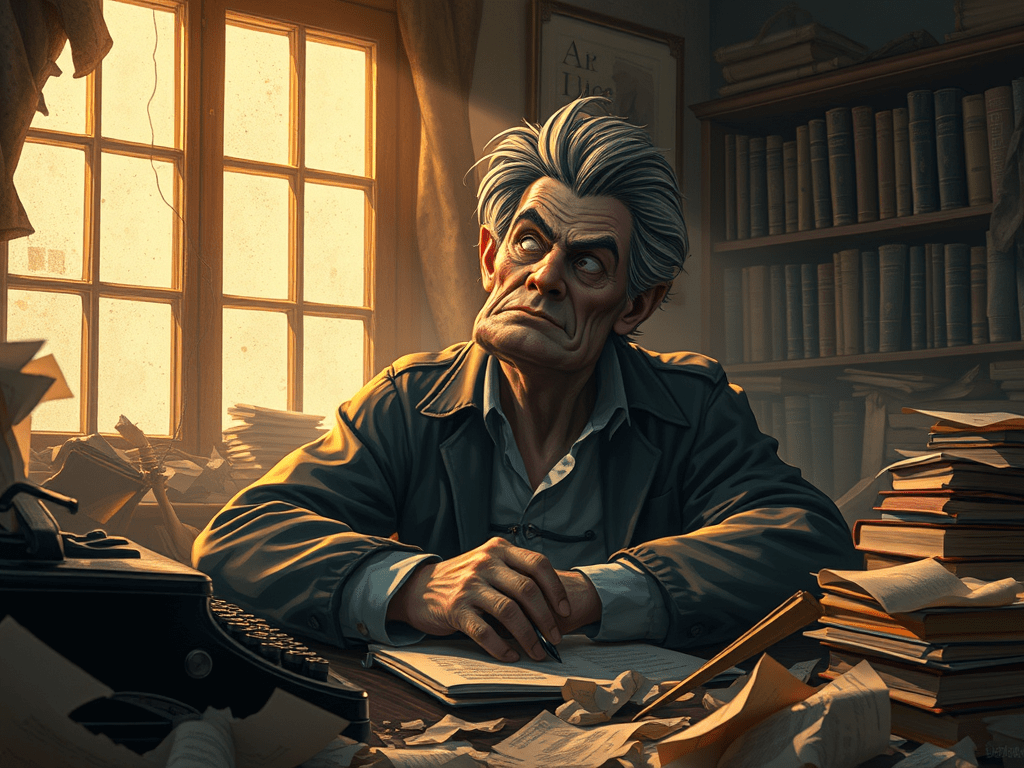
    As a recovering member of Write-a-holics Anonymous, I am contractually obligated—by my own neuroses—to scrutinize my bad habits and the deep-seated delusions that keep them alive. If you’re unfamiliar with my affliction, allow me to introduce myself: I am Manuscriptus Rex, an evolutionary dead-end of the literary world, a creature that compulsively transforms mundane existence into unsolicited book proposals. Where others see a casual conversation, I see Chapter One. Where others experience a fleeting moment of anxiety, I draft a preface. Writing isn’t just a passion; it’s my go-to coping mechanism, my panic button, my self-inflicted curse. While normal people unwind with a drink, I relax by plotting out a three-act structure. Some people journal. I accidentally draft trilogies.

    There’s ongoing debate over whether people like me willingly morph into Manuscriptus Rex—the scowling failed writer pacing his lawn and muttering about “kids these days”—or if the transformation is as unavoidable as hair loss and rising cholesterol. Maybe it’s some grim milestone on the aging checklist, or maybe it sneaks up, the natural side effect of realizing your cultural currency has expired while the youth livestream their way into the future. I’ll leave that existential puzzle for the philosophers to untangle.

    Desperate for rehabilitation, I revisited Alan Judd’s The Devil’s Own Work, a novella that reads like a cautionary tale for every starry-eyed writer who thinks talent alone will crack open the literary Olympus. The story follows Edward, a smug, silver-spooned upstart who barters his soul for literary greatness, only to discover that selling out isn’t nearly as effective as selling your soul. Judd’s cynicism is deliciously savage, peeling back the genteel façade of the literary world to expose it for what it truly is—a brutal, Darwinian circus where desperate souls claw their way up the ladder of editors, columnists, and curators, schmoozing with all the grace of a used car salesman at an estate auction.

    These hopefuls cling to the delusion that if they just network hard enough, flatter the right people, and craft the perfect blend of self-importance and faux humility, they’ll eventually ascend to greatness. But Judd knows better. The truth is, most of them will age out of relevance, their grand ambitions reduced to a handful of bitter op-eds, a smattering of unpaid guest lectures, and an attic full of unpublished manuscripts that smell faintly of despair. In the end, The Devil’s Own Work isn’t just a novella—it’s a scalpel, slicing through the bloated corpse of literary ambition to reveal the grotesque machinery inside.

    Edward is not your typical literary striver. While others claw and hustle their way up the greasy pole of literary success, he lounges at the base of it, certain that greatness will fall into his lap simply because he exists. He radiates a kind of effortless entitlement, convinced that the universe has preordained his ascent to literary immortality. Unlike the desperate social climbers around him, who at least put in the work, Edward is a narcissist of the purest strain—so enamored with his own exceptionalism that he sees ambition as beneath him.

    But Edward’s arrogance isn’t just about believing he’s destined for greatness—it’s about redefining what that greatness should look like. He is determined to strip his writing of any moral compass, crafting fiction that exists in a vacuum of pure, detached aestheticism. No lessons, no redemptions, no conscience. Just words untethered from anything resembling a soul.

    Meanwhile, the legendary O.M. Tyrrel, the region’s most revered novelist, is preparing to publish his final work before slipping into retirement. His magnum opus? A variation on the Faustian myth—a fitting coincidence, given the dark turn Edward’s life is about to take. In an act of staggering hubris, the insufferable upstart Edward pens a blistering review of Tyrrel’s novel, a hit job so scathing it should have burned any bridge between them. But instead of outrage, Tyrrel extends an invitation—dinner at his lavish villa in the south of France. There, over fine wine and literary banter, Tyrrel hands Edward a manuscript of ominous origin.

    What follows is a shortcut to literary fame that quickly warps into a descent into madness. Edward’s name skyrockets into the literary stratosphere, but his triumph is laced with terror. First, a persistent scratching sound haunts him whenever he writes—like something clawing its way out of the pages. Then, a malignant presence begins to stalk him, whispering the truth he’s been trying to drown in champagne and self-congratulation: he is a fraud. He has built his career on stolen words, and now those words have turned against him.

    By the time he realizes his fame is nothing but a gilded curse, it’s too late. Whatever twisted deal he unknowingly made, it has hollowed him out, leaving behind a man unrecognizable even to himself. His success is a mockery, his genius a sham, and his fate—a lifetime of torment, forever pursued by the spectral condemnation of the very thing he sought: greatness.

    As I sifted through the grim moral reckonings of The Devil’s Own Work, trying to extract some life lesson from Edward’s Faustian bargain, my inner writing demon—never one to miss an opportunity to heckle—chimed in.

    “Nice try, pal,” it sneered. “But this book won’t cure you. First off, you’re not Edward. He’s a smug layabout with a superiority complex. You, on the other hand, actually believe in morality tales. Second, Edward expects success to land in his lap like a butler delivering his morning tea. You, meanwhile, obsess over your subjects like a madman, descend into your characters’ fever dreams, and suffer through their torments just to wring out a halfway decent paragraph. Admit it—you’re a real novelist.”

    What a load of self-aggrandizing nonsense. Even if all that were true, there are plenty of people who observe the human condition with a keener eye than mine, and they don’t write novels. They work construction. They write poetry, fables, children’s books. They tell stories in bars, on factory floors, in courtrooms. Insight alone doesn’t make one a novelist.

    But damn that writing demon—it had a point. I wasn’t Edward. The novella didn’t apply to me. And if The Devil’s Own Work didn’t condemn me to a fate of fraudulent literary fame, then maybe—just maybe—I wasn’t doomed to failure either.

    Clearly, the writing demon still lives inside of me. My rehabilitation must continue. 

  • Where my literary delusions were born

    Where my literary delusions were born

    To understand the bloated sense of self-importance that fueled my literary delusions, we need to revisit my place of employment—a temple of pretension where my ego found fertile ground. In the early 1980s, I funded my college education by peddling fine wines and imported beers at Jackson’s Wine & Spirits in Berkeley, conveniently nestled just up the street from the Claremont Hotel on Ashby Avenue. It was the perfect setting for a young man to marinate in delusions of grandeur—surrounded by cork-sniffing sophisticates, armchair sommeliers, and the kind of clientele who believed a well-aged Bordeaux could double as a personality.

    My coworkers were the sort of intellectual show-offs who could reduce an Oxford don to a stammering fool. They held advanced degrees in everything from literature to linguistics, chemistry to musicology, and they wore their academic pedigrees like badges of honor, brandishing them in a booze emporium as if the walls were lined with first editions rather than bottles of Chianti. They’d read Flaubert in the original French and sneered at English translations with the kind of disdain usually reserved for bad table wine. To them, working for any corporation that might dare to track their time was an act of existential surrender. Instead, they peddled fine spirits with an elitism so thick you could bottle it, cork it, and slap a vintage label on it. Their motto? “Service with a smirk.” 

    I wanted to fit in, so I read voraciously, parroting these cultural heavyweights who could debate the nuances of two French Beaujolais for an entire shift while tossing out quotes from Kierkegaard or Camus. Soon enough, I was well on my way to becoming a full-blown snob, the kind who could turn a simple idea into a verbal labyrinth designed to impress rather than clarify. Slow hours found us planted by the registers dissecting the finer points of Nietzsche’s existential dread, Wagner’s bombastic compositions, and Kafka’s literary conundrums. I became intoxicated with my own intellect (mostly because I couldn’t afford the good wine) and used every fifty-dollar word in the book to convince myself I was superior to anyone with a steady paycheck. Working alongside this oddball crew was comfortable and, let’s face it, easy, but it lulled me into a delusion: I might not be wealthy or gainfully employed, but I was intellectually rich, or so I told myself.

    By my mid-twenties, I was perfectly content to be the Nerf football-throwing, Borges-quoting slacker clerk who waxed poetic about the existential themes of Alberto Moravia and the tragic pessimism of Miguel de Unamuno while restocking shelves with Chianti. 

    To further swell my already bloated ego, I spent my early twenties teaching college writing part-time, fancying myself some sort of literary prodigy destined for greatness. Whether I was regaling my students with pompous insights—laced with Nabokovian verbosity—or delivering the same drivel to wine store customers, I reveled in the delusion that I was the gravitational center of the universe. Every word I uttered, every pretentious quip, felt like a gift to the world—never mind that no one had asked for it.

    Thus mired in a fever swamp of self-regard, I began my holy quest, an epic pilgrimage of delusion. Throughout the ’80s and ’90s, I churned out novels at a terrifying speed, convinced that sheer productivity equaled genius. Wow, I must be good at this! I thought, mistaking volume for talent, like a man believing that eating more hot dogs makes him a Michelin-star chef.

    The novels blur together now, a vast landfill of ambition outpacing execution, but three stand out for their sheer absurdity.

    In 1989, I wrote Herculodge, a dystopian satire in which being overweight or displaying cellulite was illegal. This premise, better suited for a five-minute SNL skit, somehow sprawled into a 60,000-word novella, proving that even bad ideas can be tediously stretched to novel length.

    In 1991, I produced Omnivore, the tragic tale of a man who could never find satisfaction eating his own food, forcing him to break into houses and devour leftovers from strangers’ refrigerators. Only through cat burglary could he achieve satiety—a premise that sounds brilliantly unhinged in a John Cheever short story but unbearable at novel length. Unfortunately, I chose the latter, cramming 10 percent story into 90 percent padding, like an overstuffed burrito of literary excess.

    In 1992 while teaching college in the California desert, I lived next to a man who was less a neighbor and more an anthropological oddity—a legal brief-reading, Kenny G-blasting exhibitionist who pranced around the apartment pool in custom-print Speedos while slowly tanning himself into a deep mahogany hue. He became the unwitting inspiration for The Man Who Stopped Dating, my novel about an uncouth playboy who receives a vengeful fruit basket from one of his scorned lovers. A single bite from a deliquescing mango leaves him cursed with a permanent stench, a condition suspiciously similar to fish odor syndrome (trimethylaminuria, for the medically inclined). His hero’s journey becomes a desperate quest to rid himself of the smell, find redemption, and maybe—just maybe—salvage his soul.

    Convinced I had spun pure gold, I went all in—I adapted the story into a screenplay and shelled out a cool two grand to have Hollywood script guru Linda Seger take a scalpel to it. Her verdict? Great premise. Catastrophic structure. Apparently, my masterpiece wasn’t so much a movie as a sprawling narrative train wreck, gasping for subplots, character depth, and the basic bones of a coherent story.

    But did that deter me? Of course not. In my fevered delusion, the mere act of consulting with Hollywood’s premier script doctor meant I was practically in—one fortuitous lunch meeting away from a bidding war over my genius. I could already hear studio execs brawling over my brilliance, assuming they could hold their breath long enough to endure a script about a man who smells like low tide.

    In reality, I wasn’t Hemingway. I wasn’t even a second-rate Elmore Leonard. I was Rupert Pupkin, the delusional failure from The King of Comedy, rehearsing for a fame that was never coming. The difference? At least he had the decency to keep his fantasies in his mother’s basement.

  • LIZA TREYGER BELONGS ON STAGE

    LIZA TREYGER BELONGS ON STAGE

    In her Netflix stand-up special Night Owl, Liza Treyger unleashes an hour of manic brilliance, slicing through life’s absurdities with the gleeful energy of a woman who has long accepted—if not fully embraced—her own chaos. Smiling, effervescent, and naturally sarcastic, she delivers a rapid-fire confessional that feels less like a polished comedy routine and more like an open mic night inside her own hyperactive brain.

    She tells us she was born near the Chernobyl meltdown and now has a lifelong thyroid condition, that her attention span has been obliterated by her smartphone, that she’s forfeited all privacy in exchange for algorithm-curated animal videos, and that her Russian father has an uncanny ability to humiliate her by showing up to formal events in wildly inappropriate T-shirts. She doubts she has the temperament for marriage, children, or any relationship that lasts longer than a Bravo reality show season. She adores living in New York, even though she’s been mugged three times. She got an oversized butterfly tattoo—not because she wanted one, but because she was avoiding the soul-crushing task of changing her printer’s toner cartridge. She’s hungry for applause about losing forty pounds, even though she’s gained it all back. She’s openly critical of her therapist for being judgmental, yet she happily judges everyone around her. She has an encyclopedic knowledge of The Real Housewives franchise, capable of reciting random episodes in disturbingly granular detail. And, above all, she might be a bit of a misfit—too addicted to salacious gossip to maintain deep, lasting friendships.

    Treyger is intimidatingly sharp. I like to think I have a respectable level of intelligence, but I’m fairly certain she would find me basic and tedious—a conclusion I’ve already reached about myself, so no harm done. Watching Night Owl felt like a vacation from my own dullness, a thrilling rollercoaster ride through the mind of someone far wittier, sharper, and quicker than I could ever hope to be.

    For someone who claims to be a misfit, she fits perfectly on a comedy stage. The very qualities that alienate her in real life—her inability to stop talking, her obsession with gossip, her unfiltered, razor-sharp takes—are her greatest gifts in front of an audience. I’d listen to her anywhere.

  • An Unexpected Love Story in The Great

    An Unexpected Love Story in The Great

    If you had told me to watch a period drama about the turbulent love life of Peter III and Catherine the Great—one mostly confined to the gilded chambers of a Russian palace—I would have laughed, pointed to my rain gutters, and insisted I had more pressing matters to attend to. And yet, The Great did something miraculous: it took that seemingly dreary premise and spun it into one of the sharpest, most unexpected love stories I’ve ever seen on television.

    Elle Fanning’s Catherine enters the series practically vibrating with resentment, married off to a narcissistic, gluttonous man-child of an emperor played by Nicholas Hoult, whose Peter III treats ruling Russia like an all-you-can-eat buffet of debauchery. He’s selfish, crude, and revels in excess, while she’s a self-serious, idealistic reformer, convinced she’s been cursed with a fool for a husband. On paper, theirs should be a tale of mutual disdain, and indeed, for a while, it is. But then something bizarre and wonderful happens: they fall in love—not with doe-eyed, saccharine declarations, but in a way that feels both tragic and inevitable. They fall in love despite themselves.

    Peter, the arrogant peacock, starts showing unexpected flashes of vulnerability, betraying an almost boyish need to be seen and understood. Catherine, the self-righteous revolutionary, finds herself drawn to his wit, his strange charm, and his surprising capacity for change. They spar like intellectual gladiators, their verbal fencing as much foreplay as it is battle. This is where The Great sets itself apart from every predictable romance that’s ever clogged up a TV screen: the dialogue—crafted with Tony McNamara’s signature razor-sharp wit—isn’t just ornamental, it’s the very foundation of their attraction. They fall in love through language, through their relentless, biting exchanges that crackle with intelligence, irony, and reluctant admiration.

    Over three seasons, The Great delivers the most gut-wrenching, wickedly funny, and beautifully tragic love story I’ve ever seen—a romance built on war, wit, and the deeply human, utterly irrational act of loving someone against your better judgment.