Tag: books

  • Revisiting Alan Judd’s The Devil’s Own Work

    Revisiting Alan Judd’s The Devil’s Own Work

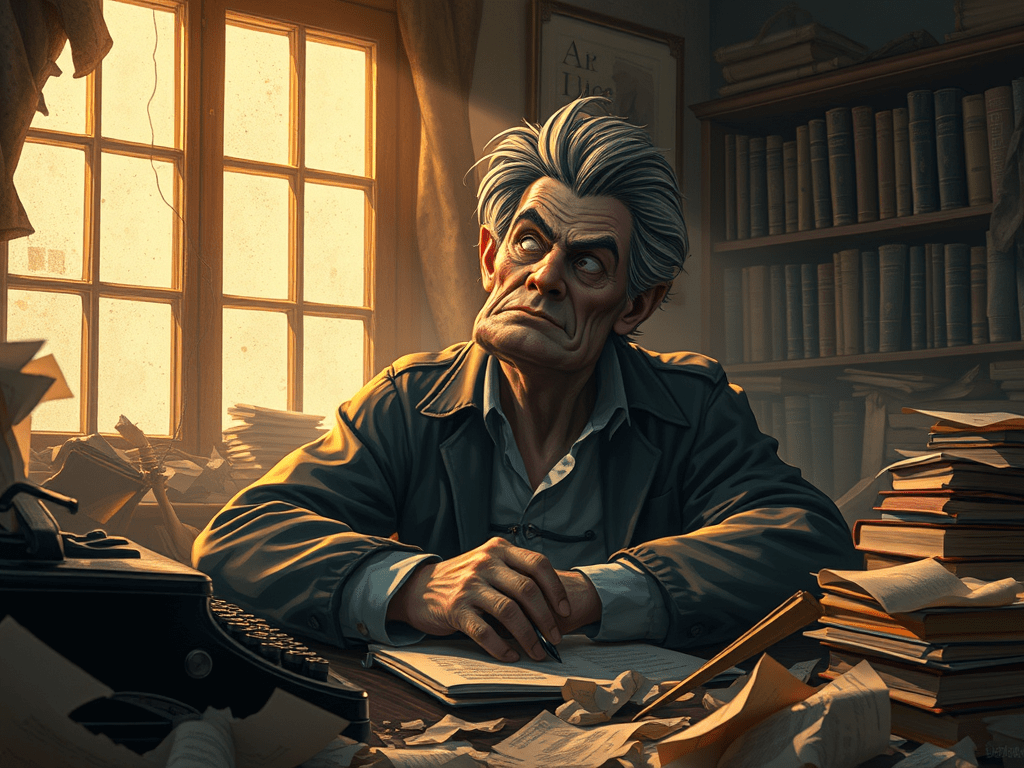
    As a recovering member of Write-a-holics Anonymous, I am contractually obligated—by my own neuroses—to scrutinize my bad habits and the deep-seated delusions that keep them alive. If you’re unfamiliar with my affliction, allow me to introduce myself: I am Manuscriptus Rex, an evolutionary dead-end of the literary world, a creature that compulsively transforms mundane existence into unsolicited book proposals. Where others see a casual conversation, I see Chapter One. Where others experience a fleeting moment of anxiety, I draft a preface. Writing isn’t just a passion; it’s my go-to coping mechanism, my panic button, my self-inflicted curse. While normal people unwind with a drink, I relax by plotting out a three-act structure. Some people journal. I accidentally draft trilogies.

    There’s ongoing debate over whether people like me willingly morph into Manuscriptus Rex—the scowling failed writer pacing his lawn and muttering about “kids these days”—or if the transformation is as unavoidable as hair loss and rising cholesterol. Maybe it’s some grim milestone on the aging checklist, or maybe it sneaks up, the natural side effect of realizing your cultural currency has expired while the youth livestream their way into the future. I’ll leave that existential puzzle for the philosophers to untangle.

    Desperate for rehabilitation, I revisited Alan Judd’s The Devil’s Own Work, a novella that reads like a cautionary tale for every starry-eyed writer who thinks talent alone will crack open the literary Olympus. The story follows Edward, a smug, silver-spooned upstart who barters his soul for literary greatness, only to discover that selling out isn’t nearly as effective as selling your soul. Judd’s cynicism is deliciously savage, peeling back the genteel façade of the literary world to expose it for what it truly is—a brutal, Darwinian circus where desperate souls claw their way up the ladder of editors, columnists, and curators, schmoozing with all the grace of a used car salesman at an estate auction.

    These hopefuls cling to the delusion that if they just network hard enough, flatter the right people, and craft the perfect blend of self-importance and faux humility, they’ll eventually ascend to greatness. But Judd knows better. The truth is, most of them will age out of relevance, their grand ambitions reduced to a handful of bitter op-eds, a smattering of unpaid guest lectures, and an attic full of unpublished manuscripts that smell faintly of despair. In the end, The Devil’s Own Work isn’t just a novella—it’s a scalpel, slicing through the bloated corpse of literary ambition to reveal the grotesque machinery inside.

    Edward is not your typical literary striver. While others claw and hustle their way up the greasy pole of literary success, he lounges at the base of it, certain that greatness will fall into his lap simply because he exists. He radiates a kind of effortless entitlement, convinced that the universe has preordained his ascent to literary immortality. Unlike the desperate social climbers around him, who at least put in the work, Edward is a narcissist of the purest strain—so enamored with his own exceptionalism that he sees ambition as beneath him.

    But Edward’s arrogance isn’t just about believing he’s destined for greatness—it’s about redefining what that greatness should look like. He is determined to strip his writing of any moral compass, crafting fiction that exists in a vacuum of pure, detached aestheticism. No lessons, no redemptions, no conscience. Just words untethered from anything resembling a soul.

    Meanwhile, the legendary O.M. Tyrrel, the region’s most revered novelist, is preparing to publish his final work before slipping into retirement. His magnum opus? A variation on the Faustian myth—a fitting coincidence, given the dark turn Edward’s life is about to take. In an act of staggering hubris, the insufferable upstart Edward pens a blistering review of Tyrrel’s novel, a hit job so scathing it should have burned any bridge between them. But instead of outrage, Tyrrel extends an invitation—dinner at his lavish villa in the south of France. There, over fine wine and literary banter, Tyrrel hands Edward a manuscript of ominous origin.

    What follows is a shortcut to literary fame that quickly warps into a descent into madness. Edward’s name skyrockets into the literary stratosphere, but his triumph is laced with terror. First, a persistent scratching sound haunts him whenever he writes—like something clawing its way out of the pages. Then, a malignant presence begins to stalk him, whispering the truth he’s been trying to drown in champagne and self-congratulation: he is a fraud. He has built his career on stolen words, and now those words have turned against him.

    By the time he realizes his fame is nothing but a gilded curse, it’s too late. Whatever twisted deal he unknowingly made, it has hollowed him out, leaving behind a man unrecognizable even to himself. His success is a mockery, his genius a sham, and his fate—a lifetime of torment, forever pursued by the spectral condemnation of the very thing he sought: greatness.

    As I sifted through the grim moral reckonings of The Devil’s Own Work, trying to extract some life lesson from Edward’s Faustian bargain, my inner writing demon—never one to miss an opportunity to heckle—chimed in.

    “Nice try, pal,” it sneered. “But this book won’t cure you. First off, you’re not Edward. He’s a smug layabout with a superiority complex. You, on the other hand, actually believe in morality tales. Second, Edward expects success to land in his lap like a butler delivering his morning tea. You, meanwhile, obsess over your subjects like a madman, descend into your characters’ fever dreams, and suffer through their torments just to wring out a halfway decent paragraph. Admit it—you’re a real novelist.”

    What a load of self-aggrandizing nonsense. Even if all that were true, there are plenty of people who observe the human condition with a keener eye than mine, and they don’t write novels. They work construction. They write poetry, fables, children’s books. They tell stories in bars, on factory floors, in courtrooms. Insight alone doesn’t make one a novelist.

    But damn that writing demon—it had a point. I wasn’t Edward. The novella didn’t apply to me. And if The Devil’s Own Work didn’t condemn me to a fate of fraudulent literary fame, then maybe—just maybe—I wasn’t doomed to failure either.

    Clearly, the writing demon still lives inside of me. My rehabilitation must continue. 

  • Failure is the default setting of the writer

    Failure is the default setting of the writer

    After churning out one literary failure after another across five decades, I’m forced to ask myself: Is my perseverance a virtue, the kind of tenacity that gets celebrated in self-help books and motivational speeches? Or is it a pathological compulsion, a lifelong affliction keeping me from my real calling—whatever that may be? And if the notion of a “true calling” is just a fairy tale we tell ourselves to make existence more bearable, then perhaps I should at least free up some time to do the dishes.

    To grapple with these existential questions, I turned to Stephen Marche’s slim but merciless On Writing and Failure: Or, On the Peculiar Perseverance Required to Endure the Life of a Writer. His thesis? Failure isn’t an anomaly in the writing life—it’s the default setting. The occasional success, when it happens, is a fluke, an accident, a glitch in the system. Failure, on the other hand, is the well-worn coat writers wrap themselves in, the skin they inhabit. And mind you, he’s not even talking about unpublished failures like myself—he’s extending this bleak diagnosis to the published ones, the so-called “real writers.”

    Marche backs up his grim pronouncement with numbers: Three hundred thousand books are published every year in the United States, and only a microscopic fraction make a dent in public consciousness. It doesn’t matter how famous you are—your book is still more likely to sink into obscurity than to make any meaningful impact. If you’re not sufficiently depressed yet, Marche then drags in examples from literary history: beloved writers who, despite their modern-day veneration, spent their lives begging for money, wallowing in debtors’ prisons, or drinking themselves into oblivion.

    Marche’s goal with this book—barely longer than a grocery receipt—is to strip writing of its romantic pretensions. Forget divine inspiration, artistic calling, or the fantasy of making it; writing is just stubbornness on repeat. But here’s where he really twists the knife: That whole narrative about failure eventually leading to success? Utter nonsense. “The internet loves this arc,” he writes, “low then high; first perseverance, then making it all; all struggle redeemed; the more struggle the more redemption. It’s pure bullshit.” The truth? Most writers fail, period. And even the rare successes are plagued by existential misery—forever misunderstood, chronically isolated, and shackled to a relentless hunger for recognition that can never truly be satisfied.

    Worse still, even the successful ones live in constant anxiety over whether they’ll ever be successful again. Literary triumphs don’t lead to security; they lead to paranoia. Marche describes the “psychology of failure” as an inescapable affliction that forces writers to cling to the smallest scraps of validation, inflating minor achievements to salve their chronic inadequacy. His case study? A professor who once had a letter published in The Times Literary Supplement and framed it on his wall like a Nobel Prize, using it as a talisman against irrelevance.

    Reading On Writing and Failure is like stepping into a room full of my own ghosts—writers far more accomplished than I am, yet still plagued by the same desperate need for affirmation, the same self-inflicted torment, the same inability to simply be content. It’s almost comforting, in a bleak sort of way. All those books about “maximizing happiness,” “daily habits of highly effective people,” and “radical gratitude” are useless against the unyielding hunger of the literary ego. If failure is the writer’s natural habitat, then perhaps the real victory isn’t in succeeding but in learning to fail with style.

    What struck me most about Marche’s book is just how desperate writers are for validation—so desperate, in fact, that we cling to the tiniest scraps of approval like a Jedi clutching a lightsaber in a dark alley. As proof that I was destined for literary greatness, I have spent the last three decades obsessively revisiting a single one-hour phone conversation I had in 1992 with the retired literary agent Reid Boates. At the time, I was hawking The Man Who Stopped Dating, a novel the publishing industry (correctly) determined should never see the light of day. But Boates, to my eternal delight, told me my synopsis knocked his socks off. That one phrase sent me soaring. If a mere synopsis could strip a seasoned agent of his footwear, surely I was on the brink of glory.

    Perhaps the memento I cherish even more is a letter I received from Samuel Wilson Fussell, author of Muscle: Confessions of an Unlikely Bodybuilder. After devouring his memoir, I wrote him a fan letter detailing my own bodybuilding misadventures and name-dropping a few of the lunatics I recognized from his book. Fussell responded enthusiastically, telling me that he and his friends had read my letter out loud and collapsed to the floor, clutching their bellies in laughter. Over the years, I’ve sometimes wondered: Were they laughing with me… or at me? But in the moment, it didn’t matter. In my mind, Fussell’s response confirmed what I already knew—I was a man of literary consequence, a peer among published authors and esteemed literary agents, a rising star on the precipice of greatness.

    And here’s the kicker: I can still remember the pure, uncut euphoria I felt after talking to Reid Boates and receiving Fussell’s letter, and I am convinced—convinced—that the high would have been no greater had I seen my best-selling novel displayed in the window of a Manhattan bookstore.

    Marche is right. My neediness was so profound that I mistook these small flashes of recognition as irrefutable proof of my imminent rise to literary celebrity. But unlike Marche, I find no solace in knowing that I am not alone in this affliction. I can only speak for myself: I am a writing addict. My compulsion produces nothing of value, it embarrasses me, and I am in desperate need of rehabilitation. And so, in a cruel twist of irony, I write about my recovery from writing—even though my so-called recovery demands that I stop writing altogether. My misery, therefore, is guaranteed.

  • The Mysterious Woman at the Moscow Zoo

    The Mysterious Woman at the Moscow Zoo

    The morning after landing in Moscow—still basking in the relief that no grim-faced customs officer had pried A Clockwork Orange from my hands—I found myself standing with a dozen other jet-lagged Americans at the Moscow Zoo, led by our perpetually chipper tour guide, Natasha. The air was thick with a mix of animal musk and cigarette smoke, and somewhere in the distance, a public speaker crooned a heart-wrenching Rachmaninoff piano piece, as if the entire city were in a state of elegant despair.

    I stood transfixed before the silverback gorilla, watching as he pounded his enormous, muscle-corded chest inside his moated enclosure, the very embodiment of brute strength and existential boredom. That’s when she appeared—an elegant woman in a black dress so perfectly tailored it looked painted onto her body, a matching black hat perched at a rakish angle, and a string of pearls glistening like a final touch of old-world sophistication. She moved toward me with an effortless grace, her dark eyes alight with something between mischief and intrigue.

    Not only was she stunning—she was smiling. At me. As if we were long-lost confidantes about to dive into a tête-à-tête of world-altering significance. My sleep-deprived, jet-lagged brain struggled to process this impossible scenario: a beautiful Russian woman, dressed for a rendezvous at Café Pushkin rather than a casual afternoon at the zoo, suddenly deciding that I was worth her time. I had come to Moscow expecting bureaucracy, bad food, and a surplus of dour expressions—not this. It was as if I had stumbled into the first act of a Cold War spy thriller, and I had absolutely no idea what my lines were supposed to be.

    “I can tell you’re American,” she said with a sharp accent that sent chills down my spine, “but you look very Russian.”

    This was true. My mother’s family was from Poland and Belarus, and I had dramatic Eastern European features. Even the other tourists on our tour said I looked Russian.

    “Russian men are very strong,” she said. “And you are a weightlifter, of course.”

    Indeed, I was. In fact, before I pivoted to bodybuilding in my mid-teens, I was an award-winning Olympic Weightlifter, and I was very fond of the great Soviet world record breaker Vasily Alekseyev. 

    “Russian women love strong men,” she said, smiling at me.

    I was too flattered by her attention to be suspicious of her ulterior motives, but Natasha saw what was going on, and the goody-two-shoes tour guide with thick spectacles grabbed me by the arm with her strong grip, walked me to some nearby bushes, and warned me that the woman was probably KGB attempting to ensnare me into some kind of kompromat or other. What the trap was Natasha did not say, so it was left to my prurient imagination. 

    While the reality was that Natasha had probably saved me from a lot of grief, I was too enticed by this elegant woman to get her out of my mind. In college, I was too socially awkward and absorbed by my bodybuilding, piano playing, and reading of “dark literature” to date or have what people considered normal socializing, but thousands of miles away from my mundane environment in the San Francisco Bay Area and now in the forbidden Soviet Union, I found myself feeling emboldened around the opposite sex, and I was hungry for a memorable encounter of some kind. What I’m trying to say is that I found myself feeling unusually lusty. My desires compelled me to believe that I had a grand opportunity with this lovely Russian woman at the zoo, and the fact that Natasha had ruined my chances pissed me off in ways that got me in touch with my Inner Silverback. Contrary to Natasha’s warnings, there may have been an outside chance that this mysterious woman simply found me attractive and wanted to get to know me, but her opportunity, and mine, had been repelled by my no-nonsense busy-body tour guide. 

  • It’s Never Been a Worse Time to Write a Book

    It’s Never Been a Worse Time to Write a Book

    Looking at Paul’s literary success—a man whose brief collection of letters has been on history’s all-time best-seller list—I can’t help but feel I bet on the wrong horse. Here I was, grinding away at novels, when I should have been an epistle-wielding scrivener, maybe even the founder of my own religion. Paul understood something I clearly did not: the world wasn’t clamoring for door stopper novels the size of The Count of Monte Cristo—it wanted sharp, incendiary tracts that could shake the foundations of belief. His instincts were dead-on, and two millennia later, his work is still in print, while my manuscripts remain in purgatory.

    And let’s be honest—there’s never been a worse time to write a book. We inhabit a post-literate wasteland, where the next generation’s idea of reading is squinting at subtitles while scrolling TikTok. The written word is being replaced by 15-second dopamine jolts, and syntax is being butchered faster than a hog in a slaughterhouse. Meanwhile, AI-generated prose is turning human creativity into an optional relic—why agonize over writing when you can plug a prompt into ChatGPT and get a grammatically competent, if soulless, 2,000-word essay faster than it takes to microwave a Hot Pocket? Argument structure, rhetorical flourish, actual thought? Who needs those when the algorithm can produce a sterile, citation-laden monstrosity with all the passion of an instruction manual? Paul saw the writing on the wall—literally. And I? I spent five decades wrestling with novels that no one wanted to read. Maybe it’s time to rethink my approach before I, too, become just another artifact of a bygone literary era.

    And yet, when you’re possessed by the writing demon, as I am, none of this matters. Reality bends around the obsession. Practical concerns slide off me like water off a duck’s back—or more accurately, like rejection letters into my trash bin. The demon doesn’t care about markets, trends, or the creeping irrelevance of books. No, the demon is hell-bent on proselytizing, convinced that I’ve stumbled upon the elixir of life, and that the world must hear my truth, whether it wants to or not. It’s not just enthusiasm—it’s derangement, the kind of fevered compulsion that outs you as a hopeless fanboy for your own ideas. People start calling you “touched” or “special,” which is just polite society’s way of saying, “You are utterly unhinged, and we wish you would stop.”

    You’re ashamed of your writing obsession, yet powerless to stop because the impulse isn’t tethered to reality—it’s pure pathology. You’re a self-appointed evangelist, convinced the world needs your message, your perspective, you. If only people would listen, if only your words took root in the collective consciousness, then maybe—just maybe—you’d finally feel the validation that’s eluded you your entire life.

    And yet, you’re no fool. You see the absurdity of your crusade. You know the odds, the futility, the sheer delusion of it all. But you’re a divided soul—the rational part watches in horror as the compulsive part keeps writing into the void, hoping someone, somewhere, will care.

  • How Eddie Murphy’s Advice Pushed Tiffany Haddish’s Career in the Right Direction

    How Eddie Murphy’s Advice Pushed Tiffany Haddish’s Career in the Right Direction

    If I was indeed possessed by a misguided writing demon in the mid-’80s—courtesy of reading A Confederacy of Dunces on repeat and subsequently squandering decades chasing a fool’s errand to capture some fraction of Toole’s novelistic splendor—then one could argue, with a certain tragic flair, that A Confederacy of Dunces ruined my life. Of course, that’s a spectacular oversimplification, but it has a nice literary ring to it, the kind of statement that cries out for a memoir deal. A perfect hook for a writing addict who, in theory, is supposed to have sworn off writing books but is secretly mainlining one on the side. It’s theatrical, adolescent, irresistibly neat. But let’s indulge the idea for a moment: a novel ruined a young man’s life. Decades later, the question remains—what do we do with this squandered life? Do we ignore it, dismiss it as a useless souvenir, or can something be salvaged from the wreckage?

    If there’s anything worth extracting from my own literary misadventures, it’s a warning to younger, equally deluded souls who might be possessed by the same demon of ambition. And make no mistake—ambition alone will not get you anywhere worth going. Yes, it will drag you through years of toil, ensure you hit your daily word count, and convince you that sheer willpower equals literary success. But ultimately, ambition alone will lead you into a tunnel with no exit. You’ll work hard—but not the right way. You’ll write, but without joy, without connection, without meaning. You will produce, but you will not matter.

    So instead of chasing the illusion of grandeur, you should be asking yourself four crucial questions. First, are you having fun with the creative process? If not, why are you doing this? The comedian Tiffany Haddish once said that Eddie Murphy pulled her aside and told her that if she wasn’t having fun on stage, the audience would sense it—and once she embraced that, her career took off. The same applies to writing. If your joy doesn’t translate onto the page, don’t expect anyone else to find it. Ambition will get words onto the page, but it won’t make them worth reading. Second, are you the only person in the world who could write this book? What unique gifts, obsessions, or quirks of personality make you the best person to write this, or are you forcing an idea simply because you think it’s marketable? If the demon of ambition is blinding you to your weaknesses, rest assured that agents and editors will see them clearly—and they will tell you to go home. The demon, of course, won’t listen. He never does.

    Third, why this book? Can you articulate—persuasively—why your book matters? Will it survive in an attention economy where a two-minute TikTok can go viral while your ten-year opus sells six copies? Do you know what your book is competing against? Can you justify its existence? 

    Imagine, for a moment, that you’ve never been published and have no social media following to catapult your debut novel into relevance. How exactly do you think this book is going to survive? Picture a horde of baby sea turtles, freshly hatched, flopping their way toward the ocean. Before they even touch the surf, they’re picked off by seagulls, crabs, raccoons, foxes, coyotes, frigatebirds, herons, egrets, snappers, jacks, barracudas, dolphins, sharks—the list of assassins is endless. The ones that do make it into open water face even worse odds. And yet, statistically, they still have a better shot at survival than your novel has at flourishing into a living, breathing piece of art that embeds itself in millions of imaginations.

    So before you get too deep into your literary fever dream, you need to ask yourself a sobering question: Is there enough juice for the squeeze? Best-selling author Sam Harris certainly asked himself that before shifting his focus away from books to his wildly successful Making Sense podcast. I remember him breaking it down with ruthless efficiency: writing a book can take five grueling years—writing, editing, publishing, book tours—and even after all that, sales might not justify the effort. Meanwhile, he can record a podcast in a few hours and reach millions instantly. No torturous rewrites, no endless editing loops, no begging the world to care.

    And that’s a best-selling author speaking. You’re not one. You’re a nobody with a dream, convinced that your fragile little hatchling of a book will somehow defy the gauntlet and fulfill your delusions of literary immortality. You have lost your mind. More than likely, the book won’t be read. Which brings us to your final, painful reckoning.

    Will your book actually connect with anyone? Or will it be yet another tree falling in the forest with no one around to hear it? Failure to connect isn’t bad luck—it’s bad writing. If your prose exists in a silo of delirious echoes, unread and unloved, then it isn’t literature—it’s literary vapor, ghostly and weightless, doomed to drift into oblivion. And here’s the cruelest truth of all: your writing demon won’t make this distinction. He’ll tell you that writing is writing, that piling up pages is progress, that if you just keep going, success is inevitable.

    It isn’t.

    Had I asked myself these questions before chasing my writing demon down every blind alley, perhaps I would have written with purpose instead of compulsion. But I was too busy obeying the demon to pause and think. If you’re an aspiring writer, don’t make the same mistake. Ambition can drive you forward, but only if it’s tethered to something real—joy, originality, necessity, and connection. Otherwise, you’re just manufacturing words, filling pages with the sound and the fury, signifying nothing.

  • Interrogating the impulse to achieve literary dominance

    Interrogating the impulse to achieve literary dominance

    Looking back at 5 decades of writing dozens of failed novels, I’m torn between admiring my audacity and filing a restraining order against my judgment. How, exactly, did I manage to pin so much hope on novels that, despite their half-decent opening chapters, quickly spiraled into the literary equivalent of a stalled elevator—going nowhere and deeply uncomfortable for everyone involved?

    In contrast, my short essays were clearly sharper, more potent—but I refused to let reality intrude on my mission. No, I was going to write the comic novel.

    This compulsion was never about art. It was about pain—the kind so deep that Jonathan Franzen famously coined Ache to describe the existential condition of adulthood: the rude awakening that we are not, in fact, the center of the universe and that our desires will always outrun our ability to satisfy them.

    Manuscriptus Rex feels this Ache acutely and has embarked on a fool’s errand to silence it with literary fame. But why this brand of glory? Why not build a real estate empire, become a movie heartthrob, or invent the perfect bed that guarantees twelve uninterrupted hours of blissful, coma-grade sleep? Because Manuscriptus Rex is too much of a narcissist for mere wealth, beauty, or utility. Writing a book—one that matters—offers something more intoxicating: the power to hijack people’s brains.

    And that’s what you really crave—not just admiration, but full cognitive occupation. You want your words burrowed into the minds of millions, your dream world dictating their thoughts. Your need for validation is so bottomless that only mass literary infiltration will mollify you. That this ambition is wildly improbable, driven by pathology, and guaranteed to bring more suffering than satisfaction? Irrelevant. The mission is all that matters. And the mission is literary dominance.

    My wife once observed that men, with their colossal egos, often wake up with sudden revelations, epiphanies so grand they feel compelled to start religions. She’s not wrong. The novelist, the polemicist—what are they really doing but trying to ignite a movement, disrupt the world, and bask in the glow of their own importance? Their gospel isn’t about some grand truth—it’s about them, standing center stage, ablaze with self-appointed brilliance.

    Religion is the ultimate expression of literary dominance. I think of the Apostle Paul himself, scribbling his epistles in a manic frenzy, waging rhetorical war in the bustling marketplace of spiritual ideas, demolishing rival orators, and confessing his own unhinged nature in Romans—his theological magnum opus, a mini-Bible inside the Bible. Only eighty pages in total. That was the sum of his obsessive writing, and yet his literary dominance is established. He’s been the talk of the town for over two thousand years. Whether they like him or not, people still want to hear what he has to say about the human condition. 

    This was the novelist’s role five decades ago, back when novelists were secular prophets, summoned to The Dick Cavett Show to pontificate on the issues of the day—because, once upon a time, their opinions mattered.

    And that’s what I loved about Cavett. Even as a ten-year-old, I grasped the show’s implicit assumption: the intellectual life was its own parallel universe, just as electrifying as Paul’s eschatological one—except with better punchlines.

    Perhaps Cavett planted the seeds of my literary delusion, setting the stage for a demon that would fully blossom into madness a decade later when I read A Confederacy of Dunces—then Portnoy’s Complaint and The Ginger Man. If I could write something as riotously funny as those masterpieces, I wouldn’t just be funny—I’d be brilliant, important, part of the conversation. My name would be etched into the pantheon of literary wit, my shattered self-esteem miraculously restored. I would find completion.

    And lest you think this was mere posturing, let me be clear: my aspirations weren’t some carefully curated cool pose. I was, without question, funny—not in the “guy who recycles late-night monologue jokes” way, but in the gimlet-eyed, take-no-prisoners way that slices through the world’s absurdities like a scalpel. I was an ally of Kafka, wielding my literary axe to shatter the frozen ocean of human folly. My quest was real, my voice authentic, my success inevitable.

    Except, of course, it wasn’t.

    I failed. Repeatedly. The novels kept coming, and to my credit, they got better—sharper, wittier, good enough to attract literary agents, which was dangerous because it fed the delusion. This wasn’t a phase. It became a lifelong affliction. In my twenties, thirties, forties, fifties—hell, even my sixties—the novels kept churning, like those chocolates on the conveyor belt in I Love Lucy, coming faster than I could process, devour, or even appreciate.

    The demon was still in business.

    And how good were these books as the result of all my literary effort? “Just okay.” Which, in an attention economy, is about as useful as a dial-up modem in the age of fiber optics. “Just okay” might sell 300 copies—a number so pitiful that the editor who championed your book could lose their job over it.

    But sure, let’s keep the dream alive.

    Having failed to write my grand, world-shaking book and having let A Confederacy of Dunces derail my life, I am left standing amid the wreckage of my literary ambitions, clutching at whatever scraps of wisdom I can salvage. Something must be redeemed, after all. And what better way to salvage a wreck than by turning it into yet another book? The Confessions of a Recovering Writing Addict.

    But of course, that’s just the demon running its mouth again. The same devious little imp that once whispered sweet nothings about my inevitable literary greatness now insists that my failure is my brand, my gimmick, my golden ticket to the book that will finally rock the world.

    And what is this seismic masterpiece, this literary game-changer? Oh, just a book about aspiring writers so starved for attention that they write not as artists, but as junkies, chasing the next fix of validation. A cautionary tale wrapped in a confession, packaged as a sales pitch—because irony, it seems, is the one thing I have mastered.

    Writing with an ego hellbent on domination, we writing junkies reveal an uncomfortable truth—we all have a little Paul in us. We insist we write out of sincerity, fueled by a pure, burning need to communicate something true. But let’s not kid ourselves. Deep down, what we really crave isn’t truth—it’s importance. Recognition. Veneration. And, above all, relevance.

    We aren’t just stringing words together; we’re mounting a last-ditch offensive against oblivion, hammering out prose as if sheer verbosity might hold off the reaper a little longer.

    In the end, we place our hope in something as fragile as a glue-and-paper book in the digital age, believing—despite all evidence to the contrary—that it will elevate us, transcend us, and make us immortal.

  • Where my literary delusions were born

    Where my literary delusions were born

    To understand the bloated sense of self-importance that fueled my literary delusions, we need to revisit my place of employment—a temple of pretension where my ego found fertile ground. In the early 1980s, I funded my college education by peddling fine wines and imported beers at Jackson’s Wine & Spirits in Berkeley, conveniently nestled just up the street from the Claremont Hotel on Ashby Avenue. It was the perfect setting for a young man to marinate in delusions of grandeur—surrounded by cork-sniffing sophisticates, armchair sommeliers, and the kind of clientele who believed a well-aged Bordeaux could double as a personality.

    My coworkers were the sort of intellectual show-offs who could reduce an Oxford don to a stammering fool. They held advanced degrees in everything from literature to linguistics, chemistry to musicology, and they wore their academic pedigrees like badges of honor, brandishing them in a booze emporium as if the walls were lined with first editions rather than bottles of Chianti. They’d read Flaubert in the original French and sneered at English translations with the kind of disdain usually reserved for bad table wine. To them, working for any corporation that might dare to track their time was an act of existential surrender. Instead, they peddled fine spirits with an elitism so thick you could bottle it, cork it, and slap a vintage label on it. Their motto? “Service with a smirk.” 

    I wanted to fit in, so I read voraciously, parroting these cultural heavyweights who could debate the nuances of two French Beaujolais for an entire shift while tossing out quotes from Kierkegaard or Camus. Soon enough, I was well on my way to becoming a full-blown snob, the kind who could turn a simple idea into a verbal labyrinth designed to impress rather than clarify. Slow hours found us planted by the registers dissecting the finer points of Nietzsche’s existential dread, Wagner’s bombastic compositions, and Kafka’s literary conundrums. I became intoxicated with my own intellect (mostly because I couldn’t afford the good wine) and used every fifty-dollar word in the book to convince myself I was superior to anyone with a steady paycheck. Working alongside this oddball crew was comfortable and, let’s face it, easy, but it lulled me into a delusion: I might not be wealthy or gainfully employed, but I was intellectually rich, or so I told myself.

    By my mid-twenties, I was perfectly content to be the Nerf football-throwing, Borges-quoting slacker clerk who waxed poetic about the existential themes of Alberto Moravia and the tragic pessimism of Miguel de Unamuno while restocking shelves with Chianti. 

    To further swell my already bloated ego, I spent my early twenties teaching college writing part-time, fancying myself some sort of literary prodigy destined for greatness. Whether I was regaling my students with pompous insights—laced with Nabokovian verbosity—or delivering the same drivel to wine store customers, I reveled in the delusion that I was the gravitational center of the universe. Every word I uttered, every pretentious quip, felt like a gift to the world—never mind that no one had asked for it.

    Thus mired in a fever swamp of self-regard, I began my holy quest, an epic pilgrimage of delusion. Throughout the ’80s and ’90s, I churned out novels at a terrifying speed, convinced that sheer productivity equaled genius. Wow, I must be good at this! I thought, mistaking volume for talent, like a man believing that eating more hot dogs makes him a Michelin-star chef.

    The novels blur together now, a vast landfill of ambition outpacing execution, but three stand out for their sheer absurdity.

    In 1989, I wrote Herculodge, a dystopian satire in which being overweight or displaying cellulite was illegal. This premise, better suited for a five-minute SNL skit, somehow sprawled into a 60,000-word novella, proving that even bad ideas can be tediously stretched to novel length.

    In 1991, I produced Omnivore, the tragic tale of a man who could never find satisfaction eating his own food, forcing him to break into houses and devour leftovers from strangers’ refrigerators. Only through cat burglary could he achieve satiety—a premise that sounds brilliantly unhinged in a John Cheever short story but unbearable at novel length. Unfortunately, I chose the latter, cramming 10 percent story into 90 percent padding, like an overstuffed burrito of literary excess.

    In 1992 while teaching college in the California desert, I lived next to a man who was less a neighbor and more an anthropological oddity—a legal brief-reading, Kenny G-blasting exhibitionist who pranced around the apartment pool in custom-print Speedos while slowly tanning himself into a deep mahogany hue. He became the unwitting inspiration for The Man Who Stopped Dating, my novel about an uncouth playboy who receives a vengeful fruit basket from one of his scorned lovers. A single bite from a deliquescing mango leaves him cursed with a permanent stench, a condition suspiciously similar to fish odor syndrome (trimethylaminuria, for the medically inclined). His hero’s journey becomes a desperate quest to rid himself of the smell, find redemption, and maybe—just maybe—salvage his soul.

    Convinced I had spun pure gold, I went all in—I adapted the story into a screenplay and shelled out a cool two grand to have Hollywood script guru Linda Seger take a scalpel to it. Her verdict? Great premise. Catastrophic structure. Apparently, my masterpiece wasn’t so much a movie as a sprawling narrative train wreck, gasping for subplots, character depth, and the basic bones of a coherent story.

    But did that deter me? Of course not. In my fevered delusion, the mere act of consulting with Hollywood’s premier script doctor meant I was practically in—one fortuitous lunch meeting away from a bidding war over my genius. I could already hear studio execs brawling over my brilliance, assuming they could hold their breath long enough to endure a script about a man who smells like low tide.

    In reality, I wasn’t Hemingway. I wasn’t even a second-rate Elmore Leonard. I was Rupert Pupkin, the delusional failure from The King of Comedy, rehearsing for a fame that was never coming. The difference? At least he had the decency to keep his fantasies in his mother’s basement.

  • Where I Could Forever Be a Man-Child–Walt’s Gym

    Where I Could Forever Be a Man-Child–Walt’s Gym

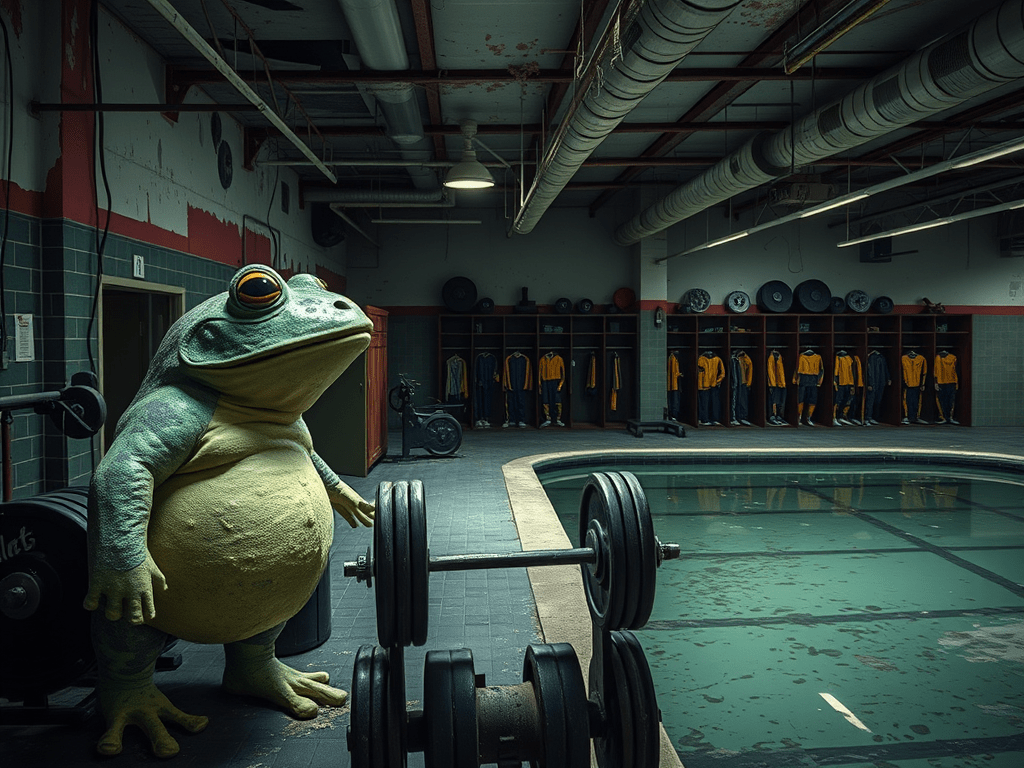
    By the time I hit fourteen, my sacred sanctuary was none other than Walt’s Gym in Hayward, California—a temple of iron that had started its inglorious life as a chicken coop in the 1950s. The place was a veritable swamp of fungus and bacteria, a thriving petri dish of maladies eager to latch onto the unsuspecting. Members whispered in hushed tones about incurable athlete’s foot, the kind that made dermatologists throw up their hands in defeat. Some swore that the strains of fungus and mold festering in the corners were so exotic they had yet to be classified by the most intrepid of mycologists. Roosting among the fungal shower stalls was an oversized frog that the pro wrestlers had affectionately named Charlie. I never saw Charlie myself, but I often wondered if he was a real creature or a figment of the wrestlers’ imagination, birthed by too many concussions and late-night benders.

    The locker room was perpetually occupied by a rotating cast of characters who looked like they’d been plucked straight out of a grimy noir film. There was always some bankrupt divorcee draped in a velour tracksuit and a gold chain thick enough to anchor a ship, hogging the payphone for marathon sessions with his attorney. He’d discuss his sordid life choices and the staggering attorney fees required to sweep his past under a rug large enough to cover the entire state of California.

    Out back, an unused swimming pool lurked, its water murky and black—a cauldron of plague, dead rats, and God knows what else. Walt, the gym’s owner and part-time crypt keeper, had a peculiar ritual. Every so often, he’d saunter outside, brandishing a pool net like a scepter, and scoop up some unfortunate deceased creature. He’d hold it aloft for all to see, like a demented priest presenting an unholy sacrament. This grim ceremony was invariably met with a thunderous round of applause from the gym-goers, who treated Walt’s rodent exorcisms like a halftime show. Walt would then toss the cadaver into a nearby dumpster with all the flourish of a Shakespearean actor delivering a monologue, bowing deeply as if he’d just conquered a dragon.

    Walt’s Gym showcased a walking fossil named Wally, an octogenarian who swore he was the original model for human anatomy textbooks—perhaps ones etched on cave walls. We all loved Wally. He was a beloved gym fixture even though he could be a pain in the butt. Wally’s routine was the stuff of myth: He’d righteously correct everyone’s form whether they asked for his advice or not. He’d monopolize the gym for hours, his workout punctuated by monologues worthy of an Oscar about his deadbeat relatives who “borrowed” money, his former lovers who once graced the silver screen, and his eternal battle with arthritis. Between sets, he’d often deliver a Ted Talk on muscle inflammation and the sorry state of the national economy. He delivered these soliloquies with the gravitas of a news anchor, then spent an eternity in the sauna and shower, emerging like a phoenix from the ashes only to douse himself head-to-toe in talcum powder, turning into a spectral beacon of gym dedication. When Wally spoke, he was engulfed in such a thick talcum haze you’d swear a lighthouse was about to blare its foghorn warning.

    The radio played the same hits on a relentless loop, as if the DJ had been possessed by the spirit of a broken record. Elvin Bishop’s “Fooled Around and Fell in Love,” The Eagles’ “New Kid in Town,” and Norman Connors’ “You Are My Starship” echoed through the gym like a soundtrack to my personal purgatory. As a kid navigating this adult world, the gym was my barbershop, my public square, where I eavesdropped on conversations about divorces, hangovers, gambling addictions, financial ruin, the exorbitant costs of sending kids to college, and the soul-sucking burdens of caring for elderly parents.

    It dawned on me then that I was at fourteen the perfect age: old enough to start building biceps like bowling balls, yet young enough to be spared the drudgery and tedium of adult life. The Road to Swoleville, I realized, was all about sidestepping the real world entirely. Why bother with mortgages and 401(k)s when I could disappear into my true paradise, the gym? As Arnold himself wrote in Arnold: The Education of a Bodybuilder, the gym was the ultimate Happy Place: “The weight lifters shone with sweat; they were powerful looking. Herculean. And there it was before me—my life, the answer I’d been seeking. It clicked. It was something I suddenly just seemed to reach out and find, as if I’d been crossing a suspended bridge and finally stepped off onto solid ground.”

    My “solid ground” was the 1976 incarnation of Walt’s Gym, a germ-infested, rat-plagued wonderland where dreams of muscle-bound glory were forged—and quite possibly the greatest place I’ve ever visited on this planet.

  • The Man Who Loved Podcasts Too Much

    The Man Who Loved Podcasts Too Much

    Last night, I was in my kitchen, casually sharing shrimp, cocktail sauce, and champagne with public intellectuals Andrew Sullivan and Reihan Salam. As one does. We dove headfirst into the big topics: public policy, identitarianism, the collapse of critical thinking in echo chambers, and the shaky health of democracy. Between bites of shrimp and sips of champagne, we reveled in our status as lifelong learners, trading stories about childhood, lost pets, first crushes, and bouts of existential despair. The shrimp bowl magically replenished itself, and the champagne glasses never emptied. It was glorious—three intellectual heavyweights, solving the world’s problems, toasting to friendship and intellectual curiosity. For a fleeting moment, I felt like I’d reached peak existence: camaraderie, enlightenment, and a deeply inflated sense of self-worth, all in one glorious, shrimp-fueled evening.

    Only it didn’t happen.

    I was dreaming, my subconscious hijacked by The Dishcast. This is my nocturnal routine: When I go to bed at night, I fall asleep to a podcast and, before long, I’m the star guest. There I am, delivering profound manifestos about the human condition, my opinions urgently needed and universally admired.

    When I woke up, the camaraderie still lingered, as if Andrew and Reihan had just slipped out the back door, leaving only a faint echo of laughter.

    This happens all the time. In my dreams, I’m not just a listener—I’m part of the podcast universe, slapping backs, sipping champagne, and dropping truths no one dared to utter. Reality, by comparison, is disappointingly quiet.

    Clearly, podcasts are taking too much bandwidth in my brain. I’m not alone. Like millions of others, I’ve practically taken up residence in the world of podcasts. My life runs on a steady soundtrack of conversations and monologues, piped directly into my ears while I swing kettlebells, pedal my exercise bike, grade uninspired writing assignments, cook, eat, and scrub the kitchen into submission. Podcasts are my companions for post-workout naps, my co-pilots on the commute, and my salvation during middle-of-the-night insomnia—the kind where you wake up at 2 a.m., stare at the ceiling, and hope a familiar voice can lull you back to sleep before dawn.

    In total, I must rack up over a hundred hours of podcast listening every week. I spend more time in the podcast multiverse than in the real one, and inevitably, these voices have taken up permanent residency in my brain. Some of these parasocial relationships I welcome with open arms; others, I tolerate with the resigned grumbling of a bad roommate. And then there are the hosts who commit unforgivable sins—becoming smug, tedious, or worse, preachy—earning themselves a one-way ticket to oblivion. In this universe, the delete button is my only weapon, and I wield it without mercy.

    Living in the podcast world as I do—where most of my waking and sleeping hours are dominated by disembodied voices—I’ve started asking some uncomfortable questions. Have I, like millions of others, surrendered my brain to the podcasters, letting them hijack my mental real estate to my own detriment? Am I so immersed in podcast life that I’ve lost all perspective, like a fish in water, oblivious to how wet it is?

    What am I really after here? Entertainment? Wisdom? A surrogate friend? Or just noise to drown out the endless chatter in my own head? Why do some podcasts stick while others fall by the wayside? Are my favorites truly brilliant, or just slightly less irritating than their competition? Is it their buttery voices, sharp wit, or the fact that they don’t seem to realize they’ve become permanent fixtures in my inner monologue?

    Could I live without podcasts? Would the silence reveal things about myself I’m not ready to confront? What do I call that blissful, cozy state when I’m wrapped in the warmth of a trusted voice? Podcastopia? Earbud Nirvana? Sonic Solace? And is it possible to “love” a podcaster too much, like when I know their pet’s name but can’t remember my sibling’s birthday?

    Am I escaping something? Is this obsession a creative pursuit or an elaborate scheme to avoid existential dread? And most importantly, does this insatiable consumption mean something is deeply, hilariously wrong with me? Or does it point to something more profound—a need for a new word to describe the bottomless, soul-deep immersion of chasing episode after episode like a digital hunter-gatherer?

    Yeah, I’ve got questions. But it might be too late. I may already be The Man Who Loved Podcasts Too Much.

    After waking up from my dream of hanging out with Andrew Sullivan and Reihan Salam, I crept into the kitchen for breakfast–a self-inflicted atrocity of overnight oats. Not just any overnight oats, mind you, but a Trader Joe’s variety touting “ancient grains,” as if the endorsement of long-dead civilizations could somehow redeem the experience. Spoiler: it didn’t. Despite my best attempts at culinary CPR—vanilla protein powder, a smattering of berries, and a dusting of pumpkin spice—the result was still cold, gluey sludge, the breakfast equivalent of a wet handshake.

    Each spoonful felt like a personal affront, a betrayal by my own hands, as though I had willingly prepared the kind of gruel Dickensian orphans would revolt over. The texture was an abominable mix of paste and gravel, and the cold temperature screamed “punishment” rather than “sustenance.” By the end, I wasn’t just eating; I was enduring. Mental note: next time, boil this nonsense into something remotely edible—or toss it and make a proper breakfast for a self-respecting adult. 

  • INTERROGATING THE ALTER EGO OF RACHEL BLOOM IN CRAZY EX-GIRLFRIEND

    INTERROGATING THE ALTER EGO OF RACHEL BLOOM IN CRAZY EX-GIRLFRIEND

    Rachel Bloom weaponizes her alter ego, Rebecca Bunch, to dissect her neuroses with surgical precision, laying bare her obsessions, compulsions, and complete disregard for boundaries. Rebecca isn’t just self-destructive—she’s a human wrecking ball, alienating friends, terrifying acquaintances, and steamrolling her own well-being with reckless abandon. And yet, despite all the chaos, she remains irresistibly lovable, armed with good intentions and a heart too big for her own good.

    Rebecca is a whip-smart New York attorney drowning in success-induced existential despair when fate—or perhaps something more deranged—intervenes. A chance sighting of her old summer camp crush, Josh Chan, sends her into a tailspin of romantic delusion. Suddenly, the only logical course of action isn’t therapy, self-reflection, or even a stiff drink—it’s packing up her entire life and moving to West Covina, California, in pursuit of a man who barely remembers her. What follows is less a fairytale romance and more an operatic descent into obsession, complete with full-blown musical numbers choreographed straight from the fevered depths of her subconscious.

    Once in West Covina, Rebecca lands in a delightfully dysfunctional law firm, where her brilliance is only matched by her ability to make everyone around her deeply uncomfortable. She barrels through life like a caffeinated hurricane, terrifying innocent bystanders with her intellect and intensity, all while chasing an idea of love that exists only in her own head. The show’s most poignant relationship, however, isn’t a romantic one—it’s her friendship with Paula, a sharp-witted, no-nonsense co-worker and mother who, in many ways, fills the maternal void in Rebecca’s life. Paula, trapped in the drudgery of domesticity, finds a thrilling (and slightly concerning) outlet in Rebecca’s increasingly unhinged escapades, turning their dynamic into the show’s emotional anchor.

    At its best, Crazy Ex-Girlfriend thrives on this friendship, an odd yet deeply affecting bond between two women clinging to each other for meaning and validation. But by season four, the show stumbles, bogged down by meandering storylines and an inexplicable reluctance to lean into its greatest strength—Rebecca and Paula’s relationship. The final season drags like an overlong curtain call, but even its missteps can’t erase the brilliance of what came before. At its core, Crazy Ex-Girlfriend is an incisive, darkly hilarious exploration of self-sabotage, redemption, and the uphill battle of getting out of your own way.