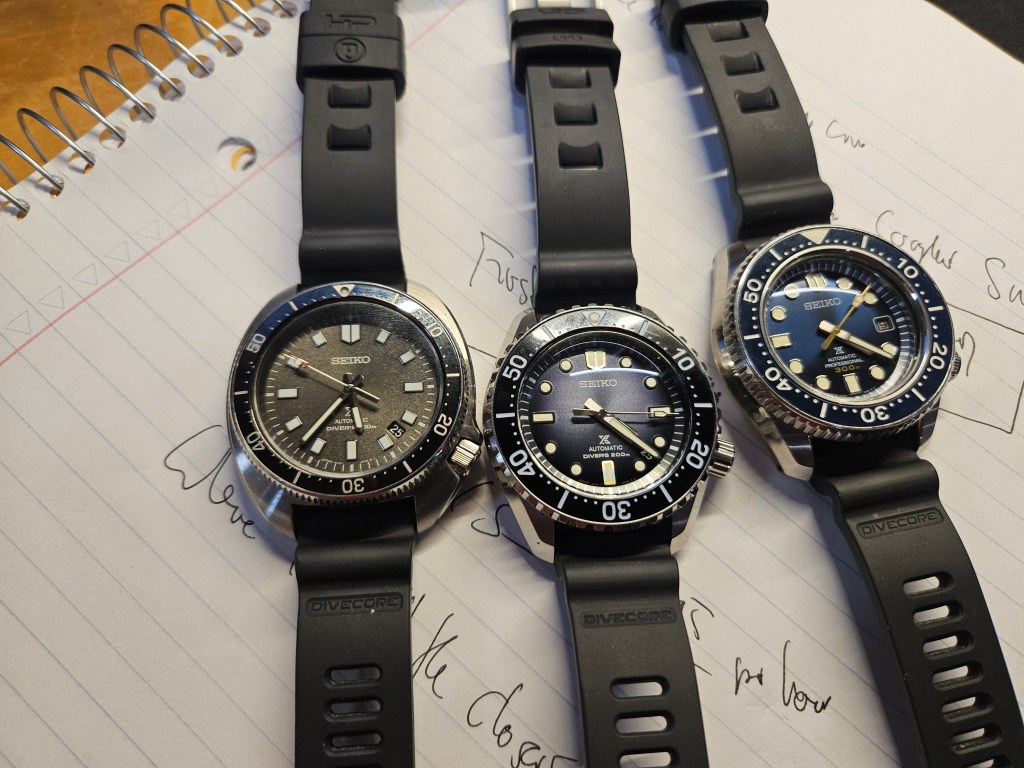
After decades of horological torment, you finally reached a fragile state of mental stability: seven Seiko mechanical divers on straps, each a gleaming monument to discipline, restraint, and the lie that this was the last one.
Then, one afternoon, on a whim, you bought a G-Shock Frogman.
It never left your wrist.
The atomic time spoke in a language your mechanical watches never could. No drift. No romance. No negotiation. Just cold, sovereign accuracy. Precision not as craft, but as authority.
Later, you noticed the numerals were slightly small at night. Not a real problem—just enough of a problem to justify research. The Frogman’s cousin joined your G-Shock team: the Rangeman. Bigger digits. Cleaner read. Perfect.
And since you were already there, you finished the trilogy with the GW5000U—the square, the legend, the watch that doesn’t try to impress because it already knows it has won.
Now you rotated three G-Shocks in quiet contentment.
Meanwhile, the Seiko divers sat untouched.
After a year, you asked the logical question.
Should you sell those lonely mechanical divers?
No.
You told yourself the mechanical itch might return—like a dormant fever waiting for the right conditions.
Five more years passed.
The mechanical divers remained untouched. Still sealed in boxes like museum artifacts from a former civilization.
You asked again.
Now am I ready to sell them?
Again: no.
Because you remembered something.
Friends with old cars that ran perfectly—until a well-meaning mechanic convinced them to do an oil change. The service was supposed to extend the car’s life. Instead, something shifted. A leak here. A vibration there. One repair triggered another. Soon the car that ran fine was on a tow truck, headed for the graveyard.
You observe the reason for the car’s demise: Old machines develop a private ecosystem, a delicate equilibrium of wear, grime, and negotiated compromise. Sludge plugs the gaps that worn seals can no longer manage. Thickened oil cushions parts that have learned to move together like an aging married couple—no surprises, no sudden demands. Then comes the well-meaning oil change. Fresh, detergent-rich oil floods the system like a power washer through a century house. It dissolves the gunk that was quietly holding things together, exposes seals that forgot how to seal, and restores pressures that aging gaskets experience as a personal attack. The engine, once stable in its gentle decline, now leaks, ticks, hesitates, and protests as if a dam has been opened upstream and released a torrent of mechanical demons long kept asleep by dirt, viscosity, and mutual resignation. Nothing was “broken” before. The oil change didn’t create the problems—it simply removed the sediment that was hiding the truce.
That’s what selling the Seikos feels like.
An oil change on your soul.
A rational act of simplification that might disturb the delicate machinery holding your psyche together. One decision leading to second thoughts. Second thoughts leading to regret. Regret leading to obsessive re-buying, late-night searches, financial damage, emotional collapse.
You’re not afraid of losing the watches.
You’re afraid of the cascade.
So you leave the mechanical divers where they are.
The three G-Shocks run your daily life. The mechanical divers sit in darkness, untouched and unnecessary—yet absolutely essential.
They are the cork in the dam.
Pull them out, and who knows what pressure comes rushing through.
This is Stability Hoarding: keeping possessions not because you use them, need them, or even want them, but because their continued existence reassures you that nothing irreversible has happened. They are emotional ballast. Identity reserves. Evidence that former versions of you remain on standby.
You’re not preserving watches.
You’re preserving options.
Selling them feels less like decluttering and more like closing a door you may someday need to sprint through in a panic.
Stability hoarding isn’t about objects.
It’s about keeping your past selves employed as an emergency backup system—just in case the life you’re living now ever crashes.

 Cinemorphosis