Tag: creative-writing

  • The First Chapter That Ate Your Book

    The First Chapter That Ate Your Book

    You come to a conclusion that feels less like insight and more like a verdict: you don’t write books. You write beginnings. Your first chapters arrive with swagger—clean sentences, live current, the sense that something large and dangerous has finally found its voice. Then the voltage drops. Page by page, the prose flattens, the ideas thin, the attention frays. What started as a symphony becomes elevator music. The opening didn’t lie; it just spent the budget in the first scene.

    The problem has a name: First-Chapter Mirage—that narcotic flash of brilliance that convinces you endurance will follow. It doesn’t. You mistake ignition for engine. You draft again, and again, and again—thirty years of rehearsing the same disappointment with professional discipline. Each time the opening whispers, You’re a novelist. Each time the middle replies, You’re a sprinter.

    Eventually you stop arguing with physics. You pivot. No more epics, no more essays with spinal cords. You go small—epigrams, fragments, paragraphs cut to a bright edge. They accumulate like polished shells. Thread enough of them together and you can call it a “book,” the way a pukka shell necklace can pass for a coastline if you squint.

    But don’t flatter yourself. Pukka Shell Authorship has limits. It gives you sheen without sweep, intensity without architecture. It can gesture at argument but rarely sustain one; it can dazzle in the moment and leave no aftertaste of necessity. It is, at best, a collection that behaves like a book when the lights are low.

    So proceed—just not triumphantly. Write lapidary aphoristic paragraphs with care and the transitions with suspicion. Admit what the form can’t do. Let humility do the binding your structure won’t. If you’re going to string shells, at least know you’re not building a cathedral.

  • The Tape Tyrant of Postmaster Plus

    The Tape Tyrant of Postmaster Plus

    I went to Postmaster Plus this morning to ship a defective camera back to Kodak—a routine errand, the kind you knock out between coffee and whatever comes next. I’ve been going there for years. The place is run by a family from Bombay, and over the last decade they’ve shipped more of my watches than I care to admit. It’s a familiar, efficient operation. Or at least, it usually is.

    When I walked in, the rhythm was off.

    At the counter stood a couple in their mid-sixties, locked in some elaborate transaction with M, the family patriarch, a man in his seventies who has the calm of someone who has seen everything and survived it. Behind the couple stood a woman clutching a stack of flattened cardboard, her face arranged in a quiet expression of despair. She looked at me as if to say, You’re seeing this too, right?

    I was.

    The woman at the counter—a redhead with severe bifocals and a face that seemed permanently braced against disappointment—had taken possession of M’s tape roller and was using it with the zeal of someone preparing artifacts for burial. Her husband hovered nearby, a classic Palm Springs Q-Tip: white hair under a baseball cap, mouth slightly open, limbs thin as dowels, torso betraying a fondness for buffets. He contributed nothing except presence.

    “I’ve seen these packages break before,” the redhead announced, as she wrapped the parcels in what could only be described as a second skin of tape. Not a practical layer—no, this was ceremonial. A kind of adhesive exorcism. When the tape ran out, she didn’t pause, didn’t apologize. She demanded another roll with the urgency of a field commander low on ammunition.

    The woman behind them caught my eye again. This time the look was unmistakable: We are both trapped here. I returned the glance with equal solemnity. Yes, we were sharing this moment. No, there was no escape.

    Then came the breaking point. The cardboard woman asked M when his son W would return from break.

    “Twenty minutes or so,” M replied.

    She nodded, made a decision, and fled. A wise woman. She chose freedom.

    I stayed.

    The redhead, now fully committed to her role as High Priestess of Packaging Integrity, began lecturing the room about the fragility of parcels and the absolute necessity of excessive tape. She spoke as if we were all negligent amateurs, one poorly wrapped box away from societal collapse.

    I opted out.

    I pulled out my phone, photographed my Casio G-Shock GW-7900, and posted it to Instagram. If I was going to be held hostage, I might as well document something worthwhile.

    Eventually—mercifully—the couple completed their transaction. Eighty dollars later, their packages were no longer parcels but laminated relics, ready to withstand not just shipping, but geological time. I stepped forward, paid for my own shipment, and shared a brief, knowing laugh with M about the spectacle we had just endured.

    We thought it was over.

    It wasn’t.

    The door opened. The couple returned.

    The redhead, unsatisfied with her previous efforts, declared that a third layer of tape was necessary for her “peace of mind.” At this point, the packages were less shipments and more mummies awaiting a sarcophagus.

    I gave M a look—the kind of look that conveys sympathy, disbelief, and resignation all at once. He nodded, the stoic veteran of countless such encounters.

    I left.

    As I walked out, I knew two things. First, those packages would survive anything short of a volcanic eruption. Second, I had just acquired a story—one that would be waiting patiently for me to tell my wife the moment I got home.

  • The G-Shock Frogman Sits in a Dark Warehouse

    The G-Shock Frogman Sits in a Dark Warehouse

    My G-Shock Frogman from Japan is currently in the custody of DHL Customs, where it has been detained for reasons that appear to fall somewhere between administrative caution and bureaucratic sport.

    After a chain of communications—email links that didn’t open, automated messages that solved nothing, and the familiar sense of shouting into a digital canyon—I finally reached a living human being. The verdict: my package had been randomly flagged. To prove I was a legitimate citizen worthy of receiving a rubber-strapped dive watch, I was instructed to photograph my 1040 tax form, Social Security number included, and submit it for verification.

    I complied.

    The representative then added the final procedural flourish: the clearance team is backlogged, they don’t work weekends, and my Friday submission will not be reviewed until Monday at the earliest.

    And so the Frogman waits.

    Somewhere in a warehouse, my solar-powered watch sits sealed in darkness, a creature built to drink sunlight now confined to a bureaucratic aquarium. It calls to mind Melville’s Dead Letter Office—objects sent with intention, now suspended in institutional stillness. The watch waits. I wait.

    We are both experiencing what might be called Solar Purgatory Syndrome: a condition in which a solar watch is deprived of light while its owner is deprived of momentum. Energy, both mechanical and emotional, drains slowly while the system remains perfectly unmoved.

    What has changed is the feeling.

    Once, waiting for an overseas parcel carried the electricity of childhood—anticipation, possibility, the quiet thrill of something special moving across the world toward you. That feeling has been replaced by fatigue. Bitterness. The dull resentment that comes from being processed rather than served.

    Getting bitten by customs bureaucracy was not part of the romance.

    And something unexpected has happened. The friction hasn’t just slowed the purchase—it has cracked open a larger question. The stress, the forms, the delays, the mild institutional suspicion directed at a man buying a watch from Japan—it all begins to feel disproportionate.

    A voice, calm and unsentimental, has begun to speak:

    You’ve been bitten by the system.
    Consider this instruction.
    Consider this an exit opportunity.
    Enjoy the watches you have.
    Move on.

    This is the onset of a Bureaucratic Burnout Event—the moment when administrative friction overwhelms the emotional reward of the hobby that triggered it. What began as excitement—tracking updates, imagined wrist time, the pleasure of acquisition—collapses under documentation, verification, delay, and institutional indifference. The object itself begins to feel smaller than the effort required to obtain it.

    But the episode may carry a deeper meaning.

    It may be an Exit Omen Moment—the psychological shift in which inconvenience stops feeling like bad luck and starts feeling like instruction. The delay becomes a message. Simplify. Reduce. Stop expanding. Perhaps even stop buying altogether.

    Whether this reaction proves temporary or permanent remains to be seen.

    But for now, somewhere in a dark warehouse, a solar watch waits for light.

    And somewhere outside it, its owner is reconsidering the whole enterprise.

  • Writing the Book That No One Can Ignore

    Writing the Book That No One Can Ignore

    You don’t sit down to write a book the world wants to read by accident. At least, it feels like an act of will. You force yourself into the chair. You produce sentences. You assemble a manuscript that lodges itself in people’s heads, agitates their assumptions, rearranges their furniture. The book exerts power—but not the vulgar kind. You’re not trying to dominate anyone. You’re simply telling the truth so cleanly, so directly, that looking away becomes impossible. Your ideas don’t shout. They persist. They refuse to be ignored.

    This kind of book is not a lecture, a scolding, or a manifesto. It doesn’t traffic in nihilism, misanthropy, or fashionable despair. It doesn’t prescribe easy solutions or luxuriate in outrage. Instead, it diagnoses. And a real diagnosis cuts both ways: it is unsparing about the human predicament while still pointing—quietly but unmistakably—toward an exit. Not optimism. Orientation.

    The book earns its authority by puncturing the clichés we treat as wisdom. It exposes the mass hallucinations surrounding happiness, success, fulfillment—all the shiny quests we pursue with religious devotion and predictable disappointment. But it does this without contempt. The tone isn’t superior; it’s exact. The pleasure of reading comes from recognition, not humiliation. You feel seen, not scolded.

    The sentences do the heavy lifting. They are short, fearless, and unembarrassed by clarity. There is no ornamental fog, no academic hedging, no decorative complexity masquerading as depth. Flowery prose and pretentious diction are weeds on a neglected lawn: they obscure what matters. This language is honed, not arid. It glints. Each sentence lands cleanly and moves on.

    If a curmudgeonly edge appears, it’s a seasoning, not the main course. A book powered by pure crankiness curdles into nihilism—and nihilism is dull. It flattens stakes, erases texture, and mistakes exhaustion for insight. This book avoids that trap. It remains alive to nuance, contradiction, and consequence.

    Because the book is so bracingly clear, other writers feel it immediately. Not admiration first—envy. The good kind. The Beatles hearing Pet Sounds and realizing the bar has been raised. The book doesn’t just succeed; it rearranges the landscape.

    What ultimately distinguishes it isn’t the subject matter but the voice. To understand that voice, Emmanuel Carrère’s Kingdom is instructive. Carrère contrasts the florid ambition of Luke—his PR-friendly, overworked prose—with the sayings of Jesus, which arrive stripped, terse, and destabilizing. Jesus’ words feel both utterly familiar and entirely unprecedented. Carrère calls this a linguistic hapax legomenon: a way of speaking so singular that it leaves no doubt a real person once spoke this way.

    That is the essence of a world-changing book. Its language has no template. It cannot be reverse-engineered or taught. It doesn’t sound like anything else. It lands in the reader’s mind with a depth that imitation can’t reach. At that point, the writer looks less like a craftsman and more like an oracle—someone through whom something passes.

    Which brings us back to will. Maybe writing such a book isn’t an act of will at all. Maybe the writer is chosen—by temperament, by obsession, by affliction—to speak this way. Either way, the true desire isn’t fame or money or validation. It’s to produce language with the force of a hapax legomenon: words that could only be said once, and yet echo forever.

    That, finally, is its own reward.

  • Why Sitting Still Is Killing Your Writing

    Why Sitting Still Is Killing Your Writing

    You can’t write all day and expect to produce anything alive. You can sit hunched in your creative cocoon for hours, but don’t be surprised when your prose comes out pale and airless. You’ve ignored your body, your need for oxygen and circulation, your need for what can only be called Otherness—a physical and spiritual encounter with the world that does not occur while you’re marinating in your own chair. I’ve always known this in my bones. Recently, Bonnie Tsui gave it language in her essay “The Writer’s Secret Weapon.” For Tsui, creativity peaks not at the desk but in the water. Swimming becomes a form of mobile meditation, a way of clearing internal static. A body in motion reroutes the brain. Kinetic energy pries open doors that inertia bolts shut. When she swims, she doesn’t skim her subjects; she descends into them.

    Tsui also makes a bracing point writers love to resist: you can’t write about something while you’re still drenched in it. When she was working on a book about swimming, she couldn’t write fresh from the pool, water still in her ears. The experience had to ferment. The mind needs distance, a change of context, a step into Otherness to metabolize meaning. This is why even writers who log eight-hour days at their desks punctuate them with long walks. You must toggle between worlds. Living in only one—especially the interior one—is claustrophobic, coercive, and hostile to genuine creativity.

    When I think of a writer who never leaves the room, I think of Nikolai Gogol’s The Overcoat. Akaky Akakievich copies documents all day, takes his copying home at night, and copies some more. Eventually, copying is all he can do. He no longer registers the world: not mockery, not humiliation, not even a horse sneezing on him. He produces mountains of text and nothing of consequence. He has become a Non Player Character. Only when winter cold seeps into his bones does he wake from his stupor, lured by a demonic tailor into an overcoat that violently reconnects him to the world. The shock is too much. His mind, underdeveloped by isolation, cannot withstand reality’s ambitions and fever dreams. He breaks. Gogol understood something essential: the writer’s task is not to hide from the physical world but to be altered by it. That radical shift in perception—the moment when the world intrudes and rearranges you—is not a distraction from writing. It is the point.

  • Failure Is the Bedrock of Writing

    Failure Is the Bedrock of Writing

    Stephen Marche, veteran journalist and author, says the secret to becoming a writer isn’t inspiration or networking or the right MFA program. It’s endurance. Grim, stubborn, occasionally delusional endurance. His slim volume On Writing and Failure makes one argument with relentless clarity: if you want to write, prepare to suffer. Forget talk of “flourishing,” “mentorship,” and “encouragement.” Writing isn’t a wellness retreat. It’s a trench.

    Marche opens with the perennial questions writers whisper to each other after one rejection too many: Does this get easier? Do you grow thicker skin? The response he quotes from Philip Roth is a gut punch: “Your skin just grows thinner and thinner. In the end, they can hold you up to the light and see right through you.” In other words, the longer you write, the more naked you become. Vulnerability isn’t a side effect of the craft; it is the craft.

    Marche’s bleak comfort is that every writer feeds off failure. Success is accidental—a borrowed tuxedo, worn briefly. Failure is the body underneath. Even the authors smiling from dust jackets look like rescued hostages, blinking at daylight before returning to the bunker of their desks to keep going. They don’t do it because it’s glamorous. They do it because not writing would be worse.

    I understand the pathology. After decades of cranking out what I believed were novels, I finally admitted I couldn’t write one—not at the level I demanded, not at the level worth inflicting on readers. That revelation didn’t spare me failure; it merely revealed strata of it. There’s the failure of rejection, the failure of the work, and the quiet, private failure of recognizing your own limits. Perhaps I could’ve spared myself time and spared literary agents grief. But failure has its curriculum, and I attended every class.

    Marche’s book is a sober reminder that writing is less a triumphal march than a pilgrimage carried out on blistered feet. Failure isn’t a detour; it’s the terrain. Rock layers of it: topsoil doubt, subsoil rejection, shale humiliation, limestone stubbornness. Dig deeper and you hit coal—compressed ambition under impossible pressure, black and combustible.

    Failure isn’t fashionable grit or a TED Talk slogan. When executives brag about “learning from failure,” they’re dilettantes. Writers are the professionals of defeat. To be a poet today is to live like a post-apocalyptic monk, scribbling in candlelight, shadow thrown against the cave wall, not out of masochism but because there’s no other way to stay human. The world may not care, but the work insists.

  • Operation 2B: Writing at the Edge of Madness

    Operation 2B: Writing at the Edge of Madness

    Last night, I dreamed I was recruited into a top-secret engineering project. Why? I have no idea. I’m not an engineer. I don’t calculate. I conjugate. But apparently, someone in a conference room with clearance and questionable judgment decided that this classified operation needed… a writer.

    They dropped me into a government-issue apartment compound, a cheerless complex filled with bunking engineers and low-grade existential dread. I was assigned a shared unit with mismatched strangers. One of them, a single mother, had laid out a modest spread of peanut butter, celery, and crackers for her toddler—a rationed still life of parental competence. “Eat,” she told me. “You’ll need fuel for the project.” And so I did—voraciously, like a man preparing to write the Constitution on deadline.

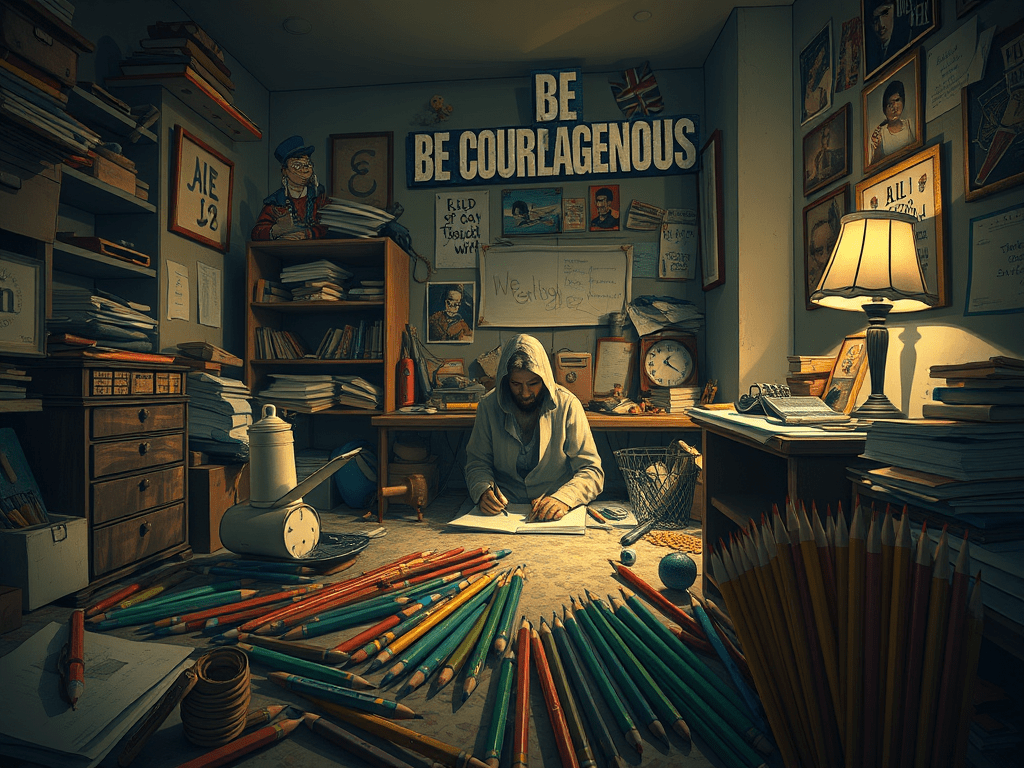
    One by one, my roommates peeled off to private rooms. There was a charming British expat with a silver beard and a childhood photo of himself in a Bentley—Old Money in exile. Despite his aristocratic roots, he was delightfully upbeat, the kind of man who would whistle while burying landmines. But soon, he too was reassigned. It became clear that my “team” had evaporated, and I had been left behind. Not fired. Not forgotten. Just… chosen. To work alone. On a project I didn’t understand. Surrounded by a sea of mechanical pencils. Hundreds of them, like offerings at the altar of Bureaucratic Futility.

    Feeling the weight of vague responsibility, I walked to the project site—a sprawl of white dust and scattered canopies that looked more like a failed music festival than a classified facility. Under one tent, I found two twenty-somethings playing at adulthood. I asked the woman which pencil I should use. She shrugged but confessed the 2B graphite was easiest on her eyes. A clue. A preference. A hierarchy of legibility. I realized she would be my proofreader, my silent companion in this ridiculous odyssey.

    Then came the sign. A man appeared—former military, highly decorated, looking like a character drafted from a Tom Clancy novel. Without a word, he walked up to my apartment door and placed a sign the size of a license plate in the window frame: BE COURAGEOUS. The kind of sign you see right before a high-stakes mission or a TED Talk.

    And that was it. My mission was mine alone. A 500-page manuscript I had to read to prepare myself for the project. No advisor, no support, no backup—just me, a pile of pencils, and a shadowy proofreader who preferred 2B. I awoke shortly after, microwaved some buckwheat groats, brewed a pot of dark roast coffee, and stared into my kitchen tiles wondering if this was a dream about writing… or about surviving it.

  • Meet the Timepiece Whisperer

    Meet the Timepiece Whisperer

    Chapter 6 of The Timepiece Whisperer

    At 6 a.m., I rose like a guilty priest on purge day and loaded my Honda Accord with a museum of failure. Each item whispered its own shame: busted radios that once sang, fans that blew nothing but despair, fossilized laptops gasping through Windows XP, iPads ghosted by iOS updates, a humidifier that wheezed its final death rattle in 2018, and a landmine of corroded batteries that could’ve earned me a write-up from the EPA.

    By 8:00, I was cruising down the 110 South, my car bloated with the technological detritus of a man who once believed that stuff—stuff!—might soothe an inner void. I exited Pacific Avenue and found myself crawling through a wasteland of rebar, chain-link fences, and brush thick enough to hide a body or two. It was less Los Angeles and more post-apocalyptic novella. A landscape haunted by discarded dreams and the occasional tented soul whose only offense was being born poor.

    After a slow-motion bounce over some railroad tracks, I veered down a bleak gravel path until I arrived at 8:50 to find a tarp flapping over what I assume someone dared to call a facility. It looked like a wedding tent designed by Satan’s party planner, squatting in front of a cinder-block warehouse that smelled like ozone and bureaucratic indifference.

    Ahead of me, a small line of sedans idled like supplicants outside a radiation baptism. Signs warned against bringing poisons, rotting food, firearms, explosives, and—oddly—crop waste. Another sign warned me not to exit my vehicle, eat, or drink, presumably because the combination of trail mix and lithium-ion residue could create a chemical lovechild that incinerated San Pedro.

    A silver SUV from Washington State attempted to cut the line, realized it had wandered into the wrong apocalypse, and peeled out in a plume of toxic dust that settled on our windshields like the aftermath of a low-budget nuke.

    By 9:00, the caravan had doubled. My rearview mirror showed a parade of shame stretching down the gravel like a funeral procession for the Age of Gadgets. Then she arrived—a smiling woman in an orange vest and clip-on radio. Clipboard in hand, she went car-to-car like a cheerful customs agent at the border of human depravity. When she got to me, I rattled off my cargo. Her nod was practiced. I suspect her real job was twofold: assess whether I was harboring illegal pesticides, and determine if I looked like the kind of man who’d stuff a body under an old humidifier.

    Eventually, I popped my trunk. Men in uniforms descended with the solemnity of pallbearers. They removed the items with clinical grace, not a single eyebrow raised at my hoarder shame. I thanked them. They nodded like undertakers who’d buried a thousand dreams before mine.

    Lighter by fifty pounds and several psychic burdens, I pulled away, my soul humming with moral superiority and the faint possibility of radiation poisoning. For a brief moment, I felt whole.

    Then came the craving.

    The Seiko Astron.

    The Watch Master had warned me. Had pleaded for restraint. But there it was again, the whisper in my mind, the itch in my wrist. By the time I got home, I was already spiraling. So I returned to the Watch Master’s house for counsel, but his front door was answered by a red-bearded mountain of a man who looked like he’d just wandered out of a Nordic crime novel.

    “Josh,” he said, extending a paw. “I’m the Timepiece Whisperer.”

    “What happened to the Watch Master?”

    “Dead. Stomachache. Went to bed and never woke up.”

    “And you’re… what, the sequel?”

    “That’s for you to decide.”

    Josh made me an iced coffee, honey and cinnamon. It tasted like guilt sweetened with denial.

    We sat at the kitchen table, a graveyard of coffee rings and philosophical despair.

    “So what’s troubling you, my friend?”

    “I’m almost sixty-four. I own seven watches. I want an eighth. Am I doomed?”

    He slurped his drink, crunched an ice cube, and nodded solemnly.

    “That depends. Are we talking about eight timepieces? Or eight identities, eight moods, eight regrets?”

    I blinked.

    He leaned forward. “If you’re still hunting, still haunted, then yes—eight is too many. You don’t have a collection. You have a symptom. But if you’ve made peace—if each watch has its rightful place in your little opera of masculinity—then eight is a symphony. A curated exhibit. A spiritual wardrobe.”

    Then he tilted his head. “The real question is: Are you wearing the watches, or are they wearing you?

    I wilted. I wanted to shrink into the upholstery.

    “I want the Astron to be the closer. I want to stop at eight. But history tells me I won’t. I go through the honeymoon, get bored, scratch the itch with another watch, and end up miserable. My collection isn’t a triumph. It’s a cry for help.”

    Josh chuckled, then howled, then nearly fell off his chair.

    “Now we’re getting somewhere. You think this is about timepieces? No, my friend. This is about you.”

    Then he called for backup.

    First came John, a zombie in slippers with bags under his eyes deep enough to hold grief. “Sell everything,” he said, “and get a Tudor Pelagos. End of story.” Then he stared at his slipper hole like it owed him money and shuffled off.

    Then came Gary, a cheerful human protein shake in a Lycra tracksuit.

    “Let the man buy the Astron,” he chirped. “Make it eight. Just get him a sponsor, a support group, maybe a hotline. The poor bastard needs this.”

    Then John stormed back, furious. “I said one watch!”

    Words escalated. Soon they were locked in a full-blown wrestling match, crashing into the walls like toddlers in a padded room. Josh laughed like a man watching Fight Club on loop and eventually threw both of them into the basement.

    He stood at the door, listening to the thumps and groans like it was jazz.

    “That,” he said, his eyes shining, “is the debate. One watch or many. Order or chaos. Simplicity or delirium.”

    I got up to leave.

    “What’s the rush?” he asked.

    “I’ve seen enough.”

    “You’ll be back.”

    “What makes you so sure?”

    Josh smiled. “Because you’re desperate.”

  • Writing Your Origin Story: A College Essay Prompt

    Writing Your Origin Story: A College Essay Prompt

    Writing Your Origin Story

    An origin story is a personal narrative that explains how someone became who they are—it connects formative experiences, struggles, and turning points to a clear sense of identity and purpose. It’s not just a chronology of events, but a curated account that gives meaning to the chaos, shaping pain, failure, or rebellion into insight and direction. Like a myth with teeth, a well-crafted origin story turns vulnerability into vision, showing not just where someone came from, but how that journey forged their voice, values, and ambitions.

    We have powerful examples of origin stories In the Amazon Prime documentary Group Therapy, in which Neil Patrick Harris plays a surprisingly restrained version of himself as moderator while six comedians—Tig Notaro, Nicole Byer, Mike Birbiglia, London Hughes, Atsuko Okatsuka, and Gary Gulman—dissect the raw material of their lives. The big reveal? That material doesn’t go from trauma to stage in one dramatic leap. No, it must be fermented, filtered, and fashioned into something more useful than pain: a persona built on an origin story.

    Mike Birbiglia delivers the central thesis of the show, and I’ll paraphrase with a bit more bite: You can’t stagger onto stage mid-breakdown and expect catharsis to double as comedy. That’s not a gift—it’s a demand. You’re taking from the audience, not offering them anything. The real craft lies in the slow, deliberate process of transforming suffering into something elegant, pointed, and—yes—entertaining. That means the comic must achieve emotional distance from the wreckage, construct a precise point of view, and build a persona strong enough to carry the weight without buckling. In other words, the chaos must be curated. Unlike therapy, where you’re still bleeding onto the couch, stand-up demands a version of you that knows how to make the bloodstains rhyme.

    This process is a perfect metaphor for what college students must do, whether they realize it or not. They’re not just acquiring credentials—they’re building selves by having a clear grasp of their origin story. And that takes more than GPAs and LinkedIn bios. An origin story requires language, history, personal narrative, and a working origin myth that turns their emotional baggage into emotional architecture. And yes, it sounds crass, but the result is a kind of “self-brand”—an identity with coherence, voice, and purpose, forged from pain but presented with polish.

    Because your success, as a human being and someone who is creative and productive in the workforce, requires an origin story, you will write your first essay about the origin story–what it is, how it develops in others, and how it develops inside of you. 

    To explore the origin story in detail, you will write an essay in 3 parts. Part 1 will analyze the importance of an origin story in the Amazon Prime documentary Group Therapy. Your job in Part 1 is to write a two-page extended definition of the origin story based on the hard-fought wisdom of the comedians who pour out their souls and explain how through their suffering, they discovered who they are, what makes them tick, and how their origin story informs their comedy. 

    In Part 2, you will write a two-page analysis of the origin story by choosing one of four media sources: 

    1. The Amazon Prime 3-part series Evolution of the Black Quarterback, a meditation on the courage of black quarterbacks who broke racial barriers and built a legacy of social justice for those quarterbacks who came after them. 
    2. Chef’s Table, Pizza, Season 1, Episode 3, Ann Kim, the origin story of a Korean-American whose origin story led her to become an award-winning chef. 
    3. Chef’s Table, Noodles, Season 1, Episode 1, Evan Funke, an American who goes to Italy where kind Italian women share their cooking so he can preserve traditional Italian noodles and become a true chef.
    4. Chef’s Table, Noodles, Season 1, Episode 2, Guirong Wei, a young woman leaves China to work in London to support her family and emerges as a noodle star. 

    In Part 3, you will write your two-page origin story. Taking the lessons from Group Therapy and the other media sources from the choices above, you will have the context to write about how you conceive yourself, your interests, your unique challenges, your unique doubts, your career goals, and your aspirations as part of your origin story. 

    Your essay should be written in MLA format and have a Works Cited page with a minimum of the 2 assigned media sources.  

    The 10 Characteristics of Your Origin Story

    1. You recognize your challenge to belong and understand why you don’t fit in with conventional notions of success, friendship, family, and belonging.
    2. You recognize your quirks, fears, and traits that make it a challenge for you to belong.
    3. You recognize the barriers between you and what you want. 
    4. You recognize what you want instead of chasing what you think others would have you want.
    5. You recognize being lost in a fog and having a moment or a series of moments in which you achieved clarity regarding what you wanted as a career, for your relationships, and for your passions. 
    6. You find a North Star, a higher goal, that pulls you from a life of lethargy and malaise to one of discipline and purpose. 
    7. You recognize the demons that you have to contend with if you are to rise above your worst tendencies and achieve happiness and success.
    8. You recognize the talents, inclinations, preferences, style, and biases that make you the person that you are, and you learn to embrace these things and allow them to inform and give expression to the kind of work that you do.
    9. You prove to your doubters that the path you have taken is the assertion of your true self and is the most likely path to happiness and success.
    10. You recognize mentors and role models who blaze a path that makes you see yourself more clearly and live in accordance with your aspirational self. 
  • If we’re looking for a role model in the art of the blog, look no further than Blaise Pascal

    If we’re looking for a role model in the art of the blog, look no further than Blaise Pascal

    Walter Mosley, like many literary heavyweights, delivers the old warhorse of writing advice: write every damn day. Rain or shine, joy or existential despair, sit down and put words on the page. It’s less about inspiration than it is about keeping the creative battery from corroding in the garage while your ambitions collect dust. Steven Pressfield echoed this doctrine in The War of Art, a self-help sermon for writers who need a firm kick in the discipline.

    But daily writing in the digital age isn’t what it used to be. Now it comes with a side of existential nausea. The modern writer doesn’t just write—they publish. Immediately. Publicly. Desperately. A blog here, a TikTok monologue there, and boom—you’re not creating, you’re performing. You’re not nurturing your authentic voice; you’re pumping caffeine into your avatar and hoping the algorithm throws you a bone. And let’s be clear: the algorithm rewards extremity, outrage, and theater. The bigger the spectacle, the better the reach. Welcome to the Faustian Bargain of digital authorship.

    In this deal with the devil, we don’t trade our souls for knowledge—we trade nuance for engagement. We sculpt our “brand” to fit the machine. Our subject matter isn’t what haunts us—it’s what trends. Our tone isn’t our voice—it’s caffeinated shouting with a faux-therapist smile. We might monetize. We might even go viral. But then what? We’ve spent our creative life howling into a dopamine feedback loop. Is this writing? Or is it a slow, glittery death of the self?

    To be clear, branding isn’t inherently evil. Mark Leyner is a brand. So is Annie Dillard, Toni Morrison, and T.C. Boyle. Their work pulses with personality—yes—but also rigor, substance, and voice. They didn’t let style drown out content. They didn’t slap their face on a thumbnail and shout into the void about “7 Ways to Hack Your Purpose.” Influencers, on the other hand, are often pure surface: style with no skeleton, affect with no architecture.

    So what happens if you’re writing online without chasing likes, shares, or ad revenue? Are you just journaling in public? Writing as catharsis masquerading as productivity? Possibly. But that’s not inherently shameful. Writing as therapy is fine—as long as it’s therapy with syntax. Catharsis isn’t the enemy; incoherence is. Even in the trenches of personal expression, we owe our readers (and ourselves) clarity, pace, and craft.

    If we’re looking for a role model in the art of the blog, look no further than Blaise Pascal. His Pensées—a blog centuries ahead of its time—is a fragmented, pithy, and piercing meditation on the human condition. Each entry was brisk, barbed, and brimming with insight. He didn’t need an algorithm. He had a point of view.

    In this sense, blogging today can be a return to Pascal, not a descent into performance art. A blog can be a sketchbook of thought, a lab for style, a home for unfinished beauty. But only if we resist the pull of artificial relevance and write for something—anything—more enduring than a trending sound clip.