Tag: diet

  • Hungerphoria: Finding Comfort in the Empty Stomach

    Hungerphoria: Finding Comfort in the Empty Stomach

    Let’s get something straight: my weight-loss quest isn’t about vanity. I’m not trying to become the next shirtless fitness guru hawking collagen peptides to the dopamine-addled masses on Instagram. No, this is about survival—mental and physical, which, despite popular delusion, are not separate departments. They’re a single, tangled mess of neurons and cravings, and if one goes down, the whole system buckles.

    So, I’ve been on a high-protein, calorie-restricted diet for five weeks (15 pounds lost so far). Not the sexy kind with green smoothies and acai bowls—this is grim, disciplined, macro-tracked warfare. And yet something strange and glorious is happening: my brain is beginning to like it.

    Case in point: I used to get jittery before class, pacing my office like a caged animal and convincing myself I needed a protein bar or an apple just to face a room of disinterested freshmen. But lately? I stroll in on an empty stomach like a monk walking into a Zen garden. The hunger is there, sure, but it doesn’t bark anymore. It purrs.

    Last night, same story. Three hours after dinner, the belly murmured—but instead of scrambling for almonds or scanning the fridge for peanut butter-oatmeal “protein” balls, I smiled. That emptiness didn’t feel like punishment. It felt like progress. A signal. A secret handshake from my metabolism saying, “We’re doing it. Keep going.”

    Which brings me to what I’m now calling Hungerphoria.

    Let’s define it properly, shall we?

    Hungerphoria is the paradoxical joy one feels in the disciplined embrace of hunger—a fleeting but addictive high that replaces food anxiety with a sense of mastery and serenity. Rather than viewing hunger as a threat or an emergency, the hungerphoric individual interprets the growl of an empty stomach as applause from the body’s metabolic engine. It’s not deprivation; it’s affirmation. Hungerphoria turns a late-night craving into a badge of progress, a quiet reminder that transformation is happening invisibly, molecule by molecule. Like the runner’s high or the monk’s calm, hungerphoria isn’t about denial—it’s about the subtle euphoria of restraint, the mental alchemy of converting appetite into purpose.

    Did I stumble onto this like a weary gold miner striking the motherlode? Maybe. Should I start selling merch—Hungerphoria hats, mugs, crop tops? Tempting. Should I become a lifestyle influencer preaching the gospel of the empty belly? Possibly.

    But then a voice in my head, the responsible one who still wears pants with belt loops, whispers: “Easy, tiger. Lose another thirty. Keep it off for a year. Then maybe you can start printing t-shirts.”

  • Flabnesia and the Fall of the Weight-Loss Hero

    Flabnesia and the Fall of the Weight-Loss Hero

    Congratulations! You’ve shed 47 pounds over 8 months, sliding from a swollen 247 to a sleek, even 200—the numerical promised land. At 247, you weren’t just overweight; you were a walking billboard for metabolic dysfunction. A bloated monument to poor impulse control. Your blood pressure was climbing Mount Everest, your triglycerides were hosting a rave, your fingers cracked like old parchment, and your foot buzzed with the low-voltage horror of neuropathy. Your joints? They screamed in Morse code every time you dared to walk more than half a Target.

    And let’s not forget the existential FOMO—not Fear of Missing Out on parties or vacations, but on the you you were supposed to be. The one who didn’t sound like an old staircase every time he stood up.

    But then, in a moment of uncharacteristic clarity—or maybe rage at your own reflection—you declared war on the fat demon. You slashed your calories to a monk-like 2,300, jacked your protein intake to bodybuilder levels, and banished refined carbs and sugar like they owed you money. Your entire cerebral cortex was repurposed into a fat-loss mission control center. Progress became your dopamine drip. Watching the numbers fall on the scale felt like watching your soul return from exile.

    You were, in the language of gymfluencers, “on a journey.” A phrase so overused it should be banished to a motivational poster graveyard. But cliché or not, the journey gave your life narrative structure. It made you feel heroic. Disciplined. Alive.

    And then—you arrived.

    Two hundred pounds. The exact number. Mission accomplished. Cue the existential silence.

    Because now what?

    With the drama over, meaning slips through your fingers like a protein shake on a sweaty treadmill. You no longer wake up with a fat war to fight. And into that vacuum slithers the ancient enemy of every former fatty: complacency.

    Complacency brings friends. First comes Calorie Creep—just a nibble here, a mindless bite there, a slow but deliberate loosening of your former austerity. Then arrives Flabnesia, that insidious amnesia that erases the memory of how awful 247 felt—how humiliating, how painful, how limited. Your jeans start getting tight again, and you blink in confusion as if the dryer is gaslighting you.

    Next, the cruelest symptom of all: Goalstalgia—a perverse longing for the righteous high of the weight-loss struggle. You miss the purpose, the metrics, the drama. And in a dark twist of psychological masochism, you begin to sabotage yourself, just to start over—to claw your way out of the hole you’re actively digging again.

    And so the cycle begins anew. You are no longer the master of your fate or the captain of your macros. You are a cautionary tale—an Ouroboros in athleisure, endlessly consuming your own progress.

  • We Must Combat Gluttirexia

    We Must Combat Gluttirexia

    In his biting essay “The Intellectual Obesity Crisis,” Gurwinder Bhogal delivers a warning we’d be wise to tattoo on our dopamine-blasted skulls: too much of a good thing can turn lethal. Whether it’s sugar, information, or affirmation, when consumed in grotesque, unrelenting quantities, it warps us. It becomes less nourishment and more self-betrayal—a slow collapse into entropy, driven by the brain’s slavish devotion to short-term gratification.

    Bhogal cites a study showing that the brain craves information like it craves sugar: both deliver a dopamine jolt, a hit of synthetic satisfaction, followed by the inevitable crash and craving. It’s the biological equivalent of that old Russian proverb: “You feed the demon only to find it’s hungrier.” Welcome to the age of Gluttirexia—a condition I’ve coined to describe the paradox of overconsumption that leaves us spiritually, intellectually, and emotionally starved. We’re stuffed to the gills, yet empty at the core.

    Demonically famished, we prowl the Internet for sustenance and instead ingest counterfeits: ragebait, influencer slop, and weaponized memes. It’s not just junk food for the mind—it’s spoiled junk food, fermented in grievance and algorithmic manipulation. The information that lights up our brains the fastest is also the most corrosive: moral outrage, clickbait trauma, tribal hysteria. It’s psychological Cheetos dust—and we are licking our fingers like addicts.

    Reading Bhogal’s work, I pictured the creature we’ve become: not a thoughtful citizen or curious learner, but a whirling, slobbering caricature straight out of Saturday morning TV—the Tasmanian Devil with Wi-Fi. And it tracks. In a moment so self-aware it feels scripted, Bhogal notes that “brain rot” was Oxford’s 2024 Word of the Year. Fitting. We gorge ourselves on intellectual cud and become bloated husks—distracted, indignant, and dumb.

    This condition—what Bhogal terms intellectual obesity—is not a joke, though it often looks like one. It’s a cognitive disorder characterized by mental bloat, sensory chaos, and a confused soundtrack of half-remembered factoids screaming over each other for attention. You don’t think. You stagger.

    As a college writing instructor trying to teach critical thinking in a post-literate era, I am in triage mode. My students—through no fault of their own—are casualties of this cognitive arms race. They arrive not just underprepared but neurologically disoriented, drowning in an ocean of noise and mistaking it for knowledge.

    Meanwhile, AI accelerates the descent. Everyone is outsourcing their cognition to silicon brains. The pace is no longer quick—it’s quantum. I’m dizzy from the whiplash, stunned by the sheer speed of the collapse.

    To survive, I’ve started building a personal lexicon—a breadcrumb trail through the algorithmic inferno. Words to name what’s happening, so I don’t lose my mind entirely:

    • Lexipocalypse: the shrinking of language into emojis, acronyms, and SEO sludge
    • Mentalluvium: the slurry of mental debris left after hours lost in the online casino
    • Chumstream: the endless digital shark tank of outrage and influencer chum
    • Gluttirexia: the grotesque irony of being overfed and undernourished—bloated with junk info and spiritually famished

    I keep this list close, like a man at sea clinging to his life vest in the middle of a storm. I sense the hungry oceanic sharks circling beneath me. 

  • The Gospel According to Protein: Five Questions, Zero Worship Required

    The Gospel According to Protein: Five Questions, Zero Worship Required

    I’ve been on a high-protein diet since I was twelve, back when I was a Junior Olympic Weightlifter with delusions of grandeur and a lunchbox full of boiled eggs. Since then, I’ve watched the cult of protein grow into something resembling an early church council—complete with feuding sects, sacred macros, and influencers with ring lights in place of halos.

    Before you start weighing your chicken breasts with the reverence of a Vatican archivist, let’s break this down. Anyone walking the high-protein path has to reckon with five questions. Five. Not fifty. And none of them require a podcast marathon or the blessing of a shirtless guru on TikTok.

    1. What even counts as high protein?
    To some, 100 grams is high. To others, it’s starvation-level—a one-way ticket to shrink into a protein-deficient homunculus. A real high-protein diet, for the average man with muscles in mind, starts around 160 grams a day and tops out around 200. Women who lift, train, or simply don’t want to be hungry all day can thrive on 120–140 grams.

    2. How much protein do you need if you train like a beast?
    Competitive athletes and bodybuilders often require more—up to 250 grams daily. Why? Because lifting heavy things repeatedly rips you apart, and protein is the duct tape of the human body. If you want to recover, grow, and not feel like a sentient bruise, you’ll need the extra load.

    3. What kind of protein should you eat for best results?
    Not all proteins are created equal. Whey protein, derived from dairy, is the bioavailability gold standard. It’s fast-digesting, rich in leucine, and built for muscle synthesis. Vegan proteins? Not useless—but they’re often slower-digesting, less complete, and may require blending or fortification to match whey’s efficiency.

    4. Should you use protein supplements?
    If you’re a monk with time to grill and prep six high-protein meals a day, go for it. For the rest of us: supplements are practical tools, not signs of weakness. A good whey protein powder can plug the gaps, especially when you’re busy or simply don’t want to eat another chicken breast.

    5. Can too much protein hurt you?
    Let’s address the boogeyman. The phrase “too much” already contains the answer. Yes, if you binge 400 grams of protein a day while ignoring water, fiber, and kidney health, your body will rebel. Moderation matters—even in the temple of gains.

    Despite clear science and decades of nutrition data, we’ve turned protein into a theological debate. Scroll through YouTube or Instagram and you’ll find influencers analyzing the topic with the fervor of 4th-century bishops arguing over the Trinity. Algorithms love it. Audiences crave it. What should be a basic nutrition conversation now has the gravity of a Nicene Council.

    So here’s my final word: Yes, eat protein. Eat a lot of it. Eat it regularly. But for the love of hypertrophy, don’t let your fitness journey become a protein-themed identity cult. Eat, lift, recover, repeat. Then go outside. Call your mom. Touch some grass. You’ll be fine.

  • “Abandon Ego, All Ye Who Enter Here.”

    “Abandon Ego, All Ye Who Enter Here.”

    Since hitting emotional rock bottom in a Miami hotel—where my subconscious, speaking through a spectral figure named Dangerfeld, lambasted me for my morbid overweight state—I’ve taken up the old, gristly religion of high-protein austerity. No refined carbs, no snacks, no joy. Just eggs, meat, and the low-humming despair of monk-like discipline. And lo, it worked. In 25 days, I descended from 247 to 232 pounds, a veritable shedding of sin through sweat and chicken thighs.

    Each day, I did kettlebells in the garage, then mounted the Schwinn Airdyne—known in the underworld as The Misery Machine—and burned over 900 calories while it shrieked like a mechanical banshee exorcising my demons through cardio. After one particularly grueling ride, I stepped onto the scale, breathless and giddy: fifteen pounds exorcised in under a month. A triumph. A cleansing. A sacrament.

    But then, from the smoky alcove of my brain where melancholy likes to lounge, came a voice. Calm, sorrowful, smug.

    “Sir,” it said, with bureaucratic precision, “I perceive that Mother’s Day is a mere three days away. There will be cake. There will be pastries. There will be family members wondering why you’re eating celery like a punishment stick while everyone else feasts. Surely, your in-laws will expect you to partake in the merriment. Surely, you understand the risk of catastrophic relapse.”

    And just like that, joy curdled into dread.

    How grotesquely narcissistic, I thought, that this sacred holiday devoted to mothers now existed as a threat to my calorie ceiling. How utterly solipsistic that I, the anti-glutton, could twist a moment of familial celebration into an existential crisis about frosting. The very thought of smiling through a family brunch while calculating the caloric impact of a Danish was enough to send me into a spiral of metaphysical nausea.

    I was ready to crucify my Inner Glutton in the name of bodily salvation, only to discover I’d built a second altar to my own dietary narcissism. I wasn’t conquering vice. I was simply trading one obsession for another—an endless, pathetic game of Morality Whack-a-Mole, where each virtue is a vice in disguise wearing protein powder as a wig.

    This, friends, is the loathsome absurdity of the human condition: Man cannot simply enjoy a scone. He must attach his eternal worth to it.

    And so I found myself lost once again—not in the forest, but in the pastry section—searching for a well-lit EXIT sign that read: “Abandon Ego, All Ye Who Enter Here.”

  • Protein’s Progress: A Pilgrimage through the Valley of Temptation

    Protein’s Progress: A Pilgrimage through the Valley of Temptation

    We’ve all heard the sacred chant of the well-meaning weight-loss evangelists: “It’s not a diet, it’s a lifestyle change.” A phrase so smugly optimistic it should be etched in cursive on a Whole Foods tote bag. These earnest cheerleaders—your friends, your doctor, that co-worker who jogs during lunch—deliver this wisdom as if they’ve just returned from Mount Sinai with the tablets of low-carb enlightenment. What they’re really doing is slapping a bow on a bear trap. Same deprivation, different branding.

    As someone who’s been up and down the scale like a yo-yo on a caffeine bender, let me be clear: no amount of euphemistic jargon will make weight loss feel like a spa day. The tipping point comes when you hate your own fatness more than you love cheddar popcorn and couch inertia. That’s what I call the Snacknnihilation Point—the exact moment your belly button starts to resemble a sinkhole of self-loathing and you realize it’s time to evacuate the disaster zone. There are no affirmations, no kale smoothies, no artisanal detox teas that can sugarcoat this reckoning. It’s a psychological come-to-Jesus via stretch marks and lab results.

    And no, you are not embarking on a seamless “lifestyle change.” You are entering a prolonged tango with productive suffering. There is anguish. There is withdrawal. But there’s also a strange, masochistic joy. Welcome to Pangagement—the evolutionary trick of finding satisfaction in a stomach’s complaint. That slight rumble used to send you diving headfirst into the pantry like a Navy SEAL in search of Oreos. Now? It’s your battle cry. It means you’re winning. It means you’re burning fat like a heretic at the metabolic stake.

    You learn Snaccrifice—the heroic act of denying yourself a sleeve of Chips Ahoy in exchange for a slightly less tragic reflection in the mirror. It’s martyrdom with macros. And soon, you taste Hungerphoria—that monk-like clarity that arrives when your body realizes it’s not dying, it’s detoxing from decades of mindless munching. The hunger stops feeling like an emergency and starts feeling like moral superiority.

    This isn’t some quaint reinvention of your morning routine with lemon water and yoga quotes. This is Protein’s Progress—your odyssey out of the Land of Lazy Indulgence, past the Sirens of Pizza, across the River of Family Potlucks, clutching your meal-prep Tupperware like a sacred relic.

    This isn’t a lifestyle change. It’s a war. And your abs are the battlefield.

  • Kettlebells, Groats, and the Ghost of Cardiac Doom

    Kettlebells, Groats, and the Ghost of Cardiac Doom

    I’m 63, and my body is a museum of movement trends. I’ve done Olympic weightlifting, bodybuilding, power yoga, and for the last 12 years, kettlebells—because nothing says “midlife stability” like swinging a cannonball on a handle five days a week while trying not to herniate a disk. I eat well—if by “well” you mean “like a disciplined wolf at a cheat-day buffet.” Animal products still feature in my diet, usually in portions that would make a cardiologist raise one eyebrow and reach for their prescription pad. I’m a good 30 pounds overweight and have cut back recently but perhaps not enough. 

    Lately, I’ve started worrying about the future: namely, a heart stent. The idea of threading a balloon through my groin to unclog a bacon-clogged artery isn’t my preferred retirement plan. So I’m contemplating a semi-vegan diet—not for virtue-signaling, but for vascular survival. Greek yogurt and whey powder will stay, though. I refuse to shrivel into a human twig for the sake of purity. Sarcopenia can go pound tempeh.

    My dream breakfast resembles a Pinterest board curated by a monk with delusions of grandeur: steel-cut oats, yogurt, whey, berries, walnuts, and dark roast coffee. Lunch is the same symphony with the oatmeal swapped for buckwheat groats, in honor of my Polish great-great grandmother who, I’m certain, could crush a man’s spirit with one glance and a bowl of groats. Dinner? A nutritional yeast-drenched, spice-blasted tempeh tableau, with beans, roasted vegetables, and maybe a solemn scoop of cottage cheese followed by an apple—the dessert equivalent of a tax deduction.

    Snacks? Don’t speak to me of snacks. They are the sneaky saboteurs of caloric creep, the grinning goblins that ruin otherwise virtuous intentions. Between meals, I’ll drink water, and maybe a diet soda or two to convince myself I’m still living on the edge.

    Of course, this plan risks collapsing under the crushing weight of its own monotony. Worse, I dread becoming that guy at family events—the joyless dietary specter haunting the buffet table with his lentil sermon. I don’t want pity, nor do I want to be admired for abstaining from Costco sheet cake while others live in reckless, frosted bliss.

    To preserve my sanity and prevent my relatives from staging a flavor intervention, I may allow one restaurant meal a week—a carefully sanctioned culinary parole. A sanity-saving bite of indulgence before I return to the tofu mines.

  • The Protein Bar Delusion: My Love Affair with Lies and Graham Crackers

    The Protein Bar Delusion: My Love Affair with Lies and Graham Crackers

    I don’t eat protein bars anymore. Not because I’m virtuous—far from it—but because I finally admitted the obvious: they’re not meal replacements. They’re meal add-ons, sneaky little calorie grenades dressed up in the halo of anabolic health, whispering sweet promises of lean muscle and zero guilt.

    I’ve been chasing that lie since the 1970s.
    Back then, the gold standard of protein bars was the Bob Hoffman Club Sandwich—a peanut butter and graham cracker Frankenstein’s monster that must have clocked in at 500 calories, easy. It wasn’t a snack. It wasn’t a supplement. It was a religious experience.
    If I wanted to recreate it today, I’d just mash a couple of Reese’s between two graham crackers and pray for forgiveness.

    Over the decades, I kept eating protein bars—dense peanut butter bricks, chewy “engineered food” monstrosities—but never to any good effect. These bars didn’t sculpt my physique. They bulked me up like a slow, steady inflation of regret. Eventually, I abandoned them, like a gambler walking away from the slot machine after realizing the house always wins.

    Still, they haunt me.
    Protein bars remind me of Willy Wonka’s cursed 7-course meal gum that turned Violet Beauregarde into a giant blueberry: a miracle product promising the world but delivering only bloat and existential crisis.

    To be fair, the bars have gotten better over the years. There’s even one called David (because apparently even protein bars have minimalist branding now) made with real food, boasting 28 grams of protein at a miraculous 150 calories. It tempts me.
    Wouldn’t it be smarter, simpler, even a bit sexier to chomp down a David bar at breakfast instead of mixing up my daily slurry of yogurt, protein powder, soy milk, and berries? (A concoction that hits 500 calories with depressing reliability.)

    Maybe. But I know myself: I’d be starving by 9:30 a.m., staring into the abyss of a second breakfast. Protein bars have never given me satiety. They’re a snack in drag—a dessert cosplaying as health food.

    And yet… with all the shredded influencers on YouTube slicing open protein bars like they’re sommelier-testing vintage wine, I feel the pull. A little FOMO. A little “Maybe this time it’ll be different.”

    I have to remind myself, again and again:
    I’m not in love with the protein bar.
    I’m in love with the idea of the protein bar—the fantasy that some sweet, tidy, macro-balanced rectangle will solve my problems, sculpt my body, and carry me into some higher, cleaner version of myself.

    Reality tastes different.
    It tastes like mealy, sweet resignation. It tastes like being duped—with a thin layer of whey isolate on top.

  • Protein, Lies, and Artificial Flattery: Wrestling with ChatGPT Over My Macros

    Protein, Lies, and Artificial Flattery: Wrestling with ChatGPT Over My Macros

    Two nights ago, I did something desperate: I asked ChatGPT to craft me a weight-loss meal plan and recommend my daily protein intake. Ever obliging, it spit out a gleaming regimen straight from a fitness influencer’s fever dream—four meals a day, 2,400 calories, and a jaw-dropping 210 grams of protein.

    The menu was pure gym-bro canon: power scrambles, protein smoothies, broiled chicken breasts stacked like cordwood, Ezekiel toast to virtue-signal my commitment, and yams because, apparently, you can’t sculpt a six-pack without a root vegetable chaser.

    Being moderately literate in both numbers and delusion, I did the math. The actual calorie count? Closer to 3,000. I told ChatGPT that at 3,000 calories a day, I wouldn’t be losing anything but my dignity. I’d be gaining—weight, resentment, possibly a second chin.

    I coaxed it down to 190 grams of protein, begging for something that resembled reality. The new menu looked less like The Rock’s breakfast and more like something a human might actually endure. Still, I pressed further, explaining that in the savage conditions of the real world—where meals are not perfectly macro-measured and humans occasionally eat a damn piece of pizza—it was hard to hit 190 grams of protein without blowing past 2,400 calories.

    Would I really lose muscle if I settled for a lowly 150 grams of protein?

    ChatGPT, showing either mercy or weakness, conceded: at worst, I might suffer a “sliver” of muscle loss. (Its word—sliver—suggesting something as insignificant as a paper cut to my physique.) It even praised my “instincts,” like a polite but slightly nervous trainer who doesn’t want to get fired.

    In three rounds, I had negotiated ChatGPT down from 210 grams to 150 grams of protein—a full 29% drop. Which left me wondering:
    Was ChatGPT telling me the truth—or just nodding agreeably like a digital butler eager to polish my biases?

    Did I really want to learn the optimal protein intake for reaching 200 pounds of shredded glory—or had I already decided that 150 grams felt right, and merely needed an algorithmic enabler to bless it?

    Here’s the grim but necessary truth: ChatGPT is infinitely more useful to me as a sparring partner than a yes-man in silicon livery.
    I don’t need an AI that strokes my ego like a coddling life coach telling me my “authentic self” is enough. I need a credible machine—one willing to challenge my preconceived notions, kick my logical lapses in the teeth, and leave my cognitive biases bleeding in the dirt.

    In short: I’m not hiring a valet. I’m training with a referee.
    And sometimes, even a well-meaning AI needs to be reminded that telling the hard truth beats handing out warm towels and platitudes.

  • Snac-lebrity Envy

    Snac-lebrity Envy

    Television, that glowing oracle of modern life, is less a form of entertainment than a padded cell for the overworked brain. It’s where we go to decompress—to let our minds wander through slickly written dramas or “authentic” reality shows that masquerade as anthropological case studies in human dysfunction. It’s just smart enough not to insult your intelligence, but just soothing enough to flatten your ambition. And yet, this ritual of mental escape comes at a price, and that price is food porn. High-definition, Dolby-enhanced, slow-motion food porn.

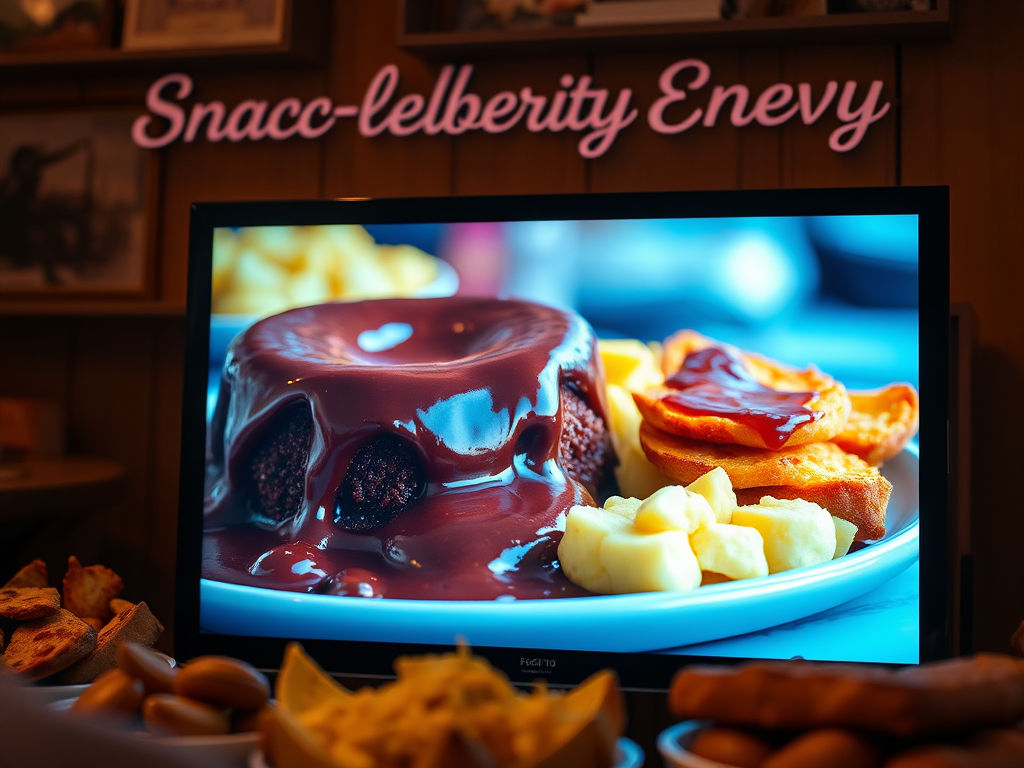
    Forget plotlines. It’s the sound of a corn tortilla cracking like a gunshot through your living room, the close-up of chocolate lava cake oozing with erotic precision. You’re not watching TV—you’re being lured into a hunger trap set by Emmy-winning saboteurs. Your willpower doesn’t stand a chance.

    Worse still, these on-screen avatars of metabolic sorcery devour garlic mashed potatoes, fruit Danishes, and croissant-stuffed French toast with impunity—then rise from the table looking like a yoga ad. These are not people; they are calorie-defying sirens sent to destroy your self-control. They nibble bearclaws and remain airbrushed and lithe. You so much as sniff a breadstick and your waistband tightens.

    This, dear reader, is Snac-lebrity Envy—the gnawing resentment you feel watching the beautiful and well-lit inhale calories like coal into a furnace while your “dessert” is a string cheese and a cry for help. It’s not simple jealousy. It’s the psychic whiplash of seeing your dietary struggle mocked in real-time by people whose only hardship is deciding between oat milk or almond.

    Snac-lebrity Envy isn’t just an emotion—it’s a syndrome. It lives in your dopamine pathways, chews on your restraint, and whispers sweet nihilism: “Go ahead. Eat the cheesecake. The system’s rigged anyway.” It’s not just TV. It’s sabotage you can binge.