Tag: diet

  • How to Stop Your Appetite from Heckling You and Achieve Savorosity

    How to Stop Your Appetite from Heckling You and Achieve Savorosity

    Coined Term: Cravattenuation

    (craving + attenuation)


    Extended Definition:

    Cravattenuation is the psychological and physiological art of turning down the volume on your inner snack gremlin—the one who starts kicking the back of your consciousness the moment your stomach makes a polite gurgle. It’s the deliberate process of retraining your body to interpret minor hunger signals not as existential emergencies but as low-priority system notifications: “You might want to eat in a bit” instead of “RAID THE PANTRY OR DIE.” Just as meditation teaches you to sit with discomfort rather than react impulsively, Cravattenuation teaches you that a little hunger isn’t a crisis—it’s foreplay for a better meal.

    We’ve been conditioned by snack culture and anxiety-driven consumption to treat hunger as something to be feared and fixed immediately, like a smoke alarm or a toddler tantrum. But when you practice Cravattenuation, something remarkable happens: your threshold for hunger strengthens, and the urgency softens. You learn to sit with a mild stomach pang without spiraling into carb-lust. Over time, you develop what can only be described as Hunger Discernment: the ability to separate emotional nibble-itching from true physiological need.


    The Unexpected Perk:

    By making your body earn the meal—not through punishment, but patience—you begin to eat with a clarity and joy that’s been missing since the dawn of office vending machines. Food tastes better when you’re actually hungry for it. Not “kinda bored” hungry, not “scrolling through cheese reels” hungry, but real hungry. Cravattenuation helps you not only manage your weight with more ease and grace, it re-enchants the eating experience itself. You’ll start treating meals like mini homecomings rather than pit stops at a dopamine gas station.


    Name for the Healthy State: Savorosity

    (savor + satiety + curiosity)

    Savorosity is the elegant state you enter after mastering Cravattenuation—a zone where hunger feels less like a hostage crisis and more like an invitation. It’s when you greet mealtime with curiosity and pleasure, not guilt or compulsion. It’s when you chew slower, taste deeper, and know you’ve arrived not because you gave in to a craving, but because you earned your appetite.

    Cravattenuation gets you there. Savorosity keeps you there. And together, they free you from the tyranny of the pantry’s siren call.

  • The Santa Claus of Donuts Must Die

    The Santa Claus of Donuts Must Die

    Let’s start with the obvious: your family bonds over food because food is reliable. It doesn’t argue with you about politics, it doesn’t criticize your life choices, and it doesn’t ask to borrow your car. It just shows up, warm and sugary, like a friend who never judges. And when you show up holding that pink box of donuts? You’re not just a guy walking through the front door—you’re the Santa Claus of Donuts, bearing gifts that turn your living room into a dopamine theme park. Everyone lights up. You are loved. You are admired. You are a hero.

    Until the sugar crash hits and you’re lying on the couch wondering how a simple box of pastries turned into a hostile takeover of your waistline. Again.

    You, my friend, have what polite society calls an “addictive personality,” but let’s not sugarcoat it (pun intended). You go overboard like it’s your patriotic duty. One treat turns into three. One bite into a blackout. You need boundaries, not Pinterest recipes.

    So here’s your prescription. It’s boring, brutal, and blessedly effective:

    Breakfast: Plain Greek yogurt, a scoop of protein powder, flaxseeds, chia seeds, and a handful of berries. Also, coffee. Strong enough to slap you awake and maybe shake loose some of your delusions.

    Lunch: A salad—yes, a salad—with actual protein in it. Maybe chicken. Maybe tuna. Add a scoop of cottage cheese if you hate joy a little less that day. Have some fruit so you don’t hallucinate cookies.
    Dinner: Protein again. Vegetables. Herbal tea, like the sad monk you are becoming. Cap it off with an apple and the faint memory of dessert.
    Snack Defense Protocol: If you start prowling like a raccoon between lunch and dinner, shove a carrot in your mouth, sip some green tea, and crack open a diet root beer. It’s not a thrill, it’s a strategy.

    And let us not forget why you had to slam the snack door shut like it owed you money: snacks are traitors. They pretend to be innocent little diversions—just a handful here, a nibble there—but they’re silent assassins. Those calories accumulate like guilt after a Vegas weekend, slowly padding your frame while you’re busy telling yourself you’re “cutting back.”

    Now, let’s address the hard truth, as spoken by the philosopher-king of overweight comedians, Tom Segura: “You don’t lose weight until you hate your fatness more than you love food.” Yes, it’s harsh. But he’s not wrong.

    Still, let’s reframe it with a little less bile and a touch more clarity:
    You won’t change until you prefer discipline to chaos. Until your craving for stability outweighs your need for a dopamine hit. Until your love of self-respect outweighs your love of Cheez-Its.

    You don’t need another meal plan—you need a code. A way of eating that doesn’t just fill your stomach, but recalibrates your priorities. Food is not your therapist. Food is not your friend. Food is fuel. And you? You’re not Santa Claus anymore. You’re something better: a man in control of his appetite, his identity, and his damn life.

    Now go make that yogurt bowl like it’s a holy ritual and not a punishment. The rest will follow.

  • The Boba-Loaded Lie: How Big Soda Got a Makeover

    The Boba-Loaded Lie: How Big Soda Got a Makeover

    Magical thinking is the bedazzled duct tape we slap onto reality to avoid facing the truth. It lets us take something objectively terrible—like a 20-ounce bottle of fizzy corn syrup—and slap on enough gloss, hashtags, and buzzwords to make it seem like an act of wellness. It’s how you turn poison into a product. And that, in essence, is what Ellen Cushing unpacks in her incisive Atlantic piece, The Drink Americans Can’t Quit.”

    Once upon a time, Big Soda was king—until the internet’s favorite shirtless gym bros decided that guzzling sugar water was about as cool as smoking indoors. Sodas became the new Marlboros: once iconic, now socially repellent. But like any villain in a rebooted franchise, soda didn’t die. It got a makeover. Now it struts back into our lives wearing a new name tag: energy drink, boba tea, cold brew, mushroom latte, functional hydration. Same blood sugar spike, new marketing copy.

    Cushing doesn’t just document this cynical rebranding—she vivisects it. The modern “status beverage” has evolved into a Trojan horse of marketing genius: wrapped in virtue-signaling wellness language, dressed in neutral tones and matte cans, and fortified with meaningless additions like adaptogens, B vitamins, or vaguely defined “nootropics.” These drinks promise energy, clarity, even spiritual alignment—because what better way to mask liquid candy than by suggesting it unlocks your third eye?

    But the rot remains. These drinks are still what Cushing calls “a remarkably unhealthy, nutritionally inessential product that costs pennies to make”—only now, they’re draped in the aesthetic of self-care. We’ve replaced high-fructose corn syrup with high-gloss delusion. It’s not soda, you see—it’s a wellness ritual. A personality in a can. A lifestyle choice with a QR code.

    And it works because the industry knows exactly who we are: vanity-ridden optimists with just enough disposable income and just little enough critical thinking to fall for it again. We don’t want hydration; we want a vibe. Something that fits in our hand, photographs well on Instagram, and makes us feel like we’re doing something good for ourselves—while doing the exact opposite.

    Cushing’s essay left me seething, in the best way. Because once you see the scam, you can’t unsee it. I don’t care if your can is minimalist, if your label says “plant-based,” or if Gwyneth Paltrow herself handed it to me with a smug nod. If it’s just soda in yoga pants, I’m out.

    So no, I won’t be purchasing a $5 can of turmeric-infused, adaptogen-enhanced, crystal-charged carbonated nonsense. Because once I understand the con, drinking it would feel like punching my own dignity in the face. I’d rather hydrate the old-fashioned way—with water and a shred of self-respect.

  • 3 College Writing Prompts: Willpower Is Not a Weight-Loss Strategy: Rewriting the Narrative of Obesity in an Age of Ozempic

    3 College Writing Prompts: Willpower Is Not a Weight-Loss Strategy: Rewriting the Narrative of Obesity in an Age of Ozempic

    Essay Prompt:

    In contemporary culture, weight loss is often framed as a matter of individual discipline: eat less, move more, stay motivated. This narrative, reinforced by diet culture, media messaging, and public health campaigns, reduces a complex biopsychosocial phenomenon into a moral test of willpower. But what if this view is not only incomplete, but damaging?

    This essay invites you to critically analyze the myth of weight loss as a simple formula of personal responsibility, using the following readings:

    • Rebecca Johns, “A Diet Writer’s Regrets”
    • Johann Hari, “A Year on Ozempic Taught Me We’re Thinking About Obesity All Wrong”
    • Harriet Brown, “The Weight of the Evidence”
    • Sandra Aamodt, “Why You Can’t Lose Weight on a Diet”

    Drawing on these texts, write a 1,700-word argumentative essay that explores the deeper systemic, biological, and psychological forces that influence body weight. In your analysis, define what is meant by diet culture, obesity stigma, metabolic adaptation, and the illusion of control. Consider how economic privilege, the Industrial Food Complex, and the Diabetes-Management Complex affect who gets access to treatment and who gets blamed for their bodies.

    Reflect on the question: Is obesity the result of failed individual discipline—or a condition shaped by biology, capitalism, and inequality? And what are the ethical and political consequences of continuing to frame weight as a personal failing?


    Key Themes and Concepts to Define in Essay:

    • Diet culture: The belief system that prioritizes thinness as a moral virtue and equates weight loss with health and worth.
    • Obesity stigma: The systemic dehumanization, bias, and blame placed on people in larger bodies.
    • Metabolic adaptation: The body’s physiological resistance to weight loss, often leading to weight regain.
    • Ozempic and GLP-1 drugs: Medications that challenge traditional weight-loss advice by offering pharmacological interventions, often accessible only to the wealthy.
    • Industrial Food Complex: The economic system that prioritizes hyper-palatable, processed foods for profit.
    • Diabetes-Management Complex: The medical-industrial apparatus that profits from managing obesity-related conditions without addressing root causes.

    10-Paragraph Essay Outline


    Paragraph 1 – Introduction

    • Begin with a personal or cultural anecdote about dieting, body shame, or the weight-loss industry.
    • State the prevailing myth: that weight loss is just about willpower, calories, and exercise.
    • Introduce the core idea: this myth obscures structural, biological, and psychological realities.
    • End with a strong thesis: The cultural obsession with personal discipline in weight loss not only ignores science but perpetuates economic injustice, medical misinformation, and moral shame.

    Paragraph 2 – The Myth of Personal Responsibility

    • Explore how diet culture frames obesity as a personal failure.
    • Use Johns and Brown to show how this narrative is reinforced by health media and public policy.
    • Define diet culture and obesity stigma as forms of social control.

    Paragraph 3 – The Science of Weight and Metabolism

    • Explain Aamodt’s key argument: the body defends a weight range through metabolic adaptation.
    • Introduce the concept of the set point and how dieting can backfire physiologically.
    • Emphasize the biological limits of “discipline” in long-term weight maintenance.

    Paragraph 4 – Ozempic and the Medical Disruption of Diet Culture

    • Analyze Hari’s experience with Ozempic as a reframing of what obesity is and isn’t.
    • Explain how drugs like Ozempic challenge the calorie-math logic of diet culture.
    • Raise the question: if a drug changes appetite, was willpower ever the issue?

    Paragraph 5 – Economic Access and the Ozempic Divide

    • Examine the cost of GLP-1 drugs and the class-based disparity in access.
    • Discuss how the rich can “solve” obesity pharmacologically while others are blamed.
    • Introduce the concept of the Diabetes-Management Complex and its profit motives.

    Paragraph 6 – The Industrial Food Complex and Engineered Cravings

    • Analyze the food industry’s role in promoting addictive, ultra-processed foods.
    • Use Brown and outside data (optional) to show how working-class communities are targeted by fast food and soda industries.
    • Connect this to systemic inequality: people are set up to fail and then blamed for it.

    Paragraph 7 – Psychological Toll and the Shame Cycle

    • Highlight the emotional and mental health damage caused by diet failure and stigma.
    • Reference Johns and Aamodt: shame is not a motivator—it’s a trap.
    • Argue that repeated dieting often leads to worse health outcomes, not better ones.

    Paragraph 8 – Counterargument: Isn’t Some Responsibility Necessary?

    • Acknowledge the argument that individuals do make choices about food and movement.
    • Rebut by showing how choice is constrained by biology, environment, and marketing.
    • Emphasize that awareness and access—not shame—should guide public health.

    Paragraph 9 – Reframing Obesity: Toward Compassionate Policy and Practice

    • Suggest new narratives: body neutrality, medical compassion, anti-poverty approaches.
    • Point to Hari’s conclusion: we must rethink how we talk about food, body, and health.
    • Argue for policies that regulate Big Food and expand access to affordable treatment—not just lectures on willpower.

    Paragraph 10 – Conclusion

    • Reaffirm thesis: The weight-loss myth isn’t just scientifically flawed—it’s morally dangerous.
    • Remind the reader that bodies are not math problems to be solved.
    • End with a call to change the story: from blame to understanding, from shame to structural justice.

    Three Sample Thesis Statements


    Thesis 1:
    Despite decades of public health messaging urging personal responsibility, evidence from metabolic science and socioeconomic analysis shows that weight loss is rarely a matter of willpower; rather, it is shaped by systemic inequalities, industrial food marketing, and biological resistance that diet culture refuses to acknowledge.


    Thesis 2:
    Ozempic has exposed the hollowness of traditional dieting advice by proving that appetite, metabolism, and weight are governed by mechanisms beyond discipline—forcing us to rethink obesity not as moral failure, but as a condition entangled in capitalism, privilege, and biology.


    Thesis 3:
    While self-discipline plays a role in shaping health behaviors, framing obesity as a personal choice erases the complex realities faced by those in larger bodies—and perpetuates a culture that profits from their shame while denying them access to real solutions.

    Prompt Variation #1:

    Title:

    Ozempic Nation: Rethinking Health, Shame, and the New Politics of Body Control

    Prompt:

    In recent years, the rise of weight-loss drugs like Ozempic has disrupted the cultural script about how people should lose weight. For decades, Americans were taught that health was a product of self-control, calorie-counting, and personal virtue. Now, pharmaceutical interventions are reframing obesity not as a failure of discipline, but as a medical condition treatable through science—at least, for those who can afford it.

    In a 1,700-word argumentative essay, use the following sources to explore the tension between medical innovation and cultural shame in the weight-loss conversation:

    • Rebecca Johns, “A Diet Writer’s Regrets”
    • Johann Hari, “A Year on Ozempic Taught Me We’re Thinking About Obesity All Wrong”
    • Harriet Brown, “The Weight of the Evidence”
    • Sandra Aamodt, “Why You Can’t Lose Weight on a Diet”

    Your essay should analyze the shifting meanings of health, body control, and legitimacy in the age of Ozempic. What happens when pharmaceutical shortcuts challenge decades of moral messaging around food and fitness? Who benefits from this shift—and who is still left behind?

    Define and explore key concepts such as obesity stigma, the illusion of dietary control, medical privilege, and the cultural performance of health. Consider how these sources challenge or reinforce the idea that technology can “fix” what social systems continue to break.


    Sample Thesis Statements:

    Thesis 1:
    Ozempic reveals the deep contradictions at the heart of American health culture: while it promises to liberate people from shame and failed diets, it reinforces an unequal system in which the wealthy gain slimness without stigma while the poor remain trapped in cycles of blame and exclusion.

    Thesis 2:
    The pharmaceutical rebranding of obesity as a treatable disease may signal progress, but it risks medicalizing a problem rooted in inequality and cultural cruelty—shifting the solution from public reform to private access.

    Thesis 3:
    Even as Ozempic offers a scientific disruption of diet culture, the surrounding narrative still clings to old myths of self-control, body optimization, and moral value, showing that shame is more durable than even the most effective drug.


    Prompt Variation #2:

    Title:

    The Hunger Trap: How Diet Culture Profits from Our Failure

    Prompt:

    For decades, diet culture has promised transformation through willpower: thinner bodies, better health, and a more valuable self. Yet mounting evidence suggests that these promises are not only false but economically and biologically rigged to ensure failure.

    Using the following texts, write a 1,700-word argumentative essay examining how diet culture operates as an economic and psychological trap:

    • Rebecca Johns, “A Diet Writer’s Regrets”
    • Johann Hari, “A Year on Ozempic Taught Me We’re Thinking About Obesity All Wrong”
    • Harriet Brown, “The Weight of the Evidence”
    • Sandra Aamodt, “Why You Can’t Lose Weight on a Diet”

    Your task is to explore how the weight-loss industry—and the broader systems of food production, health marketing, and cultural control—profits from the manufactured failure of diets. Analyze how this industry shapes individual psychology while diverting attention from systemic issues such as poverty, food engineering, and medical access.

    Define key terms such as the weight-loss industrial complex, metabolic resistance, social shame as behavioral control, and the commodification of insecurity. Ask: who profits when we hate our bodies, and what changes when we stop believing weight loss is the solution?


    Sample Thesis Statements:

    Thesis 1:
    Diet culture functions less as a roadmap to health than as a profit engine fueled by failure, shame, and false hope—ensuring that the more we try to lose weight, the more the system wins.

    Thesis 2:
    The illusion of dietary control is not a harmless myth but a profitable one, carefully engineered by the Industrial Food Complex and the diet industry to keep consumers trapped in a cycle of craving, guilt, and spending.

    Thesis 3:
    By exposing how diets are designed to fail and shame is weaponized for profit, these texts argue that weight loss is not a health goal—it is an industry built on emotional extraction and economic exploitation.
  • Meat, Morals, and the Myth of the “Faketarian”

    Meat, Morals, and the Myth of the “Faketarian”

    In Yasmin Tayag’s Atlantic essay, “America Is Done Pretending About Meat,” she slices through the tofu-thin veneer of plant-based hype with surgical clarity. Her subtitle—“Plant-based has lost its appeal”—isn’t just a culinary observation; it’s a cultural postmortem. In today’s ideological food fight, meat isn’t just food. It’s masculinity on a plate, red-state swagger served rare. Meanwhile, the plant-based lifestyle—once the darling of climate warriors and West Coast yoga instructors—now reeks of smugness and crumbling coastal elitism.

    Pre-pandemic, faux meat had its moment. Impossible Burgers sizzled their way into fast food joints, and Beyond Meat strutted onto grocery shelves like it was about to win a Nobel Prize in moral superiority. But somewhere between mask mandates and mutual loathing, America got bored with pretending its black bean patty was filet mignon. Political tribalism hardened, and nothing says “I vote red” like a slab of charred ribeye.

    Beyond the performative virtue signaling, there’s a more primal truth: meat is delicious. Our conscience may wag its finger over climate guilt and industrial cruelty, but our mouths water for seared fat and sizzle. And let’s be honest—those plant-based patties? Nutritional Trojan horses. They’re packed with sodium, industrial oils, and the kind of pea protein that leaves you hungry two hours later. A real burger satisfies. A fake one is cosplay.

    Tayag throws another burger on the grill: half of all self-proclaimed vegans and vegetarians are liars—“faketarians,” as my cousin calls them—quietly munching chicken wings when no one’s looking. The moral high ground is slippery when coated in barbecue sauce.

    Personally, my culinary choices are less about ethics and more about domestic diplomacy. My wife and daughters are carnivores, and I’m not about to start a civil war over tempeh. Sure, I dabble in lentils and drizzle tahini on roasted vegetables, but I still rely on Greek yogurt and whey protein to keep my muscles from filing a grievance.

    So yes, I lean plant-based, but only enough to stay credible in a Whole Foods aisle—not enough to trigger a household mutiny. Call it “functional tribalism.” Call it “married life.” Just don’t call it vegan.

  • DEATH BY SNACKS

    DEATH BY SNACKS

    After dinner, my wife and I luxuriated in a couple of Arrested Development reruns, marveling at the genius of Mitchell Hurwitz and Ron Howard. The show, an absurdist ode to familial dysfunction, felt decades ahead of its time—sharp enough to leave paper cuts on your brain. During the opening credits, I rose from the couch with noble intentions: I was off to fetch my so-called “satiety apple,” a modest, virtuous snack that allegedly curbs my post-dinner cravings without derailing my calorie count.

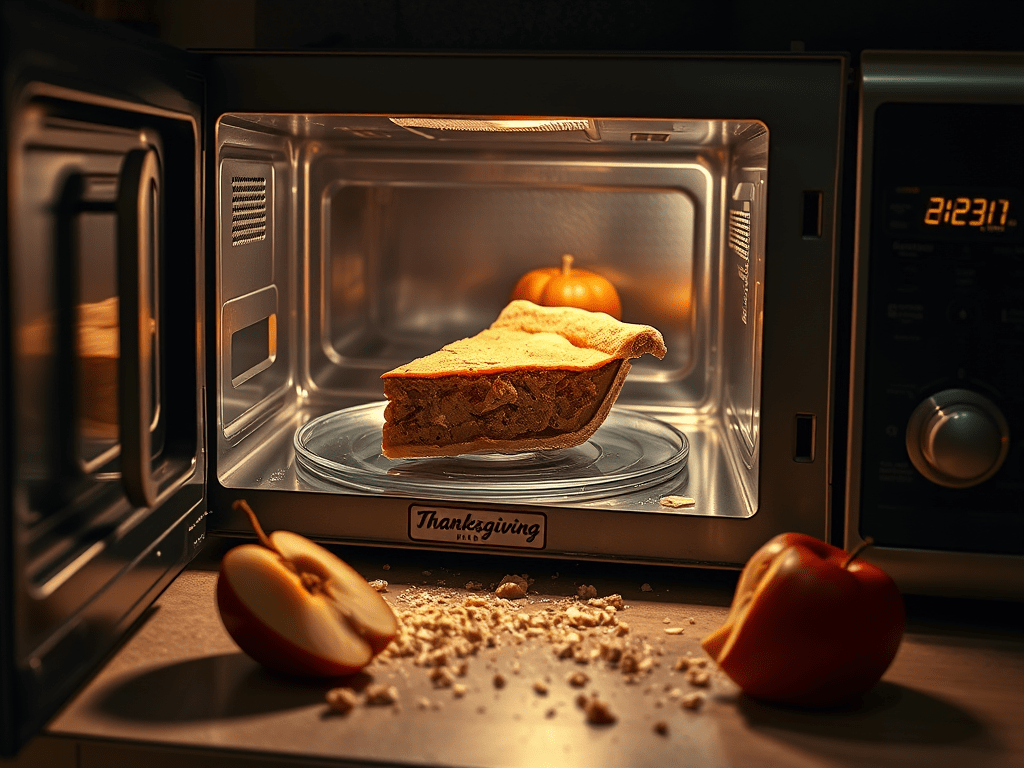
    But as I crossed the kitchen, fate—or treachery—beckoned me toward the microwave. There it sat: a pie box, faintly glowing, practically humming a siren song of buttery crust and spiced filling. One peek inside, and there it was—the last slice of Thanksgiving pie, radiating the kind of allure that no apple could ever muster.

    Before I knew it, I was hunched over the sink, inhaling that pie like a feral animal who’d just discovered civilization’s baked goods. Crumbs flew. Filling dripped. I was mid-bite, fully in beast mode, when my daughter Alison walked in. She stopped, surveyed the scene, and with surgical precision, dropped her line: “When’s the last time you were on a diet?”

    I froze mid-chew, my cheeks puffed out like a chipmunk caught in a raid. “A single slice of pie hardly merits such harsh judgment,” I said, wiping a smear of whipped cream off my chin.

    “Don’t be so defensive,” she said, her voice carrying the kind of condescension only a teenage girl can master. “I’m just asking—when was the last time you were on a diet?”

    “I didn’t realize you were the official historian of my weight management strategies,” I shot back, trying to maintain some shred of dignity.

    “What strategy?” she deadpanned, her tone as flat as the pie tin now sitting empty in the sink.

    I opened my mouth in an exaggerated display of mock offense, as if her words had wounded me so deeply that I could only respond with silence. We laughed, but the truth landed like a sucker punch: despite my heroic kettlebell workouts and high-protein meal plans, my daughter saw me for what I really was—a fat slob, undone by my inability to resist the siren song of leftover pie.

    My conversation with my daughter hit a nerve: my relationship with food is less of a partnership and more of a chaotic entanglement worthy of a reality show. I’m living with a chronic condition others have dubbed food noise—the relentless, mind-consuming obsession with food. It’s not just a passing craving; it’s a full-time occupation. Food noise is that little gremlin in your head planning tomorrow’s breakfast while you’re still wiping pie crumbs off your shirt from dinner. It’s exhausting, intrusive, and, frankly, a massive pain in the ass.

    I’ve tried all the supposed solutions. High-protein meals? Check. Fiber-packed fruits and veggies? Done. Permission to eat favorite foods to deflate their psychological power? Sure, why not. Listening to my so-called “hunger cues”? Please, those cues have been drowned out by a symphony of appetite louder than a Wagner opera. The truth is, my love of food has nothing to do with hunger. This isn’t about survival—it’s about passion.

    I crave food the way a musician craves music, except instead of performing Beethoven’s Ninth, I’m inhaling pie and serenading a protein bar like it’s my muse. Eating isn’t just sustenance; it’s a full-body euphoria, a never-ending sonata of chewing that I never want to end.

    So here I am, a helpless Snack Serenader, crooning over every dish like it’s the centerpiece of my magnum opus. Pie, pasta, cereal, or steak—it doesn’t matter. They’re all part of the eternal love song I sing to food, even as it steamrolls my willpower and expands my waistline. And while it may sound romantic, let’s be honest: it’s less about joy and more about imprisonment. I don’t just eat food; I worship it. I’m not hungry for a meal; I’m desperate for an encore. Just as a Beethoven superfan can lose themselves in the ninth symphony on repeat, I want to marinate in a bottomless jacuzzi of flavor, chewing my way through life’s buffet like a one-man marching band of mastication.

    As a Snack Serenader, I croon love songs to everything from pie to chicken shawarma. That Thanksgiving slice of pie wasn’t dessert; it was a crescendo. A bag of chips isn’t a snack; it’s an aria. And here I am, the tragic hero, swooning over leftovers as my waistline rolls its eyes and mutters, “You’re killing me.”

    The irony isn’t lost on me that I began this post with Arrested Development while chronicling my sink-side pie binge—a man-child devouring apple pie like it was the elixir of life, all under the unimpressed gaze of my daughter. Uncontrolled eating, it seems, is less about hunger and more about a deep-seated infantilization for which there’s no cure, just a lifetime subscription.