Tag: family

  • Wrestling with an especially virulent case of “Influenza A”

    Wrestling with an especially virulent case of “Influenza A”

    In I’m Dysfunctional, You’re Dysfunctional: The Recovery Movement and Other Self-Help Fashions, Wendy Kaminer lays waste to the therapeutic fads of the 1990s, particularly the trend of “reclaiming the inner child”—a ritual that took infantilization to near-religious extremes.

    She describes John Bradshaw’s workshops, where grown adults with respectable careers arrived clutching teddy bears like traumatized toddlers, preparing to embark on a guided journey into the mansion of their past. There, as Bradshaw whispered encouragements, lower lips trembled, tears streamed, and a congregation of emotionally overqualified professionals sobbed into the polyester fur of their stuffed animals.

    What floored Kaminer wasn’t the unhinged emotionalism—it was the sheer, shameless conviction. These people weren’t just indulging in a saccharine, self-indulgent spectacle—they were true believers, convinced that squeezing a doll and reliving some long-buried playground trauma was nothing short of a spiritual awakening.

    Kaminer was not impressed. What others saw as self-reflection and healing, she saw as an infantilizing orgy of narcissism, a self-help séance in which grown-ups tried to resurrect their inner kindergartener, only to be possessed by a ghost that refused to leave.

    Now, I’d like to say that my bullshit detector is too finely tuned for me to cradle a stuffed animal and regress into baby talk. But the bitter irony is that writing this memoir has forced me into my own brand of infantilization—just without the teddy bear and group cry session.

    Nothing made this clearer than the pathetic spectacle of my post-Thanksgiving downfall, which started with a game of Russian roulette—except instead of a revolver, I played with rotting cabbage.

    It all began when I decided to make chicken tacos—a wholesome, adult dinner choice. Unfortunately, the bag of shredded cabbage I retrieved from the fridge had been marinating in its own decay for two weeks, slowly transforming into hell’s compost pile.

    The moment I tore open the bag, my wife recoiled with the dramatic flair of a crime scene detective stumbling upon a long-decomposed body. She clutched her nose, waved her hands like an exorcist warding off a demon, and issued a forensic report:

    “That smells like a mix of a latrine and a horse’s taint.”

    A normal person would have taken this as a warning. But, fueled by misplaced confidence and the hubris of someone who had survived worse, I dumped the cabbage on my tacos and dug in.

    Hours later, my immune system, weakened by the Thanksgiving marathon of forced hospitality, collapsed like a debt-ridden empire. The virus that had been lurking in the shadows seized its moment, and by the next morning, I was a feverish, shivering wreck, contemplating my life choices between bouts of violent gastrointestinal reckoning.

    It seems that you don’t need a stuffed animal and a therapy circle to regress into infancy. Sometimes, all it takes is spoiled cabbage and a ruinous lack of self-preservation.

    Naturally, instead of exercising common sense, I channeled my inner cheapskate prophet. “Cabbage by its very nature has a funky scent,” I proclaimed with the confidence of a man who regularly courts disaster. “A little fermentation won’t hurt anyone.” My wife frowned and said, “It’s smelling up the entire kitchen.”
    “We’ll be fine,” I insisted, scooping copious amounts of fetid-smelling cabbage onto my tacos like I was auditioning for a daredevil cooking show.

    At dinner, I was the only one brave—or foolish—enough to eat it. Within an hour, my body issued a resounding, “You absolute moron.” No GI issues, but I felt like I’d been hit by a truck, reversed over, and then hit again. My head throbbed, my eyes were so sensitive to light I had to drape a T-shirt over my face just to listen to a Netflix show, and my energy flatlined by eight p.m. I crawled into bed, feeling like a half-baked zombie.

    The next morning was worse. Still no GI problems, but the 101 fever and crushing fatigue made me question my will to live. I tried to eat some oatmeal and grapefruit, the culinary equivalent of punishment food, but even that felt like too much effort. 

    By day three, no improvement. I’d become a cautionary tale, researching induced vomiting and discovering it was far too late. Apparently, if you don’t purge immediately, the toxins settle in like an unwanted houseguest who insists on staying for five to seven days.

    Being sick in my family makes everyone else suffer. Our teenage twins require constant care, frequent snacks that generate endless dirty dishes, and someone breathing down their necks to ensure homework gets done. My wife had to shoulder it all while I languished in my misery. I apologized profusely for my reckless hubris and promised, at the age of sixty-three, to turn over a new leaf—or at least stop eating ones that reek like death.

    For decades, I’d treated eating old, moldy food like a badge of honor, quoting my dad’s immortal wisdom: “Pilgrims who ate blue cheese on the Mayflower survived disease while the mold-avoiders died.” It was as if I’d been brainwashed into believing spoiled food was a superfood. But this cabbage debacle—this hellish, cabbage-induced reckoning—put the fear of God in me. Never again would I be the fool who eats something that smells like a medieval torture chamber. This time, I mean it. The next funky bag of cabbage? Straight to the trash. May it ferment in peace.

    As the alleged food-borne illness dragged on and my fever turned my brain into a swamp, I found myself pondering a morbid yet painfully stupid thought: What if I died because I was too cheap to toss a two-dollar bag of cabbage? Imagine the headline: “Man Perishes Over Discount Vegetables.” How could I ever forgive myself for such world-class idiocy? Worse, how could my wife ever forget that I lectured her with the smug confidence of a food-safety guru right before scarfing down a fatal dose of rotting produce? I’d be immortalized as the kind of hapless buffoon who wouldn’t even get a name in a Chekhov short story—just “The Idiot Who Ate the Cabbage.”

    Then, because fever dreams and existential crises go hand in hand, another absurd thought hit me: How would my YouTube subscribers and Instagram followers know what happened to me? I’d be gone, but my accounts would still sit there, ghostlike, leaving them to wonder why the witty guy with the diver watches and snack obsession suddenly went dark. What a tragedy—I wouldn’t even get the chance to create a final piece of content documenting my own demise in comedic glory. A video titled, “How Cabbage Killed Me (And Why You Should Toss Yours)” would surely have gone viral.

    This realization struck me as profoundly twisted: content creators care more about producing “engaging material” than their own mortality. Forget self-preservation—I was more upset that my audience might miss out on the hilarity of my self-inflicted cabbage-related downfall. The pathology runs deep: we’re so hooked on being performative, we’d probably narrate our own deaths if we could. Imagine me, breathless and feverish, croaking out, “Don’t forget to like, comment, and subscribe—assuming I make it to tomorrow.” The absurdity of it all made me laugh, which hurt, because even my ribs were exhausted from this cabbage-induced purgatory.

    It was apparent I was so desperate to be relevant on social media that I had become a Gravefluencer–an influencer who extends his reach six feet under, ensuring even death is on-brand.

    After five days of relentless illness, I had a phone consultation with my doctor about what I was sure was self-inflicted food poisoning. I laid out the symptoms with the kind of detail you’d expect from someone auditioning for a medical drama. My doctor listened patiently, then unceremoniously popped my bubble of absurdity. “This isn’t food poisoning,” she said. “You’ve got the flu. It’s going around.”

    Just like that, my grand narrative of culinary hubris—the man who dared to defy rancid cabbage and paid the ultimate price—was dead. Instead, I was left with something far less glamorous: virulent flu. Part of me was relieved that I wasn’t poisoning myself with poisoned produce, but another part of me felt cheated. I’d lost the absurd, darkly comedic morality tale about a man so cheap he nearly killed himself over a two-dollar bag of cabbage. What a waste.

    The doctor wasn’t exactly brimming with solutions, either. “Rest and stay hydrated,” she advised, the way you might tell a child to eat their vegetables. That night, my fever spiked close to 104, launching me into a kaleidoscope of fever dreams where my brain decided to give me the full surrealist experience. Words from my podcasts took on physical forms—spiky, sticky, grotesque shapes—and suddenly, I was inside them. I wandered through caves of conversation, waded through cocoons of dialogue, and got tangled in thick spider webs spun from language. Each sentence wrapped around me, trapping me in its endless loops of nonsense.

    When I woke up, drenched in sweat and feeling like I’d wrestled a linguistically gifted tarantula, I realized the flu wasn’t just an illness—it was a full-blown avant-garde art installation happening in my own head. So no, I didn’t have food poisoning. I had performance art fever. And while it wasn’t the cabbage apocalypse I’d hoped for, it was plenty weird in its own way.

    For six days, I had been wrestling with the so-called “Thanksgiving Flu,” a charming little virus that kept my fever bouncing between 101 and 104, as if my body were auditioning for a medical melodrama. Being that sick wasn’t just about physical misery—it was a battering ram smashing through the cozy little mental structures I had built around my life. Aspirations? Pointless. Health goals? A cruel joke. My reading list? Forget it. Even my hunger for social belonging and validation had been knocked flat. What remained was a stripped-down nihilism so bleak it made Nietzsche look like an optimist.

    Sickness dragged me to a dark place where life felt like a cosmic prank. I could almost hear my 14-year-old self rolling his eyes as I remembered my Grandma Mildred’s wise words from one of her letters: “Illnesses bring out the doldrums.” No kidding, Grandma. That particular flu had brought out more than the doldrums—it had conjured a maudlin cocktail of despair and self-pity.

    In that state, I found myself spiraling into melodrama, muttering things like, “What’s the point? Just end the torment and let me meet my Maker already!” It was ridiculous, of course, but I couldn’t help but notice how flu-induced misery fed into a distinctly male flavor of narcissism. Egotism, after all, was a hallmark of the man-child: the guy who thought the universe should pause when he didn’t get his way.

    Men, it seemed, were uniquely gifted at turning minor discomforts into existential crises. While women powered through illness with a mix of stoicism and practicality, men turned their sickbeds into thrones of self-pity, proclaiming their impending doom to anyone who would listen. And me? I was no exception. With every feverish shiver, I became the star of my own overwrought drama, raging against the cruelty of a world that dared to continue spinning while I wallowed in flu-induced existential despair.

    Sure, Grandma Mildred, the doldrums were part of the package—but why did it feel like men turned those doldrums into an art form? Perhaps the real flu virus wasn’t in my body; it was in my ego, throwing a tantrum because life wasn’t bending to my fevered will.

    I appeared to be languishing in the Flu-tile State—a fever-fueled realization that all human endeavor was futile.

    On day 8 of this flu from hell, my doctor emailed me a cheerful little grenade: “Your symptoms are concerning. I need to see you today.” Fabulous. At 11 a.m., feverish, grouchy, and radiating the energy of a half-cooked zombie, I dragged myself to her office for the usual poking and prodding. COVID? Negative. Influenza? Oh yes, Influenza A—the viral overachiever of the season. My nurse, who’d had it two weeks earlier, gave me the kind of pep talk you’d expect from someone who survived a minor apocalypse. “Seven days of fever,” she chirped, “so you’ve probably got two more to go!” Like I’d won a spa weekend in purgatory.

    But the flu wasn’t the real sucker punch. No, that came when I stepped on the scale. At a soul-crushing 252 pounds, with blood pressure at 166 over 92, Dr. Okada laid it out with the dispassion of someone reading a menu: “You’re at high risk for a massive stroke or heart attack.” She might as well have handed me a shovel and a map to my future grave. Then, just to twist the knife, she added, “You need to lose fifty pounds in six months. Otherwise…” She trailed off, but I got the point: dead man waddling.

    Her final blow came with a steely gaze and a guilt grenade: “If not for yourself, lose weight for your wife and daughters.” Translation: stop being selfish and get your act together before they have to plan your funeral.

    Desperate for a cheat code, I asked about Mounjaro or Ozempic, those miracle weight-loss injectables I’d read about. She barely stifled a laugh. “We prescribe those for people with exclusive employer benefits.” I muttered something about how my college likely doesn’t cover luxury drugs, and her thin smile confirmed it. I’d be fighting this battle the old-fashioned way: with the DASH diet and restricted calories, not cutting-edge pharmaceuticals.

    And then there was the Motrin ban. Apparently, my go-to painkiller was a blood-pressure ticking time bomb. “No more Motrin. Tylenol only,” she said, with all the enthusiasm of a waiter recommending the tofu option. So now, my fevers would be accompanied by a dull, Tylenol-soaked march toward mortality. Fantastic.

    I thanked her—sincerely, I swear—because she wasn’t wrong. But the whole thing felt like I’d been blindsided by a particularly grim episode of The Biggest Loser: Medical Edition. On the drive home, Miley Cyrus’s “Flowers (Demo)” came on, and I—feverish, bloated, and thoroughly defeated—actually cried. Miley crooned about resilience and self-love, and all I could think about was how laxity, that slow, sneaky killer, had been working me over for years. Skipped workouts, mindless snacks, every excuse—it had all led to this: a middle-aged man sobbing in his car, mourning his dignity while stuck in traffic.

    Dr. Okada’s tough love landed like a wrecking ball. This was my moment—the kind where you either turn your life around or start drafting your obituary. Time to put down the Motrin, pick up some discipline, and drag myself back from the brink before I became the subject of one of those tragic lessons everyone ignores until it’s too late cautionary tales.

    I had entered the clinic expecting to get a quick flu diagnosis and maybe a lecture about rest and fluids. Instead, I walked out with the realization that my life wasn’t just off-track; it was an unmitigated dumpster fire rolling downhill. How had I missed it? The creeping wreckage of my existence had been unfolding right under my nose, like a slow-motion train derailment I refused to acknowledge. Denial, thy name is me.

    Dr. Okada, bless her clinical professionalism, had held up a mirror and forced me to see what I’d been expertly avoiding for years: that my life, much like my blood pressure, was a ticking time bomb. I’d been blind to my own unraveling, and now the blinders were off. The view wasn’t pretty, but at least now I knew what I was working with—a fixer-upper existence in desperate need of a renovation.

    My visit to the doctor turned into an unplanned catalyst for a long-overdue moral metamorphosis. I left not just diagnosed, but afflicted by a new condition I can only call the Scales of Justice (and Shame)—that peculiar state where the doctor’s scale transforms into the ultimate moral arbiter. Each number glaring back at me didn’t just measure pounds; it weighed my life choices, my discipline, my worthiness as a functioning adult. It was less a medical device and more a courtroom, and let’s just say I was found guilty on all counts.

    I was convinced that had I been ten years older, this bout of influenza would have finished me off. The first week felt less like an illness and more like the aftermath of a roadside bombing, with me as the unfortunate bystander left mangled in a ditch. My body was a buffet for phantom wolves and mosquitoes—every nerve ending seemed to host its own ravenous pest. Mentally, I spiraled into fever-induced madness, complete with hallucinatory jungle scenes: Gumby-esque AI bodybuilders, sculpted and sinewy yet gelatinous, painted the revolting hue of yellow sea slugs, slithered around me in an Amazonian hellscape.

    By Week Three, the influenza had mercifully downgraded its malevolence, though “mild” feels like an insult to language. I still shivered like a Victorian orphan in a snowstorm, my body temperature yoyoing between inferno and tundra. Aches gnawed at me persistently, like bad houseguests who don’t get the hint. And mentally? I was underwater—grasping at reality as it floats just out of reach. My brain felt stripped of a few critical screws, rattling around and threatening to unscrew the rest.

    At some point, I recalled, in the hazy, fevered way of someone stranded in a desert, that my daughter had lozenges in her room. Fueled by desperation, I shuffled to her door, knocked weakly, and thrust my trembling hands forward as if auditioning for a Dickens adaptation. “Please,” I croaked, my voice barely above a whisper, “fill my hands with lozenges for your poor ailing father.”

    The response? Hysterical laughter. Both of my daughters, cozied up watching TV, howled with the kind of delight usually reserved for viral cat videos. I caught a glimpse of myself in the hallway mirror: pajamas wrinkled like a bad alibi, beanie perched jauntily askew, my face the pallor of a sickly sailor. I was every bit the tragicomic figure they saw—a fevered street urchin begging for cough drops.

    My wife, ever the realist, stormed in to restore order. “We have plenty of lozenges in the kitchen,” she barked, clearly unimpressed by my Oscar-worthy theatrics. She led me, limping and pathetic, to the cupboard, where she proceeded to dump several bags of lozenges onto the table with all the ceremony of Santa Claus unloading his sleigh. My daughters, tears of laughter streaming down their faces, declared me Oliver Twist reincarnated.

    I retreated to bed clutching a handful of lozenges, humiliated but momentarily soothed, only to lie awake wondering when this fever would break—or if the AI bodybuilders would show up again to finish the job.

    Four weeks into my bout with influenza, I emerged bleary-eyed, fever-wrecked, and staring down my old nemesis: addiction. Not the sexy kind you’d brag about in a memoir—just the creeping, mundane kind that comes with a tendency to overindulge in things like self-pity, compulsive behaviors, and yes, an irrational attachment to writing books.

    And so, I emerged from this fever-ridden odyssey not as a transformed man, but as someone who had simply suffered enough to pause and reflect—until the next catastrophe beckoned. If John Bradshaw were leading my recovery workshop, he’d likely hand me a stuffed animal and instruct me to embrace my inner child, soothing my cabbage-traumatized soul with affirmations of self-love. But after weeks of sweating, hallucinating, and contemplating my own obituary over a bag of rotting vegetables, I didn’t need a teddy bear. I needed a referee, a financial adviser, and possibly an exorcist.

    The true lesson here? My inner child doesn’t need rescuing. He needs a restraining order. Because left to his own devices, he’ll continue to eat spoiled food out of spite, spiral into existential despair at the first sign of adversity, and demand that every brush with mortality be converted into premium content. So if I’m to move forward as a recovering writing addict, I have to acknowledge this truth: The inner child is not a sage. He’s a lunatic. And I should probably stop taking his advice.

    CHAPTER FORTY-SIX

    As part of my rehabilitation from writing novels I have no business writing, I remind myself of an uncomfortable truth: 95% of books—both fiction and nonfiction—are just bloated short stories and essays with unnecessary padding. How many times have I read a novel and thought, This would have been a killer short story, but as a novel, it’s a slog? How often have I powered through a nonfiction screed only to realize that everything I needed was in the first chapter, and the rest was just an echo chamber of diminishing returns?

    Perhaps someday, I’ll learn to write an exceptional short story—the kind that punches above its weight, the kind that leaves you feeling like you’ve just read a 400-page novel even though it barely clears 30. It takes a rare kind of genius to pull off this magic trick. I think of Alice Munro’s layered portraits of regret, Lorrie Moore’s razor-sharp wit, and John Cheever’s meticulous dissections of suburban despair. I flip through my extra-large edition of The Stories of John Cheever, and three stand out like glittering relics: “The Swimmer,” “The Country Husband,” and “The Jewels of the Cabots.” Each is a self-contained universe, a potent literary multivitamin that somehow delivers all the nourishment of a novel in a single, concentrated dose. Let’s call these rare works Stories That Ate a Novel—compact, ferocious, and packed with enough emotional and intellectual weight to render lesser novels redundant.

    As part of my rehabilitation, I must seek out such stories, study them, and attempt to write them. Not just as an artistic exercise, but as a safeguard against relapse—the last thing I need is another 300-page corpse of a novel stinking up my hard drive.

    But maybe this is more than just a recovery plan. Maybe this is a new mission—championing Stories That Eat Novels. The cultural winds are shifting in my favor. Attention spans, gnawed to the bone by social media, no longer tolerate literary excess. Even the New York Times has noted the rise of the short novel, reporting in “To the Point: Short Novels Dominate International Booker Prize Nominees” that books under 200 pages are taking center stage. We may be witnessing a tectonic shift, an age where brevity is not just a virtue but a necessity.

    For a failed novelist and an unapologetic literary wind-sprinter, this could be my moment. I can already see it—my sleek, ruthless 160-page collection, Stories That Eat Novels, four lapidary masterpieces gleaming like finely cut diamonds. Rehabilitation has never felt so good. Who says a man in his sixties can’t find his literary niche and stage an artistic rebirth? Maybe I wasn’t a failed novelist after all—maybe I was just a short-form assassin waiting for the right age to arrive.

  • What does it feel like to be crushed beneath decades of writing addiction?

    What does it feel like to be crushed beneath decades of writing addiction?

    What does it mean to be pinned down for decades by some vast, crushing force, an unmovable, soul-flattening monolith that convinces you of your own helplessness? More importantly, do we even want to be free from it, or is that liberation its own special kind of agony?

    This takes me back to 1970, watching Adam-12, one of my favorite TV shows, though I only remember one episode. A man was trapped under a fallen telephone pole, the weight pressing into his ribs. When paramedics arrived, they informed him they’d be using a crane to lift it off. “Funny,” the man remarked. “I don’t even feel any pain.” The paramedic’s response? You don’t feel pain now—but once we lift it, you will.

    That moment lodged itself in my brain like a splinter. Because, really, what is breaking free from an addiction if not having a telephone pole lifted off your chest? You think you’re ready for freedom, but then the weight is gone, and suddenly, every nerve in your body starts screaming. You had learned to live with the oppression, adapted to its limits, made peace with your own captivity. And now, you have to face everything that weight once shielded you from—all the wounds you ignored, all the realities you deferred, all the choices you never had to make because you were conveniently immobilized.

    That’s where I am now. My recovery means staying in my lane, so I have to admit that I will never write A Confederacy of Dunces. I don’t have the genius to write something like The Ginger Man. I won’t be crafting an autofictional masterwork à la Emmanuel Carrère’s Kingdom. What I do have is a lifetime spent crushed under the telephone pole of writing addiction, a weight that once gave my life structure—even as it kept me from actually living it.

    So, I had to be the crane operator, the paramedic, and the doctor all at once. I had to lift the damn pole, endure the pain, and figure out how to move forward. 

    Lifting the telephone pole off my ribs did indeed hurt like hell. By the time the 2024 Thanksgiving rolled around, I could feel the weight of grief like an overstuffed holiday plate. I’d said goodbye to my mother during the pandemic, standing outside a nursing home window and offering her love through a mesh screen, as if I were visiting someone in solitary confinement. Two years later, I watched my father—a proud infantryman in his day—fade to 130 pounds, his body surrendering to cancer. Since their passing, the world felt quieter, smaller, like someone had dimmed the lights without warning.

    So, when hosting Thanksgiving fell squarely on my plate, it wasn’t some Norman Rockwell fantasy. It was more like getting crushed by a baby grand piano dropped from the second floor. And instead of gracefully stepping aside, I just let it hit me—because honestly, moving felt like too much effort.

    The guest list wasn’t exactly daunting—just my perpetually single brother, whose dating apps seemed better at generating cautionary tales than romantic prospects, and two of my wife’s teacher friends, both middle school band directors still recovering from clarinet-induced PTSD. The conversation was polite, though it had all the flavor of plain oatmeal.

    Stuffed to the gills but somehow still shoveling pie like our lives depended on it, we trudged through the ritual of TV show recommendations. Each suggestion was delivered with the gravitas of a public service announcement—skip this series at your own peril. Apparently, failing to watch that one obscure, eight-part masterpiece would leave me culturally destitute, wandering through a desolate landscape devoid of punchlines and plot twists.

    Honestly, I enjoyed the company. The real villain of Thanksgiving wasn’t the guests—it was the dishes. The endless scrubbing that left my hands raw, the dishwashing marathon that stretched into eternity, the mountain of dirty plates multiplying like gremlins in the sink. That’s where the wheels came off.

    My wife, meanwhile, glided through the chaos like some kind of culinary sorceress, humming softly as she orchestrated the entire meal with the grace of a Michelin-starred maestro. She didn’t grumble. Not a single passive-aggressive sigh escaped her lips. She was the picture of serene competence.

    I, on the other hand, hovered around the kitchen like a useless NPC in a video game—occasionally moving a plate from table to sink and acting as though I’d just conquered Everest. At one point, I genuinely felt winded after rearranging the silverware. My contribution was so meager it felt performative, like a child pretending to be tired after “helping” Dad mow the lawn by pushing a plastic toy mower ten feet behind him.

    Somewhere between rinsing the roasting pan and glaring at the pile of silverware, it hit me—I was teetering on the edge of a Mope-a-saurus moment. The only thing preventing my full transformation was the vague sense of shame that my wife, who had just cooked for hours, wasn’t grumbling about the aftermath. That’s when you know you’re in trouble—when someone else’s superior competence and good cheer makes you feel like a defective appliance, sputtering through life with a flickering power cord and a weak motor.

    The lethal cocktail of self-loathing and forced sociability had drained me to the marrow. By the time the guests finally took their leave, I should have collapsed straight into bed, preferably into a coma-level sleep.

    But as a writing addict, I stayed up deep into the night and wrote a book proposal. 

    Surviving Thanksgiving: The Essential Guide

    A Memoir of Grief, Dysfunction, and the Existential Terror of Dishes

    Author: Jeff McMahon, recovering member of Write-a-holics Anonymous, part-time Manuscriptus Rex, full-time over-thinker.

    Overview:
    The holidays are supposed to be about gratitude, togetherness, and the warm glow of familial love. But let’s be honest—Thanksgiving is a psychological endurance test wrapped in a turkey-scented mirage of Norman Rockwell propaganda. You either come out of it spiritually enriched or barely clinging to sanity, drowning in a sea of gravy-stained regrets.

    This book is for those of us who, instead of basking in holiday joy, find ourselves staring into the abyss of mashed potatoes, contemplating the futility of existence while our hands prune in dishwater. It’s for the people who, somewhere between the third helping of stuffing and the forced enthusiasm over TV show recommendations, realize they are hurtling toward their final transformation: a hollow version of their former selves.

    Through dark humor, painfully relatable anecdotes, and some uncomfortably personal self-reflection, Surviving Thanksgiving: The Essential Guide will navigate the holiday’s perils—family dysfunction, grief-laden nostalgia, the crushing disappointment of dry turkey, and the passive-aggressive Olympics that inevitably break out over pie. Along the way, I’ll explore the psychology of holiday meltdowns, the delusions of tradition, and why washing dishes can trigger a full existential crisis.

    Target Audience:
    This book is for:

    • Burnt-out hosts who wonder why they agreed to this in the first place.
    • Perpetually single siblings trapped in the “Any Special Someone?” interrogation.
    • Grief-stricken folks realizing the empty chairs at the table hurt more than expected.
    • Introverts who barely survived the social gauntlet.
    • Writing addicts who turn all their misery into book proposals.

    Tone & Style:
    Think David Sedaris meets Kitchen Confidential with a side of A Confederacy of Dunces. It’s part memoir, part cultural critique, and entirely fueled by existential dread and too much pie.

    Managing my anxieties over Thanksgiving, I had conceived a preposterous memoir, a premise clearly more suitable for an essay than a book, but I couldn’t help it. Conceiving of these “comic memoirs” and providing a book proposal was a compulsion. Stopping one addiction didn’t make my compulsions disappear. They simply rerouted, popping up in new, mutated forms, like a literary game of whack-a-mole.

    Now, instead of writing doomed novels, I found myself obsessing over my own struggles, crafting fractured hero tales where I was the comic fool, perpetually failing forward, stumbling through existence like a man who just had a telephone pole yanked off his chest—and is still waiting for his ribs to stop throbbing.

  • First Love in Leningrad, Circa 1984

    First Love in Leningrad, Circa 1984

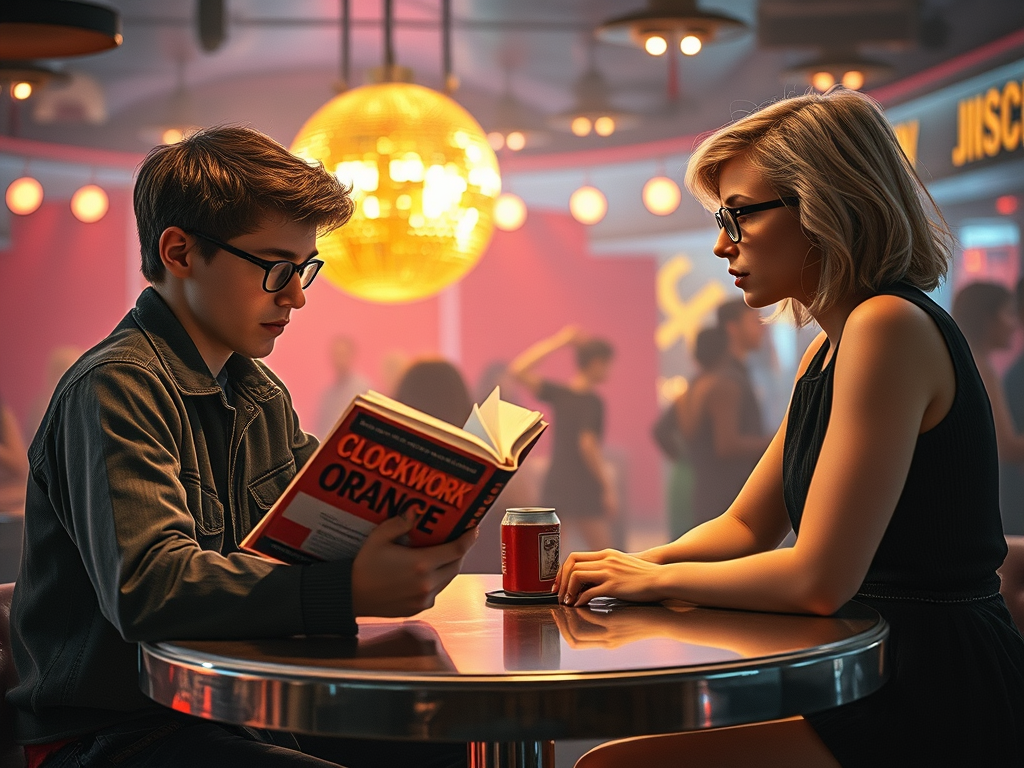
    The following evening found me slouched in a Leningrad discotheque, still nursing the kind of sore backside only a Soviet bus seat could deliver. I was stationed at a high-top table, reading A Clockwork Orange, trying to project an air of literary detachment while simultaneously avoiding eye contact with the throng of dancers twisting under the flickering neon lights.

    Then she appeared.

    Short, elfin, bespectacled—like an intellectual sprite who had wandered in from some parallel universe where bookish charm trumped disco fever. Her sandy-blonde hair framed a delicate face, and her gaze, sharp and assessing, landed squarely on me. “A very famous book,” she observed, nodding toward my well-worn copy.

    She introduced herself as Tula, a Finn on vacation, and without hesitation, slid into the seat across from me. We launched into a conversation that flowed as naturally as vodka at a Russian wedding—literature, music, the intoxicating allure of Russian novelists who knew how to suffer properly. I rattled off every book I had read, every philosophical revelation I had gleaned, and, with the reckless bravado of a twenty-something, confessed my grand ambition to write a novel.

    “You will be famous,” she declared with absolute certainty, as if she had peered through the murky fog of the future and spotted my name emblazoned on book covers. “I can feel it. You must visit me at Lake Saimaa. We will celebrate. Who knows. Perhaps I too will be a published novelist again. We can live together and be each other’s muse.”

    Flattered, I let my guard down. For two hours, we spoke like old friends who had simply taken too long to meet. Our mutual love for Russian literature, the music of Rachmaninoff, and the strange magnetic pull of doomed genius bound us together in a bubble of conversation. Then, as if she had been waiting for just the right moment, she reached into her purse, retrieved a small scrap of paper, and wrote down a title.

    “This,” she said, sliding it toward me, “is the book you must read.”

    I picked it up and saw the name—The Master and Margarita by Mikhail Bulgakov.

    She looked at me with the intensity of a woman who had just handed over a sacred text. 

    As we conversed under the glittering gold disco ball, the Bee Gees’ “Too Much Heaven” blared across the club. It became apparent through our self-revelations that neither of us had any romantic experience.  Tula At one point, she said, “I will never marry. I have, what do you say in English? Melancholy. Yes, I have melancholy. You know this word?”

    “Yes, I am no stranger to melancholy.”

    “I am so much like that,” she said.

    “That explains your love of Rachmaninoff.”

    She clasped her hands and almost became teary-eyed. “How I love Rachmaninoff. Just utter his name, and I will break down weeping.”

    I thought I was a depressive, but in the presence of Tula, I had the perkiness of Richard Simmons leading an aerobics class. 

    She asked me what I was doing in Russia. I explained that my grandfather was a card-carrying communist, a friend of Fidel Castro, and a supporter of the Soviet Union. He used a shortwave radio in his San Pedro house to communicate with Soviet sailors in nearby ships and submarines. He visited Cuba as often as he could to bring medical supplies that were in need there. One of his friends, a Hollywood writer, lived in exile in Nicaragua after being arrested in France by Interpol for driving a Peugeot station wagon filled with illegal weapons. My grandfather wanted me to fall in love with the Soviet Union and become a champion of its utopian vision, so he paid for me to go on a peace tour. Had I fallen in love with Russia as my grandfather had hoped? Not really. So far, I had been approached at the Moscow Zoo by a striking woman dressed in black and pearls who my tour guide Natasha warned me was a KGB agent trying to have me arrested for soliciting a prostitute. I was washing my hands at the newly built Olympic Hotel in Moscow when the bathroom sink fell out of the wall and against my torso, causing a bloody cut on my abdomen. I got a fever in Novgorod prompting a beautiful female doctor with a severe face to come into my hotel and give me a shot in the butt.  I was, as my fellow traveler Jerry Gold warned me, approached by young men on the subway who wanted to know if I had any American blue jeans to sell as a way of having me arrested for illicit black-market trading.  Everywhere I went in Russia–hotels, trains, restaurants–there were speakers playing grim chamber music as if the authorities were saying, “Try not to be too happy during your stay here.”

    Tula listened to me talk for a couple of hours with a wide gaze while touching my shoulder. “I need to see you again,” she said.

    We agreed to meet the next day at the Peterhof Royal Palace by the Samson Fountain. There is this giant garden the size of several football fields with monuments, gold statues, and fountains shooting streams of water straight into the blue sky. We sat on concrete steps around the fountains. It was close to ninety degrees as statues of gold naked bodies stood in various poses next to jets of erupting water in a spectacle called The Grand Cascade. Tula wore a short white dress and we sat on the steps. In the heat, we decided I would get us some ice cream.

    While I was walking toward the ice cream bar, a gypsy tried to hand off a baby to me the way a quarterback would hand off a football to a running back. It all happened so quickly. Before the baby was cradled in my chest, a fast-acting Russian police officer grabbed the baby, returned the baby to the gypsy, and shouted at her. I thought she would be arrested, but the officer appeared content with scolding her. She withered at his remarks and slumped away with the child in her arms.  

    I returned with the ice cream and told Tula about the incident with the gypsy. She said things like that happen all the time here.

    “But what was I supposed to do with the baby?”

    “Perhaps adopt it? Buy it? Save it from a life of misery? There is so much tragedy here.”

    “So I was supposed to fly back to the States with a baby? Go through customs and everything else?”

    “I know. It’s crazy.”

    “I don’t think I could be a parent. I don’t have the hardwiring for it.”

    “Me either. I’m too sad to be a parent. Sadness is a full-time job that leaves me with little energy for much else.”

    She finished her ice cream and smiled at me, then said, “You and I are like two kindred spirits meeting each other in this strange world.”

    “It’s hotter than hell out here.”

    “So will you marry someday?”

    I shrugged, then said, “I doubt anyone will take me.”

    “Don’t be so hard on yourself. If I were the marrying type, I would come to America and spend my life with you. We could live in California and be sad together. Wouldn’t that be lovely?”

    It actually sounded rather appealing. Tula and I living a life of sadness, writing novels together, marinating in Rachmaninoff’s Second Symphony while discussing the existential torment of Tolstoy and Dostoyevsky. What other kind of life was there?

    She stood up and said she had to catch her plane back to Finland and gave me a chaste kiss on the cheek.

    “I really hope you find happiness. You are such an outstanding person.”

    “Outstanding?”

    That adjective used to describe me was a bit hard to take. It was like a real estate agent trying to describe a decrepit property by the train tracks as palatial. I repeated the word outstanding with perhaps a trace of sarcasm and said goodbye to her. I never saw her again, but I still remember the vanilla ice cream–the best I’ve ever tasted. 

    Nine months later while back in my routine of working out, playing piano, and doing my college studies in the Bay Area, I received a letter from Tula. I was living with my mother and standing by our front yard’s loquat tree while holding the envelope and staring with fascination at the Finnish return address. Nearby some Mexican parrots were making a ruckus in a neighbor’s dogwood tree. It was a warm May. I walked under the porch light by the front door entrance and read Tula’s letter.

    Dear Jeff,

    So much has happened since I met you. I took your recommendation and read A Confederacy of Dunces. I laughed my ass off, but the book was so sad. I keep the book on my shelf and always think of you when I see it. Now for some big news. Brace yourself. You won’t believe this. I’m getting married! I have you to thank for this. I never thought I was the marrying type, but those two days I spent with you in Russia changed me. When I got back to Finland, I was restless, I thought about you constantly, and even at one time I had this mad idea that I should arrange to visit you, but a high school friend Oliver came into my life, and we began seeing each other, not as friends but as lovers. I have you to thank for this. Meeting you awakened a part of my soul that I had never known before. I hope that you don’t forsake love, as I had planned to do, that you too will find someone special in your life. You deserve it. You are an amazing man!

    Love Always,

    Tula

    I stood at the entryway and listened to the shrill cackles of the nearby parrots. 

    So I was the guy who had helped a sweet-souled depressive fall in love. No, I wasn’t the recipient of that love. But I was the lighter fluid to get the grill going. I was the spark, the catalyst, and the kindling to get Tula on the road to Loveville. I had made a difference.

    I went inside the house, walked into the living room, and played something sad at my ebony Yamaha upright.  I tried to imagine Tula as my sole audience, but she was replaced by the Russian Commander and I could see him mocking me. 

    “You are a charlatan,” I could imagine him saying. “You are an American charlatan in Russia. You must always be put in your place. You must drink warm beer till you puke your guts out. Only then can you find redemption for your vain self.”

    Over the years, I attempted to channel the absurdities of the totalitarian police state into my fiction, convinced I could capture its paranoia and bureaucratic lunacy in novel form. Herculodge depicted a dystopia where physical fitness was the highest moral virtue—where to be svelte was to be righteous, and to carry an extra pound was to invite public shaming and possible exile. Gym-Nauseam imagined a society where citizens willingly surrendered their freedom, not to a dictator, but to the tyranny of endless, punishing workouts, their lives consumed by squats, protein intake calculations, and the pursuit of an ever-elusive “goal weight.”

    As short stories, they worked—a sharp jab of satire, a bitter laugh at the madness of it all. But as novels? They were so catastrophically bad, they deserved their own show trial. Any competent literary tribunal would have sentenced me to hard labor in a Siberian gulag, where I could atone for my crimes against narrative structure by stacking bricks in the permafrost and reconsidering my life choices.

  • What devotion really looks like

    What devotion really looks like

    When I think of love in all its fullness, I dredge up a memory from 1982—a gem buried deep in my psyche from my early twenties. Back then, I was in college, slogging through a statistics course taught by a professor who looked like he’d been teleported straight out of a Dickens novel. Wild white hair defied gravity, crazed blue eyes darted around like they were searching for meaning, a nose as red as a warning light hinted at extracurricular activities with a bottle, and his overall aura was eau de whiskey. He was a kind man, though, in that shabby, endearingly tragic way.

    The class itself was a masochist’s delight, and by week four—when the sadistic monster called “standard deviation” reared its head—half of us were drowning. Among my classmates was an elderly African American couple in their early seventies and always dressed for church, who were either a heartwarming sitcom subplot or walking proof that God has a delicious sense of humor. The husband, a determined relic with a cane, announced on the first day of class that this was his seventh attempt at passing statistics. His wife, the embodiment of long-suffering devotion, was there not as a student but as his support system—a Bible-toting, knitting saint.

    The husband’s approach to learning was…unorthodox. While the rest of us quietly sunk in our seats, he would occasionally leap to his feet mid-lecture, his cane clattering dramatically, and hobble to the chalkboard. Pointing a finger like a preacher calling out sin, he’d declare, “That’s not the answer I got. Let me show you!” And then he’d scrawl his “solution” on the board—a series of hieroglyphics that no one could understand. 

    The professor, to his credit, tolerated these interruptions with the forbearance of a man who had seen worse (probably in his flask). Meanwhile, the wife would bow her head and whisper desperate prayers to “sweet Jesus” as if divine intervention might save her husband—or at least restore a shred of her dignity. Students stifled laughter behind cupped hands, and I sat there, torn between secondhand embarrassment and the sneaking suspicion that this was comedy gold worthy of Saturday Night Live.

    After class, I’d drive home and pop in a cassette of “Tiny Children” by The Teardrop Explodes—a song that paired perfectly with my mood of existential dread. I’d replay the scene in my mind: the old man’s quixotic battle with the chalkboard, the wife’s quiet perseverance. And then, like clockwork, I’d start crying. Not just because I was floundering as badly as he was with standard deviation or because my social skills were nonexistent, but because that woman had shown me something profound: the power of love. Real love—the kind that sticks with you through seven attempts at statistics, through public humiliation, through everything.

    I can still see that couple vividly. The husband’s determination, the wife’s quiet strength, and my own pathetic, lonely self, sitting there and learning—without realizing it—what devotion really looks like.

  • Father Time’s Frenemy

    Father Time’s Frenemy

    I often think back to the summer of 2019 when my wife and twin daughters were vacationing in Maui. There, on the beach, I spotted a short, compact man in his mid-seventies parading around in dark blue Speedos with a woman at least fifty years his junior—a striking Mediterranean beauty in her twenties. The guy was trim, well-manscaped, and scampering confidently on the sand like a millionaire who spends half his life in boardrooms and the other half trying to outrun the Grim Reaper. He dove into the waves with the vigor of someone convinced that as long as he keeps moving, Father Time can’t catch him.

    You could smell the wealth on him. He was probably some CEO with a portfolio big enough to buy the illusion of eternal youth. He worked hard and played hard, to quote Hugh Hefner’s mantra. Now, I’m not here to pass judgment on the guy for choosing a partner young enough to be his granddaughter—that’s his business. What fascinates me is this idea that money, discipline, and a little manscaping can somehow hold age at bay, like youth is a rare potion you can sip on to stay forever young.

    But the whole scene was off. He and his youthful companion looked like mismatched puzzle pieces being forced together by sheer willpower. It was as if they were two jagged halves of a broken mirror, stubbornly pressed together despite clearly not fitting. And with each attempt to make it work, the edges chipped away a little more, until all that was left was a pile of shattered glass—a perfect metaphor for trying to cheat time.

    This rich fit man is Father Time’s Frenemy–a guy who pretends he’s on good terms with aging while secretly plotting to outwit it. He may have fooled himself with the “perfect picture” he created, but the eyesore is as plain as day to the rest of us. 

  • Transforming into Mope-a-saurus Rex

    Transforming into Mope-a-saurus Rex

    There’s ongoing debate over whether boomers willingly morph into Mope-a-saurus Rex—the scowling relic pacing his lawn and muttering about “kids these days”—or if the transformation is as unavoidable as hair loss and rising cholesterol. Maybe it’s some grim milestone on the aging checklist, or maybe it sneaks up, the natural side effect of realizing your cultural currency has expired while the youth livestream their way into the future. I’ll leave that existential puzzle for the philosophers to untangle.

    What I do know is that by the time Thanksgiving rolled around, I was still carrying the weight of grief like an overstuffed holiday plate. I’d said goodbye to my mother during the pandemic, standing outside a nursing home window and offering her love through a mesh screen, as if I were visiting someone in solitary confinement. Two years later, I watched my father—a proud infantryman in his day—fade to 130 pounds, his body surrendering to cancer. Since their passing, the world felt quieter, smaller, like someone had dimmed the lights without warning.

    So, when hosting Thanksgiving fell squarely on my plate, it wasn’t some Norman Rockwell fantasy. It was more like getting crushed by a baby grand piano dropped from the second floor. And instead of gracefully stepping aside, I just let it hit me—because honestly, moving felt like too much effort.

    The guest list wasn’t exactly daunting—just my perpetually single brother, whose dating apps seemed better at generating cautionary tales than romantic prospects, and two of my wife’s teacher friends, both middle school band directors still recovering from clarinet-induced PTSD. The conversation was polite, though it had all the flavor of plain oatmeal.

    Stuffed to the gills but somehow still shoveling pie like our lives depended on it, we trudged through the ritual of TV show recommendations. Each suggestion was delivered with the gravitas of a public service announcement—skip this series at your own peril. Apparently, failing to watch that one obscure, eight-part masterpiece would leave me culturally destitute, wandering through a desolate landscape devoid of punchlines and plot twists.

    Honestly, I enjoyed the company. The real villain of Thanksgiving wasn’t the guests—it was the dishes. The endless scrubbing that left my hands raw, the dishwashing marathon that stretched into eternity, the mountain of dirty plates multiplying like gremlins in the sink. That’s where the wheels came off.

    My wife, meanwhile, glided through the chaos like some kind of culinary sorceress, humming softly as she orchestrated the entire meal with the grace of a Michelin-starred maestro. She didn’t grumble. Not a single passive-aggressive sigh escaped her lips. She was the picture of serene competence.

    I, on the other hand, hovered around the kitchen like a useless NPC in a video game—occasionally moving a plate from table to sink and acting as though I’d just conquered Everest. At one point, I genuinely felt winded after rearranging the silverware. My contribution was so meager it felt performative, like a child pretending to be tired after “helping” Dad mow the lawn by pushing a plastic toy mower ten feet behind him.

    Somewhere between rinsing the roasting pan and glaring at the pile of silverware, it hit me—I was teetering on the edge of a Mope-a-saurus moment. The only thing preventing my full transformation was the vague sense of shame that my wife, who had just cooked for hours, wasn’t grumbling about the aftermath. That’s when you know you’re in trouble—when someone else’s superior competence and good cheer makes you feel like a defective appliance, sputtering through life with a flickering power cord and a weak motor.

    I’m such a fragile soul that after surviving the harrowing gauntlet of Thanksgiving dishes and the Herculean task of small talk, I felt entitled to a months-long convalescence—something involving soft blankets, intravenous fluids, and a team of specialists monitoring my vitals like I’d just summited Kilimanjaro in flip-flops. Surely, I had earned the right to collapse melodramatically onto a fainting couch and demand chicken soup by candlelight.

  • I Had to Choose to Either be a Thief Or Superman

    I Had to Choose to Either be a Thief Or Superman

    When I was six years old in 1968, I lived for a year with my grandparents in Belmont Shore. One day after school, a distraught neighbor, a 79-year-old widow named Mrs. Davis, said she locked herself out of her house. Could she borrow me to climb through her bedroom window and unlock the front door for her? With my grandmother’s approval, I did just that. I pretended to be a cat burglar, slithered through the ajar window, and walked through her house. With great curiosity, I examined the interior of the living room.  The floor was covered with a plush, floral-patterned rug. The centerpiece of the room was a large, floral-patterned couch. It was flanked by two wingback chairs, upholstered in a velvety red fabric. Each chair had a lace doily draped over the backrest. A coffee table with spindly legs sat in front of the couch, its surface crowded with an assortment of knickknacks: a porcelain figurine of a ballerina, a small crystal bowl filled with wrapped candies, and a couple of framed photos. The walls were adorned with family portraits, framed cross-stitch samplers, and a large, oval mirror with a gold frame. A grandfather clock ticked methodically in the background, its pendulum swinging with a steady rhythm that made me feel lost in time. Something came over me. Being alone, I felt possessed with a transgressive spirit, and I lifted the candy jar’s lid and stuffed a butterscotch candy in my pocket before opening the front door for Mrs. Davis. I felt guilty for my act of theft because Mrs. Davis proclaimed me to be her newly-minted hero and handed me a crisp one-dollar bill, which I would later spend on Baby Ruth and Almond Joy Bars. I had difficulty sleeping that night. I worried that Mrs. Davis might feel inclined to take inventory of her candies and discover that one was missing, prompting her to demote me from hero to villain. My career as a thief had come to a quick end. On the other hand, I had a glimpse of what it was like to be a superhero entering houses and saving people in distress. I convinced myself that my career as Superman was just beginning. 

  • EATING THE UNCLE NORMAN WAY

    EATING THE UNCLE NORMAN WAY

    Every morning during my teenage years, I’d stagger out of bed and make my daily plea to the heavens: “God, please grant me the confidence and self-assuredness to ask a woman on a date without suffering from a full-blown cerebral explosion.” And every morning, God’s response was as subtle as a sledgehammer to the forehead: “You’re essentially a walking emotional landfill, a neurotic mess doomed to wander the planet bereft of charm, romantic grace, and any semblance of healthy relationships. Get used to it, buddy.” And thus commenced my legendary odyssey in the land of perpetual non-dating.

    This was not the grand design I had envisioned. No, the blueprint was to be a suave bachelor, just like my childhood idol, Uncle Norman from The Courtship of Eddie’s Father. At the ripe age of eight, I watched in awe as Uncle Norman demonstrated his revolutionary kitchen hack: why bother with dishes when you can devour an entire head of lettuce while standing over the sink? He proclaimed, “This way, you avoid cleanup, dishes, and the pesky inconvenience of sitting at a table.” In that glorious moment, I was struck with a revelation so profound it reshaped my entire existence. The Uncle Norman Method, as I would grandiosely dub it, became my life’s guiding principle, my personal beacon of satisfaction, and the defining factor of my existence for decades.

    Channeling my inner Uncle Norman, I envisioned a life of unparalleled convenience. My bed would be perpetually unmade because who needs sheets when you have a trusty sleeping bag? I’d never waste time watering plants—plastic ones were far superior. Cooking? Please. Cereal, toast, bananas, and yogurt would sustain me in perpetuity. My job would be conveniently located within a five-mile radius of my house, and my romantic escapades would be strictly zip code-based. Laundry? My washing machine’s drum would double as my hamper, and I’d simply press Start when it reached capacity. Fashion coordination? Not a concern, as all my clothes would be in sleek, omnipresent black. My linen closet would be repurposed to stash protein bars, because who needs linens anyway?

    I’d execute my grocery shopping like a stealthy ninja, hitting Trader Joe’s at the crack of dawn to dodge crowds, while avoiding those colossal supermarkets that felt like traversing a grid of football fields. 

    Embracing the Uncle Norman Way wasn’t just a new approach to dining; it was a radical overhaul of my entire lifestyle. The world would bow before the sheer efficiency and unadulterated convenience of my new existence, and I would remain eternally satisfied, basking in the glory of my splendidly uncomplicated life.

    Of course, it didn’t take long for my delusion to expand into a literary empire—or at least, that was the plan. The world, I was convinced, desperately needed The Uncle Norman Way, my magnum opus on streamlining life’s most tedious inconveniences. It would be part manifesto, part self-help guide, and part fever dream of a man who had spent far too much time contemplating the finer points of lettuce consumption over a sink. Each chapter would tackle a crucial element of existence, from the philosophy of single-pot cooking (aka, eating directly from the saucepan) to the art of strategic sock re-wearing to extend laundry cycles. I even envisioned a deluxe edition featuring tear-out coupons for discounted plastic plants, a fold-out map of the most efficient grocery store layouts, and, for true devotees, a companion workbook to track their progress toward the ultimate goal: Maximum Laziness with Minimum Effort™.

    Naturally, I imagined its meteoric rise to cultural dominance. Talk show hosts would marvel at my ingenuity, college professors would weave my wisdom into philosophy courses, and minimalists would declare me their messiah. Young bachelors, overwhelmed by the burden of societal expectations, would turn to my book in their darkest hour, finding solace in the knowledge that they, too, could abandon the tyranny of dishware and lean fully into sink-based eating. The revolution would be televised, one head of lettuce at a time.

  • DREAMING OF BARBARA EDEN

    DREAMING OF BARBARA EDEN

    I grew up in VA housing, transplanted army barracks rebadged “Flavet Villages,” in Gainesville, Florida. The barracks were close to an alligator swamp and a forest where a Mynah bird was always perched on the same tree branch so it was a favorite pastime before bedtime for my father and me to visit the bird on the edge of the forest and converse with it. At dusk, there was a low tide so the alligator dung was particularly pungent. While the smell repelled most, I found the strong aroma strangely soothing and stimulating in a way that made me feel connected to the universe. One evening while my father and I visited the Mynah bird, we could hear a distant radio playing “Bali Ha’i,” sung so beautifully by Juanita Hall. From the Rodgers and Hammerstein musical South Pacific, “Bali Ha’i” is about an island paradise that seems so close but always remains just out of reach by those who are tantalized by it, causing great melancholy. But I suffered no such melancholy. Paradise was in my presence as my father and I stood by the enchanted forest and spoke to the talking Mynah bird. 

    The ache of an elusive paradise didn’t afflict me until I discovered I Dream of Jeannie in 1965. The blonde goddess Barbara Eden lived in her genie bottle, a luxurious enclosure with a purple circular sofa lined with pink and purple satin brocade pillows and the inner wall lining of glass jewels shining like mother of pearl. More than anything, I wanted to live inside the bottle with Jeannie. To be denied that wish crushed me with a pang of sadness as deeply as Juanita Hall’s rendition of “Bali Ha’i.” That Jeannie’s bottle was in reality a painted Jim Beam Scotch Whiskey decanter speaks to the intoxication I suffered from my incessant dreams of Barbara Eden. 

    Living in the bottle with Barbara Eden was my unconscious wish to never grow up, to live forever in the womb with my first crush. I realized I had the personality of a man-child who never wanted to enter the adult world in 1974 when as a thirteen-year-old bodybuilder, I had started my training at Walt’s Gym in Hayward, California. Converted from a chicken coop in the 1950s, the gym was a swamp of fungus and bacteria. Members complained of incurable athlete’s foot and some claimed there were strains of fungus and mold that had not yet been identified in scientific journals. Making a home in the fungal shower stalls was an oversized frog. The pro wrestlers had nicknamed the old-timer frog Charlie. The locker always had a bankrupt divorcee or other in a velour top and gold chain hogging the payphone while having a two-hour-long talk with his attorney about his bleak life choices. There was an unused outdoor swimming pool in the back with murky water black with plague and dead rats. A lonely octogenarian named Wally, who claimed to be a model for human anatomy textbooks, worked out for several hours before spending an equal time in the sauna and shower, completing his grooming with a complete-body talcum powder treatment so that when he spoke to you, he did so embalmed in a giant talcum cloud. The radio played the same hits over and over: Elvin Bishop’s “Fooled Around and Fell in Love” and The Eagles’ “New Kid in Town.” What stood out to me was that I was just a kid navigating in an adult world, and the gym, like the barbershop, was a public square that allowed me to hear adult conversations about divorces, hangovers, gambling addictions, financial ruin, the cost of sending kids to college, the burdens of taking care of elderly parents. I realized then that I was at the perfect age: Old enough to grow big and strong but young enough to be saved from the drudgery and tedium of adult life. It became clear to me then that I never wanted to grow up. I wanted to spend my life luxuriating inside the mother of pearl bottle with Barbara Eden in a condition of perpetual adolescence.

    Wanting to live in Jeannie’s bottle wasn’t just about being joined to the hip with the one I loved. It was about protection from evil. This became apparent in 1972 when I was ten, and I watched an ABC Movie of the Week, The Screaming Woman. Based on a Ray Bradbury short story, the movie was about a woman buried alive. Her screams haunted me so much that I could not sleep for two weeks as I imagined the mud-covered lady under my bed crying for my help. I swore I would never watch a scary movie again, but a year later when my parents had left for a party, I was bored, so I watched Night of the Living Dead. What I learned from watching these scary movies is that when you see depictions of evil, you can’t “unsee” them. Those visions leave a permanent mark so that nothing is ever the same again. What was once the happy, innocent sound of the neighborhood jingle of the ice cream truck is now a jalopy full of devil-clowns ready to exit the vehicle and kidnap me from my room. I tried to remedy my trauma by watching The Waltons and Little House on the Prairie, but these wholesome depictions of family life could not bring back the innocence that was lost forever, so at age eleven, I was already conceiving my elaborate bunker for the Great Zombie Apocalypse. And that bunker, of course, was Jeannie’s bottle.

    In my early teens, my life became a futile quest to find substitutes for living inside Jeannie’s bottle. For example, in 1974 I visited several friends and neighbors who had recently purchased waterbeds, tried them out, and became convinced that waterbeds would afford me a life of luxury, unimagined pleasures, and relaxation that life had so far denied me. I persuaded my parents to buy me one. My love affair with the contraption proved to be short-lived. Its temperature was either too hot or too cold. It leaked. It often smelled like a frog swamp. I remember if I moved my body, there would be a counterreaction, like some invisible wave force fighting me as I tried to get comfortable. One day the waterbed leaked so badly that the floorboards were damaged and my bedroom looked like something out of Hurricane Katrina. What was supposed to be a revolution in sleep proved to be a nightmare, and my quest to find a substitute for Jeannie’s bottle had to be started afresh.

    The longing to be inside Jeannie’s bottle is a regression impulse, and I can’t talk about regression without mentioning Cap ‘N Crunch. My mother indulged my appetite for this sugary cereal and bought me all its variations: Cap ‘N Crunch with Crunch Berries, Peanut Butter Cap ‘N Crunch, and then the renamed versions of the same-tasting cereal: Quisp, Quake, and King Vitamin. Quaker cereals took their winning formula of corn and brown sugar flavors and sold several variations with different mascots and names. 

    As a kid watching these cereals being advertised on TV, it was clear that too much of a good thing was not a problem. On the contrary, I felt compelled to taste-test all these cereal varieties the way a sommelier would taste dozens of Zinfandel wines from the same region or a musicologist would listen to hundreds of different versions of Rachmaninoff’s Second Symphony.

    Eating six versions of Cap ‘N Crunch afforded me the illusion of variety while eating the same cereal over and over. I was a seven-year-old boy who wanted to believe I had choices but at the same time didn’t want any choices. 

    You will sometimes hear about the man who is in his sixth marriage and his wives in terms of appearance, temperament, and personality are all more or less the same. The man keeps going back to the same woman but wants to believe he has “found someone new” to give him the hope of a new life. 

    That was essentially my relationship with Cap ‘N Crunch. Not only was I stagnant in my food tastes, but I was also regressing into sugar-coated pablum. My love of cereal, which endures to this day, was the equivalent of finding comfort in Jeannie’s bottle. 

    In addition to sweetened cereal as evidence of my emotional stagnation was my choice of damaged role models. While I was fixated on I Dream of Jeannie, my bodybuilding partner Bull was fixated on Gilligan’s Island. Choosing Bull as my role model must have prolonged my delayed development. Bull was not known for his social decorum and gallantry. One example that stands out is that one night we were swimming at the Tanglewood apartments swimming pool when Bull found a giant orange fluorescent bra hanging by its strap on the diving board. It practically glowed in the dark. Bull grabbed the bra and twirled it above his head as if he were going to fling it. Then he stopped and said it was his sister’s birthday the next day, and he had forgotten to buy her a present. He didn’t even wrap it. He just gave his sister this orange bra, and she wasn’t even shocked. For her, it was just another day in the life of having a crazy brother. When I think back to my delayed development in the world of dating and relationships, I have to attribute much of that delay to my misguided choices of male role models. It would be unfair, after all, to lay all the blame on Jeannie. The fact was that I was in love with Jeannie as a fantasy, but as a real woman she terrified me.

    This was evident on one warm California spring afternoon in 1973.  After sixth-grade classes were over and the bus dropped us off at Crow Canyon Road, we would often walk across the street to 7-Eleven to get a Slurpee before trekking up the steep hill that was Greenridge Road. I was standing inside 7-Eleven with my friends listening to “Brandy, You’re a Fine Girl” playing on the store radio when the Horsefault sisters, both freckled with long blonde hair and beaming, mischievous blue eyes, came into the store and asked me if I wanted to see a rabbit inside their cage. One was an eighth-grader and the other a high school sophomore. They lived in a farmhouse behind the 7-Eleven. I had no interest in seeing a rabbit inside a cage, but the girls had high cheekbones and figures that reminded me of my first crush, Barbara Eden, so I told them I was very interested in seeing their caged rabbit. I exited 7-Eleven with the girls, and we walked about a hundred yards on a trail that was covered with dry horse dung and surrounded by a field of grass before we reached the outskirts of their farmhouse. Behind a thicket of bushes was a large cage, with the door slightly ajar. A heavy chain lock hung on the door latch. I looked inside the cage, but I saw that there was no rabbit. At this point, the sisters, cackling like witches, grabbed me and tried to drag me into the cage. It was clear that they were attempting to prank me, put me inside the cage, lock the door, and make me their prisoner. But I was too strong for them, and as we wrestled outside the cage and rolled on the grass, we became enveloped in a cloud of dust and hay. In a nearby coop, chickens were clucking and flapping their wings with great alarm and alacrity. When the sisters, now covered in sweat, realized they did not have the strength to carry on with their mission, I fled them and rushed home. I was outraged that they had tried to steal my freedom,  and I diverted myself by watching my favorite TV show, I Dream of Jeannie, starring the gorgeous Barbara Eden, who played a lovelorn genie trapped in a bottle except when summoned by her master. Clearly, I was still too young to understand the exquisite pleasures of irony. 

  • THE ALPHA MALES OF COLD WAR TV

    THE ALPHA MALES OF COLD WAR TV

    As a small child, I had a surprisingly sharp grasp of the Cold War, thanks in no small part to my relentless viewing of The Rocky and Bullwinkle Show. Russian spies Boris Badenov and Natasha Fatale were my first introduction to geopolitical villainy, their cartoonish skullduggery revolving around stealing U.S. military secrets and pilfering jet fuel for nefarious purposes. These two Soviet saboteurs lurked on American soil, risking their lives for the Motherland, making it clear to me that the United States and Russia were locked in a high-stakes global chess match—one where espionage, sabotage, and suspiciously bad Russian accents were the order of the day.

    But it wasn’t just Rocky and Bullwinkle feeding my young mind a steady diet of American military might. TV shows across the board hammered home the same lesson: the true Goalkeepers of Dominance weren’t politicians or businessmen; they were highly decorated military officers, soaring through the skies and beyond. Exhibit A: I Dream of Jeannie.

    Major Anthony Nelson, astronaut, and all-American heartthrob, was living the dream—piloting spacecraft, rubbing shoulders with generals, and, most importantly, stumbling upon a genie in a bottle who just happened to be Barbara Eden in a sheer harem outfit. As far as my prepubescent brain was concerned, this was a direct confirmation of how the universe worked: the smartest, most disciplined men—those with military and scientific prowess—got the most beautiful women. If you weren’t a decorated officer or a NASA golden boy, good luck summoning a blonde bombshell out of a lamp.

    This hierarchy of Alpha Males wasn’t just something television taught me—it was practically family doctrine. My father, an infantryman turned engineer, was living proof. In fact, without his sheer resourcefulness and competitive streak, I wouldn’t exist.

    In the early 1960s, my father was stationed in Anchorage, where he and another army suitor, a certain John Shalikashvili (who would later become a U.S. General and Chairman of the Joint Chiefs of Staff), found themselves locked in a battle for the romantic affections of my teenage mother. Their duel was temporarily paused over Christmas—Shalikashvili went home to Peoria, Illinois, while my father visited his family in Hollywood, Florida. But my father, ever the tactician, decided to cut his holiday short, determined to beat Shalikashvili back to Alaska and win the girl.

    The problem? His cream-colored 1959 Morris Minor was suffering from a faulty Lucas fuel filter, and the auto parts store was fresh out of replacements. Undeterred, my father—who would later become a top engineer at IBM—rigged a temporary fix using a prophylactic and a paperclip, fashioning a makeshift spring to keep the fuel pump from locking up. It was a ludicrously desperate, MacGyver-esque solution, but somehow, it worked. He made it to Seattle, caught the ferry to Alaska, and reunited with my mother a full 48 hours before Shalikashvili arrived.

    Nine months later, I was born. In the great Cold War of romance, my father had won the ultimate victory—not through military rank, but through sheer ingenuity, timing, and, apparently, latex-based automotive engineering.