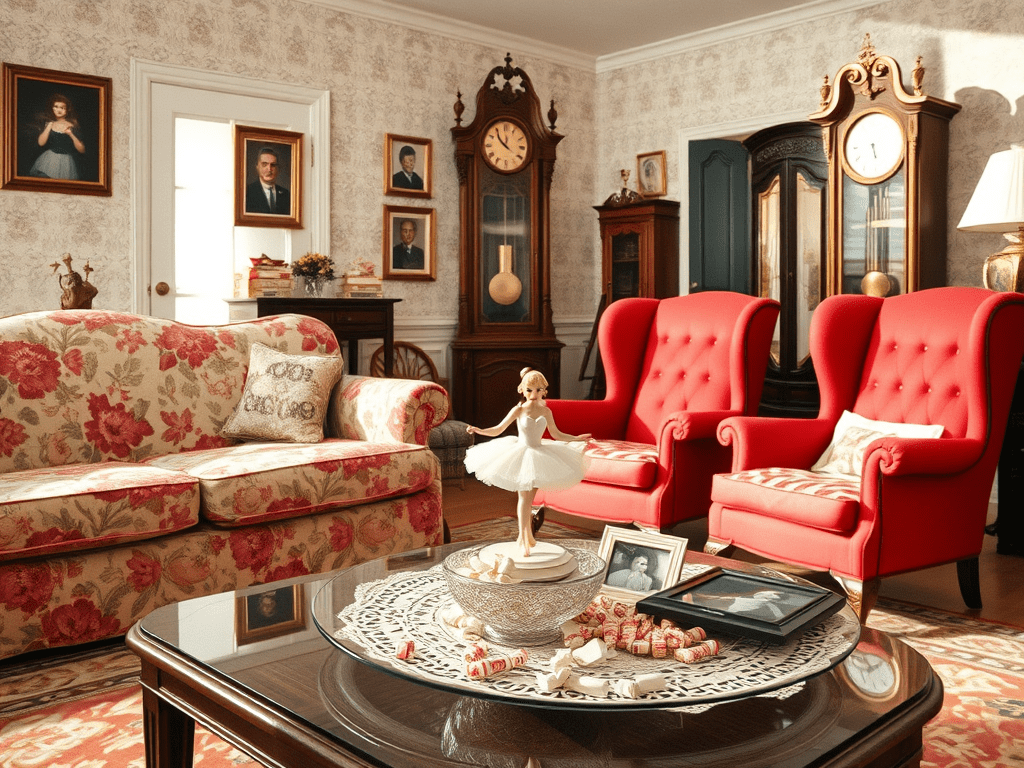
When I was six years old in 1968, I lived for a year with my grandparents in Belmont Shore. One day after school, a distraught neighbor, a 79-year-old widow named Mrs. Davis, said she locked herself out of her house. Could she borrow me to climb through her bedroom window and unlock the front door for her? With my grandmother’s approval, I did just that. I pretended to be a cat burglar, slithered through the ajar window, and walked through her house. With great curiosity, I examined the interior of the living room. The floor was covered with a plush, floral-patterned rug. The centerpiece of the room was a large, floral-patterned couch. It was flanked by two wingback chairs, upholstered in a velvety red fabric. Each chair had a lace doily draped over the backrest. A coffee table with spindly legs sat in front of the couch, its surface crowded with an assortment of knickknacks: a porcelain figurine of a ballerina, a small crystal bowl filled with wrapped candies, and a couple of framed photos. The walls were adorned with family portraits, framed cross-stitch samplers, and a large, oval mirror with a gold frame. A grandfather clock ticked methodically in the background, its pendulum swinging with a steady rhythm that made me feel lost in time. Something came over me. Being alone, I felt possessed with a transgressive spirit, and I lifted the candy jar’s lid and stuffed a butterscotch candy in my pocket before opening the front door for Mrs. Davis. I felt guilty for my act of theft because Mrs. Davis proclaimed me to be her newly-minted hero and handed me a crisp one-dollar bill, which I would later spend on Baby Ruth and Almond Joy Bars. I had difficulty sleeping that night. I worried that Mrs. Davis might feel inclined to take inventory of her candies and discover that one was missing, prompting her to demote me from hero to villain. My career as a thief had come to a quick end. On the other hand, I had a glimpse of what it was like to be a superhero entering houses and saving people in distress. I convinced myself that my career as Superman was just beginning.
Tag: family
-
I Had to Choose to Either be a Thief Or Superman
-

EATING THE UNCLE NORMAN WAY
Every morning during my teenage years, I’d stagger out of bed and make my daily plea to the heavens: “God, please grant me the confidence and self-assuredness to ask a woman on a date without suffering from a full-blown cerebral explosion.” And every morning, God’s response was as subtle as a sledgehammer to the forehead: “You’re essentially a walking emotional landfill, a neurotic mess doomed to wander the planet bereft of charm, romantic grace, and any semblance of healthy relationships. Get used to it, buddy.” And thus commenced my legendary odyssey in the land of perpetual non-dating.
This was not the grand design I had envisioned. No, the blueprint was to be a suave bachelor, just like my childhood idol, Uncle Norman from The Courtship of Eddie’s Father. At the ripe age of eight, I watched in awe as Uncle Norman demonstrated his revolutionary kitchen hack: why bother with dishes when you can devour an entire head of lettuce while standing over the sink? He proclaimed, “This way, you avoid cleanup, dishes, and the pesky inconvenience of sitting at a table.” In that glorious moment, I was struck with a revelation so profound it reshaped my entire existence. The Uncle Norman Method, as I would grandiosely dub it, became my life’s guiding principle, my personal beacon of satisfaction, and the defining factor of my existence for decades.
Channeling my inner Uncle Norman, I envisioned a life of unparalleled convenience. My bed would be perpetually unmade because who needs sheets when you have a trusty sleeping bag? I’d never waste time watering plants—plastic ones were far superior. Cooking? Please. Cereal, toast, bananas, and yogurt would sustain me in perpetuity. My job would be conveniently located within a five-mile radius of my house, and my romantic escapades would be strictly zip code-based. Laundry? My washing machine’s drum would double as my hamper, and I’d simply press Start when it reached capacity. Fashion coordination? Not a concern, as all my clothes would be in sleek, omnipresent black. My linen closet would be repurposed to stash protein bars, because who needs linens anyway?
I’d execute my grocery shopping like a stealthy ninja, hitting Trader Joe’s at the crack of dawn to dodge crowds, while avoiding those colossal supermarkets that felt like traversing a grid of football fields.
Embracing the Uncle Norman Way wasn’t just a new approach to dining; it was a radical overhaul of my entire lifestyle. The world would bow before the sheer efficiency and unadulterated convenience of my new existence, and I would remain eternally satisfied, basking in the glory of my splendidly uncomplicated life.
Of course, it didn’t take long for my delusion to expand into a literary empire—or at least, that was the plan. The world, I was convinced, desperately needed The Uncle Norman Way, my magnum opus on streamlining life’s most tedious inconveniences. It would be part manifesto, part self-help guide, and part fever dream of a man who had spent far too much time contemplating the finer points of lettuce consumption over a sink. Each chapter would tackle a crucial element of existence, from the philosophy of single-pot cooking (aka, eating directly from the saucepan) to the art of strategic sock re-wearing to extend laundry cycles. I even envisioned a deluxe edition featuring tear-out coupons for discounted plastic plants, a fold-out map of the most efficient grocery store layouts, and, for true devotees, a companion workbook to track their progress toward the ultimate goal: Maximum Laziness with Minimum Effort™.
Naturally, I imagined its meteoric rise to cultural dominance. Talk show hosts would marvel at my ingenuity, college professors would weave my wisdom into philosophy courses, and minimalists would declare me their messiah. Young bachelors, overwhelmed by the burden of societal expectations, would turn to my book in their darkest hour, finding solace in the knowledge that they, too, could abandon the tyranny of dishware and lean fully into sink-based eating. The revolution would be televised, one head of lettuce at a time.
-

DREAMING OF BARBARA EDEN
I grew up in VA housing, transplanted army barracks rebadged “Flavet Villages,” in Gainesville, Florida. The barracks were close to an alligator swamp and a forest where a Mynah bird was always perched on the same tree branch so it was a favorite pastime before bedtime for my father and me to visit the bird on the edge of the forest and converse with it. At dusk, there was a low tide so the alligator dung was particularly pungent. While the smell repelled most, I found the strong aroma strangely soothing and stimulating in a way that made me feel connected to the universe. One evening while my father and I visited the Mynah bird, we could hear a distant radio playing “Bali Ha’i,” sung so beautifully by Juanita Hall. From the Rodgers and Hammerstein musical South Pacific, “Bali Ha’i” is about an island paradise that seems so close but always remains just out of reach by those who are tantalized by it, causing great melancholy. But I suffered no such melancholy. Paradise was in my presence as my father and I stood by the enchanted forest and spoke to the talking Mynah bird.
The ache of an elusive paradise didn’t afflict me until I discovered I Dream of Jeannie in 1965. The blonde goddess Barbara Eden lived in her genie bottle, a luxurious enclosure with a purple circular sofa lined with pink and purple satin brocade pillows and the inner wall lining of glass jewels shining like mother of pearl. More than anything, I wanted to live inside the bottle with Jeannie. To be denied that wish crushed me with a pang of sadness as deeply as Juanita Hall’s rendition of “Bali Ha’i.” That Jeannie’s bottle was in reality a painted Jim Beam Scotch Whiskey decanter speaks to the intoxication I suffered from my incessant dreams of Barbara Eden.
Living in the bottle with Barbara Eden was my unconscious wish to never grow up, to live forever in the womb with my first crush. I realized I had the personality of a man-child who never wanted to enter the adult world in 1974 when as a thirteen-year-old bodybuilder, I had started my training at Walt’s Gym in Hayward, California. Converted from a chicken coop in the 1950s, the gym was a swamp of fungus and bacteria. Members complained of incurable athlete’s foot and some claimed there were strains of fungus and mold that had not yet been identified in scientific journals. Making a home in the fungal shower stalls was an oversized frog. The pro wrestlers had nicknamed the old-timer frog Charlie. The locker always had a bankrupt divorcee or other in a velour top and gold chain hogging the payphone while having a two-hour-long talk with his attorney about his bleak life choices. There was an unused outdoor swimming pool in the back with murky water black with plague and dead rats. A lonely octogenarian named Wally, who claimed to be a model for human anatomy textbooks, worked out for several hours before spending an equal time in the sauna and shower, completing his grooming with a complete-body talcum powder treatment so that when he spoke to you, he did so embalmed in a giant talcum cloud. The radio played the same hits over and over: Elvin Bishop’s “Fooled Around and Fell in Love” and The Eagles’ “New Kid in Town.” What stood out to me was that I was just a kid navigating in an adult world, and the gym, like the barbershop, was a public square that allowed me to hear adult conversations about divorces, hangovers, gambling addictions, financial ruin, the cost of sending kids to college, the burdens of taking care of elderly parents. I realized then that I was at the perfect age: Old enough to grow big and strong but young enough to be saved from the drudgery and tedium of adult life. It became clear to me then that I never wanted to grow up. I wanted to spend my life luxuriating inside the mother of pearl bottle with Barbara Eden in a condition of perpetual adolescence.
Wanting to live in Jeannie’s bottle wasn’t just about being joined to the hip with the one I loved. It was about protection from evil. This became apparent in 1972 when I was ten, and I watched an ABC Movie of the Week, The Screaming Woman. Based on a Ray Bradbury short story, the movie was about a woman buried alive. Her screams haunted me so much that I could not sleep for two weeks as I imagined the mud-covered lady under my bed crying for my help. I swore I would never watch a scary movie again, but a year later when my parents had left for a party, I was bored, so I watched Night of the Living Dead. What I learned from watching these scary movies is that when you see depictions of evil, you can’t “unsee” them. Those visions leave a permanent mark so that nothing is ever the same again. What was once the happy, innocent sound of the neighborhood jingle of the ice cream truck is now a jalopy full of devil-clowns ready to exit the vehicle and kidnap me from my room. I tried to remedy my trauma by watching The Waltons and Little House on the Prairie, but these wholesome depictions of family life could not bring back the innocence that was lost forever, so at age eleven, I was already conceiving my elaborate bunker for the Great Zombie Apocalypse. And that bunker, of course, was Jeannie’s bottle.
In my early teens, my life became a futile quest to find substitutes for living inside Jeannie’s bottle. For example, in 1974 I visited several friends and neighbors who had recently purchased waterbeds, tried them out, and became convinced that waterbeds would afford me a life of luxury, unimagined pleasures, and relaxation that life had so far denied me. I persuaded my parents to buy me one. My love affair with the contraption proved to be short-lived. Its temperature was either too hot or too cold. It leaked. It often smelled like a frog swamp. I remember if I moved my body, there would be a counterreaction, like some invisible wave force fighting me as I tried to get comfortable. One day the waterbed leaked so badly that the floorboards were damaged and my bedroom looked like something out of Hurricane Katrina. What was supposed to be a revolution in sleep proved to be a nightmare, and my quest to find a substitute for Jeannie’s bottle had to be started afresh.
The longing to be inside Jeannie’s bottle is a regression impulse, and I can’t talk about regression without mentioning Cap ‘N Crunch. My mother indulged my appetite for this sugary cereal and bought me all its variations: Cap ‘N Crunch with Crunch Berries, Peanut Butter Cap ‘N Crunch, and then the renamed versions of the same-tasting cereal: Quisp, Quake, and King Vitamin. Quaker cereals took their winning formula of corn and brown sugar flavors and sold several variations with different mascots and names.
As a kid watching these cereals being advertised on TV, it was clear that too much of a good thing was not a problem. On the contrary, I felt compelled to taste-test all these cereal varieties the way a sommelier would taste dozens of Zinfandel wines from the same region or a musicologist would listen to hundreds of different versions of Rachmaninoff’s Second Symphony.
Eating six versions of Cap ‘N Crunch afforded me the illusion of variety while eating the same cereal over and over. I was a seven-year-old boy who wanted to believe I had choices but at the same time didn’t want any choices.
You will sometimes hear about the man who is in his sixth marriage and his wives in terms of appearance, temperament, and personality are all more or less the same. The man keeps going back to the same woman but wants to believe he has “found someone new” to give him the hope of a new life.
That was essentially my relationship with Cap ‘N Crunch. Not only was I stagnant in my food tastes, but I was also regressing into sugar-coated pablum. My love of cereal, which endures to this day, was the equivalent of finding comfort in Jeannie’s bottle.
In addition to sweetened cereal as evidence of my emotional stagnation was my choice of damaged role models. While I was fixated on I Dream of Jeannie, my bodybuilding partner Bull was fixated on Gilligan’s Island. Choosing Bull as my role model must have prolonged my delayed development. Bull was not known for his social decorum and gallantry. One example that stands out is that one night we were swimming at the Tanglewood apartments swimming pool when Bull found a giant orange fluorescent bra hanging by its strap on the diving board. It practically glowed in the dark. Bull grabbed the bra and twirled it above his head as if he were going to fling it. Then he stopped and said it was his sister’s birthday the next day, and he had forgotten to buy her a present. He didn’t even wrap it. He just gave his sister this orange bra, and she wasn’t even shocked. For her, it was just another day in the life of having a crazy brother. When I think back to my delayed development in the world of dating and relationships, I have to attribute much of that delay to my misguided choices of male role models. It would be unfair, after all, to lay all the blame on Jeannie. The fact was that I was in love with Jeannie as a fantasy, but as a real woman she terrified me.
This was evident on one warm California spring afternoon in 1973. After sixth-grade classes were over and the bus dropped us off at Crow Canyon Road, we would often walk across the street to 7-Eleven to get a Slurpee before trekking up the steep hill that was Greenridge Road. I was standing inside 7-Eleven with my friends listening to “Brandy, You’re a Fine Girl” playing on the store radio when the Horsefault sisters, both freckled with long blonde hair and beaming, mischievous blue eyes, came into the store and asked me if I wanted to see a rabbit inside their cage. One was an eighth-grader and the other a high school sophomore. They lived in a farmhouse behind the 7-Eleven. I had no interest in seeing a rabbit inside a cage, but the girls had high cheekbones and figures that reminded me of my first crush, Barbara Eden, so I told them I was very interested in seeing their caged rabbit. I exited 7-Eleven with the girls, and we walked about a hundred yards on a trail that was covered with dry horse dung and surrounded by a field of grass before we reached the outskirts of their farmhouse. Behind a thicket of bushes was a large cage, with the door slightly ajar. A heavy chain lock hung on the door latch. I looked inside the cage, but I saw that there was no rabbit. At this point, the sisters, cackling like witches, grabbed me and tried to drag me into the cage. It was clear that they were attempting to prank me, put me inside the cage, lock the door, and make me their prisoner. But I was too strong for them, and as we wrestled outside the cage and rolled on the grass, we became enveloped in a cloud of dust and hay. In a nearby coop, chickens were clucking and flapping their wings with great alarm and alacrity. When the sisters, now covered in sweat, realized they did not have the strength to carry on with their mission, I fled them and rushed home. I was outraged that they had tried to steal my freedom, and I diverted myself by watching my favorite TV show, I Dream of Jeannie, starring the gorgeous Barbara Eden, who played a lovelorn genie trapped in a bottle except when summoned by her master. Clearly, I was still too young to understand the exquisite pleasures of irony.
-

THE ALPHA MALES OF COLD WAR TV
As a small child, I had a surprisingly sharp grasp of the Cold War, thanks in no small part to my relentless viewing of The Rocky and Bullwinkle Show. Russian spies Boris Badenov and Natasha Fatale were my first introduction to geopolitical villainy, their cartoonish skullduggery revolving around stealing U.S. military secrets and pilfering jet fuel for nefarious purposes. These two Soviet saboteurs lurked on American soil, risking their lives for the Motherland, making it clear to me that the United States and Russia were locked in a high-stakes global chess match—one where espionage, sabotage, and suspiciously bad Russian accents were the order of the day.
But it wasn’t just Rocky and Bullwinkle feeding my young mind a steady diet of American military might. TV shows across the board hammered home the same lesson: the true Goalkeepers of Dominance weren’t politicians or businessmen; they were highly decorated military officers, soaring through the skies and beyond. Exhibit A: I Dream of Jeannie.
Major Anthony Nelson, astronaut, and all-American heartthrob, was living the dream—piloting spacecraft, rubbing shoulders with generals, and, most importantly, stumbling upon a genie in a bottle who just happened to be Barbara Eden in a sheer harem outfit. As far as my prepubescent brain was concerned, this was a direct confirmation of how the universe worked: the smartest, most disciplined men—those with military and scientific prowess—got the most beautiful women. If you weren’t a decorated officer or a NASA golden boy, good luck summoning a blonde bombshell out of a lamp.
This hierarchy of Alpha Males wasn’t just something television taught me—it was practically family doctrine. My father, an infantryman turned engineer, was living proof. In fact, without his sheer resourcefulness and competitive streak, I wouldn’t exist.
In the early 1960s, my father was stationed in Anchorage, where he and another army suitor, a certain John Shalikashvili (who would later become a U.S. General and Chairman of the Joint Chiefs of Staff), found themselves locked in a battle for the romantic affections of my teenage mother. Their duel was temporarily paused over Christmas—Shalikashvili went home to Peoria, Illinois, while my father visited his family in Hollywood, Florida. But my father, ever the tactician, decided to cut his holiday short, determined to beat Shalikashvili back to Alaska and win the girl.
The problem? His cream-colored 1959 Morris Minor was suffering from a faulty Lucas fuel filter, and the auto parts store was fresh out of replacements. Undeterred, my father—who would later become a top engineer at IBM—rigged a temporary fix using a prophylactic and a paperclip, fashioning a makeshift spring to keep the fuel pump from locking up. It was a ludicrously desperate, MacGyver-esque solution, but somehow, it worked. He made it to Seattle, caught the ferry to Alaska, and reunited with my mother a full 48 hours before Shalikashvili arrived.
Nine months later, I was born. In the great Cold War of romance, my father had won the ultimate victory—not through military rank, but through sheer ingenuity, timing, and, apparently, latex-based automotive engineering.
 Cinemorphosis