Tag: fashion

  • Acid-Washed Jeans and Artificial Intelligence: The Rise and Fall of Instant Cool

    Acid-Washed Jeans and Artificial Intelligence: The Rise and Fall of Instant Cool

    I have a confession that belongs in the Museum of Bad Decisions: I wore acid-washed jeans in the 80s. Not casually. Not ironically. I wore them to teach college writing at twenty-four, convinced I was the cool professor—the kind of man who could annotate a thesis statement and headline a Duran Duran video without changing outfits.

    The problem, of course, is that everyone thought they were that guy. Acid-washed jeans thrived because they delivered instant mythology. You looked like you had lived—hard, fast, dangerously—when in reality you had simply survived a trip to the mall. They were rebellion by chemical treatment, authenticity by rinse cycle. For a brief, glittering moment, that illusion worked. But illusions collapse under mass adoption. When everyone looks distressed, no one looks interesting. The jeans had nowhere to go; they began at maximum volume and stayed there, screaming. Eventually, the culture regained its hearing, glanced downward, and realized it had dressed itself like survivors of a denim-related explosion. Acid wash didn’t fade—it was exiled.

    I think about that rise and fall when I look at my students’ shifting attitude toward AI. In 2022, AI arrived like those jeans: a miracle fabric promising salvation from drudgery, writer’s block, and the existential dread of the blank page. It offered pre-fabricated brilliance—the intellectual version of showing up to the gym already sweating. Students embraced it with the same breathless certainty that this time, finally, the shortcut would make them exceptional.

    Now? They roll their eyes. They call it cringey.

    What changed is not the technology but the perception of authenticity. Factory-installed insight, like factory-installed distress, has become suspect. My students are not naïve; they have finely tuned detectors for fraud. They live in a world saturated with performance—the influencer selling a life they don’t live, the hollow expert recycling borrowed ideas, the unprepared instructor filling class time by sharing his dreams and domestic dramas while they politely tune him out and read Tolstoy’s War and Peace or the entire oeuvre of J.K. Rowling. 

    AI, at its worst, slots neatly into that ecosystem. It produces language that sounds like thinking without the inconvenience of actually thinking. And my students can hear the hollowness.

    This does not mean AI is useless. At its best, it belongs alongside Word, Google Docs, and Grammarly—a tool, not a personality. But tools do not build a self. They do not generate voice, conviction, or the slow accumulation of insight that makes writing worth reading. Lean on them too heavily, and the result isn’t mastery—it’s dependency dressed up as efficiency.

    My students understand this. That’s why the fever has broken. The early hype—the belief that AI would function as a kind of intellectual superpower—has lost its grip. The spell didn’t shatter because AI failed. It shattered because people learned to recognize the difference between something that helps you think and something that pretends to think for you.

    Acid-washed jeans didn’t disappear because denim stopped working. They disappeared because people grew embarrassed of the shortcut.

    AI isn’t going anywhere.

    But the illusion that it can make you interesting just by wearing it?

    That’s already out of style.

  • Mechanical Atrophy Prevention

    Mechanical Atrophy Prevention

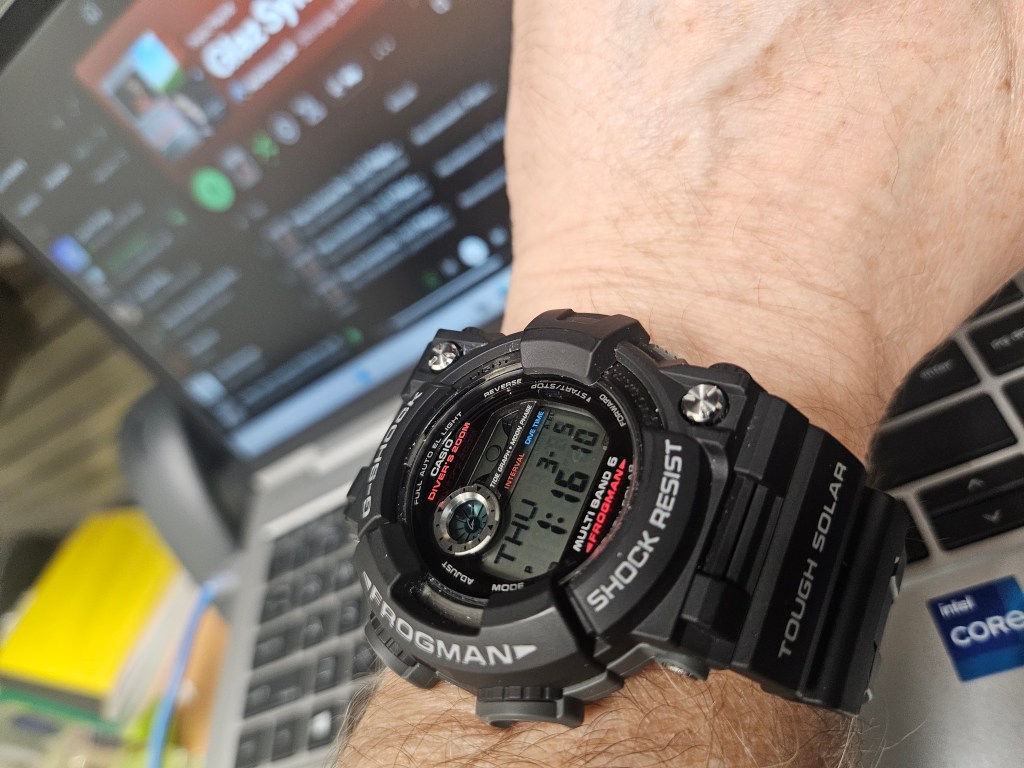
    I wear my G-Shock Frogman GWF-1000 almost every day. It has become the default setting of my wrist, the horological equivalent of gravity. Twice a week, however, I stage a small act of resistance. I slip on one of my Seiko divers. If I don’t, the Frogman will quietly suffocate the rest of the collection. It already has, to a degree. The moment I first strapped that Frogman on, it felt less like a purchase and more like a declaration: this watch had my name written across it in thick permanent ink. It fit my life with such ruthless competence that every other watch in the box began to look like an understudy waiting for a call that will never come.

    So twice a week I impose discipline. The Seikos get their turn. Think of it as horological cross-training. Most days I’m on the exercise bike or doing yoga, but I still force myself to swing the kettlebells twice a week so my muscles don’t dissolve into decorative noodles. The Seikos perform the same function. They are my defense against mechanical watch atrophy.

    This ritual belongs to what I call my Mechanical Atrophy Prevention program: the deliberate act of wearing a mechanical watch just often enough to preserve one’s emotional bond with gears, springs, and that hypnotic sweeping second hand. Without this intervention, the human brain quickly adapts to the ruthless efficiency of digital timekeeping. Soon you’re living in a world of solar charging, atomic synchronization, and clinical precision, and the charming little clockwork creatures in your watch box begin to feel quaint—like writing letters with a quill.

    Wearing the Seikos twice a week is my version of lifting weights so my body doesn’t evolve into an ergonomic office chair with legs. The practice keeps alive the fragile illusion that I am still a “mechanical watch person,” not a man who has quietly surrendered to the cold efficiency of quartz.

    Does this sound crazy to you?

    Welcome to my world.

  • Power Jewelry Rejection

    Power Jewelry Rejection

    Many of you have written to me about your migration from luxury mechanical watches to G-Shocks. In your telling, it wasn’t a casual shift. It was a renunciation. The grails were sold, the bracelets retired, the safe emptied. The wrist went digital and never looked back.

    Your stories are not universal. They are personal, situational, shaped by your own history with status, money, and identity. But taken together, they reveal a pattern worth examining.

    The turning point for many of you was a growing discomfort with what your watches had become: power jewelry. The grail that once represented achievement began to feel like a performance—an expensive signal broadcast to strangers. What had felt like success started to feel like theater. The watch no longer told time. It told a story about you, and you were tired of telling it.

    That moment marked the beginning of Power Jewelry Rejection.

    Power Jewelry Rejection is the instant a collector looks down and realizes he isn’t wearing a tool—he’s wearing a résumé. The rejection isn’t driven by finances or fashion. It comes from fatigue with the performance itself. The grail is sold. In its place comes something blunt, durable, socially invisible. And with that change comes an unexpected sensation: relief. Not the thrill of acquisition, but the quiet authority of no longer needing to explain yourself. This isn’t anti-luxury. It’s anti-broadcast. The real power is wearing a watch that does its job and asks nothing about your status in return.

    Once the performance ends, something else appears: a different kind of attachment.

    Many of you described a bond with your G-Shocks that never existed with your luxury pieces. Not pride. Not admiration. Something quieter. The watch became a companion rather than a symbol. You wore it hard. You stopped worrying about it. You trusted it. The relationship shifted from ownership to reliance. For the first time, the watch served you instead of representing you.

    Interestingly, this conversion produced very little missionary zeal.

    There was no urge to persuade others, no need to defend the choice. G-Shock Nation, as you quickly discovered, requires no recruitment. The community is vast, stable, and unconcerned with validation. Evangelism felt unnecessary, even absurd. Confidence made persuasion irrelevant.

    But honesty required one more admission.

    Yes, you had abandoned the idolatry of luxury. But you had not escaped devotion. You had simply changed altars. The emotional intensity remained—only the object had become more practical, more affordable, less socially conspicuous. The new attachment felt healthier, but it was still an attachment.

    And here is where the tone of your stories becomes notable: there was no triumphalism.

    You did not claim enlightenment. You did not declare moral victory. You acknowledged the obvious truth: you hadn’t left consumerism. You had changed its form. The new version felt cleaner, quieter, more aligned with your values. Less performance. More use. Less anxiety. More stability.

    No revolution. Just a recalibration.

    And that may be the most honest outcome the watch hobby ever produces.

  • From Wrist to World: The Long Climb Out of Gollumification

    From Wrist to World: The Long Climb Out of Gollumification

    At a certain depth, the watch obsessive stops merely owning watches and begins inhabiting them. He lives in beat rates and power reserves, dreams in lume, and speaks a dialect composed entirely of tolerances, metallurgy, and micro-adjustments. This language becomes his native tongue—and everyone else’s becomes a foreign one. Instead of translating himself back into ordinary conversation, he doubles down. Why speak about people, work, or weather when there are case coatings, anti-magnetism ratings, and the eternal question of 20mm versus 22mm?

    This is Gollumification: the slow psychological narrowing that occurs when a hobby expands to occupy the territory once reserved for identity, emotion, and social life. The enthusiast begins to interpret the world through horological logic. Reliability matters more than warmth. Precision outranks connection. Conversations become monologues disguised as education. Over time, the technical vocabulary hardens into a private dialect that excludes anyone not fluent in the faith.

    The social consequences arrive quietly. Friends feel the intensity and step back. Family members nod politely, then change the subject, then eventually stop asking. Their distance confirms the collector’s growing suspicion that the outside world lacks depth or appreciation. The loop closes: fewer people, more watches; more expertise, less range as a human being.

    Advanced Gollumification produces a curious asymmetry. The collection becomes refined, curated, museum-worthy. The collector becomes narrower, guarded, and faintly brittle—capable of explaining torque tolerances at length but uncomfortable with ordinary emotional exchange. He manages mechanisms with surgical care while neglecting the untidy maintenance of relationships.

    Some drift into this state gradually, the behavioral accretion so slow they don’t notice the cave forming around them. Others embrace it knowingly, wearing their social withdrawal like a badge of purity. If the world doesn’t understand watches, the problem must be the world.

    Rarely, something interrupts the descent. A spouse’s fatigue. A child’s indifference. The uneasy realization that the collection is thriving while the rest of life is running on reserve. This is the beginning of De-Gollumification.

    De-Gollumification is the difficult return from horological exile—the moment the collector recognizes that memorizing every movement specification is not the same as being present in his own life. The shift begins with a painful inventory: relationships neglected, conversations hijacked, attention diverted into stainless steel and sapphire. The enthusiast steps back from the private dialect of lume performance and lug geometry and relearns the language of ordinary human exchange.

    The watches remain, but their jurisdiction shrinks. Identity migrates back to where it belongs. The collector stops leading with the wrist and starts leading with attention. The transition is humbling and occasionally disorienting, like emerging from a quiet bunker into daylight.

    Successful De-Gollumification does not require selling the collection. It requires abandoning the bunker. The pieces stay. The spell breaks. There are fewer lectures and more listening, fewer unboxings and more presence. The whisper of my precious gives way to something healthier and far more difficult: our life.

  • Chunky: The Candy Bar That Gaslit My Taste Buds

    Chunky: The Candy Bar That Gaslit My Taste Buds

    Of all the confections that have ever graced my palm, none haunts my imagination quite like the Chunky bar. It’s not a candy bar so much as a relic—an absurd, silver-foiled ingot you’d expect to pry loose from a cursed dwarven mine, guarded by balrogs and bureaucracy.

    Let’s start with the shape. The Chunky is a squat, lumpy pyramid—a candy bar built like it wants to be a paperweight. Peanuts and raisins form the bulk of its crude alchemy, though earlier iterations flaunted Brazil nuts and cashews, adding to its ancient mystique.

    The taste? Off. Not bad exactly, but certainly not seductive. Its faintly bitter, vaguely disappointing flavor has a curious effect: you start to convince yourself that this underwhelming mouthful must be good for you. A health food in disguise. A sweet for contrarians. Like chewing on moral fiber.

    Then there’s the weight. The Chunky carries mass. It sits in your hand with the cold confidence of a Seiko diver watch on a stainless-steel bracelet. There’s a heft to it—an aura of seriousness. No one double-fists a Chunky on a whim. You eat one as an act of personal philosophy.

    To deepen its enigma, the Chunky has become scarce. Since the ’90s, it’s been largely exiled from gas station shelves, spotted only in the digital wilds of the Internet. It’s no longer a candy bar—it’s a rumor. A memory. A grail. And even when you do track one down and unwrap it in a moment of nostalgic triumph, you’re struck with the bitter realization: you’re not reliving a taste. You’re chasing a ghost.

    The truth is, you’re more in love with the idea of the Chunky bar than the thing itself. Its greatest ingredient is projection. It is candy-as-concept. The chunky grail.

    And so, like a certain kind of watch obsessive—those who hunt for the mythical One Perfect Timepiece, the Holy Grail Diver that will satisfy all wrist cravings—you may find that what you’re after is not an object, but an ideal. The Chunky isn’t a candy bar. It’s a mirror. A reminder that the real addiction lies not in sugar or steel, but in fantasy.

  • The Cult of Cool: How Fashion Brands Turned Insecurity Into Gold

    The Cult of Cool: How Fashion Brands Turned Insecurity Into Gold

    Three documentaries—White Hot: The Rise & Fall of Abercrombie & Fitch, Brandy Hellville and the Cult of Fast Fashion, and Trainwreck: The Cult of American Apparel—reveal a sobering truth: some of the most iconic youth fashion brands haven’t just sold clothes; they’ve trafficked in identity, manipulated insecurity, and run full-scale psychological cons dressed up as marketing.

    These brands built empires on seductive illusions—creating tight-knit aspirational worlds where beauty, desirability, and social status were pre-packaged into a logo and sold at a premium. The catch? Entry required blind conformity to a narrow aesthetic, behavioral uniformity, and uncritical loyalty. This wasn’t fashion—it was Groupthink in skinny jeans. And behind it all pulsed the emotional engine of modern consumer culture: FOMO, the fear of being left out, unseen, unchosen.

    White Hot, reviewed by Ben Kenigsberg, focuses on Abercrombie’s marketing of “aspirational frattiness”—a euphemism for white exclusivity wrapped in khaki shorts and cologne. It was a smug, muscular nostalgia trip to a sanitized, all-white upper-class fantasy where thinness, wealth, and preppy arrogance were the unspoken requirements for membership.

    At the helm was CEO Mike Jeffries, a marketing savant whose obsession with aesthetic purity bordered on cultic. Under his reign, the company embraced racist T-shirts, discriminatory hiring practices, and a toxic definition of “cool.” His executive team mirrored his vision so fully they might as well have been in a bunker, smiling and nodding as the walls caught fire. Groupthink didn’t just enable the brand’s rise—it ensured its blindness to its own downfall.

    Why revisit Abercrombie now? Because its story is a pre-Instagram case study in the mechanics of cult marketing: how insecurity is mined, branded, and sold back to consumers at 400% markup. My students in the 90s already saw through the ruse—complaining the shirts fell apart in the armpits within a week. What mattered wasn’t the clothing but the illusion of status sewn into every threadbare seam.

    Ultimately, White Hot offers a rare glimpse of justice: a cool brand undone by its own arrogance, its aesthetic no longer aspirational but pitiful. The Abercrombie collapse isn’t just a business story—it’s a warning. When branding becomes religion and coolness becomes a weapon, consumers become disciples in a theology of self-erasure.

  • Wristwatches and Wastelands: How Fashion Can Hollow You Out

    Wristwatches and Wastelands: How Fashion Can Hollow You Out

    Amy Larocca, a fashion journalist with twenty years of runway reportage under her belt, understands the psychological scaffolding beneath a well-tailored sleeve. “Fashion,” she writes in How to Be Well, “is about beauty, of course, but it is also about the desire to elevate daily life from its more banal limitations, to consciously and actively share something about how you’d like to be perceived by the rest of the world.”

    And that, my friend, is exactly where the trouble starts.

    Take a stroll through the horological asylum known as the watch community. What starts as an appreciation for precision craftsmanship often spirals into a neurotic fixation. A dive watch isn’t just for telling time—it’s for announcing to the world that you’re rugged, refined, and possibly ready to harpoon something. The desire to “elevate daily life” with just the right wrist candy turns into a slow-motion personality collapse. It becomes a lifestyle audition for an identity you don’t actually inhabit.

    The trap is cunning. At first, fashion promises transformation: a sharper silhouette, a touch of mystique, a sense of control in a chaotic world. But when the performance replaces the person—when dressing well becomes a proxy for purpose—you’re not elevating your life. You’re embalming it in linen and leather.

    The real tragedy isn’t vanity. It’s the way compulsive self-curation smothers empathy. Narcissism isn’t just annoying—it’s lonely. It dislocates you from community, connection, and anything approaching transcendence. A meaningful life, if it’s worth living at all, doesn’t orbit around the mirror.

    To be clear: there’s nothing wrong with looking sharp. Be fit, be stylish, radiate confidence. But when your wardrobe becomes your worldview—when you dress not to express but to impress—you trade depth for dazzle. You don’t become interesting. You become exhausting.

  • The Beautiful Unwearable

    The Beautiful Unwearable

    Do you own a Beautiful Unwearable? If so, you already know the cruel paradox: the watch that steals your breath every time you look at it, yet somehow never makes it onto your wrist.

    Picture this: you’re hypnotized by a $2,000 Seiko Astron—a stunner whose build quality punches well above its weight class, easily rivaling watches priced four digits higher. Every gleam of that GPS-synced, zirconia ceramic bezel sends a little burst of dopamine through your bloodstream. So you do what any horological romantic would do: you pull the trigger. A week later, it’s in your hands, fresh from Japan, glinting like a Bond villain’s cufflink.

    And then… nothing.

    You stare at it. You admire it. You photograph it from five angles under different lighting conditions. But when it’s time to choose a watch to wear—on a walk, to the store, or even to teach class—it’s always your rugged dive watch that gets the call. The Astron? It’s too dressy, too refined, too… aspirational. Like buying a tuxedo when your calendar is a wasteland of Costco runs and Zoom meetings.

    So it sits. Day after day. In its cushioned little coffin, gorgeous and neglected, whispering, “You’re not worthy of me.” Unlike wall art, it can’t be displayed; unlike a tool watch, it doesn’t beg to be worn. It becomes horological purgatory—a $2,000 museum piece trapped in a drawer.

    Personally? I’ve never bought an Astron. Why? Because I’ve already mentally lived this scenario. I’ve played out the whole Shakespearean arc in my head: love at first sight, the impulsive purchase, the honeymoon glow… followed by guilt, alienation, and silent shame. I don’t need a Beautiful Unwearable in my collection to know it would haunt me like a luxury ghost.