I am a writing addict, at least in part, because I was indoctrinated by the twin cults of positive thinking and unrelenting perseverance. Never quit. Fight like hell. Success is inevitable if you just want it badly enough. And if it doesn’t come? Well, then you’re just not a real American.
By the time I hit kindergarten, I was a true believer in the gospel of hard work. My worldview was a Frankenstein’s monster stitched together from children’s books, Charles Atlas bodybuilding ads wedged between comic book panels, and the propaganda of Captain Kangaroo. The formula was clear: effort equals triumph. I swallowed this doctrine whole, with the blind conviction of a kid who thought that eating all his vegetables would one day grant him the ability to fly.
My optimism knew no bounds. It was untethered, soaring on the helium of pop-culture platitudes. The Little Engine That Could had me whispering “I think I can” like a monk chanting a holy incantation, convinced that sheer willpower and enough push-ups could bulldoze any obstacle. It didn’t occur to me that sometimes you think you can, but you absolutely cannot—and that no amount of stubborn persistence will turn a delusion into destiny.
And then came the night of October 16, 1967—a date I would later remember as the day the universe gave me a cosmic swirly. Twelve days before my sixth birthday, I sat cross-legged in front of the TV, ready to revel in another episode of my favorite show, The Monkees. But what played out before me was a betrayal so deep it made Santa Claus feel like a Ponzi scheme.
The episode, “I Was a 99-lb. Weakling,” featured my hero, Micky Dolenz, getting steamrolled by Bulk, a slab of human granite played by Mr. Universe himself, Dave Draper. Bulk wasn’t just big—he was the walking embodiment of every Charles Atlas ad come to life, the muscle-bound colossus I had been taught to revere. And right on cue, Brenda, the bikini-clad goddess of the beach, ditched Micky for Bulk without so much as a backward glance.
This was a crisis of faith. How could the Monkees’ resident goofball, my spiritual avatar, lose to a guy who looked like he bench-pressed telephone poles for fun? Desperate to reclaim his dignity, Micky enrolled in Weaklings Anonymous, where he endured a training montage so ludicrous it made Rocky Balboa’s look like a casual Pilates class. He lifted weights the size of Buicks. He chugged fermented goat milk curd—a punishment so grotesque it could only be described as liquefied despair. He even sold his drum set. His very essence, his identity, was on the chopping block, all in pursuit of the almighty muscle.
But the final twist? Brenda changed her mind. Just as Micky was emerging from his trial by whey protein, she dropped Bulk like a bad habit and swooned over a pencil-necked intellectual—a guy who looked like he could barely lift a library book, but there he was, nose buried in Marcel Proust’s Remembrance of Things Past. Brenda, the same woman who had once melted for a walking slab of muscle, now found transcendence in a man contemplating lost time in a cork-lined room.
It was then that the tectonic plates of my worldview shifted. Muscles weren’t the real source of power—books were. The secret wasn’t in deadlifts or protein shakes but in the right combination of words, strung together with enough elegance, insight, and authority to bend the universe to your will. The revelation landed with the force of a divine decree: if you wanted to shape the world, you didn’t need biceps—you needed prose.
That night, my inner writing demon was born. It didn’t arrive with fanfare but stealthily, like an assassin—hijacking my ambitions, whispering to me that if I truly wanted to matter, I needed to trade in my devotion to squat racks for an obsession with syntax. The real alphas weren’t the ones flexing on the beach; they were the ones commanding attention through the written word, weaving sentences so powerful they made bikini-clad goddesses switch allegiances overnight.
***
Picture a five-year-old boy glued to The Monkees, absorbing every absurd twist and turn, when suddenly—a revelation. Not from a heroic feat, a rock anthem, or a daring stunt, but from a pencil-necked geek buried in Remembrance of Things Past. The sheer audacity of it! This bookish weakling wasn’t just reading—he was brandishing literature like a weapon, as if cracking open Proust conferred an instant intellectual throne.
That moment rewired my brain and began my transformation into Manuscriptus Rex. I wanted that kind of power. I wanted to be indelible, undeniable, and necessary—a man whose words carried weight, whose sentences etched themselves into the fabric of cultural consciousness. And when, at twenty-three, I read A Confederacy of Dunces, my mission crystallized. It wasn’t enough to be intelligent or insightful. No, I had to be a satirical novelist, an ambassador of caustic wit, a statesman of irony, and just self-deprecating enough that people wouldn’t hate me for it. I saw myself as a literary assassin, razor-sharp, unignorable, the kind of writer who forces the world to take notice.
What the writing demon conveniently failed to mention—what it actively conspired to keep from me—is the vast and merciless chasm between the actual process of writing and the seductive fantasy of literary fame. To ignore this gulf is to court a special kind of stupidity, the kind that can waste an entire lifetime.
Writing is a protracted act of self-torture, an endless loop of revision, self-doubt, and existential agony. J.P. Donleavy, author of The Ginger Man, had no idea what fresh hell awaited him as he wrestled his novel into something that met his own impossibly high standards. The process was not romantic; it was a war of attrition. Tedium, solitude, mental torment—these were his constant companions. But he and his book trudged forward, bloodied but breathing, as if the act of creation itself were some cursed form of survival.
Meanwhile, I was high on a much glossier hallucination. I wasn’t going to be some embattled craftsman drowning in rewrites—I was going to be the genius, the confetti-drenched literary deity, basking in the ovation of an enraptured public. This was the demon’s cruel joke. The more reality smacked me in the face, the deeper I dug into the delusion. It wasn’t just self-deception; it was a pathology, a spiritual affliction.
F. Scott Fitzgerald mapped this sickness in “Winter Dreams,” the tale of Dexter Green, a man who squanders his entire existence chasing Judy Jones, a capricious cipher onto which he projects all his longings. She isn’t a goddess—she’s an empty shell, a faithless mediocrity. No matter. His fantasy of perfection keeps him shackled to his own vanity, blind to the fact that life is passing him by.
Dexter Green is a sucker. He doesn’t know how to live—only how to worship an illusion. He believes in moments frozen in time, in pristine, untouchable ideals, instead of the mess and movement of real life. And that, of course, is the problem. As therapist Phil Stutz puts it in Lessons for Living, “Our culture makes the destructive suggestion that we can perfect life and then get it to stand still… but real life is a process.” The ideal world is a snapshot—a slick, frozen fantasy that never existed. But still, these images are intoxicating. There’s no mess in them. And that’s precisely why they’re a trap.
I cannot overstate the self-imposed destruction, loneliness, and sheer dumb misery that comes from being seduced by these moments frozen in time. To underscore my point, let’s rewind to 1982—a memory buried so deep in my psyche it took writing a book about the dangers of writing a book to dig it up.
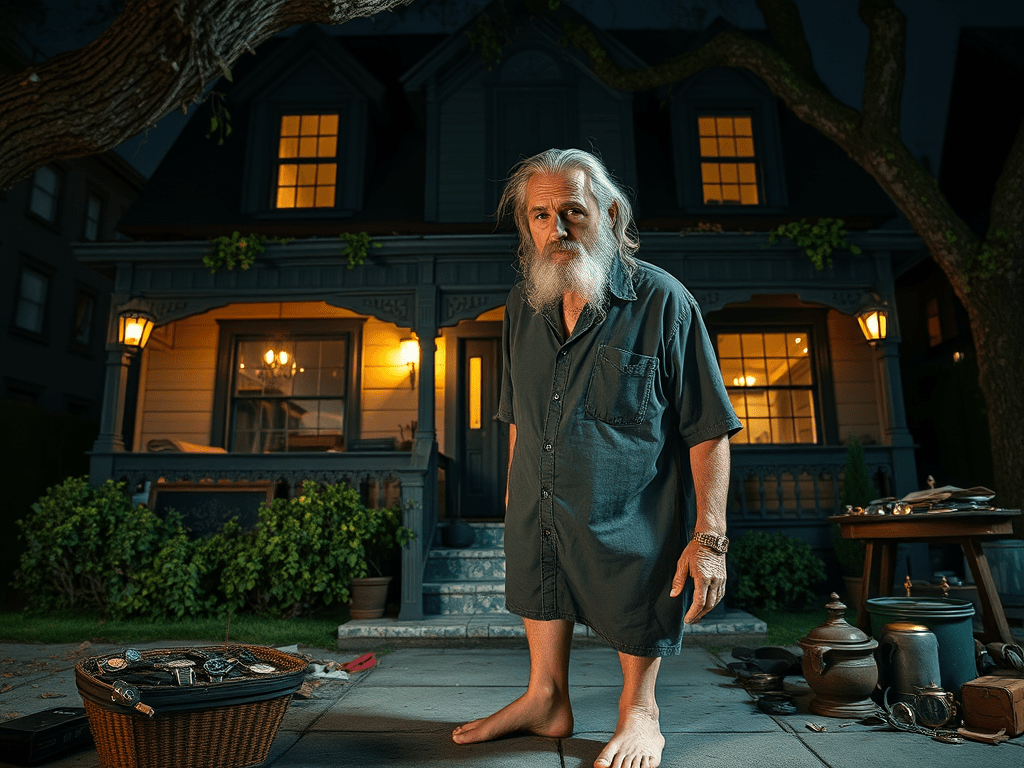
Back then, I was in college, drowning in an evening statistics course taught by a professor who looked like he’d been yanked straight from the pages of Dickens. His wild white hair defied gravity, his darting blue eyes seemed permanently lost in a private existential crisis, and his nose—aggressively red—suggested a longstanding love affair with whiskey. His aura? Pure, unfiltered eau de liquor. But he was kind, in the way that only deeply tragic people can be.
The class itself was a slow-motion car crash. By week four—when the sadistic monster known as “standard deviation” reared its head—half of us were openly contemplating dropping out. Among my classmates was an elderly African American couple, dressed for church every single day, like they had wandered into the wrong building but decided to stay out of sheer politeness. The husband, Clarence, announced on day one that this was his seventh attempt at passing statistics. His wife, Dorothy, wasn’t even enrolled—she was there as his Bible-toting, knitting, long-suffering support system.
Clarence’s approach to learning was… improvisational. While the rest of us shrank into our seats, he would leap up mid-lecture, cane clattering to the ground, and hobble to the chalkboard. Pointing an accusatory finger, he’d declare, “That’s not the answer I got! Let me show you!” Then he’d scrawl his “solution”—a series of indecipherable symbols that looked more like an alien distress signal than math.
The professor, possibly fortified by whatever he had stashed in his desk, took these interruptions with monk-like patience. Dorothy, meanwhile, would bow her head and whisper prayers to “sweet Jesus,” presumably asking Him to either deliver her husband from his statistical afflictions or at least save her from public humiliation. The rest of us stifled laughter behind our hands. I sat there, torn between secondhand embarrassment and the creeping realization that this was pure comedy gold, something straight out of Saturday Night Live.
After class, I’d drive home, pop in a cassette of The Psychedelic Furs or Echo and the Bunnymen, and drown in existential dread. I’d replay the scene over and over: Clarence’s quixotic battle with numbers, Dorothy’s quiet suffering. And then, like clockwork, I’d start crying. Not because I was flunking statistics or because my social life was a wasteland, but because that couple had shown me something profound: the power of love.
Not the saccharine kind from movies, but the kind that trudges alongside you through seven failed attempts at statistics. The kind that withstands public embarrassment, dashed hopes, and sheer futility. The kind that endures.
And here I was, wasting my life chasing a mirage. I was too caught up in my grand illusion of literary immortality. In my fevered fantasy, writing wasn’t grueling labor—it was divine alchemy. I would conjure brilliance with effortless flair, radiate tortured genius with an insouciant smirk. The world would see. The world would know. I would be whole. Complete. Immortal.
But, of course, none of that happened.
Decades passed. The literary world remained profoundly unaffected by my absence. The holy grail I had obsessed over wasn’t stolen—it simply… never materialized. And so, left standing in the wreckage of my own delusion, I did the only logical thing: I started writing a book about how foolish it is to write a book.
And in that act of failure, I dug deep. In this memoir, which I am forbidden to write according to the terms of my sobriety, I excavated my past, peeling back layers of delusion, tracing the origins of this writing demon, this unquenchable hunger to be heard, to be distinct, to matter.
Now, with some clarity (if not closure), a bigger question looms: What threatens me now?
My war isn’t just with obscurity. It’s with a world surrendering to algorithms, generative AI, and the hollow dopamine drip of social media engagement. As a college writing professor who lives in the shadow of Manuscriptus Rex, I see my own relevance dangling by a thread, held hostage by an era where a bot can churn out a passable essay in seconds, where language itself is becoming disposable.
So here we are. If I’m to survive, if my voice is to matter in this algorithmic wasteland, I must confront the existential question:
How do you assert your presence in a world that is actively erasing the need for presence at all?