Tag: fiction

  • The Watch Potency Principle and the Man Who Couldn’t Count to Eight

    The Watch Potency Principle and the Man Who Couldn’t Count to Eight

    Chapter 2 from The Timepiece Whisperer of Redondo Beach

    The Watch Master accepted my Venmo transfer—five grand, no questions asked. He nodded like a monk receiving an offering, commending me for “putting my money where my mouth is,” as if throwing cash at the problem proved I was spiritually ready to shed my horological demons. Then he sent me home with a single directive: return the next night with all seven of my watches arranged in one box for evaluation.

    At precisely 10 p.m., under a bloated moon that cast an eerie glow across the red roof tiles of his dilapidated Redondo Beach bungalow, I stood in his living room. The Master’s pale, angular face looked freshly excavated from a tomb. He gestured for the box.

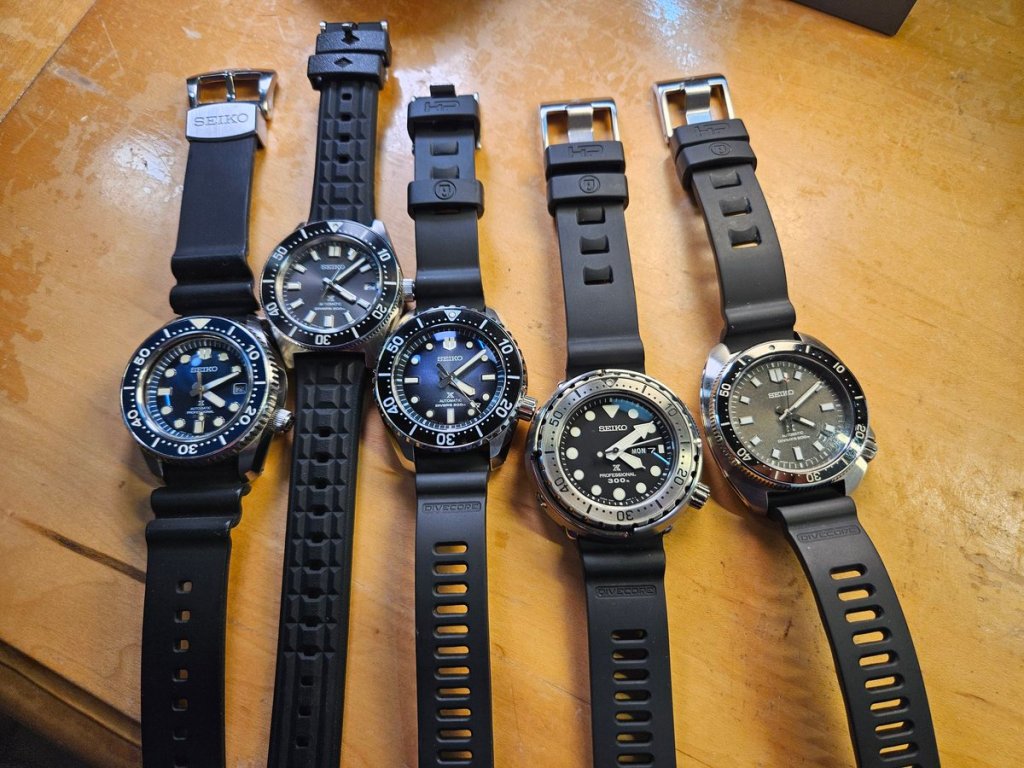
    He opened it. Seven divers—six Seikos and a lonely Citizen—gleamed under the yellowed light of a hanging stained-glass lamp.

    “Good,” he said, scanning the collection with the intensity of a mortician identifying a corpse. “All divers. That shows thematic restraint. You’re not a complete degenerate.”

    He picked up each Seiko, held it to his eye like a jeweler, then scoffed. “You baby these. When’s the last time you actually swam? Clinton administration?”

    He chuckled at his own joke, which I pretended not to hear.

    His bony fingers closed around the Citizen. “Hmm. Titanium case and bracelet. The others are all on straps. This inconsistency must be clawing at your OCD like a raccoon under drywall.”

    I nodded.

    “Sell it,” he said flatly. “It’s feeding your misery.”

    “But what about the Seiko Astron I’ve been eyeing? That one has a titanium bracelet too.”

    “Yes. And that’s not the least of your problems.” He sipped his black coffee—no cream, no joy. “You’re teetering on the edge of a collecting abyss. The Citizen’s already rotting your center. Add one more watch, and your soul will be lost to cluttered mediocrity.”

    “But the Astron—it’s beautiful,” I protested.

    “Of course it is,” he said, shrugging. “So is opium. Doesn’t mean you should buy a kilo.”

    I tried to recover. “It’s the Watch Potency Principle, right? The more watches you own, the more you dilute the power of each one.”

    He looked up sharply. “So you have read my work. Then why can’t you live by it? You recite the commandments, but break them before sunrise. Your brain and behavior are locked in bitter divorce.”

    “I just need a plan,” I said. “What do I do?”

    “Purge,” he said, as if uttering a sacred mantra.

    “Purge?”

    “Start with the titanium Citizen. Shed that one, then we’ll talk next steps.”

    “Our next move?”

    He sighed, pinched the bridge of his nose. “You’re exhausting. Come back tomorrow at ten sharp. And for God’s sake, don’t buy anything in the meantime.”

  • No One Gets Out of Here Alive

    No One Gets Out of Here Alive

    Chapter 1 of the Timepiece Whisperer of Redondo Beach

    Late one night, I found myself piloting my car through the hushed streets of Redondo Beach, past manicured lawns and hedges trimmed with neurosis, until I arrived at the blight in paradise: a hulking, lichen-tinged Victorian heap that looked like it had been shipped in from Transylvania on a dare. This was the home of the Watch Master—a reclusive oracle to the chronometrically cursed, a man whispered about in collector circles the way children whisper about the Boogeyman.

    The Master was once a studio guitarist in the ’70s, back when coke was a food group and solos could last nine minutes. He’d since traded fretboards for bezels, amassing a fortune in wrist candy—most of it gifted by rock gods in states of manic gratitude. Yet despite his vault of horological riches, he wore only a battered G-Shock Square with a scratched acrylic face that looked like it had survived a tour in Fallujah. He wore it like a monk wears a hair shirt.

    He answered the door barefoot, his jeans collapsing around his ankles like they’d given up. A Led Zeppelin shirt sagged off his wiry frame, and his hair, silver and stubborn, was pulled back from a gleaming bald crown. His beard was a frizzled thicket, somewhere between Rasputin and an abandoned Brillo pad.

    “What’s your problem?” he asked, voice rough as gravel and just as warm.

    I didn’t flinch. “I own seven watches. That’s my limit. Any more and I spiral. Emotional collapse, obsessive thoughts, buyer’s remorse, the whole circus. But I saw a Seiko Astron—the blue-dial SSJ013J1—and now I need it. Crave it. Is there any way to prepare my psyche for an eighth watch without descending into madness?”

    He stared at me like I’d just asked if I could take up recreational black tar heroin “responsibly.”

    “You’re asking how to rationalize a relapse,” he said. “That’s like asking if there’s a polite way to punch yourself in the throat.”

    And with that, he opened the door wider and let me in.

    The Watch Master squinted at me through the porch light haze, as if sizing up a man who’d brought his own shackles and wanted help tightening them. He scratched his beard, winced like my  question had given him tinnitus, and finally spoke:

    “So let me get this straight. You’ve reached your personal watch ceiling—seven tickers, your magic number, your horological emotional support grid. And now you want to blow a hole in the hull with a satellite-synced Seiko spaceship that tells time in Tokyo, Toledo, and the twelfth ring of Saturn. And you’re asking me how to prepare your psyche for this?”

    He stepped back into the house and waved me in. “Come inside, pilgrim. I need a drink before I answer that.”

    Once in the dark-paneled den, surrounded by velvet paintings of Hendrix and a lava lamp that looked clinically depressed, he continued:

    “You don’t need an eighth watch. You need a spiritual bypass. The Seiko Astron isn’t a timepiece. It’s a cry for help dressed in sapphire crystal. You’re not telling time—you’re telling yourself a story: that the right watch will rescue you from restlessness. You’re like a man trying to fix a leaky roof with a diamond-encrusted hammer. Beautiful tool, wrong job.”

    He leaned in. “So if you must buy it, do this first: Write a eulogy for the peace of mind you once had at seven watches. Light a candle. Say goodbye to balance. Then hit ‘add to cart.’ And remember: when the remorse creeps in—and it will—just whisper to yourself what we all know in this house of horological horrors: No one gets out of here alive.

    I repeated the Watch Master’s words, “No one gets out of here alive.” Then I said, “I was told you could help me with my problem. All I’m asking is that you help prepare my psyche for an eighth watch. I want you to help me prepare for this Seiko Astron as an Exit Watch. I heard you could do this for me. I had assurances. I gave you five hundred dollars. I was expecting more than a scolding.”

    The Watch Master squinted at me through a cloud of sandalwood incense, scratched his sun-damaged scalp, and said:

    “Five hundred dollars gets you a scolding. A thousand gets you a metaphor. If you want catharsis, enlightenment, and a stable seven-watch rotation, you’re looking at premium pricing. And as for an Exit Watch?” —he let out a low chuckle— “That’s like asking a bourbon addict for one last glass to sober up.”

    He leaned closer, the scratched G-Shock catching a glint of porch light. “You don’t want an Exit Watch. You want absolution. And I don’t do sacraments—I do timekeeping.”

    “So you want more money.”

    “Of course. The five hundred was for the privilege to just see me. If you want an Exit Watch, that will cost you.”

    “The Astron is close to two grand.”

    “Peanuts. If you want to close this deal, pay me five grand, and I’ll make your troubles go away.”

    I was desperate. “Venmo or Paypal,” I said.

    “Now we’re talking.”

  • Recycling in the Shadow of the End Times

    Recycling in the Shadow of the End Times

    Last night, my wife asked me to handle a sacred domestic rite of passage: haul a trunk-load of obsolete electronics to the Gaffey S.A.F.E. Recycle Collection Center in San Pedro. “They open at 9 a.m.,” she said, which is code for: Don’t sleep in.

    So I dutifully loaded my Honda Accord with a hall of shame—old radios, half-dead fans, ghosted iPads, prehistoric laptops, orphaned computer speakers, a humidifier that wheezed its last breath in 2018, and enough acid-leaking batteries to qualify as a small environmental disaster.

    By morning, I punched the address into my phone, merged onto the 110 South, and exited Pacific Avenue, driving through an industrial no-man’s-land of rusting warehouses, improvised shelters, and overgrown brush—a Stephen King set piece waiting to happen. After bouncing over railroad tracks and veering onto a gravel path flanked by nothing but dirt and faint regret, I arrived at 8:50.

    The “facility” was a glorified tarp tent squatting in front of a cinder-block warehouse. A small line of cars idled ahead of me like penitents outside a confessional. Signs warned against dumping poisons, spoiled crops, medical waste, firearms, and, refreshingly, detonation materials of any kind. A second sign warned against exiting your vehicle, eating, or drinking—because apparently the mere whiff of your lukewarm coffee might trigger a chemical reaction that could incinerate the South Bay.

    At one point, a confused driver from Washington state cut in front, realized he was in the wrong dystopian checkpoint, U-turned, and peeled off down the gravel road, leaving a dust plume that coated our windshields like nuclear ash.

    By nine o’clock, two dozen cars were idling behind me in what now resembled the opening act of an eco-thriller. A cheerful woman in an orange vest began making her rounds, clipboard in hand. She asked what I was dropping off, and I gave her the rundown—my sad parade of malfunctioning tech. I suspect her job was twofold: confirm I wasn’t smuggling Chernobyl-grade waste, and quietly profile whether I looked like the kind of guy who dumps bodies with his broken humidifiers. Somewhere nearby, I imagined, there was a man with a headset and a sidearm watching from a repurposed FEMA trailer.

    Finally, I popped the trunk. Uniformed workers retrieved my gadgets with grim efficiency. I thanked them. They returned my gratitude like seasoned pallbearers—calm, practiced, unfazed.

    Unburdened, I pulled away from the hazmat drive-thru, feeling 50 pounds lighter and slightly radioactive. I had fulfilled my civic duty to both my marriage and the planet.

  • Lot’s Wife Was Human—And So Are You

    Lot’s Wife Was Human—And So Are You

    The story of Lot’s wife is usually trotted out as a biblical “gotcha”—a cautionary tale about disobedience, attachment, and the fatal cost of looking back. But really, it’s much darker, much richer. It’s about the soul-crushing gravity of nostalgia, the seductive pull of the past, and how the refusal to fully commit to forward motion—spiritually, morally, existentially—can leave us frozen, calcified, halfway between escape and surrender.

    Lot’s wife is never named in the Genesis account. She’s just “Lot’s wife,” a narrative afterthought, a supporting character reduced to a cautionary statue. And yet her fate is more memorable than her husband’s, etched into the landscape as a monument to hesitation.

    Fortunately, Midrashic literature gives her a name—Ado, or more memorably to my ear, Edith. Maybe it’s the residue of All in the Family, but Edith conjures a kind of moral warmth: a woman who feels deeply, who wants to do right, but is also tragically susceptible to emotion and memory. I prefer Edith to “Lot’s wife” not for historical accuracy, but for dignity. Edith feels human, conflicted, real.

    I don’t think Edith turned around because she was vain or shallow. I think she turned because she was haunted. She turned because the past was more than rubble—it was love, memories, people. Her heart was a complex web of longing, and it snagged her. The salt wasn’t a punishment. It was a crystallization of what happens when our nostalgia outweighs our conviction.

    And let’s be honest: Who among us doesn’t have some briny lump of regret weighing us down? Some internal salt pillar we’ve built in the shape of a younger self we can’t stop worshiping?

    Our culture is Edith’s playground. Social media, advertising, and even the algorithms know exactly how to pander to the Edith within. I can’t scroll without being invited into some “Golden Age of Bodybuilding” time warp: vintage photos of Arnold, Zane, Platz, Mentzer; protein powder reboots; playlists that reek of adolescent testosterone and gym chalk. Jefferson Starship and Sergio Oliva, side by side. It’s like being invited to embalm my past and celebrate its eternal youth. I can join message boards and talk shop with other proud monuments to vanished glory, all of us reenacting the same ritual: remembering what life used to feel like. Not what it is.

    This, I suspect, is what it means to turn to salt. Not just to long for the past, but to despise the present. To dig our heels into a world that no longer fits and spit at progress as if it betrayed us. To canonize a version of ourselves that no longer exists, then try to live in its shadow.

    But maybe Edith’s not just a warning. Maybe she’s a mirror. A deeply flawed, deeply human figure who reminds us that the instinct to look back isn’t evil—it’s inevitable. And maybe we don’t conquer that instinct so much as we recognize it, name it, and learn when to say: Enough. That life was real, and it was mine. But I’m walking forward now.

    Or at least trying to.

  • The Gold and Purple Pyramids at the Gates of Heaven

    The Gold and Purple Pyramids at the Gates of Heaven

    Last night, I dreamed I lived in heaven—and like most people blessed beyond comprehension, I had absolutely no idea.

    The dream began in a hectic classroom, as these things often do. I was teaching at a strange college campus. The students were more postgrad in their maturity and engagement than freshman—mature, sharp, and fully caffeinated on the joy of learning.

    We were deep in discussion, when I glanced out the window and saw rain falling in soft sheets. I drifted, just for a second, and in that brief lapse, the class was commandeered—gracefully—by one of my more opinionated students, Tim Miller, moonlighting as a podcaster and self-appointed co-professor.

    Tim, without missing a beat, told everyone to take out the assigned blue textbook. The expensive one. The one I myself had never read. I looked at the book with the guilt of a host who’s never tasted his own hors d’oeuvres. Trying to recover, I asked what they thought. They said it was “okay”—the academic kiss of death. I nodded solemnly and was mercifully saved by the end of class.

    I looked at the exit and saw a nearsighted colleague half my age pushing a fleet of book carts. I offered to help. He kindly accepted my offer—but by the time I reached the carts, he had finished everything himself. He waved goodbye, like a benevolent young professor who didn’t need me after all.

    As I walked through the corridor, I spotted something. A green coffee mug I’d abandoned earlier on a table, shimmering like a forgotten relic. I scooped it up and raced across campus in the rain, placing it delicately on the windowsill of the library. Two librarians emerged, eyes wide with wonder, as if I’d returned the Ark of the Covenant. They smiled as if I’d done something sacred.

    Onward. The rain kept falling, warm and tropical, more blessing than burden. I reached for my phone–the same emerald green as the coffee mug–now coated in fine beach sand. I frantically wiped it clean, restoring it to its gleaming perfection.

    I wasn’t driving. I never did. I preferred walking the five miles home, savoring the trek. In the distance, my residence came into view: three mountain-sized pyramids rising into the mist, woven from purple and gold stone, arranged in a mesmerizing zigzag pattern. I’d always loved purple—no surprise there—but for the first time, I saw the gold properly. I normally detest gold. Too garish. But this gold? This gold was alive. Deep, radiant, humming with mystery.

    I realized, with a kind of thudding wonder, that I lived there. Among the pyramids. In the mist. In heaven. And somehow, until that moment, I’d never truly seen it.

    Then I woke up, soaked not in rain but contrition, and wondered: How much of my real life do I miss by failing to see what’s already shimmering around me? What marvels have I demoted to the mundane? What if heaven isn’t a destination but a perception we keep forgetting to use?

  • The Pilgrim, the Mansion, and the Flying Death Rig

    The Pilgrim, the Mansion, and the Flying Death Rig

    Last night, I dreamed I worked at a surreal hybrid of a college campus and an amusement park—the kind of place where tenured professors could file paperwork in one building and ride a log flume in another. Picture syllabus deadlines and cotton candy coexisting. Naturally, I was late for both.

    Meanwhile, several miles away in my old neighborhood, Marcus, a childhood friend, decided he’d had enough of modern civilization. His exit wasn’t dramatic—no manifesto, no angry blog post—just a quiet pilgrimage beginning in front of my house. The weather was unreasonably perfect. Sunlight filtered through air that smelled like rose petals and eternal spring. Think Garden of Eden meets Orange County real estate brochure.

    So why would Marcus leave paradise? We didn’t know. But my neighbors and I were offended by the sheer moral audacity of it. His journey felt like a judgment—like he’d stared into the hollow eyes of our HOA and whispered, “You people are dead inside.” Naturally, we chased him. Not to stop him, but to prove we were decent people too. We jogged after him, waving metaphysical CVs and shouting, “We recycle! We make our own salad dressing!”

    But Marcus was too far ahead. By the time I arrived at the college-amusement park, he was gone. I retreated to my professor’s office to catch up on what dreams insist professors do: paperwork. That’s when Mike arrived—a former student, Navy SEAL, and time-traveling spirit guide from the 1990s. He led me to a house in Buena Park, once his father’s, now transfigured by dream logic into a mansion of staggering beauty, where I apparently lived a life of joy and ease in another dimension. It was, quite simply, the life I never knew I had but now mourned like a phantom limb. I was flooded with regret. Why did I leave that parallel mansion where I was whole, radiant, and probably never had to grade a single freshman essay?

    Then the sun set, and—as dreams do—I stopped being a professor and morphed into some kind of blue-collar rig worker, one of four men hauling cargo across the freeways of this theme park universe. At breakneck speed, we clung to the roof of a truck, flying over the 5 freeway like a band of deluded daredevils. I alone had the courage (or sanity) to question this arrangement. “You know,” I said, wind slapping my face, “we don’t have to die tonight. There’s an interior cabin. With seats.”

    At first, they mocked me—because apparently, dreamland logic still includes workplace hazing—but eventually, they gave in. We climbed down into the safety of the rig, like cowards, or people who enjoy not being flung across asphalt.

    As I relaxed, I thought once more about that mansion in Buena Park, that shadow life where I wasn’t trying to prove my worth or cling to cargo. A life of belonging, not striving. Then I woke up, ate a bowl of buckwheat groats, drank my Sumatra coffee, and wondered what it all meant.

  • Writing Your Origin Story: A College Essay Prompt

    Writing Your Origin Story: A College Essay Prompt

    Writing Your Origin Story

    An origin story is a personal narrative that explains how someone became who they are—it connects formative experiences, struggles, and turning points to a clear sense of identity and purpose. It’s not just a chronology of events, but a curated account that gives meaning to the chaos, shaping pain, failure, or rebellion into insight and direction. Like a myth with teeth, a well-crafted origin story turns vulnerability into vision, showing not just where someone came from, but how that journey forged their voice, values, and ambitions.

    We have powerful examples of origin stories In the Amazon Prime documentary Group Therapy, in which Neil Patrick Harris plays a surprisingly restrained version of himself as moderator while six comedians—Tig Notaro, Nicole Byer, Mike Birbiglia, London Hughes, Atsuko Okatsuka, and Gary Gulman—dissect the raw material of their lives. The big reveal? That material doesn’t go from trauma to stage in one dramatic leap. No, it must be fermented, filtered, and fashioned into something more useful than pain: a persona built on an origin story.

    Mike Birbiglia delivers the central thesis of the show, and I’ll paraphrase with a bit more bite: You can’t stagger onto stage mid-breakdown and expect catharsis to double as comedy. That’s not a gift—it’s a demand. You’re taking from the audience, not offering them anything. The real craft lies in the slow, deliberate process of transforming suffering into something elegant, pointed, and—yes—entertaining. That means the comic must achieve emotional distance from the wreckage, construct a precise point of view, and build a persona strong enough to carry the weight without buckling. In other words, the chaos must be curated. Unlike therapy, where you’re still bleeding onto the couch, stand-up demands a version of you that knows how to make the bloodstains rhyme.

    This process is a perfect metaphor for what college students must do, whether they realize it or not. They’re not just acquiring credentials—they’re building selves by having a clear grasp of their origin story. And that takes more than GPAs and LinkedIn bios. An origin story requires language, history, personal narrative, and a working origin myth that turns their emotional baggage into emotional architecture. And yes, it sounds crass, but the result is a kind of “self-brand”—an identity with coherence, voice, and purpose, forged from pain but presented with polish.

    Because your success, as a human being and someone who is creative and productive in the workforce, requires an origin story, you will write your first essay about the origin story–what it is, how it develops in others, and how it develops inside of you. 

    To explore the origin story in detail, you will write an essay in 3 parts. Part 1 will analyze the importance of an origin story in the Amazon Prime documentary Group Therapy. Your job in Part 1 is to write a two-page extended definition of the origin story based on the hard-fought wisdom of the comedians who pour out their souls and explain how through their suffering, they discovered who they are, what makes them tick, and how their origin story informs their comedy. 

    In Part 2, you will write a two-page analysis of the origin story by choosing one of four media sources: 

    1. The Amazon Prime 3-part series Evolution of the Black Quarterback, a meditation on the courage of black quarterbacks who broke racial barriers and built a legacy of social justice for those quarterbacks who came after them. 
    2. Chef’s Table, Pizza, Season 1, Episode 3, Ann Kim, the origin story of a Korean-American whose origin story led her to become an award-winning chef. 
    3. Chef’s Table, Noodles, Season 1, Episode 1, Evan Funke, an American who goes to Italy where kind Italian women share their cooking so he can preserve traditional Italian noodles and become a true chef.
    4. Chef’s Table, Noodles, Season 1, Episode 2, Guirong Wei, a young woman leaves China to work in London to support her family and emerges as a noodle star. 

    In Part 3, you will write your two-page origin story. Taking the lessons from Group Therapy and the other media sources from the choices above, you will have the context to write about how you conceive yourself, your interests, your unique challenges, your unique doubts, your career goals, and your aspirations as part of your origin story. 

    Your essay should be written in MLA format and have a Works Cited page with a minimum of the 2 assigned media sources.  

    The 10 Characteristics of Your Origin Story

    1. You recognize your challenge to belong and understand why you don’t fit in with conventional notions of success, friendship, family, and belonging.
    2. You recognize your quirks, fears, and traits that make it a challenge for you to belong.
    3. You recognize the barriers between you and what you want. 
    4. You recognize what you want instead of chasing what you think others would have you want.
    5. You recognize being lost in a fog and having a moment or a series of moments in which you achieved clarity regarding what you wanted as a career, for your relationships, and for your passions. 
    6. You find a North Star, a higher goal, that pulls you from a life of lethargy and malaise to one of discipline and purpose. 
    7. You recognize the demons that you have to contend with if you are to rise above your worst tendencies and achieve happiness and success.
    8. You recognize the talents, inclinations, preferences, style, and biases that make you the person that you are, and you learn to embrace these things and allow them to inform and give expression to the kind of work that you do.
    9. You prove to your doubters that the path you have taken is the assertion of your true self and is the most likely path to happiness and success.
    10. You recognize mentors and role models who blaze a path that makes you see yourself more clearly and live in accordance with your aspirational self. 
  • Old Money, New Misery: My Southern Charm Obsession

    Old Money, New Misery: My Southern Charm Obsession

    Yes, I’m hooked—addicted, really—to Southern Charm, Bravo’s televised safari through Charlotte, South Carolina’s aristocratic swamp of ennui, vanity, and monogrammed dysfunction. Most of the men are local fixtures: old money, old habits, old egos. They drift through their curated lives like shirtless Gatsby extras, tumbling into affairs, start-up flops, and half-baked rebrands of their own manhood—usually involving whiskey, dubious real estate ventures, and “branding consultants” who charge $8,000 to tell them to get a podcast. They aren’t villains exactly—there’s a flicker of decency beneath the smugness—but they are prone to recreational cruelty. Boredom gives their mischief a sadistic edge. Monogamy is a punchline. Direction is a punch-drunk memory. They’re trapped in a gilded cage of their own entitlement, slouching toward irrelevance with cocktails in hand. For the most part, they are a cast of man-child babies performing businessman cosplay.

    The women, in contrast, seem genetically engineered for composure, ambition, and unearned patience. While the men unravel like overpriced cable-knit sweaters, the women balance jobs, goals, and the emotional labor of pretending to be intrigued by yet another man-child’s whiskey brand. They hold the show together. They’re smarter, sharper, and infinitely more emotionally competent. Frankly, they deserve their own spin-off where they leave the men behind and conquer the Southeast in blazers and heels.

    And presiding over this high-society soap opera like a Southern Sphinx is Grand Matriarch Patricia. She doesn’t walk—she presides. Draped in silk and judgment, she rules from her settee with a cocktail in one hand and a butler at her heels. Her hobbies include throwing theme parties for her yapping purse-dogs, matchmaking with surgical precision, and purchasing $30,000 gold elephants out of sheer boredom. She’s not a character; she’s a living monument to genteel tyranny. Watching her is like watching Downton Abbey if it were sponsored by bourbon and Botox.

    Honestly? The show makes me want to move to Charlotte. The humid rain gives me Florida flashbacks. The homes are plush, the restaurants look sinfully inviting, and every time I watch Southern Charm, I find myself daydreaming of strolling through the city in linen pants, pretending I too have nothing better to do than flirt, sip, and emotionally combust in a well-upholstered room.

  • His Royal Hairdresser: A Dream in Kettlebells and Class Anxiety

    His Royal Hairdresser: A Dream in Kettlebells and Class Anxiety

    Last night, my subconscious staged an outdoor fitness class without my consent.

    I found myself in a park in Redondo Beach, the sun blinding, the grass impossibly green—an Instagram-filtered fantasy of Southern California wellness. I was mid-kettlebell swing, drenched in purpose and a light sheen of dream-sweat, when I realized I was surrounded. Dozens of adult learners had appeared from nowhere, kettlebells in hand, eager and expectant. Apparently, I was their instructor. No one had hired me. No one had asked. But the dream had spoken, and I complied.

    Midway through a set of Turkish get-ups, a British emissary arrived. She looked like a character from a post-Brexit spy novel: stern, sun-dried, calves like cannonballs, dressed in a starched khaki uniform that screamed military cosplay and mid-level bureaucrat. She informed me—in clipped tones—that she worked for Prince Charles and that, regrettably, I lacked the proper haircut to instruct kettlebell technique. Apparently, the heir to the throne had strong feelings about grooming standards in recreational fitness.

    I explained, gently but firmly, that I was bald. Smooth as an egg. No haircut necessary. She did not care. My objections were irrelevant. Orders were orders.

    We marched off to a nearby luxury hotel, the kind with carpeting so plush it slows your gait. Prince Charles was there, sitting cross-legged on a massive hotel bed surrounded by two open laptops, deep in what I can only assume was royal doom-scrolling. When he saw me, he snapped both laptops shut with the speed of a man hiding state secrets or Wordle stats.

    He gestured toward a massive, throne-adjacent salon chair, upholstered in padded leather and colonial guilt. “You need your hair parted down the middle,” he declared.

    Again, I protested—I was bald. But His Royal Highness was undeterred. He placed a comb on my scalp, and as if conjured by the Crown itself, hair appeared. Thick, black, center-parted. The haircut was bestowed.

    Feeling both knighted and absurd, I reached into my wallet and tipped him two twenties. He accepted the bills with the contempt of a man too wealthy for paper currency. It was as though I had handed him used Kleenex. He nodded, purely out of ritual, and turned back to his laptops, already erasing the memory of me from his mind.

    I returned to the park, my hair neatly parted, my purpose restored. I resumed leading my eager students in kettlebell swings, disappearing into the warm fog of belonging, convinced—for at least this dream—that I was a vital member of my sun-drenched community.

  • Toxins, Teas, and the Tyranny of Self-Care

    Toxins, Teas, and the Tyranny of Self-Care

    In How to Be Well: Navigating Our Self-Care Epidemic, One Dubious Cure at a Time, Amy Larocca introduces us to the “Well Woman”—an aspirational specter of affluent spirituality who floats through Erewhon aisles like a priestess of turmeric. She is non-religious but deeply “spiritual,” an educated, upper-middle-class avatar of intentional living. Her diet? Whole, organic, plant-based. Her skincare? Sourced from the tears of ethically massaged avocados. Her wardrobe? Soft, breathable cottons dyed with herbs. Her soul? Allegedly pure.

    She’s the type who throws around words like “boundaries” and “holding space” while sipping adaptogenic mushroom tea. Fluent in therapy-speak and swaddled in the cozy lexicon of mindfulness, she’s not just living—she’s curating her life, building an identity out of emollients, detoxes, and artisanal spices. And all of it—every mindful, ethically sourced drop—feeds the $5.6 trillion wellness-industrial complex.

    Larocca sees through the yoga-scented fog. The Well Woman, she argues, is just the latest installment in America’s ongoing franchise of unattainable feminine ideals: a new model to aspire to, envy, and—most importantly—buy into. Today’s purity isn’t moral; it’s material.

    Reading Larocca’s opening, I couldn’t help but think of Todd Haynes’s 1995 masterpiece Safe, in which Carol White—a vapid housewife in the chemical-glazed sprawl of the San Fernando Valley—slowly dissolves into the cult of purity. After one too many trips to the dry cleaner, Carol spirals into an obsession with environmental toxins, abandons her friends and family, and ends up exiled to a pastel-drenched wellness commune. There she lives alone in a sterile dome, staring at herself in the mirror, parroting affirmations until there’s nothing left behind her eyes but empty devotion.

    Carol White is the ghost of the Well Woman’s future—a cautionary tale in Lululemon. She doesn’t find peace; she finds a purgatory curated by Goop. And as Larocca peels back the lavender-scented rhetoric of self-care, it’s clear she sees this modern cult of wellness not as healing but as hollowing—a $5.6 trillion seduction that promises salvation and delivers scented self-delusion.