Tag: film

  • Weapons of Fear: Epistemic Collapse in Eddington and Weapons (college writing prompt)

    Weapons of Fear: Epistemic Collapse in Eddington and Weapons (college writing prompt)

    Over the last decade, American culture has undergone a profound crisis of shared reality—what scholars call an epistemic collapse. In the vacuum created by fractured institutions, algorithm-driven outrage, political opportunism, and a populace trained to distrust expertise, communities have turned inward, building their own private universes of truth. Two recent films—Ari Aster’s Eddington (2024) and Zach Cregger’s Weapons (2025)—stand at the center of this cultural conversation. While their genres differ—Eddington as a neo-Western political drama and Weapons as a folk-horror anthology—both films dramatize the same underlying catastrophe: when people no longer agree on what is real, they become dangerously easy to manipulate, divide, and weaponize.

    In Eddington, the small New Mexico town is already fractured before the plot begins. The COVID-19 pandemic becomes the spark that exposes deep fault lines: anti-mask sheriff Joe Cross stokes resentment and paranoia, pro-mandate Mayor Ted Garcia attempts to preserve public health in a community that no longer trusts him, and the town’s institutions melt under the weight of political rage, conspiracy theories, and personal vendettas. Masks, lockdowns, land rights, and municipal policy become symbols of existential war. Citizens drift into echo chambers where identity outweighs truth and where “freedom” can be invoked to justify violence. Through these tensions, Eddington examines how tribal politics, misinformation, and fear transform ordinary people into agents of chaos—into what the film metaphorically frames as “weapons.”

    Weapons begins in a seemingly different register—a folk-horror narrative involving children, trauma, and community superstition—but it ultimately reveals itself as a story about the same phenomenon: collective panic filling the void left by failed institutions. When mysterious events shake the town, people reach not for evidence, reason, or communal deliberation, but for myths. Rumors calcify into “truth,” grief mutates into paranoia, and the community turns against itself in a desperate search for someone to blame. In this atmosphere, children, grief-stricken parents, and unstable townspeople all become susceptible to narratives that promise clarity and purpose, even at the price of cruelty. Like Eddington, Weapons suggests that the human need for certainty can be exploited, turning vulnerable people into instruments of violence.

    Both films take place in communities that feel abandoned—by government, by truth, by stability, by the social contract. In Eddington, the pandemic reveals a town already primed for collapse: neighbors distrust each other, public servants abuse their power, and media ecosystems churn conspiracies at a devastating pace. In Weapons, the terror centers on mysterious disappearances and supernatural dread, but the underlying cause is similar: when people feel unmoored, they grasp at stories—however irrational—that make sense of suffering. In both cases, the crisis is not just external; it is psychological, emotional, and cultural. These films argue that a society that no longer shares a framework of truth inevitably begins producing its own monsters.

    Your task is to write a comparative, argumentative essay that analyzes how both Eddington and Weapons depict the collapse of shared reality and the transformation of ordinary individuals into “weapons”—tools of fear, ideology, grief, or superstition. You will argue how each film uses different storytelling techniques to illuminate the same cultural trauma: a nation where trust in institutions has eroded, where truth is increasingly privatized, and where communities respond to uncertainty with tribalism, scapegoating, and paranoia.

    To frame your argument, consider the following thematic questions:

    1. Epistemic Crisis: What happens when communities no longer share the same reality?

    In Eddington, the pandemic becomes a catalyst for unraveling collective trust. Sheriff Joe Cross exploits the crisis for personal power, leveraging fear and resentment to undermine public-health directives. Misinformation spreads faster than illness, and political theater replaces governance. In Weapons, suspicion and folk belief dominate; characters construct supernatural explanations for grief they cannot otherwise process. How do these fictional communities illustrate the broader national struggle to maintain a shared understanding of truth?

    2. Scapegoating and Manufactured Monsters

    Both films show societies that create monsters when reality becomes intolerable. In Weapons, grief and superstition lead to scapegoating—outsiders, children, even supernatural entities become symbols of community anxiety. In Eddington, “the monster” is political: masks, mandates, immigrants, liberals, conservatives—whatever the tribe defines as the existential threat. Analyze how each film uses its respective genre (horror vs. political drama) to critique the human impulse toward blame when confronted with collective fear.

    3. The Weaponized Individual: When people become instruments of chaos

    Sheriff Cross turns himself into a political weapon; Vernon weaponizes conspiracy thinking; Brian transforms a viral video into a career. Meanwhile, characters in Weapons become pawns of rumor and superstition. How do the films examine the way individuals can be radicalized or repurposed by fear, trauma, or ideological narratives?

    4. Institutional Failure and the Vacuum It Creates

    In Eddington, institutions collapse under pressure: public health, municipal leadership, local law enforcement, media, and even basic civic trust. In Weapons, institutions either fail or play no meaningful role, leaving individuals to fill the void with folklore and violent improvisation. Compare how each film portrays the consequences of institutional breakdown—and how that vacuum shapes community behavior.

    5. The Loss of Humanity in a Post-COVID World

    Even though Weapons is not explicitly a pandemic film, its emotional landscape reflects post-COVID anxieties: loneliness, grief, mistrust, and the longing for clear explanations. Eddington addresses the pandemic head-on, depicting how fear strips people of empathy and connection. In both films, humanity erodes as people prioritize survival, identity, or belonging over compassion. Analyze how each story portrays this transformation.

    6. The Role of Media, Algorithmic Influence, and Storytelling

    Eddington explicitly critiques media spectacle and algorithmic manipulation; Weapons does so more subtly through mythmaking and rumor. Compare how each film reveals the power of narrative—factual or fictional—to shape belief, identity, and behavior. What does each film suggest about the modern American hunger for stories that confirm our fears, validate our tribal loyalties, or simplify our grief?

    7. The Nietzschean Last Man: A Society Without Higher Purpose

    For extra depth, you may choose to integrate the concept of Nietzsche’s “Last Man”—the individual who seeks comfort over purpose, safety over meaning, distraction over responsibility. Which characters in each film exemplify this drift toward nihilism? Does each film suggest that the Last Man is a symptom of cultural decay—or part of its cause?


    Write a comparative essay of 1,800–2,200 words that argues how Eddington and Weapons portray the following intertwined themes:

    • the breakdown of shared reality
    • the rise of tribalism and paranoia
    • the transformation of ordinary people into “weapons”
    • the creation of monsters—psychological, political, or supernatural—to fill the void left by institutional failure
    • the erosion of humanity in a culture defined by fear, spectacle, and algorithmic influence

    Your thesis must make a clear, debatable claim about what these films reveal about post-COVID American society. You must support your analysis with close reading of key scenes, comparison of cinematic techniques, and sustained argumentation.

    Your essay must also include:

    1. A Counterargument

    Acknowledge at least one opposing view—for example, the claim that Eddington is primarily about political extremism while Weapons is primarily about horror and grief, and therefore the comparison is forced. Then rebut that view by showing that genre differences sharpen, rather than undermine, the thematic parallels.

    2. A Rebuttal

    Explain why your central claim still holds. You may argue that both films are ultimately parables about epistemic breakdown and human vulnerability in the absence of trusted institutions.

    3. A Conclusion That Opens Outward

    Discuss what these films suggest about where American culture may be heading if fragmentation, mistrust, and weaponized narratives continue.

    Your writing should demonstrate:

    • analytical depth
    • clarity
    • engagement with cinematic detail
    • strong comparative structure
    • thoughtful paragraph organization
    • precise sentence-level control

    This essay invites you not only to compare two compelling films, but also to reflect on the cultural moment that shaped them—and the uncertain landscape we now inhabit.


  • Richard Brody vs. the Algorithm: A Critic’s Lament in a Post-Print World

    Richard Brody vs. the Algorithm: A Critic’s Lament in a Post-Print World

    In his essay “In Defense of the Traditional Review,” New Yorker critic Richard Brody goes to battle against The New York Times’ editorial decision to shift arts criticism—from the long-form written review to short-form videos designed for a digital audience. It’s a cultural downgrade, Brody argues, a move from substance to performance, from sustained reflection to algorithm-choked ephemera. The move may be pitched as modernization, but Brody sees it for what it is: intellectual compromise dressed up as digital innovation.

    Brody’s stance isn’t anti-technology. He concedes we can chew gum and walk at the same time—that written essays and short videos can coexist. But his core concern is that the center of criticism is the written word. Shift the balance too far toward video, and you risk gutting that center entirely. Worse, video reviews tend to drift toward celebrity interviews and promotional puffery. The fear isn’t hypothetical. When given the choice between a serious review and a clip featuring a celebrity making faces in a car, algorithms will reward the latter. And so criticism is flattened into entertainment, and standards dissolve beneath a rising tide of digital applause.

    Brody’s alarm resonates with me, because I’ve spent the last four decades teaching college writing and watching the same cultural drift. Long books are gone. In many cases, books are gone altogether. We assign short essays because that’s what students can handle. And yet, paradoxically, I’ve never seen such sharp classroom discussions, never written better prompts, never witnessed better argumentation than I do today. The intellectual work isn’t dead—it’s just found new vessels. Brody is right to warn against cultural decay, but the answer isn’t clinging to vanished ideals. It’s adaptation with integrity. If we don’t evolve, we lose our audience. But if we adapt wisely, we might still reach them—and even challenge them—where they are.

  • Uncut Bezels: Watch Addiction and the Cult of Chaos

    Uncut Bezels: Watch Addiction and the Cult of Chaos

    Watch obsessives have more in common with Howard Ratner than we care to admit. Yes, that Howard Ratner—the unhinged gem pusher played with twitchy brilliance by Adam Sandler in the Safdie brothers’ cinematic panic attack, Uncut Gems. Ratner operates in the Diamond District behind bulletproof glass, drowning in sparkle and debt. We operate behind the bulletproof delusions of horological obsession, buried in brushed steel and moonphase complications.

    Like Ratner, we gamble—not at sportsbooks, but with FedEx tracking numbers. We tell ourselves, this is the one as we refresh the delivery status of the next “grail” watch. The package might as well be glowing, Pulp Fiction-style. And like Ratner chasing a cursed Ethiopian black opal mined from the bloodied crust of the Earth, we twist ourselves into financial and emotional pretzels to score that one special piece—the wrist-mounted miracle that will finally quiet the voices.

    Spoiler: it never does.

    Ratner is a man who thinks more is the cure. More bets. More jewels. More chaos. The watch obsessive runs the same play. We soothe our midlife despair not with therapy or silence, but with spring drives, meteorite dials, and limited edition bronze cases. Our collections don’t grow—they metastasize.

    Like Ratner, our problem isn’t the world. Our problem is internal. The call is coming from inside the skull. He can’t stop because he doesn’t want to stop. The thrill is the point. Every acquisition, every wrist shot, every gushing forum post—just another hit of synthetic joy to distract from the gnawing void. We call it a hobby. Let’s not kid ourselves. It’s dopamine addiction disguised as design appreciation.

    Uncut Gems is a cinematic espresso shot laced with panic. My wife and brother couldn’t sit through thirty minutes. Too stressful, they said. Too jittery. I’ve watched it three times.

    But of course I have. I’m a watch addict.

    I live in Ratner’s world. The caffeinated chaos? That’s not discomfort. That’s home.

  • Gene Wilder’s Prelude to Mischief and Mayhem

    Gene Wilder’s Prelude to Mischief and Mayhem

    In fourth grade at Anderson Elementary in San Jose, our teacher cracked open Charlie and the Chocolate Factory and unleashed a literary sugar bomb on the classroom. The characters didn’t just leap off the page—they kicked down the door of our imaginations and set up shop. The book hijacked our brains. Good luck checking it out from the library—there was a waiting list that stretched into eternity.

    A year later, the film Willy Wonka and the Chocolate Factory hit theaters, but my parents, apparently operating under some moral suspicion of Hollywood whimsy, refused to take me. I wouldn’t see it until the VHS era, when cultural consensus finally upgraded it to “beloved classic” status. That’s when I met Gene Wilder’s Wonka—equal parts sorcerer, satirist, and deranged uncle.

    The best moment? Easy. He hobbles out, leaning on a cane like a relic of Victorian fragility—then suddenly drops the act, executes a flawless somersault, and stands up with a gleam that says, I know exactly what game I’m playing, and so should you. That glint in his eye, equal parts wonder and judgment, has haunted me for decades. His entire persona is a velvet-gloved slap to the smug, the spoiled, and the blissfully ignorant. He isn’t just testing children—he’s taking society’s moral pulse and finding a weak, sugary beat.

    That gleam stayed with me. So much so that I wrote a piano piece inspired by Wilder’s performance. I called it Gene Wilder’s Prelude to Mischief and Mayhem. The first movement was a nightmare—rewritten more times than I care to admit. Oddly, the second and third movements came first, composed together in the aftermath of my mother’s passing on October 1, 2020. Nearly five years later, I finally completed the first movement, like some strange reverse birth.

    The result? A tribute in three acts to the sly grin, the righteous mischief, and the bittersweet brilliance of Gene Wilder—a man who, like the best artists, never let kindness become cowardice or magic become a mask for mediocrity.

  • A Missed Opportunity for Nicolas Cage in The Surfer

    A Missed Opportunity for Nicolas Cage in The Surfer

    Yesterday, I subjected myself to The Surfer (2025), a cinematic hallucination starring Nicolas Cage, filmed somewhere in a fictional Luna Bay, Australia—or at least in a version of coastal Australia designed to feel like a fever dream. Cage plays a middle-aged man who seems to believe he lives inside a Lexus commercial and is some kind of real estate baron returning to reclaim the beachfront childhood home that slipped through his fingers decades ago. A house that, in his mind, will grant him redemption, absolution, and perhaps a complimentary cappuccino.

    Here’s the twist: he’s almost certainly homeless and entirely unhinged.

    The local surfing gang—shirtless nihilists who act like they’re in a meth-fueled remake of Lord of the Flies—perform what can only be described as satanic hazing rituals and torment Cage’s character with such sadistic flair that one wonders if they were cast straight from a skate park exorcism.

    The whole production gave me flashbacks to the art house theaters I frequented in Berkeley in the early ’80s. It has the self-important weirdness of Jodorowsky’s El Topo (a film I admired in theory and loathed in practice), but desperately wishes it had the quiet transcendence of Nicolas Roeg’s Walkabout, a true masterpiece. Alas, The Surfer is neither.

    Once it becomes clear—about twenty minutes in—that Cage’s character is a delusional man harassing beachgoers, the rest of the film becomes a masochistic ritual for the viewer: 80 long minutes of escalating humiliations. He’s mocked by surfers, snubbed by a barista, rejected by a dog-walking woman, and disdained by a real estate agent with the warmth of a lizard in escrow. Each scene checks off another indignity in a cinematic punishment parade.

    And yet, somewhere in this wreckage is the seed of a decent story. Imagine this: Cage plays a sane, if eccentric, man with a legitimate past beef with the local surf gang. The setting becomes a character in itself. The plot thickens into a psychological turf war. Give it ten episodes and some competent writers, and you’d have a fascinating limited series. But no—The Surfer opts for a half-baked film that commits the worst artistic sin: not provocation, but tedium.

    This movie didn’t just reaffirm my bias against most modern films—it fortified it. This is why I stick to television. At least TV has the decency to pretend it respects my time.

  • The Postcard Life: Why Perfection Always Rings Hollow

    The Postcard Life: Why Perfection Always Rings Hollow

    I can’t shake an interview I heard thirty years ago—an offhand confession that stuck to me like burrs on a wool coat.
    Terry Gilliam, the Monty Python animator turned fever-dream film director, was talking with Charlie Rose. Gilliam described a moment straight from a high school dream: he was walking the Santa Monica Pier on a twilight evening, a beautiful woman on his arm, the beach shimmering under a dying sun. It was the kind of moment that screams You’ve Made It! if you’ve ever been a teenage boy with a tragic imagination.

    And yet, Gilliam said, he felt nothing. Not euphoria. Not awe. Just… flatness. Like he wasn’t even in his own life but rather trapped inside one of his own cartoons—a two-dimensional fantasy drawn by someone who had seen too many movies and lived too little.
    That was his grim epiphany: we don’t chase life—we chase the idea of it.

    Gilliam’s teenage dream had come true, but it rang hollow because it wasn’t connection he had caught. It was a postcard of connection, a lifeless image polished smooth by years of expectation.

    I’ve thought about that moment a lot, especially in the slow burns of my own life, in all the arenas where the blueprint of perfection crashed hard against the walls of reality.
    Take teaching: I’ve taught college writing for forty years. More times than I care to admit, I walked into class with what I believed was a masterstroke of a lesson plan—polished, structured, airtight. And then I delivered it like a robot with tenure. The students, bless them, tried not to visibly expire.
    Only when I threw away the script and talked to them like a breathing, flawed human being did I finally see heads lift and eyes focus.

    It’s the same poison at work: that blueprint, that false idol of how it’s supposed to be.
    Therapist Phil Stutz calls it the Magical Moment Frozen in Time—a mental snapshot of ideal beauty, love, success, whatever, that we spend our lives trying to recreate. And like the cruelest mirage, it recedes the closer we get.
    Because it’s not life.
    It’s a knockoff. A counterfeit so slick, it fools even the person living it.

    It’s sobering, humiliating even, to realize how often my life has been a performance for an audience that doesn’t exist—measuring real experiences against some fantasy standard cooked up in the caves of my mind.
    Maybe Plato had it right all along: we’re prisoners staring at shadows, mistaking flickers on the wall for the blazing, complicated, imperfect mess that is actual life.
    And every time we chase the shadow instead of the fire, we walk the Santa Monica Pier at sunset, hand in hand with a beautiful illusion, and feel… nothing.

  • Black Mirror’s “Joan Is Awful” and the Algorithmic Pact with the Devil

    Black Mirror’s “Joan Is Awful” and the Algorithmic Pact with the Devil

    If The Truman Show warned us about the dangers of involuntary surveillance masquerading as entertainment, Black Mirror’s “Joan Is Awful” updates the nightmare for the age of algorithmic narcissism and digital convenience. Where Truman was trapped in a fake world constructed for him, Joan willingly signs away her soul in the fine print of a Terms of Service agreement—an agreement she didn’t read, because who reads those when there’s AI-generated content to binge and oat milk lattes to sip?

    “Joan Is Awful” isn’t just a satire about streaming culture or artificial intelligence gone rogue. It’s a scalpel-sharp metaphor for Ozempification—our cultural surrender to the gods of optimization, where being frictionless is the highest virtue and being real is a liability. Ozempification isn’t just about weight loss. It’s about trimming down everything that makes us inconveniently human: messiness, contradictions, privacy, shame, even joy. We trade all of it for a pre-chewed, camera-ready version of ourselves that fits neatly into an algorithmic feed.

    Joan becomes the star of her own life not by choice, but by being optimized—flattened into a content-producing puppet who behaves like a mashup of the worst moments from her day. It’s not just that her life is turned into a reality show; it’s that the version of her that streams every evening is algorithmically engineered for maximum watch time and outrage. The real Joan is rendered irrelevant—just source material for a soap opera she has no control over.

    This isn’t dystopia, by the way. It’s Tuesday on Instagram.

    We live in a Truman Show remix where we’re both performer and voyeur, curating a persona for a crowd we cannot see and will never know. Like Joan, we sign away our likeness every time we click “Accept All Cookies.” Our deepest thoughts are mined, our image is harvested, our data is commodified, all in exchange for a life so smooth, so seamless, it might as well be a corporate press release.

    The chilling genius of “Joan Is Awful” lies in how no one seems particularly surprised by any of this. Her boyfriend leaves her not because he doubts her, but because the show made her look like a monster—and worse, a boring one. Her boss isn’t shocked; she’s just annoyed that Joan’s AI doppelgänger is bad for brand synergy. Even the therapist is part of the machine. Everyone has already accepted the premise: you don’t own your life anymore—Streamberry does.

    This is Ozempification in its final form. Not a sleeker body, but a sanitized self, scrubbed of complexity, repackaged for virality. Like reality TV contestants, Joan is hypervisible and utterly dehumanized, the protagonist of a story she didn’t write. And like so many of those contestants—remember the ones who cracked on camera only to be mocked in GIFs and memes—her breakdown is part of the entertainment. Joan’s humiliation isn’t a glitch; it’s the product. We want the breakdown. We crave the trainwreck. Because in a world that rewards optimized personas, the real human underneath is just noise to be edited out.

    In the end, Joan fights back, but only after enduring the full crucifixion of parasocial fame. It’s a cathartic moment, but also a reminder: she had to become completely unrecognizable—to herself and to others—before she could reclaim a shred of agency.

    The tragedy isn’t just that Joan’s life is broadcast without her consent. It’s that she ever believed she was still the protagonist in her own story. That’s the Ozempic Lie: that you can control the process while outsourcing the self. But once the machine gets hold of your image, your data, your likeness, it doesn’t need you anymore. Just a version of you that performs well.

    So yes, “Joan Is Awful” is awful. And Joan is all of us.

  • ANDREW SCHULZ IS NOSTALGIC FOR A BYGONE ERA OF STREETWISE AMERICANA

    ANDREW SCHULZ IS NOSTALGIC FOR A BYGONE ERA OF STREETWISE AMERICANA

    Andrew Schulz’s Netflix comedy special Life is a raw, ribald, and unfiltered chronicle of his and his wife’s grueling journey to have a child. It’s a ride that careens between lewd confessionals, streetwise swagger, and sentimental catharsis. For an hour, Schulz prowls the stage like a wisecracking, mustachioed throwback to an old-school gangster film, his booming presence equal parts stand-up comic and mob enforcer. At six-foot-two, broad-shouldered, and built like a guy who settles arguments with a left hook, he radiates a menace rarely seen in stand-up. This is not a comedian you heckle. You laugh, or you keep quiet.

    I had never seen Schulz’s stand-up before, but I knew him as a popular podcaster, so I figured I’d see what all the fuss was about. It didn’t take long to realize that the hype is well-earned. He’s a master wordsmith, a virtuoso of sarcasm, persona, and hyperbole, wielding his sharp tongue like a switchblade. But what really sets him apart is his ability to straddle two opposing forces: he is both a blistering satirist of the old-school street tough guy and a full-throated champion of it. Watching him, you feel like you’ve been dropped into a smoky Brooklyn steakhouse circa 1975, where the grizzled patriarch of a blue-collar family is holding court at the dinner table, explaining—with obscene embellishments—how the world really works.

    His comedy plays like a high-stakes game of verbal poker. As he launches into brutally unfiltered takes on relationships, sex, and masculinity, he flashes an ambiguous grin, as if daring you to figure out whether he’s mocking the persona or reveling in it. The joke is always half on him, half on you, and entirely in his control. But beneath all the bravado and shock humor, Schulz betrays a sentimental streak. He adores his wife. He’s obsessed with his newborn daughter. By the end, he ditches the swagger for a moment of sincerity, showing a video montage of his family and telling his audience that for all the struggles, the reward is worth it.

    Schulz isn’t just nostalgic for a bygone era of streetwise, no-nonsense Americana—he’s built his entire persona around it. And somehow, in a world of algorithm-driven, sanitized comedy, it works.

  • ROAD HOUSE IS A 2-HOUR INFOMERCIAL FOR TESTOSTERONE

    ROAD HOUSE IS A 2-HOUR INFOMERCIAL FOR TESTOSTERONE

    My pride as a lifelong bodybuilder took a glorious nosedive one recent evening when, sprawled on the couch like a man who had long abandoned ambition, I decided to indulge in the cinematic opus that is Road House. This film—if we must use that term generously—stars a Jake Gyllenhaal so sculpted he looks like Michelangelo, midway through carving David, got bored and said, Screw it, let’s make him a UFC fighter instead.

    Gyllenhaal plays a brooding, sinewy bouncer in Key West, grinding out a living by doing what all action heroes must—protecting a bar and its stunning owner, played by Jessica Williams, from the looming threat of corrupt mob bosses. Naturally, this leads to an inevitable showdown with their number-one enforcer: Conor McGregor, sporting the physique of a shaved grizzly bear on clenbuterol, his veins bulging like he’s one flex away from detonating. His performance lands somewhere between rabid pit bull and man who hasn’t blinked since 2019, and frankly, it’s magnificent.

    The plot? Barely there—thinner than a gas station receipt and about as consequential. It’s the classic Western trope: a stranger rides into town, cleans up the mess, and leaves behind a trail of broken bones and smoldering stares. But let’s not kid ourselves—the storyline exists solely as an excuse to showcase glistening, heaving slabs of muscle in slow motion. The camera caresses each bicep, each rippling lat, with the kind of reverence usually reserved for Renaissance art. It’s not an action movie so much as a two-hour infomercial for pre-workout supplements, high-intensity interval training, and whatever unregulated substance has been making its way through underground fight gyms.

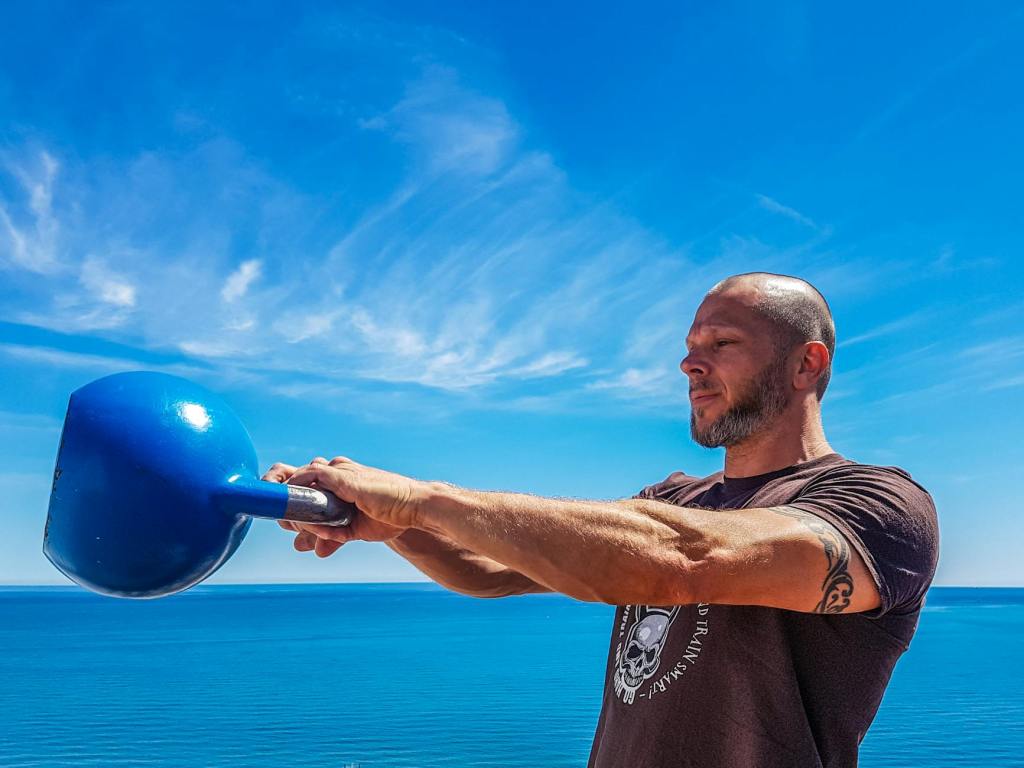
    Somewhere between Gyllenhaal’s 47th shirtless moment and McGregor snarling like a man whose only source of hydration is pure testosterone, I found myself reaching for my phone—not to check the time, but to Google Conor McGregor’s diet plan. Because Road House isn’t just a film—it’s a flashing neon sign reminding you that you are, at best, a sentient pudding cup compared to these granite-hewn demigods. This isn’t entertainment; it’s an intervention. And the message is clear: drop the remote, pick up a kettlebell, and try to reclaim your dignity before it’s too late.

    When the credits finally rolled and I peeled myself off the couch, I had a revelation—if I wanted my memoir, Cinemorphosis: How I Become the Hero of Every Show I’ve Ever Watched, to thrive in today’s ruthless marketplace, it too needed a marketing tie-in. Just as Road House is a Trojan horse for fitness supplements and gym memberships, my book needed its own branded merchandise. But considering my subject matter—living vicariously through TV characters—the only viable promotional tie-in would be a chain of Self-Flagellation Chambers™, where disillusioned TV addicts could atone for their wasted lives. Or perhaps a TV Watcher’s Repentance Kit, complete with a burlap sack, an artisanal cilice, and a deluxe “discipline” whip for those long, dark nights of the soul.