If you think of yourself as a watch addict—someone whose hobby has drifted from interest into pathology—then you are probably also someone who longs for balance, for improvement, for a steadier inner life. You turn, as serious people do, to philosophy. Cicero’s Tusculan Disputations offers the promise: a tranquil soul, calmed by restraint and consistency. No distress. No fear. No desperate longing. No childish emotional swings. The happy man, Cicero suggests, is not the one who feels good, but the one who lives well.
Then you look at your watch history and feel personally indicted.
Restraint? You chased the perfect collection like a man hunting a mirage. Consistency? Your tastes pivoted with the emotional weather. Instead of tranquility, you endured the familiar cycle: anticipation, anxiety, justification, regret, and renewed desire. Twenty years of it. Even writing a book about the madness begins to look suspicious—less reflection than performance, a long-form version of hobby melodrama.
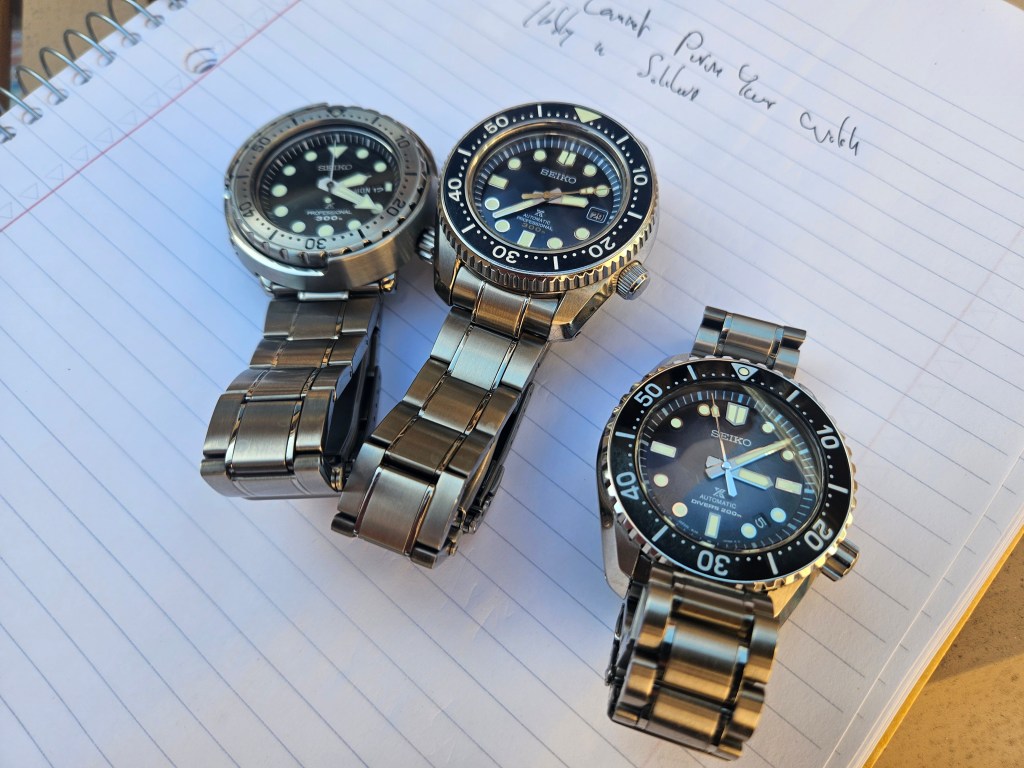
You thought you had achieved peace. Seven mechanical divers. Stability. Closure.
Then a G-Shock arrived.
Then another.
Like Augustine praying for chastity, the watch collector makes the classic promise:
“Give me watch sobriety—only not yet.”
The private bargain follows: One more watch, and the madness will be over.
The promise is never kept.
At this point, you have two options. You can keep prosecuting yourself for moral failure, or you can acknowledge a simpler truth: every hobby runs on enthusiasm, and enthusiasm always carries a trace of obsession. If you’re honest, part of this has been fun. But honesty requires the other admission as well: balance matters. An hour spent comparing G-Shock legibility is recreation. Losing an entire day to forums while your family heads to the beach without you is not enthusiasm. That’s displacement.
So stop diagnosing yourself as diseased. You are not broken. You are wired this way. Some people chase golf swings. Some chase wine vintages. You chase watches.
The real task is not suppression. It’s containment.
This is where Guardrail Collecting begins.
Guardrail Collecting allows your enthusiasm to run at full emotional voltage while installing firm limits that keep it from reorganizing your life around itself. It accepts a non-negotiable fact: the impulse isn’t going away. You will want to research, compare, optimize, and improve. The system doesn’t silence that impulse. It puts it inside a lane where curiosity remains pleasure instead of sliding into compulsion. The goal is not austerity. The goal is stability—so the hobby adds energy to your life instead of quietly draining it.
The guardrails must be built before the surge hits, because no one makes rational decisions during Acquisition Afterglow. Establish three hard limits: a spending ceiling, a time boundary, and a capacity rule—maximum collection size or strict one-in/one-out. Then add a reality check: if watch activity begins to replace family time, sleep, health, or focused work, the rail has been hit. Activity stops. No bargaining. No heroic narratives.
Maintenance requires periodic audits. Every few months, ask three questions: What am I wearing? What am I spending? How much time disappeared into comparison and speculation? If the hobby feels heavy, tighten the rails. If it feels light and contained, leave them alone.
Because willpower is unreliable. Mood fluctuates. Enthusiasm surges and crashes.
Structure does not.
Guardrail Collecting works for one reason: it replaces self-control with architecture—and architecture holds steady long after motivation fades.
 Cinemorphosis