Tag: football

  • Quarterback Hell: America’s Favorite Demigod and the Price of Glory

    Quarterback Hell: America’s Favorite Demigod and the Price of Glory

    In her New Yorker essay “Consider the Quarterback,” Louisa Thomas plunders Seth Wickersham’s American Kings and paints the quarterback not as a football player, but as America’s most tortured mythological beast. Quarterbacks embody our national delusions about leadership and manhood; they manage violence and spectacle at once, parading each week into a gladiatorial hell where one misread or misthrow detonates in front of millions. Actors can flub a line, pop stars can botch a note, tech bros can tank a product and still recover. A quarterback’s mistake, by contrast, is immortalized on ESPN in slow-motion high definition. Surviving this gauntlet elevates him beyond celebrity—he becomes a demigod, but one forged in a furnace that melts sanity along with steel.

    Wickersham’s question—what happens when you achieve the dream of being a star NFL quarterback?—turns out to be a warning label. The answer is grotesque. Yes, genius is displayed on the field: the audibles, the poise, the impossible throws. But the book catalogues the price—alcohol, depression, busted marriages, fatherhood disasters, chronic pain, and, at the core, narcissism metastasized into pathology. “Football, it seems, can unleash the kind of narcissistic personality that normal society might constrain,” Thomas notes. Being a quarterback isn’t a job; it’s a metamorphosis, one that can turn men into monsters.

    That Faustian bargain echoes across sports. Once you buy into a mission of athletic greatness, you accept self-destruction as the down payment. Ronnie Coleman illustrates this truth with brutal clarity. His eight Mr. Olympia titles were purchased with 800-pound squats, deadlifts, and a training style that would make orthopedic surgeons salivate. The bill: spinal fusions, hip replacements, shattered hardware in his back, and a daily life of chronic pain, crutches, and wheelchairs. And yet Coleman, a family man without scandal, smiles through it all. He insists he’d repeat it, no regrets—because the wreckage of his body was, to him, a fair trade for immortality.

    Coleman is a useful counterpoint because, compared to the quarterback, he got off easy. Bodybuilding stripped his mobility but not his humanity. The quarterback, however, inherits the same orthopedic carnage plus something darker: brain trauma, depression, addiction, and the corrosive narcissism required to play the role. Football elevates these men into Olympian figures—half god, half brand—while hollowing out their hearts and souls. To be a quarterback is to win everything the culture worships, and to lose everything that makes life worth living.

  • Comparing the Qodosen DX-286 with the Tecsun PL-330 (Which I Absolutely Did Not Need)

    Comparing the Qodosen DX-286 with the Tecsun PL-330 (Which I Absolutely Did Not Need)

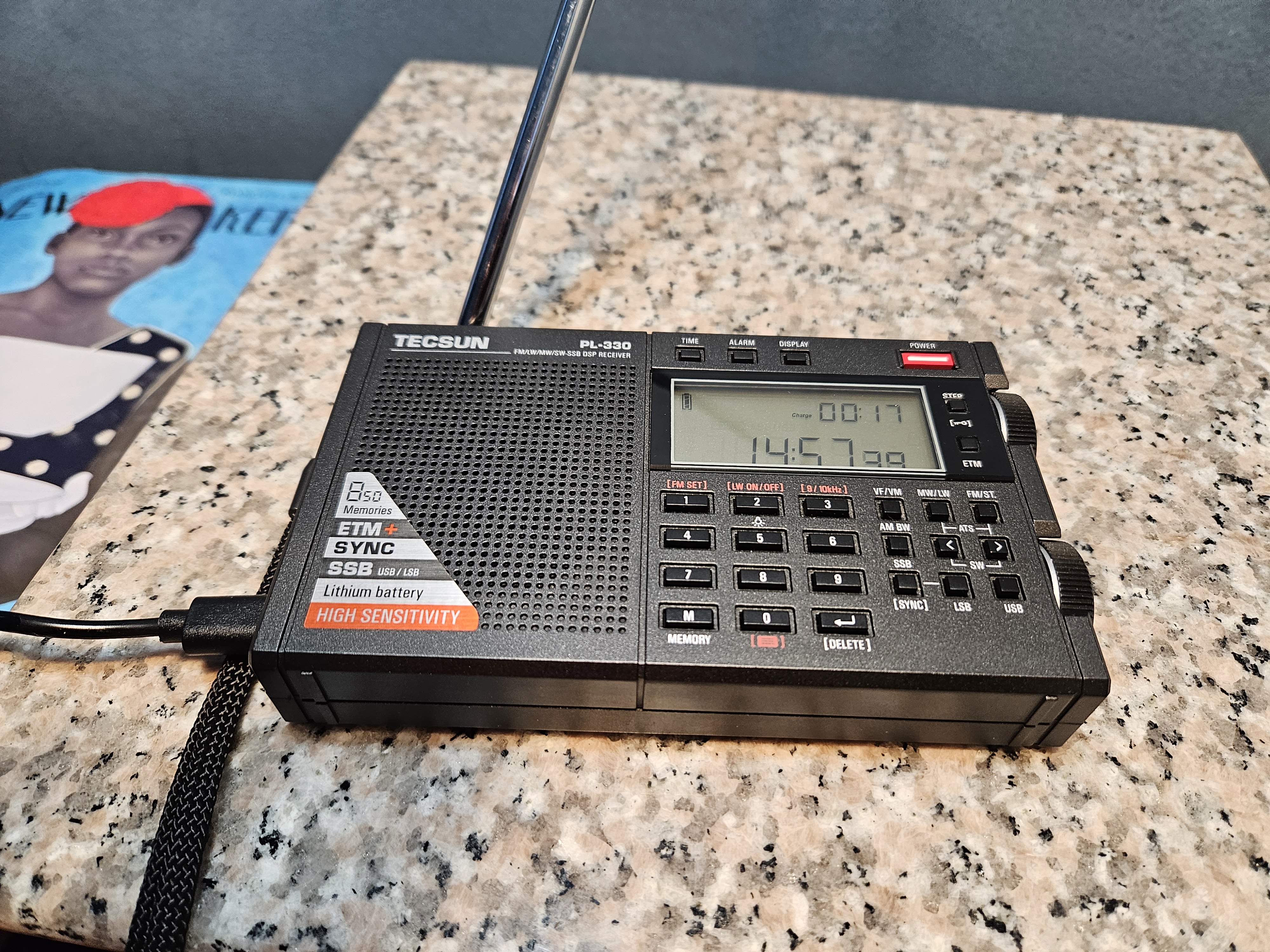
    Tecsun 330 & Qodosen

    Let’s get one thing straight: I had no business buying the Tecsun PL-330. None. I already own the Tecsun Four Horsemen—660, 680, 880, and 990—all brilliant in their own right, all lovingly hoarded. I even own the Qodosen DX-286, a small-footprint miracle that punches above its weight with a speaker that sounds like it’s packing 3 watts of sonic muscle, though the specs remain elusive. That radio even beats the Tecsuns on AM shielding, filtering out the urban electrical swamp that makes most radios wheeze and crackle like they’re being exorcised.

    And yet… the PL-330, a compact, .25-watt whisper of a radio, somehow seduced me. Maybe it was the open-box discount—$50 for a radio with a good reputation and a slightly rumpled box? Resistance was futile. I hit “Buy Now” faster than a dopamine junkie in a Black Friday frenzy.

    I didn’t even need the manual. Owning this many Tecsuns means I’m essentially fluent in Tecsunese. Clock setting? Presets? I could do it blindfolded while flossing.

    But let me be honest: The PL-330 is sleek. It has the crisp, militaristic geometry of something NASA might issue to interns. The buttons are snug and precise, unlike the Qodosen’s oversized, Playskool-style layout that screams “Designed by someone who just discovered ergonomics last Tuesday.”

    That said, Qodosen wins on practicality—it has a kickstand. The PL-330, bafflingly, does not. A design oversight or a cruel joke? We may never know.

    I don’t dabble in shortwave, but word on the street is that the 330 handles it like a champ. For FM, both radios are impressively sensitive, but I give a hair-thin edge to the Qodosen. On AM, the Qodosen’s clarity and noise control make it the better choice. For music, the Qodosen delivers a richer, more textured experience. But for talk radio, the PL-330 is sharper and cleaner—great for absorbing Madeleine Brand or NPR in the quiet of dawn.

    Verdict? The Qodosen stays bedside, loyal and boomy. The PL-330 earns a home in the master bath or kitchen, a quiet companion for 5 a.m. when the world still sleeps.

    Did I need it? Absolutely not. Am I keeping it? Absolutely.

    Tecsun PL-330 1
  • Brains for Glory: How Football Became the Lottery of the Left Behind

    Brains for Glory: How Football Became the Lottery of the Left Behind

    In Alana Semuels’ “The White Flight from Football,” we meet Shantavia Jackson, a single mother working the night shift at Home Depot. With three sons—ages 11, 12, and 14—she turns to youth football not just for recreation but as a form of structure, mentorship, and protection. Coaches become surrogate father figures, teaching discipline and teamwork. For her son Qway, who lives with a mental disorder, football provides a stabilizing force: a team that functions as his support system.

    For Shantavia, football isn’t just a sport—it’s an escape hatch. She can’t afford to send her sons to college, and she sees football as the only viable route out of a life circumscribed by poverty. It’s a desperate gamble, but in communities like hers, desperate gambles are often the only kind available.

    Against this backdrop, research continues to pile up showing that tackle football can cause severe and irreversible brain trauma. In response, many parents—particularly white and affluent—are pulling their children out of youth leagues. The ability to make that choice is, at its core, an expression of privilege. While white participation in youth football declines, Black participation remains disproportionately high: 44 percent of Black boys play tackle football, compared to just 29 percent of their white peers. This racial divide plays out on the national stage: today, Black athletes make up nearly half of all Division I college football players, up from 39 percent in 2000, while white athletes have dropped from 51 percent to 37 percent.

    The implication is grim: Black children are more likely to accept long-term risks because they have fewer short-term options. White children, cushioned by economic security and broader educational opportunities, can afford to walk away. The more the science reveals about the dangers of early head trauma, the more it becomes clear who is left holding the risk.

    And the science is damning. A 2017 Boston University study found that athletes who began playing tackle football before age 12 were twice as likely to develop behavioral problems and three times as likely to suffer from clinical depression. A separate study by Wake Forest University revealed that boys who played just one season of tackle football between the ages of 8 and 13 showed diminished brain function. The greatest fear is CTE—chronic traumatic encephalopathy—a degenerative brain disease caused by repeated hits to the head, not just concussions. Even subconcussive blows can cause lasting damage. In 2017, researchers examined the brains of 111 deceased NFL players. They found CTE in 110 of them.

    In response, some former players and medical experts now advocate delaying tackle football until high school, when bodies are more physically mature and kids are better able to understand and implement safe tackling techniques. But the sport is growing, not shrinking, and its profitability only reinforces the risk. At Texas A&M University, football generates $148 million a year. That revenue stream depends on a constant influx of young talent—often from families like Shantavia’s—eager for a scholarship and a shot at something better.

    The decision to play football, or not to, has become yet another expression of America’s racial wealth divide. As of 2021, the median wealth of white households was $250,400—about 9.2 times that of Black households, which stood at just $27,100. Though there have been modest gains in Black wealth, the gap remains vast. In 2022, the median wealth for Black households rose to $44,890—still far behind the $285,000 median for white households. This disparity isn’t merely numerical; it’s structural, baked into the opportunities people can or cannot access.

    In this context, football becomes less a sport and more a bloodletting ritual—one that disproportionately brutalizes the bodies of those with the fewest alternatives. For children growing up in neighborhoods with failing schools, limited healthcare, and short life expectancies, football isn’t just a game. It’s a high-stakes wager: risk your brain for a future, or settle for no future at all.

  • The Football Team Will Write About the Morality of Football for Our Freshman Composition Class

    The Football Team Will Write About the Morality of Football for Our Freshman Composition Class

    Next fall, I’ll be teaching freshman composition to the college football team, so I’m looking at the topic of football for one of their essay units.

    Here are three argumentative essay prompts that compare the book Against Football by Steve Almond with the film Concussion (2015, dir. Peter Landesman), all designed to be suitable for a 9-paragraph college essay structure (intro, 3 body sections with 2 paragraphs each, counterargument and rebuttal, conclusion). 

    Each prompt pushes students to wrestle with ethical, cultural, or systemic questions in a way that connects to their personal investment as student-athletes, without being simplistic or moralizing.


    Prompt 1: “The Morality of the Game”

    To what extent does Against Football and Concussion suggest that supporting or playing football is morally indefensible in light of what we now know about brain trauma, exploitation, and the business of the sport? Should young people still pursue football as a career path, given the risks?

    • In your essay, compare how Almond and the film depict the ethical stakes of football: What arguments do they make about the price players pay—physically, emotionally, and socially?
    • Analyze how both texts address public complicity: fans, media, institutions.
    • Take a clear stance: Can football be reformed, or is it inherently harmful?
    • Address the counterargument that football builds character, community, and economic opportunity—especially for marginalized groups.

    Prompt 2: “Who Owns the Narrative?”

    Both Against Football and Concussion challenge the dominant narrative that football is a patriotic, character-building institution. Who controls the narrative about football, and what do these two texts reveal about the gap between myth and reality?

    • Analyze how each text critiques the institutional power of the NFL and media: what’s hidden, denied, or spun?
    • Discuss how truth-tellers like Steve Almond and Dr. Bennet Omalu are treated when they challenge football’s mythology.
    • Evaluate the cultural need to preserve football’s heroic image. Who benefits?
    • Address the counterargument that critique undermines a beloved national tradition and can have unintended consequences for working-class athletes.

    Prompt 3: “Risk, Choice, and Exploitation”

    Do players—especially college athletes—truly understand and consent to the risks of playing football, or are they part of a system that exploits them for entertainment and profit? Use Against Football and Concussion to explore how knowledge, agency, and power intersect in the sport.

    • Analyze how the film and book portray informed consent—do players know what they’re signing up for?
    • Compare how the NCAA and NFL manage risk and liability, and who bears the consequences.
    • Examine the role of race, class, and opportunity: how does background shape one’s ability to walk away?
    • Address the counterargument that players have free will, financial incentives, and personal responsibility to weigh the risks.

    Here are five counterarguments that defend football against the criticisms raised by Steve Almond’s Against Football and the film Concussion—each paired with a rationale that students can expand into argumentative paragraphs or use in rebuttal sections:


    1. Football Builds Character, Discipline, and Resilience

    Defense:
    While Almond argues that football glorifies violence and toxic masculinity, defenders claim the sport instills discipline, work ethic, time management, and perseverance. Players must memorize complex plays, train year-round, and learn how to function under pressure—skills transferable to education, careers, and life.

    Example expansion:
    For many young athletes, football teaches more than just how to tackle. It’s a structured environment that requires commitment and accountability, often keeping students academically eligible and socially supported in school communities.


    2. Informed Consent and Autonomy

    Defense:
    Critics like Almond and Concussion raise serious concerns about brain injuries, but players—especially adults—now have increasing access to information about those risks. If someone chooses to play football despite those risks, it’s their right. To suggest otherwise is to infantilize athletes and undermine their agency.

    Example expansion:
    We allow adults to drive motorcycles, box, or climb Everest—why should football be different? Autonomy means respecting a person’s right to assess danger and still choose to participate.


    3. Football Creates Educational and Economic Opportunities

    Defense:
    For many students, especially from low-income communities, football offers a path to college, scholarships, and sometimes even professional careers. Removing or diminishing football could eliminate one of the few structured pipelines to higher education.

    Example expansion:
    Steve Almond critiques the exploitative nature of college football, but what alternatives exist that offer the same combination of structure, community, and opportunity? For some, football is the only shot at upward mobility.


    4. Reforms Are Happening—Football Isn’t Static

    Defense:
    Football has changed. Rules have evolved to protect quarterbacks and defenseless receivers, and protocols around concussions are stricter than ever. Critics assume the sport is frozen in time, but it’s adapting to new science and pressure from advocates.

    Example expansion:
    While Concussion dramatizes the NFL’s history of denial, today’s league invests in helmet technology, baseline testing, and return-to-play guidelines. Youth leagues are teaching safer tackling methods. Progress is slow, but it’s happening.


    5. Football Builds Community and Cultural Unity

    Defense:
    Football isn’t just a sport—it’s a shared cultural ritual. From Friday night lights to Super Bowl Sunday, it creates bonds between families, towns, and regions. For many Americans, football is one of the few communal experiences left.

    Example expansion:
    Almond sees fandom as complicit, but fans see themselves as part of something larger—cheering for their school, city, or nation. That sense of belonging can be powerful, especially in an increasingly fragmented society.