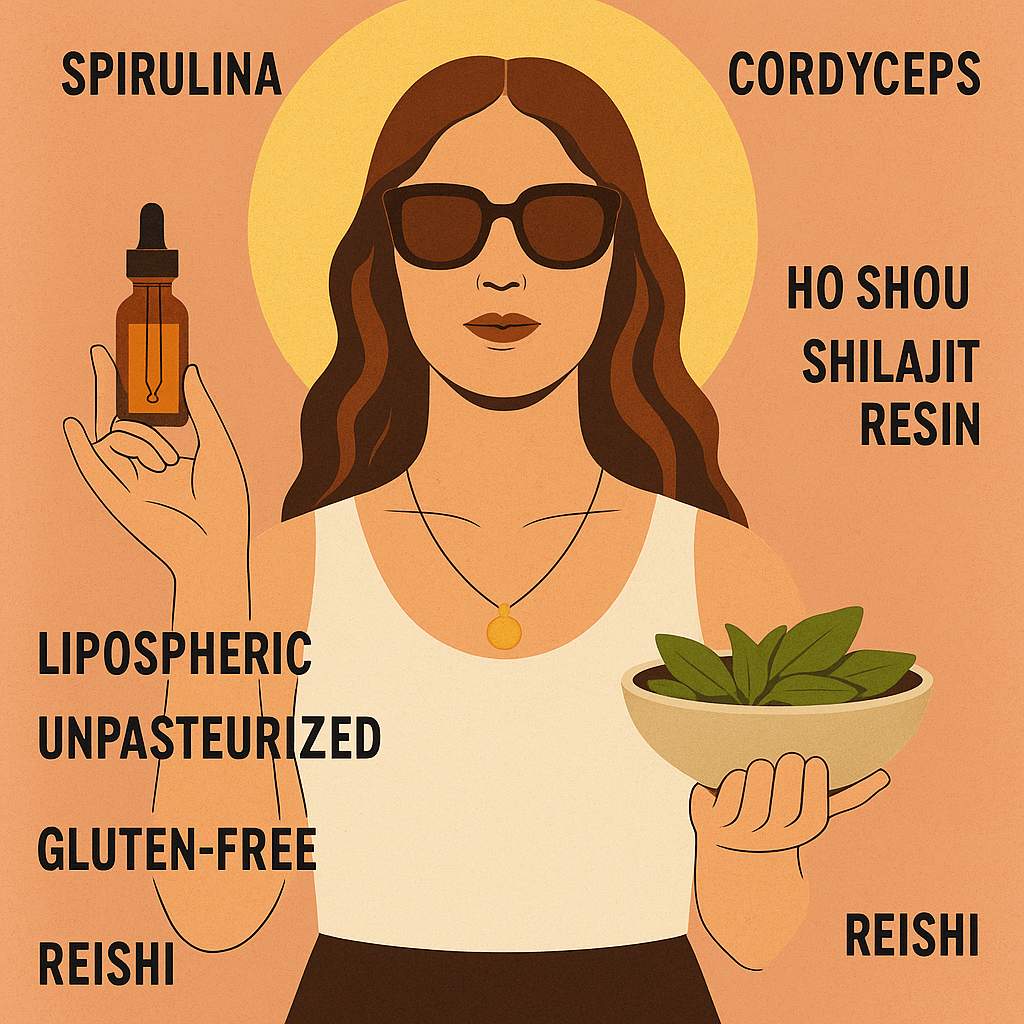
Reading Amy Larocca’s How to Be Well is like watching Gwyneth Paltrow’s ghost possess a Whole Foods employee mid-mushroom latte. Her book is equal parts riveting and scalpel-sharp, dissecting the strange mutation of fashionistas who’ve traded in Gucci for goop and now drape themselves in wellness jargon like it’s couture. These wellness evangelists don’t just eat clean—they chant it. They speak in tongues made of spirulina, lipospheric vitamin C, Cordyceps, Shilajit resin, and ho shou wu, stringing together syllables like they’re summoning the ghost of Hippocrates.
What we’re witnessing isn’t self-care—it’s a personality cult with better lighting. The modern wellness priestess has crowned herself a demigod, armed with adaptogens instead of sacraments, waving her magic tincture dropper and pointing lesser mortals toward the True Path of purified, gluten-free, unpasteurized transcendence. It’s not just health—it’s high-performance sanctimony.
Larocca nails the diagnosis with surgical precision: “I sometimes think of wellness as the project of buying your own body back for yourself.” Translation? Welcome to America’s chicest hostage situation, where the ransom is payable in collagen peptides and oat milk. The goal is to become the luxury-branded version of you—perfect skin, toxin-free bowels, and moral superiority radiating from every overpriced yoga mat. The side effect? It magnifies the gaping inequalities of modern life like a magnifying mirror you didn’t ask to look into.
Because let’s be honest: none of this comes cheap. These rituals of wellness cost money—bucketloads of it. We’re not talking about a jog around the park and some tap water. We’re talking $12 green juices and $300 infrared saunas. The entire project is rigged to serve the few while gaslighting the many. The wellness priestess doesn’t just ignore that her lifestyle is unattainable for most—she markets that inaccessibility as part of the charm.
This isn’t health—it’s spiritual cosplay for the affluent.
 Cinemorphosis