Tag: hawaii

  • Why I’ll Never Be a Normal Tourist

    Why I’ll Never Be a Normal Tourist

    I don’t deserve a nice vacation. Who am I to lounge in tropical paradise, sipping a Miss Sunshine on the rooftop of Tommy Bahama’s in Honolulu—a lemon-infused Grey Goose cocktail dressed up with coconut and salted honey, basically sunshine in a martini glass?

    Yet that’s exactly what I did on my last night in town. My family and I ate dinner under the soft glow of string lights while a guitarist named Mark worked the crowd. He had that rare gift of making diners feel the music was just for them. My daughter requested Neil Young’s “Harvest Moon.” Mark delivered it like a love letter. I followed with The Go-Betweens’ “Streets of Our Town.” He’d never heard of it. Then I tried “Back to the Old House” by The Smiths. His eyes lit up.

    “Oh, you’re one of those,” he said, as if I’d just flashed a velvet-lined membership card to the Melancholy Music Society. “Are you a musician?”

    I admitted to being an amateur pianist. During his break, we talked shop. He’d been gigging since 1979, grew up on Oahu, and had soured on Maui—“negative energy,” he said, with the certainty of a man who’s read the island’s aura. His favorite? The Big Island, especially Hilo. “Hilo’s the lush side,” he told me, as if revealing a secret password.

    The next day, stuck in the Honolulu airport waiting for a delayed United flight (short a flight attendant, with a substitute speeding in from home), I met Zack—a 48-year-old professional golf caddy with the leathery tan of someone who spends life between fairways and airports. He was headed to Houston, then on to Kansas City for a tournament at Blue Hills Country Club.

    We talked for forty-five minutes about the job. “You have to make a world-class golfer like you, trust you, and win,” I told him. “That’s harder than being a psychiatrist.”

    He grinned. “Same as being a college writing instructor.”

    Touché. We agreed we were both part salesman, part psychologist.

    Zack checked his watch. “If I make my Houston connection, I get Texas brisket with my family before the drive to KC.” His wife taught French at an Oahu high school; they’d lived there over twenty years. Like Mark, he loved the Big Island most. Also like Mark, he worshipped Hilo. In fact, he’d bought land there for his retirement.

    On the flight, I lost myself in Jim Bouton’s Ball Four on Audible, forgetting about Zack—until landing, when the flight attendants asked passengers to clear the way for passengers with tight connections. At the back, there was Zach, looking like he’d just played eighteen holes without water.

    With the authority of a man who’d just been handed the Staff of Moses, I raised my hand: “Make way for my friend Zack! He has three minutes to make his connection!” The crowd parted. As he hurried past me, I patted his back and told him to enjoy the brisket.

    My wife nearly folded in half laughing at my grandiosity, my habit of turning chance encounters into minor epics. At baggage claim, she called Mark and Zack my “new friends.”

    She’s right. I may never learn to truly relax on vacation. But give me a stranger with a story, and I’ll make a night of it.
  • Ghosts at Pearl Harbor: A Morning of Reverence and Unease

    Ghosts at Pearl Harbor: A Morning of Reverence and Unease

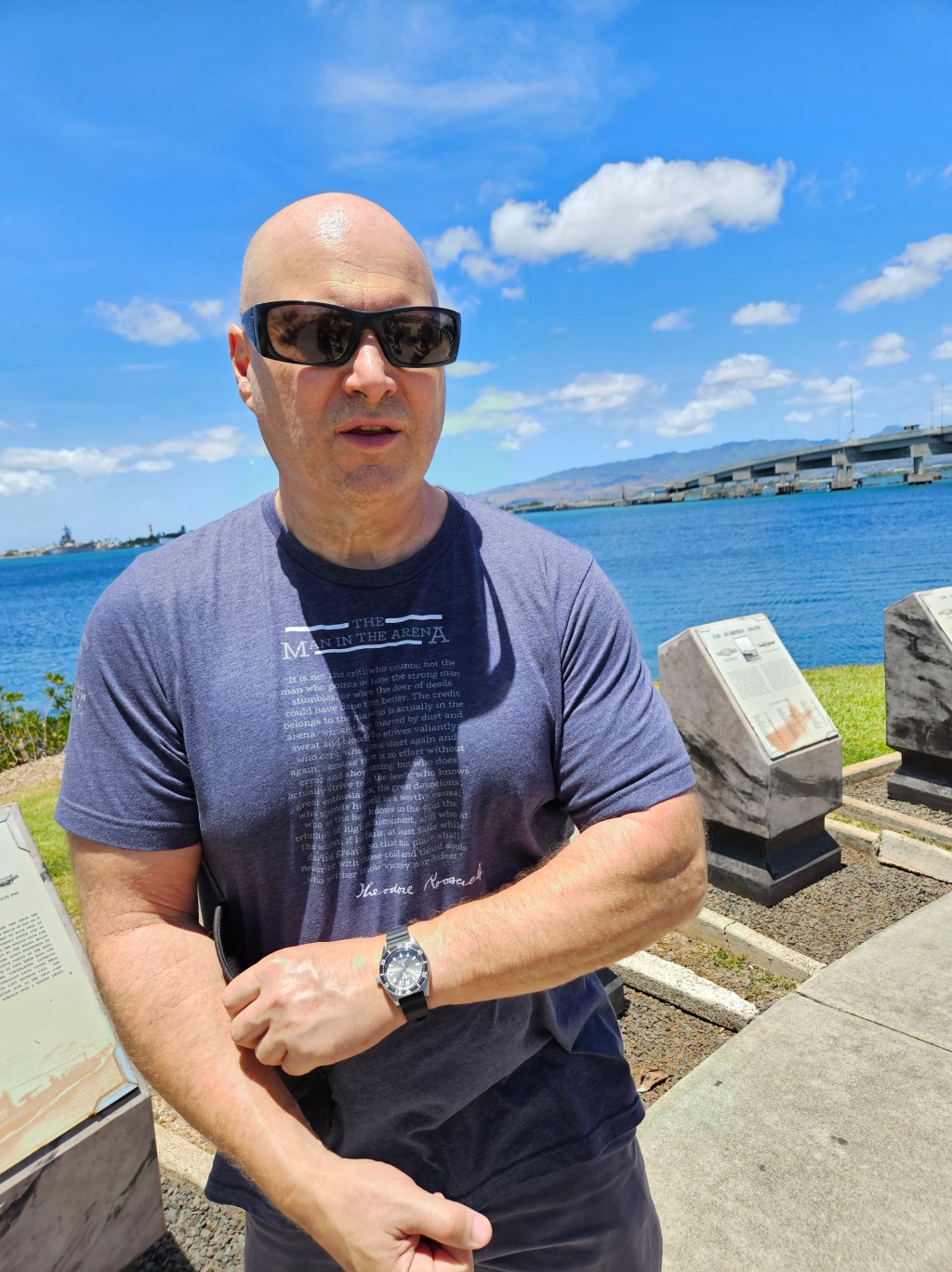
    Yesterday we drove thirty minutes from the Embassy Suites in Waikīkī to the Pearl Harbor Memorial, where solemnity hangs in the air like thick humidity. The journey from beachfront ease to battlefield remembrance felt immediate and irreversible.

    Inside the visitor center’s theater, a National Park spokesperson stood behind a lectern—short, compact, dark-haired, with the confident charisma of someone who has delivered this message a thousand times, and still means every word.

    “You’re not on a must-see tour,” he said, with an edge of reprimand. “You’re visiting a mass military gravesite. This is more than a military tragedy—it’s familial. Thousands of children lost their parents that day. That grief doesn’t expire. It echoes. Please treat this place with respect—not as a TikTok backdrop.”

    I thanked him on the way to the dock. His words stripped away any residue of tourism and replaced it with reverence.

    We boarded a navy-operated boat alongside a quietly murmuring mix of global visitors—Germans, Japanese, mainland Americans, Australians. The boat was packed, but no one jostled or joked. You could feel the history pressing in from all directions.

    At the memorial itself, I tried to read the names etched into white marble. I tried to focus. But I was distracted—haunted—by two figures lingering at the edge of my vision.

    They were brothers, unmistakably. In their thirties, pale as winter ash, with dirty-blond hair and heads shaped like crude pyramids. Their eyes—almond-shaped, off-kilter—glinted with something sharp. Their teeth were crooked and small, the kind that suggest years of silent snarling. They were so wiry, so sunken, that even their frosted skinny jeans hung like surrender flags around their twiggy legs. Nicotine-stained, post-industrial, almost spectral.

    They spoke in rapid whispers—something Slavic, maybe Czech or Slovak—always leaning close, always glancing. They radiated the kind of anxious secrecy that suggested they were either up to something or simply never learned how not to seem that way.

    Everyone avoided them. Even when we were asked to scoot together on the boat to make room, the brothers sat untouched—shunned like they carried some forgotten plague. They were the kind of figures who seem pulled from the margins of a Dostoevsky novel or the casting list of a horror film.

    I can’t stop thinking about them. What drew them to Pearl Harbor? What shadow were they following? Their presence felt less like tourism and more like reconnaissance. In another life, in another medium, they could be characters in a Safdie brothers film—like John the heavy from Uncut Gems, who wasn’t an actor at all, just a force of nature discovered on the street.

    You can’t invent that kind of menace. You can only observe it, marvel at it, and wonder: what story did they bring to the memorial, and what story did they take away? And why in my heart do I see them less as tourists and more as criminals embarking on some kind of scheme?