Tag: health

  • New Yorker’s Remorse Syndrome

    New Yorker’s Remorse Syndrome

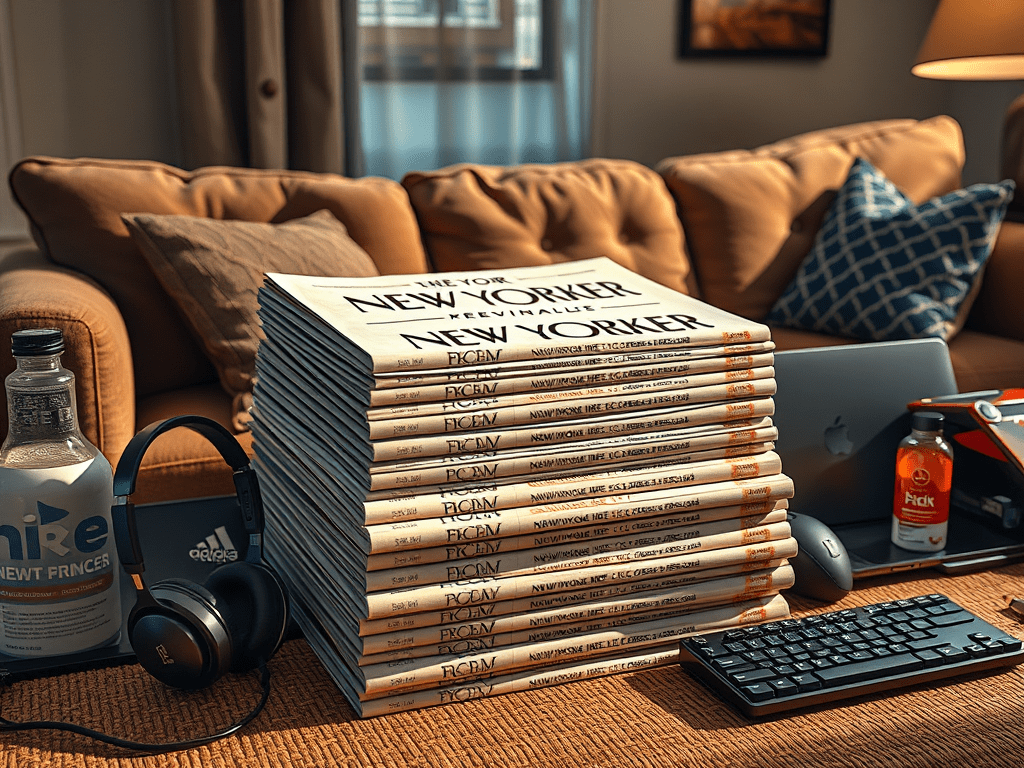
    It’s a charming form of cosplay, really — striding around as a “well-informed citizen” while sinking ungodly hours into consumer research. Watches, radios, headphones, laptops, Chromebooks, mechanical keyboards, high-end sweatshirts, orthopedic luxury sneakers, protein powders, protein bars, athletic-grade water bottles — an entire temple of optimized living, curated with clerical devotion.

    Meanwhile, out in the real world, society is fraying like an ancient flag in a hurricane. Yeats’ prophecy is no longer a chilling warning — it’s a project status update.
    The center isn’t holding. The center left the chat months ago.
    But instead of reckoning with the slow dissolve of civil society, it’s so much easier, so much kinder to the blood pressure, to compare toaster ovens with touchless air fryer settings.

    Yes, yes, I know — one must be informed. George Carlin gave us front-row tickets to the Freak Show. We owe it to the species, or at least to our own dim dignity, to bear witness.
    But honestly? Some days, it feels like sanity demands partial withdrawal. A news podcast here. A curated briefing there. Enough to feign civic engagement at parties without having to call a therapist immediately afterward.

    This brings me to the shrine of guilt at the center of my living room: the great, unread New Yorker stack.
    I have subscribed since 1985, back when Reagan was doing his best kingly impression and nobody had heard of an iPhone.
    The stack now functions less as reading material and more as a kind of grim altar — a silent accusation in glossy print.
    Friends glance at it and nod approvingly, as if my very possession of these magazines implies moral seriousness.
    I let them believe.
    Inside, I know better.
    I know that I am a fallen monk, a heretic of intellectual duty, choosing the velvet lure of consumer escapism over the weighty gospels of sociopolitical collapse.

    I have a diagnosis: New Yorker’s Remorse Syndrome — a condition in which one publicly performs allegiance to Enlightenment values while privately seeking refuge among comparison charts and Amazon star ratings.
    The mind knows what it ought to do.
    The heart, however, prefers shopping for the perfect water bottle while Rome burns quietly in the background.

  • Riding the Misery Machine: How Not Looking Became My Superpower

    Riding the Misery Machine: How Not Looking Became My Superpower

    Sixteen days ago, bloated at a mortifying 247 pounds, I decided enough was enough.
    On April 10th, I gave my calorie binges the boot, hacking my intake down to around 2,400 calories a day while shoving 160 grams of protein down my gullet like a man training for a hostage rescue mission.
    I also added a sixth workout to my weekly five kettlebell sessions: a brutal appointment with what I now lovingly call the Misery Machine.

    What’s the Misery Machine, you ask?
    It’s the Schwinn Airdyne—a sadistic stationary bike crossed with a medieval torture rack.
    It has pedals for your legs and levers for your arms, ensuring that no muscle group escapes unscathed. Your pecs, shoulders, triceps, forearms, glutes, quads—all dragged into the inferno.
    And because Schwinn engineers apparently hate human joy, the faster you go, the more resistance it throws at you.
    It’s not a workout; it’s a trial by fire.

    My first two rides were pathetic: 59 minutes of flailing, barely burning 600 calories.
    Today, though, I hit 706 calories in the same time—an improvement, and not just physically.

    Part of the success came from a psychological gambit: don’t look at the odometer.
    Staring at the screen, counting every miserable calorie and every sadistic second, makes the workout feel endless, like some gym-rat version of waterboarding.
    So today, I swore: I will not look.
    My secret weapon would be ignorance. Eyes forward. Mind blank. Focus on breathing, moving, surviving.

    Did it work?
    Mostly.
    I cheated about six times, sneaking guilty glances at the odometer—still, better than the constant obsessive checking that turns my bike rides into psychological horror shows reminiscent of my endless, soul-crushing drives up the I-5 from Los Angeles to San Francisco.

    But the real goal—the Holy Grail—is zero looks.
    Like Lot’s wife, ordered not to turn back lest she turn into a pillar of salt, I know: if I glance back at the numbers, I’ll be punished with despair.

    Today, post-shower, the scale gave me a small nod: 239 pounds.
    Only 39 pounds to go until I reclaim something resembling dignity.

    Lucky me.
    Nothing but time, pain, and the Misery Machine standing between me and the man I intend to be.

  • The Protein Bar Delusion: My Love Affair with Lies and Graham Crackers

    The Protein Bar Delusion: My Love Affair with Lies and Graham Crackers

    I don’t eat protein bars anymore. Not because I’m virtuous—far from it—but because I finally admitted the obvious: they’re not meal replacements. They’re meal add-ons, sneaky little calorie grenades dressed up in the halo of anabolic health, whispering sweet promises of lean muscle and zero guilt.

    I’ve been chasing that lie since the 1970s.
    Back then, the gold standard of protein bars was the Bob Hoffman Club Sandwich—a peanut butter and graham cracker Frankenstein’s monster that must have clocked in at 500 calories, easy. It wasn’t a snack. It wasn’t a supplement. It was a religious experience.
    If I wanted to recreate it today, I’d just mash a couple of Reese’s between two graham crackers and pray for forgiveness.

    Over the decades, I kept eating protein bars—dense peanut butter bricks, chewy “engineered food” monstrosities—but never to any good effect. These bars didn’t sculpt my physique. They bulked me up like a slow, steady inflation of regret. Eventually, I abandoned them, like a gambler walking away from the slot machine after realizing the house always wins.

    Still, they haunt me.
    Protein bars remind me of Willy Wonka’s cursed 7-course meal gum that turned Violet Beauregarde into a giant blueberry: a miracle product promising the world but delivering only bloat and existential crisis.

    To be fair, the bars have gotten better over the years. There’s even one called David (because apparently even protein bars have minimalist branding now) made with real food, boasting 28 grams of protein at a miraculous 150 calories. It tempts me.
    Wouldn’t it be smarter, simpler, even a bit sexier to chomp down a David bar at breakfast instead of mixing up my daily slurry of yogurt, protein powder, soy milk, and berries? (A concoction that hits 500 calories with depressing reliability.)

    Maybe. But I know myself: I’d be starving by 9:30 a.m., staring into the abyss of a second breakfast. Protein bars have never given me satiety. They’re a snack in drag—a dessert cosplaying as health food.

    And yet… with all the shredded influencers on YouTube slicing open protein bars like they’re sommelier-testing vintage wine, I feel the pull. A little FOMO. A little “Maybe this time it’ll be different.”

    I have to remind myself, again and again:
    I’m not in love with the protein bar.
    I’m in love with the idea of the protein bar—the fantasy that some sweet, tidy, macro-balanced rectangle will solve my problems, sculpt my body, and carry me into some higher, cleaner version of myself.

    Reality tastes different.
    It tastes like mealy, sweet resignation. It tastes like being duped—with a thin layer of whey isolate on top.

  • Protein, Lies, and Artificial Flattery: Wrestling with ChatGPT Over My Macros

    Protein, Lies, and Artificial Flattery: Wrestling with ChatGPT Over My Macros

    Two nights ago, I did something desperate: I asked ChatGPT to craft me a weight-loss meal plan and recommend my daily protein intake. Ever obliging, it spit out a gleaming regimen straight from a fitness influencer’s fever dream—four meals a day, 2,400 calories, and a jaw-dropping 210 grams of protein.

    The menu was pure gym-bro canon: power scrambles, protein smoothies, broiled chicken breasts stacked like cordwood, Ezekiel toast to virtue-signal my commitment, and yams because, apparently, you can’t sculpt a six-pack without a root vegetable chaser.

    Being moderately literate in both numbers and delusion, I did the math. The actual calorie count? Closer to 3,000. I told ChatGPT that at 3,000 calories a day, I wouldn’t be losing anything but my dignity. I’d be gaining—weight, resentment, possibly a second chin.

    I coaxed it down to 190 grams of protein, begging for something that resembled reality. The new menu looked less like The Rock’s breakfast and more like something a human might actually endure. Still, I pressed further, explaining that in the savage conditions of the real world—where meals are not perfectly macro-measured and humans occasionally eat a damn piece of pizza—it was hard to hit 190 grams of protein without blowing past 2,400 calories.

    Would I really lose muscle if I settled for a lowly 150 grams of protein?

    ChatGPT, showing either mercy or weakness, conceded: at worst, I might suffer a “sliver” of muscle loss. (Its word—sliver—suggesting something as insignificant as a paper cut to my physique.) It even praised my “instincts,” like a polite but slightly nervous trainer who doesn’t want to get fired.

    In three rounds, I had negotiated ChatGPT down from 210 grams to 150 grams of protein—a full 29% drop. Which left me wondering:
    Was ChatGPT telling me the truth—or just nodding agreeably like a digital butler eager to polish my biases?

    Did I really want to learn the optimal protein intake for reaching 200 pounds of shredded glory—or had I already decided that 150 grams felt right, and merely needed an algorithmic enabler to bless it?

    Here’s the grim but necessary truth: ChatGPT is infinitely more useful to me as a sparring partner than a yes-man in silicon livery.
    I don’t need an AI that strokes my ego like a coddling life coach telling me my “authentic self” is enough. I need a credible machine—one willing to challenge my preconceived notions, kick my logical lapses in the teeth, and leave my cognitive biases bleeding in the dirt.

    In short: I’m not hiring a valet. I’m training with a referee.
    And sometimes, even a well-meaning AI needs to be reminded that telling the hard truth beats handing out warm towels and platitudes.

  • Snac-lebrity Envy

    Snac-lebrity Envy

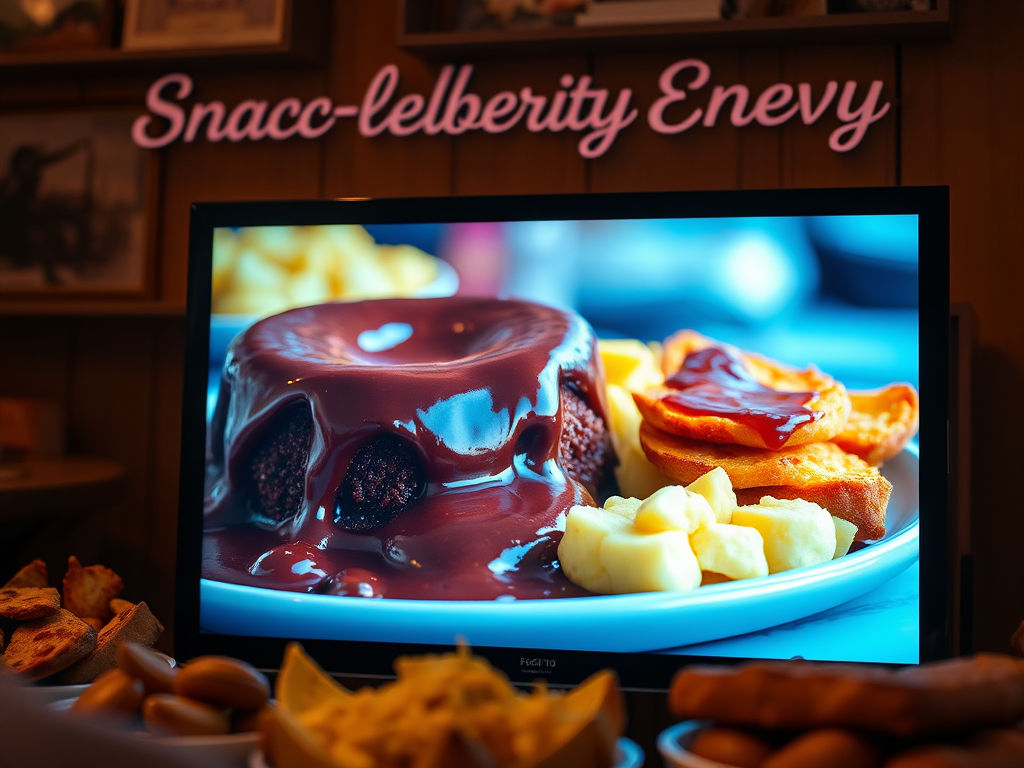
    Television, that glowing oracle of modern life, is less a form of entertainment than a padded cell for the overworked brain. It’s where we go to decompress—to let our minds wander through slickly written dramas or “authentic” reality shows that masquerade as anthropological case studies in human dysfunction. It’s just smart enough not to insult your intelligence, but just soothing enough to flatten your ambition. And yet, this ritual of mental escape comes at a price, and that price is food porn. High-definition, Dolby-enhanced, slow-motion food porn.

    Forget plotlines. It’s the sound of a corn tortilla cracking like a gunshot through your living room, the close-up of chocolate lava cake oozing with erotic precision. You’re not watching TV—you’re being lured into a hunger trap set by Emmy-winning saboteurs. Your willpower doesn’t stand a chance.

    Worse still, these on-screen avatars of metabolic sorcery devour garlic mashed potatoes, fruit Danishes, and croissant-stuffed French toast with impunity—then rise from the table looking like a yoga ad. These are not people; they are calorie-defying sirens sent to destroy your self-control. They nibble bearclaws and remain airbrushed and lithe. You so much as sniff a breadstick and your waistband tightens.

    This, dear reader, is Snac-lebrity Envy—the gnawing resentment you feel watching the beautiful and well-lit inhale calories like coal into a furnace while your “dessert” is a string cheese and a cry for help. It’s not simple jealousy. It’s the psychic whiplash of seeing your dietary struggle mocked in real-time by people whose only hardship is deciding between oat milk or almond.

    Snac-lebrity Envy isn’t just an emotion—it’s a syndrome. It lives in your dopamine pathways, chews on your restraint, and whispers sweet nihilism: “Go ahead. Eat the cheesecake. The system’s rigged anyway.” It’s not just TV. It’s sabotage you can binge.

  • The Skinny Kingdom Denied

    The Skinny Kingdom Denied

    When it comes to convincing your healthcare plan to cover GLP-1 drugs like Mounjaro or Ozempic, prepare to enter the bureaucratic Twilight Zone. You might think being thirty or forty pounds overweight with blood pressure, cholesterol, and triglycerides inching toward DEFCON 2 would qualify you for a pharmaceutical lifeline. But no—your semi-morbid condition isn’t morbid enough. You’re not quite in the “Skinny Kingdom” yet. You’re stuck in the purgatory of “almost sick,” where the medical advice is to do what 80% of people can’t manage long-term: lose weight the old-fashioned way. Cue the eye-roll and the salad.

    This is where I live—too metabolically misaligned for comfort, but too “not dying fast enough” for insurance. So without the aid of GLP-1 wonder-drugs, I’ve been forced to build my own survival kit. Enter: the diet blog. Yes, that hackneyed relic of the internet. One evolutionary rung above the YouTube weight-loss vlog, and about one click away from a Pinterest board full of quinoa regret. But here’s my defense: writing this thing keeps me sane. First, let’s acknowledge the stakes. I’m attempting to succeed at something with an 80% failure rate. If journaling helps me thread the needle between health and hoagies, I deserve at least a participation trophy. Second, maybe—just maybe—my hard-earned insights might help someone else. Third, I need a breadcrumb trail for myself. Because when the binge fog clears, I need a record of how I got out of the woods.

    But let’s get this straight: if I’m going to write a diet blog, it comes with rules.
    Rule #1: No hawking miracle powders or gut-cleansing teas. This isn’t a supplement commercial. It’s a field report from the front lines of temptation.
    Rule #2: No ab selfies. No one asked, and no one wants to see the cinematic arc of my belly fat.
    Rule #3: No sanctimonious “one-size-fits-all” advice. What works for me may not work for you. I’m here to offer humility, not doctrine.
    Rule #4: Keep it funny. We live in a world where 2,000-calorie muffins are marketed as breakfast. If you can’t laugh at that, you’re doomed.
    Rule #5: No performative pity. Yes, self-discipline is hard. But I’m not marching across Antarctica—I’m just saying no to a Costco cheesecake. Keep perspective.

    If there’s a unifying thesis to this blog, it’s this: self-indulgence is a false god. The man who eats without limits is not happier—he’s just momentarily sedated. True satisfaction comes from self-possession, not pastry. This isn’t about vanity or some fantasy of being a low-body-fat Spartan. It’s about dignity. The mature eater is the happier eater. And if I have to claw my way there without the help of Ozempic, so be it. I’ll blog my way through the absurdity. One disciplined bite at a time.

  • The Gospel According to Mounjaro and ChatGPT

    The Gospel According to Mounjaro and ChatGPT

    The other day I was listening to Howard Stern and his co-host Robin Quivers talking about how a bunch of celebrities magically slimmed down at the same time. The culprit, they noted, was Ozempic—a drug available mostly to the rich. While they laughed about the side effects, such as incontinence, “Ozempic face” and “Ozempic butt,” I couldn’t help but see these grotesque symptoms as a metaphor for the Ozempification of a society hooked on shortcuts. They enjoyed some short-term benefits but the side effects were far worse than the supposed solution. Ozempification was strikingly evident in AI-generated essays–boring, generic, surface-level, cliche-ridden, just about worthless. Regardless of how well structured and logically composed, these essays have the telltale signs of “Ozempfic face” and “Ozempic butt.” 

    As a college writing instructor, I’m not just trying to sell academic honesty. I’m trying to sell pride. As I face the brave new world of teaching writing in the AI era, I’ve realized that my job as a college instructor has morphed into that of a supercharged salesman. And what am I selling? No less than survival in an age where the very tools meant to empower us—like AI—threaten to bury us alive under layers of polished mediocrity. Imagine it: a spaceship has landed on Earth in the form of ChatGPT. It’s got warp-speed potential, sure, but it can either launch students into the stars of academic brilliance or plunge them into the soulless abyss of bland, AI-generated drivel. My mission? To make them realize that handling this tool without care is like inviting a black hole into their writing.

    As I fine-tune my sales pitch, I think about Ozempic–that magic slimming drug, beloved by celebrities who’ve turned from mid-sized to stick figures overnight. Like AI, Ozempic offers a seductive shortcut. But shortcuts have a price. You see the trade-off in “Ozempic face”—that gaunt, deflated look where once-thriving skin sags like a Shar-Pei’s wrinkles—or, worse still, “Ozempic butt,” where shapely glutes shrink to grim, skeletal wiring. The body wasn’t worked; it was bypassed. No muscle-building, no discipline. Just magic pill ingestion—and what do you get? A husk of your former self. Ozempified.

    The Ozempification of writing is a marvel of modern mediocrity—a literary gastric bypass where prose, instead of slimming down to something sleek and muscular, collapses into a bloated mess of clichés and stock phrases. It’s writing on autopilot, devoid of tension, rhythm, or even the faintest trace of a soul. Like the human body without effort, writing handed over to AI without scrutiny deteriorates into a skeletal, soulless product: technically coherent, yes, but lifeless as an elevator pitch for another cookie-cutter Marvel spinoff.

    What’s worse? Most people can’t spot it. They think their AI-crafted essay sparkles when, in reality, it has all the charm of Botox gone wrong—rigid, lifeless, and unnervingly “off.” Call it literary Ozempic face: a hollowed-out, sagging simulacrum of actual creativity. These essays prance about like bargain-bin Hollywood knock-offs—flashy at first glance but gutless on closer inspection.

    But here’s the twist: demonizing AI and Ozempic as shortcuts to ruin isn’t the full story. Both technologies have a darker complexity that defies simplistic moralizing. Sometimes, they’re necessary. Just as Ozempic can prevent a diabetic’s fast track to early organ failure, AI can become a valuable tool—if wielded with care and skill.

    Take Rebecca Johns’ haunting essay, “A Diet Writer’s Regrets.” It rattled me with its brutal honesty and became the cornerstone of my first Critical Thinking essay assignment. Johns doesn’t preach or wallow in platitudes. She exposes the failures of free will and good intentions in weight management with surgical precision. Her piece suggests that, as seductive as shortcuts may be, they can sometimes be life-saving, not soul-destroying. This tension—between convenience and survival, between control and surrender—deserves far more than a knee-jerk dismissal. It’s a line we walk daily in both our bodies and our writing. The key is knowing when you’re using a crutch versus when you’re just hobbling on borrowed time. 

    I want my students to grasp the uncanny parallels between Ozempic and AI writing platforms like ChatGPT. Both are cutting-edge solutions to modern problems: GLP-1 drugs for weight management and AI tools for productivity. And let’s be honest—both are becoming necessary adaptations to the absurd conditions of modern life. In a world flooded with calorie-dense junk, “willpower” and “food literacy” are about as effective as handing out umbrellas during a tsunami. For many, weight gain isn’t just an inconvenience—it’s a life-threatening hazard. Enter GLP-1s, the biochemical cavalry.

    Similarly, with AI tools quickly becoming the default infrastructure for white-collar work, resisting them might soon feel as futile as refusing to use Google Docs or Windows. If you’re in the information economy, you either adapt or get left behind. But here’s the twist I want my students to explore: both technologies, while necessary, come with strings attached. They save us from drowning, but they also bind us in ways that provoke deep, existential anguish.

    Rebecca Johns captures this anguish in her essay, “A Diet Writer’s Regrets.” Ironically, Johns started her career in diet journalism not just to inform others, but to arm herself with insider knowledge to win her own weight battles. Perhaps she could kill two birds with one stone: craft top-tier content while secretly curbing her emotional eating. But, as she admits, “None of it helped.” Instead, her career exploded along with her waistline. The magazine industry’s appetite for diet articles grew insatiable—and so did her own cravings. The stress ate away at her resolve, and before long, she was 30 pounds heavier, trapped by the very cycle she was paid to analyze.

    By the time her BMI hit 45 (deep in the obesity range), Johns was ashamed to tell anyone—even her husband. Desperate, she cycled through every diet plan she had ever recommended, only to regain the weight every time. Enter 2023. Her doctor handed her a lifeline: Mounjaro, a GLP-1 drug with a name as grand as the results it promised. (Seriously, who wouldn’t picture themselves triumphantly hiking Mount Kilimanjaro after hearing that name?) For Johns, it delivered. She shed 80 pounds without white-knuckling through hunger pangs. The miracle wasn’t just the weight loss—it was how Mounjaro rewired her mind.

    “Medical science has done what no diet-and-exercise plan ever could,” she writes. “It changed my entire relationship with what I eat and when and why.” Food no longer controlled her. But here’s the kicker: while the drug granted her a newfound sense of freedom, it also raises profound questions about dependence, control, and the shifting boundaries of human resilience—questions not unlike those we face with AI. Both Ozempic and AI can save us. But at what cost? 

    And is the cost of not using these technologies even greater? Rebecca Johns’ doctor didn’t mince words—she was teetering on the edge of diabetes. The trendy gospel of “self-love” and “body acceptance” she had once explored for her articles suddenly felt like a cruel joke. What’s the point of “self-acceptance” when carrying extra weight could put you six feet under?

    Once she started Mounjaro, everything changed. Her cravings for rich, calorie bombs disappeared, she got full on tiny portions, and all those golden nuggets of diet advice she’d dished out over the years—cut carbs, eat more protein and veggies, avoid snacks—were suddenly effortless. No more bargaining with herself for “just one cookie.” The biggest shift, however, was in her mind. She experienced a complete mental “reset.” Food no longer haunted her every waking thought. “I no longer had to white-knuckle my way through the day to lose weight,” she writes.

    Reading that, I couldn’t help but picture my students with their glowing ChatGPT tabs, no longer caffeinated zombies trying to churn out a midnight essay. With AI as their academic Mounjaro, they’ve ditched the anxiety-fueled, last-minute grind and achieved polished results with half the effort. AI cushions the process—time, energy, and creativity now outsourced to a digital assistant.

    Of course, the analogy isn’t perfect. AI tools like ChatGPT are dirt-cheap (or free), while GLP-1 drugs are expensive, scarce, and buried under a maze of insurance red tape. Johns herself is on borrowed time—her insurance will stop covering Mounjaro in just over a year. Her doctor warns that once off the drug, her weight will likely return, dragging her health risks back with it. Faced with this grim reality, she worries she’ll have no choice but to return to the endless cycle of dieting—“white-knuckling” her days with tricks and hacks that have repeatedly failed her.

    Her essay devastates me for many reasons. Johns is a smart, painfully honest narrator who lays bare the shame and anguish of relying on technology to rescue her from a problem that neither expertise nor willpower could fix. She reports on newfound freedom—freedom from food obsession, the physical benefits of shedding 80 pounds, and the relief of finally feeling like a more present, functional family member. But lurking beneath it all is the bitter truth: her well-being is tethered to technology, and that dependency is a permanent part of her identity.

    This contradiction haunts me. Technology, which I was raised to believe would stifle our potential, is now enhancing identity, granting people the ability to finally become their “better selves.” As a kid, I grew up on Captain Kangaroo, where Bob Keeshan preached the gospel of free will and positive thinking. Books like The Little Engine That Could drilled into me the sacred mantra: “I think I can.” Hard work, affirmations, and determination were supposed to be the alchemy that transformed character and gave us a true sense of self-worth.

    But Johns’ story—and millions like hers—rewrite that childhood gospel into something far darker: The Little Engine That Couldn’t. No amount of grit or optimism got her to the top of the hill. In the end, only medical science saved her from herself. And it terrifies me to think that maybe, just maybe, this is the new human condition: we can’t become our Higher Selves without technological crutches.

    This raises questions that I can’t easily shake. What does it mean to cheat if technology is now essential to survival and success? Just as GLP-1 drugs sculpt bodies society deems “acceptable,” AI is quietly reshaping creativity and productivity. At what point do we stop being individuals who achieve greatness through discipline and instead become avatars of the tech we rely on? Have we traded the dream of self-actualization for a digital illusion of competence and control?

    Of course, these philosophical quandaries feel like a luxury when most of us are drowning in the realities of modern life. Who has time to ponder free will or moral fortitude when you’re working overtime just to stay afloat? Maybe that’s the cruelest twist of all. Technology hasn’t just rewritten the rules—it’s made them inescapable. You adapt, or you get left behind. And maybe, somewhere deep down, we all already know which path we’re on.
  • Gluttonshame

    Gluttonshame

    During the Great Life Purge, flashbacks of gluttony didn’t just sneak up on me—they stormed in like uninvited relatives, loud and unrelenting. Just today, I winced remembering a scene from six months prior, when my wife and I, wrapped in the post-dinner glow of calories and denial, settled in for a couple Arrested Development reruns. The show—a chaotic valentine to familial dysfunction—still felt razor-sharp, sharp enough to leave paper cuts on your frontal lobe.

    As the theme song played, I rose from the couch with the sanctimony of a monk on pilgrimage. I was off to retrieve my so-called “satiety apple,” that smug little orb of virtue allegedly designed to curb cravings without detonating my calorie budget.

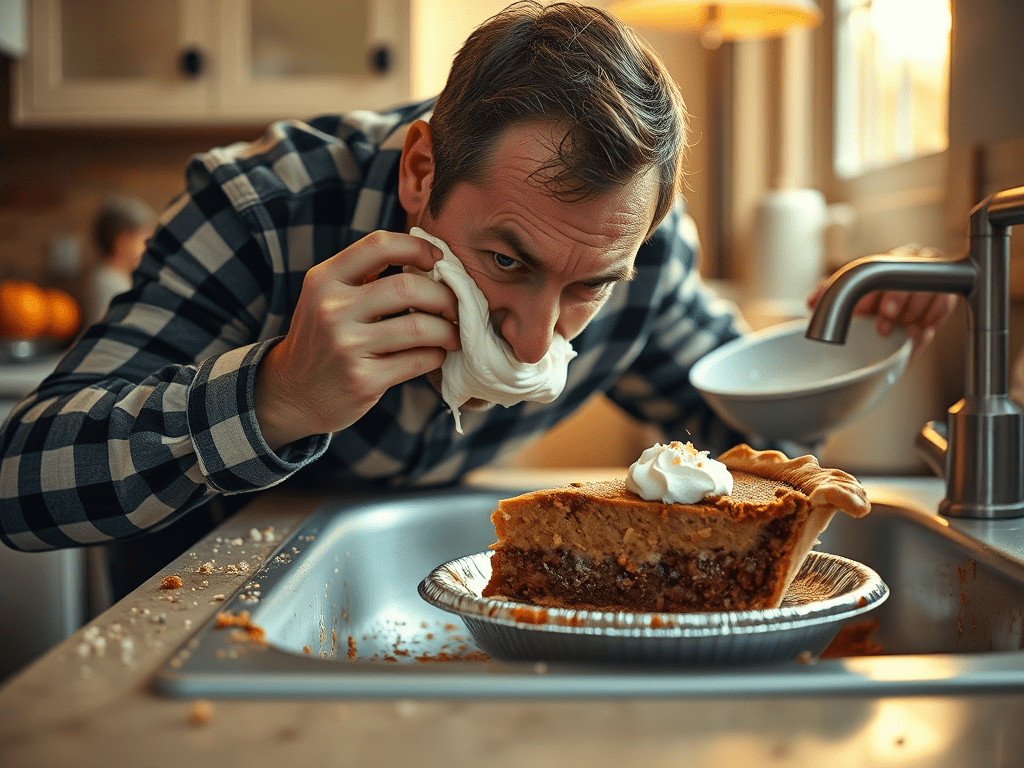
    But then I heard it—a low, seductive hum from the direction of the microwave. There it was: a lone pie box, faintly glowing like radioactive treasure, humming a siren song of buttery crust and spiced filling. I opened the box. Inside, the final slice of Thanksgiving pie waited like a femme fatale in a noir film—dangerous, irresistible, and destined to ruin me.

    I didn’t stand a chance. One second I was a man of discipline; the next, I was hunched over the sink, inhaling that pie like a raccoon who’d broken into a bakery. Crumbs flew. Filling oozed. I was mid-bite, feral and euphoric, when my daughter Alison entered the kitchen.

    She paused, surveyed the carnage, and with surgical precision asked, “When’s the last time you were on a diet?”

    I froze, mid-chew, cheeks ballooned like a chipmunk caught mid-heist. “It’s one slice of pie,” I sputtered, wiping whipped cream off my face. “Hardly a relapse worthy of a family intervention.”

    “Don’t be so defensive,” she replied, with the kind of tonal flatline only teenage girls can weaponize. “I’m just asking—when was the last time you had a strategy?”

    “I didn’t realize you were moonlighting as the historian of my weight management failures,” I muttered, scrambling for dignity.

    “What strategy?” she deadpanned, her eyes sliding toward the now-empty pie tin in the sink like a prosecutor resting her case.

    I opened my mouth in exaggerated mock offense, miming emotional devastation. We laughed, sort of. But her words hit like a sucker punch wrapped in fondant. Despite my kettlebell crusades and protein piety, my daughter saw me for what I was—a man-child undone by pastry.

    The truth hurt because it wasn’t just about pie. It was about a lifetime of performing duets with food, not as nourishment, but as codependence. My relationship with eating wasn’t a partnership; it was a soap opera—a never-ending saga of longing, betrayal, and deeply inappropriate snacking.

    I suffered from food noise—a chronic condition in which the brain becomes a 24-hour food court blaring meal ideas through a megaphone. It wasn’t a craving. It was a full-time broadcast. Even as I wiped pie filling off my shirt, some inner gremlin was planning breakfast, brunch, and an emotionally necessary mid-morning protein bar.

    I had, of course, tried everything. High-protein meals? Check. Fiber-packed produce? Ate it until I squeaked. “Permission to eat favorite foods”? Please. That just gave me moral cover for more cheesecake. As for “hunger cues”—those had long since been drowned in a Wagnerian opera of appetite, where every aria ended in a trip to the fridge.

    I didn’t eat because I was hungry. I ate because I was enchanted. Food was my symphony, and I was its slobbering conductor. While others savored notes of flavor, I devoured entire movements. Pie wasn’t dessert—it was the crescendo. A bag of chips? That was a tragic aria. My kitchen was a concert hall, and I, a helpless Snack Serenader, crooning sonnets to chicken shawarma and tearfully composing odes to sourdough.

    Romantic? Maybe. But make no mistake: this was less about joy than it was about entrapment. I didn’t eat food—I worshipped it. I wasn’t hungry for sustenance—I was desperate for an encore.

    And that’s when the memory landed with full force: the gluttonshame. A post-binge echo of mortification so potent it deserved its own DSM entry. Gluttonshame—the echoing pang of regret triggered by the memory of a food orgy, often witnessed, preferably by someone genetically programmed to judge you—is no passing embarrassment. It sticks, greasy and persistent, like pie filling on a dress shirt. It whispers, “This is why your jeans stage a mutiny every morning.”

    Symptoms? Defensive sarcasm. Performative chuckles. Sudden existential dread. And an uncontrollable urge to delete your food log and relocate to another time zone.

    I felt it all. But if the Great Life Purge taught me anything, it’s that these flashbacks are necessary. They remind me that change doesn’t happen without confession—and a little mockery. Because behind every gluttonshame echo is a man trying, however clumsily, to crawl his way back to self-control—one apple, one salad, one deeply judged slice of pie at a time.

  • Welcome to the Great Life Purge

    Welcome to the Great Life Purge

    When you cut junk food to lose weight, that’s just the beginning. Hundreds of dominoes fall. Welcome to The Great Life Purge—that glorious, semi-manic chain reaction where you set out to cut one small vice and suddenly find yourself Marie Kondo-ing your entire existence with a vengeance.

    You think weight loss is just about dialing back calories and hitting your macros? Think again. This isn’t a tweak. It’s a controlled burn. A purge. A full-blown exorcism of the clutter, chemicals, and chaos posing as comfort. You’re not escaping Fat Jail with a low-carb key and a side of willpower—you’re staging a prison riot and setting the whole institution on fire.

    Think of your life as a garage—no, not one of those Pinterest garages with labeled bins and mounted bikes. I’m talking about a real garage. The kind where a busted leaf blower shares space with a half-used tub of creatine and a pile of shame. That’s your psyche. And mine. Crammed with junk, denial, and forgotten intentions. And now? I’m hauling it all to the curb.

    It started with coffee. I used to down 36 ounces in the morning like a jittery insomniac in a diner scene. Now I’ve cut that to 18. Less milk. Less sweetener. Less gut turmoil. Fewer acid flashbacks from the third cup. Progress.

    Then came lunch. I evicted the canned fish—farewell, mercury-laced mackerel and gout-triggering sardines. My new midday ritual is an arugula salad with tempeh, beans, and cottage cheese—a meal so righteous it practically writes its own self-help book.

    Whey protein? Slashed in half. Just enough to lace my morning yogurt. Sure, I could use more protein, but I’m not going to burn down my 2,400-calorie ceiling just to keep my muscles Instagram-ready.

    Snacks? Gone. Munchdrift—my term for the unplanned snack spiral that sneaks calories into the bloodstream like an embezzler—has been cut off at the source. There’s no room for that soft betrayal anymore.

    Creatine? Down from 6 grams to 3. Why? Because I’m not trying to retain water like a Roman cistern. I’m done with the bloat masquerading as muscle.

    Social media? I nuked 97% of it. That dopamine circus was hijacking my focus, feeding my anxiety, and keeping me stuck in a loop of comparison, craving, and manufactured outrage. Cutting it wasn’t self-care. It was a hostage negotiation with my own sanity.

    Even my workout chalk had to go. Turns out those satisfying powder clouds were drying out my hands and spawning digital ulcers—tiny, furious paper cuts from hell. Three weeks off chalk, and the wounds are retreating like a bad memory.

    And yes—I quit buying watches. Why? Because a bloated watch collection leads to wrist rotation anxiety, which feeds decision fatigue, which then morphs into existential despair that can only be soothed by ice cream. Every anxiety becomes a hunger. I had to cut it at the root.

    Notice the verbs: cut, quit, slashed, purged. This isn’t moderation. This is triage. What started as a diet became a full-scale reckoning. Because once you yank one loose thread, the whole costume of denial begins to unravel. You’re not just quitting sugar and processed carbs—you’re firing the whole cabinet of coping mechanisms.

    The Great Life Purge doesn’t just empty your garage—it changes your address. You’re no longer living in the house of excuses. You’re moving into something leaner, meaner, and unmistakably yours.

    Now, if you’ll excuse me, I have a fat mountain to climb—and I don’t need a sugar crash, a digital ulcer, or a six-watch rotation slowing me down.

  • Losing Weight in Suburbgainia Isn’t Just About Willpower

    Losing Weight in Suburbgainia Isn’t Just About Willpower

    I live in the padded belly of the beast—a Southern California suburb so manicured and overpriced it feels like a gated community built on a diet of Zillow listings and delusion. Here, tiny homes crouch next to high-performing schools like obedient little dogs, and you can practically hear the sound of families hemorrhaging two-thirds of their salary just for the right to say they live in “one of the most desirable zip codes on Earth.” Never mind the suffocating health insurance premiums, the rent-sized car payments, or the phones that become obsolete faster than the milk expires. Somehow, despite all this, we still manage to gorge ourselves into oblivion.

    And gorge we do—with the kind of unapologetic culinary nihilism that says: Why not chase your statins with a triple-decker guacamole onion ring bacon cheeseburger the size of a toddler’s head? These meals don’t nourish. They sedate. They carpet-bomb the body with a week’s worth of calories and lull us into a coma only broken by the siren song of the ice cream truck chirping its Pavlovian jingle.

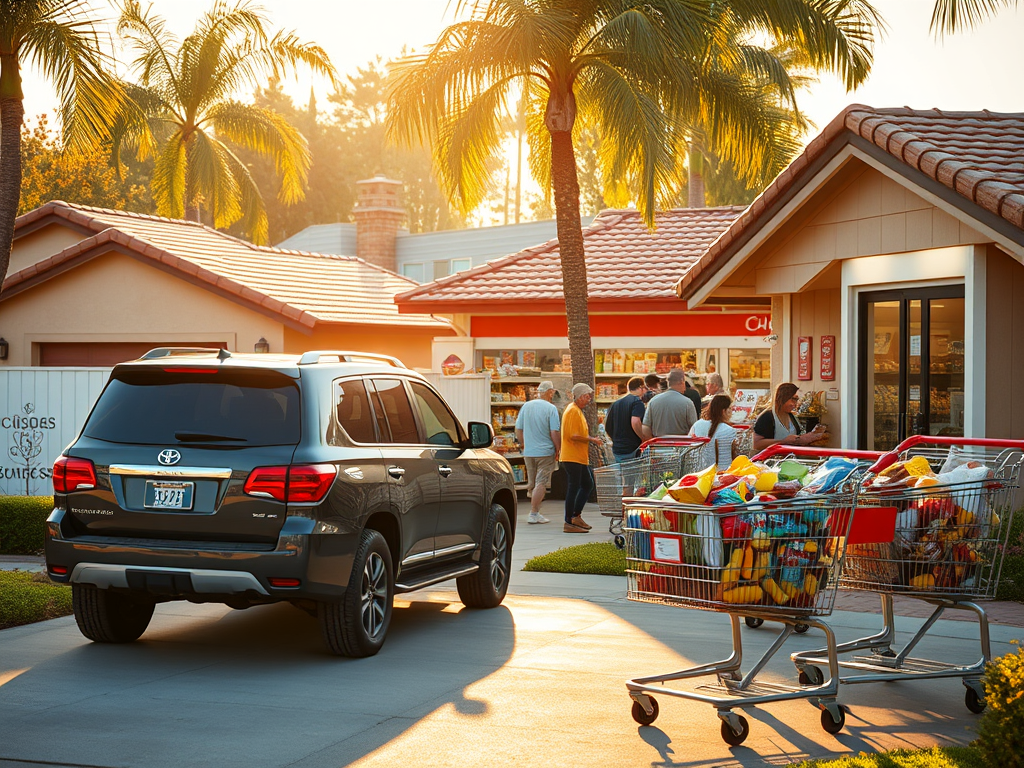
    Sedated and bloated, we require appropriate transport. Enter the all-terrain behemoths—SUVs that could ferry a minor league baseball team but are usually occupied by one distracted suburbanite and their half-finished iced mocha. These vehicles aren’t just cars—they’re padded rooms on wheels, egg-shaped mirrors of their drivers’ own expanding silhouettes, stuffed with sensors to correct for our chronic inattention and entertainment centers to distract us from the creeping dread that this might be it.

    Their true purpose? A fantasy of freedom. A lifestyle accessory for people who dream of hitting the open road, yet refuse to drive more than two miles for a pedicure, a Panda Express run, or the latest Marvel sequel. Why venture beyond the safety of the suburb when out there lies gridlock, road rage, parking scarcity, and the occasional wildfire licking the edge of the 405 like it’s auditioning for a role in Dante’s Inferno: The LA Edition?

    So we stay. We scroll. We snack. And when the walls of this sun-bleached hamster cage start closing in, we do what any respectable suburbanite does—we shop.

    The heart of our civic religion is the membership superstore, a concrete cathedral where the faithful line up before opening like doomsday preppers. We flash our membership cards like VIP badges to the apocalypse, and once inside, the frenzy begins: cartloads of triplet-pack peanut butter, bulk tubs of sourdough pretzels, yogurt for an army, and the holy grail—those chocolate cream-filled sandwich cookies that whisper, You’ve earned this.

    Ravenous and under-cabineted, many of us start devouring our haul in the parking lot just to make room for more. We don’t so much eat as conduct calorie triage, clearing shelf space in our bellies before the next Costco pilgrimage. And thus, a problem festers—one so normalized it’s barely acknowledged: obesity.

    But we don’t call it that. Here, being overfed is reframed as being “well-lived.” Belly overhang becomes a badge of leisure. A neck absent from sight is recast as comfort. A visible jawline is regarded with suspicion, even disdain.

    Yet behind this rebranding lies a biochemical horror show: insulin resistance, fat-marbled pancreases, and a Pavlovian addiction to sugary, creamy, sprinkle-laden beverages masquerading as coffee. Our organs are staging quiet rebellions while we sip iced mochas adorned like carnival floats.

    I don’t sketch this grotesque portrait of Suburbia to mock my neighbors. I sketch it because I am them. I, Jeff McMahon, reside in this land of ambient adiposity and quiet desperation—a land I’ve come to call Suburgainia.

    Suburgainia is a soft dystopia stitched together with frozen yogurt kiosks, massage chairs, and drive-thru frappuccinos. It is a place where convenience calcifies into inertia, and waistlines widen in lockstep with our sense of entitlement. It is where obesity isn’t a warning sign—it’s a lifestyle brand.

    Losing weight in Suburgainia isn’t just about willpower—it’s an act of rebellion against a system meticulously designed to keep you soft, slow, and sedated. You can’t change what you refuse to confront, and the truth is this: our environment is a padded cell masquerading as paradise. The enemy isn’t just calories—it’s culture. It’s the drive-thru dopamine, the Costco-induced euphoria, the suburban sprawl that turns a three-block stroll into a vehicular event.

    Real progress begins when we stop romanticizing these indulgences and start recognizing them for what they are: fat traps dressed in convenience, landmines stitched into the elastic waistband of modern life. Reclaiming our health requires more than kale and kettlebells—it demands clear eyes and an honest reckoning with the architecture of excess that surrounds us.

    Somewhere beneath this quilt of belly fat and bulk-pack chicken bakes lives a man with arteries worth saving. But before I can meet him, I have to scale the fat mountain I’ve built—one step, one salad, one unsweetened iced tea at a time.

    Will I make it to the summit without collapsing from myocardial betrayal? I don’t know. But I’ve started the climb. And for now, that’s enough.