Tag: health

  • Claustrophobia Reveals Your True Soul to the World

    Claustrophobia Reveals Your True Soul to the World

    There are many ways to expose your raw, unfiltered self to the world. Some people achieve this through a near-death experience, a public meltdown, or a bout of food poisoning on an international flight. For me, claustrophobia is the great revealer, an unrelenting force that strips away every ounce of composure and leaves me flailing like a man trapped in quicksand. It doesn’t matter if I’m in a dentist’s chair or strapped into a sadistic amusement park ride—when the walls start closing in, I become the star of my own public humiliation showcase.

    The first great revelation of my soul came at Universal Studios, where I made the tragic miscalculation of sacrificing my personal comfort for my wife and twin daughters. A father’s love is boundless, but so, unfortunately, was my terror. The very air of the place reeked of Las Vegas grift, stale churros, and desperate cash grabs. Every corner had some overenthusiastic performer in mothball-scented epaulets or a handlebar-mustached imposter butchering a French accent for a paycheck. But nothing could have prepared me for the medieval horror that awaited on the Harry Potter Forbidden Journey ride.

    After standing in line for an eternity, I found myself wedged into an airplane seat designed for a malnourished Victorian child. A heavy metal harness slammed down on my 52-inch chest like a bear trap, and within seconds, my body entered full-blown rebellion mode. My lungs went on strike, my heart pounded out an emergency evacuation order, and my brain whispered, You are about to die in the most embarrassing way possible. As the conveyor belt dragged me toward a dark, swirling vortex of Hogwarts-themed doom, I did what any reasonable person would do—I began screaming like a man being lowered into a pit of snakes.

    “STOP THE RIDE! I’M HAVING A HEART ATTACK!” I wailed, flailing like an air dancer outside a used car lot.

    At first, no one in charge seemed to care, but the fellow prisoners trapped beside me picked up on my panic and began chanting my cause like a medieval mob: “STOP THE RIDE! STOP THE RIDE!” Finally, a burly security officer in an FBI-grade sport coat emerged, walkie-talkie in hand, and surveyed my meltdown with the practiced patience of a man who had seen worse. I looked up at him, sheepish and sweaty, and asked, “Do you need to take me to a debriefing room?” He chuckled, helped me out of my restraints, and sent me shuffling out of Universal Studios, a broken man.

    But the universe was not done exposing my fragility.

    The Dentist’s Chair: A Torture Chamber Disguised as Healthcare

    Around the same time as the Universal Studios fiasco, I had a similarly catastrophic loss of dignity at Dr. Howard Chen’s dental office. The appointment started out fine—numbing shots, ear-splitting drills, the usual dance with mortality. But then the bite block came out. For those blissfully unaware, a bite block is a rubber wedge designed to keep your mouth open during dental procedures, but in my case, it may as well have been a medieval jaw clamp designed by Torquemada himself.

    The second it locked my mouth open, my brain fired off the same claustrophobic distress signal as it had on the Harry Potter ride. I couldn’t swallow, which meant I couldn’t breathe, which meant I was about to die, right there, in a flannel shirt, under a fluorescent light, to the soft rock stylings of The Carpenters.

    Before I could stop myself, I ripped off my shirt, launched myself out of the dental chair, and began gasping like a shipwreck survivor.

    “Are you going to be okay, Jeff?” Dr. Chen asked, his voice dripping with the calm patience of a man who has dealt with neurotics before.

    “I CAN’T HAVE THIS RUBBER THING IN MY MOUTH,” I announced, holding the bite block aloft like a relic from an exorcism.

    Dr. Chen nodded, his eyes a mix of concern and professional detachment. “Okay, we’ll do it without the bite block.” He gestured toward the chair. “Go ahead and sit back down.”

    I obeyed, heart pounding, and the rest of the drilling continued without further catastrophe. But the damage to my dignity was irreversible.

    Sensory Hell: The Dentist’s Office Smells Like Death

    The claustrophobia is bad enough, but what really pushes me over the edge is that I am what some might call a “super smeller.” Lying in the dental chair, I am forced to marinate in an unholy stew of:

    • Clove oil
    • Formaldehyde
    • Acrylic
    • Glutaraldehyde
    • Latex gloves
    • The lingering decay of other patients’ tooth dust

    It is the aroma of death itself. I am not a dental patient—I am a cadaver in the early stages of embalming.

    And while I fight off nausea, my mind spirals into a full existential crisis. Something about lying prone, mouth pried open, surgical tools scraping at my enamel, makes me contemplate my soul more than any other moment in my life. The sheer vulnerability of the position mimics some prelude to the afterlife, and I am left with only my own morbid thoughts for company.

    Morbidity Hits Different with 1970s Soft Rock

    As if my anxiety needed any further provocation, Dr. Chen’s office plays 1970s easy listening on a continuous loop. The Carpenters, Neil Diamond, John Denver—songs that transport me straight back to my early years as a melancholic prepubescent. Suddenly, I am ten years old again, scribbling dramatic diary entries about my unrequited love for Patty Wilson, the rosy-cheeked blonde girl from fourth grade who never knew I existed.

    But before I can fully dissolve into a puddle of nostalgic despair, Dr. Chen interrupts.

    “You’re brushing too hard,” he warns. “You’re murdering your gum line.”

    “But I don’t trust the Sonicare to do the job!” I protest.

    “You need to have faith in the Sonicare, Jeff.”

    “But I am a man of doubt.”

    Dr. Chen sighs, shaking his head. “I can see that.”

    Final Humiliation: The Dentist Knows I’m Crazy

    During my latest visit, he threw a new horror into the mix: the possibility of a root canal.

    “What can I do to avoid it?” I asked, racked with dread.

    “Relax, Jeff,” he said. “All this stress is hurting your immune system. You need a strong immune system to fight decay.”

    Great. Now I have to worry about stress-induced tooth rot.

    As I staggered out of the office, I nearly reversed into an angry SUV driver, who honked with the force of a nuclear siren. But what truly shattered me was the sight of Dr. Chen, peering through his office window, watching the entire debacle unfold.

    And in that moment, as our eyes met, I knew—I was, without a doubt, the most unhinged patient he had ever seen. There would be no coming back from this.

    Claustrophobia, once again, had revealed my true soul to the world.

  • Wrestling with an especially virulent case of “Influenza A”

    Wrestling with an especially virulent case of “Influenza A”

    In I’m Dysfunctional, You’re Dysfunctional: The Recovery Movement and Other Self-Help Fashions, Wendy Kaminer lays waste to the therapeutic fads of the 1990s, particularly the trend of “reclaiming the inner child”—a ritual that took infantilization to near-religious extremes.

    She describes John Bradshaw’s workshops, where grown adults with respectable careers arrived clutching teddy bears like traumatized toddlers, preparing to embark on a guided journey into the mansion of their past. There, as Bradshaw whispered encouragements, lower lips trembled, tears streamed, and a congregation of emotionally overqualified professionals sobbed into the polyester fur of their stuffed animals.

    What floored Kaminer wasn’t the unhinged emotionalism—it was the sheer, shameless conviction. These people weren’t just indulging in a saccharine, self-indulgent spectacle—they were true believers, convinced that squeezing a doll and reliving some long-buried playground trauma was nothing short of a spiritual awakening.

    Kaminer was not impressed. What others saw as self-reflection and healing, she saw as an infantilizing orgy of narcissism, a self-help séance in which grown-ups tried to resurrect their inner kindergartener, only to be possessed by a ghost that refused to leave.

    Now, I’d like to say that my bullshit detector is too finely tuned for me to cradle a stuffed animal and regress into baby talk. But the bitter irony is that writing this memoir has forced me into my own brand of infantilization—just without the teddy bear and group cry session.

    Nothing made this clearer than the pathetic spectacle of my post-Thanksgiving downfall, which started with a game of Russian roulette—except instead of a revolver, I played with rotting cabbage.

    It all began when I decided to make chicken tacos—a wholesome, adult dinner choice. Unfortunately, the bag of shredded cabbage I retrieved from the fridge had been marinating in its own decay for two weeks, slowly transforming into hell’s compost pile.

    The moment I tore open the bag, my wife recoiled with the dramatic flair of a crime scene detective stumbling upon a long-decomposed body. She clutched her nose, waved her hands like an exorcist warding off a demon, and issued a forensic report:

    “That smells like a mix of a latrine and a horse’s taint.”

    A normal person would have taken this as a warning. But, fueled by misplaced confidence and the hubris of someone who had survived worse, I dumped the cabbage on my tacos and dug in.

    Hours later, my immune system, weakened by the Thanksgiving marathon of forced hospitality, collapsed like a debt-ridden empire. The virus that had been lurking in the shadows seized its moment, and by the next morning, I was a feverish, shivering wreck, contemplating my life choices between bouts of violent gastrointestinal reckoning.

    It seems that you don’t need a stuffed animal and a therapy circle to regress into infancy. Sometimes, all it takes is spoiled cabbage and a ruinous lack of self-preservation.

    Naturally, instead of exercising common sense, I channeled my inner cheapskate prophet. “Cabbage by its very nature has a funky scent,” I proclaimed with the confidence of a man who regularly courts disaster. “A little fermentation won’t hurt anyone.” My wife frowned and said, “It’s smelling up the entire kitchen.”
    “We’ll be fine,” I insisted, scooping copious amounts of fetid-smelling cabbage onto my tacos like I was auditioning for a daredevil cooking show.

    At dinner, I was the only one brave—or foolish—enough to eat it. Within an hour, my body issued a resounding, “You absolute moron.” No GI issues, but I felt like I’d been hit by a truck, reversed over, and then hit again. My head throbbed, my eyes were so sensitive to light I had to drape a T-shirt over my face just to listen to a Netflix show, and my energy flatlined by eight p.m. I crawled into bed, feeling like a half-baked zombie.

    The next morning was worse. Still no GI problems, but the 101 fever and crushing fatigue made me question my will to live. I tried to eat some oatmeal and grapefruit, the culinary equivalent of punishment food, but even that felt like too much effort. 

    By day three, no improvement. I’d become a cautionary tale, researching induced vomiting and discovering it was far too late. Apparently, if you don’t purge immediately, the toxins settle in like an unwanted houseguest who insists on staying for five to seven days.

    Being sick in my family makes everyone else suffer. Our teenage twins require constant care, frequent snacks that generate endless dirty dishes, and someone breathing down their necks to ensure homework gets done. My wife had to shoulder it all while I languished in my misery. I apologized profusely for my reckless hubris and promised, at the age of sixty-three, to turn over a new leaf—or at least stop eating ones that reek like death.

    For decades, I’d treated eating old, moldy food like a badge of honor, quoting my dad’s immortal wisdom: “Pilgrims who ate blue cheese on the Mayflower survived disease while the mold-avoiders died.” It was as if I’d been brainwashed into believing spoiled food was a superfood. But this cabbage debacle—this hellish, cabbage-induced reckoning—put the fear of God in me. Never again would I be the fool who eats something that smells like a medieval torture chamber. This time, I mean it. The next funky bag of cabbage? Straight to the trash. May it ferment in peace.

    As the alleged food-borne illness dragged on and my fever turned my brain into a swamp, I found myself pondering a morbid yet painfully stupid thought: What if I died because I was too cheap to toss a two-dollar bag of cabbage? Imagine the headline: “Man Perishes Over Discount Vegetables.” How could I ever forgive myself for such world-class idiocy? Worse, how could my wife ever forget that I lectured her with the smug confidence of a food-safety guru right before scarfing down a fatal dose of rotting produce? I’d be immortalized as the kind of hapless buffoon who wouldn’t even get a name in a Chekhov short story—just “The Idiot Who Ate the Cabbage.”

    Then, because fever dreams and existential crises go hand in hand, another absurd thought hit me: How would my YouTube subscribers and Instagram followers know what happened to me? I’d be gone, but my accounts would still sit there, ghostlike, leaving them to wonder why the witty guy with the diver watches and snack obsession suddenly went dark. What a tragedy—I wouldn’t even get the chance to create a final piece of content documenting my own demise in comedic glory. A video titled, “How Cabbage Killed Me (And Why You Should Toss Yours)” would surely have gone viral.

    This realization struck me as profoundly twisted: content creators care more about producing “engaging material” than their own mortality. Forget self-preservation—I was more upset that my audience might miss out on the hilarity of my self-inflicted cabbage-related downfall. The pathology runs deep: we’re so hooked on being performative, we’d probably narrate our own deaths if we could. Imagine me, breathless and feverish, croaking out, “Don’t forget to like, comment, and subscribe—assuming I make it to tomorrow.” The absurdity of it all made me laugh, which hurt, because even my ribs were exhausted from this cabbage-induced purgatory.

    It was apparent I was so desperate to be relevant on social media that I had become a Gravefluencer–an influencer who extends his reach six feet under, ensuring even death is on-brand.

    After five days of relentless illness, I had a phone consultation with my doctor about what I was sure was self-inflicted food poisoning. I laid out the symptoms with the kind of detail you’d expect from someone auditioning for a medical drama. My doctor listened patiently, then unceremoniously popped my bubble of absurdity. “This isn’t food poisoning,” she said. “You’ve got the flu. It’s going around.”

    Just like that, my grand narrative of culinary hubris—the man who dared to defy rancid cabbage and paid the ultimate price—was dead. Instead, I was left with something far less glamorous: virulent flu. Part of me was relieved that I wasn’t poisoning myself with poisoned produce, but another part of me felt cheated. I’d lost the absurd, darkly comedic morality tale about a man so cheap he nearly killed himself over a two-dollar bag of cabbage. What a waste.

    The doctor wasn’t exactly brimming with solutions, either. “Rest and stay hydrated,” she advised, the way you might tell a child to eat their vegetables. That night, my fever spiked close to 104, launching me into a kaleidoscope of fever dreams where my brain decided to give me the full surrealist experience. Words from my podcasts took on physical forms—spiky, sticky, grotesque shapes—and suddenly, I was inside them. I wandered through caves of conversation, waded through cocoons of dialogue, and got tangled in thick spider webs spun from language. Each sentence wrapped around me, trapping me in its endless loops of nonsense.

    When I woke up, drenched in sweat and feeling like I’d wrestled a linguistically gifted tarantula, I realized the flu wasn’t just an illness—it was a full-blown avant-garde art installation happening in my own head. So no, I didn’t have food poisoning. I had performance art fever. And while it wasn’t the cabbage apocalypse I’d hoped for, it was plenty weird in its own way.

    For six days, I had been wrestling with the so-called “Thanksgiving Flu,” a charming little virus that kept my fever bouncing between 101 and 104, as if my body were auditioning for a medical melodrama. Being that sick wasn’t just about physical misery—it was a battering ram smashing through the cozy little mental structures I had built around my life. Aspirations? Pointless. Health goals? A cruel joke. My reading list? Forget it. Even my hunger for social belonging and validation had been knocked flat. What remained was a stripped-down nihilism so bleak it made Nietzsche look like an optimist.

    Sickness dragged me to a dark place where life felt like a cosmic prank. I could almost hear my 14-year-old self rolling his eyes as I remembered my Grandma Mildred’s wise words from one of her letters: “Illnesses bring out the doldrums.” No kidding, Grandma. That particular flu had brought out more than the doldrums—it had conjured a maudlin cocktail of despair and self-pity.

    In that state, I found myself spiraling into melodrama, muttering things like, “What’s the point? Just end the torment and let me meet my Maker already!” It was ridiculous, of course, but I couldn’t help but notice how flu-induced misery fed into a distinctly male flavor of narcissism. Egotism, after all, was a hallmark of the man-child: the guy who thought the universe should pause when he didn’t get his way.

    Men, it seemed, were uniquely gifted at turning minor discomforts into existential crises. While women powered through illness with a mix of stoicism and practicality, men turned their sickbeds into thrones of self-pity, proclaiming their impending doom to anyone who would listen. And me? I was no exception. With every feverish shiver, I became the star of my own overwrought drama, raging against the cruelty of a world that dared to continue spinning while I wallowed in flu-induced existential despair.

    Sure, Grandma Mildred, the doldrums were part of the package—but why did it feel like men turned those doldrums into an art form? Perhaps the real flu virus wasn’t in my body; it was in my ego, throwing a tantrum because life wasn’t bending to my fevered will.

    I appeared to be languishing in the Flu-tile State—a fever-fueled realization that all human endeavor was futile.

    On day 8 of this flu from hell, my doctor emailed me a cheerful little grenade: “Your symptoms are concerning. I need to see you today.” Fabulous. At 11 a.m., feverish, grouchy, and radiating the energy of a half-cooked zombie, I dragged myself to her office for the usual poking and prodding. COVID? Negative. Influenza? Oh yes, Influenza A—the viral overachiever of the season. My nurse, who’d had it two weeks earlier, gave me the kind of pep talk you’d expect from someone who survived a minor apocalypse. “Seven days of fever,” she chirped, “so you’ve probably got two more to go!” Like I’d won a spa weekend in purgatory.

    But the flu wasn’t the real sucker punch. No, that came when I stepped on the scale. At a soul-crushing 252 pounds, with blood pressure at 166 over 92, Dr. Okada laid it out with the dispassion of someone reading a menu: “You’re at high risk for a massive stroke or heart attack.” She might as well have handed me a shovel and a map to my future grave. Then, just to twist the knife, she added, “You need to lose fifty pounds in six months. Otherwise…” She trailed off, but I got the point: dead man waddling.

    Her final blow came with a steely gaze and a guilt grenade: “If not for yourself, lose weight for your wife and daughters.” Translation: stop being selfish and get your act together before they have to plan your funeral.

    Desperate for a cheat code, I asked about Mounjaro or Ozempic, those miracle weight-loss injectables I’d read about. She barely stifled a laugh. “We prescribe those for people with exclusive employer benefits.” I muttered something about how my college likely doesn’t cover luxury drugs, and her thin smile confirmed it. I’d be fighting this battle the old-fashioned way: with the DASH diet and restricted calories, not cutting-edge pharmaceuticals.

    And then there was the Motrin ban. Apparently, my go-to painkiller was a blood-pressure ticking time bomb. “No more Motrin. Tylenol only,” she said, with all the enthusiasm of a waiter recommending the tofu option. So now, my fevers would be accompanied by a dull, Tylenol-soaked march toward mortality. Fantastic.

    I thanked her—sincerely, I swear—because she wasn’t wrong. But the whole thing felt like I’d been blindsided by a particularly grim episode of The Biggest Loser: Medical Edition. On the drive home, Miley Cyrus’s “Flowers (Demo)” came on, and I—feverish, bloated, and thoroughly defeated—actually cried. Miley crooned about resilience and self-love, and all I could think about was how laxity, that slow, sneaky killer, had been working me over for years. Skipped workouts, mindless snacks, every excuse—it had all led to this: a middle-aged man sobbing in his car, mourning his dignity while stuck in traffic.

    Dr. Okada’s tough love landed like a wrecking ball. This was my moment—the kind where you either turn your life around or start drafting your obituary. Time to put down the Motrin, pick up some discipline, and drag myself back from the brink before I became the subject of one of those tragic lessons everyone ignores until it’s too late cautionary tales.

    I had entered the clinic expecting to get a quick flu diagnosis and maybe a lecture about rest and fluids. Instead, I walked out with the realization that my life wasn’t just off-track; it was an unmitigated dumpster fire rolling downhill. How had I missed it? The creeping wreckage of my existence had been unfolding right under my nose, like a slow-motion train derailment I refused to acknowledge. Denial, thy name is me.

    Dr. Okada, bless her clinical professionalism, had held up a mirror and forced me to see what I’d been expertly avoiding for years: that my life, much like my blood pressure, was a ticking time bomb. I’d been blind to my own unraveling, and now the blinders were off. The view wasn’t pretty, but at least now I knew what I was working with—a fixer-upper existence in desperate need of a renovation.

    My visit to the doctor turned into an unplanned catalyst for a long-overdue moral metamorphosis. I left not just diagnosed, but afflicted by a new condition I can only call the Scales of Justice (and Shame)—that peculiar state where the doctor’s scale transforms into the ultimate moral arbiter. Each number glaring back at me didn’t just measure pounds; it weighed my life choices, my discipline, my worthiness as a functioning adult. It was less a medical device and more a courtroom, and let’s just say I was found guilty on all counts.

    I was convinced that had I been ten years older, this bout of influenza would have finished me off. The first week felt less like an illness and more like the aftermath of a roadside bombing, with me as the unfortunate bystander left mangled in a ditch. My body was a buffet for phantom wolves and mosquitoes—every nerve ending seemed to host its own ravenous pest. Mentally, I spiraled into fever-induced madness, complete with hallucinatory jungle scenes: Gumby-esque AI bodybuilders, sculpted and sinewy yet gelatinous, painted the revolting hue of yellow sea slugs, slithered around me in an Amazonian hellscape.

    By Week Three, the influenza had mercifully downgraded its malevolence, though “mild” feels like an insult to language. I still shivered like a Victorian orphan in a snowstorm, my body temperature yoyoing between inferno and tundra. Aches gnawed at me persistently, like bad houseguests who don’t get the hint. And mentally? I was underwater—grasping at reality as it floats just out of reach. My brain felt stripped of a few critical screws, rattling around and threatening to unscrew the rest.

    At some point, I recalled, in the hazy, fevered way of someone stranded in a desert, that my daughter had lozenges in her room. Fueled by desperation, I shuffled to her door, knocked weakly, and thrust my trembling hands forward as if auditioning for a Dickens adaptation. “Please,” I croaked, my voice barely above a whisper, “fill my hands with lozenges for your poor ailing father.”

    The response? Hysterical laughter. Both of my daughters, cozied up watching TV, howled with the kind of delight usually reserved for viral cat videos. I caught a glimpse of myself in the hallway mirror: pajamas wrinkled like a bad alibi, beanie perched jauntily askew, my face the pallor of a sickly sailor. I was every bit the tragicomic figure they saw—a fevered street urchin begging for cough drops.

    My wife, ever the realist, stormed in to restore order. “We have plenty of lozenges in the kitchen,” she barked, clearly unimpressed by my Oscar-worthy theatrics. She led me, limping and pathetic, to the cupboard, where she proceeded to dump several bags of lozenges onto the table with all the ceremony of Santa Claus unloading his sleigh. My daughters, tears of laughter streaming down their faces, declared me Oliver Twist reincarnated.

    I retreated to bed clutching a handful of lozenges, humiliated but momentarily soothed, only to lie awake wondering when this fever would break—or if the AI bodybuilders would show up again to finish the job.

    Four weeks into my bout with influenza, I emerged bleary-eyed, fever-wrecked, and staring down my old nemesis: addiction. Not the sexy kind you’d brag about in a memoir—just the creeping, mundane kind that comes with a tendency to overindulge in things like self-pity, compulsive behaviors, and yes, an irrational attachment to writing books.

    And so, I emerged from this fever-ridden odyssey not as a transformed man, but as someone who had simply suffered enough to pause and reflect—until the next catastrophe beckoned. If John Bradshaw were leading my recovery workshop, he’d likely hand me a stuffed animal and instruct me to embrace my inner child, soothing my cabbage-traumatized soul with affirmations of self-love. But after weeks of sweating, hallucinating, and contemplating my own obituary over a bag of rotting vegetables, I didn’t need a teddy bear. I needed a referee, a financial adviser, and possibly an exorcist.

    The true lesson here? My inner child doesn’t need rescuing. He needs a restraining order. Because left to his own devices, he’ll continue to eat spoiled food out of spite, spiral into existential despair at the first sign of adversity, and demand that every brush with mortality be converted into premium content. So if I’m to move forward as a recovering writing addict, I have to acknowledge this truth: The inner child is not a sage. He’s a lunatic. And I should probably stop taking his advice.

    CHAPTER FORTY-SIX

    As part of my rehabilitation from writing novels I have no business writing, I remind myself of an uncomfortable truth: 95% of books—both fiction and nonfiction—are just bloated short stories and essays with unnecessary padding. How many times have I read a novel and thought, This would have been a killer short story, but as a novel, it’s a slog? How often have I powered through a nonfiction screed only to realize that everything I needed was in the first chapter, and the rest was just an echo chamber of diminishing returns?

    Perhaps someday, I’ll learn to write an exceptional short story—the kind that punches above its weight, the kind that leaves you feeling like you’ve just read a 400-page novel even though it barely clears 30. It takes a rare kind of genius to pull off this magic trick. I think of Alice Munro’s layered portraits of regret, Lorrie Moore’s razor-sharp wit, and John Cheever’s meticulous dissections of suburban despair. I flip through my extra-large edition of The Stories of John Cheever, and three stand out like glittering relics: “The Swimmer,” “The Country Husband,” and “The Jewels of the Cabots.” Each is a self-contained universe, a potent literary multivitamin that somehow delivers all the nourishment of a novel in a single, concentrated dose. Let’s call these rare works Stories That Ate a Novel—compact, ferocious, and packed with enough emotional and intellectual weight to render lesser novels redundant.

    As part of my rehabilitation, I must seek out such stories, study them, and attempt to write them. Not just as an artistic exercise, but as a safeguard against relapse—the last thing I need is another 300-page corpse of a novel stinking up my hard drive.

    But maybe this is more than just a recovery plan. Maybe this is a new mission—championing Stories That Eat Novels. The cultural winds are shifting in my favor. Attention spans, gnawed to the bone by social media, no longer tolerate literary excess. Even the New York Times has noted the rise of the short novel, reporting in “To the Point: Short Novels Dominate International Booker Prize Nominees” that books under 200 pages are taking center stage. We may be witnessing a tectonic shift, an age where brevity is not just a virtue but a necessity.

    For a failed novelist and an unapologetic literary wind-sprinter, this could be my moment. I can already see it—my sleek, ruthless 160-page collection, Stories That Eat Novels, four lapidary masterpieces gleaming like finely cut diamonds. Rehabilitation has never felt so good. Who says a man in his sixties can’t find his literary niche and stage an artistic rebirth? Maybe I wasn’t a failed novelist after all—maybe I was just a short-form assassin waiting for the right age to arrive.

  • The Weight of the System: Rethinking Willpower, Obesity, and the Economics of Weight Loss

    The Weight of the System: Rethinking Willpower, Obesity, and the Economics of Weight Loss

    Here is the first essay prompt for my critical thinking class:

    The Weight of the System: Rethinking Willpower, Obesity, and the Economics of Weight Loss

    For decades, society has preached the same mantra: weight loss is a matter of willpower, personal responsibility, and discipline. But what if that narrative is flawed, oversimplified, or even deliberately misleading? In reality, obesity is not just about individual choices—it is shaped by biology, economics, corporate interests, and healthcare disparities. The diet industry thrives on promising easy fixes, while the pharmaceutical industry profits from expensive weight-loss drugs like Ozempic. Meanwhile, processed foods—engineered for addiction—ensure that millions remain locked in an endless cycle of weight gain and dieting.

    For this 1,700-word argumentative essay (MLA format required), analyze the misconceptions surrounding weight loss and explore the deeper forces at play. Use the following sources to challenge the idea that weight management is simply about eating less and exercising more:

    • Rebecca Johns – “A Diet Writer’s Regrets”
    • Johann Hari – “A Year on Ozempic Taught Me We’re Thinking About Obesity All Wrong”
    • Harriet Brown – “The Weight of the Evidence”
    • Sandra Aamodt – “Why You Can’t Lose Weight on a Diet”

    Key Questions to Consider:

    • Is personal responsibility a fair framework for understanding obesity, or does it obscure the role of systemic barriers?
    • How do economic privilege and the availability of weight-loss drugs like Ozempic create a divide between those who can afford to manage their weight and those who cannot?
    • What role does the food industry play in promoting processed, addictive foods while pharmaceutical companies profit from treating the consequences?
    • Does the concept of “self-discipline” in dieting ignore scientific realities about metabolism, set points, and the long-term difficulty of maintaining weight loss?

    Focus Areas for Analysis:

    1. Personal Responsibility vs. Systemic Barriers – Johns and Hari challenge the traditional belief that dieting is a matter of willpower, exposing the emotional and physical toll of long-term weight struggles.
    2. Economic Disparity in Weight Loss Solutions – Hari’s critique of Ozempic highlights the ethical concerns surrounding healthcare access and the commercialization of weight loss.
    3. The Science of Set Points and Metabolism – Aamodt and Brown explain how biology resists sustained weight loss, complicating the simplistic “calories in, calories out” narrative.
    4. Capitalism and the Food Industry – Examine how the Industrial Food Complex profits from processed foods while the pharmaceutical industry monetizes weight-related health conditions.

    Conclusion:

    Is the weight-loss narrative fed to the public based on reality, or is it a distraction from larger economic and corporate interests? Consider how acknowledging these systemic influences could reshape our understanding of obesity and lead to more effective and compassionate solutions.

  • 30 Years of Teaching College Writing in the Greatest City in the World

    30 Years of Teaching College Writing in the Greatest City in the World

    Yesterday, in my college critical thinking class, I played a clip from Liza Treyger’s Night Owls set, where she spirals into a monologue about her addiction to animal videos. The class erupted in recognition—Treyger’s bit was less comedy, more collective confession. We then compared the insidious grip of food addiction to the death grip of smartphones, two habits nearly impossible to break because, unlike more glamorous vices, they’re baked into the daily human experience. You have to eat. You have to communicate. And thanks to Pavlovian conditioning, the mere buzz of a notification or the scent of a cheeseburger can hijack your willpower before you even know what hit you.

    At one point, I noticed one of my students—a professional surfer—had a can of Celsius energy drink perched on his desk like a talisman of modern endurance. I mentioned that my daughters practically mainline the stuff, to which he casually replied that he was transitioning to Accelerator, as if he were upgrading his addiction to something with a more explosive name. This led us down a delightful rabbit hole about the marketing committee responsible for naming that monstrosity, the raw aggression of Costco shoppers jostling for bulk energy drinks, and how smartphones are turning my students into exhausted zombies. They shared their chosen comfort foods, each confession tinged with equal parts nostalgia and shame.

    The discussion was sharp, lively, and deeply engaging. And yet, in a moment of brutal self-awareness, I admitted to them that I felt pathetic. Here I was, sitting among the chillest students in the world, having a profound conversation about addiction—and all I could think about was ditching class to speed down to Costco and buy a case of Accelerator. They cracked up, and we carried on dissecting addiction for their essay on weight management and free will.

    After thirty years of teaching in Los Angeles, I’m convinced I’ve won the academic lottery. There’s no better place to teach, no better students to challenge my tomfoolery, and no better city to fuel my own ridiculous, completely relatable compulsions.

  • DEATH BY SNACKS

    DEATH BY SNACKS

    After dinner, my wife and I luxuriated in a couple of Arrested Development reruns, marveling at the genius of Mitchell Hurwitz and Ron Howard. The show, an absurdist ode to familial dysfunction, felt decades ahead of its time—sharp enough to leave paper cuts on your brain. During the opening credits, I rose from the couch with noble intentions: I was off to fetch my so-called “satiety apple,” a modest, virtuous snack that allegedly curbs my post-dinner cravings without derailing my calorie count.

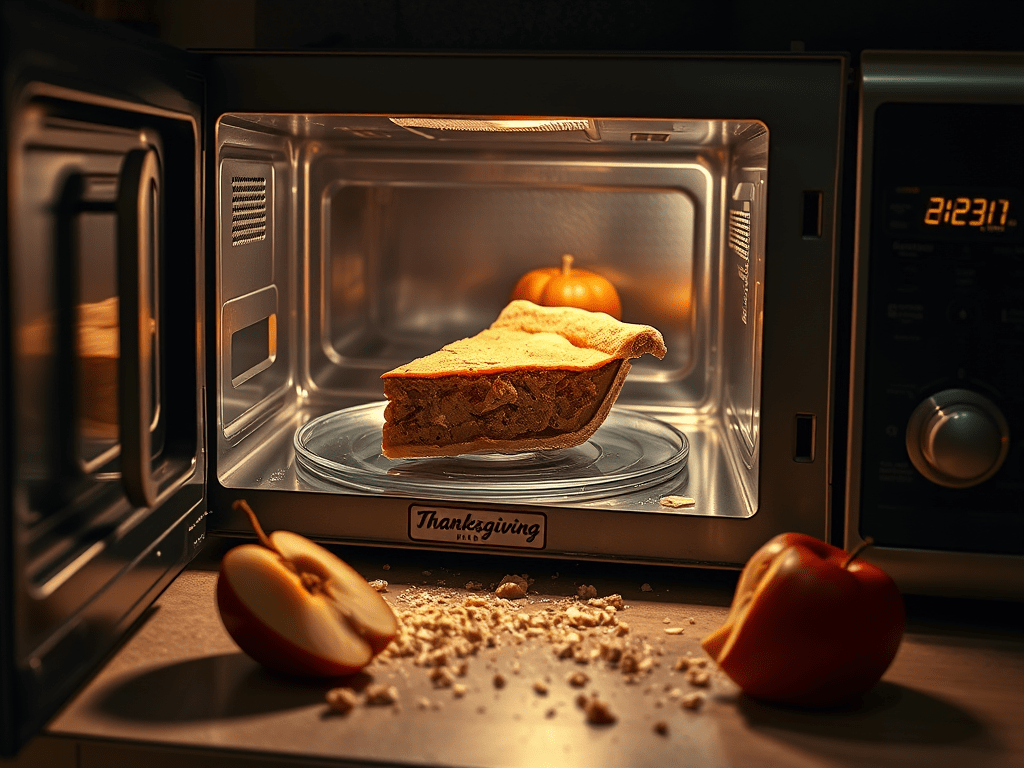
    But as I crossed the kitchen, fate—or treachery—beckoned me toward the microwave. There it sat: a pie box, faintly glowing, practically humming a siren song of buttery crust and spiced filling. One peek inside, and there it was—the last slice of Thanksgiving pie, radiating the kind of allure that no apple could ever muster.

    Before I knew it, I was hunched over the sink, inhaling that pie like a feral animal who’d just discovered civilization’s baked goods. Crumbs flew. Filling dripped. I was mid-bite, fully in beast mode, when my daughter Alison walked in. She stopped, surveyed the scene, and with surgical precision, dropped her line: “When’s the last time you were on a diet?”

    I froze mid-chew, my cheeks puffed out like a chipmunk caught in a raid. “A single slice of pie hardly merits such harsh judgment,” I said, wiping a smear of whipped cream off my chin.

    “Don’t be so defensive,” she said, her voice carrying the kind of condescension only a teenage girl can master. “I’m just asking—when was the last time you were on a diet?”

    “I didn’t realize you were the official historian of my weight management strategies,” I shot back, trying to maintain some shred of dignity.

    “What strategy?” she deadpanned, her tone as flat as the pie tin now sitting empty in the sink.

    I opened my mouth in an exaggerated display of mock offense, as if her words had wounded me so deeply that I could only respond with silence. We laughed, but the truth landed like a sucker punch: despite my heroic kettlebell workouts and high-protein meal plans, my daughter saw me for what I really was—a fat slob, undone by my inability to resist the siren song of leftover pie.

    My conversation with my daughter hit a nerve: my relationship with food is less of a partnership and more of a chaotic entanglement worthy of a reality show. I’m living with a chronic condition others have dubbed food noise—the relentless, mind-consuming obsession with food. It’s not just a passing craving; it’s a full-time occupation. Food noise is that little gremlin in your head planning tomorrow’s breakfast while you’re still wiping pie crumbs off your shirt from dinner. It’s exhausting, intrusive, and, frankly, a massive pain in the ass.

    I’ve tried all the supposed solutions. High-protein meals? Check. Fiber-packed fruits and veggies? Done. Permission to eat favorite foods to deflate their psychological power? Sure, why not. Listening to my so-called “hunger cues”? Please, those cues have been drowned out by a symphony of appetite louder than a Wagner opera. The truth is, my love of food has nothing to do with hunger. This isn’t about survival—it’s about passion.

    I crave food the way a musician craves music, except instead of performing Beethoven’s Ninth, I’m inhaling pie and serenading a protein bar like it’s my muse. Eating isn’t just sustenance; it’s a full-body euphoria, a never-ending sonata of chewing that I never want to end.

    So here I am, a helpless Snack Serenader, crooning over every dish like it’s the centerpiece of my magnum opus. Pie, pasta, cereal, or steak—it doesn’t matter. They’re all part of the eternal love song I sing to food, even as it steamrolls my willpower and expands my waistline. And while it may sound romantic, let’s be honest: it’s less about joy and more about imprisonment. I don’t just eat food; I worship it. I’m not hungry for a meal; I’m desperate for an encore. Just as a Beethoven superfan can lose themselves in the ninth symphony on repeat, I want to marinate in a bottomless jacuzzi of flavor, chewing my way through life’s buffet like a one-man marching band of mastication.

    As a Snack Serenader, I croon love songs to everything from pie to chicken shawarma. That Thanksgiving slice of pie wasn’t dessert; it was a crescendo. A bag of chips isn’t a snack; it’s an aria. And here I am, the tragic hero, swooning over leftovers as my waistline rolls its eyes and mutters, “You’re killing me.”

    The irony isn’t lost on me that I began this post with Arrested Development while chronicling my sink-side pie binge—a man-child devouring apple pie like it was the elixir of life, all under the unimpressed gaze of my daughter. Uncontrolled eating, it seems, is less about hunger and more about a deep-seated infantilization for which there’s no cure, just a lifetime subscription.

  • Perkatory

    Perkatory

    Every morning at 6 sharp, like some deranged caffeinated monk, I stagger to the kitchen, where the sacred rite of coffee-making begins. This isn’t just a routine—it’s a holy sacrament that grants me the powers of focus, confidence, and the kind of superhuman alertness that helps me work on one of my best-selling coffee table humor books or grade college essays. The taste of that bitter coffee kissed with a hint of milk and a drop of liquid stevia, is nothing short of ambrosia. By 7 a.m., after downing two 18-ounce cups, I’ve ascended to a higher plane—a realm where I’m not just a man, but a writing, essay-grading, piano-playing, kettlebell-swinging demigod. I go through my day, shower, lunch, nap—rinse and repeat—like a well-oiled machine of productivity, albeit one lugging around a trunkful of neuroses and the social skills of a startled raccoon.

    But there’s this nagging little itch I can’t quite scratch: coffee. It’s more than just a drink at this point; it’s an obsession. Do I love coffee too much? Maybe. Do I worship the ritual a bit too fervently? Definitely. Throughout the day, this thought keeps tiptoeing into my mind like a ninja with a vendetta: “I can’t wait till tomorrow morning when I can make coffee again.” And then, the existential kicker: “Is my life just one endless loop of killing time between coffee sessions?”

    Pat myself on the back: I’ve crossed into a special kind of hell—a hell I’ve christened Perkatory. It’s not quite purgatory, but it’s close. It’s that torturous stretch of time where I’m just existing, dragging myself through the mind-numbing hours between one glorious cup of coffee and the next. It’s a slow-burning obsession that has taken over my life, turning everything else into the dull, gray filler content I’d skip if life had a fast-forward button.

    I remember those bleak, pre-coffee days of my youth—days when Perkatory wasn’t even a thing. Back then, life was simpler, more innocent, and tragically devoid of the caffeinated highs I now chase with the zeal of a junkie trying to recapture that first, glorious hit. But let’s be honest: there’s no going back. Perkatory is here to stay, like that annoying roommate who never does the dishes and steals your leftovers. I’m stuck in this never-ending cycle of waiting, longing, and counting down the hours until I can get my next hit of that sweet, sweet java.

  • NOT THE GREATEST AMERICAN HERO

    NOT THE GREATEST AMERICAN HERO

    When I was a nineteen-year-old bodybuilder in Northern California, I stumbled into a gig at UPS, where they transformed the likes of me into over-caffeinated parcel gladiators. Picture this: UPS, the coliseum of cardboard where bubble wrap is revered like a deity. My mission? To load 1,200 boxes an hour, stacking them into trailer walls so precise you’d think I was defending a Tetris championship title. Five nights a week, from eleven p.m. to three a.m., I morphed into a nocturnal legend of the loading dock. Unintentionally, I shed ten pounds and saw my muscles morph into something straight out of a comic book—like the ones where the hero’s biceps could bench-press a car.

    I had a chance to redeem myself from the embarrassment of two previous bodybuilding fiascos. At sixteen, I competed in the Mr. Teenage Golden State in Sacramento, appearing as smooth as a marble statue without the necessary cuts. I repeated the folly a year later at the Mr. Teenage California in San Jose. I refused to let my early bodybuilding career be tarnished by these debacles. With a major competition looming, I noticed my cuts sharpening from the relentless cardio at UPS. Redemption seemed not only possible but inevitable.

    Naturally, I did what any self-respecting bodybuilder would do: I slashed my carbs to near starvation levels and set my sights on the 1981 Mr. Teenage San Francisco contest at Mission High School. My physique transformed into a sculpted masterpiece—180 pounds of perfectly bronzed beefcake. The downside? My clothes draped off me like a sad, deflated costume. Cue an emergency shopping trip to a Pleasanton mall, where I found myself in a fitting room that felt like a shrine to Joey Scarbury’s “Theme from The Greatest American Hero,” the ultimate heroic anthem of 1981.

    As I tried on pants behind a curtain so flimsy it could’ve been mistaken for a fogged-up windshield, I overheard two young women employees outside arguing about which one should ask me out. Their voices escalated, each vying for the honor of basking in my bronzed splendor. As I slid a tanned, shaved calf through a pants leg, I pictured the cute young women outside my dressing room engaged in a WWE smackdown right there on the store floor, complete with body slams and flying elbows, all for a dinner date with me. This was it—the ultimate validation of my sweat-drenched hours in the gym. And what did I do? I froze like a deer in headlights, donning an aloof expression so potent it was like tossing a wet blanket on a fireworks show. They scattered, muttering about my stuck-up demeanor, while I stood there in my Calvin Kleins, paralyzed by the attention I had so craved.

    For a brief, shining moment—from my mid-teens to my early twenties—I possessed the kind of looks that could make a Cosmopolitan “Bachelor of the Month” seem like the “Before” picture in a self-help book. But my personality? Stuck in the same developmental phase as a slab of walking protein powder with the social finesse of a half-melted wax figure.

    I had sculpted the body of a Greek god but inhabited it with the poise of a toddler wearing his dad’s shoes. In this regrettable state, I found that dozens of attractive women threw themselves at me, and I responded with the enthusiasm of a tax auditor on Xanax. Look past the Herculean exterior, and you’d find a hollow shell—a construction site abandoned mid-project, complete with rusted scaffolding and a sign that said, “Sorry, we’re closed.”