Tag: hiking

  • The El Capitan Principle of Retirement

    The El Capitan Principle of Retirement

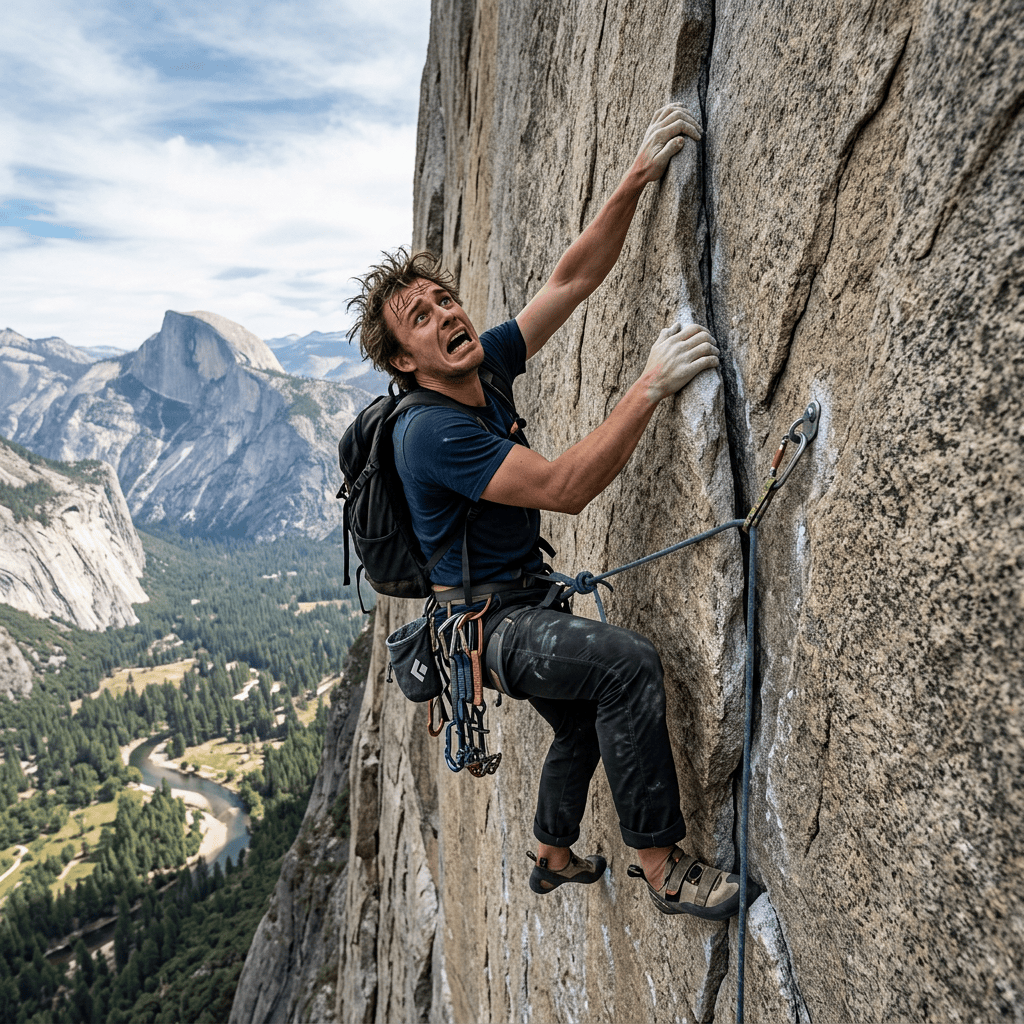
    Think of retirement as a solo climb up El Capitan. At first, the whole enterprise feels exhilarating. You have studied the route, checked your finances, calculated your pension, announced your plans, and begun climbing toward that glorious summit called Freedom. The office is shrinking beneath you. Meetings are disappearing into the mist. Somewhere far below, people are discussing Student Learning Outcomes without you.

    Then, halfway up the granite wall, a gust of doubt hits you.

    What the hell are you doing here?

    You cling to the rock and suddenly reconsider the entire project. Retirement was a terrible idea. You were meant to work forever. Work gives you structure, identity, colleagues, purpose, deadlines, and a reason to put on pants before noon. Perhaps employment is the machinery keeping you alive. Remove it and the gears stop turning. Six months after retirement, they will find you sitting in a recliner at eleven in the morning watching a documentary about airport baggage systems while eating low-fat cottage cheese directly from the container.

    Turn around.

    Save yourself.

    Go back to work.

    Then you make the mistake of looking down.

    The people below are specks. You have already told everyone you’re retiring. You have calculated your revenue streams. You have contacted CalSTRS and CalPERS. You have enrolled in Medicare Part A. You have begun arranging your health insurance. You have started describing ordinary events as “my last fall semester,” “my last opening-day meeting,” and “my last year of grading freshman essays.” You have spent so much time filling out retirement paperwork that returning to work would require filling out paperwork to recover from the paperwork you completed in order to stop working.

    You realize that descending may now be more dangerous than continuing upward.

    Call this the El Capitan Principle: the point in retirement when continuing toward the summit terrifies you, but you have climbed too far to descend safely.

    This is not courage. Courage would imply that you have conquered your fear. You haven’t conquered anything. You are hanging from a granite wall wondering whether your career was actually a life-support system and whether removing it will cause your internal organs to shut down in alphabetical order.

    But the choice has changed.

    Earlier, you were deciding whether to retire. Now you are retiring.

    So you tighten your grip, stop looking down, and continue climbing.

    The summit awaits.
  • The Day Grief Turned Into Courage at Canyon High School

    The Day Grief Turned Into Courage at Canyon High School

    This happened about fifty years ago, so forgive me if some of the details have softened around the edges. Memory fades, but certain moments burn themselves into the mind so deeply that time cannot erase them. This is one of those moments.

    I was fourteen, a freshman at Canyon High School. It was during PE, just before lunch, and we were on the outdoor basketball courts. The courts sat beside a grassy field that sloped down into a steep canyon. A narrow trail zigzagged up the canyon wall toward a quiet residential neighborhood above us.

    The trail had its regular occupants: the self-appointed tough guys who preferred ditching PE to playing sports. They would lean on the canyon tiers like spectators in cheap seats, laughing at the rest of us for following the rules.

    One of them was a loudmouth whose name I’ve forgotten. Let’s call him Jeremy.

    That day Jeremy and his friends stood above us on the canyon trail, tossing dirt clods down onto the courts. Most of them missed, but one landed close enough to sting the air around my friend Mark Redman.

    Mark stood out among us. He was over six feet tall, lean and muscular, with long black wavy hair that brushed his shoulders. He ran track and threw the javelin. Quiet, mostly to himself. My friends had recently told me that Mark had just lost a parent. I don’t remember whether it was his mother or father, but I remember the grief in his eyes when I offered my condolences.

    When the dirt clod nearly struck him, Mark looked up and calmly told Jeremy to cut it out.

    Jeremy grinned and shouted something cruel back down. I don’t remember the exact words, but it was the kind of remark meant to wound—something low and cheap.

    Then something changed.

    Mark went perfectly still. His eyes locked onto Jeremy. The expression on his face shifted into something I will never forget: fury mixed with resolve, the kind of cold certainty that comes when a man has decided exactly what must happen next.

    Without a word he tore off his tank top, balled it up, and started climbing the canyon.

    The transformation stunned everyone.

    But it wasn’t only Mark who transformed. So did Jeremy. His grin vanished. His mouth hung open as he watched Mark coming toward him. In that instant he understood the situation perfectly. He could run, but Mark was faster. He could fight, but Mark was animated by a courage Jeremy would never have. So Jeremy did the only thing left to him.

    He stood there and waited.

    When Mark reached him, Jeremy made a weak attempt to defend himself—more out of pride than hope. It lasted only seconds. Mark pummeled Jeremy to the ground, delivered the message clearly, and told him never to treat him that way again.

    Then, without celebration or swagger, Mark walked back down the canyon, disappeared into the locker room, and left the rest of us standing there in stunned silence.

    Over the years I’ve thought about that moment often. Watching a grieving young man summon that kind of conviction gives me a kind of moral clarity that has stayed with me. In a world that often feels confused and chaotic, I remember the look on Mark’s face that day.

    Mark, wherever you are, I have never forgotten you.