Tag: history

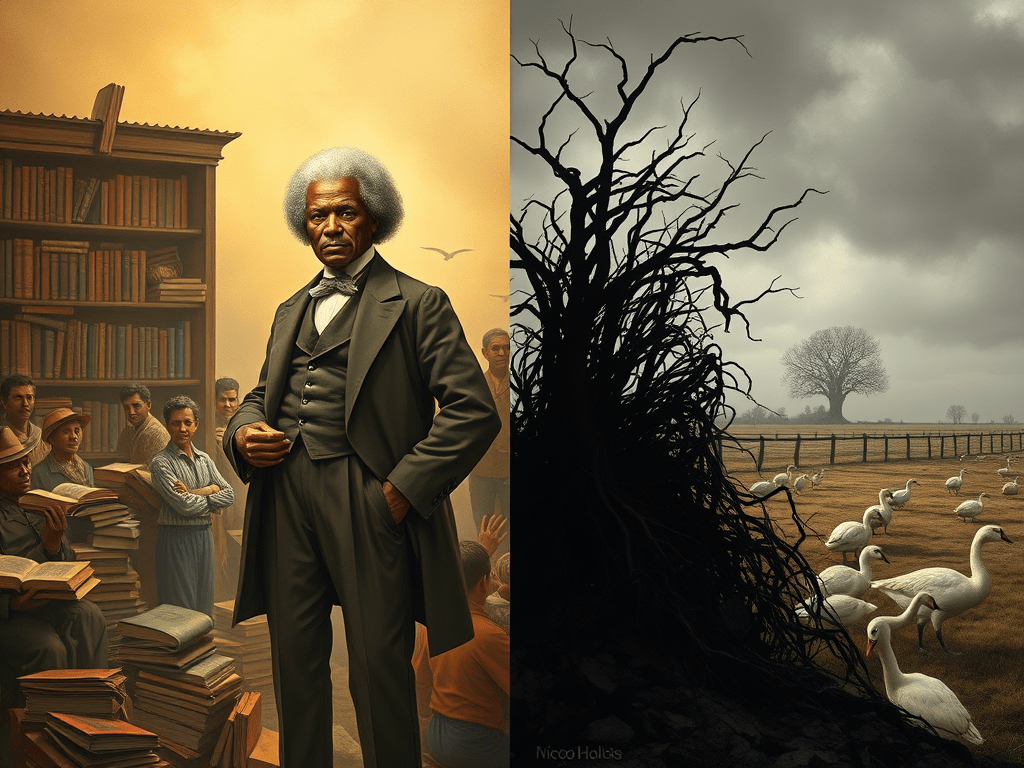
  • Heroes and Living Dead: What Douglass and Chekhov’s Nikolai Teach Us About the Meaning of a Good Life

    Heroes and Living Dead: What Douglass and Chekhov’s Nikolai Teach Us About the Meaning of a Good Life

    College Essay Prompt

    We often assume that the pursuit of freedom and happiness is a universal human impulse, shared across eras, cultures, and personal histories. Yet the paths individuals take toward those goals can be radically different, and those differences reveal whether one’s concept of happiness liberates or destroys. Few figures illustrate this divide more clearly than Frederick Douglass and Nikolai Ivanovitch from Anton Chekhov’s short story “Gooseberries.” Douglass’s character and trajectory embody a moral code that turns hardship into purpose: through literacy, community, courage, and a refusal to internalize oppression, he transforms enslavement into a platform for human dignity—not only for himself, but for others. By contrast, Nikolai pursues a narrow, adolescent fantasy of happiness, one built not on self-growth or empathy but on domination, comfort, and the myth of personal entitlement. His life becomes a grotesque parody of fulfillment—an existence of empty pleasures, self-deception, parasitic dependence, and spiritual decay beneath the veneer of material abundance.

    In a 1,700-word essay, analyze how Douglass’s journey to freedom stands as a model of healthy, ethical happiness while Nikolai’s descent exposes a warped, toxic version of happiness rooted in narcissism and self-indulgence. Your essay should do the following:

    1. Compare the moral foundations of Douglass and Nikolai’s pursuits.
      Explain how Douglass’s “Bushido-like” moral code—discipline, responsibility, representation, courage, and community—shapes his identity and empowers those around him. Contrast this with Nikolai’s rejection of accountability, his obsession with land ownership, and his willingness to deplete others—emotionally, financially, and spiritually—to maintain his fantasy of contentment. Discuss how each man’s vision of freedom manifests in their treatment of other people.
    2. Analyze the role of community vs. isolation in each character’s development.
      Douglass’s path is paradoxically individual and communal: he cultivates internal strength, but he locates freedom in solidarity—those who teach him to read, abolitionists who elevate his voice, and the enslaved people whose suffering he speaks for. Meanwhile, Nikolai constructs a private empire that excludes others, even the brother who once supported him. Consider how their relationships either amplify or erode their humanity.
    3. Examine the symbolic images of transformation and degradation.
      Use key passages from Douglass’s Narrative to show how literacy, speech, political action, and public representation transform him from an enslaved boy into a moral and political leader. Then show how Nikolai’s physical and spiritual decay—his swollen body, the petty rituals of comfort, the stagnant gooseberries—reflect the collapse of his inner self. Avoid plot summary; instead interrogate how each author uses these symbols to define what “freedom” looks like in practice.
    4. Discuss how each figure embodies or violates a healthy definition of happiness.
      What does Douglass’s version of happiness require? Effort, growth, sacrifice, connection, and the willingness to uplift others even when it hurts. What does Nikolai’s version require? Exploitation, avoidance of reality, refusal to change, and the delusion that comfort equals fulfillment. Describe how a life built on purpose creates meaning, while a life built on selfish gratification becomes spiritually unlivable.
    5. Address at least one counterargument.
      Consider why Nikolai might be appealing to some readers. Isn’t his dream of having a small estate, comfort, and peace understandable? Why might some view Douglass’s path as impossibly heroic—too demanding, too painful, or too noble for the average person? Engage with these viewpoints seriously, and rebut them using evidence from the texts.
    6. End with a conclusion that points to broader implications.
      Connect your contrast to the world we live in now. What do Douglass and Nikolai teach us about modern definitions of success, happiness, and the “good life”? Can happiness exist without social responsibility? Does personal freedom become toxic when it is purchased at the expense of others? Ask yourself what moral code has the power to sustain a person—and why some forms of comfort inevitably rot the soul.

    Your essay should not merely compare two characters; it should interrogate the meaning behind their choices. You are ultimately making an argument about what counts as real freedom and real happiness. Your goal is to show that the paths we choose do not simply determine the lives we build—they determine the kind of people we become.

  • The Myth of the Self-Made Man

    The Myth of the Self-Made Man

    Essay Prompt

    Many commentators, institutions, and public narratives present Frederick Douglass as the quintessential “self-made man,” using his rise from slavery to argue that personal discipline and individual grit are enough to overcome oppression. Write an essay analyzing why Douglass is framed this way: What political, cultural, or ideological purposes does this simplified narrative serve, and what parts of Douglass’s life and writing does it erase?

    Then, drawing on one or more of the following—Get Out, Black Panther, The Evolution of the Black Quarterback, and ALLENIV3SON—argue how these works challenge the myth that individual effort alone is sufficient to escape a modern form of the “Sunken Place.” Use evidence from Douglass and your chosen texts, address at least one counterargument, and provide a reasoned rebuttal.


    8-Paragraph Outline

    Paragraph 1: Introduction

    Open with the cultural popularity of the “self-made man” myth and how Douglass is often drafted into that narrative. Introduce the contemporary film(s)/docuseries you will analyze. End with a thesis that presents your argument and mapping components.

    Paragraph 2: How Douglass Is Framed as the Self-Made Man

    Explain the most common public uses of Douglass—textbooks, political speeches, social media, corporate training, etc. Describe the appealing simplicity of the “rise by grit alone” narrative.

    Paragraph 3: Why This Framing Is Useful (to Whom and for What)

    Analyze the motives behind this selective portrayal. Discuss how the myth supports certain political or ideological agendas: minimizing systemic racism, shifting responsibility to individuals, or celebrating a sanitized American Dream.

    Paragraph 4: What This Narrative Omits

    Show what disappears when Douglass is turned into a solo hero: abolitionist networks, Anna Murray’s role, collective struggle, federal intervention, racial terror, psychological trauma, and Douglass’s critique of American power.

    Paragraph 5: Modern Text #1—How It Challenges the Self-Made Myth

    Explain how your first chosen film or docuseries exposes structural forces no individual can escape alone. For Get Out, this may be psychological colonization; for Evolution of the Black Quarterback, structural biases; for Black Panther, political histories; etc.

    Paragraph 6: Modern Text #2 (Optional if using more than one)

    If choosing a second text, show how it reinforces or expands the critique. If using only one film, broaden the analysis: zoom in on multiple scenes, characters, or arcs that dismantle the self-made myth.

    Paragraph 7: Counterargument and Rebuttal

    Present the strongest version of the opposing view: Douglass “proved” that grit is enough; modern examples of individual triumph exist; the Sunken Place metaphor is too pessimistic. Then rebut each point with evidence showing that exceptional individuals do not invalidate structural realities.

    Paragraph 8: Conclusion

    Show why reducing Douglass to a self-made hero is not only historically inaccurate but also misleading for understanding modern struggles. End by synthesizing your insights across Douglass and the contemporary works.


    Four Thesis Statements with Mapping Components

    Thesis 1

    Although many public narratives portray Frederick Douglass as the perfect “self-made man,” this framing ignores the collective networks that shaped his freedom, misrepresents his political message, and distorts the historical reality of slavery; by contrast, films like Get Out and The Evolution of the Black Quarterback reveal how structural forces—psychological control, institutional racism, and inherited power—make the self-made myth dangerously incomplete.

    Mapping Components:

    (1) collective networks,
    (2) misrepresented political message,
    (3) distorted historical reality,
    (4) structural forces in modern texts.


    Thesis 2

    The myth of Douglass as a solo architect of his destiny persists because it offers a convenient story about American meritocracy, but Black Panther and ALLENIV3SON expose the limits of individual effort in the face of systemic pressures, inherited trauma, and institutional barriers. Together, these works demonstrate that liberation requires community, history, and structural change—not just personal grit.

    Mapping Components:

    (1) meritocracy narrative,
    (2) systemic pressures,
    (3) inherited trauma,
    (4) institutional barriers.


    Thesis 3

    Frederick Douglass is often drafted into the self-made-man myth to support political arguments that blame individuals rather than systems, yet both Get Out and Black Panther challenge this myth by showing how racial surveillance, technological domination, and geopolitical history create Sunken Places no individual can escape alone.

    Mapping Components:

    (1) political uses of the myth,
    (2) racial surveillance,
    (3) technological domination,
    (4) geopolitical history.


    Thesis 4

    The popular image of Douglass as the ultimate self-starter survives because it offers a comforting fantasy about upward mobility, but documentaries like The Evolution of the Black Quarterback reveal that success stories are never purely individual—they emerge from networks, opportunities, and battles with deeply entrenched structures. Both the historical record and modern media refute the idea that grit alone can defeat the Sunken Place.

    Mapping Components:

    (1) fantasy of mobility,
    (2) networks and opportunity,
    (3) entrenched structures,
    (4) historical and modern refutation.

  • Essay Prompt: Innovation, Identity, and the Meaning of “Authentic” Food

    Essay Prompt: Innovation, Identity, and the Meaning of “Authentic” Food

    In Chef’s Table: Pizza, Ann Kim rebuilds her life after a failed acting career by reinventing pizza through the lens of her Korean-American identity. Her dishes fold together memory, rebellion, shame, pride, and the complicated love between immigrant parents and their children. Yet the moment she alters traditional recipes or refuses rigid cultural expectations, she steps into a debate that surrounds many immigrant chefs:
    Does innovation honor one’s heritage—or distort it?

    In this 1,700-word argumentative essay, you will explore that tension by comparing Ann Kim’s story with the themes found in Ugly Delicious (Season 1, “Tacos”), selected episodes of The Taco Chronicles, Gustavo Arellano’s “Let White People Appropriate Mexican Food,” and Kelley Kwok’s “‘Not Real Chinese’: Why American Chinese Food Deserves Our Respect.” Your goal is to craft an argument that responds to the following question:

    When immigrant chefs remix, adapt, or modernize traditional dishes, are they betraying cultural authenticity—or creating a new form of belonging that honors their past in a more personal way?

    To answer this question, analyze how each show or essay portrays the cultural meaning of food—its connection to heritage, shame, pride, memory, and the immigrant experience. Pay close attention to visual rhetoric (music, tone, pacing, imagery), and consider how these choices shape our sense of what counts as “authentic.”

    Include at least two scholarly secondary sources on food studies, cultural identity, or immigrant narratives to deepen your analysis. These sources should help you place the shows and essays within broader academic conversations about authenticity, assimilation, and innovation.

    Your essay must include a counterargument-rebuttal section. Address the view that innovation leads to “tourist food” or watered-down Americanization, and explain whether these cases justify a purist stance toward food traditions—or whether purity itself is an illusion shaped by nostalgia, nationalism, or fear of cultural loss.

    Ultimately, your task is to show how food becomes a form of storytelling—and to argue whether storytelling requires faithful preservation, bold revision, or something in between.

  • Fiona Hill and the Art of Clear Seeing

    Fiona Hill and the Art of Clear Seeing

    Fiona Hill stunned me on Andrew Sullivan’s Dishcast—not with theatrics or self-branding, but with something rarer: unvarnished intelligence. She spoke for more than an hour, weaving global politics, history, and sober analysis together without even a hint of schtick. No sales pitch. No influencer glow. Just clarity and competence. Listening to her felt like opening a window in a stale room. I’m now on track to read both of her books, if only to spend more time in the presence of a mind that refuses mediocrity.

    A few moments hit me squarely. She explained that she has never been drawn to social media, which she sees as a global time sink—an interactive void where people argue about nothing as if it were everything. Then she broadened the frame: we are living through a massive transition in politics, work, education, and culture, and we’d be naïve to pretend we understand it. She argued for humility—an acknowledgment that we can’t yet grasp the scale or direction of the upheaval we’re living through. We are, she suggested, walking into the unknown whether we like it or not.

    Sullivan agreed, calling this moment a “liminal” period in history. I hadn’t heard that word in years and had to remind myself that it means transitional—the uneasy space between what was and what will be. Hill embraced the term. She and Sullivan compared our moment to the Hundred Years’ War. No one living through the 14th century knew they were participants in a century-long conflict. They only knew that the ground was shifting.

    That’s where we are now. Nations wrestling for dominance, AI upending national security and labor markets, globalization rewiring identity and culture, political leaders who behave like pranksters with nuclear codes—this is our chaos. And like medieval villagers, we have no idea how long this period will last. Are these volatile leaders a temporary fever, or will they define an entire era? Are we living through a Hundred-Year Grifter Period? No one knows.

    Strangely, the conversation felt therapeutic. Hearing two sharp, grounded people speak honestly about uncertainty made me feel less panicked and less isolated. My anxiety and existential dread aren’t signs of unraveling—they’re signs of being alert during a liminal age that refuses easy explanations.

  • When Distrusting Experts Becomes Its Own Dogma

    When Distrusting Experts Becomes Its Own Dogma

    In his Atlantic essay “Everyone Hates Groupthink. Experts Aren’t Sure It Exists,” David Merritt Johns challenges the reflexive idea that groupthink is always harmful. He notes that Robert F. Kennedy Jr. and the MAHA movement accuse public-health experts of groupthink in order to undermine trust in institutions. Their narrative is familiar: elite scientists misled the public on masks and lockdowns, so now vaccines must be suspect too. But this rebellion against “consensus” doesn’t eliminate groupthink—it simply creates a rival version of it, one driven by conspiracy, resentment, and selective skepticism.

    Johns argues that not all group alignment is created equal. Sometimes consensus forms because experts evaluate evidence and converge on the best available guidance. Other times, conformity produces catastrophic choices. The trick is to distinguish disciplined collaboration from unthinking obedience. Irving Janis gave groupthink its negative reputation as the enemy of independent thought, but scholars like Sally Riggs Fuller and Ramon Alday complicate the picture, noting that what we often label “groupthink” may actually be bureaucratic opportunism—people following political incentives, not blind loyalty.

    The term has since been weaponized. Political commentators now dismiss peer-reviewed science as “groupthink” whenever it clashes with their ideology. Johns argues this is sloppy and dangerous. Blaming pandemic missteps on a mystical force called groupthink distracts from real causes, while assuming “lonethink”—the rebel outsider posture—automatically produces better decisions is equally foolish. Expertise demands rigorous debate, scrutiny, and correction, not reflexive suspicion or anti-institution bravado.

    Following conspiracy movements like MAHA and their crusade against vaccines reveals the stakes. Lives saved through immunization are treated as evidence of corruption, and public-health systems are condemned for doing exactly what they are designed to do: evaluate data, revise strategy, and protect citizens. When political identity replaces critical thinking and “groupthink” becomes a lazy insult for any professional consensus, the result is not liberation—it is reckless decision-making disguised as independent thought.

  • Maps, Not Megaphones: Lessons from Harari, Harris, and Kaplan

    Maps, Not Megaphones: Lessons from Harari, Harris, and Kaplan

    Yuval Noah Harari opens 21 Lessons for the 21st Century with a line that feels more prophetic with each passing year: “In a world deluged by irrelevant information, clarity is power.”


    He’s right. Millions of people rush into the digital coliseum to debate humanity’s future, yet 99.9% of them are shouting through a fog of misinformation, moral panic, and algorithmic distortion. Their sense of the world—our world—is scrambled beyond use.

    Unfair? Of course. But as Harari reminds us, history doesn’t deal in fairness. He admits he can’t give us food, shelter, or comfort, but he can, as a historian, offer something rarer: clarity. A small light in the long night.

    That phrase—clarity in the darkness—hit me like a gut punch while listening to one of the most illuminating podcasts I’ve ever encountered: Sam Harris’s Making Sense, episode #440 (October 24, 2025), featuring author and geopolitical thinker Robert D. Kaplan. Their conversation, centered on Kaplan’s terse 200-page book Waste Land: A World in Permanent Crisis, offered something I hadn’t felt in years: coherence.

    Most days, I feel swept away by the torrent of half-truths and hot takes about the state of the planet. We seem to be living out Yeats’s grim prophecy that “the center cannot hold.” And yet, as Kaplan spoke, the chaos briefly organized itself into a pattern I could recognize.

    Kaplan’s global map is not comforting—but it’s lucid. He traces the roots of instability to climate change stripping water and fertile soil from sub-Saharan Africa, forcing waves of migration toward Europe. Those migrations, he argues, will ignite decades of right-wing populism across the continent—a slow, grinding backlash that may define the century.

    Equally destructive, he warns, is our collapse of media credibility. Print journalism—with its editors, fact-checkers, and professional skepticism—has been displaced by digital media, where “passion replaces analysis.” Emotion has become the currency of attention. Reason, outbid by rage, has left the building.

    Listening to Kaplan for a single hour taught me more about the architecture of global disorder than months of doomscrolling could. His vision is bleak, but it’s ordered. Sobering, but strangely liberating. In a time when everyone is shouting, he simply draws a map.

    And as Harari might say—maps, not megaphones, are what lead us out of the dark.

  • Latte Palace at the End of the Earth

    Latte Palace at the End of the Earth

    Last night I dreamed that my mother and her family—gone twenty years and counting—came back to life as if they’d only stepped outside for air. No trumpet blast, no spectral fog. Just my aunt’s kitchen in Los Angeles: sunlight on the vinyl, the smell of coffee and waffles, forks tapping plates like tiny hammers. My mother kissed my cheek the way she used to, a quick press and a pat—quality control for the living.

    Between bites of waffles and scrambled eggs my grandfather announced, in the same voice he used for weekend errands, that we were driving to a mansion in Alaska. He said “mansion” as if it were around the corner, not at the end of the continent and a climate shift away. Heads nodded. Coats appeared. Dream logistics are ruthless: one cut and we were already rolling, my grandfather at the wheel of a weary sedan, a caravan of relatives stacking up behind us like punctuation.

    The city dissolved. Los Angeles flattened into a silver slab, then a bright white riddle. Snow stitched itself across the windshield; the tires made that soft, murderous hush you hear on ice. My grandfather drove with cheerful indifference to physics, tapping the wheel to music only he could hear. I watched the road bloom and vanish and thought: so this is how resurrection handles transportation—no chariot of fire, just black ice and a bench seat.

    We crested a hill and there it was: a palace poured in espresso and cream, a latte-colored sprawl with too many windows and the kind of confidence money wears when it doesn’t expect to be told no. Someone in the back called it “Politburo chic,” and the phrase snapped into place—midcentury power with an indoor fur policy. The façade implied heated floors and quiet compromises. The roofline looked like it had read every memo and approved half of them.

    What struck me wasn’t that my family had returned; it was how casual I felt about it. My mother was alive. My grandfather was alive. Aunts and uncles murmured behind me, inventorying snacks, debating rooms. And I sat there with the calm of a man who receives an impossible package on his porch and signs without reading the label. Maybe grief is software and last night the update finally took.

    We idled at the circular drive while the house regarded us with its many eyes. I tried to imagine the foyer: the smell of wax and cold marble, a staircase that curves with the arrogance of a purebred. My brain kept blurring the picture like a censor’s bar. I could sense chandeliers, a staff of refined butlers. 

    But I woke up before entering the mansion. Now more than anything, I feel tantalized by what was inside that mansion. Now I’ll never know. 

  • The Bodybuilding Gollum of Shepherd College

    The Bodybuilding Gollum of Shepherd College

    In Jordan Castro’s Muscle Man, paranoia has a name: Harold, a disgruntled English professor who stalks the halls of Shepherd College convinced his masculinity is shriveling under fluorescent lights and academic jargon. The place is no sanctuary of learning but a mausoleum of joyless theory—an institution where semiotics and power structures reign supreme, while Harold dreams of biceps, protein macros, and shredded abs. To him, the Priests of the Intellect are laughable scarecrows, their bodies soft as tomatoes skewered on toothpicks, their credibility dissolving with every Oreo they dunk between papers on Derrida.

    Banished to a basement classroom without sunlight, Harold becomes a musclebound Gollum snarling at his colleagues above, who bask in daylight and collegial belonging. Faculty meetings are his personal hell: an ordeal as odious as wisdom-teeth extractions performed by a dentist with no anesthetic and no soul. While his peers pontificate about “backward design” and “cohorts,” Harold visualizes his metabolism torching fat, each fiber of muscle flexing like a Renaissance sculpture coming alive.

    What makes Harold truly unhinged is Shepherd College itself—a cult in mortar and brick, built on the deranged philosophy of the late R.K. Mort, who declared that architecture should “infect” and “haunt” its inhabitants. Mort’s disciples fawn over his absurdities as if he were an academic messiah, turning the college into a dehumanizing theme park of theory. It’s Severance with faculty ID cards.

    As a lifelong bodybuilder trapped in academia myself, I relate to Harold’s plight more than I’d like to admit. Yet I nearly hurled the book across the room when Harold showed up to his interminable meeting without food. A man obsessed with protein who forgets to pack a meal? Unforgivable. In my forty years of teaching, I never once forgot to bring my Tupperware of chicken breast or Greek yogurt to the institutional trenches. I wanted to shout at the page: “Get in the game, Harold! Respect the gains!” Still, his misfit rage and comic pathos hook me. Harold may be a wreck, but he’s my kind of wreck.

    I’m only two chapters in but eager to consume the entirety of this delicious satire.

  • Blast from the Past: Angelo’s Review of the Montgomery Ward Airline GEN-1494A Vintage Radio

    Since the very first time I saw this model listed on E-Bay a couple years ago, I’ve wanted one of these:  The Montgomery Ward Airline GEN-1494A.

    I guess the thing that attracted me to this radio the most is the handsome looks.  I like the symmetry of the dual tuning dials, divided by the power meter.  I like the contrast of brushed aluminum and charcoal color plastics, encased in clear acrylic dial covers.  I like the large but not huge size of the receiver.  Simply, I like everything about this radio’s styling.  I wouldn’t change anything—not even the orange and white frequency information, which looks great on the dark gray/black. 

    The materials are not quite up to Sony or Panasonic standards, but there’s nothing to be ashamed of here.  It’s good quality stuff, certainly comparable to any Sharp or Sanyo of a similar vintage.  It’s in that Toshiba/Hitachi category as far as I can tell.

    Performance wise, it’s a winner.  I was astounded by the shortwave reception—very, very close to matching the Sony ICF-5800 that I recently sold.  It picks up shortwave signals that most of my other radios are unable to track.  FM sound is strong, AM crisp.  It’s very capable of getting the full compliment of AM-FM stations that my other good radios can receive.  After the stellar shortwave performance, I was surprised that it didn’t perform well on the PSB 1 or PSB 2 options.  They were pretty dead—and my old Arvin radios generally get activity on these bands.  Maybe it’s just the night and the location.

    Speaker sound is another high grade.  While it’s not as powerful as the Panasonic 888, it has a pleasing sound.  The “tone” adjustment actually does its job too.  It’s equally good for talk or music.

    This is a well balanced radio that I can heartily recommend.  I have seen several of these over the years, and have bid on a few of them.  I was never able to wrangle one until this one failed to cross the $30.00 mark, and I snatched it up in the closing minutes.  It needed a little cleaning—and to get it to work on batteries, I had to use steel wool to remove corrosion from the battery compartment contacts—-but aside from those minor issues, it’s pretty darn nice.  Perfect antenna, no major dings and a real player.

    Is it a keeper?  For me, there aren’t many keepers.  I generally buy radios at what I consider a value price.  After cleaning them up and playing with them for a few months, I’m willing to throw them back to keep funding my hobby and charting new territory—such as a very recent interest in old tube radios.  But I have to say, the great shortwave performance, on this Ward model will make it a tough decision to let this go.  Like my Panasonic 888, Zenith Trans-Oceanic 7000 and Grundig Ocean Boy 820, this Ward Airline 1494 has virtues that might make it a permanent fixture.  That’s pretty strong company that this radio finds itself in.

  • When the Levees Broke, So Did the Nation

    When the Levees Broke, So Did the Nation

    The documentaries Hurricane Katrina: Race Against Time (Hulu) and Katrina: Come Hell and High Water (Netflix) are searing indictments as much as they are testaments to survival. They tell the story of a singular city—New Orleans, a cultural jewel—betrayed and abandoned by its own nation.

    Told through the voices of those who endured the storm in 2005, these films lay bare a fourfold sin against the people of New Orleans.

    First sin: red-lining. Decades of discriminatory housing policies corralled Black families into neighborhoods below sea level—neighborhoods left exposed to catastrophe—while white families secured higher, safer ground. Yet out of this coerced geography bloomed community, kinship, jazz, art, and a way of life so distinctive that New Orleans became not just a city but a state of mind.

    Second sin: neglect. The protective marshlands were carved away, the levees shoddily built, the safeguards ignored. What should have been natural resilience was dismantled piece by piece, until a storm became a man-made massacre.

    Third sin: abandonment. When the waters rose, thousands of citizens waited for rescue that never came. They suffered hunger, thirst, illness, despair. Bureaucracies paralyzed by incompetence and poisoned by political rivalry left them stranded—leaders too intent on humiliating one another to save lives.

    Fourth sin: defamation. Media outlets, infected with racism, painted Black survivors as looters and criminals while white survivors were depicted as resourceful and brave. Rumors of sniper fire and marauding gangs turned aid missions into militarized standoffs, with the National Guard pointing rifles at the very people they were sent to save. These lies fueled white vigilantes who hunted Black residents as if the collapse of law gave them license to kill.

    This fourfold betrayal is almost unbearable to watch, yet threaded through the grief is a resilient beauty: the music, the food, the language, the humor, the love of place that make New Orleans irreducible. Katrina remains one of America’s most shameful chapters—but also a reminder that the soul of New Orleans is larger than its wounds.