
Tag: honda

  • The Great Honda Uncoupling

    The Great Honda Uncoupling

    A car crisis has entered my life and sent me down a rabbit hole of angst and distress. Honda has a major engine problem affecting many of its models. The problem involves the cylinder-head gasket losing its seal. This can result in coolant loss, overheating, engine misfires, and coolant entering the combustion chambers. The affected engines include Honda’s 1.5-liter turbos, 2.0-liter turbos, naturally aspirated 2.0-liters, and naturally aspirated hybrid models. Eight models are affected from 2017 through 2026. Honda has extended the warranty on these models to ten years or 150,000 miles.

    My 2018 Accord with the 2.0 turbo is not on the list. While I’m relieved, I’m not exactly brimming with confidence either. It is more than eight years old with only 29,200 miles on the odometer as I write this twenty days before my sixty-fifth birthday, October 28. I no longer look at my Accord with confidence. I look at it with mistrust.

    And this leads to a painful fact: I am afraid that Honda and I may be uncoupling.

    I take this breach of trust personally. Having a car divorce after forty years is heartbreaking. Honda was always my cozy companion. Honda was my trusty sherpa, taking me to work, medical appointments, Trader Joe’s, and Target. The Honda service center is within walking distance of my home. I know the staff. I joke with them. I tell them how much I love Honda. They smile back at me tenderly. Like me, they own Hondas. They are part of my extended family.

    But the breach of trust resulting from faulty engines has forced me to look elsewhere. Honda’s only competition for me is Toyota because, like Honda, it has a reputation for reliability. However, while the Honda service center is only one and a half miles away, the Toyota service center is an intimidating four miles away. Yet a little research offers some consolation: Toyota offers a pickup and drop-off service, which Honda does not. More importantly, Toyota has a clean bill of health on its engines, which Honda does not.

    In my risk-averse mind, I’m uncoupling from Honda and moving toward Toyota. For me, this is far more than a rational consumer decision. The change has emotional weight. It’s like getting divorced and remarried. It’s like selling your house and moving across the country. It’s like making a career change. Imagine working as an engineer for twenty years and then opening a yoga studio. I am entering foreign territory.

    But Honda has left me little choice. For years, its engineers had a massive engine problem growing right under their noses. This degree of negligence and incompetence feels like the automotive equivalent of marital infidelity. A massive breach of trust has occurred.

    And this points to yet another problem: If and when Honda fixes its defective engines, regaining my trust could take at least a decade. I would need long-term data to be convinced that Honda reliability is up to spec again. I don’t want to be the car buyer who provides the data. I want to be the car buyer who studies the data after the fact and then makes his decision.

    Buying a car is like choosing a bride. I don’t want some thirty-six-month dalliance with a car lease. I want to commit for the long term. Till death do us part.

    The holy sacrament between Honda and me has dissolved. Unless Honda does something as dramatic as moving a few mountains and parting the Pacific Ocean to win back my trust, I am afraid the uncoupling is upon us.

    I am looking over the horizon.

    I see a beaming light.

    It reads Toyota Camry.

    Preferably in Dark Cosmos.
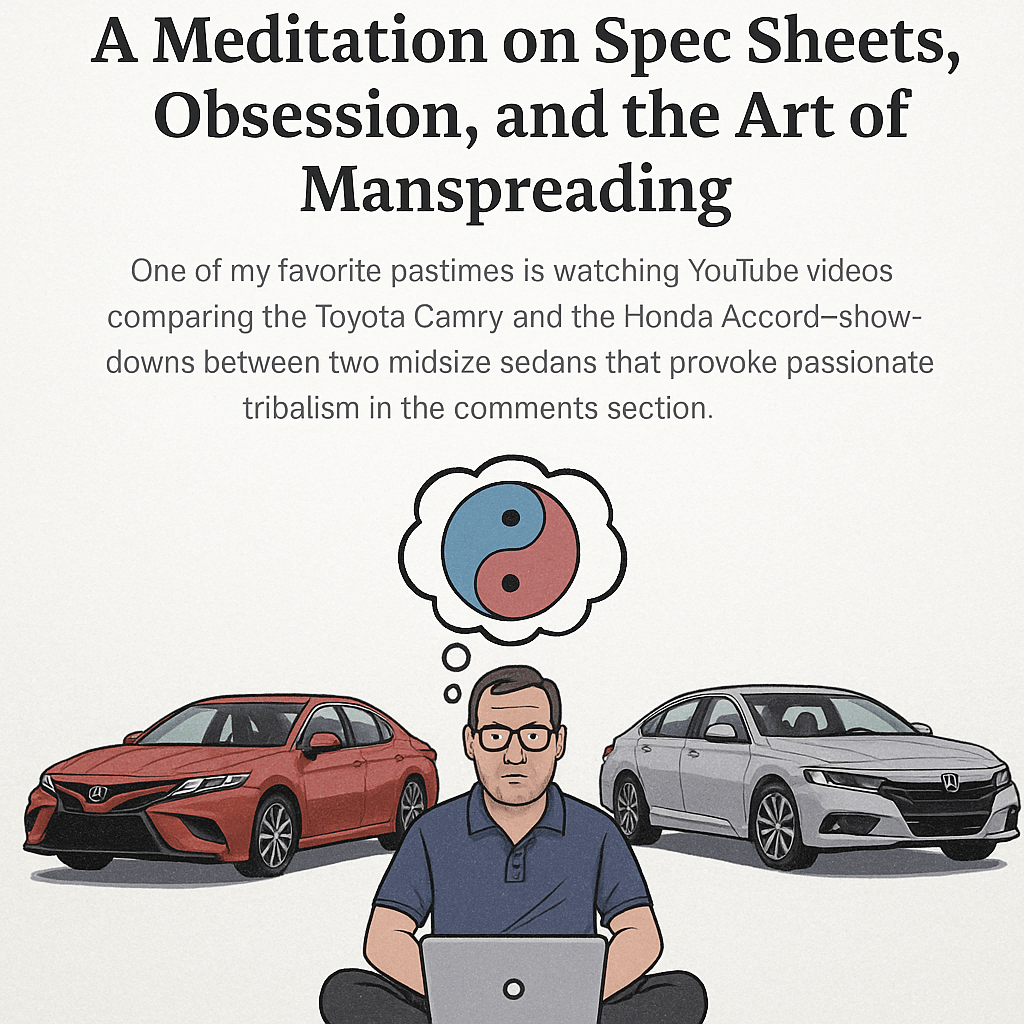
  • Camry vs. Accord: A Meditation on Spec Sheets, Obsession, and the Art of Manspreading

    Camry vs. Accord: A Meditation on Spec Sheets, Obsession, and the Art of Manspreading

    One of my favorite pastimes—oddly specific and strangely soothing—is watching YouTube comparison videos of the Toyota Camry vs. the Honda Accord. I’m not car shopping. I don’t need a car. I may never buy another car. But these videos are my digital comfort food. They’re as satisfying to me as fine wine is to a sommelier or apple pie tastings are to a pastry chef—only instead of tasting notes, I savor engine specs and torque curves.

    There’s something singular about the Camry-Accord rivalry. In the sedan world, these two are the Goliaths. It’s not just another car comparison. It’s the comparison. Watching these two go head-to-head year after year is like seeing the best Steelers team take on the peak Patriots in a Super Bowl that never ends. Everything else—BMW vs. Mercedes, Rolex vs. Omega—feels less pure. BMW and Mercedes aren’t in the same pricing tier. Rolex exists in a brand vacuum. And while coffee maker comparisons have their niche charm, they lack the existential gravity of Camry vs. Accord.

    No rivalry inspires more content—or more heated debate. YouTube is flooded with these matchups, and if you scan the view counts, it’s clear: Camry vs. Accord is the king of consumer showdowns. Reviewers comb over the details with forensic intensity—fuel economy, powertrain specs, road noise, trunk space, rear-seat legroom, infotainment ergonomics, ride comfort, styling. They break it down like seminary students parsing Greek New Testament syntax.

    But what really fascinates me is the comments section, where strangers proclaim their loyalty with righteous conviction. Owners justify their purchase with religious fervor, deploying cherry-picked data to reinforce their superiority. It’s a textbook case of post-purchase rationalization: that psychological reflex where we inflate the virtues of what we bought to feel smarter, savvier, and self-assured.

    One commenter might praise the Accord’s refined cabin and roomier interior—but add that its exterior is so bland, driving one is akin to living as an NPC. Another insists Camry’s superior sales figures are proof of its aesthetic and mechanical dominance. Some dismiss the Accord entirely, predicting its extinction in five years. Others proudly declare they’re on their fifth generation of the same car, with brand loyalty woven into the fabric of their identity. For these drivers, the car isn’t a tool—it’s family.

    Ultimately, this rivalry isn’t really about cars. It’s about identity, tribalism, and the human need to choose a side and be right. It’s a Dr. Seussian fable in metallic paint: one team wears Honda badges, the other wears Toyota, and both believe their side represents reason, taste, and truth.

    For those of us with no appetite for political tribalism, this is our outlet. Camry vs. Accord is safer ground—less polarizing than politics, but don’t tell that to a diehard on either side. Watch how they argue: calmly, firmly, methodically—as if their livelihood depends on selecting the superior midsize sedan. They approach the debate with the solemnity of theologians discussing substitutionary atonement or post-mortem salvation.

    And me? I’m both relaxed and riveted. The debate calms my nerves and sharpens my focus. For a glorious hour, as I parse suspension tuning and rear-seat headroom, my worries dissolve. My thoughts narrow into something blissful. I study the specs like they’re verses from Leviticus. And in that deep focus, my anxiety lifts.

    Then it hits me: I don’t actually want the car—I want the focus. The Camry and Accord are just proxies for obsession. They’re placeholders in the temple of hyper-attention. Some people do yoga. I watch two middle-aged men compare infotainment systems like Cold War arms inspectors.

    And I do this with full self-awareness. I said earlier I might never buy another car. That wasn’t entirely true. My wife owns a 2014 silver Honda Accord Sport. I drive a 2018 gunmetal gray Accord Sport. We’re a two-Accord household. When it comes to car-buying, I’m conservative by nature—and what’s more conservative than buying a Camry or an Accord?

    I’m nearly certain our next car—whether hers or mine—will be one of the two. Likely an Accord, given that I’m six feet tall, 230 pounds, claustrophobic, and deeply committed to driver’s seat manspreading. The Accord gives me room to sprawl. The Camry? Not so much. I know this because, during a San Francisco vacation, an Uber driver picked us up in a brand-new Camry. It looked sleek from the curb, but once inside I felt like I was strapped into a fetal position. The experience ruined the car for me.

    And yet, I want to love the Camry. I really do. In my ideal life, my driveway would have both: the Camry and the Accord parked side by side like yin and yang. One the smooth operator, the other the sensible sibling. Their competition makes each better. Their rivalry sustains them both—and keeps me obsessively circling the rabbit hole.

    Because in the end, the Camry vs. Accord battle isn’t just about choosing a car. It’s about longing for clarity in a world of noise. It’s about choosing sides, rationalizing decisions, and pretending—for a few hours on YouTube—that the world makes sense if you can just pick the right sedan.