
Tag: humor

  • The Ascent of Paper Towel Man

    The Ascent of Paper Towel Man

    Last night, my subconscious staged a farce: I was back on my old college campus, nervously ordering textbooks for my freshman comp classes—because that’s how my brain parties at night. After hours in the academic underworld of ISBNs and course numbers, I stumbled home under a moonless sky only to be seized by a grim realization: I forgot to order a crucial book.

    Panic.

    In this emergency, I reached not for Xanax, but a dark green landline phone, the color of envy or perhaps bureaucratic despair. I called the English Chair. Except in dream logic, the English Chair was not the overworked academic I know—but Scott Galloway, the sarcastic podcaster and economics professor. 

    I told him he had to submit the textbook order by midnight.

    True to form, he lobbed verbal grenades at me. Taunts, jabs, snide remarks. His voice had that tone—the kind that leaves you wondering if you’re being insulted or inducted into a secret society of useful idiots.

    I said, “Don’t joke over the phone. Only mock me in person.”

    He replied, “Fine. Come over. I’m having a dinner party.”

    Naturally.

    So, in the witching hour, I opened my front door—expecting a miles-long slog up a mountain—and instead, in the way only dreams and luxury real estate can allow, I was already at Casa Galloway, perched perilously on stilts over a cliff like some Bond villain’s hideout with a podcast studio.

    He was charming in person—gregarious, warm, practically glowing with hospitality. He led me into a dimly lit dining room where guests laughed and angel hair pasta sat arranged like delicate tumbleweeds on silver trays. White sauce shimmered like divine lubrication.

    “Take as much as you like,” he said, arms open.

    I hesitated. Did he make enough? Should I pretend restraint for the optics? Was this a test of my caloric discipline?

    I took a tiny, tragic portion.

    He raised an eyebrow. I mumbled something about “leaving enough for everyone,” which seemed to impress him. He praised my selflessness, as if I’d just refused seconds at a famine relief banquet.

    After eating my guilt-ridden noodle clump and participating in some effervescent dinner chatter, I left and returned home to my modest flat at the bottom of the hill. But before I could nestle into my bed of neuroses, it hit me: Galloway might be short on paper towels after his soirée.

    And I had a Costco-sized case.

    I threw the rolls under my arm and charged up the mountain like a sentient Amazon Prime delivery. My quads flexed with purpose. I was the Paper Towel Man, delivering absorbency and justice. I swung the rolls from hand to hand like batons of competence.

    I found him on the front porch—a cliffside slab barely larger than a yoga mat, with a waterfall crashing nearby like some sort of capitalist Shangri-La.

    “I’ve brought reinforcements,” I said, brandishing the paper towels like sacred scrolls.

    He smiled, then warned me: “The last fifty feet are treacherous.”

    Of course they were. The final ascent required mountaineering skills I didn’t have—jagged rocks, sudden drops, the kind of climb you’d expect in a spiritual thriller set in Tibet.

    But I was determined. Galloway had ordered my textbook and served me pasta. Reciprocity was sacred. I would reach that porch if it killed me.

    And then I woke up. Standing in my kitchen. Brewing coffee. Scribbling this fever dream into a notebook, trying to decide if it meant anything—or just meant I shouldn’t eat carbs after 9 p.m.

  • Pedagogical Incontinence and Other Nightmares

    Pedagogical Incontinence and Other Nightmares

    Last night, I found myself caught in that classic pedagogical panic dream—the one where you’re supposed to be teaching but haven’t the faintest idea what class you’re in, what subject you’re meant to teach, or whether you’re even wearing pants. In this installment of the recurring nightmare franchise, the setting was not a classroom but a vast beachside arcade—a surreal mash-up of administrative buildings, decrepit apartments, and suspiciously cheerful employees who all seemed to be on the take.

    My only tether to coherence was a middle-aged reentry student named Fred, bald, officious, and inexplicably committed to serving as my personal secretary. Fred wore the expression of a man who once managed a Kinko’s in Bakersfield and had never fully recovered. He trailed me through the maze of kiosks and clammy hallways, reminding me of when my night classes began and which lecture I was supposed to pull out of thin air. He was part calendar app, part parole officer.

    Then Fred vanished. Just like that. I was suddenly alone and bladder-full, desperately seeking a bathroom that refused to stay in one place. The rest of the dream dissolved into a fevered montage of my failed search for a bathroom: dead-ends, hills of ice plant slick with dream-dew, craggy rock climbs worthy of a National Geographic feature on confused professors, and an aquatic plunge into time itself. I dove through the Paleozoic, drifted across the Devonian, waded through the Carboniferous—each era choked with psychedelic fossil-fish and haunting evolutionary whispers. And still, no bathroom. My urgency transcended epochs.

    When I awoke—sweating, humbled, and dry—I was left with one existential question: Was Fred my inner adult, the stoic bureaucrat of my soul? And without him, am I just an overgrown child, lost in a shifting dreamscape, chronically unprepared, and forever in pursuit of a bathroom that may not exist?

  • New Yorker’s Remorse Syndrome

    New Yorker’s Remorse Syndrome

    It’s a charming form of cosplay, really — striding around as a “well-informed citizen” while sinking ungodly hours into consumer research. Watches, radios, headphones, laptops, Chromebooks, mechanical keyboards, high-end sweatshirts, orthopedic luxury sneakers, protein powders, protein bars, athletic-grade water bottles — an entire temple of optimized living, curated with clerical devotion.

    Meanwhile, out in the real world, society is fraying like an ancient flag in a hurricane. Yeats’ prophecy is no longer a chilling warning — it’s a project status update.
    The center isn’t holding. The center left the chat months ago.
    But instead of reckoning with the slow dissolve of civil society, it’s so much easier, so much kinder to the blood pressure, to compare toaster ovens with touchless air fryer settings.

    Yes, yes, I know — one must be informed. George Carlin gave us front-row tickets to the Freak Show. We owe it to the species, or at least to our own dim dignity, to bear witness.
    But honestly? Some days, it feels like sanity demands partial withdrawal. A news podcast here. A curated briefing there. Enough to feign civic engagement at parties without having to call a therapist immediately afterward.

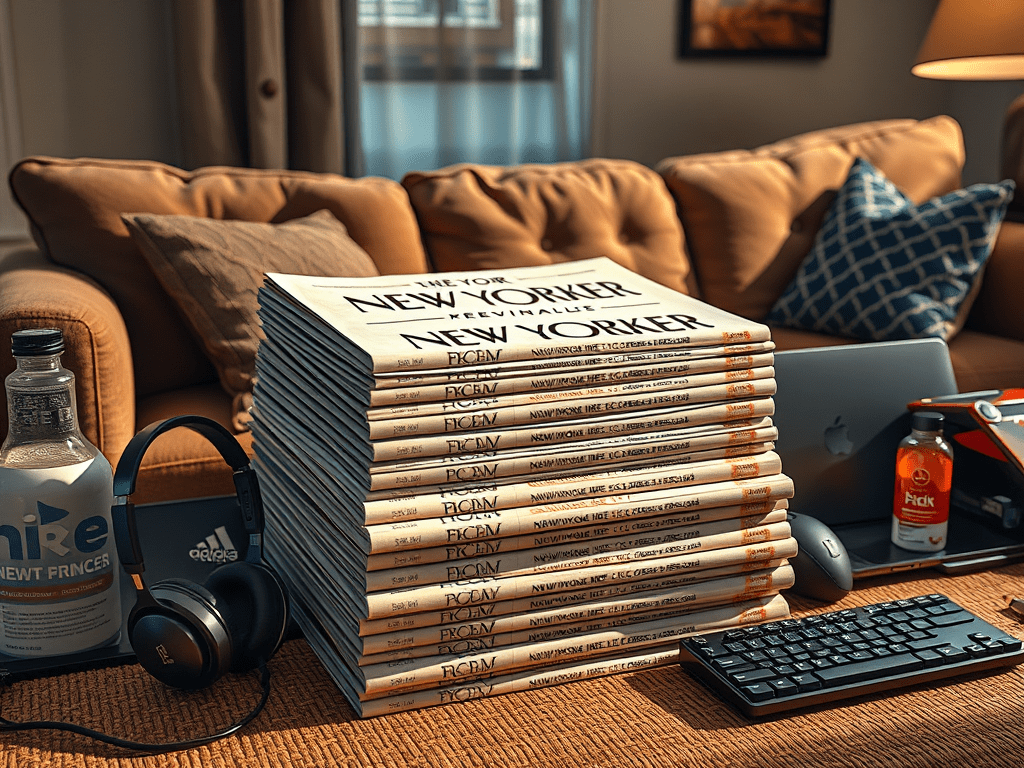
    This brings me to the shrine of guilt at the center of my living room: the great, unread New Yorker stack.
    I have subscribed since 1985, back when Reagan was doing his best kingly impression and nobody had heard of an iPhone.
    The stack now functions less as reading material and more as a kind of grim altar — a silent accusation in glossy print.
    Friends glance at it and nod approvingly, as if my very possession of these magazines implies moral seriousness.
    I let them believe.
    Inside, I know better.
    I know that I am a fallen monk, a heretic of intellectual duty, choosing the velvet lure of consumer escapism over the weighty gospels of sociopolitical collapse.

    I have a diagnosis: New Yorker’s Remorse Syndrome — a condition in which one publicly performs allegiance to Enlightenment values while privately seeking refuge among comparison charts and Amazon star ratings.
    The mind knows what it ought to do.
    The heart, however, prefers shopping for the perfect water bottle while Rome burns quietly in the background.

  • I found my true life purpose at a McDonald’s in Mojave

    I found my true life purpose at a McDonald’s in Mojave

    Coming home from Mammoth last summer, I had naively believed that my children would be sated from their breakfast at the McDonald’s in Bishop, allowing us to drive straight home without further interruptions.

    But by the time we reached Mojave around noon, my daughters swore they would perish on the spot if they didn’t have lunch immediately. So, we found ourselves pulling into yet another McDonald’s in Mojave. The thought of visiting two McDonald’s in a single day felt like a deep plunge into the abyss of self-debasement, a loss of dignity on par with other legendary acts of self-humiliation. I began to think this might be the modern-day equivalent of wearing a sandwich board that reads, “I have given up.” Yet, amid my indignation, I secretly thanked the universe for my daughters’ insatiable appetites because I desperately needed to use the bathroom.

    However, fate—or rather the cruel architects of this establishment—had installed combination locks on the bathroom doors, and the workers guarding these sacred numbers were about as generous with them as a dragon hoarding gold. I had to persuade them that my family of four would be forking over more than fifty dollars for the world’s most lackluster cuisine, and thus, I was surely deserving of the golden code.

    After securing the coveted combination, I made a beeline for the bathroom, practically kicking the door open like a cowboy in a saloon. The relief was so immense that it felt as if I had just liberated a small nation from tyranny. Afterward, I returned to the counter to wait for our food, feeling light as a feather. As I stood there, I observed dozens of men rattling the bathroom doorknob with the desperation of someone who had just spotted an oasis in the desert, only to find it locked. Their faces were contorted in pain, and their eyes begged for mercy but the cruel workers were unmoved.

    Seeing their plight, I realized I had the power to make a difference. I could be their savior. In an act of defiance against the oppressive bathroom code policy, I began shouting the combination with a gusto that could only be described as revolutionary. “Two-four-six-eight!” I bellowed, as if each digit was a bullet in the war against bladder injustice. The relief that spread across their faces was almost spiritual. I had become a mythical prophet, a modern-day Moses leading the oppressed to the Promised Land of Bladder Relief.

    Meanwhile, as I basked in the glory of my newfound role, my wife and daughters sank deeper into their chairs, their faces a mix of horror and embarrassment. They pretended not to know me, as if I were some wild-eyed lunatic who had wandered in from the Mojave Desert. But I didn’t care. I had found my spiritual calling, even if it was in the unlikeliest of places—shouting bathroom codes at a McDonald’s in Mojave.